Hirschsprung disease
HAMAD EMAD HAMAD DHUHAYR
Contents
Definition
Etiology
Clinical picture
Complication
Investigations
Treatment
Definition
Hirschsprung disease ( HSCR) also called congenital aganglionic
megacolon,
is a disorder of the abdomen that occurs when part or all of the large
intestine or antecedent parts of the gastrointestinal tract have no
nerves and therefore cannot function. The major gene of
Hirschsprung disease was identified in this chromosomal 10 region,
it was the RET protooncogene .
1/5000 live births
M:F = 4:1
Racial distribution similar
There are four types of Hirschsprung disease:
In 80% of individuals, aganglionosis is restricted to the rectosigmoid colon
( short-segment disease).
In approximately 15%-20%, the aganglionosis extends proximal to the
sigmoid colon ( long-segment disease).
In approximately 5% of individuals, aganglionosis affects the entire large
intestine ( total colonic aganglionosis).
Rarely, the aganglionosis extends into the small bowel or even more
proximally to encompass the entire bowel ( total intestinal aganglionosis)
Embryology and Etiology
Neuroenteric cells migrate from neural crest to upper end
of alimentary tract and proceed in distal direction
12th week : migration to distal colon – first into myenteric
(Auerbach’s plexus) then into submucosal plexus
Embryologic defect
Failure of neural crest migration
Immunologic mechanism: increased expression of class II
antigens in the mucosa and submucosa-> causes fetus to
mount an immunologic response against the neuroblast
Genetic factors: May affect more than one family member
in 3-7% of cases
Deletion in the RET gene chromosome 10q11 and EDNRB
gene located on 13q22 and EDN 3 gene (major role in the
development of the enteric nervous system)
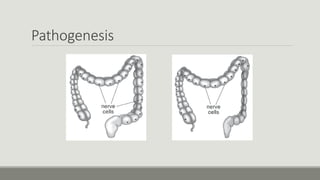
Pathogenesis
Pathology
Neonatal period: intestine is normal
Proximal ganglionic intestine hypertrophies and becomes thicker and
longer than normal
Taeniae disappear and longitudinal muscle layer completely surrounds
colon
Distal intestine: absence of ganglion cells in the submucosal (Meissner’s)
plexus and myenteric (Auerbach’s) plexus
Marked increase in nerve fibers which extend into the submucosa (seen
with acetylcholinesterase stain)
Aganglionosis extends to rectosigmoid region in 80% of cases
Presentation
Presentation
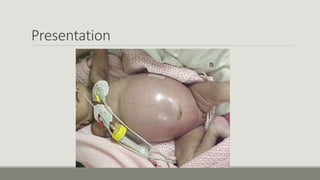
Severe abdominal distention
95% - failure to pass meconium in first 24 hours life
Bilious vomiting
Older children - constipation, failure to thrive
10-15% - severe diarrhea alternating
constipation—enterocolitis of Hirschsprung’s disease
Symptoms
chronic constipation:
- Delayed passage of meconium > 24 hrs.
- Defecation occurs every few days & only after insertion of a finger of the mother
in the anus of the baby.
Signs
1. inspection:
- Abdominal distension, visible peristalsis.
2. Palpation:
- Doughy mass in Lt. iliac fossa.
3. Percussion:
- Tympanitic resonance.
4. Auscultation: increase intestinal sounds.
5. DRE:
- Empty rectum
- Grips on the finger.
- Characteristic gush of foetid stool on withdrawal of the fingers.
General:
1. Delayed growth and development.
2. Chest infection.
Local:
1. Obstructive toxic enterocolitis (fever,
diarrhea and abdominal distension) >>
cause of death.
2. Acute obstruction.
moderate cases: failure to thrive
Diagnosis
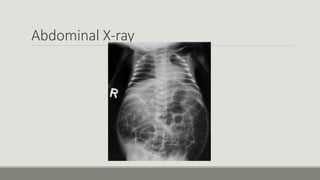
Abdominal plain X-rays
Barium Enema
Rectal Biopsies
Anal manometry
Abdominal X-ray
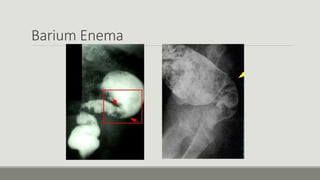
Barium Enema
Barium Enema
Less sensitive for detecting short lesions, total colon
aganglionosis, and disease of the newborn
Many newborns do NOT show definitive transition
zone
Delayed evacuation of contrast
Rectal biopsy
Submucosal suction biopsy
◦Meissner’s submucosal plexus
Full thickness rectal biopsy
◦Auerbach’s myenteric plexus
Acetylcholinesterase staining
◦increased staining of neurofibrils
Anorectal manometry
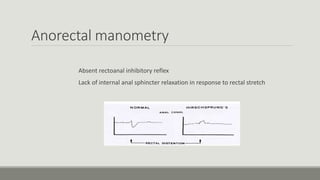
Absent rectoanal inhibitory reflex
Lack of internal anal sphincter relaxation in response to rectal stretch
Surgical Options
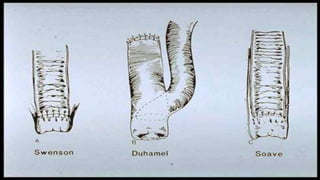
Swenson Procedure (1948)
Duhamel Procedure (1960)
Soave Procedure (1963)
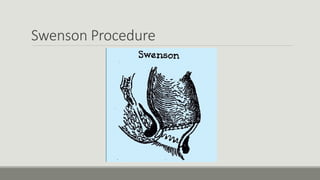
Swenson Procedure
Sharp extrarectal dissection down to 2 cm above the anal
canal.
Aganglionic colonic segment resected End-to-end
anastamosis of normal proximal colon to anal canal
Completely removes defective aganglionic colon.
Swenson Procedure
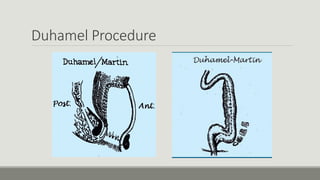
Duhamel Procedure
Posterior portion of defective colon segment resected
Side to side anastamosis to left over portion of rectum
Constipation a major problem remaining aganglionic tissue
Simpler operation, less dissection.
Duhamel Procedure
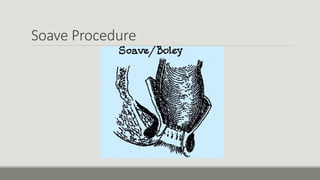
Soave Procedure
Circumferential cut through muscular coat of colon at
peritoneal reflection
Mucosa separated from the muscular coat down to the anal
canal
Proximal normal colon is pulled through retained muscular
sleeve
Telescoping anastamosis of normal colon to anal canal
Soave Procedure
Soave Procedure
Advantage: rectal intramural dissection ensures no
damage to pelvic neural structures
Higher rate enterocolitis, diarrhea
Problems cuff abscesses, often requires repeated
dilations
Overall Mortality
Swenson procedure: 1-5%
Duhamel procedure: 6%
Soave procedure: 4-5%
Operative complications
Leak at anastamosis: 5-7%
Postop Enterocolitis: 19-27%
Constipation
Stricture Formation
Incontinence
References
Matary-GIT_Surgery_2013
Bailey And Love's Short Practice of Surgery 26th Edition by Norman
Williams

Hirdschsprug disease

  • 1.
  • 2.
  • 3.
    Definition Hirschsprung disease (HSCR) also called congenital aganglionic megacolon, is a disorder of the abdomen that occurs when part or all of the large intestine or antecedent parts of the gastrointestinal tract have no nerves and therefore cannot function. The major gene of Hirschsprung disease was identified in this chromosomal 10 region, it was the RET protooncogene . 1/5000 live births M:F = 4:1 Racial distribution similar
  • 4.
    There are fourtypes of Hirschsprung disease: In 80% of individuals, aganglionosis is restricted to the rectosigmoid colon ( short-segment disease). In approximately 15%-20%, the aganglionosis extends proximal to the sigmoid colon ( long-segment disease). In approximately 5% of individuals, aganglionosis affects the entire large intestine ( total colonic aganglionosis). Rarely, the aganglionosis extends into the small bowel or even more proximally to encompass the entire bowel ( total intestinal aganglionosis)
  • 5.
    Embryology and Etiology Neuroentericcells migrate from neural crest to upper end of alimentary tract and proceed in distal direction 12th week : migration to distal colon – first into myenteric (Auerbach’s plexus) then into submucosal plexus Embryologic defect
  • 6.
    Failure of neuralcrest migration Immunologic mechanism: increased expression of class II antigens in the mucosa and submucosa-> causes fetus to mount an immunologic response against the neuroblast Genetic factors: May affect more than one family member in 3-7% of cases Deletion in the RET gene chromosome 10q11 and EDNRB gene located on 13q22 and EDN 3 gene (major role in the development of the enteric nervous system)
  • 7.
  • 8.
    Pathology Neonatal period: intestineis normal Proximal ganglionic intestine hypertrophies and becomes thicker and longer than normal Taeniae disappear and longitudinal muscle layer completely surrounds colon Distal intestine: absence of ganglion cells in the submucosal (Meissner’s) plexus and myenteric (Auerbach’s) plexus Marked increase in nerve fibers which extend into the submucosa (seen with acetylcholinesterase stain) Aganglionosis extends to rectosigmoid region in 80% of cases
  • 9.
  • 10.
    Presentation Severe abdominal distention 95%- failure to pass meconium in first 24 hours life Bilious vomiting Older children - constipation, failure to thrive 10-15% - severe diarrhea alternating constipation—enterocolitis of Hirschsprung’s disease
  • 11.
    Symptoms chronic constipation: - Delayedpassage of meconium > 24 hrs. - Defecation occurs every few days & only after insertion of a finger of the mother in the anus of the baby.
  • 12.
    Signs 1. inspection: - Abdominaldistension, visible peristalsis. 2. Palpation: - Doughy mass in Lt. iliac fossa. 3. Percussion: - Tympanitic resonance. 4. Auscultation: increase intestinal sounds. 5. DRE: - Empty rectum - Grips on the finger. - Characteristic gush of foetid stool on withdrawal of the fingers.
  • 13.
    General: 1. Delayed growthand development. 2. Chest infection. Local: 1. Obstructive toxic enterocolitis (fever, diarrhea and abdominal distension) >> cause of death. 2. Acute obstruction. moderate cases: failure to thrive
  • 14.
    Diagnosis Abdominal plain X-rays BariumEnema Rectal Biopsies Anal manometry
  • 15.
  • 16.
  • 17.
    Barium Enema Less sensitivefor detecting short lesions, total colon aganglionosis, and disease of the newborn Many newborns do NOT show definitive transition zone Delayed evacuation of contrast
  • 18.
    Rectal biopsy Submucosal suctionbiopsy ◦Meissner’s submucosal plexus Full thickness rectal biopsy ◦Auerbach’s myenteric plexus Acetylcholinesterase staining ◦increased staining of neurofibrils
  • 19.
    Anorectal manometry Absent rectoanalinhibitory reflex Lack of internal anal sphincter relaxation in response to rectal stretch
  • 20.
    Surgical Options Swenson Procedure(1948) Duhamel Procedure (1960) Soave Procedure (1963)
  • 21.
    Swenson Procedure Sharp extrarectaldissection down to 2 cm above the anal canal. Aganglionic colonic segment resected End-to-end anastamosis of normal proximal colon to anal canal Completely removes defective aganglionic colon.
  • 22.
  • 23.
    Duhamel Procedure Posterior portionof defective colon segment resected Side to side anastamosis to left over portion of rectum Constipation a major problem remaining aganglionic tissue Simpler operation, less dissection.
  • 24.
  • 25.
    Soave Procedure Circumferential cutthrough muscular coat of colon at peritoneal reflection Mucosa separated from the muscular coat down to the anal canal Proximal normal colon is pulled through retained muscular sleeve Telescoping anastamosis of normal colon to anal canal
  • 26.
  • 27.
    Soave Procedure Advantage: rectalintramural dissection ensures no damage to pelvic neural structures Higher rate enterocolitis, diarrhea Problems cuff abscesses, often requires repeated dilations
  • 28.
    Overall Mortality Swenson procedure:1-5% Duhamel procedure: 6% Soave procedure: 4-5%
  • 30.
    Operative complications Leak atanastamosis: 5-7% Postop Enterocolitis: 19-27% Constipation Stricture Formation Incontinence
  • 31.
    References Matary-GIT_Surgery_2013 Bailey And Love'sShort Practice of Surgery 26th Edition by Norman Williams