

› General concepts
› Mechanism of action
› Indications
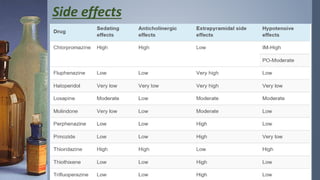
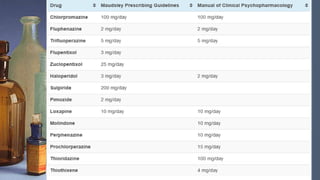
› Side effects
› SPECIFIC ANTIPSYCHOTIC MEDICATIONS
› Conclusion
Contents:-
› They have an equal or greater affinity for D2
receptors than for 5-HT2 receptors
› Antagonism of D2 receptors in mesolimbic
pathways suppress the positive symptoms of
Schezophrenia.
› Blockade of D2 receptors in the basal ganglia is
responsible for parkinsonian and other
extrapyramidal side effects of anti psychotic
drugs
General concepts for typical
› The exact mechanism of action of antipsychotic drugs
is unknown.
› According to the dopamine theory of schizophrenia,
positive symptoms are the result of an overactivity in
the mesolimbic dopamine pathway.
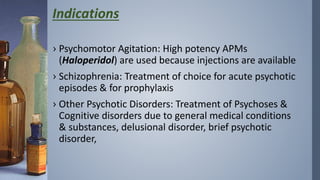
› first-generation antipsychotics are D2 antagonists. As
a result, they reduce dopaminergic neurotransmission
in the four dopamine pathways.
Mechanism of action
› Psychomotor Agitation: High potency APMs
(Haloperidol) are used because injections are available
› Schizophrenia: Treatment of choice for acute psychotic
episodes & for prophylaxis
› Other Psychotic Disorders: Treatment of Psychoses &
Cognitive disorders due to general medical conditions
& substances, delusional disorder, brief psychotic
disorder,
Indications
› schizophreniform disorder & other rarer psychotic disorders
› ! Mood Disorders: Treatment of Agitation & Psychosis during
mood episodes
› ! Sedation: Useful when Benzodiazepines are contraindicated
(specially in older
› patients) or as an adjunct during anesthesia
› ! Movement Disorders: Treatment of choice for Huntington
disease & Tourette disorder
Side effects
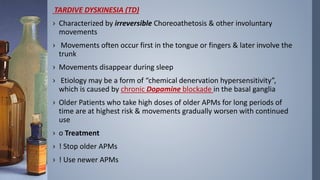
TARDIVE DYSKINESIA (TD)
› Characterized by irreversible Choreoathetosis & other involuntary
movements
› Movements often occur first in the tongue or fingers & later involve the
trunk
› Movements disappear during sleep
› Etiology may be a form of “chemical denervation hypersensitivity”,
which is caused by chronic Dopamine blockade in the basal ganglia
› Older Patients who take high doses of older APMs for long periods of
time are at highest risk & movements gradually worsen with continued
use
› o Treatment
› ! Stop older APMs
› ! Use newer APMs
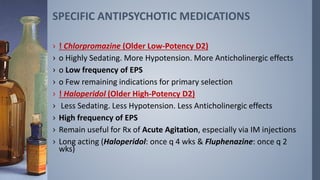
› ! Chlorpromazine (Older Low-Potency D2)
› o Highly Sedating. More Hypotension. More Anticholinergic effects
› o Low frequency of EPS
› o Few remaining indications for primary selection
› ! Haloperidol (Older High-Potency D2)
› Less Sedating. Less Hypotension. Less Anticholinergic effects
› High frequency of EPS
› Remain useful for Rx of Acute Agitation, especially via IM injections
› Long acting (Haloperidol: once q 4 wks & Fluphenazine: once q 2
wks)
SPECIFIC ANTIPSYCHOTIC MEDICATIONS
› First-generation antipsychotics are also known as: typical
antipsychotics, conventional or classic antipsychotics and
dopamine antagonists.
› FGAs reduce dopaminergic neurotransmission in the four
dopamine pathways by blocking D2 receptors.
› FGAs differ in potency, not effectiveness.
– High-potency: haloperidol, fluphenazine
– Mid-potency: perphenazine, loxapine
– Low-potency: chlorpromazine
Conclusion
References
&
Typical antipsychotic

Typical antipsychotic

  • 2.
    › General concepts ›Mechanism of action › Indications › Side effects › SPECIFIC ANTIPSYCHOTIC MEDICATIONS › Conclusion Contents:-
  • 3.
    › They havean equal or greater affinity for D2 receptors than for 5-HT2 receptors › Antagonism of D2 receptors in mesolimbic pathways suppress the positive symptoms of Schezophrenia. › Blockade of D2 receptors in the basal ganglia is responsible for parkinsonian and other extrapyramidal side effects of anti psychotic drugs General concepts for typical
  • 4.
    › The exactmechanism of action of antipsychotic drugs is unknown. › According to the dopamine theory of schizophrenia, positive symptoms are the result of an overactivity in the mesolimbic dopamine pathway. › first-generation antipsychotics are D2 antagonists. As a result, they reduce dopaminergic neurotransmission in the four dopamine pathways. Mechanism of action
  • 6.
    › Psychomotor Agitation:High potency APMs (Haloperidol) are used because injections are available › Schizophrenia: Treatment of choice for acute psychotic episodes & for prophylaxis › Other Psychotic Disorders: Treatment of Psychoses & Cognitive disorders due to general medical conditions & substances, delusional disorder, brief psychotic disorder, Indications
  • 7.
    › schizophreniform disorder& other rarer psychotic disorders › ! Mood Disorders: Treatment of Agitation & Psychosis during mood episodes › ! Sedation: Useful when Benzodiazepines are contraindicated (specially in older › patients) or as an adjunct during anesthesia › ! Movement Disorders: Treatment of choice for Huntington disease & Tourette disorder
  • 8.
  • 9.
    TARDIVE DYSKINESIA (TD) ›Characterized by irreversible Choreoathetosis & other involuntary movements › Movements often occur first in the tongue or fingers & later involve the trunk › Movements disappear during sleep › Etiology may be a form of “chemical denervation hypersensitivity”, which is caused by chronic Dopamine blockade in the basal ganglia › Older Patients who take high doses of older APMs for long periods of time are at highest risk & movements gradually worsen with continued use › o Treatment › ! Stop older APMs › ! Use newer APMs
  • 11.
    › ! Chlorpromazine(Older Low-Potency D2) › o Highly Sedating. More Hypotension. More Anticholinergic effects › o Low frequency of EPS › o Few remaining indications for primary selection › ! Haloperidol (Older High-Potency D2) › Less Sedating. Less Hypotension. Less Anticholinergic effects › High frequency of EPS › Remain useful for Rx of Acute Agitation, especially via IM injections › Long acting (Haloperidol: once q 4 wks & Fluphenazine: once q 2 wks) SPECIFIC ANTIPSYCHOTIC MEDICATIONS
  • 12.
    › First-generation antipsychoticsare also known as: typical antipsychotics, conventional or classic antipsychotics and dopamine antagonists. › FGAs reduce dopaminergic neurotransmission in the four dopamine pathways by blocking D2 receptors. › FGAs differ in potency, not effectiveness. – High-potency: haloperidol, fluphenazine – Mid-potency: perphenazine, loxapine – Low-potency: chlorpromazine Conclusion
  • 13.