BLOOD AND BLOOD
PRODUCTS TRANSFUSION
Salso Team
In Obstetrics
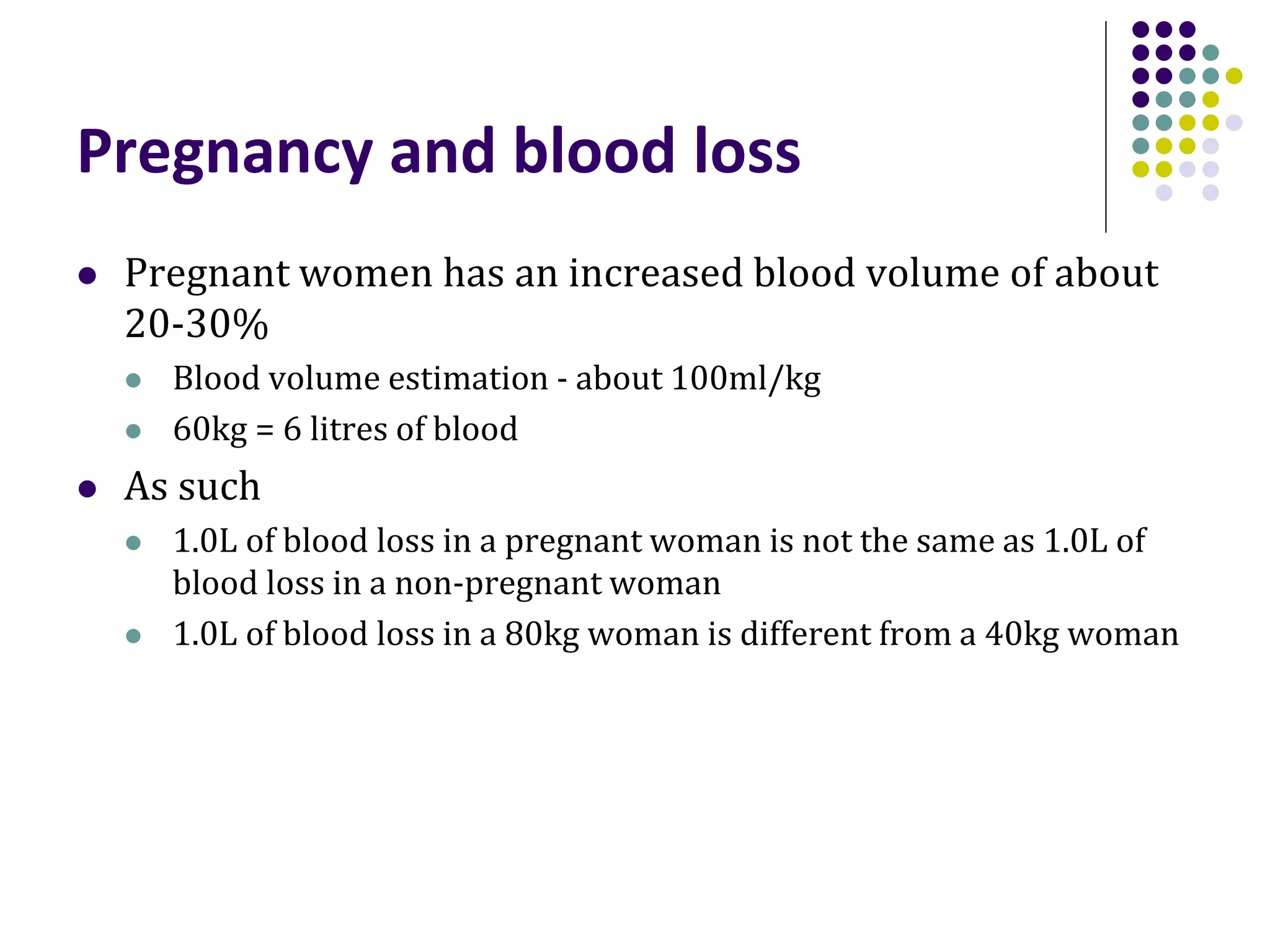
Pregnancy and blood loss
 Pregnant women has an increased blood volume of about
20-30%
 Blood volume estimation - about 100ml/kg
 60kg = 6 litres of blood
 As such
 1.0L of blood loss in a pregnant woman is not the same as 1.0L of
blood loss in a non-pregnant woman
 1.0L of blood loss in a 80kg woman is different from a 40kg woman
Lost of circulating volume in
obstetrics
Circulating
volume lost
Signs
Up to 0.5L-1.0L Mild increase in PR -
1.0-1.5L Increase PR
Increase breathing
Slight fall in BP (80-100
mmHg SBP)
Use crystalloids to replace fluid
loss
1.5-2.0L Use colloids to replace
30-40%
(Over 2 L)
BP drops Need a blood transfusion in
addition to crystalloids
>40% Immediate life threatening Blood transfusion is required
immediately
Need rapid transfusion
Referring to a normal healthy pregnant woman i.e. not anaemic, etc
Vital signs
 When abnormal in the context of haemorrhage,
they are useful in assessing the severity of the
hypovolemic shock
 When normal however, they are not reliable in
assessing the severity of the hypovolemic shock
 Remember that a drop in BP is a late sign of
hypovolaemia! Patient has lost at least 30% of her blood
volume!!!
 Should not rely on BP to assess volume loss!!!
 <30% blood loss - Red cell transfusion not necessary unless:
 Pre-existing anaemia
 Reduced cardiorespiratory reserve
 Ongoing blood loss
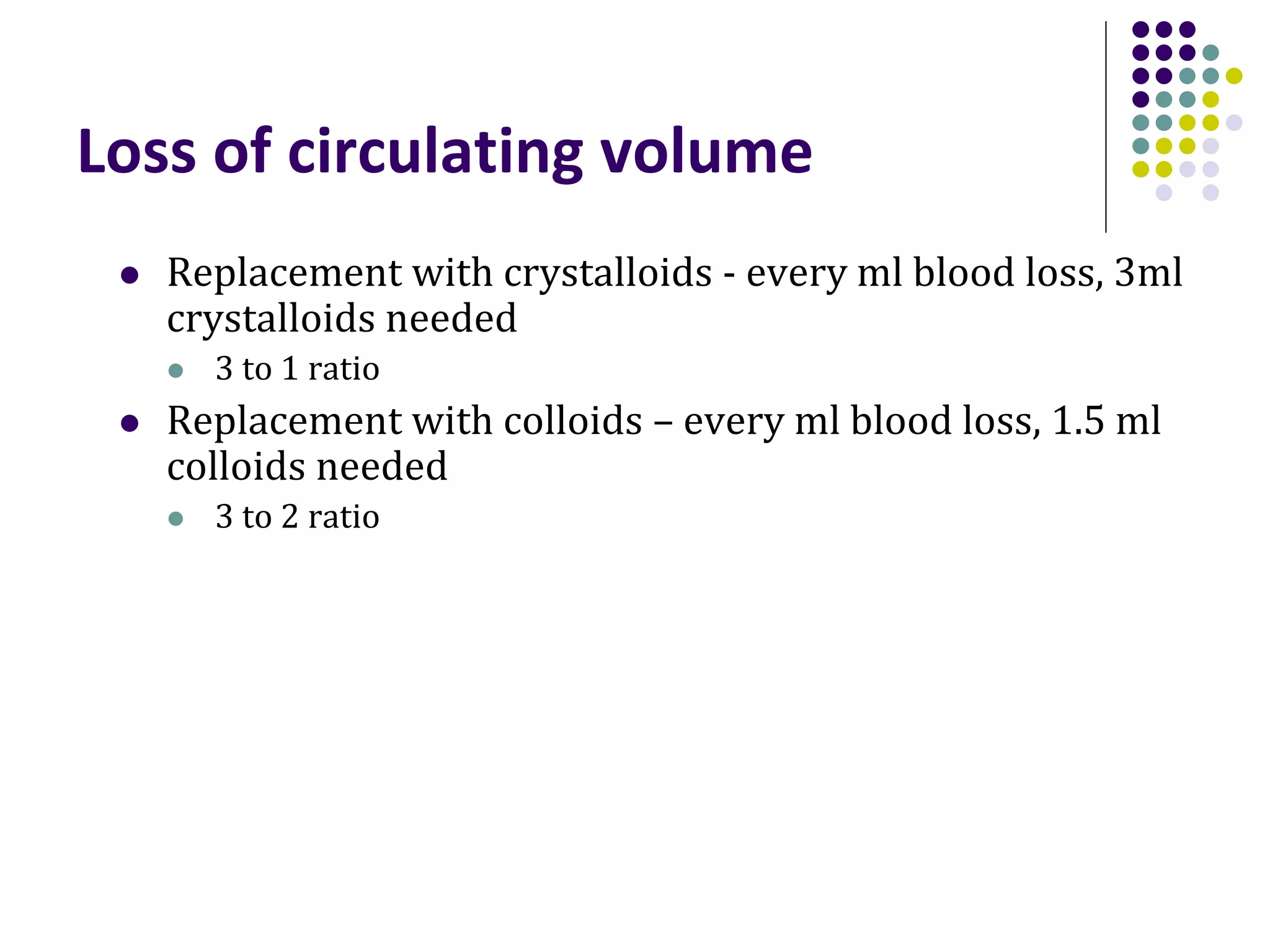
Loss of circulating volume
 Replacement with crystalloids - every ml blood loss, 3ml
crystalloids needed
 3 to 1 ratio
 Replacement with colloids – every ml blood loss, 1.5 ml
colloids needed
 3 to 2 ratio
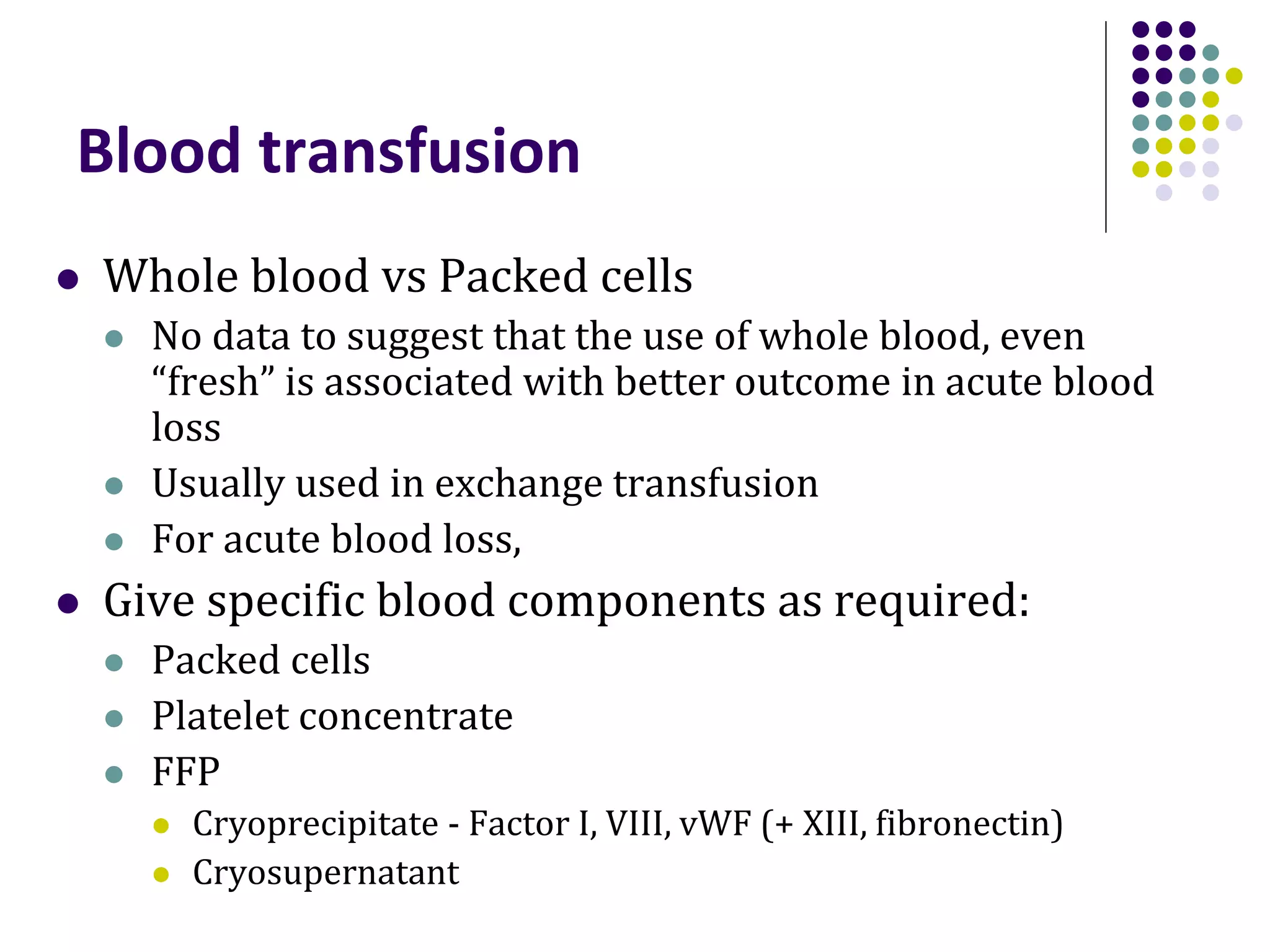
Blood transfusion
 Whole blood vs Packed cells
 No data to suggest that the use of whole blood, even
“fresh” is associated with better outcome in acute blood
loss
 Usually used in exchange transfusion
 For acute blood loss,
 Give specific blood components as required:
 Packed cells
 Platelet concentrate
 FFP
 Cryoprecipitate - Factor I, VIII, vWF (+ XIII, fibronectin)
 Cryosupernatant
Rapid blood transfusion in life-
threatening condition
 BP cuff (high-pressure infusion devices)
 No blood filters
 With warmers
 O-ve blood
DIVC in obstetrics
 Consumption coagulopathy (depletion of
platelets and coagulation factors) that leads to
further haemorrhage
 Can be due to:
 Massive bleeding (e.g. APH, PPH, abruption)
 Sepsis
 Amniotic fluid embolism
 Eclampsia
 IUD
DIVC
 Treat the underlying cause (sepsis, massive blood
loss, severe vessel injury, toxins)
 Transfuse platelet if bleeding associated with
thrombocytopaenia. Aim for > 50 x 109 /L (C, IV)
 Platelets should not be allowed to fall <50 x 109 in
acutely bleeding patient
DIVC
 If bleeding continues after large volumes red cell
and platelets have been transfused, FFP and
cryoprecipitate may be given (depending on
protocol e.g. after 10 units of RBCs, abnormal
coagulation profile, etc)
 Transfuse FFP and cryoprecipitate so that the PT
and APTT ratios are within 1.5 and a fibrinogen
level of > 1.0 g/ L
 Adequate resuscitation from shock - most
important in preventing coagulopathy
 No evidence that prophylactic regimes
prevents or reduce transfusion
requirements
Massive Blood Loss
 Replacement of total blood volume (5 L) within
24 hours
 Loss of 50% blood volume in less than or equal
to 3 hours
 150ml/ min blood loss (Loss of half the blood
volume in 20 minutes)
 Transfusion of more than 20 units of
erythrocytes
Complications of massive transfusion
 Hypothermia
 Acid-base disturbance – metabolic alkalosis >
acidosis
 Thrombocytopenia & reduced factor I,V,VIII
 Electrolyte imbalance
 Hypokalemia > Hyperkalemia
 Hypocalcemia & citrate intoxication

Blood & Blood Products Transfusion

  • 1.
    BLOOD AND BLOOD PRODUCTSTRANSFUSION Salso Team In Obstetrics
  • 2.
    Pregnancy and bloodloss  Pregnant women has an increased blood volume of about 20-30%  Blood volume estimation - about 100ml/kg  60kg = 6 litres of blood  As such  1.0L of blood loss in a pregnant woman is not the same as 1.0L of blood loss in a non-pregnant woman  1.0L of blood loss in a 80kg woman is different from a 40kg woman
  • 3.
    Lost of circulatingvolume in obstetrics Circulating volume lost Signs Up to 0.5L-1.0L Mild increase in PR - 1.0-1.5L Increase PR Increase breathing Slight fall in BP (80-100 mmHg SBP) Use crystalloids to replace fluid loss 1.5-2.0L Use colloids to replace 30-40% (Over 2 L) BP drops Need a blood transfusion in addition to crystalloids >40% Immediate life threatening Blood transfusion is required immediately Need rapid transfusion Referring to a normal healthy pregnant woman i.e. not anaemic, etc
  • 4.
    Vital signs  Whenabnormal in the context of haemorrhage, they are useful in assessing the severity of the hypovolemic shock  When normal however, they are not reliable in assessing the severity of the hypovolemic shock  Remember that a drop in BP is a late sign of hypovolaemia! Patient has lost at least 30% of her blood volume!!!  Should not rely on BP to assess volume loss!!!
  • 5.
     <30% bloodloss - Red cell transfusion not necessary unless:  Pre-existing anaemia  Reduced cardiorespiratory reserve  Ongoing blood loss
  • 6.
    Loss of circulatingvolume  Replacement with crystalloids - every ml blood loss, 3ml crystalloids needed  3 to 1 ratio  Replacement with colloids – every ml blood loss, 1.5 ml colloids needed  3 to 2 ratio
  • 7.
    Blood transfusion  Wholeblood vs Packed cells  No data to suggest that the use of whole blood, even “fresh” is associated with better outcome in acute blood loss  Usually used in exchange transfusion  For acute blood loss,  Give specific blood components as required:  Packed cells  Platelet concentrate  FFP  Cryoprecipitate - Factor I, VIII, vWF (+ XIII, fibronectin)  Cryosupernatant
  • 8.
    Rapid blood transfusionin life- threatening condition  BP cuff (high-pressure infusion devices)  No blood filters  With warmers  O-ve blood
  • 9.
    DIVC in obstetrics Consumption coagulopathy (depletion of platelets and coagulation factors) that leads to further haemorrhage  Can be due to:  Massive bleeding (e.g. APH, PPH, abruption)  Sepsis  Amniotic fluid embolism  Eclampsia  IUD
  • 10.
    DIVC  Treat theunderlying cause (sepsis, massive blood loss, severe vessel injury, toxins)  Transfuse platelet if bleeding associated with thrombocytopaenia. Aim for > 50 x 109 /L (C, IV)  Platelets should not be allowed to fall <50 x 109 in acutely bleeding patient
  • 11.
    DIVC  If bleedingcontinues after large volumes red cell and platelets have been transfused, FFP and cryoprecipitate may be given (depending on protocol e.g. after 10 units of RBCs, abnormal coagulation profile, etc)  Transfuse FFP and cryoprecipitate so that the PT and APTT ratios are within 1.5 and a fibrinogen level of > 1.0 g/ L
  • 12.
     Adequate resuscitationfrom shock - most important in preventing coagulopathy  No evidence that prophylactic regimes prevents or reduce transfusion requirements
  • 13.
    Massive Blood Loss Replacement of total blood volume (5 L) within 24 hours  Loss of 50% blood volume in less than or equal to 3 hours  150ml/ min blood loss (Loss of half the blood volume in 20 minutes)  Transfusion of more than 20 units of erythrocytes
  • 14.
    Complications of massivetransfusion  Hypothermia  Acid-base disturbance – metabolic alkalosis > acidosis  Thrombocytopenia & reduced factor I,V,VIII  Electrolyte imbalance  Hypokalemia > Hyperkalemia  Hypocalcemia & citrate intoxication