DKA vs HHS by suraya salleh
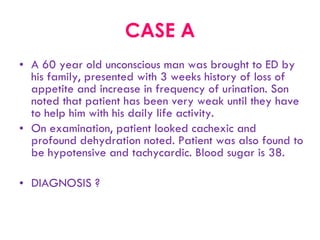
CASE A A 60 year old unconscious man was brought to ED by his family, presented with 3 weeks history of loss of appetite and increase in frequency of urination. Son noted that patient has been very weak until they have to help him with his daily life activity.  On examination, patient looked cachexic and profound dehydration noted. Patient was also found to be hypotensive and tachycardic. Blood sugar is 38. DIAGNOSIS ?
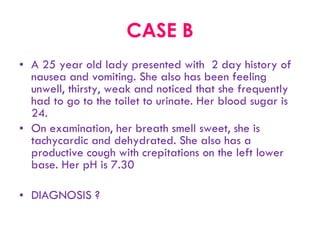
CASE B A 25 year old lady presented with  2 day history of nausea and vomiting. She also has been feeling unwell, thirsty, weak and noticed that she frequently had to go to the toilet to urinate. Her blood sugar is 24.  On examination, her breath smell sweet, she is  tachycardic and dehydrated. She also has a productive cough with crepitations on the left lower base. Her pH is 7.30 DIAGNOSIS ?
Which one is HHS? Which one is DKA?
DKA vs HHS Common Type 1  Precipitated by infection Ketoacidosis Short prodromal sympts Mortality 5-10% Age 20-29 Uncommon Type 2 More severe illness Not ketoacidotic Longer prodromal sympts Mortality 40-60% Age 57-70
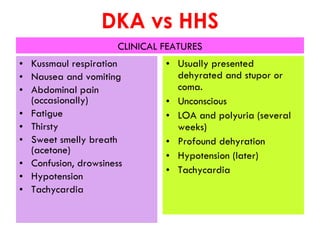
DKA vs HHS Kussmaul respiration Nausea and vomiting Abdominal pain (occasionally) Fatigue Thirsty Sweet smelly breath (acetone) Confusion, drowsiness Hypotension Tachycardia Usually presented dehyrated and stupor or coma. Unconscious LOA and polyuria (several weeks) Profound dehyration Hypotension (later) Tachycardia CLINICAL FEATURES
DKA vs HHS Hyperglycemia : Blood glucose  > 14 mmol/L Acidosis : pH < 7.3, HCO 3  <15 mmol/L Ketonaemia or ketonuria Plasma glucose level of  >  33 mmol/L Arterial pH > 7.3, serum bicarbonate > 15 mmol/L Absence  of severe ketonaemia or ketonuria Serum total  osmolality >330 mmol/L Diagnostic  Criteria
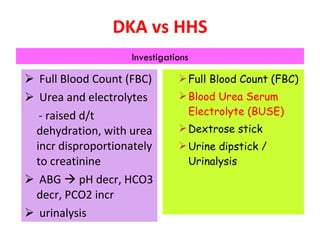
DKA vs HHS Full Blood Count (FBC) Blood Urea Serum Electrolyte (BUSE) Dextrose stick  Urine dipstick / Urinalysis Full Blood Count (FBC) Urea and electrolytes - raised d/t dehydration, with urea incr disproportionately to creatinine  ABG    pH decr, HCO3 decr, PCO2 incr urinalysis  Investigations
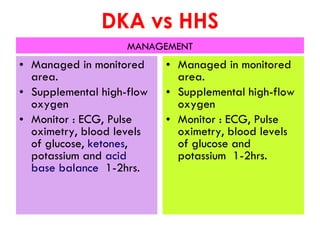
DKA vs HHS Managed in monitored area. Supplemental high-flow oxygen Monitor : ECG, Pulse oximetry, blood levels of glucose,  ketones , potassium and  acid base balance   1-2hrs.  Managed in monitored area. Supplemental high-flow oxygen Monitor : ECG, Pulse oximetry, blood levels of glucose and potassium  1-2hrs. MANAGEMENT
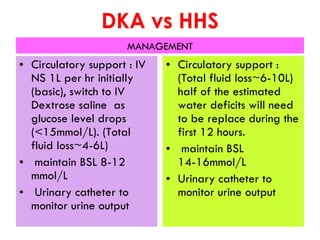
DKA vs HHS Circulatory support : IV NS 1L per hr initially (basic), switch to IV Dextrose saline  as glucose level drops (<15mmol/L). (Total fluid loss~4-6L) maintain BSL 8-12 mmol/L  Urinary catheter to monitor urine output Circulatory support : (Total fluid loss~6-10L) half of the estimated water deficits will need to be replace during the first 12 hours. maintain BSL 14-16mmol/L  Urinary catheter to monitor urine output MANAGEMENT
Do you know how to differentiate DKA and HHS now??
Referrence : Clinical Medicine Kumar and Clark  SARAWAK  Handbook of Medical Emergencies 2 nd  edition
THANK YOU

Dka Vs Hhs Suraya

  • 1.
    DKA vs HHSby suraya salleh
  • 2.
    CASE A A60 year old unconscious man was brought to ED by his family, presented with 3 weeks history of loss of appetite and increase in frequency of urination. Son noted that patient has been very weak until they have to help him with his daily life activity. On examination, patient looked cachexic and profound dehydration noted. Patient was also found to be hypotensive and tachycardic. Blood sugar is 38. DIAGNOSIS ?
  • 3.
    CASE B A25 year old lady presented with 2 day history of nausea and vomiting. She also has been feeling unwell, thirsty, weak and noticed that she frequently had to go to the toilet to urinate. Her blood sugar is 24. On examination, her breath smell sweet, she is tachycardic and dehydrated. She also has a productive cough with crepitations on the left lower base. Her pH is 7.30 DIAGNOSIS ?
  • 4.
    Which one isHHS? Which one is DKA?
  • 5.
    DKA vs HHSCommon Type 1 Precipitated by infection Ketoacidosis Short prodromal sympts Mortality 5-10% Age 20-29 Uncommon Type 2 More severe illness Not ketoacidotic Longer prodromal sympts Mortality 40-60% Age 57-70
  • 6.
    DKA vs HHSKussmaul respiration Nausea and vomiting Abdominal pain (occasionally) Fatigue Thirsty Sweet smelly breath (acetone) Confusion, drowsiness Hypotension Tachycardia Usually presented dehyrated and stupor or coma. Unconscious LOA and polyuria (several weeks) Profound dehyration Hypotension (later) Tachycardia CLINICAL FEATURES
  • 7.
    DKA vs HHSHyperglycemia : Blood glucose > 14 mmol/L Acidosis : pH < 7.3, HCO 3 <15 mmol/L Ketonaemia or ketonuria Plasma glucose level of > 33 mmol/L Arterial pH > 7.3, serum bicarbonate > 15 mmol/L Absence of severe ketonaemia or ketonuria Serum total osmolality >330 mmol/L Diagnostic Criteria
  • 8.
    DKA vs HHSFull Blood Count (FBC) Blood Urea Serum Electrolyte (BUSE) Dextrose stick Urine dipstick / Urinalysis Full Blood Count (FBC) Urea and electrolytes - raised d/t dehydration, with urea incr disproportionately to creatinine ABG  pH decr, HCO3 decr, PCO2 incr urinalysis Investigations
  • 9.
    DKA vs HHSManaged in monitored area. Supplemental high-flow oxygen Monitor : ECG, Pulse oximetry, blood levels of glucose, ketones , potassium and acid base balance 1-2hrs. Managed in monitored area. Supplemental high-flow oxygen Monitor : ECG, Pulse oximetry, blood levels of glucose and potassium 1-2hrs. MANAGEMENT
  • 10.
    DKA vs HHSCirculatory support : IV NS 1L per hr initially (basic), switch to IV Dextrose saline as glucose level drops (<15mmol/L). (Total fluid loss~4-6L) maintain BSL 8-12 mmol/L Urinary catheter to monitor urine output Circulatory support : (Total fluid loss~6-10L) half of the estimated water deficits will need to be replace during the first 12 hours. maintain BSL 14-16mmol/L Urinary catheter to monitor urine output MANAGEMENT
  • 11.
    Do you knowhow to differentiate DKA and HHS now??
  • 12.
    Referrence : ClinicalMedicine Kumar and Clark SARAWAK Handbook of Medical Emergencies 2 nd edition
  • 13.