THYROID DISORDERS
-
HYPOFUNCTION AND
HYPERFUNCTION
Presented by Dr. Hrudi Sundar
Sahoo
INTRODUCTION
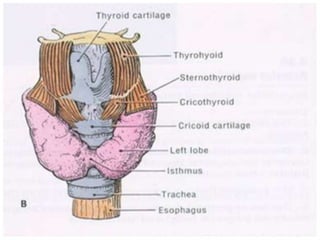
 Largest endocrine gland.
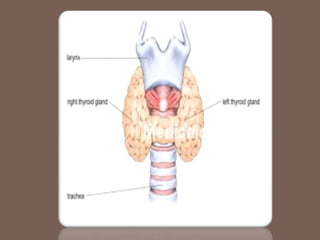
 Located inferior to cricoid cartilage.
 Butterfly shaped organ comprising of two
lobes
- lobus dexter(right)
- lobus sinister(left)
 Weighs 18-60gms in adults.
 Histologically it is made up of follicular and
parafollicular cells.
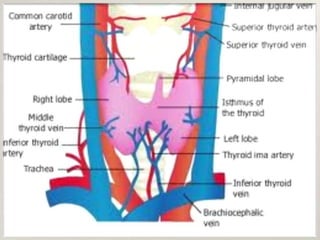
 Blood supply
Arterial supply - superior thyroid artery
- inferior thyroid artery
Venous supply - superior thyroid vein
- inferior thyroid vein
 Nerve supply
- Superior laryngeal nerve
- Recurrent laryngeal nerve
 Lymphatic drainage
- Lateral deep cervical lymph node
- Pretracheal/para tracheal lymph nodes
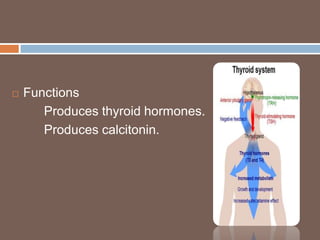
 Functions
Produces thyroid hormones.
Produces calcitonin.
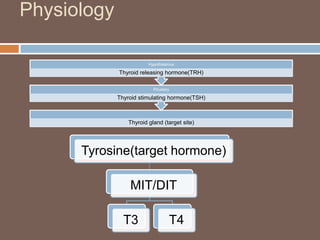
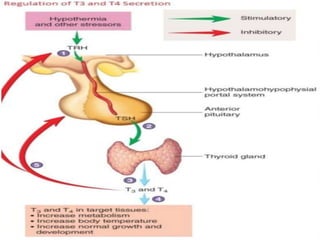
Physiology
Thyroid gland (target site)
Pituatary
Thyroid stimulating hormone(TSH)
Hypothalamus
Thyroid releasing hormone(TRH)
Tyrosine(target hormone)
MIT/DIT
T3 T4
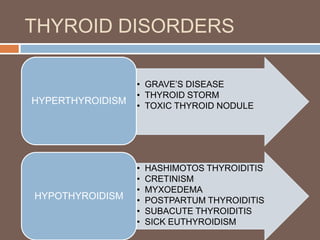
THYROID DISORDERS
• GRAVE’S DISEASE
• THYROID STORM
• TOXIC THYROID NODULE
HYPERTHYROIDISM
• HASHIMOTOS THYROIDITIS
• CRETINISM
• MYXOEDEMA
• POSTPARTUM THYROIDITIS
• SUBACUTE THYROIDITIS
• SICK EUTHYROIDISM
HYPOTHYROIDISM
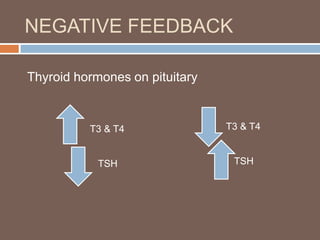
NEGATIVE FEEDBACK
Thyroid hormones on pituitary
T3 & T4
TSH
T3 & T4
TSH
THYROTOXICOSIS
 Hypermetabolic clinical syndrome resulting
from serum elevation of thyroid hormone
levels(T3 & T4).
 Causes are GRAVE’ S disease, multinodular
goitre and toxic adenoma.
 GRAVE’S DISEASE is the most common
form.
GRAVE’S DISEASE
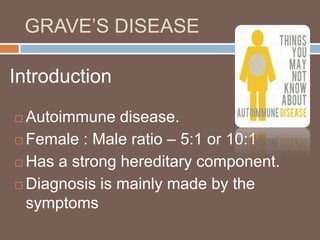
 Autoimmune disease.
 Female : Male ratio – 5:1 or 10:1
 Has a strong hereditary component.
 Diagnosis is mainly made by the
symptoms
Introduction
Signs and symptoms
 Skin is warm and moist, palms are warm,moist
and hyperemic and Plummer’s nails are seen.
 Pretibial myxedema.
 Alopecia and vitiligo.
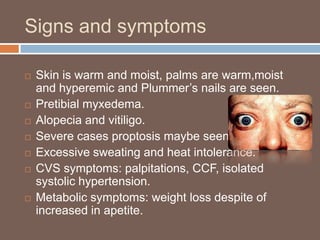
 Severe cases proptosis maybe seen.
 Excessive sweating and heat intolerance.
 CVS symptoms: palpitations, CCF, isolated
systolic hypertension.
 Metabolic symptoms: weight loss despite of
increased in apetite.
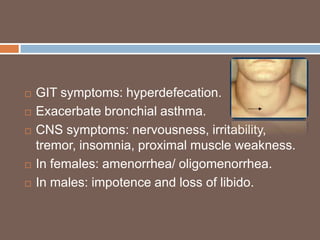
 GIT symptoms: hyperdefecation.
 Exacerbate bronchial asthma.
 CNS symptoms: nervousness, irritability,
tremor, insomnia, proximal muscle weakness.
 In females: amenorrhea/ oligomenorrhea.
 In males: impotence and loss of libido.
Eye signs
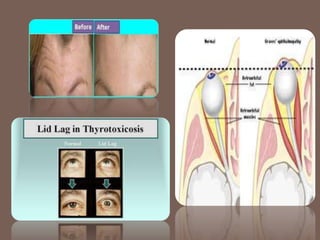
 VON GRAEFE’S SIGN – Lid lag.
 JOFFROY’S SIGN – Absence of wrinkling of
forehead on looking up.
 STELLWAG’S SIGN – Decreased frequency of
blinking.
 DALRIMPLE’S SIGN – Lid retraction exposing
the upper sclera.
 MOBIUS SIGN – Absence of convergence.
Investigations
 T3 & T4 levels.
 Thyroid uptake of radio iodine.
 Presence of antibodies: TSH receptor antibody
Antimicrosomal antibody
 CT orbits thyroid scans.
Management
 Immediate control: Propranolol 40mg/6hr orally.
 Long term control:
Anti thyroid drugs – Carbimazole 15mg tid
initially and then reducing it to 5mg tid for
12-18 months.
Radio iodine ablation – Postmenopausal women
and elderly men.
In recurrence following surgery.
Given to fertile women conception postponed to
1
year.
Surgery – Presence of large goitre.
Poor drug compliance.
 Exopthalmos: Corticosteroids.
Tarsorrhaphy.
Orbital decompression.
 Cardiac arrythmias: ß- blockers.
In euthyroid state,
cardioversion is done.
MULTINODULAR GOITRE
 Excess production of thyroid
hormones from functionally
autonomous thyroid nodules which
do not require the stimulation from
TSH.
 Second common cause.
 Occurs in individual over 60 years of
age and females are mostly affected.
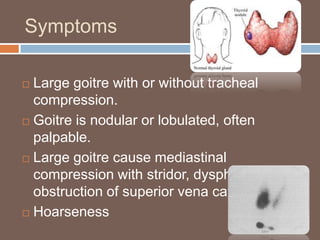
Symptoms
 Large goitre with or without tracheal
compression.
 Goitre is nodular or lobulated, often
palpable.
 Large goitre cause mediastinal
compression with stridor, dysphagia and
obstruction of superior vena cava.
 Hoarseness
Management
 Small goitre : No treatment.
Annual review.
 Large goitres : Partial thyroidectomy.
Radioactive iodine I
 Recurrence is common after 10-20 years.
131
THYROID STORM
 Rare but life threatening sudden severe
exarcerbation of hyperthyroidism.
 Causes: Precipitated by stress or infection with
either unrecognized thyrotoxicosis or
inadequately treated thyrotoxicosis.
Following subtotal thyroidectomy/radio
active iodine.
Trauma.
Pregnancy.
Emotional stress.
Signs
 Elevation of temperature.
 Increase in heart rate.
 Irritable.
 Delirius/comatose.
 Hypotension.
 Vomiting.
 Diarrhoea.
Management
 Treatment started immediately with
Propranolol 80mg/6hrs orally(dose of 1-5mg/6hrs
given IV).
Potassium iodide 60mg daily orally/ sodium
iopodate 500mg daily orally.
Carbimazole 60-120mg daily
Dexamethasone 2mg/6hrs IV.
Fluid replacement.
Antibiotics.
Emergency management in dental
office
 Terminate all treatment.
 Have someone summon medical assistance.
 Administer oxygen.
 Monitar all vital signs.
 Initiate basic life support if necessary.
 Start IV line with drip of crystalloid
solution(150mL/hr).
 Transport patient to emergency care facility.
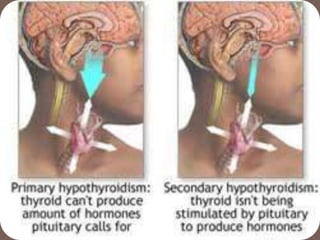
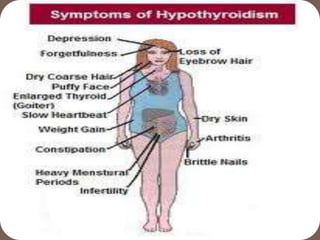
HYPOTHYROIDISM
 Insufficiency synthesis of thyroid hormones.
 Female : Male ratio is 6 : 1.
 Causes : Hashimoto’s thyroiditis
Thyroid failure following radio iodine.
surgical treatment of thyrotoxicosis.
Drugs like carbimazole, amiadarone.
Iodine deficiency.
HASHIMOTO’S THYROIDITIS
 Primary condition of
hypothyroidism
 Autoimmune.
 Described by Hakaru Hashimoto
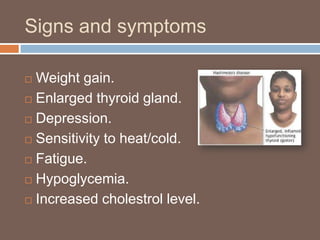
Signs and symptoms
 Weight gain.
 Enlarged thyroid gland.
 Depression.
 Sensitivity to heat/cold.
 Fatigue.
 Hypoglycemia.
 Increased cholestrol level.
Diagnosis
 T3 & T4 levels.
 Presence of TPO antibodies.
 Positive ANF.
Treatment
 Thyroxine therapy.
 Helps in both hypothyroidism and goitre
shrinkage
LEVOTHYROX
INE
CRETINISM
 Hypothyroidism dating from birth.
 Tyroxine is essential for growth and development of
brain during the first three years.
 Earlier onset greater is the brain damage.
 Causes : - Congenital developmental defects.
- Radio iodine/surgery.
- Post radiation.
- Iodine deficiency.
- Drug induced.
- Hashimoto’s thyroiditis.
- Recurrent hypothyroidism.
Signs and symptoms
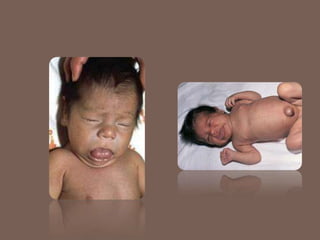
 Dry, cool, mottled skin, hoarse cry, broad flat
nose, puffy face.
 Protruberant abdomen, umblical hernia,
hypotonia.
 Large posterior fontanelle.
 Lethargy, delayed stooling, poor
feeding/sucking.
 Cold to touch.
 Delayed dentition.
 Mental retardation.
Management
 Investigation : Cord blood T4, TSH.
Serum T4, TSH
RAIU
X-ray of knee, foot and skull.
 Treatment
Medication : levothyroxine (initial dose of 10-
15mcg/kg/dl).
Diet : iodine rich foods.
Follow up.
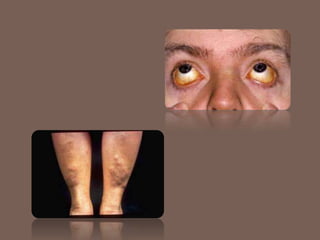
MYXOEDEMA
 Severe hypothyroidism in which there is
accumulation of hydrophilic
mucopolysaccharides in the skin and other
tissues.
 Common in women.
 Two variants – Hyperthyroid myxoedema
– Hypothyroid myxoedema.
 Cause : Increased deposition of glycosamine
glycans
Hashimoto’s thyroiditis.
MYXOEDEMA COMA
 Uncommon but life threatening form of
untreated hypothyroidism with physiological
decompensation.
 Occurs in patients with long standing
hypothyroidism.
 Precipitated by a climate induced hypothermia,
infection, drug therapy and other systemic
conditions
.
Symptoms
 Lethargy
 Stupor,
 Delirium.
 Hypotension.
 Convulsions.
 Hypoglycemia.
 Hyponatremia.
 Hypoventillation.
 Coma.
Investigations
 Free T4 and TSH
 T3 & T4 levels are decreased and TSH
are elevated or normal.
 Serum electrolyte and serum osmolality.
 Serum creatinine.
 Serum glucose.
 Differential blood count.
 Pan culture for sepsis.
Treatment
 Hyperventilation if respiratory acidosis is
significant.
 Immediate IV levothyroxine given
 Loading dose of 500 - 800mcg followed by 50
– 100mcg daily.
 Hydrocortisone 5 – 10mg/hr.
 Treatment of associated infection.
 Correction of hyponatremia with saline.
 Correction of hypoglycemia with IV dextrose.
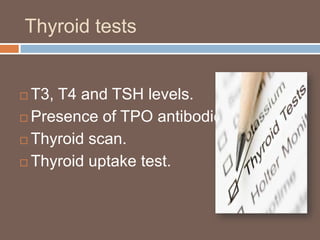
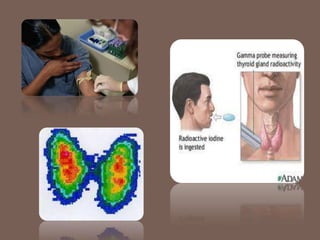
Thyroid tests
 T3, T4 and TSH levels.
 Presence of TPO antibodies.
 Thyroid scan.
 Thyroid uptake test.
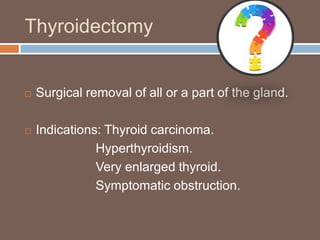
Thyroidectomy
 Surgical removal of all or a part of the gland.
 Indications: Thyroid carcinoma.
Hyperthyroidism.
Very enlarged thyroid.
Symptomatic obstruction.
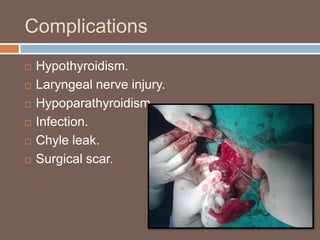
Complications
 Hypothyroidism.
 Laryngeal nerve injury.
 Hypoparathyroidism.
 Infection.
 Chyle leak.
 Surgical scar.
Conclusion
A self assessment of thyroid gland is
necessary for earliar detection of thyroid
disorders.
THANKYOU

thyroiddisorders-ppt2-130409004827-phpapp01.pdf

  • 1.
  • 2.
    INTRODUCTION  Largest endocrinegland.  Located inferior to cricoid cartilage.  Butterfly shaped organ comprising of two lobes - lobus dexter(right) - lobus sinister(left)  Weighs 18-60gms in adults.  Histologically it is made up of follicular and parafollicular cells.
  • 3.
     Blood supply Arterialsupply - superior thyroid artery - inferior thyroid artery Venous supply - superior thyroid vein - inferior thyroid vein  Nerve supply - Superior laryngeal nerve - Recurrent laryngeal nerve  Lymphatic drainage - Lateral deep cervical lymph node - Pretracheal/para tracheal lymph nodes
  • 7.
     Functions Produces thyroidhormones. Produces calcitonin.
  • 8.
    Physiology Thyroid gland (targetsite) Pituatary Thyroid stimulating hormone(TSH) Hypothalamus Thyroid releasing hormone(TRH) Tyrosine(target hormone) MIT/DIT T3 T4
  • 10.
    THYROID DISORDERS • GRAVE’SDISEASE • THYROID STORM • TOXIC THYROID NODULE HYPERTHYROIDISM • HASHIMOTOS THYROIDITIS • CRETINISM • MYXOEDEMA • POSTPARTUM THYROIDITIS • SUBACUTE THYROIDITIS • SICK EUTHYROIDISM HYPOTHYROIDISM
  • 11.
    NEGATIVE FEEDBACK Thyroid hormoneson pituitary T3 & T4 TSH T3 & T4 TSH
  • 12.
    THYROTOXICOSIS  Hypermetabolic clinicalsyndrome resulting from serum elevation of thyroid hormone levels(T3 & T4).  Causes are GRAVE’ S disease, multinodular goitre and toxic adenoma.  GRAVE’S DISEASE is the most common form.
  • 13.
    GRAVE’S DISEASE  Autoimmunedisease.  Female : Male ratio – 5:1 or 10:1  Has a strong hereditary component.  Diagnosis is mainly made by the symptoms Introduction
  • 14.
    Signs and symptoms Skin is warm and moist, palms are warm,moist and hyperemic and Plummer’s nails are seen.  Pretibial myxedema.  Alopecia and vitiligo.  Severe cases proptosis maybe seen.  Excessive sweating and heat intolerance.  CVS symptoms: palpitations, CCF, isolated systolic hypertension.  Metabolic symptoms: weight loss despite of increased in apetite.
  • 15.
     GIT symptoms:hyperdefecation.  Exacerbate bronchial asthma.  CNS symptoms: nervousness, irritability, tremor, insomnia, proximal muscle weakness.  In females: amenorrhea/ oligomenorrhea.  In males: impotence and loss of libido.
  • 16.
    Eye signs  VONGRAEFE’S SIGN – Lid lag.  JOFFROY’S SIGN – Absence of wrinkling of forehead on looking up.  STELLWAG’S SIGN – Decreased frequency of blinking.  DALRIMPLE’S SIGN – Lid retraction exposing the upper sclera.  MOBIUS SIGN – Absence of convergence.
  • 18.
    Investigations  T3 &T4 levels.  Thyroid uptake of radio iodine.  Presence of antibodies: TSH receptor antibody Antimicrosomal antibody  CT orbits thyroid scans.
  • 19.
    Management  Immediate control:Propranolol 40mg/6hr orally.  Long term control: Anti thyroid drugs – Carbimazole 15mg tid initially and then reducing it to 5mg tid for 12-18 months. Radio iodine ablation – Postmenopausal women and elderly men. In recurrence following surgery. Given to fertile women conception postponed to 1 year. Surgery – Presence of large goitre. Poor drug compliance.
  • 20.
     Exopthalmos: Corticosteroids. Tarsorrhaphy. Orbitaldecompression.  Cardiac arrythmias: ß- blockers. In euthyroid state, cardioversion is done.
  • 21.
    MULTINODULAR GOITRE  Excessproduction of thyroid hormones from functionally autonomous thyroid nodules which do not require the stimulation from TSH.  Second common cause.  Occurs in individual over 60 years of age and females are mostly affected.
  • 22.
    Symptoms  Large goitrewith or without tracheal compression.  Goitre is nodular or lobulated, often palpable.  Large goitre cause mediastinal compression with stridor, dysphagia and obstruction of superior vena cava.  Hoarseness
  • 23.
    Management  Small goitre: No treatment. Annual review.  Large goitres : Partial thyroidectomy. Radioactive iodine I  Recurrence is common after 10-20 years. 131
  • 24.
    THYROID STORM  Rarebut life threatening sudden severe exarcerbation of hyperthyroidism.  Causes: Precipitated by stress or infection with either unrecognized thyrotoxicosis or inadequately treated thyrotoxicosis. Following subtotal thyroidectomy/radio active iodine. Trauma. Pregnancy. Emotional stress.
  • 26.
    Signs  Elevation oftemperature.  Increase in heart rate.  Irritable.  Delirius/comatose.  Hypotension.  Vomiting.  Diarrhoea.
  • 27.
    Management  Treatment startedimmediately with Propranolol 80mg/6hrs orally(dose of 1-5mg/6hrs given IV). Potassium iodide 60mg daily orally/ sodium iopodate 500mg daily orally. Carbimazole 60-120mg daily Dexamethasone 2mg/6hrs IV. Fluid replacement. Antibiotics.
  • 28.
    Emergency management indental office  Terminate all treatment.  Have someone summon medical assistance.  Administer oxygen.  Monitar all vital signs.  Initiate basic life support if necessary.  Start IV line with drip of crystalloid solution(150mL/hr).  Transport patient to emergency care facility.
  • 29.
    HYPOTHYROIDISM  Insufficiency synthesisof thyroid hormones.  Female : Male ratio is 6 : 1.  Causes : Hashimoto’s thyroiditis Thyroid failure following radio iodine. surgical treatment of thyrotoxicosis. Drugs like carbimazole, amiadarone. Iodine deficiency.
  • 32.
    HASHIMOTO’S THYROIDITIS  Primarycondition of hypothyroidism  Autoimmune.  Described by Hakaru Hashimoto
  • 33.
    Signs and symptoms Weight gain.  Enlarged thyroid gland.  Depression.  Sensitivity to heat/cold.  Fatigue.  Hypoglycemia.  Increased cholestrol level.
  • 34.
    Diagnosis  T3 &T4 levels.  Presence of TPO antibodies.  Positive ANF.
  • 35.
    Treatment  Thyroxine therapy. Helps in both hypothyroidism and goitre shrinkage LEVOTHYROX INE
  • 36.
    CRETINISM  Hypothyroidism datingfrom birth.  Tyroxine is essential for growth and development of brain during the first three years.  Earlier onset greater is the brain damage.  Causes : - Congenital developmental defects. - Radio iodine/surgery. - Post radiation. - Iodine deficiency. - Drug induced. - Hashimoto’s thyroiditis. - Recurrent hypothyroidism.
  • 37.
    Signs and symptoms Dry, cool, mottled skin, hoarse cry, broad flat nose, puffy face.  Protruberant abdomen, umblical hernia, hypotonia.  Large posterior fontanelle.  Lethargy, delayed stooling, poor feeding/sucking.  Cold to touch.  Delayed dentition.  Mental retardation.
  • 39.
    Management  Investigation :Cord blood T4, TSH. Serum T4, TSH RAIU X-ray of knee, foot and skull.  Treatment Medication : levothyroxine (initial dose of 10- 15mcg/kg/dl). Diet : iodine rich foods. Follow up.
  • 40.
    MYXOEDEMA  Severe hypothyroidismin which there is accumulation of hydrophilic mucopolysaccharides in the skin and other tissues.  Common in women.  Two variants – Hyperthyroid myxoedema – Hypothyroid myxoedema.  Cause : Increased deposition of glycosamine glycans Hashimoto’s thyroiditis.
  • 42.
    MYXOEDEMA COMA  Uncommonbut life threatening form of untreated hypothyroidism with physiological decompensation.  Occurs in patients with long standing hypothyroidism.  Precipitated by a climate induced hypothermia, infection, drug therapy and other systemic conditions .
  • 43.
    Symptoms  Lethargy  Stupor, Delirium.  Hypotension.  Convulsions.  Hypoglycemia.  Hyponatremia.  Hypoventillation.  Coma.
  • 44.
    Investigations  Free T4and TSH  T3 & T4 levels are decreased and TSH are elevated or normal.  Serum electrolyte and serum osmolality.  Serum creatinine.  Serum glucose.  Differential blood count.  Pan culture for sepsis.
  • 45.
    Treatment  Hyperventilation ifrespiratory acidosis is significant.  Immediate IV levothyroxine given  Loading dose of 500 - 800mcg followed by 50 – 100mcg daily.  Hydrocortisone 5 – 10mg/hr.  Treatment of associated infection.  Correction of hyponatremia with saline.  Correction of hypoglycemia with IV dextrose.
  • 46.
    Thyroid tests  T3,T4 and TSH levels.  Presence of TPO antibodies.  Thyroid scan.  Thyroid uptake test.
  • 48.
    Thyroidectomy  Surgical removalof all or a part of the gland.  Indications: Thyroid carcinoma. Hyperthyroidism. Very enlarged thyroid. Symptomatic obstruction.
  • 49.
    Complications  Hypothyroidism.  Laryngealnerve injury.  Hypoparathyroidism.  Infection.  Chyle leak.  Surgical scar.
  • 50.
    Conclusion A self assessmentof thyroid gland is necessary for earliar detection of thyroid disorders.
  • 51.