
THYROID EMERGENCIES
Dr KTD Priyadarshani
Registrar in Emergency Medicine
National Hospital Kandy
2023/11/18
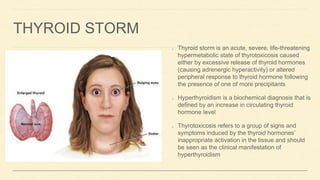
THYROID STORM
Thyroid storm is an acute, severe, life-threatening
hypermetabolic state of thyrotoxicosis caused
either by excessive release of thyroid hormones
(causing adrenergic hyperactivity) or altered
peripheral response to thyroid hormone following
the presence of one of more precipitants
Hyperthyroidism is a biochemical diagnosis that is
defined by an increase in circulating thyroid
hormone level
Thyrotoxicosis refers to a group of signs and
symptoms induced by the thyroid hormones’
inappropriate activation in the tissue and should
be seen as the clinical manifestation of
hyperthyroidism
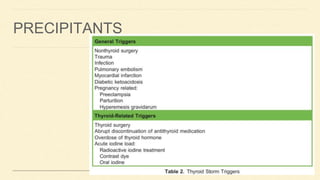
PRECIPITANTS
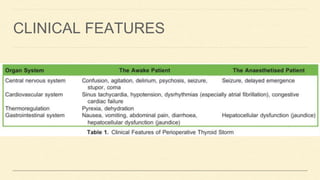
CLINICAL FEATURES
CLINICAL SCORING
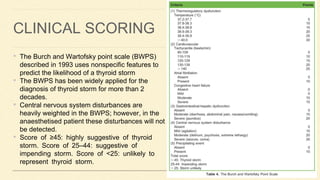
• The Burch and Wartofsky point scale (BWPS)
described in 1993 uses nonspecific features to
predict the likelihood of a thyroid storm
• The BWPS has been widely applied for the
diagnosis of thyroid storm for more than 2
decades.
• Central nervous system disturbances are
heavily weighted in the BWPS; however, in the
anaesthetised patient these disturbances will not
be detected.
• Score of ≥45: highly suggestive of thyroid
storm. Score of 25–44: suggestive of
impending storm. Score of <25: unlikely to
represent thyroid storm.
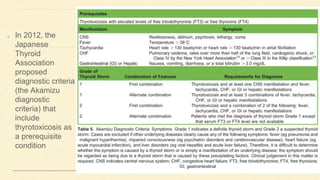
In 2012, the
Japanese
Thyroid
Association
proposed
diagnostic criteria
(the Akamizu
diagnostic
criteria) that
include
thyrotoxicosis as
a prerequisite
condition
Using both scores to evaluate an awake patient’s condition is recommended to
increase diagnostic accuracy.
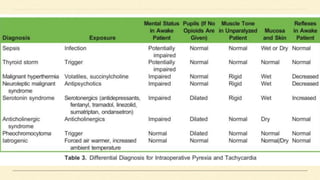
These diagnostic criteria are helpful because they provide a systematic framework
to think about the diagnosis.
Limitations.
Firstly, the diagnosis of thyroid storm is partially a diagnosis of exclusion. For
example, sepsis with multi-organ failure could easily score >45 on the BWPS.
Therefore, a score > 45 does not prove a diagnosis of thyroid storm.
Secondly, treatment for thyroid storm is reasonable in any patient with severe
hyperthyroidism causing organ failure (especially heart failure). Therefore, even
if the patient does not have a score >45 on the BWPS, it may be prudent to
initiate therapy for thyroid storm
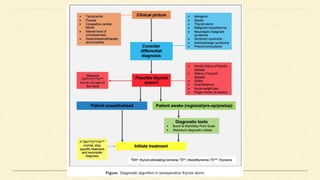
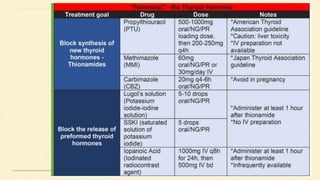
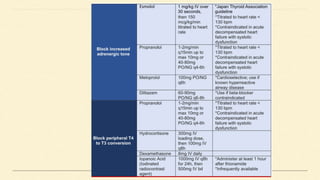
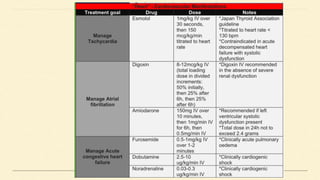
MANAGEMENT
Management principles can be divided into general considerations and specific
considerations and encompass the following:
Consideration and exclusion of the differential diagnoses,
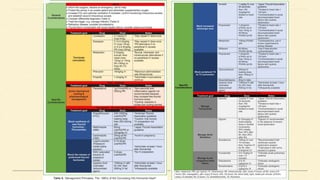
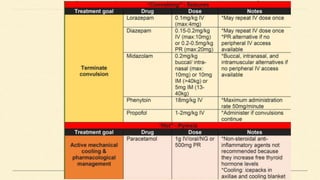
If thyroid storm is likely, implementation of the “ABCs of the Convulsing Hot
Hormonal heart” , and
Consideration of thyroidectomy in refractory cases and plasma exchange in
thyroid storm complicated with acute hepatic failure.
MYXOEDEMA COMA
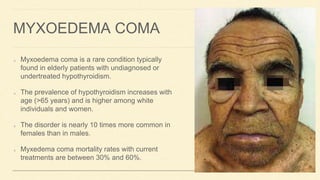
Myxoedema coma is a rare condition typically
found in elderly patients with undiagnosed or
undertreated hypothyroidism.
The prevalence of hypothyroidism increases with
age (>65 years) and is higher among white
individuals and women.
The disorder is nearly 10 times more common in
females than in males.
Myxedema coma mortality rates with current
treatments are between 30% and 60%.
CLINICAL FEATURES
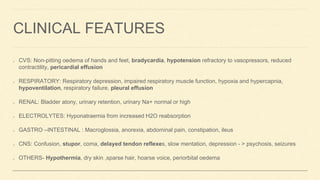
CVS: Non-pitting oedema of hands and feet, bradycardia, hypotension refractory to vasopressors, reduced
contractility, pericardial effusion
RESPIRATORY: Respiratory depression, impaired respiratory muscle function, hypoxia and hypercapnia,
hypoventilation, respiratory failure, pleural effusion
RENAL: Bladder atony, urinary retention, urinary Na+ normal or high
ELECTROLYTES: Hyponatraemia from increased H2O reabsorption
GASTRO –INTESTINAL : Macroglossia, anorexia, abdominal pain, constipation, ileus
CNS: Confusion, stupor, coma, delayed tendon reflexes, slow mentation, depression - > psychosis, seizures
OTHERS- Hypothermia, dry skin ,sparse hair, hoarse voice, periorbital oedema
PRECIPITATING FACTORS
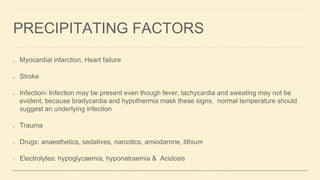
Myocardial infarction, Heart failure
Stroke
Infection- Infection may be present even though fever, tachycardia and sweating may not be
evident, because bradycardia and hypothermia mask these signs. normal temperature should
suggest an underlying infection
Trauma
Drugs: anaesthetics, sedatives, narcotics, amiodarone, lithium
Electrolytes: hypoglycaemia, hyponatraemia & Acidosis
DIFFERENTIAL DIAGNOSES
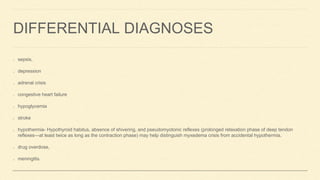
sepsis,
depression
adrenal crisis
congestive heart failure
hypoglycemia
stroke
hypothermia- Hypothyroid habitus, absence of shivering, and pseudomyotonic reflexes (prolonged relaxation phase of deep tendon
reflexes—at least twice as long as the contraction phase) may help distinguish myxedema crisis from accidental hypothermia.
drug overdose,
meningitis.
INVESTIGATIONS
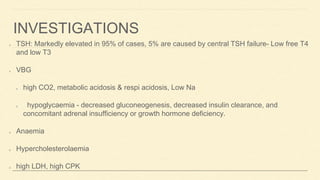
TSH: Markedly elevated in 95% of cases, 5% are caused by central TSH failure- Low free T4
and low T3
VBG
high CO2, metabolic acidosis & respi acidosis, Low Na
hypoglycaemia - decreased gluconeogenesis, decreased insulin clearance, and
concomitant adrenal insufficiency or growth hormone deficiency.
Anaemia
Hypercholesterolaemia
high LDH, high CPK
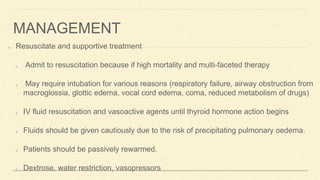
MANAGEMENT
Resuscitate and supportive treatment
Admit to resuscitation because if high mortality and multi-faceted therapy
May require intubation for various reasons (respiratory failure, airway obstruction from
macroglossia, glottic edema, vocal cord edema, coma, reduced metabolism of drugs)
IV fluid resuscitation and vasoactive agents until thyroid hormone action begins
Fluids should be given cautiously due to the risk of precipitating pulmonary oedema.
Patients should be passively rewarmed.
Dextrose, water restriction, vasopressors
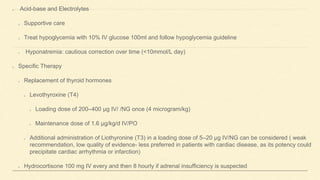
Acid-base and Electrolytes
Supportive care
Treat hypoglycemia with 10% IV glucose 100ml and follow hypoglycemia guideline
Hyponatremia: cautious correction over time (<10mmol/L day)
Specific Therapy
Replacement of thyroid hormones
Levothyroxine (T4)
Loading dose of 200–400 μg IV/ /NG once (4 microgram/kg)
Maintenance dose of 1.6 μg/kg/d IV/PO
Additional administration of Liothyronine (T3) in a loading dose of 5–20 μg IV/NG can be considered ( weak
recommendation, low quality of evidence- less preferred in patients with cardiac disease, as its potency could
precipitate cardiac arrhythmia or infarction)
Hydrocortisone 100 mg IV every and then 8 hourly if adrenal insufficiency is suspected
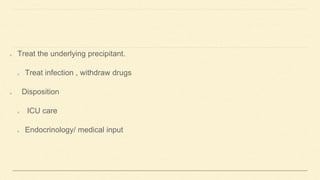
Treat the underlying precipitant.
Treat infection , withdraw drugs
Disposition
ICU care
Endocrinology/ medical input
REFERENCES
ATOTW 496 — The Diagnosis and Management of a Perioperative Thyrotoxic
Crisis (9 May 2023)
https://litfl.com/myxoedema-coma/
Tintinali’s Emergency Medicine- 9 E
“Thank You”

Thyroid Emergencies updated management .pptx

  • 1.
    THYROID EMERGENCIES Dr KTDPriyadarshani Registrar in Emergency Medicine National Hospital Kandy 2023/11/18
  • 2.
    THYROID STORM Thyroid stormis an acute, severe, life-threatening hypermetabolic state of thyrotoxicosis caused either by excessive release of thyroid hormones (causing adrenergic hyperactivity) or altered peripheral response to thyroid hormone following the presence of one of more precipitants Hyperthyroidism is a biochemical diagnosis that is defined by an increase in circulating thyroid hormone level Thyrotoxicosis refers to a group of signs and symptoms induced by the thyroid hormones’ inappropriate activation in the tissue and should be seen as the clinical manifestation of hyperthyroidism
  • 3.
  • 4.
  • 7.
    CLINICAL SCORING • TheBurch and Wartofsky point scale (BWPS) described in 1993 uses nonspecific features to predict the likelihood of a thyroid storm • The BWPS has been widely applied for the diagnosis of thyroid storm for more than 2 decades. • Central nervous system disturbances are heavily weighted in the BWPS; however, in the anaesthetised patient these disturbances will not be detected. • Score of ≥45: highly suggestive of thyroid storm. Score of 25–44: suggestive of impending storm. Score of <25: unlikely to represent thyroid storm.
  • 8.
    In 2012, the Japanese Thyroid Association proposed diagnosticcriteria (the Akamizu diagnostic criteria) that include thyrotoxicosis as a prerequisite condition
  • 9.
    Using both scoresto evaluate an awake patient’s condition is recommended to increase diagnostic accuracy. These diagnostic criteria are helpful because they provide a systematic framework to think about the diagnosis. Limitations. Firstly, the diagnosis of thyroid storm is partially a diagnosis of exclusion. For example, sepsis with multi-organ failure could easily score >45 on the BWPS. Therefore, a score > 45 does not prove a diagnosis of thyroid storm. Secondly, treatment for thyroid storm is reasonable in any patient with severe hyperthyroidism causing organ failure (especially heart failure). Therefore, even if the patient does not have a score >45 on the BWPS, it may be prudent to initiate therapy for thyroid storm
  • 10.
    MANAGEMENT Management principles canbe divided into general considerations and specific considerations and encompass the following: Consideration and exclusion of the differential diagnoses, If thyroid storm is likely, implementation of the “ABCs of the Convulsing Hot Hormonal heart” , and Consideration of thyroidectomy in refractory cases and plasma exchange in thyroid storm complicated with acute hepatic failure.
  • 16.
    MYXOEDEMA COMA Myxoedema comais a rare condition typically found in elderly patients with undiagnosed or undertreated hypothyroidism. The prevalence of hypothyroidism increases with age (>65 years) and is higher among white individuals and women. The disorder is nearly 10 times more common in females than in males. Myxedema coma mortality rates with current treatments are between 30% and 60%.
  • 17.
    CLINICAL FEATURES CVS: Non-pittingoedema of hands and feet, bradycardia, hypotension refractory to vasopressors, reduced contractility, pericardial effusion RESPIRATORY: Respiratory depression, impaired respiratory muscle function, hypoxia and hypercapnia, hypoventilation, respiratory failure, pleural effusion RENAL: Bladder atony, urinary retention, urinary Na+ normal or high ELECTROLYTES: Hyponatraemia from increased H2O reabsorption GASTRO –INTESTINAL : Macroglossia, anorexia, abdominal pain, constipation, ileus CNS: Confusion, stupor, coma, delayed tendon reflexes, slow mentation, depression - > psychosis, seizures OTHERS- Hypothermia, dry skin ,sparse hair, hoarse voice, periorbital oedema
  • 18.
    PRECIPITATING FACTORS Myocardial infarction,Heart failure Stroke Infection- Infection may be present even though fever, tachycardia and sweating may not be evident, because bradycardia and hypothermia mask these signs. normal temperature should suggest an underlying infection Trauma Drugs: anaesthetics, sedatives, narcotics, amiodarone, lithium Electrolytes: hypoglycaemia, hyponatraemia & Acidosis
  • 19.
    DIFFERENTIAL DIAGNOSES sepsis, depression adrenal crisis congestiveheart failure hypoglycemia stroke hypothermia- Hypothyroid habitus, absence of shivering, and pseudomyotonic reflexes (prolonged relaxation phase of deep tendon reflexes—at least twice as long as the contraction phase) may help distinguish myxedema crisis from accidental hypothermia. drug overdose, meningitis.
  • 20.
    INVESTIGATIONS TSH: Markedly elevatedin 95% of cases, 5% are caused by central TSH failure- Low free T4 and low T3 VBG high CO2, metabolic acidosis & respi acidosis, Low Na hypoglycaemia - decreased gluconeogenesis, decreased insulin clearance, and concomitant adrenal insufficiency or growth hormone deficiency. Anaemia Hypercholesterolaemia high LDH, high CPK
  • 21.
    MANAGEMENT Resuscitate and supportivetreatment Admit to resuscitation because if high mortality and multi-faceted therapy May require intubation for various reasons (respiratory failure, airway obstruction from macroglossia, glottic edema, vocal cord edema, coma, reduced metabolism of drugs) IV fluid resuscitation and vasoactive agents until thyroid hormone action begins Fluids should be given cautiously due to the risk of precipitating pulmonary oedema. Patients should be passively rewarmed. Dextrose, water restriction, vasopressors
  • 22.
    Acid-base and Electrolytes Supportivecare Treat hypoglycemia with 10% IV glucose 100ml and follow hypoglycemia guideline Hyponatremia: cautious correction over time (<10mmol/L day) Specific Therapy Replacement of thyroid hormones Levothyroxine (T4) Loading dose of 200–400 μg IV/ /NG once (4 microgram/kg) Maintenance dose of 1.6 μg/kg/d IV/PO Additional administration of Liothyronine (T3) in a loading dose of 5–20 μg IV/NG can be considered ( weak recommendation, low quality of evidence- less preferred in patients with cardiac disease, as its potency could precipitate cardiac arrhythmia or infarction) Hydrocortisone 100 mg IV every and then 8 hourly if adrenal insufficiency is suspected
  • 23.
    Treat the underlyingprecipitant. Treat infection , withdraw drugs Disposition ICU care Endocrinology/ medical input
  • 24.
    REFERENCES ATOTW 496 —The Diagnosis and Management of a Perioperative Thyrotoxic Crisis (9 May 2023) https://litfl.com/myxoedema-coma/ Tintinali’s Emergency Medicine- 9 E
  • 25.