MSICU Junior Grand Round
March 17th, 2023
Mohammed Alagha, PGY-2 IM
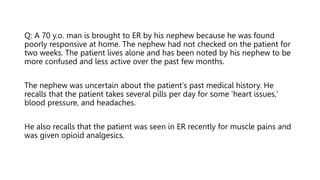
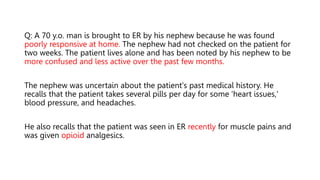
Q: A 70 y.o. man is brought to ER by his nephew because he was found
poorly responsive at home. The nephew had not checked on the patient for
two weeks. The patient lives alone and has been noted by his nephew to be
more confused and less active over the past few months.
The nephew was uncertain about the patient's past medical history. He
recalls that the patient takes several pills per day for some 'heart issues,'
blood pressure, and headaches.
He also recalls that the patient was seen in ER recently for muscle pains and
was given opioid analgesics.
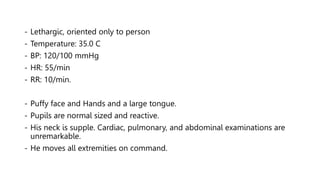
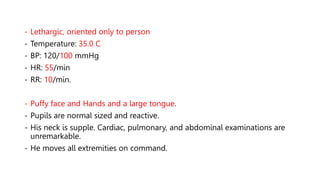
- Lethargic, oriented only to person
- Temperature: 35.0 C
- BP: 120/100 mmHg
- HR: 55/min
- RR: 10/min.
- Puffy face and Hands and a large tongue.
- Pupils are normal sized and reactive.
- His neck is supple. Cardiac, pulmonary, and abdominal examinations are
unremarkable.
- He moves all extremities on command.
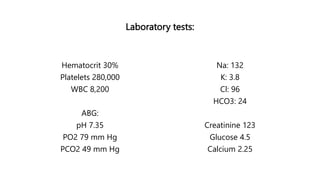
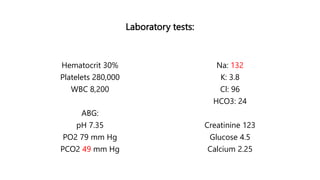
Laboratory tests:
Hematocrit 30%
Platelets 280,000
WBC 8,200
ABG:
pH 7.35
PO2 79 mm Hg
PCO2 49 mm Hg
Na: 132
K: 3.8
Cl: 96
HCO3: 24
Creatinine 123
Glucose 4.5
Calcium 2.25
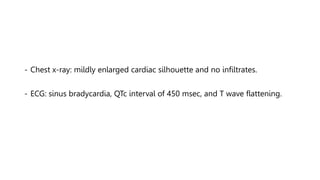
- Chest x-ray: mildly enlarged cardiac silhouette and no infiltrates.
- ECG: sinus bradycardia, QTc interval of 450 msec, and T wave flattening.
Differential Diagnosis?
Initial Management?
Which of the following is the most appropriate next step in management for
this patient?
A. Abdominal fat pad biopsy
B. Intravenous broad-spectrum antibiotics
C. Intravenous corticosteroids and thyroid hormone
D. Intravenous naloxone
E. Non-contrast CT scan of the head
Thyroid Disease Emergencies
1- Myxedema Coma
2- Thyroid storm
Myxedema coma is defined as:
Severe hypothyroidism leading to decreased mental status,
hypothermia, and other symptoms related to slowing of function
in multiple organs
It is a medical emergency with a high mortality rate; Thus,
Treatment should be initiated on the basis of clinical suspicion
without waiting for laboratory results
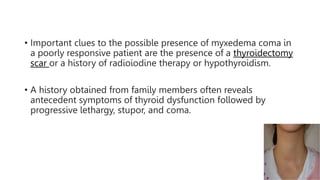
• Important clues to the possible presence of myxedema coma in
a poorly responsive patient are the presence of a thyroidectomy
scar or a history of radioiodine therapy or hypothyroidism.
• A history obtained from family members often reveals
antecedent symptoms of thyroid dysfunction followed by
progressive lethargy, stupor, and coma.
Epidemiology and risk factors
• Older women most often affected
• Myxedema coma can occur as the culmination of severe, longstanding
hypothyroidism, or
• Be precipitated by an acute event in a poorly controlled hypothyroid
patient, such as infection, myocardial infarction, cold exposure, surgery, or
the administration of sedative drugs, especially opioids.
• Also, in lithium-induced hypothyroidism, or checkpoint inhibitor
(Pembrolizumab)-induced hypothyroidism, or amiodarone.
Clinical presentation
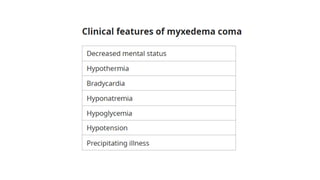
• The hallmarks of myxedema coma are
1- Decreased mental status
2- Hypothermia
- But hypotension, bradycardia, hyponatremia, hypoglycemia, and
hypoventilation are often present as well.
- Puffiness of the hands and face, a thickened nose, swollen lips, and an
enlarged tongue may occur secondary to nonpitting edema with abnormal
deposits of albumin and mucin in the skin and other tissues (myxedema)
>> Non-pitting edema
Neurologic manifestations
• Despite the name myxedema coma, patients frequently do not present in
coma but do manifest lesser degrees of altered consciousness; confusion
with lethargy and obtundation.
• Untreated, patients will progress to coma.
• Focal or generalized seizures may occur, sometimes due to concomitant
hyponatremia, and status epilepticus has been reported.
• When CSF is obtained (usually to rule out infection in a patient with fever
and mental status changes), modest elevation of protein levels (<100
mg/dL) may be seen.
Hyponatremia
• Present in ≈ ½ of patients with myxedema coma.
• It can be severe and may contribute to the decrease in mental status.
• Most, but not all, patients have an impairment in free water excretion due
to inappropriate excess vasopressin secretion or impaired renal function.
• In addition, some patients may have concomitant adrenal insufficiency.
Hypothermia
• Metabolism = Thermogenesis.
• It may not be recognized initially, As many automatic thermometers do not
register frankly hypothermic body temperatures.
• The severity of the hypothermia is related to mortality in severe
hypothyroidism; the lower the temperature, the more likely a patient is to
die.
• Patients may not have a febrile response to infection; but the possibility of
a precipitating infection should always be considered.
Hypoventilation
• Hypoventilation with respiratory acidosis results primarily from central
depression of ventilatory drive with decreased responsiveness to hypoxia
and hypercapnia. Other contributing factors include respiratory muscle
weakness, mechanical obstruction by a large tongue, and sleep apnea.
• Some patients require mechanical ventilation. Airway management may be
complicated by myxedematous infiltration of the pharynx.
• Recovery from ventilatory depression may take as long as three to six
months after treatment of hypothyroidism
Hypoglycemia
• Can be caused by hypothyroidism alone or, more often, by concurrent
adrenal insufficiency due to autoimmune adrenal disease or hypothalamic-
pituitary disease.
• The presumed mechanism is decreased gluconeogenesis, but starvation
and infection can contribute.
Cardiovascular abnormalities
• Diastolic hypertension, even though cardiac output is reduced, and a
narrowed pulse pressure.
• Bradycardia, contractility, low CO, sometimes hypotension.
• Overt CHF is quite rare in the absence of preexisting cardiac disease;
probably due to the lower tissue demands for oxygenation and cardiac
output in hypothyroidism.
• Pericardial effusion may be present; ( heart sounds, low voltage ECG, &
large cardiac silhouette on CXR).
Diagnosis
• Initially based upon the history, physical examination, and exclusion of
other causes of coma. In patients in whom the diagnosis is suspected,
thyroid function tests confirm the diagnosis.
• When to suspect the diagnosis?
- Any patient with coma or depressed mental status who also has
hypothermia, hyponatremia, and/or hypercapnia. Important clues in a poorly
responsive patient are the presence of a thyroidectomy scar or a history of
radioiodine therapy or hypothyroidism. A history obtained from family
members often reveals antecedent symptoms of thyroid dysfunction
followed by progressive lethargy, stupor, and coma.
Laboratory evaluation
- TSH, Free T4
- Cortisol
- MUST RULE OUT CONCOMITANT ADRENAL INSUFFICIENCY!
- A diagnostic scoring system for myxedema coma has been proposed
based on 21 patients diagnosed with myxedema coma. Although some
clinicians may find this scoring system useful, it is limited by the small
number of patients from which it was derived.
Treatment
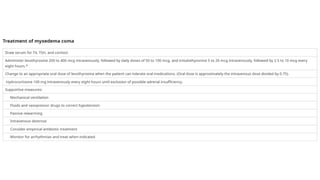
• If myxedema coma is suspected, treatment should be instituted without
waiting for laboratory confirmation.
• Myxedema coma is an endocrine emergency that should be managed
aggressively as the mortality rate remains high, even with treatment.
Treatment consists of:
1- Thyroid hormone
2- Glucocorticoids (until the possibility of coexisting adrenal insufficiency
has been excluded)
3- Supportive measures
4- Appropriate management of coexisting problems (eg, infection)
1- Thyroid hormone
• Combined therapy with T4 (Levothyroxine) and T3 (Liothyronine).
• The optimal mode is controversial, largely because the condition is so rare
that there are no clinical trials comparing the efficacy of different treatment
regimens; (treating with T4, T3, or both is uncertain).
• Pros of giving both hormones;
- The biologic activity of T3 is greater and its onset of action is more rapid
than T4.
- Conversion of T4 to T3 is impaired due to both hypothyroidism and any
concurrent nonthyroidal illness.
1- Thyroid hormone
• T4 and T3 should be given intravenously as a slow bolus, because GI
absorption may be impaired.
• T4: Bolus 200 to 400 mcg IV, then daily IV doses of 50 to 100 mcg until the
patient can take T4 orally. This regimen should raise the total serum T4
level by 2 to 4 mcg/dL.
• T3: Bolus 5 to 20 mcg IV (at the same time with T4), followed by 2.5 to 10
mcg Q8h, continued until there is clinical improvement and the patient is
stable.
• Excessive replacement of T3 should be avoided. In one small study, high
serum T3 levels during therapy were associated with mortality
1- Thyroid hormone
• Monitoring — T4 & T3 should be measured every one to two days to confirm that the
therapy is working and that very high levels of T3 are avoided.
• Due to its pharmacokinetics, serum T3 levels may be above the reference range if
measured within an hour after IV administration. Therefore, in patients receiving
parenteral T3 therapy, serum T3 should be measured at least one hour after dosing.
• Clinical and biochemical improvement are typically evident within a week. Serum TSH
typically falls at a rate of approximately 50% per week in hypothyroid patients receiving a
full replacement dose of thyroid hormone. Therefore, failure of the serum TSH to fall is an
indication of inadequate therapy.
• Once there is improvement (regained consciousness, improved mental status, improved
pulmonary and cardiac function), the patient can be treated with oral T4 alone.
2- Glucocorticoids
• Until the possibility of coexisting adrenal insufficiency has been excluded,
the patient must be treated with glucocorticoids in stress doses
(eg, Hydrocortisone IV, 100mg Q8h).
• DDx for concomitant Adrenal Insufficiency (AI):
- If central hypothyroidism; secondary AI.
- If autoimmune 1ry hypothyroidism; autoimmune 1ry AI.
- Also, ACTH secretion may be blunted in severe hypothyroidism, resulting in
subnormal cortisol response to stress
3- Supportive measures
- Supportive measures in the first day or so, may make the difference
between survival and death.
These measures include:
1- Treatment in an ICU
2- Mechanical ventilation, if necessary
3- Judicious administration of IVF including electrolytes and glucose
4- Correction of hypothermia
5- Treatment of any underlying infection
3- Supportive measures
- Dilute fluids should be avoided in hyponatremic patient.
- Hypotension, if present and not caused by volume depletion, will be
corrected by thyroid hormone therapy over a period of hours to days.
Severe hypotension that does not respond to fluids should be treated with
a vasopressor drug until the T4 has had time to act.
- Passive rewarming with a blanket is preferred for correction of
hypothermia. Active rewarming carries a risk of vasodilatation and
worsening hypotension.
- As with any critically ill, comatose patient, empiric administration of
antibiotics should be considered until appropriate cultures are proven
negative.
Prognosis
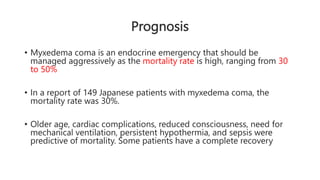
• Myxedema coma is an endocrine emergency that should be
managed aggressively as the mortality rate is high, ranging from 30
to 50%
• In a report of 149 Japanese patients with myxedema coma, the
mortality rate was 30%.
• Older age, cardiac complications, reduced consciousness, need for
mechanical ventilation, persistent hypothermia, and sepsis were
predictive of mortality. Some patients have a complete recovery
BACK TO OUR CASE!
Q: A 70 y.o. man is brought to ER by his nephew because he was found
poorly responsive at home. The nephew had not checked on the patient for
two weeks. The patient lives alone and has been noted by his nephew to be
more confused and less active over the past few months.
The nephew was uncertain about the patient's past medical history. He
recalls that the patient takes several pills per day for some 'heart issues,'
blood pressure, and headaches.
He also recalls that the patient was seen in ER recently for muscle pains and
was given opioid analgesics.
- Lethargic, oriented only to person
- Temperature: 35.0 C
- BP: 120/100 mmHg
- HR: 55/min
- RR: 10/min.
- Puffy face and Hands and a large tongue.
- Pupils are normal sized and reactive.
- His neck is supple. Cardiac, pulmonary, and abdominal examinations are
unremarkable.
- He moves all extremities on command.
Laboratory tests:
Hematocrit 30%
Platelets 280,000
WBC 8,200
ABG:
pH 7.35
PO2 79 mm Hg
PCO2 49 mm Hg
Na: 132
K: 3.8
Cl: 96
HCO3: 24
Creatinine 123
Glucose 4.5
Calcium 2.25
- Chest x-ray: mildly enlarged cardiac silhouette and no infiltrates.
- ECG: sinus bradycardia, QTc interval of 450 msec, and T wave flattening.
Which of the following is the most appropriate next step in management for
this patient?
A. Abdominal fat pad biopsy
B. IV broad-spectrum antibiotics
C. IV corticosteroids and thyroid hormone
D. IV naloxone
E. Non-contrast CT scan of the head
(Choice B) IV broad-spectrum antibiotics;
A high index of suspicion for an associated infection should be maintained,
especially since the patient may not be able to mount a febrile response.
However, this patient has no clinical, laboratory, or x-ray findings suggestive of an
infection.
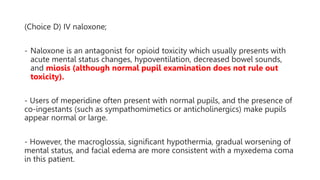
(Choice D) IV naloxone;
- Naloxone is an antagonist for opioid toxicity which usually presents with
acute mental status changes, hypoventilation, decreased bowel sounds,
and miosis (although normal pupil examination does not rule out
toxicity).
- Users of meperidine often present with normal pupils, and the presence of
co-ingestants (such as sympathomimetics or anticholinergics) make pupils
appear normal or large.
- However, the macroglossia, significant hypothermia, gradual worsening of
mental status, and facial edema are more consistent with a myxedema coma
in this patient.
Thyroid Storm
Definition and risk factors
- Thyroid storm is a rare, life-threatening condition characterized by severe
or exaggerated clinical manifestations of thyrotoxicosis.
- Although thyroid storm can develop in patients with longstanding
untreated hyperthyroidism (Graves' disease, toxic multinodular goiter,
solitary toxic adenoma), it is often precipitated by an acute event such as
thyroid or nonthyroidal surgery, trauma, infection, an acute iodine load, or
parturition.
Symptoms and signs
- CVS: tachycardia, CHF, Hypotension, cardiac arrhythmia, and death from
cardiovascular collapse may occur.
- Hyperpyrexia (40-41 C) is common.
- Agitation, anxiety, delirium, psychosis, stupor, or coma are also common and are
considered by many to be essential to the diagnosis.
- In one series, altered mentation was the only clinical finding that distinguished
"storm" from "compensated" hyperthyroidism.
- Severe N/V, diarrhea, abdominal pain, or hepatic failure with jaundice.
- Ex: goiter, ophthalmopathy, lid lag, hand tremor, and warm and moist skin.
Laboratory findings
- In 1ry hyperthyroidism: low TSH, high fT4 and/or T3
- The degree of thyroid hormone excess typically is not more profound than
that seen in patients with uncomplicated thyrotoxicosis.
Other nonspecific findings:
- Mild hyperglycemia (secondary to a catecholamine-induced inhibition of
insulin release and increased glycogenolysis)
- Mild hypercalcemia (secondary to hemoconcentration and enhanced bone
resorption)
- Abnormal liver function tests
- Leukocytosis or leukopenia
DIAGNOSIS
Diagnosis is based upon the presence of:
1- Severe and life-threatening symptoms (hyperpyrexia, CVS dysfunction,
altered mentation)
2- Biochemical evidence of hyperthyroidism.
The degree of hyperthyroidism (elevation of T4 and/or T3 and suppression of TSH) in patients with thyroid storm is,
in general, comparable with that in patients with uncomplicated overt hyperthyroidism. Thus, the degree of
hyperthyroidism is not a criterion for diagnosing thyroid storm.
DIAGNOSIS
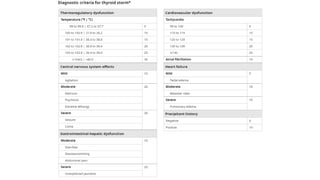
- There are no universally accepted criteria or validated clinical tools for
diagnosing thyroid storm.
- In 1993, Burch and Wartofsky introduced a scoring system using precise
clinical criteria for the identification of thyroid storm. A score of 45 or more
is highly suggestive of thyroid storm, whereas a score below 25 makes
thyroid storm unlikely.
- While this scoring system is likely sensitive, it is not very specific.
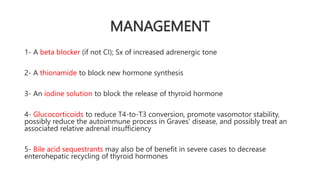
MANAGEMENT
1- A beta blocker (if not CI); Sx of increased adrenergic tone
2- A thionamide to block new hormone synthesis
3- An iodine solution to block the release of thyroid hormone
4- Glucocorticoids to reduce T4-to-T3 conversion, promote vasomotor stability,
possibly reduce the autoimmune process in Graves' disease, and possibly treat an
associated relative adrenal insufficiency
5- Bile acid sequestrants may also be of benefit in severe cases to decrease
enterohepatic recycling of thyroid hormones
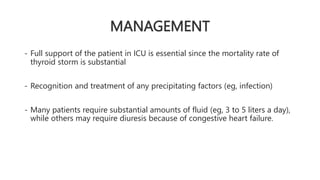
MANAGEMENT
- Full support of the patient in ICU is essential since the mortality rate of
thyroid storm is substantial
- Recognition and treatment of any precipitating factors (eg, infection)
- Many patients require substantial amounts of fluid (eg, 3 to 5 liters a day),
while others may require diuresis because of congestive heart failure.
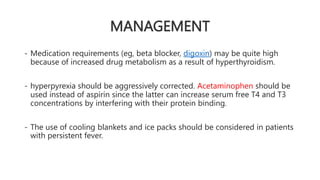
MANAGEMENT
- Medication requirements (eg, beta blocker, digoxin) may be quite high
because of increased drug metabolism as a result of hyperthyroidism.
- hyperpyrexia should be aggressively corrected. Acetaminophen should be
used instead of aspirin since the latter can increase serum free T4 and T3
concentrations by interfering with their protein binding.
- The use of cooling blankets and ice packs should be considered in patients
with persistent fever.
Beta blockers
• Typically, propranolol. In a dose to achieve adequate control of heart rate
and blood pressure.
• Although control of tachycardia may lead to improvement in cardiac
function (if heart rate is an exacerbating factor), beta blockers (PO or IV)
are CI with acute decompensated heart failure with systolic dysfunction.
The hyperadrenergic state is important for maintaining cardiac output. In
this setting, a beta blocker-induced reduction in heart rate could lead to
profound hypotension
Beta blockers
• Propranolol in high doses inhibits the conversion of T4 to T3 by inhibiting
the type 1 deiodinase.
• The dose is titrated to achieve adequate control of HR, typically 60 to 80
mg PO Q4h or Q6h, with appropriate adjustment for heart rate and blood
pressure.
• It can also be given IV or via NGT. The IV dose of propranolol is 0.5 to 1 mg
over 10 minutes followed by 1 to 2 mg over 10 minutes every few hours.
Thionamides
• They block de novo thyroid hormone synthesis within 1-2 hours after
administration. However, they have no effect on the release of preformed
hormone from the thyroid gland.
• PTU preferred for the acute treatment of life-threatening thyroid storm in
an ICU setting, where it can be administered regularly every four hours.
• PTU is favored over methimazole because of PTU's effect to decrease T4-
to-T3 conversion. T3 levels drop by approximately 45 percent within 24
hours after PTU but only 10 to 15 percent within 24 hours after
methimazole.
• PTU – The dose of PTU is 200 to 250 mg Q4h. We do not typically
administer a loading dose of PTU since the initial dose is generally
adequate to block thyroid hormone synthesis. The American Thyroid
Association (ATA) guidelines suggest a loading dose of 500 to 1000 mg
• The dose of thionamide given to patients with thyroid storm is likely higher
higher than that required to completely block thyroid hormone synthesis.
Both the substantial mortality associated with thyroid storm and the
possibility of poor absorption because of concurrent gastrointestinal
dysfunction have been used to justify the higher dose.
Patients unable to take a thionamide
- Thyroid storm has been reported in patients with Graves' disease after
discontinuation of thionamides (due to agranulocytosis or hepatotoxicity).
- Thyroidectomy is the treatment of choice. However, if too unstable for
urgent thyroidectomy, cautious use of the alternate drug could be
considered for 1-2 weeks with close monitoring (CBC, LFT).
- Patients who are to undergo surgery require preoperative treatment of
thyrotoxicosis. We typically treat with beta blockers, glucocorticoids, bile
acid sequestrants, and, in patients with Graves' disease, iodine drops.
Patients unable to take a thionamide
- The recommended preoperative treatment with iodine is 5 to 14
days, but 10 days is optimal.
- Surgery should not be delayed longer due to the Wolff-Chaikoff
effect, which inhibits iodine organification but is transient
(escape).
- Plasmapheresis and iodinated contrast agents have been used
in some cases to prepare hyperthyroid patients for surgery, but
the latter is no longer available in most countries.
Iodine
• The administration of potassium iodide or Lugol's solution should be
delayed for at least one hour after thionamide administration to prevent the
iodine from being used as substrate for new hormone synthesis, especially
if the etiology of thyroid storm was toxic adenoma or toxic multinodular
goiter.
• These iodine-containing solutions are used to treat thyroid storm as they
block the release of T4 and T3 from the thyroid gland.
• The recommended doses are 5 drops of SSKI Q6h or 10 drops of Lugol's
solution orally TID. IV administration of iodine is not standardized, but 10
drops of Lugol's solution can be added to intravenous fluids or given
rectally.
Glucocorticoids
- Hydrocortisone 300 mg loading dose, then 100 mg IV Q8h,
(dexamethasone can be used as an alternative).
- Not used in severe, but not life-threatening, hyperthyroidism.
- In a retrospective study based on a claims database (811 ICU admissions
for thyroid storm between 2013 and 2017), 600 patients received
glucocorticoids and 211 did not. There was no change in hospital mortality
or mortality 30 days after discharge. Glucocorticoid use was associated with
increased use of insulin.
Other therapies
• Cholestyramine:
- Thyroid hormones are metabolized in the liver, then excreted in the bile,
then released in the intestine and are reabsorbed.
- Bile acid sequestrants (eg, cholestyramine 4 g PO QID) have been found to
reduce thyroid hormone levels in thyrotoxic patients by interfering with
enterohepatic circulation and recycling of thyroid hormone.
- Cholestyramine can be a useful adjunctive therapy in patients with thyroid
storm, particularly in patients who are intolerant of thionamides.
Other therapies
• Plasmapheresis:
- An option for patients who cannot tolerate thionamides while being
prepared for urgent thyroidectomy.
- It removes cytokines, antibodies, and thyroid hormones from plasma.
- In one case report, a woman with Graves' disease and methimazole-
induced agranulocytosis developed thyroid storm after methimazole was
discontinued. Treatment with plasmapheresis resulted in marked
improvement in thyrotoxicosis within 3 days, allowing thyroidectomy for
definitive therapy.
- Its effects are transient, lasting 24 to 48 hrs.
Thank You!
Thank You!

ICU presentation.pptx

  • 1.
    MSICU Junior GrandRound March 17th, 2023 Mohammed Alagha, PGY-2 IM
  • 2.
    Q: A 70y.o. man is brought to ER by his nephew because he was found poorly responsive at home. The nephew had not checked on the patient for two weeks. The patient lives alone and has been noted by his nephew to be more confused and less active over the past few months. The nephew was uncertain about the patient's past medical history. He recalls that the patient takes several pills per day for some 'heart issues,' blood pressure, and headaches. He also recalls that the patient was seen in ER recently for muscle pains and was given opioid analgesics.
  • 3.
    - Lethargic, orientedonly to person - Temperature: 35.0 C - BP: 120/100 mmHg - HR: 55/min - RR: 10/min. - Puffy face and Hands and a large tongue. - Pupils are normal sized and reactive. - His neck is supple. Cardiac, pulmonary, and abdominal examinations are unremarkable. - He moves all extremities on command.
  • 4.
    Laboratory tests: Hematocrit 30% Platelets280,000 WBC 8,200 ABG: pH 7.35 PO2 79 mm Hg PCO2 49 mm Hg Na: 132 K: 3.8 Cl: 96 HCO3: 24 Creatinine 123 Glucose 4.5 Calcium 2.25
  • 5.
    - Chest x-ray:mildly enlarged cardiac silhouette and no infiltrates. - ECG: sinus bradycardia, QTc interval of 450 msec, and T wave flattening.
  • 6.
  • 7.
    Which of thefollowing is the most appropriate next step in management for this patient? A. Abdominal fat pad biopsy B. Intravenous broad-spectrum antibiotics C. Intravenous corticosteroids and thyroid hormone D. Intravenous naloxone E. Non-contrast CT scan of the head
  • 8.
    Thyroid Disease Emergencies 1-Myxedema Coma 2- Thyroid storm
  • 9.
    Myxedema coma isdefined as: Severe hypothyroidism leading to decreased mental status, hypothermia, and other symptoms related to slowing of function in multiple organs It is a medical emergency with a high mortality rate; Thus, Treatment should be initiated on the basis of clinical suspicion without waiting for laboratory results
  • 10.
    • Important cluesto the possible presence of myxedema coma in a poorly responsive patient are the presence of a thyroidectomy scar or a history of radioiodine therapy or hypothyroidism. • A history obtained from family members often reveals antecedent symptoms of thyroid dysfunction followed by progressive lethargy, stupor, and coma.
  • 11.
    Epidemiology and riskfactors • Older women most often affected • Myxedema coma can occur as the culmination of severe, longstanding hypothyroidism, or • Be precipitated by an acute event in a poorly controlled hypothyroid patient, such as infection, myocardial infarction, cold exposure, surgery, or the administration of sedative drugs, especially opioids. • Also, in lithium-induced hypothyroidism, or checkpoint inhibitor (Pembrolizumab)-induced hypothyroidism, or amiodarone.
  • 12.
    Clinical presentation • Thehallmarks of myxedema coma are 1- Decreased mental status 2- Hypothermia - But hypotension, bradycardia, hyponatremia, hypoglycemia, and hypoventilation are often present as well. - Puffiness of the hands and face, a thickened nose, swollen lips, and an enlarged tongue may occur secondary to nonpitting edema with abnormal deposits of albumin and mucin in the skin and other tissues (myxedema) >> Non-pitting edema
  • 14.
    Neurologic manifestations • Despitethe name myxedema coma, patients frequently do not present in coma but do manifest lesser degrees of altered consciousness; confusion with lethargy and obtundation. • Untreated, patients will progress to coma. • Focal or generalized seizures may occur, sometimes due to concomitant hyponatremia, and status epilepticus has been reported. • When CSF is obtained (usually to rule out infection in a patient with fever and mental status changes), modest elevation of protein levels (<100 mg/dL) may be seen.
  • 15.
    Hyponatremia • Present in≈ ½ of patients with myxedema coma. • It can be severe and may contribute to the decrease in mental status. • Most, but not all, patients have an impairment in free water excretion due to inappropriate excess vasopressin secretion or impaired renal function. • In addition, some patients may have concomitant adrenal insufficiency.
  • 16.
    Hypothermia • Metabolism =Thermogenesis. • It may not be recognized initially, As many automatic thermometers do not register frankly hypothermic body temperatures. • The severity of the hypothermia is related to mortality in severe hypothyroidism; the lower the temperature, the more likely a patient is to die. • Patients may not have a febrile response to infection; but the possibility of a precipitating infection should always be considered.
  • 17.
    Hypoventilation • Hypoventilation withrespiratory acidosis results primarily from central depression of ventilatory drive with decreased responsiveness to hypoxia and hypercapnia. Other contributing factors include respiratory muscle weakness, mechanical obstruction by a large tongue, and sleep apnea. • Some patients require mechanical ventilation. Airway management may be complicated by myxedematous infiltration of the pharynx. • Recovery from ventilatory depression may take as long as three to six months after treatment of hypothyroidism
  • 18.
    Hypoglycemia • Can becaused by hypothyroidism alone or, more often, by concurrent adrenal insufficiency due to autoimmune adrenal disease or hypothalamic- pituitary disease. • The presumed mechanism is decreased gluconeogenesis, but starvation and infection can contribute.
  • 19.
    Cardiovascular abnormalities • Diastolichypertension, even though cardiac output is reduced, and a narrowed pulse pressure. • Bradycardia, contractility, low CO, sometimes hypotension. • Overt CHF is quite rare in the absence of preexisting cardiac disease; probably due to the lower tissue demands for oxygenation and cardiac output in hypothyroidism. • Pericardial effusion may be present; ( heart sounds, low voltage ECG, & large cardiac silhouette on CXR).
  • 20.
    Diagnosis • Initially basedupon the history, physical examination, and exclusion of other causes of coma. In patients in whom the diagnosis is suspected, thyroid function tests confirm the diagnosis. • When to suspect the diagnosis? - Any patient with coma or depressed mental status who also has hypothermia, hyponatremia, and/or hypercapnia. Important clues in a poorly responsive patient are the presence of a thyroidectomy scar or a history of radioiodine therapy or hypothyroidism. A history obtained from family members often reveals antecedent symptoms of thyroid dysfunction followed by progressive lethargy, stupor, and coma.
  • 21.
    Laboratory evaluation - TSH,Free T4 - Cortisol - MUST RULE OUT CONCOMITANT ADRENAL INSUFFICIENCY! - A diagnostic scoring system for myxedema coma has been proposed based on 21 patients diagnosed with myxedema coma. Although some clinicians may find this scoring system useful, it is limited by the small number of patients from which it was derived.
  • 22.
    Treatment • If myxedemacoma is suspected, treatment should be instituted without waiting for laboratory confirmation. • Myxedema coma is an endocrine emergency that should be managed aggressively as the mortality rate remains high, even with treatment.
  • 23.
    Treatment consists of: 1-Thyroid hormone 2- Glucocorticoids (until the possibility of coexisting adrenal insufficiency has been excluded) 3- Supportive measures 4- Appropriate management of coexisting problems (eg, infection)
  • 24.
    1- Thyroid hormone •Combined therapy with T4 (Levothyroxine) and T3 (Liothyronine). • The optimal mode is controversial, largely because the condition is so rare that there are no clinical trials comparing the efficacy of different treatment regimens; (treating with T4, T3, or both is uncertain). • Pros of giving both hormones; - The biologic activity of T3 is greater and its onset of action is more rapid than T4. - Conversion of T4 to T3 is impaired due to both hypothyroidism and any concurrent nonthyroidal illness.
  • 25.
    1- Thyroid hormone •T4 and T3 should be given intravenously as a slow bolus, because GI absorption may be impaired. • T4: Bolus 200 to 400 mcg IV, then daily IV doses of 50 to 100 mcg until the patient can take T4 orally. This regimen should raise the total serum T4 level by 2 to 4 mcg/dL. • T3: Bolus 5 to 20 mcg IV (at the same time with T4), followed by 2.5 to 10 mcg Q8h, continued until there is clinical improvement and the patient is stable. • Excessive replacement of T3 should be avoided. In one small study, high serum T3 levels during therapy were associated with mortality
  • 26.
    1- Thyroid hormone •Monitoring — T4 & T3 should be measured every one to two days to confirm that the therapy is working and that very high levels of T3 are avoided. • Due to its pharmacokinetics, serum T3 levels may be above the reference range if measured within an hour after IV administration. Therefore, in patients receiving parenteral T3 therapy, serum T3 should be measured at least one hour after dosing. • Clinical and biochemical improvement are typically evident within a week. Serum TSH typically falls at a rate of approximately 50% per week in hypothyroid patients receiving a full replacement dose of thyroid hormone. Therefore, failure of the serum TSH to fall is an indication of inadequate therapy. • Once there is improvement (regained consciousness, improved mental status, improved pulmonary and cardiac function), the patient can be treated with oral T4 alone.
  • 27.
    2- Glucocorticoids • Untilthe possibility of coexisting adrenal insufficiency has been excluded, the patient must be treated with glucocorticoids in stress doses (eg, Hydrocortisone IV, 100mg Q8h). • DDx for concomitant Adrenal Insufficiency (AI): - If central hypothyroidism; secondary AI. - If autoimmune 1ry hypothyroidism; autoimmune 1ry AI. - Also, ACTH secretion may be blunted in severe hypothyroidism, resulting in subnormal cortisol response to stress
  • 28.
    3- Supportive measures -Supportive measures in the first day or so, may make the difference between survival and death. These measures include: 1- Treatment in an ICU 2- Mechanical ventilation, if necessary 3- Judicious administration of IVF including electrolytes and glucose 4- Correction of hypothermia 5- Treatment of any underlying infection
  • 29.
    3- Supportive measures -Dilute fluids should be avoided in hyponatremic patient. - Hypotension, if present and not caused by volume depletion, will be corrected by thyroid hormone therapy over a period of hours to days. Severe hypotension that does not respond to fluids should be treated with a vasopressor drug until the T4 has had time to act. - Passive rewarming with a blanket is preferred for correction of hypothermia. Active rewarming carries a risk of vasodilatation and worsening hypotension. - As with any critically ill, comatose patient, empiric administration of antibiotics should be considered until appropriate cultures are proven negative.
  • 31.
    Prognosis • Myxedema comais an endocrine emergency that should be managed aggressively as the mortality rate is high, ranging from 30 to 50% • In a report of 149 Japanese patients with myxedema coma, the mortality rate was 30%. • Older age, cardiac complications, reduced consciousness, need for mechanical ventilation, persistent hypothermia, and sepsis were predictive of mortality. Some patients have a complete recovery
  • 32.
  • 33.
    Q: A 70y.o. man is brought to ER by his nephew because he was found poorly responsive at home. The nephew had not checked on the patient for two weeks. The patient lives alone and has been noted by his nephew to be more confused and less active over the past few months. The nephew was uncertain about the patient's past medical history. He recalls that the patient takes several pills per day for some 'heart issues,' blood pressure, and headaches. He also recalls that the patient was seen in ER recently for muscle pains and was given opioid analgesics.
  • 34.
    - Lethargic, orientedonly to person - Temperature: 35.0 C - BP: 120/100 mmHg - HR: 55/min - RR: 10/min. - Puffy face and Hands and a large tongue. - Pupils are normal sized and reactive. - His neck is supple. Cardiac, pulmonary, and abdominal examinations are unremarkable. - He moves all extremities on command.
  • 35.
    Laboratory tests: Hematocrit 30% Platelets280,000 WBC 8,200 ABG: pH 7.35 PO2 79 mm Hg PCO2 49 mm Hg Na: 132 K: 3.8 Cl: 96 HCO3: 24 Creatinine 123 Glucose 4.5 Calcium 2.25
  • 36.
    - Chest x-ray:mildly enlarged cardiac silhouette and no infiltrates. - ECG: sinus bradycardia, QTc interval of 450 msec, and T wave flattening.
  • 37.
    Which of thefollowing is the most appropriate next step in management for this patient? A. Abdominal fat pad biopsy B. IV broad-spectrum antibiotics C. IV corticosteroids and thyroid hormone D. IV naloxone E. Non-contrast CT scan of the head
  • 38.
    (Choice B) IVbroad-spectrum antibiotics; A high index of suspicion for an associated infection should be maintained, especially since the patient may not be able to mount a febrile response. However, this patient has no clinical, laboratory, or x-ray findings suggestive of an infection.
  • 39.
    (Choice D) IVnaloxone; - Naloxone is an antagonist for opioid toxicity which usually presents with acute mental status changes, hypoventilation, decreased bowel sounds, and miosis (although normal pupil examination does not rule out toxicity). - Users of meperidine often present with normal pupils, and the presence of co-ingestants (such as sympathomimetics or anticholinergics) make pupils appear normal or large. - However, the macroglossia, significant hypothermia, gradual worsening of mental status, and facial edema are more consistent with a myxedema coma in this patient.
  • 40.
  • 41.
    Definition and riskfactors - Thyroid storm is a rare, life-threatening condition characterized by severe or exaggerated clinical manifestations of thyrotoxicosis. - Although thyroid storm can develop in patients with longstanding untreated hyperthyroidism (Graves' disease, toxic multinodular goiter, solitary toxic adenoma), it is often precipitated by an acute event such as thyroid or nonthyroidal surgery, trauma, infection, an acute iodine load, or parturition.
  • 42.
    Symptoms and signs -CVS: tachycardia, CHF, Hypotension, cardiac arrhythmia, and death from cardiovascular collapse may occur. - Hyperpyrexia (40-41 C) is common. - Agitation, anxiety, delirium, psychosis, stupor, or coma are also common and are considered by many to be essential to the diagnosis. - In one series, altered mentation was the only clinical finding that distinguished "storm" from "compensated" hyperthyroidism. - Severe N/V, diarrhea, abdominal pain, or hepatic failure with jaundice. - Ex: goiter, ophthalmopathy, lid lag, hand tremor, and warm and moist skin.
  • 43.
    Laboratory findings - In1ry hyperthyroidism: low TSH, high fT4 and/or T3 - The degree of thyroid hormone excess typically is not more profound than that seen in patients with uncomplicated thyrotoxicosis. Other nonspecific findings: - Mild hyperglycemia (secondary to a catecholamine-induced inhibition of insulin release and increased glycogenolysis) - Mild hypercalcemia (secondary to hemoconcentration and enhanced bone resorption) - Abnormal liver function tests - Leukocytosis or leukopenia
  • 44.
    DIAGNOSIS Diagnosis is basedupon the presence of: 1- Severe and life-threatening symptoms (hyperpyrexia, CVS dysfunction, altered mentation) 2- Biochemical evidence of hyperthyroidism. The degree of hyperthyroidism (elevation of T4 and/or T3 and suppression of TSH) in patients with thyroid storm is, in general, comparable with that in patients with uncomplicated overt hyperthyroidism. Thus, the degree of hyperthyroidism is not a criterion for diagnosing thyroid storm.
  • 45.
    DIAGNOSIS - There areno universally accepted criteria or validated clinical tools for diagnosing thyroid storm. - In 1993, Burch and Wartofsky introduced a scoring system using precise clinical criteria for the identification of thyroid storm. A score of 45 or more is highly suggestive of thyroid storm, whereas a score below 25 makes thyroid storm unlikely. - While this scoring system is likely sensitive, it is not very specific.
  • 47.
    MANAGEMENT 1- A betablocker (if not CI); Sx of increased adrenergic tone 2- A thionamide to block new hormone synthesis 3- An iodine solution to block the release of thyroid hormone 4- Glucocorticoids to reduce T4-to-T3 conversion, promote vasomotor stability, possibly reduce the autoimmune process in Graves' disease, and possibly treat an associated relative adrenal insufficiency 5- Bile acid sequestrants may also be of benefit in severe cases to decrease enterohepatic recycling of thyroid hormones
  • 48.
    MANAGEMENT - Full supportof the patient in ICU is essential since the mortality rate of thyroid storm is substantial - Recognition and treatment of any precipitating factors (eg, infection) - Many patients require substantial amounts of fluid (eg, 3 to 5 liters a day), while others may require diuresis because of congestive heart failure.
  • 49.
    MANAGEMENT - Medication requirements(eg, beta blocker, digoxin) may be quite high because of increased drug metabolism as a result of hyperthyroidism. - hyperpyrexia should be aggressively corrected. Acetaminophen should be used instead of aspirin since the latter can increase serum free T4 and T3 concentrations by interfering with their protein binding. - The use of cooling blankets and ice packs should be considered in patients with persistent fever.
  • 50.
    Beta blockers • Typically,propranolol. In a dose to achieve adequate control of heart rate and blood pressure. • Although control of tachycardia may lead to improvement in cardiac function (if heart rate is an exacerbating factor), beta blockers (PO or IV) are CI with acute decompensated heart failure with systolic dysfunction. The hyperadrenergic state is important for maintaining cardiac output. In this setting, a beta blocker-induced reduction in heart rate could lead to profound hypotension
  • 51.
    Beta blockers • Propranololin high doses inhibits the conversion of T4 to T3 by inhibiting the type 1 deiodinase. • The dose is titrated to achieve adequate control of HR, typically 60 to 80 mg PO Q4h or Q6h, with appropriate adjustment for heart rate and blood pressure. • It can also be given IV or via NGT. The IV dose of propranolol is 0.5 to 1 mg over 10 minutes followed by 1 to 2 mg over 10 minutes every few hours.
  • 52.
    Thionamides • They blockde novo thyroid hormone synthesis within 1-2 hours after administration. However, they have no effect on the release of preformed hormone from the thyroid gland. • PTU preferred for the acute treatment of life-threatening thyroid storm in an ICU setting, where it can be administered regularly every four hours. • PTU is favored over methimazole because of PTU's effect to decrease T4- to-T3 conversion. T3 levels drop by approximately 45 percent within 24 hours after PTU but only 10 to 15 percent within 24 hours after methimazole.
  • 53.
    • PTU –The dose of PTU is 200 to 250 mg Q4h. We do not typically administer a loading dose of PTU since the initial dose is generally adequate to block thyroid hormone synthesis. The American Thyroid Association (ATA) guidelines suggest a loading dose of 500 to 1000 mg • The dose of thionamide given to patients with thyroid storm is likely higher higher than that required to completely block thyroid hormone synthesis. Both the substantial mortality associated with thyroid storm and the possibility of poor absorption because of concurrent gastrointestinal dysfunction have been used to justify the higher dose.
  • 54.
    Patients unable totake a thionamide - Thyroid storm has been reported in patients with Graves' disease after discontinuation of thionamides (due to agranulocytosis or hepatotoxicity). - Thyroidectomy is the treatment of choice. However, if too unstable for urgent thyroidectomy, cautious use of the alternate drug could be considered for 1-2 weeks with close monitoring (CBC, LFT). - Patients who are to undergo surgery require preoperative treatment of thyrotoxicosis. We typically treat with beta blockers, glucocorticoids, bile acid sequestrants, and, in patients with Graves' disease, iodine drops.
  • 55.
    Patients unable totake a thionamide - The recommended preoperative treatment with iodine is 5 to 14 days, but 10 days is optimal. - Surgery should not be delayed longer due to the Wolff-Chaikoff effect, which inhibits iodine organification but is transient (escape). - Plasmapheresis and iodinated contrast agents have been used in some cases to prepare hyperthyroid patients for surgery, but the latter is no longer available in most countries.
  • 56.
    Iodine • The administrationof potassium iodide or Lugol's solution should be delayed for at least one hour after thionamide administration to prevent the iodine from being used as substrate for new hormone synthesis, especially if the etiology of thyroid storm was toxic adenoma or toxic multinodular goiter. • These iodine-containing solutions are used to treat thyroid storm as they block the release of T4 and T3 from the thyroid gland. • The recommended doses are 5 drops of SSKI Q6h or 10 drops of Lugol's solution orally TID. IV administration of iodine is not standardized, but 10 drops of Lugol's solution can be added to intravenous fluids or given rectally.
  • 57.
    Glucocorticoids - Hydrocortisone 300mg loading dose, then 100 mg IV Q8h, (dexamethasone can be used as an alternative). - Not used in severe, but not life-threatening, hyperthyroidism. - In a retrospective study based on a claims database (811 ICU admissions for thyroid storm between 2013 and 2017), 600 patients received glucocorticoids and 211 did not. There was no change in hospital mortality or mortality 30 days after discharge. Glucocorticoid use was associated with increased use of insulin.
  • 58.
    Other therapies • Cholestyramine: -Thyroid hormones are metabolized in the liver, then excreted in the bile, then released in the intestine and are reabsorbed. - Bile acid sequestrants (eg, cholestyramine 4 g PO QID) have been found to reduce thyroid hormone levels in thyrotoxic patients by interfering with enterohepatic circulation and recycling of thyroid hormone. - Cholestyramine can be a useful adjunctive therapy in patients with thyroid storm, particularly in patients who are intolerant of thionamides.
  • 59.
    Other therapies • Plasmapheresis: -An option for patients who cannot tolerate thionamides while being prepared for urgent thyroidectomy. - It removes cytokines, antibodies, and thyroid hormones from plasma. - In one case report, a woman with Graves' disease and methimazole- induced agranulocytosis developed thyroid storm after methimazole was discontinued. Treatment with plasmapheresis resulted in marked improvement in thyrotoxicosis within 3 days, allowing thyroidectomy for definitive therapy. - Its effects are transient, lasting 24 to 48 hrs.
  • 60.
  • 61.

Editor's Notes

  • #12 It can occur in patients who have any of the usual causes of hypothyroidism, particularly chronic autoimmune thyroiditis, because its insidious course may lead the diagnosis to be overlooked, compared with postsurgical or postablative hypothyroidism. Myxedema coma can occur in patients with central hypothyroidism, lithium-induced hypothyroidism, or checkpoint inhibitor (pembrolizumab)-induced hypothyroidism, and there are a dozen case reports of myxedema coma in patients taking amiodarone
  • #13 The possibility of a precipitating infection or other acute illness should always be considered; it is important to appreciate, however, that the patient may not have a febrile response to infection.
  • #15 In the absence of seizures, EEG findings are nonspecific with slowing and decreased amplitude.
  • #22 The serum T4 concentration is usually very low. The serum TSH concentration may be high, indicating primary hypothyroidism, or it may be low, normal, or slightly high, indicating central hypothyroidism. Most patients with myxedema coma have primary hypothyroidism. Patients with central hypothyroidism may have associated hypopituitarism and secondary adrenal insufficiency. Furthermore, the pituitary corticotropin (ACTH) response to stress may be impaired in severe hypothyroidism. In addition, patients with autoimmune-mediated primary hypothyroidism may have concomitant primary adrenal insufficiency. Ideally, cortisol should be measured before and after cosyntropin administration.
  • #26 The lower end of the dosing range is preferred in lighter and older patients and in those at risk for cardiac complications (myocardial infarction, arrhythmia).
  • #27 The initial oral T4 dose should be determined based on body weight, age, coexistent cardiovascular disease, and the recent intravenous dose (note that only 75 to 80 percent of an oral dose is absorbed when converting from an intravenous to an oral dose under steady state conditions, but the intravenous dose given in the early treatment of myxedema coma is unlikely to reflect steady state conditions).
  • #40 The best predictor of opioid toxicity is a respiratory rate <12/minute, which predicted response to naloxone in virtually all patients in one series 
  • #45 For example, a mildly hyperthyroid patient with influenza, a fever, and nausea could score high enough to meet the criteria for storm. Another diagnostic system based upon similar clinical findings (central nervous system manifestations, fever, tachycardia, congestive heart failure, gastrointestinal manifestations) has been proposed [2], but this latter system may have reduced sensitivity for making the diagnosis
  • #53 Patients started on PTU in the ICU should be transitioned to methimazole before discharge from the hospital. (See 'Subsequent management' below.) ●Methimazole may be preferred for severe (but not life-threatening) hyperthyroidism because methimazole has a longer duration of action and, after weeks of treatment, results in more rapid normalization of serum T3 compared with PTU. In addition, the frequency of hepatotoxicity may be less with methimazole.