MYXEDEMA COMA
DR LAVANYA BONNY
SR, DEPT OF ENDOCRINOLOGY
ST JOHNS MEDICAL COLLEGE
BANGALORE
INTRODUCTION
 most extreme form of hypothyroidism
 May readily progress to death unless diagnosed promptly and treated vigorously.
 The term myxedema coma is a misnomer
 myxedema crisis may be an apt term - patients are obtunded, rather than frankly
comatose.
EPIDEMIOLOGY
 Around 300 cases reported in the literature
 most patients are women.
 More in the elderly
 even with reasonably early diagnosis and therapy, the mortality rate - 50% to
60%.
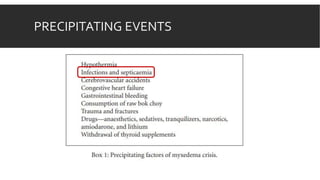
PRECIPITATING EVENTS
 most patients present in winter
 Extremely cold weather seems to lower the threshold for vulnerability
 incidence of severe hypothermia may be lower in tropical countries
PRECIPITATING EVENTS
 Typical infections - pneumonia, urinary tract infections, and cellulitis
 Diuretics may mask some of the myxedematous features
 may also aggravate the hyponatremia associated with myxedema crisis
PRECIPITATING EVENTS
 Metabolic disturbances exacerbating myxedema coma
 Hypoglycemia
 Hyponatremia
 Acidosis
 Hypercalcemia
 Hypoxemia
 Hypercapnia
PRECIPITATING EVENTS
 Recently, Chu and Seltzer reported a case of myxedema crisis precipitated by
consumption of raw bok choy
 Bok choy or Chinese white cabbage contains glucosinolates.
 Some of the breakdown products of glucosinolates, such as thiocyanates, nitriles,
and oxazolidines have inhibitory effects on the thyroid as they may inhibit the
uptake of iodine.
PRECIPITATING EVENTS
 When eaten raw, brassica vegetables release the enzyme myrosinase, which
accelerates the hydrolysis of glucosinolates.
 Cooking deactivates myrosinase
PATHOGENESIS
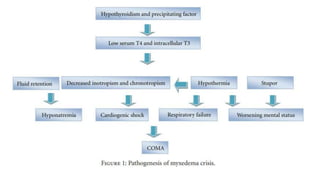
 Low intracellularT3 secondary to hypothyroidism is the basic underlying
pathology in myxedema crisis
 This leads to hypothermia and suppression of cardiac activity.
 The body tries to compensate by neurovascular adaptations including chronic
peripheral vasoconstriction, mild diastolic hypertension, and diminished blood
volume.
PATHOGENESIS
 Low intracellularT3 leads to depressed cardiac functions with decreased
inotropism and chronotropism with vasoconstriction
 The hypothyroid heart tries to perform more work at a given amount of oxygen by
better coupling of ATP to contractile events.
 A precipitating factor pushes this precarious balance over the brink
PATHOGENESIS
 In the decompensated state, low cardiac output and hypotension will result in
cardiogenic shock
 may not be responsive to vasopressors without thyroid hormone replacement
CLINICAL FEATURES
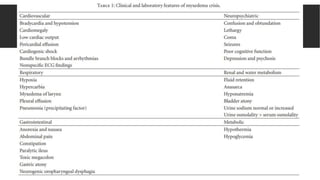
 course is typically one of lethargy progressing to stupor and then coma, with
respiratory failure and hypothermia
 may be hastened by the administration of drugs that depress respiration and
other brain functions
CLINICAL FEATURES
 Physical examination should focus on features of severe hypothyroidism
 dry skin
 sparse hair
 a hoarse voice
 Hypothermia
 delayed tendon reflexes
 Macroglossia
 nonpitting edema
 Goiter
 surgical scar of thyroidectomy
CLINICAL FEATURES
 Presence of orbitopathy may indicate underlying GD which may have been
treated with radioiodine or surgery
 Study by Dutta et al - 39% of them had hypothyroidism detected only at the time
of crisis.
CLINICAL FEATURES
 NEUROPSYCHIATRIC MANIFESTATIONS
 may be a history of lethargy, slowed mentation, poor memory, cognitive
dysfunction, depression, or even psychosis, as can also be seen in patients with
uncomplicated hypothyroidism.
 Pts do not complain of these symptoms because of their impaired state of
consciousness.
CLINICAL FEATURES
 NEUROPSYCHIATRIC MANIFESTATIONS
 Focal or generalized seizures - in up to 25% of patients
 D/t hyponatremia
 Hypoglycemia
 hypoxemia because of reduced cerebral blood flow
 generalized depression of cerebral function
CLINICAL FEATURES
 HYPOTHERMIA
 hypothermia is present in virtually all patients and may be quite profound (<80F).
 In many of the reported cases, hypothermia was the first clinical clue to the
diagnosis of myxedema coma.
 survival has been shown to correlate with the degree of hypothermia (worst
prognosis with a core body temperature < 90F)
CLINICAL FEATURES
 CARDIOVASCULAR MANIFESTATIONS
 Low stroke volume and cardiac output occur as a result of the reduction in cardiac
contractility
 frank CCF is rare.
 Cardiac enlargement – d/t ventricular dilatation or pericardial effusion.
CLINICAL FEATURES
 CARDIOVASCULAR MANIFESTATIONS
 Hypotension – d/t decreased intravascular volume and cardiovascular collapse
 shock may occur late in the course of the disease.
 hypotension may be refractory to vasopressor therapy unless thyroid hormone is
also being given
CLINICAL FEATURES
 ECG – non specific
 Sinus bradycardia, low voltage complexes, bundle branch blocks, complete heart
blocks, and nonspecific ST-T changes
 Rare - Prolongation of QT interval and increased QT dispersion, a marker of
electrical instability
 Increased myocardial fibrosis in severe hypothyroidism may lead to a resistance in
improvement of QT dispersion with thyroid hormone supplementation
CLINICAL FEATURES
 RESPIRATORY SYSTEM
 reduced hypoxic respiratory drive and decreased ventilatory response to
hypercapnia
 impaired respiratory muscle function and obesity may exacerbate the
hypoventilation
 The respiratory depression leads to alveolar hypoventilation and progressive
hypoxemia and, ultimately, to carbon dioxide narcosis and coma.
CLINICAL FEATURES
 RESPIRATORY SYSTEM
 Respiration may be impaired by the presence of
 pleural effusions or ascites
 by reduced lung volume
 by macroglossia
 And myxedema of the nasopharynx and larynx
CLINICAL FEATURES
 GASTROINTESTINAL SYSTEM
 anorexia, nausea, abdominal pain, and constipation with fecal retention.
 distended quiet abdomen may be present
 reduced intestinal motility is common, and paralytic ileus and megacolon may
occur.
CLINICAL FEATURES
 GASTROINTESTINAL SYSTEM
 neurogenic oropharyngeal dysphagia
 Pts have delayed swallowing, aspiration, and risk of aspiration pneumonia
 Gastric atony may reduce absorption of oral medications.
CLINICAL FEATURES
 INFECTIONS
 the presence of a ‘‘normal’’ temperature should be a clue to underlying infection.
 Other signs of infection, such as diaphoresis and tachycardia, are also absent
 The possibility of an underlying infection should always be considered while
maintaining a low threshold for initiation of systemic antibiotic coverage
CLINICAL FEATURES
 HYPOGLYCEMIA
 Causes:
 Decreased gluconeogenesis
 precipitating factors like sepsis
 concomitant adrenal insufficiency
CLINICAL FEATURES
 RENAL AND ELECTROLYTE MANIFESTATIONS
 bladder atony with urinary retention.
 Reduced GFR
 Hyponatremia may cause lethargy and confusion
CLINICAL FEATURES
 RENAL AND ELECTROLYTE MANIFESTATIONS
 The hyponatremia results from an inability to excrete a water load, which is
caused by decreased delivery of water to the distal nephron and excess
vasopressin secretion
 Urinary sodium excretion is normal or increased
 urinary osmolality is high relative to plasma osmolality.
DIAGNOSIS
 The probable diagnosis of myxedema coma should be considered in a patient with
a history of or physical findings compatible with hypothyroidism
 in the presence of stupor, confusion, or coma, especially in the setting of
hypothermia.
 markedly elevated serumTSH would be expected
DIAGNOSIS
 patients with severe nonthyroidal systemic illness may demonstrate a
phenomenon parallel to the ‘‘euthyroid sick’’ syndrome
 can be called the ‘‘hypothyroid sick’’ syndrome.
 In such circumstances, pituitaryTSH secretion is reduced and the blood levels may
not be as high as expected
DIAGNOSIS
 5% - may be due to central hypothyroidism
 The deciding factor here will be associated pituitary hormone deficiencies as
isolated central hypothyroidism is rare.
 all patients with myxedema coma have low serum total and freeT4 andT3
 In patients with the hypothyroid sick syndrome, serumT3 levels may be unusually
low (<25 ng/mL).
HASHIMOTO’S ENCEPHALOPATHY
 rare complication of Hashimoto’s thyroiditis
 may present as a subacute or acute encephalopathy with seizures, stroke-like episodes,
myoclonus, and tremor
 Patients will have elevated thyroid-specific autoantibodies (Anti-TPO), elevated CSF
protein without pleocytosis, and abnormal EEG
 most patients are euthyroid and the condition is steroid responsive
INVESTIGATIONS
 normocytic normochromic anemia - secondary to decreased oxygen requirement
and erythropoietin
 Macrocytic blood picture - low folate absorption and pernicious anemia
 Severely hypothyroid patients - prolonged bleeding time and clotting time,
decreased platelet adhesiveness, elevated APTT, and low or normal factorVIII
activity.
INVESTIGATIONS
 Acquired vonWillebrand’s disease
 Due to decreased synthesis of vonWillebrand factor in the absence of adequate
levels of thyroxine
INVESTIGATIONS
 Other common biochemical anomalies
 increased levels of creatine phosphokinase
 lactate dehydrogenase
 aspartate transaminase
 hypercholesterolemia
TREATMENT
COMPONENTS
 (a) intensive care treatment with ventilator support, central venous pressure
monitoring, and pulmonary capillary wedge pressure if feasible in patients with
cardiac disease
 (b) appropriate fluid management and correction of hypotension and
dyselectrolytemia
 (c) aggressive management of precipitating factors and steroid supplementation
if required
 (d) thyroid hormone replacement.
GENERAL MEASURES
 AIRWAY
 Management of airway and airway protection from aspiration in case of patients
with poor consciousness level should be the utmost priority.
 Endotracheal intubation or tracheostomy with mechanical ventilation may be
performed.
 Frequent ABG to ensure adequate oxygenation and correction of hypercarbia.
GENERAL MEASURES
 FLUID MANAGEMENT
 the choice is between fluid supplementation for hypotension and fluid restriction
for hyponatremia.
 mild hyponatremia - fluid restriction with replacement to cover the daily losses
taking care to supplement glucose, sodium, and potassium
 severe hyponatremia (<120 mEq/L) - 3% saline along with furosemide, so that Na
may be elevated by 3-4 meq/L to tide over the immediate crisis
GENERAL MEASURES
 FLUID MANAGEMENT
 A rapid correction of chronic hyponatremia might put patients at risk for central
pontine myelinolysis
 Treatment with furosemide will prevent fluid overloading associated with
hypertonic saline
GENERAL MEASURES
 HYPOTHERMIA
 may be managed by external warming
 the accompanying vasodilatation may precipitate hypotension.
GENERAL MEASURES
 HYPOTENSION
 Hypotension requires careful infusion of dextrose saline solutions and
vasopressors if required.
 search for other causes of hypotension like sepsis, myocardial infarction,
pericardial effusion, and occult bleeding
 hydrocortisone supplementation for concomitant adrenal insufficiency
GENERAL MEASURES
 HYPOCORTISOLEMIA
 may be due to primary or secondary adrenal insufficiency.
 Hyperpigmentation, hyperkalemia, hypercalcemia, and previous history of on and
off steroid use must be sought.
 Thyroid hormone replacement may increase cortisol clearance and may
aggravate cortisol deficiency
GENERAL MEASURES
 HYPOCORTISOLEMIA
 Intravenous hydrocortisone is preferred at a rate of 50 mg every 6 hours
GENERAL MEASURES
 PRECIPITATING FACTOR
 antibiotics in case of infection
 hemodialysis for associated renal failure
 comprehensive care of multiorgan dysfunction.
THYROID HORMONETHERAPY
 T4 therapy
 provides a steady, smooth, and slow onset of action with relatively few adverse
events.
 avoids major peaks and troughs in body, and values of serumT4 may be easy to
interpret
 However,T3 is the active hormone in the body, and in a setting of severe illness
there may be a decreased conversion ofT4 toT3
THYROID HORMONETHERAPY
 ParenteralT4 may be used at a dose of 300–500 µg as bolus to saturate the body
pool.
 The usual protocol then is to continueT4 at a dose of 50–100 µg daily.
 T4 concentrations rise acutely to levels above normal and slowly gets converted
toT3
THYROID HORMONETHERAPY
 Oral administration ofT4 through Ryles tube has proved to be equally effective
 Drawback - gastric atony may prevent absorption and put the patient at risk for
aspiration.
 Dutta and colleagues compared 500 µg of oral loading dose ofT4 with 150 µg of
maintenance dose orally and 200 µg ofT4 intravenously followed by 100 µgT4
intravenously - did not find any difference in outcome among the patients
THYROID HORMONETHERAPY
 Advantages of usingT3
 rapid onset of action
 earlier beneficial effect on neuropsychiatric symptoms
 significant clinical improvement within 24 hours.
 dose of 10 to 20 µg, followed by 10 µg every 4 hours for the first 24 hours and then
10 µg every 6 hours for 1 or 2 days till the patient is alert enough to continue
therapy through oral route.
THYROID HORMONETHERAPY
 Measurable increases in body temperature and oxygen consumption occur within
2 to 3 hours after i.vT3
 may take 8 to 14 hours or longer after i.vT4
THYROID HORMONETHERAPY
 DISADVANTAGES OFT3
 poor availability ofT3
 fluctuations in serum levels ofT3
 adverse cardiac effects
 Yamamoto et al. reported that doses of LT4 more than 500 µg per day and LT3
more than 75 µg/day were associated with increased mortality
THYROID HORMONETHERAPY
 Combined therapy ofT4 andT3 may also prove to be useful.
 T4 may be initiated at a dose of 4 µg/kg lean bwt, followed by 100 µg 24 hours
later and then 50 µg daily i.v or orally.
 T3 may also be started simultaneously withT4 at a dose of 10 µg iv, and the same
dose is given every 8 to 12 hours until the patient can take maintenance oral doses
ofT4
PREDICTORS OF MORTALITY
 Hypotension
 bradycardia at presentation
 need for mechanical ventilation
 hypothermia unresponsive to treatment
 Sepsis
 intake of sedative drugs
 lower GCS
 high APACHE II
PREDICTORS OF MORTALITY
 Sequential organ failure assessment (SOFA) score was more effective than other
predictive models.
 Baseline and day 3 SOFA scores of more than 6 were highly predictive of poor
outcome
 treatment defaulters had more severe manifestations than de novo patients
PREDICTORS OF MORTALITY
 higher doses ofT3 are associated with increased mortality, and lower doses ofT3
andT4 may be associated with favorable prognosis
 Other factors associated with mortality include advanced age and cardiovascular
disease
THANKYOU

MYXOEDEMA COMA

  • 1.
    MYXEDEMA COMA DR LAVANYABONNY SR, DEPT OF ENDOCRINOLOGY ST JOHNS MEDICAL COLLEGE BANGALORE
  • 2.
    INTRODUCTION  most extremeform of hypothyroidism  May readily progress to death unless diagnosed promptly and treated vigorously.  The term myxedema coma is a misnomer  myxedema crisis may be an apt term - patients are obtunded, rather than frankly comatose.
  • 3.
    EPIDEMIOLOGY  Around 300cases reported in the literature  most patients are women.  More in the elderly  even with reasonably early diagnosis and therapy, the mortality rate - 50% to 60%.
  • 4.
    PRECIPITATING EVENTS  mostpatients present in winter  Extremely cold weather seems to lower the threshold for vulnerability  incidence of severe hypothermia may be lower in tropical countries
  • 5.
  • 6.
    PRECIPITATING EVENTS  Typicalinfections - pneumonia, urinary tract infections, and cellulitis  Diuretics may mask some of the myxedematous features  may also aggravate the hyponatremia associated with myxedema crisis
  • 7.
    PRECIPITATING EVENTS  Metabolicdisturbances exacerbating myxedema coma  Hypoglycemia  Hyponatremia  Acidosis  Hypercalcemia  Hypoxemia  Hypercapnia
  • 8.
    PRECIPITATING EVENTS  Recently,Chu and Seltzer reported a case of myxedema crisis precipitated by consumption of raw bok choy  Bok choy or Chinese white cabbage contains glucosinolates.  Some of the breakdown products of glucosinolates, such as thiocyanates, nitriles, and oxazolidines have inhibitory effects on the thyroid as they may inhibit the uptake of iodine.
  • 9.
    PRECIPITATING EVENTS  Wheneaten raw, brassica vegetables release the enzyme myrosinase, which accelerates the hydrolysis of glucosinolates.  Cooking deactivates myrosinase
  • 10.
    PATHOGENESIS  Low intracellularT3secondary to hypothyroidism is the basic underlying pathology in myxedema crisis  This leads to hypothermia and suppression of cardiac activity.  The body tries to compensate by neurovascular adaptations including chronic peripheral vasoconstriction, mild diastolic hypertension, and diminished blood volume.
  • 11.
    PATHOGENESIS  Low intracellularT3leads to depressed cardiac functions with decreased inotropism and chronotropism with vasoconstriction  The hypothyroid heart tries to perform more work at a given amount of oxygen by better coupling of ATP to contractile events.  A precipitating factor pushes this precarious balance over the brink
  • 12.
    PATHOGENESIS  In thedecompensated state, low cardiac output and hypotension will result in cardiogenic shock  may not be responsive to vasopressors without thyroid hormone replacement
  • 14.
    CLINICAL FEATURES  courseis typically one of lethargy progressing to stupor and then coma, with respiratory failure and hypothermia  may be hastened by the administration of drugs that depress respiration and other brain functions
  • 15.
    CLINICAL FEATURES  Physicalexamination should focus on features of severe hypothyroidism  dry skin  sparse hair  a hoarse voice  Hypothermia  delayed tendon reflexes  Macroglossia  nonpitting edema  Goiter  surgical scar of thyroidectomy
  • 16.
    CLINICAL FEATURES  Presenceof orbitopathy may indicate underlying GD which may have been treated with radioiodine or surgery  Study by Dutta et al - 39% of them had hypothyroidism detected only at the time of crisis.
  • 17.
    CLINICAL FEATURES  NEUROPSYCHIATRICMANIFESTATIONS  may be a history of lethargy, slowed mentation, poor memory, cognitive dysfunction, depression, or even psychosis, as can also be seen in patients with uncomplicated hypothyroidism.  Pts do not complain of these symptoms because of their impaired state of consciousness.
  • 18.
    CLINICAL FEATURES  NEUROPSYCHIATRICMANIFESTATIONS  Focal or generalized seizures - in up to 25% of patients  D/t hyponatremia  Hypoglycemia  hypoxemia because of reduced cerebral blood flow  generalized depression of cerebral function
  • 19.
    CLINICAL FEATURES  HYPOTHERMIA hypothermia is present in virtually all patients and may be quite profound (<80F).  In many of the reported cases, hypothermia was the first clinical clue to the diagnosis of myxedema coma.  survival has been shown to correlate with the degree of hypothermia (worst prognosis with a core body temperature < 90F)
  • 20.
    CLINICAL FEATURES  CARDIOVASCULARMANIFESTATIONS  Low stroke volume and cardiac output occur as a result of the reduction in cardiac contractility  frank CCF is rare.  Cardiac enlargement – d/t ventricular dilatation or pericardial effusion.
  • 21.
    CLINICAL FEATURES  CARDIOVASCULARMANIFESTATIONS  Hypotension – d/t decreased intravascular volume and cardiovascular collapse  shock may occur late in the course of the disease.  hypotension may be refractory to vasopressor therapy unless thyroid hormone is also being given
  • 22.
    CLINICAL FEATURES  ECG– non specific  Sinus bradycardia, low voltage complexes, bundle branch blocks, complete heart blocks, and nonspecific ST-T changes  Rare - Prolongation of QT interval and increased QT dispersion, a marker of electrical instability  Increased myocardial fibrosis in severe hypothyroidism may lead to a resistance in improvement of QT dispersion with thyroid hormone supplementation
  • 23.
    CLINICAL FEATURES  RESPIRATORYSYSTEM  reduced hypoxic respiratory drive and decreased ventilatory response to hypercapnia  impaired respiratory muscle function and obesity may exacerbate the hypoventilation  The respiratory depression leads to alveolar hypoventilation and progressive hypoxemia and, ultimately, to carbon dioxide narcosis and coma.
  • 24.
    CLINICAL FEATURES  RESPIRATORYSYSTEM  Respiration may be impaired by the presence of  pleural effusions or ascites  by reduced lung volume  by macroglossia  And myxedema of the nasopharynx and larynx
  • 25.
    CLINICAL FEATURES  GASTROINTESTINALSYSTEM  anorexia, nausea, abdominal pain, and constipation with fecal retention.  distended quiet abdomen may be present  reduced intestinal motility is common, and paralytic ileus and megacolon may occur.
  • 26.
    CLINICAL FEATURES  GASTROINTESTINALSYSTEM  neurogenic oropharyngeal dysphagia  Pts have delayed swallowing, aspiration, and risk of aspiration pneumonia  Gastric atony may reduce absorption of oral medications.
  • 27.
    CLINICAL FEATURES  INFECTIONS the presence of a ‘‘normal’’ temperature should be a clue to underlying infection.  Other signs of infection, such as diaphoresis and tachycardia, are also absent  The possibility of an underlying infection should always be considered while maintaining a low threshold for initiation of systemic antibiotic coverage
  • 28.
    CLINICAL FEATURES  HYPOGLYCEMIA Causes:  Decreased gluconeogenesis  precipitating factors like sepsis  concomitant adrenal insufficiency
  • 29.
    CLINICAL FEATURES  RENALAND ELECTROLYTE MANIFESTATIONS  bladder atony with urinary retention.  Reduced GFR  Hyponatremia may cause lethargy and confusion
  • 30.
    CLINICAL FEATURES  RENALAND ELECTROLYTE MANIFESTATIONS  The hyponatremia results from an inability to excrete a water load, which is caused by decreased delivery of water to the distal nephron and excess vasopressin secretion  Urinary sodium excretion is normal or increased  urinary osmolality is high relative to plasma osmolality.
  • 31.
    DIAGNOSIS  The probablediagnosis of myxedema coma should be considered in a patient with a history of or physical findings compatible with hypothyroidism  in the presence of stupor, confusion, or coma, especially in the setting of hypothermia.  markedly elevated serumTSH would be expected
  • 32.
    DIAGNOSIS  patients withsevere nonthyroidal systemic illness may demonstrate a phenomenon parallel to the ‘‘euthyroid sick’’ syndrome  can be called the ‘‘hypothyroid sick’’ syndrome.  In such circumstances, pituitaryTSH secretion is reduced and the blood levels may not be as high as expected
  • 33.
    DIAGNOSIS  5% -may be due to central hypothyroidism  The deciding factor here will be associated pituitary hormone deficiencies as isolated central hypothyroidism is rare.  all patients with myxedema coma have low serum total and freeT4 andT3  In patients with the hypothyroid sick syndrome, serumT3 levels may be unusually low (<25 ng/mL).
  • 34.
    HASHIMOTO’S ENCEPHALOPATHY  rarecomplication of Hashimoto’s thyroiditis  may present as a subacute or acute encephalopathy with seizures, stroke-like episodes, myoclonus, and tremor  Patients will have elevated thyroid-specific autoantibodies (Anti-TPO), elevated CSF protein without pleocytosis, and abnormal EEG  most patients are euthyroid and the condition is steroid responsive
  • 35.
    INVESTIGATIONS  normocytic normochromicanemia - secondary to decreased oxygen requirement and erythropoietin  Macrocytic blood picture - low folate absorption and pernicious anemia  Severely hypothyroid patients - prolonged bleeding time and clotting time, decreased platelet adhesiveness, elevated APTT, and low or normal factorVIII activity.
  • 36.
    INVESTIGATIONS  Acquired vonWillebrand’sdisease  Due to decreased synthesis of vonWillebrand factor in the absence of adequate levels of thyroxine
  • 37.
    INVESTIGATIONS  Other commonbiochemical anomalies  increased levels of creatine phosphokinase  lactate dehydrogenase  aspartate transaminase  hypercholesterolemia
  • 39.
    TREATMENT COMPONENTS  (a) intensivecare treatment with ventilator support, central venous pressure monitoring, and pulmonary capillary wedge pressure if feasible in patients with cardiac disease  (b) appropriate fluid management and correction of hypotension and dyselectrolytemia  (c) aggressive management of precipitating factors and steroid supplementation if required  (d) thyroid hormone replacement.
  • 40.
    GENERAL MEASURES  AIRWAY Management of airway and airway protection from aspiration in case of patients with poor consciousness level should be the utmost priority.  Endotracheal intubation or tracheostomy with mechanical ventilation may be performed.  Frequent ABG to ensure adequate oxygenation and correction of hypercarbia.
  • 41.
    GENERAL MEASURES  FLUIDMANAGEMENT  the choice is between fluid supplementation for hypotension and fluid restriction for hyponatremia.  mild hyponatremia - fluid restriction with replacement to cover the daily losses taking care to supplement glucose, sodium, and potassium  severe hyponatremia (<120 mEq/L) - 3% saline along with furosemide, so that Na may be elevated by 3-4 meq/L to tide over the immediate crisis
  • 42.
    GENERAL MEASURES  FLUIDMANAGEMENT  A rapid correction of chronic hyponatremia might put patients at risk for central pontine myelinolysis  Treatment with furosemide will prevent fluid overloading associated with hypertonic saline
  • 43.
    GENERAL MEASURES  HYPOTHERMIA may be managed by external warming  the accompanying vasodilatation may precipitate hypotension.
  • 44.
    GENERAL MEASURES  HYPOTENSION Hypotension requires careful infusion of dextrose saline solutions and vasopressors if required.  search for other causes of hypotension like sepsis, myocardial infarction, pericardial effusion, and occult bleeding  hydrocortisone supplementation for concomitant adrenal insufficiency
  • 45.
    GENERAL MEASURES  HYPOCORTISOLEMIA may be due to primary or secondary adrenal insufficiency.  Hyperpigmentation, hyperkalemia, hypercalcemia, and previous history of on and off steroid use must be sought.  Thyroid hormone replacement may increase cortisol clearance and may aggravate cortisol deficiency
  • 46.
    GENERAL MEASURES  HYPOCORTISOLEMIA Intravenous hydrocortisone is preferred at a rate of 50 mg every 6 hours
  • 47.
    GENERAL MEASURES  PRECIPITATINGFACTOR  antibiotics in case of infection  hemodialysis for associated renal failure  comprehensive care of multiorgan dysfunction.
  • 48.
    THYROID HORMONETHERAPY  T4therapy  provides a steady, smooth, and slow onset of action with relatively few adverse events.  avoids major peaks and troughs in body, and values of serumT4 may be easy to interpret  However,T3 is the active hormone in the body, and in a setting of severe illness there may be a decreased conversion ofT4 toT3
  • 49.
    THYROID HORMONETHERAPY  ParenteralT4may be used at a dose of 300–500 µg as bolus to saturate the body pool.  The usual protocol then is to continueT4 at a dose of 50–100 µg daily.  T4 concentrations rise acutely to levels above normal and slowly gets converted toT3
  • 50.
    THYROID HORMONETHERAPY  Oraladministration ofT4 through Ryles tube has proved to be equally effective  Drawback - gastric atony may prevent absorption and put the patient at risk for aspiration.  Dutta and colleagues compared 500 µg of oral loading dose ofT4 with 150 µg of maintenance dose orally and 200 µg ofT4 intravenously followed by 100 µgT4 intravenously - did not find any difference in outcome among the patients
  • 51.
    THYROID HORMONETHERAPY  Advantagesof usingT3  rapid onset of action  earlier beneficial effect on neuropsychiatric symptoms  significant clinical improvement within 24 hours.  dose of 10 to 20 µg, followed by 10 µg every 4 hours for the first 24 hours and then 10 µg every 6 hours for 1 or 2 days till the patient is alert enough to continue therapy through oral route.
  • 52.
    THYROID HORMONETHERAPY  Measurableincreases in body temperature and oxygen consumption occur within 2 to 3 hours after i.vT3  may take 8 to 14 hours or longer after i.vT4
  • 53.
    THYROID HORMONETHERAPY  DISADVANTAGESOFT3  poor availability ofT3  fluctuations in serum levels ofT3  adverse cardiac effects  Yamamoto et al. reported that doses of LT4 more than 500 µg per day and LT3 more than 75 µg/day were associated with increased mortality
  • 54.
    THYROID HORMONETHERAPY  Combinedtherapy ofT4 andT3 may also prove to be useful.  T4 may be initiated at a dose of 4 µg/kg lean bwt, followed by 100 µg 24 hours later and then 50 µg daily i.v or orally.  T3 may also be started simultaneously withT4 at a dose of 10 µg iv, and the same dose is given every 8 to 12 hours until the patient can take maintenance oral doses ofT4
  • 55.
    PREDICTORS OF MORTALITY Hypotension  bradycardia at presentation  need for mechanical ventilation  hypothermia unresponsive to treatment  Sepsis  intake of sedative drugs  lower GCS  high APACHE II
  • 56.
    PREDICTORS OF MORTALITY Sequential organ failure assessment (SOFA) score was more effective than other predictive models.  Baseline and day 3 SOFA scores of more than 6 were highly predictive of poor outcome  treatment defaulters had more severe manifestations than de novo patients
  • 57.
    PREDICTORS OF MORTALITY higher doses ofT3 are associated with increased mortality, and lower doses ofT3 andT4 may be associated with favorable prognosis  Other factors associated with mortality include advanced age and cardiovascular disease
  • 58.

Editor's Notes

  • #9 Glucosinolates are relatively stable in plant cell. However, when the plant tissue containing glucosinolates is damaged, as is the case in the preparation (cutting, chopping, mixing) or chewing food, a β-thioglucosidase called myrosinase is released. The enzyme is normally stored separately from glucosinolates in different cells, or in different intracellular compartments, depending on the plant species (6). The hydrolysis of glucosinolate by myrosinase produces a molecule of β-d-glucose and an unstable aglycone; thiohydroximate-O-sulfonate (Figure 1). Spontaneous reorganization of this intermediate (chemical rearrangement of Lossen) results in the release of sulfate ion and in the formation of metabolites, the structures of which depend on the nature of the side chain (R) of glucosinolate, and the physico-chemical conditions of the medium 
  • #23 QT dispersion is simply defined as the difference between the longest (QTmax) and the shortest (QTmin) QT intervals within a 12‐lead ECG. Both a prolonged QT interval and increased QT interval dispersion (QTD) have been proposed as surface ECG markers of vulnerability to ventricular arrhythmias and potential predictors of mortality.
  • #34 384 pmol/L
  • #38 Acquired von Willebrand’s disease is very likely to be type 1 in all cases because of a normal ratio of von Willebrand’s factor antigen to ristocetin cofactor r partial quantitative deficiency (low levels) of von Willebrand factor (type 1), qualitative deficiency (type 2), or virtually complete deficiency (type 3)
  • #47 First, adrenal insufficiency causes hypovolemia and a consequent reduction in glomerular infiltration rate. Decreased glomerular infiltration rate results in reduction in the amount of calcium filtered at the glomerulus, and increased calcium renal reabsorption in proximal tubule.8,9 Rehydration with normal saline will normalize the glomerular filtration rate as well as the level of filtered calcium. Second, the enzyme activity of 1-alpha-hydroxylase may be increased in adrenal insufficiency. The 1-alpha-hydroxylase is a renal enzyme that participates in conversion of calcidiol to the active form of vitamin D, calcitriol, leading to increased intestinal absorption of calcium.10 As prednisone inhibits 1-alpha-hydroxylase, thus reducing hypercalcemia, adrenal insufficiency may result in hypercalcemia. Third, a decrease in circulating stanniocalcin, a paracrine hormone secreted from the adrenal gland, could result in reduced levels of circulating calcium. Deficient adrenal hormone and decreased level of stanniocalcin may affect skeletal calcium efflux into circulation and result in hypercalcemia
  • #53 CYTOMEL – T3 brand
  • #57 Acute Physiology and Chronic Health Evaluation ( AaDO2 or PaO2 (depending on FiO2) Temperature (rectal) Mean arterial pressure pH arterial Heart rate Respiratory rate Sodium (serum) Potassium (serum) Creatinine Hematocrit White blood cell count Glasgow Coma Scale
  • #58 SOFA – resp, CVS, CNS, kidney, liver, coagulation total 24