Occlusal techniques
Mandibular techniques
       Islam Kassem


         ikassem@dr.com
Outlines
Definition
Patient management
Classifications : Mand
                  Max
Clinical indications & techniques


                     ikassem@dr.com
Dental radiograph
I – Extra oral
II- Intraoral : Periapical
                Bite wing
                Occlusal


                        ikassem@dr.com
Occlusal radiography is defined as those
 intraoral radiographic techniques taken using
 a dental X-ray set where the film packet (5.7 x
 7.6 cm) or a small intraoral cassette is placed
 in the occlusal plane.


                    ikassem@dr.com
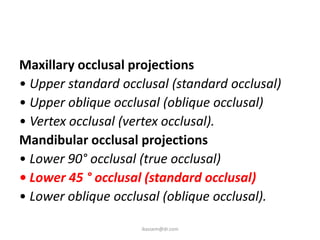
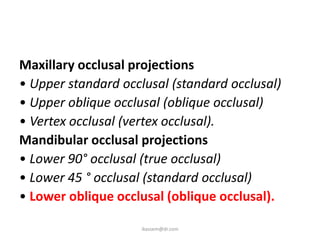
Maxillary occlusal projections
• Upper standard occlusal (standard occlusal)
• Upper oblique occlusal (oblique occlusal)
• Vertex occlusal (vertex occlusal).
Mandibular occlusal projections
• Lower 90° occlusal (true occlusal)
• Lower 45 ° occlusal (standard occlusal)
• Lower oblique occlusal (oblique occlusal).

                     ikassem@dr.com
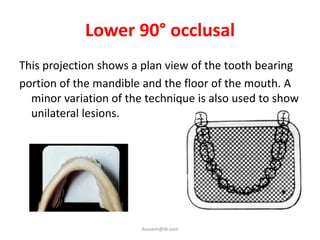
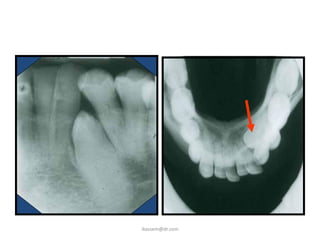
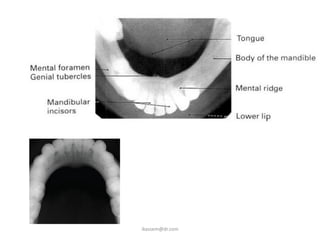
Lower 90° occlusal
This projection shows a plan view of the tooth bearing
portion of the mandible and the floor of the mouth. A
  minor variation of the technique is also used to show
  unilateral lesions.


                        ikassem@dr.com
ikassem@dr.com
ikassem@dr.com
Main clinical indications
Detection of the presence and position of
  radiopaque calculi in the submandibular salivary
  ducts
• Assessment of the bucco-lingual position of
  unerupted mandibular teeth
• Evaluation of the bucco-lingual expansion of the
  body of the mandible by cysts, tumours or
  osteodystrophies
• Assessment of displacement fractures of the
  anterior body of the mandible in the horizontal
  plane.
                      ikassem@dr.com
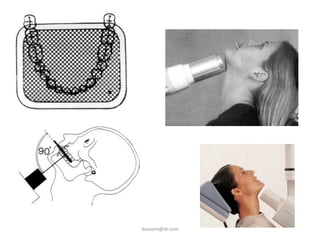
Technique and positioning
1. The film packet, with the white (pebbly) surface facing
   downwards, is placed centrally into the mouth, on to
   the occlusal surfaces of the lower teeth, with its long
   axis crossways. The patient is asked to bite together
   gently.
2. The patient then leans forwards and then tips the head
   backwards as far as is comfortable, where it is
   supported.
3. The X-ray tubehead, with circular collimator fitted, is
   placed below the patient's chin, in the midline, centring
   on an imaginary line joining the first molars, at an
   angle of 90° to the film .

                          ikassem@dr.com
Variation of technique. To show a particular
part of the mandible, the film packet is placed in
the mouth with its long axis anteroposteriorly over
the area of interest. The X-ray tubehead, still
aimed at 90° to the film, is centred below the
  bodyof the mandible in that area.
Note: The lower 90° occlusal is mounted as if the
examiner were looking into the patient's mouth.
The radiograph is therefore mounted with the
embossed dot pointing away from the examiner.
                      ikassem@dr.com
ikassem@dr.com
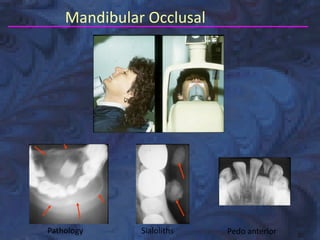
Mandibular Occlusal


Pathology     Sialoliths   Pedo anterior
ikassem@dr.com
ikassem@dr.com
Maxillary occlusal projections
• Upper standard occlusal (standard occlusal)
• Upper oblique occlusal (oblique occlusal)
• Vertex occlusal (vertex occlusal).
Mandibular occlusal projections
• Lower 90° occlusal (true occlusal)
• Lower 45 ° occlusal (standard occlusal)
• Lower oblique occlusal (oblique occlusal).

                     ikassem@dr.com
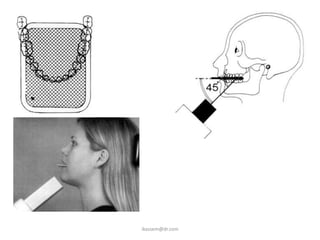
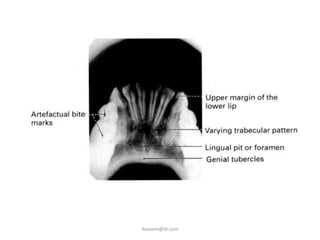
Lower 45° occlusal
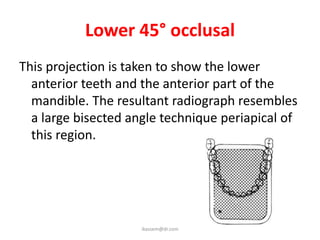
This projection is taken to show the lower
  anterior teeth and the anterior part of the
  mandible. The resultant radiograph resembles
  a large bisected angle technique periapical of
  this region.


                     ikassem@dr.com
Main clinical indications
• Periapical assessment of the lower incisor
teeth, especially useful in adults and children
  unable to tolerate periapical films
• Evaluation of the size and extent of lesions
such as cysts or tumours affecting the anterior
part of the mandible
• Assessment of displacement fractures of the
anterior mandible in the vertical plane.

                     ikassem@dr.com
ikassem@dr.com
Technique and positioning
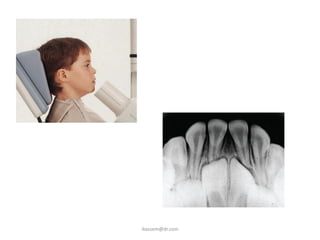
1. The patient is seated with the head supported
and with the occlusal plane horizontal and parallel
   to the floor.
2. The film packet, with the white (pebbly)surface
   facing downwards, is placed centrally into the
   mouth, on to the occlusal surfaces of the lower
   teeth, with its long axis anteroposteriorly, and
   thepatient is asked to bite gently together.
3. The X-ray tubehead is positioned in the midline,
   centring through the chin point, at an angle of
   45° to the film
                      ikassem@dr.com
ikassem@dr.com
ikassem@dr.com
Maxillary occlusal projections
• Upper standard occlusal (standard occlusal)
• Upper oblique occlusal (oblique occlusal)
• Vertex occlusal (vertex occlusal).
Mandibular occlusal projections
• Lower 90° occlusal (true occlusal)
• Lower 45 ° occlusal (standard occlusal)
• Lower oblique occlusal (oblique occlusal).

                     ikassem@dr.com
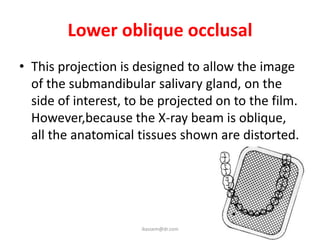
Lower oblique occlusal
• This projection is designed to allow the image
  of the submandibular salivary gland, on the
  side of interest, to be projected on to the film.
  However,because the X-ray beam is oblique,
  all the anatomical tissues shown are distorted.


                      ikassem@dr.com
Main clinical indications
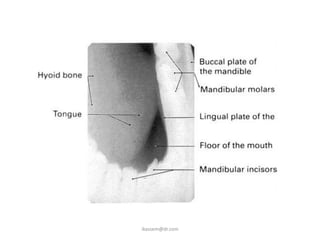
• Detection of radiopaque calculi in a
  submandibular salivary gland
• Assessment of the bucco-lingual position of
unerupted lower wisdom teeth
• Evaluation of the extent and expansion of
cysts, tumours or osteodystrophies in the
posterior part of the body and angle of the
mandible.

                     ikassem@dr.com
Technique and positioning
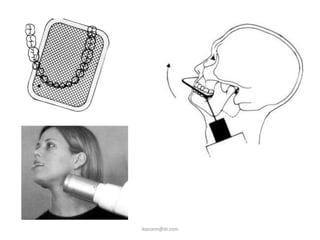
1. The film packet, with the white (pebbly) surface facing downwards,
    is inserted into the mouth, on to the occlusal surfaces of the lower
teeth, over to the side under investigation, with its
long axis anteroposteriorly. The patient is asked to bite together gently.
2. The patient's head is supported, then rotated away from the side
    under investigation and the chin is raised. This rotated positioning
    allows the subsequent positioning of the X-ray tube head.
3. The X-ray tubehead with circular collimator is aimed upwards and
    forwards towards the film, from below and behind the angle of the
    mandible and parallel to the lingual surface of the mandible


                                ikassem@dr.com
ikassem@dr.com
ikassem@dr.com
Thank you

Occlusal techniques

  • 1.
    Occlusal techniques Mandibular techniques Islam Kassem ikassem@dr.com
  • 2.
    Outlines Definition Patient management Classifications :Mand Max Clinical indications & techniques ikassem@dr.com
  • 3.
    Dental radiograph I –Extra oral II- Intraoral : Periapical Bite wing Occlusal ikassem@dr.com
  • 4.
    Occlusal radiography isdefined as those intraoral radiographic techniques taken using a dental X-ray set where the film packet (5.7 x 7.6 cm) or a small intraoral cassette is placed in the occlusal plane. ikassem@dr.com
  • 5.
    Maxillary occlusal projections •Upper standard occlusal (standard occlusal) • Upper oblique occlusal (oblique occlusal) • Vertex occlusal (vertex occlusal). Mandibular occlusal projections • Lower 90° occlusal (true occlusal) • Lower 45 ° occlusal (standard occlusal) • Lower oblique occlusal (oblique occlusal). ikassem@dr.com
  • 6.
    Lower 90° occlusal Thisprojection shows a plan view of the tooth bearing portion of the mandible and the floor of the mouth. A minor variation of the technique is also used to show unilateral lesions. ikassem@dr.com
  • 8.
  • 9.
  • 10.
    Main clinical indications Detectionof the presence and position of radiopaque calculi in the submandibular salivary ducts • Assessment of the bucco-lingual position of unerupted mandibular teeth • Evaluation of the bucco-lingual expansion of the body of the mandible by cysts, tumours or osteodystrophies • Assessment of displacement fractures of the anterior body of the mandible in the horizontal plane. ikassem@dr.com
  • 11.
    Technique and positioning 1.The film packet, with the white (pebbly) surface facing downwards, is placed centrally into the mouth, on to the occlusal surfaces of the lower teeth, with its long axis crossways. The patient is asked to bite together gently. 2. The patient then leans forwards and then tips the head backwards as far as is comfortable, where it is supported. 3. The X-ray tubehead, with circular collimator fitted, is placed below the patient's chin, in the midline, centring on an imaginary line joining the first molars, at an angle of 90° to the film . ikassem@dr.com
  • 12.
    Variation of technique.To show a particular part of the mandible, the film packet is placed in the mouth with its long axis anteroposteriorly over the area of interest. The X-ray tubehead, still aimed at 90° to the film, is centred below the bodyof the mandible in that area. Note: The lower 90° occlusal is mounted as if the examiner were looking into the patient's mouth. The radiograph is therefore mounted with the embossed dot pointing away from the examiner. ikassem@dr.com
  • 13.
  • 14.
    Mandibular Occlusal Pathology Sialoliths Pedo anterior
  • 15.
  • 16.
  • 17.
    Maxillary occlusal projections •Upper standard occlusal (standard occlusal) • Upper oblique occlusal (oblique occlusal) • Vertex occlusal (vertex occlusal). Mandibular occlusal projections • Lower 90° occlusal (true occlusal) • Lower 45 ° occlusal (standard occlusal) • Lower oblique occlusal (oblique occlusal). ikassem@dr.com
  • 18.
    Lower 45° occlusal Thisprojection is taken to show the lower anterior teeth and the anterior part of the mandible. The resultant radiograph resembles a large bisected angle technique periapical of this region. ikassem@dr.com
  • 19.
    Main clinical indications •Periapical assessment of the lower incisor teeth, especially useful in adults and children unable to tolerate periapical films • Evaluation of the size and extent of lesions such as cysts or tumours affecting the anterior part of the mandible • Assessment of displacement fractures of the anterior mandible in the vertical plane. ikassem@dr.com
  • 20.
  • 21.
    Technique and positioning 1.The patient is seated with the head supported and with the occlusal plane horizontal and parallel to the floor. 2. The film packet, with the white (pebbly)surface facing downwards, is placed centrally into the mouth, on to the occlusal surfaces of the lower teeth, with its long axis anteroposteriorly, and thepatient is asked to bite gently together. 3. The X-ray tubehead is positioned in the midline, centring through the chin point, at an angle of 45° to the film ikassem@dr.com
  • 22.
  • 23.
  • 24.
    Maxillary occlusal projections •Upper standard occlusal (standard occlusal) • Upper oblique occlusal (oblique occlusal) • Vertex occlusal (vertex occlusal). Mandibular occlusal projections • Lower 90° occlusal (true occlusal) • Lower 45 ° occlusal (standard occlusal) • Lower oblique occlusal (oblique occlusal). ikassem@dr.com
  • 25.
    Lower oblique occlusal •This projection is designed to allow the image of the submandibular salivary gland, on the side of interest, to be projected on to the film. However,because the X-ray beam is oblique, all the anatomical tissues shown are distorted. ikassem@dr.com
  • 26.
    Main clinical indications •Detection of radiopaque calculi in a submandibular salivary gland • Assessment of the bucco-lingual position of unerupted lower wisdom teeth • Evaluation of the extent and expansion of cysts, tumours or osteodystrophies in the posterior part of the body and angle of the mandible. ikassem@dr.com
  • 27.
    Technique and positioning 1.The film packet, with the white (pebbly) surface facing downwards, is inserted into the mouth, on to the occlusal surfaces of the lower teeth, over to the side under investigation, with its long axis anteroposteriorly. The patient is asked to bite together gently. 2. The patient's head is supported, then rotated away from the side under investigation and the chin is raised. This rotated positioning allows the subsequent positioning of the X-ray tube head. 3. The X-ray tubehead with circular collimator is aimed upwards and forwards towards the film, from below and behind the angle of the mandible and parallel to the lingual surface of the mandible ikassem@dr.com
  • 28.
  • 29.
  • 30.