Dr Sahidul Islam
PGTRadiology(1styr)
FAAMCH
Case presentation
dr.sahidul@gmail.com
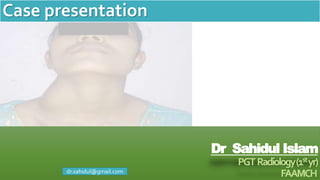
History
23
right neck 3
headache
fever
On Examination
80
50
mandibular ramus
clavicle
soft
& cystic
USG
cystic mass
anechoic
posterior
acoustic enhancement.
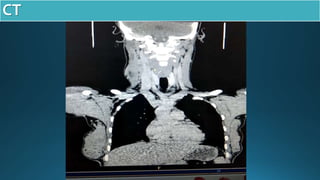
CT NECK
cystic mass with
internal sepation
enhancement of cystic wall
internal jugular common
carotid
sternocleodomastoid
carotid bifurcation
ramus of right mandible
axilla
lymph nodes
CT NECK
MRI
T2 hyperintense
T2
hypointense internal septation calcification
peripheral rim
enhancement
level 2
MRI
Differential Diagnosis
Thyroglossal duct cyst
midline
early childhood
hyoid bone
smooth, well-
circumscribed mass with homogeneous
attenuation.
Cystic Hygroma/Lymphangioma
multilocular
poorly circumscribed, multiloculated,
hypoattenuated masses
Dermoid Cyst
midline, suprahyoid
unilocular
homogeneous,
hypoattenuating
2ND BRANCHIAL CYST
Discussion
Branchial Cyst
 Branchial cleft
branchial apparatus
 Second branchial arch
95 %
Embroyology of Branchial apparatus
6
4
4
5
6
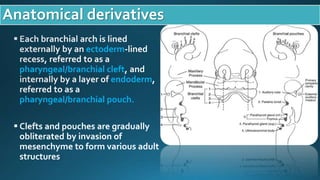
Anatomical derivatives
ectoderm
pharyngeal/branchial cleft
endoderm
pharyngeal/branchial pouch.
 Clefts and pouches are gradually
obliterated by invasion of
mesenchyme to form various adult
structures
Derivatives
 1st arch
 2nd arch
 3rd & 4th
Brancial Arch Anomalies
cysts, fistulas, sinuses
cysts
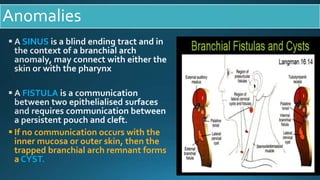
Anomalies
SINUS
FISTULA
 If no communication occurs with the
inner mucosa or outer skin, then the
trapped branchial arch remnant forms
a CYST.
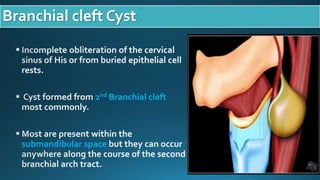
Branchial cleft Cyst
2nd Branchial cleft
submandibular space
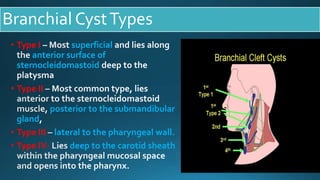
Branchial CystTypes
• Type I superficial
anterior surface of
sternocleidomastoid
• Type II
posterior to the submandibular
gland
• Type III lateral to the pharyngeal wall.
• Type IV- deep to the carotid sheath
Clinical Presentation
10-40
rounded swelling
sternocleidomastoid
Presentation
painless, compressible
mucoid material
fat stranding and skin changes
Radiographic Features
Ultrasound
70%
82%
• anechoic 41%
• homogeneously hypoechoic with internal debris 24%
• pseudo solid 12%
• heterogeneous 23%
CT
rounded or spheric, sharply circumscribed
fluid density centrally
thin wall
extension of the cyst wall between the internal and
external carotid arteries just above the carotid bifurcation
(features referred to as the notch sign, tail sign or beak
sign ), is highly suggestive of the diagnosis but not
pathognomonic
Radiographic Features
CT
MRI
 T1
 high protein content: high signal
 low protein content: low signal
 T2
 T1 C+ (Gd):
Radiographic Features
MRI
Conclussion
Branchial cyst
ThankYou

Case Presentation Branchial Cyst