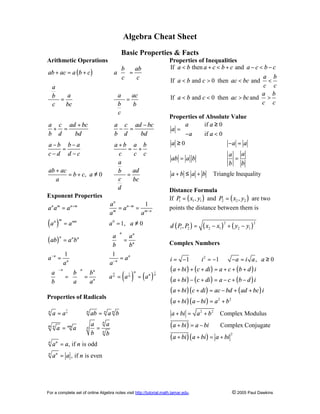
Algebra Cheat Sheet
Basic Properties & Facts
Arithmetic Operations

Properties of Inequalities
If a < b then a + c < b + c and a − c < b − c
a b
If a < b and c > 0 then ac < bc and <
c c
a b
If a < b and c < 0 then ac > bc and >
c c

 b  ab
a  =
c c

ab + ac = a ( b + c )
a
  a
b =
c
bc

a
ac
=
b b
 
c

a c ad + bc
+ =
b d
bd

a c ad − bc
− =
b d
bd

a −b b−a
=
c−d d −c

Properties of Absolute Value
if a ≥ 0
a
a =
if a < 0
 −a
a ≥0
−a = a

a+b a b
= +
c
c c
a
  ad
b =
 c  bc
 
d

ab + ac
= b + c, a ≠ 0
a

a+b ≤ a + b

(a )

n m

an
1
= a n−m = m−n
m
a
a

( ab )

a 0 = 1, a ≠ 0
n

n

a −n =
a
 
b

= a nm

−n

1
an
n

bn
b
=  = n
a
a

n
m

1

a = an

m n

a = nm a

( x2 − x1 ) + ( y2 − y1 )
2

2

n

Complex Numbers
i = −1

( ) = (a )

a = a

Properties of Radicals
n

d ( P , P2 ) =
1

a
a
  = n
b
b
1
= an
−n
a

= a nb n

Triangle Inequality

Distance Formula
If P = ( x1 , y1 ) and P2 = ( x2 , y2 ) are two
1
points the distance between them is

Exponent Properties
a n a m = a n+m

a
a
=
b
b

ab = a b

1
m

n

n

1
m

i 2 = −1

−a = i a , a ≥ 0

( a + bi ) + ( c + di ) = a + c + ( b + d ) i
( a + bi ) − ( c + di ) = a − c + ( b − d ) i
( a + bi )( c + di ) = ac − bd + ( ad + bc ) i
( a + bi )( a − bi ) = a 2 + b 2

n

ab = n a n b

a + bi = a 2 + b 2

n

a na
=
b nb

( a + bi ) = a − bi Complex Conjugate
2
( a + bi )( a + bi ) = a + bi

n

a n = a, if n is odd

n

Complex Modulus

a n = a , if n is even

For a complete set of online Algebra notes visit http://tutorial.math.lamar.edu.

© 2005 Paul Dawkins
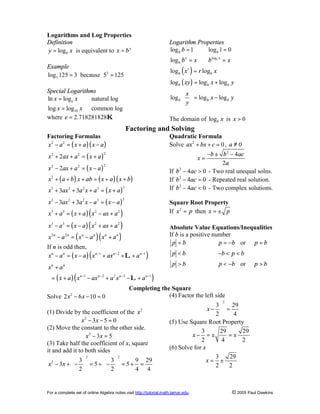
Logarithms and Log Properties
Definition
y = log b x is equivalent to x = b y

Logarithm Properties
log b b = 1
log b 1 = 0
log b b x = x

b logb x = x

log b ( x r ) = r log b x

Example
log 5 125 = 3 because 53 = 125

log b ( xy ) = log b x + log b y

Special Logarithms
ln x = log e x
natural log

x
log b   = log b x − log b y
 y

log x = log10 x common log
where e = 2.718281828K

The domain of log b x is x > 0

Factoring and Solving
Factoring Formulas
x 2 − a 2 = ( x + a )( x − a )

Quadratic Formula
Solve ax 2 + bx + c = 0 , a ≠ 0

x 2 + 2ax + a 2 = ( x + a )

2

x 2 − 2ax + a 2 = ( x − a )

2

−b ± b 2 − 4ac
2a
2
If b − 4ac > 0 - Two real unequal solns.
If b 2 − 4ac = 0 - Repeated real solution.
If b 2 − 4ac < 0 - Two complex solutions.
x=

x 2 + ( a + b ) x + ab = ( x + a )( x + b )
x3 + 3ax 2 + 3a 2 x + a 3 = ( x + a )
x3 − 3ax 2 + 3a 2 x − a 3 = ( x − a )

3

3

Square Root Property
If x 2 = p then x = ± p

x3 + a3 = ( x + a ) ( x 2 − ax + a 2 )
x3 − a 3 = ( x − a ) ( x 2 + ax + a 2 )
x −a
2n

2n

= (x −a
n

n

)( x

n

+a

n

)

If n is odd then,
x n − a n = ( x − a ) ( x n −1 + ax n − 2 + L + a n −1 )
xn + a n

Absolute Value Equations/Inequalities
If b is a positive number
p =b
⇒
p = −b or p = b
p <b

⇒

−b < p < b

p >b

⇒

p < −b or

p>b

= ( x + a ) ( x n −1 − ax n − 2 + a 2 x n −3 − L + a n −1 )
Completing the Square
(4) Factor the left side

Solve 2 x − 6 x − 10 = 0
2

2

(1) Divide by the coefficient of the x 2
x 2 − 3x − 5 = 0
(2) Move the constant to the other side.
x 2 − 3x = 5
(3) Take half the coefficient of x, square
it and add it to both sides
2

2

9 29
 3
 3
x 2 − 3x +  −  = 5 +  −  = 5 + =
4 4
 2
 2

3
29

x−  =
2
4

(5) Use Square Root Property
3
29
29
x− = ±
=±
2
4
2
(6) Solve for x
3
29
x= ±
2
2

For a complete set of online Algebra notes visit http://tutorial.math.lamar.edu.

© 2005 Paul Dawkins
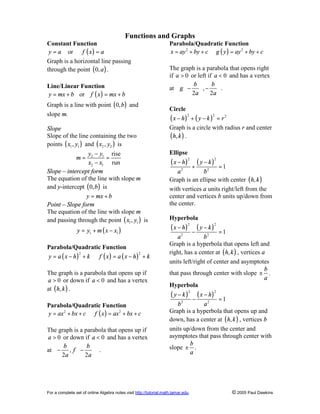
Functions and Graphs
Constant Function
y = a or f ( x ) = a
Graph is a horizontal line passing
through the point ( 0, a ) .
Line/Linear Function
y = mx + b or f ( x ) = mx + b

Graph is a line with point ( 0, b ) and
slope m.
Slope
Slope of the line containing the two
points ( x1 , y1 ) and ( x2 , y2 ) is
y2 − y1 rise
=
x2 − x1 run
Slope – intercept form
The equation of the line with slope m
and y-intercept ( 0,b ) is
y = mx + b
Point – Slope form
The equation of the line with slope m
and passing through the point ( x1 , y1 ) is
m=

y = y1 + m ( x − x1 )

Parabola/Quadratic Function
2
2
y = a ( x − h) + k
f ( x) = a ( x − h) + k
The graph is a parabola that opens up if
a > 0 or down if a < 0 and has a vertex
at ( h, k ) .
Parabola/Quadratic Function
y = ax 2 + bx + c f ( x ) = ax 2 + bx + c
The graph is a parabola that opens up if
a > 0 or down if a < 0 and has a vertex
 b
 b 
at  − , f  −   .
 2a  2 a  

Parabola/Quadratic Function
x = ay 2 + by + c g ( y ) = ay 2 + by + c
The graph is a parabola that opens right
if a > 0 or left if a < 0 and has a vertex
  b  b 
at  g  −  , −  .
  2a  2 a 
Circle
2
2
( x − h) + ( y − k ) = r 2
Graph is a circle with radius r and center
( h, k ) .
Ellipse

( x − h)

2

( y −k)
+

2

=1
a2
b2
Graph is an ellipse with center ( h, k )
with vertices a units right/left from the
center and vertices b units up/down from
the center.
Hyperbola

( x − h)

2

( y −k)
−

2

( x − h)

2

=1
a2
b2
Graph is a hyperbola that opens left and
right, has a center at ( h, k ) , vertices a
units left/right of center and asymptotes
b
that pass through center with slope ± .
a
Hyperbola

(y −k)

2

=1
b2
a2
Graph is a hyperbola that opens up and
down, has a center at ( h, k ) , vertices b
units up/down from the center and
asymptotes that pass through center with
b
slope ± .
a

For a complete set of online Algebra notes visit http://tutorial.math.lamar.edu.

−

© 2005 Paul Dawkins
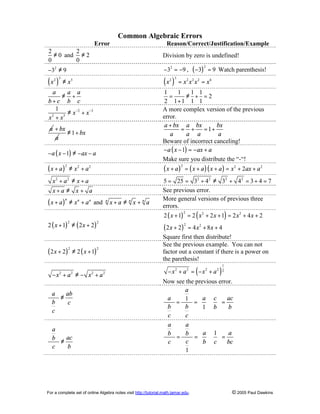
Common Algebraic Errors
Error

Reason/Correct/Justification/Example

2
2
≠ 0 and ≠ 2
0
0

Division by zero is undefined!

−32 ≠ 9

−32 = −9 ,

(x )

(x )

2 3

2 3

≠ x5

a
a a
≠ +
b+c b c
1
≠ x −2 + x −3
2
3
x +x

− a ( x − 1) ≠ − ax − a

x2 + a2 ≠ x + a
x+a ≠ x + a

( x + a)

≠ x n + a n and

n

= 9 Watch parenthesis!

= x2 x2 x2 = x6

( x + a)

≠ x2 + a2

2

2

1
1
1 1
=
≠ + =2
2 1+1 1 1
A more complex version of the previous
error.
a + bx a bx
bx
= +
= 1+
a
a a
a
Beware of incorrect canceling!
− a ( x − 1) = − ax + a
Make sure you distribute the “-“!

a + bx
≠ 1 + bx
a

( x + a)

( −3 )

n

x+a ≠ n x + n a

= ( x + a )( x + a ) = x 2 + 2ax + a 2

2

5 = 25 = 32 + 42 ≠ 32 + 42 = 3 + 4 = 7
See previous error.
More general versions of previous three
errors.
2 ( x + 1) = 2 ( x 2 + 2 x + 1) = 2 x 2 + 4 x + 2
2

2 ( x + 1) ≠ ( 2 x + 2 )

2

( 2 x + 2)

2

2

2

≠ 2 ( x + 1)

( 2 x + 2)

= 4 x2 + 8x + 4
Square first then distribute!
See the previous example. You can not
factor out a constant if there is a power on
the parethesis!
2

1

− x2 + a2 ≠ − x2 + a2
a
ab
≠
b c
 
c
a
  ac
b ≠
c
b

− x2 + a2 = ( − x2 + a 2 ) 2
Now see the previous error.
a
 
a
1
 a  c  ac
=   =    =
 b   b   1  b  b
   
c c
a a
   
 b  =  b  =  a  1  = a
  
c
 c   b  c  bc
 
1

For a complete set of online Algebra notes visit http://tutorial.math.lamar.edu.

© 2005 Paul Dawkins

Algebra formulas

  • 1.
    Algebra Cheat Sheet BasicProperties & Facts Arithmetic Operations Properties of Inequalities If a < b then a + c < b + c and a − c < b − c a b If a < b and c > 0 then ac < bc and < c c a b If a < b and c < 0 then ac > bc and > c c  b  ab a  = c c ab + ac = a ( b + c ) a   a b = c bc a ac = b b   c a c ad + bc + = b d bd a c ad − bc − = b d bd a −b b−a = c−d d −c Properties of Absolute Value if a ≥ 0 a a = if a < 0  −a a ≥0 −a = a a+b a b = + c c c a   ad b =  c  bc   d ab + ac = b + c, a ≠ 0 a a+b ≤ a + b (a ) n m an 1 = a n−m = m−n m a a ( ab ) a 0 = 1, a ≠ 0 n n a −n = a   b = a nm −n 1 an n bn b =  = n a a n m 1 a = an m n a = nm a ( x2 − x1 ) + ( y2 − y1 ) 2 2 n Complex Numbers i = −1 ( ) = (a ) a = a Properties of Radicals n d ( P , P2 ) = 1 a a   = n b b 1 = an −n a = a nb n Triangle Inequality Distance Formula If P = ( x1 , y1 ) and P2 = ( x2 , y2 ) are two 1 points the distance between them is Exponent Properties a n a m = a n+m a a = b b ab = a b 1 m n n 1 m i 2 = −1 −a = i a , a ≥ 0 ( a + bi ) + ( c + di ) = a + c + ( b + d ) i ( a + bi ) − ( c + di ) = a − c + ( b − d ) i ( a + bi )( c + di ) = ac − bd + ( ad + bc ) i ( a + bi )( a − bi ) = a 2 + b 2 n ab = n a n b a + bi = a 2 + b 2 n a na = b nb ( a + bi ) = a − bi Complex Conjugate 2 ( a + bi )( a + bi ) = a + bi n a n = a, if n is odd n Complex Modulus a n = a , if n is even For a complete set of online Algebra notes visit http://tutorial.math.lamar.edu. © 2005 Paul Dawkins
  • 2.
    Logarithms and LogProperties Definition y = log b x is equivalent to x = b y Logarithm Properties log b b = 1 log b 1 = 0 log b b x = x b logb x = x log b ( x r ) = r log b x Example log 5 125 = 3 because 53 = 125 log b ( xy ) = log b x + log b y Special Logarithms ln x = log e x natural log x log b   = log b x − log b y  y log x = log10 x common log where e = 2.718281828K The domain of log b x is x > 0 Factoring and Solving Factoring Formulas x 2 − a 2 = ( x + a )( x − a ) Quadratic Formula Solve ax 2 + bx + c = 0 , a ≠ 0 x 2 + 2ax + a 2 = ( x + a ) 2 x 2 − 2ax + a 2 = ( x − a ) 2 −b ± b 2 − 4ac 2a 2 If b − 4ac > 0 - Two real unequal solns. If b 2 − 4ac = 0 - Repeated real solution. If b 2 − 4ac < 0 - Two complex solutions. x= x 2 + ( a + b ) x + ab = ( x + a )( x + b ) x3 + 3ax 2 + 3a 2 x + a 3 = ( x + a ) x3 − 3ax 2 + 3a 2 x − a 3 = ( x − a ) 3 3 Square Root Property If x 2 = p then x = ± p x3 + a3 = ( x + a ) ( x 2 − ax + a 2 ) x3 − a 3 = ( x − a ) ( x 2 + ax + a 2 ) x −a 2n 2n = (x −a n n )( x n +a n ) If n is odd then, x n − a n = ( x − a ) ( x n −1 + ax n − 2 + L + a n −1 ) xn + a n Absolute Value Equations/Inequalities If b is a positive number p =b ⇒ p = −b or p = b p <b ⇒ −b < p < b p >b ⇒ p < −b or p>b = ( x + a ) ( x n −1 − ax n − 2 + a 2 x n −3 − L + a n −1 ) Completing the Square (4) Factor the left side Solve 2 x − 6 x − 10 = 0 2 2 (1) Divide by the coefficient of the x 2 x 2 − 3x − 5 = 0 (2) Move the constant to the other side. x 2 − 3x = 5 (3) Take half the coefficient of x, square it and add it to both sides 2 2 9 29  3  3 x 2 − 3x +  −  = 5 +  −  = 5 + = 4 4  2  2 3 29  x−  = 2 4  (5) Use Square Root Property 3 29 29 x− = ± =± 2 4 2 (6) Solve for x 3 29 x= ± 2 2 For a complete set of online Algebra notes visit http://tutorial.math.lamar.edu. © 2005 Paul Dawkins
  • 3.
    Functions and Graphs ConstantFunction y = a or f ( x ) = a Graph is a horizontal line passing through the point ( 0, a ) . Line/Linear Function y = mx + b or f ( x ) = mx + b Graph is a line with point ( 0, b ) and slope m. Slope Slope of the line containing the two points ( x1 , y1 ) and ( x2 , y2 ) is y2 − y1 rise = x2 − x1 run Slope – intercept form The equation of the line with slope m and y-intercept ( 0,b ) is y = mx + b Point – Slope form The equation of the line with slope m and passing through the point ( x1 , y1 ) is m= y = y1 + m ( x − x1 ) Parabola/Quadratic Function 2 2 y = a ( x − h) + k f ( x) = a ( x − h) + k The graph is a parabola that opens up if a > 0 or down if a < 0 and has a vertex at ( h, k ) . Parabola/Quadratic Function y = ax 2 + bx + c f ( x ) = ax 2 + bx + c The graph is a parabola that opens up if a > 0 or down if a < 0 and has a vertex  b  b  at  − , f  −   .  2a  2 a   Parabola/Quadratic Function x = ay 2 + by + c g ( y ) = ay 2 + by + c The graph is a parabola that opens right if a > 0 or left if a < 0 and has a vertex   b  b  at  g  −  , −  .   2a  2 a  Circle 2 2 ( x − h) + ( y − k ) = r 2 Graph is a circle with radius r and center ( h, k ) . Ellipse ( x − h) 2 ( y −k) + 2 =1 a2 b2 Graph is an ellipse with center ( h, k ) with vertices a units right/left from the center and vertices b units up/down from the center. Hyperbola ( x − h) 2 ( y −k) − 2 ( x − h) 2 =1 a2 b2 Graph is a hyperbola that opens left and right, has a center at ( h, k ) , vertices a units left/right of center and asymptotes b that pass through center with slope ± . a Hyperbola (y −k) 2 =1 b2 a2 Graph is a hyperbola that opens up and down, has a center at ( h, k ) , vertices b units up/down from the center and asymptotes that pass through center with b slope ± . a For a complete set of online Algebra notes visit http://tutorial.math.lamar.edu. − © 2005 Paul Dawkins
  • 4.
    Common Algebraic Errors Error Reason/Correct/Justification/Example 2 2 ≠0 and ≠ 2 0 0 Division by zero is undefined! −32 ≠ 9 −32 = −9 , (x ) (x ) 2 3 2 3 ≠ x5 a a a ≠ + b+c b c 1 ≠ x −2 + x −3 2 3 x +x − a ( x − 1) ≠ − ax − a x2 + a2 ≠ x + a x+a ≠ x + a ( x + a) ≠ x n + a n and n = 9 Watch parenthesis! = x2 x2 x2 = x6 ( x + a) ≠ x2 + a2 2 2 1 1 1 1 = ≠ + =2 2 1+1 1 1 A more complex version of the previous error. a + bx a bx bx = + = 1+ a a a a Beware of incorrect canceling! − a ( x − 1) = − ax + a Make sure you distribute the “-“! a + bx ≠ 1 + bx a ( x + a) ( −3 ) n x+a ≠ n x + n a = ( x + a )( x + a ) = x 2 + 2ax + a 2 2 5 = 25 = 32 + 42 ≠ 32 + 42 = 3 + 4 = 7 See previous error. More general versions of previous three errors. 2 ( x + 1) = 2 ( x 2 + 2 x + 1) = 2 x 2 + 4 x + 2 2 2 ( x + 1) ≠ ( 2 x + 2 ) 2 ( 2 x + 2) 2 2 2 ≠ 2 ( x + 1) ( 2 x + 2) = 4 x2 + 8x + 4 Square first then distribute! See the previous example. You can not factor out a constant if there is a power on the parethesis! 2 1 − x2 + a2 ≠ − x2 + a2 a ab ≠ b c   c a   ac b ≠ c b − x2 + a2 = ( − x2 + a 2 ) 2 Now see the previous error. a   a 1  a  c  ac =   =    =  b   b   1  b  b     c c a a      b  =  b  =  a  1  = a    c  c   b  c  bc   1 For a complete set of online Algebra notes visit http://tutorial.math.lamar.edu. © 2005 Paul Dawkins