TRAUMA: The acute management of a trauma victim follows a linear algorithm that
should be performed in the same order every time: ABCDE, 1° survey, 2° survey.
Ac: Airway maintenance with Cervical spine control:
Check the patency of the airway first, and then give supplemental O2 via nasal cannula, face
mask, airway adjunct (nasopharyngeal or oropharyngeal airway), or bag-valve mask (Ambu-
Bag) as appropriate.
Indications for intubation include impending airway compromise, a Glasgow Coma
Scale (GCS) score of = 8, ↓ mental status, apnea, and severe closed-head injuries.
A surgical airway (cricothyroidotomy) should be performed in the setting of
significant maxillofacial trauma.
B: Breathing with ventilation: Quickly evaluate for causes of impending
cardiopulmonary death— e.g. tension pneumothorax, cardiac tamponade, open
pneumothorax, massive hemothorax, or airway obstruction.
C: Circulation with hemorrhage control:
Resuscitation: Think short and fat IV lines—e.g. two large-bore (16- or 18-gauge)
antecubital lines.
A good rule of thumb is to give three times as much isotonic fluid (NS or LR) as the estimated
blood lost.
D: Disability—determined by a brief neurologic examination:
AVPU system: A = Alert; V = responds to Vocal stimuli; P = responds to Painful stimuli; U =
Unresponsive.
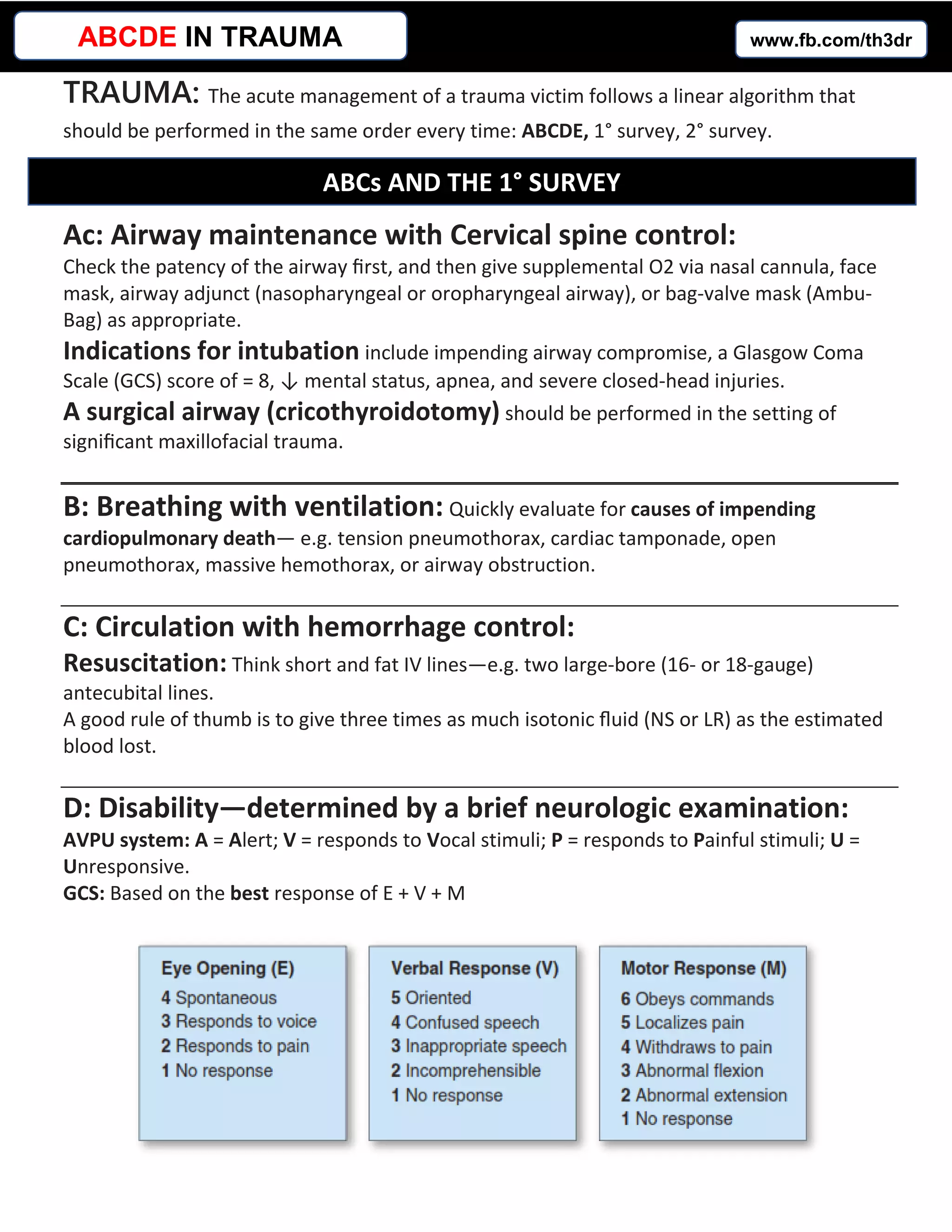
GCS: Based on the best response of E + V + M
ABCDE IN TRAUMA www.fb.com/th3dr
ABCs AND THE 1° SURVEY
Focused neurologic exam: Examine for unequal pupils, depressed skull fracture, focal
weakness, and posturing.
E: Exposure/Environmental control:
Completely undress the patient to assess for injury, but avoid hypothermia.
Obtain an AMPLE history: Inquire about Allergies, Medications, Past medical history,
Last oral intake, and Events/Environmental factors related to the injury. If the patient can
speak, ask about other symptoms that may not be obvious on exam. Obtain as much
information as possible about the circumstances of the trauma from EMTs/paramedics,
witnesses, and the like.
conduct a focused physical exam:
Head and skull: Inspect for trauma, pupils, and loss of consciousness. Examine for
hemorrhage around the mastoid (Battle’s sign), eyes (“raccoon eyes”), and tympanic
membrane, all of which are indicative of a basilar skull fracture. Inspect the nose for CSF
leakage and for an unstable airway due to facial fractures.
Neck: Look for trauma; palpate for midline tenderness, crepitus, and tracheal deformity.
Chest: Inspect for irregular or paradoxical breathing patterns resulting from multiple rib
fractures—i.e. flail chest. Listen for equal and bilateral breath sounds (if not found, or if there
is crepitus on palpation of the chest, suspect pneumothorax). Listen for clear heart sounds
(if muffled and accompanied by JVD, suspect cardiac tamponade).
A new diastolic murmur after trauma suggests aortic dissection.
Abdomen: Inspect the anterior and posterior abdomen for signs of trauma. Palpate the
pelvis for tenderness or instability.
Perineum/rectum/vagina: Assess for trauma, including urethral bleeding (suggests urethral
tear). Check for prostate position, rectal tone, and rectal blood. In female patients, check for
vaginal trauma and blood in the vaginal vault.
Musculoskeletal system: Look for evidence of trauma, including contusions, lacerations,
and deformities. Inspect the extremities for tenderness, crepitus, abnormal range of motion,
and sensation. An externally rotated, shortened leg suggests hip fracture
2° SURVEY
Management:
1. Head and skull:
Maintain the airway; continue oxygenation and ventilation. Obtain a CT scan of the head
and face if indicated; intubate if necessary.
2. Neck:
• Maintain in-line immobilization and protection with a hard-cervical collar.
• Obtain radiographs if the C-spine cannot be cleared clinically. If indeterminate,
consider CT of the cervical spine.
3. Chest:
• Obtain a CXR and, if necessary, a CT scan.
• Tube thoracostomy for pneumothorax (needle thoracostomy for tension
pneumothorax); pericardiocentesis for cardiac tamponade; and emergent surgical
repair for aortic disruption Consider placing an NG tube.
4. Abdomen:
• Obtain a pelvic x-ray; arrange for a FAST (focused abdominal sonography for
trauma) and/or abdominal CT if indicated.
• Transfer to an OR in the presence of a penetrating wound to the abdomen deeper
than the fascia or with any significant bleeding or bowel injury.
5. Keep any impaled objects in place, and do not remove them until the patient has been
taken to the OR. Stable patients who are cleared of metal shrapnel may have a triple-
contrast CT exam first.
6. Urinary system: Insert a Foley catheter (contraindications include blood at the urethral
meatus, a severe pelvic fracture, or abnormal position of the prostate)
7. Musculoskeletal system:
• Wound irrigation and tissue debridement.
• Obtain an arteriogram if vascular injury is suspected. Obtain radiographs as needed.
• Maintain immobilization of the patient’s thoracic and lumbar spine; apply a splint as
indicated.
• Open fractures and suspected compartment syndromes require urgent orthopedic
consultation.
• Administer tetanus immunization and antibiotics as required.
Set by: Ahmed Al Emad

ABCDE in trauma

  • 1.
    TRAUMA: The acutemanagement of a trauma victim follows a linear algorithm that should be performed in the same order every time: ABCDE, 1° survey, 2° survey. Ac: Airway maintenance with Cervical spine control: Check the patency of the airway first, and then give supplemental O2 via nasal cannula, face mask, airway adjunct (nasopharyngeal or oropharyngeal airway), or bag-valve mask (Ambu- Bag) as appropriate. Indications for intubation include impending airway compromise, a Glasgow Coma Scale (GCS) score of = 8, ↓ mental status, apnea, and severe closed-head injuries. A surgical airway (cricothyroidotomy) should be performed in the setting of significant maxillofacial trauma. B: Breathing with ventilation: Quickly evaluate for causes of impending cardiopulmonary death— e.g. tension pneumothorax, cardiac tamponade, open pneumothorax, massive hemothorax, or airway obstruction. C: Circulation with hemorrhage control: Resuscitation: Think short and fat IV lines—e.g. two large-bore (16- or 18-gauge) antecubital lines. A good rule of thumb is to give three times as much isotonic fluid (NS or LR) as the estimated blood lost. D: Disability—determined by a brief neurologic examination: AVPU system: A = Alert; V = responds to Vocal stimuli; P = responds to Painful stimuli; U = Unresponsive. GCS: Based on the best response of E + V + M ABCDE IN TRAUMA www.fb.com/th3dr ABCs AND THE 1° SURVEY
  • 2.
    Focused neurologic exam:Examine for unequal pupils, depressed skull fracture, focal weakness, and posturing. E: Exposure/Environmental control: Completely undress the patient to assess for injury, but avoid hypothermia. Obtain an AMPLE history: Inquire about Allergies, Medications, Past medical history, Last oral intake, and Events/Environmental factors related to the injury. If the patient can speak, ask about other symptoms that may not be obvious on exam. Obtain as much information as possible about the circumstances of the trauma from EMTs/paramedics, witnesses, and the like. conduct a focused physical exam: Head and skull: Inspect for trauma, pupils, and loss of consciousness. Examine for hemorrhage around the mastoid (Battle’s sign), eyes (“raccoon eyes”), and tympanic membrane, all of which are indicative of a basilar skull fracture. Inspect the nose for CSF leakage and for an unstable airway due to facial fractures. Neck: Look for trauma; palpate for midline tenderness, crepitus, and tracheal deformity. Chest: Inspect for irregular or paradoxical breathing patterns resulting from multiple rib fractures—i.e. flail chest. Listen for equal and bilateral breath sounds (if not found, or if there is crepitus on palpation of the chest, suspect pneumothorax). Listen for clear heart sounds (if muffled and accompanied by JVD, suspect cardiac tamponade). A new diastolic murmur after trauma suggests aortic dissection. Abdomen: Inspect the anterior and posterior abdomen for signs of trauma. Palpate the pelvis for tenderness or instability. Perineum/rectum/vagina: Assess for trauma, including urethral bleeding (suggests urethral tear). Check for prostate position, rectal tone, and rectal blood. In female patients, check for vaginal trauma and blood in the vaginal vault. Musculoskeletal system: Look for evidence of trauma, including contusions, lacerations, and deformities. Inspect the extremities for tenderness, crepitus, abnormal range of motion, and sensation. An externally rotated, shortened leg suggests hip fracture 2° SURVEY
  • 3.
    Management: 1. Head andskull: Maintain the airway; continue oxygenation and ventilation. Obtain a CT scan of the head and face if indicated; intubate if necessary. 2. Neck: • Maintain in-line immobilization and protection with a hard-cervical collar. • Obtain radiographs if the C-spine cannot be cleared clinically. If indeterminate, consider CT of the cervical spine. 3. Chest: • Obtain a CXR and, if necessary, a CT scan. • Tube thoracostomy for pneumothorax (needle thoracostomy for tension pneumothorax); pericardiocentesis for cardiac tamponade; and emergent surgical repair for aortic disruption Consider placing an NG tube. 4. Abdomen: • Obtain a pelvic x-ray; arrange for a FAST (focused abdominal sonography for trauma) and/or abdominal CT if indicated. • Transfer to an OR in the presence of a penetrating wound to the abdomen deeper than the fascia or with any significant bleeding or bowel injury. 5. Keep any impaled objects in place, and do not remove them until the patient has been taken to the OR. Stable patients who are cleared of metal shrapnel may have a triple- contrast CT exam first. 6. Urinary system: Insert a Foley catheter (contraindications include blood at the urethral meatus, a severe pelvic fracture, or abnormal position of the prostate) 7. Musculoskeletal system: • Wound irrigation and tissue debridement. • Obtain an arteriogram if vascular injury is suspected. Obtain radiographs as needed. • Maintain immobilization of the patient’s thoracic and lumbar spine; apply a splint as indicated. • Open fractures and suspected compartment syndromes require urgent orthopedic consultation. • Administer tetanus immunization and antibiotics as required. Set by: Ahmed Al Emad