VINAYAK KUMAR - 212314011
SANJAY SINGH - 212314013
 Discovered at MIT in 1970
 During research on hot tears
 Molded by Lead-Tin alloys in the annular space created by two concentric
cylinder.
 Outer cylinder was rotated & discovered that the when the outer cylinder was
continuously rotated the semisolid alloy exhibits low shear strenght even at
high fraction of solidified.
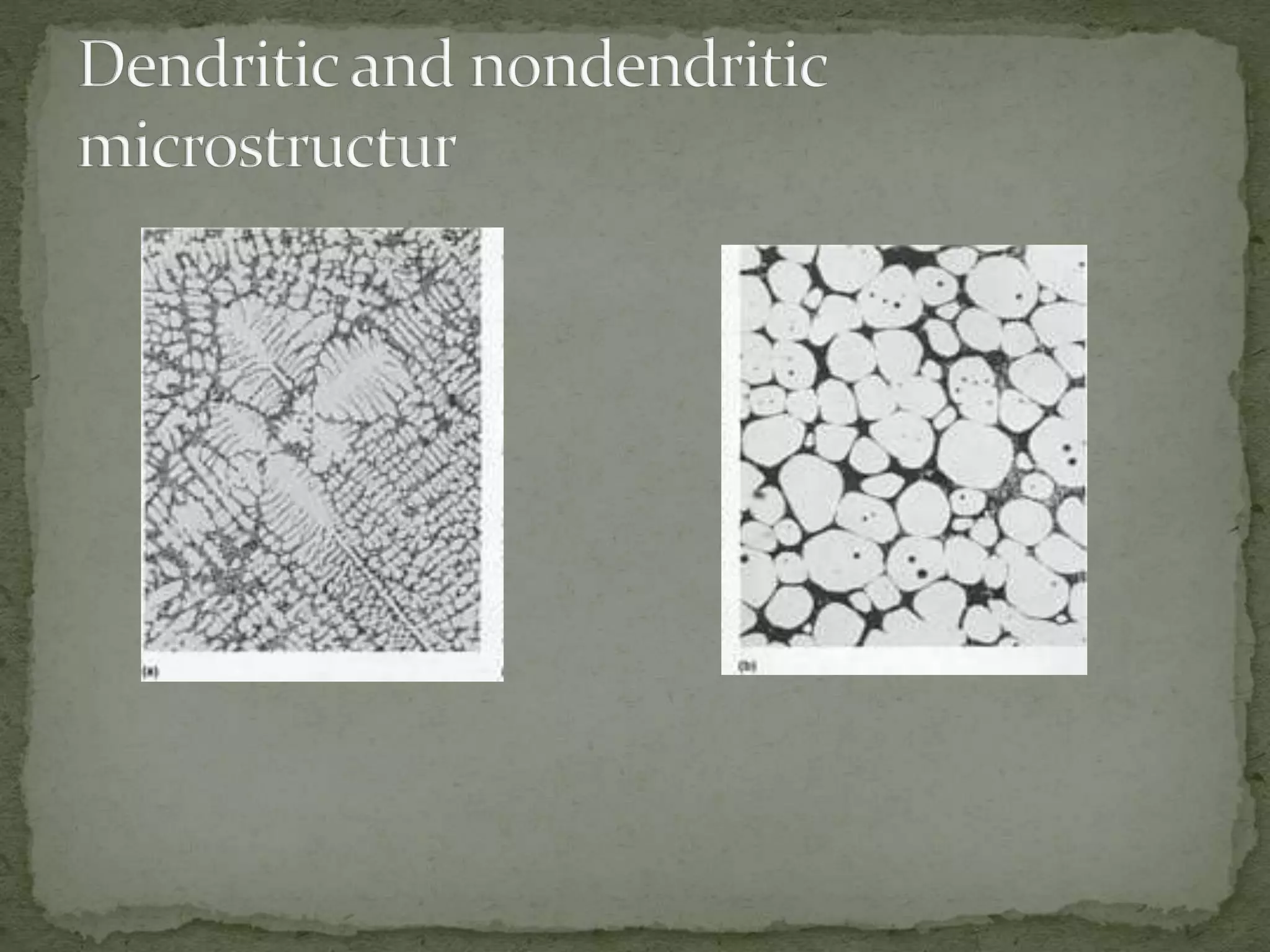
 So a novel nondendritic (spheroidal) microstructure .
 Semisolid alloys displayed viscosity that depends on shear rate and that risers
hundred to thousand of poise when at rest and yet increase to less than 5 to 50
poise upon vigorous agitation.
 So we can control the viscosity of alloy metal.
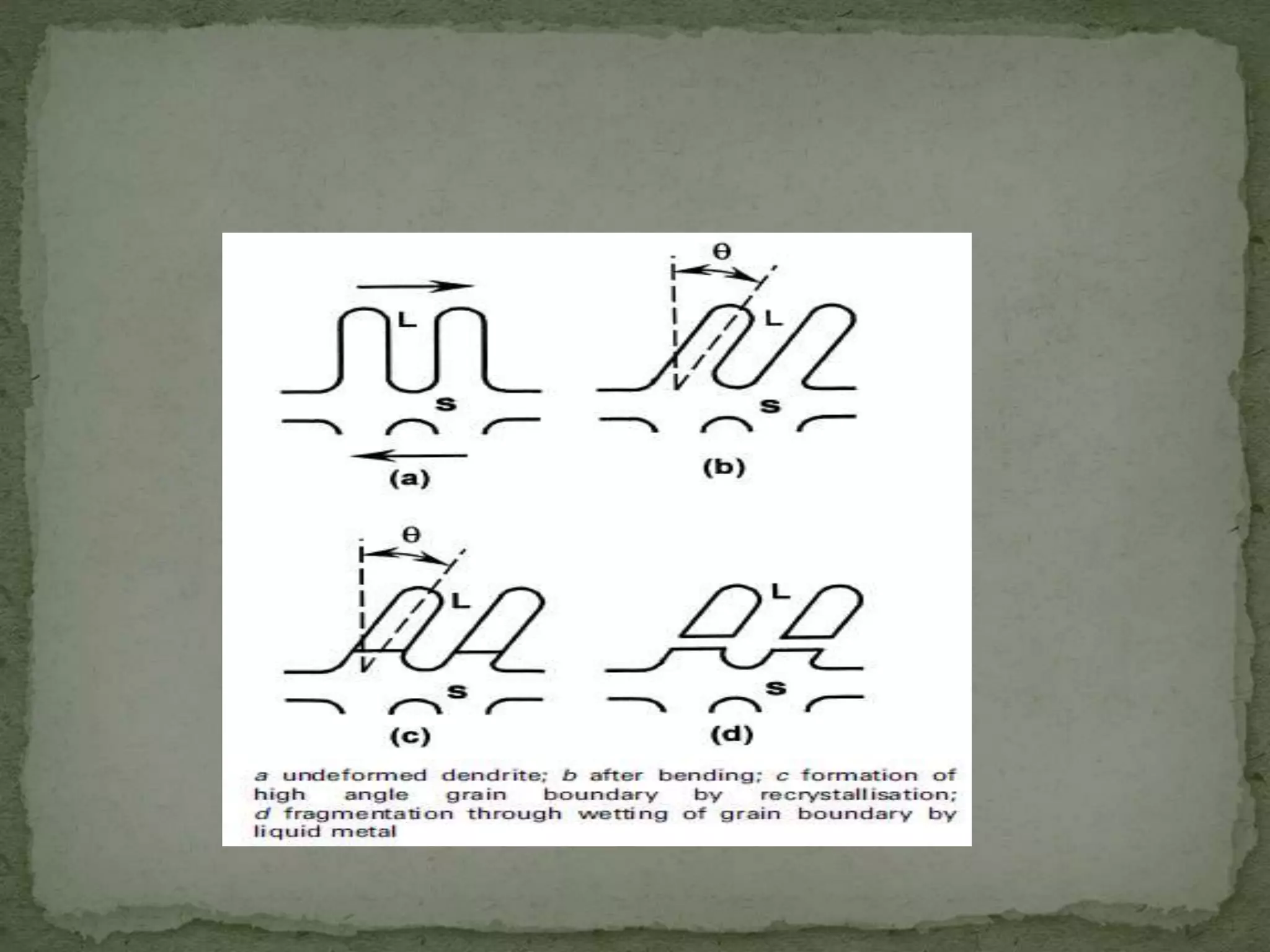
 Under forced convection
 Fragmentation of primary dendrites by
 Root melting of secondary dendritic arms
 Bending and shearing of secondary dendritic arms
 Bending and root melting of secondary arms
 Fragments of primary dendrites grow into globular grains
under forced convection
 Thixo is a general term used to describe the near-net shape forming
process from a partially melted nondendritic alloy slug within a metal
die.
 “Thixotropy”- viscosity decreases with time due to constant agitation
or strain.
 If the component shaping is performed in a closed die it is called Thixo
casting.
 If the component shaping is performed in an open die it is called Thixo
Forming.
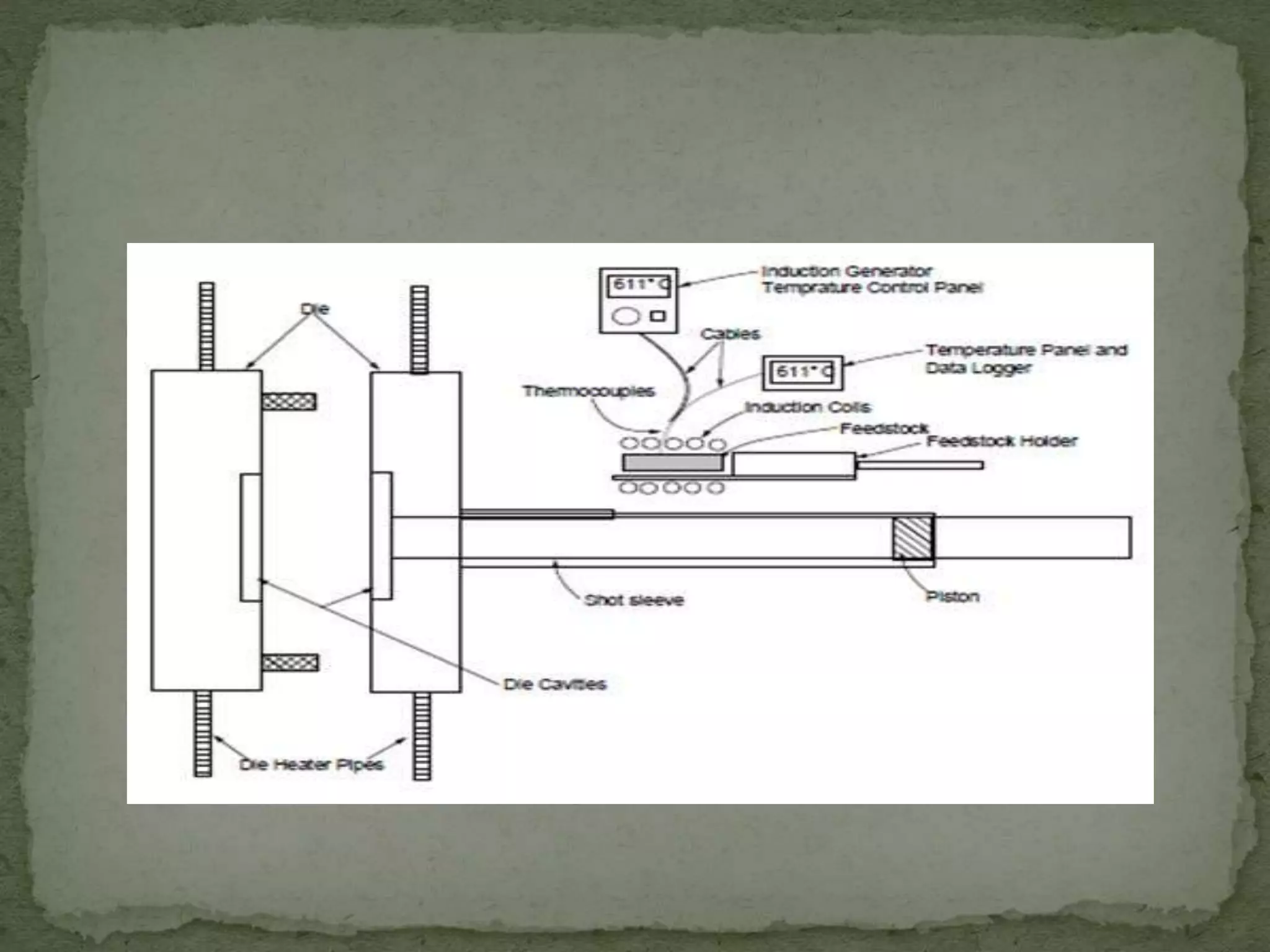
 Bar could be cast from semi-solid that possesses non
dendritic microstructure.
 These bar then represent a raw material that could be
heated.
 Process is conducted using a cold chamber high
pressure die casting.
 Medium frequency induction heater is used.
 Specimen are formed 50% liquid fraction and different
injection speed
 Temperature of the die is maintained at 150˚C
 Semi-solid metal working offers lower operating
temperature and reused metal heat content.
 Viscous flow behavior could provide laminar casting
fill which reduce gas entrapment.
 solidification shrinkage would be reduced in direct
proportion to fractional solidification within the semi-
solid metalworking alloy, which should reduce both
shrinkage porosity and tendency towards hot tears.
 Viscous nature of SSA provides environment for
metal-matrix composites.
 Blister – (occasionally ) on the surface of Al at 540˚c.
 Cold shut, fold and laps- (infrequent) Where two
metal meet but fusion is incomplete.
 Non fill- (infrequent) Due to premature freezing, low
pressure or metal velocity or entrapped mold
atmospheric air prevent the complete filling of die
cavity.
Remedy- increase the liquid fraction in slug,
raising die temperature, increase venting & higher
pressure and high velocity.
 Surface blow- (occasionally) When lubricant and
hydraulic fluid trapped on the die surface.
Remedy- Ensuring that all the die surface are clean
and dry.
 Hot tears (infrequent)
 Shrinkage porosity
Remedy- by adjusting of die temperature and
feeding section and by high temperature and pressure
during dwell time.
 Gas porosity- (very infrequent)can be due to high
gate velocity resulting excessive turbulence and
atmospheric gas entrapped.
Remedy- Decrease the velocity.
 Flow lines(occasionally)
 Manufacturing with complex shape thin wall etc.
 Good mechanical properties.
 High dimensional tolerance and accuracy.
 Globuletic micro structure.
 Near net shaped product.
 Lower forming temperature.
 longer die life.
 Need for special feed stock with near net spheroid
primary crystal.
 Expensive.
 Automotive wheel, motor brake cylinder, antilock
brake valve, disk brake caliper, engine piston
Thank you

Thixocasting

  • 1.
    VINAYAK KUMAR -212314011 SANJAY SINGH - 212314013
  • 2.
     Discovered atMIT in 1970  During research on hot tears  Molded by Lead-Tin alloys in the annular space created by two concentric cylinder.  Outer cylinder was rotated & discovered that the when the outer cylinder was continuously rotated the semisolid alloy exhibits low shear strenght even at high fraction of solidified.  So a novel nondendritic (spheroidal) microstructure .  Semisolid alloys displayed viscosity that depends on shear rate and that risers hundred to thousand of poise when at rest and yet increase to less than 5 to 50 poise upon vigorous agitation.  So we can control the viscosity of alloy metal.
  • 4.
     Under forcedconvection  Fragmentation of primary dendrites by  Root melting of secondary dendritic arms  Bending and shearing of secondary dendritic arms  Bending and root melting of secondary arms  Fragments of primary dendrites grow into globular grains under forced convection
  • 6.
     Thixo isa general term used to describe the near-net shape forming process from a partially melted nondendritic alloy slug within a metal die.  “Thixotropy”- viscosity decreases with time due to constant agitation or strain.  If the component shaping is performed in a closed die it is called Thixo casting.  If the component shaping is performed in an open die it is called Thixo Forming.
  • 7.
     Bar couldbe cast from semi-solid that possesses non dendritic microstructure.  These bar then represent a raw material that could be heated.  Process is conducted using a cold chamber high pressure die casting.  Medium frequency induction heater is used.  Specimen are formed 50% liquid fraction and different injection speed  Temperature of the die is maintained at 150˚C
  • 9.
     Semi-solid metalworking offers lower operating temperature and reused metal heat content.  Viscous flow behavior could provide laminar casting fill which reduce gas entrapment.  solidification shrinkage would be reduced in direct proportion to fractional solidification within the semi- solid metalworking alloy, which should reduce both shrinkage porosity and tendency towards hot tears.  Viscous nature of SSA provides environment for metal-matrix composites.
  • 10.
     Blister –(occasionally ) on the surface of Al at 540˚c.  Cold shut, fold and laps- (infrequent) Where two metal meet but fusion is incomplete.  Non fill- (infrequent) Due to premature freezing, low pressure or metal velocity or entrapped mold atmospheric air prevent the complete filling of die cavity. Remedy- increase the liquid fraction in slug, raising die temperature, increase venting & higher pressure and high velocity.
  • 11.
     Surface blow-(occasionally) When lubricant and hydraulic fluid trapped on the die surface. Remedy- Ensuring that all the die surface are clean and dry.  Hot tears (infrequent)  Shrinkage porosity Remedy- by adjusting of die temperature and feeding section and by high temperature and pressure during dwell time.
  • 12.
     Gas porosity-(very infrequent)can be due to high gate velocity resulting excessive turbulence and atmospheric gas entrapped. Remedy- Decrease the velocity.  Flow lines(occasionally)
  • 13.
     Manufacturing withcomplex shape thin wall etc.  Good mechanical properties.  High dimensional tolerance and accuracy.  Globuletic micro structure.  Near net shaped product.  Lower forming temperature.  longer die life.
  • 14.
     Need forspecial feed stock with near net spheroid primary crystal.  Expensive.
  • 15.
     Automotive wheel,motor brake cylinder, antilock brake valve, disk brake caliper, engine piston
  • 16.