Seminar Report
On
Study Of Rheocasting
Under Guidance of-
Dr. Amitesh Kumar
Presented By-
Satyaranjan pattanayak
Contents:
 Introduction
 Different Types Of Semisolid Metal
Working Process
 Benefits Of Semisolid Metal Casting
 Mechanism Of Semisolid Metal Casting
 Manufacture Of Rheocasting
 Slurry Generation For Rheocasting
 The Advantages Of Semisolid Casting
 The Disadvantages Of Semisolid
Casting
 Application
2
INTRODUCTION
Semisolid metal processing is a relatively
new technology which offer distinct advantage
over other near net shape manufacturing
process . This process is ideally suited for die
casting . In this process cast parts are
produced form a slurry kept at a temperature
between the solidus and the liquidus isotherm
. This process produced complex parts with
better quality when compared to parts made
by similar process. It also allows net shape
forming reducing farther machining operation.
The process combines the advantage of both
 In this process the raw material is melted
and allowed to cool and solidify, when the
dendrite formed during solidification are
broken up. The morphology of the dendrite
is altered using machanical
electromagnetic or other forces.
Subsequently , the specially prepared raw
material is remelted to its musy state, and ,
while the temperature is kept between the
liquid and solidus isotherm, it is then
processed to its final shape .
4
5
DIFFERENT TYPES -
•SEMISOLID METAL WORKING PROCESS
SEMI SOLID
METAL
PROCESS
THIXOCASTING
RHEOCASTING
THIXOMOLDING
SIMA
6
1 . Potentially for better control of flow , final
porosity and microstructure of cast parts,
2. Cast products with near-net shape complex
geometries ,
3. Reduced energy consumption due to lower
temperature processing of billets ,
4 . Increased productivity due to shorter
solidification time , reduced shrinkage ,
5 . Improved die life , and casting property ,
6.Improved ductility and dimensional repeatability
compared to conventional cast products .
BENEFITS OF SEMI SOLID METAL PROCESSING :
7
MECHANISM OF SSM CASTING -
There are two general approaches to the semi
solid metal working process: Rheocasting, in
which a slurry is produced in a mixer and
delivered directly into the die ,and thixoforming
in which a billet is heated to the semi solid
state and formed in the die. In semi solid
slurries the solid exists in the form of spherical
particles . slugs of semi solid alloy may
,therefore be injected into a die or shaped
between closed dies to produce components
near to shape with good surface finish ,free
from porosity and possessing fine uniform
microstructures.
8
 The exact mechanism for SSM structure formation
is still unclear . One theory that explain the
formation of semi solid metal structure is grain
multiplication of dendrite fragmentation . It has
been proposed that the convection produced
during the solidification causes dendrite arms to
“melt off “or “break off “ which then act as “
secondary nuclei “ particles. A schematic of the
dendrite multiplication process is shown in figure
below ,
 Then, the high density of the particles
generated allows non dendrite growth and
result in non dendritic , semisolid metal slurry.
 In this process it has been discovered that by
flowing gas bubbles through a porouss object
into the molten metal , held at atemperature
above the liquidus temperature , non-dendritic
, semi-solid metal slurry is obtained . The likely
mechanism of this process is grain
multiplication . in this case convention is
effectively archive by the flow of fine gas
bubbles in the melt. The convection helps to
generate “secondary nucvlei “ particles ,
resulting in a non-dendritic SSM structure .
9
10
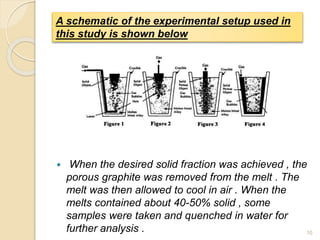
 When the desired solid fraction was achieved , the
porous graphite was removed from the melt . The
melt was then allowed to cool in air . When the
melts contained about 40-50% solid , some
samples were taken and quenched in water for
further analysis .
A schematic of the experimental setup used in
this study is shown below
11
•THERMAL ANALYSIS OF SSM –
From thermal analysis , the liquidus temperature and
eutectic temperature of different alloy at 612c , and 574 ,
571c respectively. Thus thermal analysis were used to
estimate the solid fraction of the alloy at different
temperature .
COOLING CURVE OF SSM ALLOY
 The rheocasting is a process of creating a
semi-solid slurry followed by its pushing into
a metal mold for freezing. Unlike
thixocasting, which re-heats a billet,
rheocasting develops the semi-solid slurry
from the molten metal produced in a typical
die casting furnace/machine. This is a big
advantage over thixocasting because it
results in less expensive feedstock, in the
form of typical die casting alloys, and allows
for direct recycling .
 Rheocasting involves preparation of SSM
slurry directly from the liquid alloy, followed
by a forming process such as High 12
RHEOCASTING
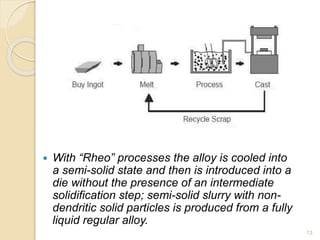
 With “Rheo” processes the alloy is cooled into
a semi-solid state and then is introduced into a
die without the presence of an intermediate
solidification step; semi-solid slurry with non-
dendritic solid particles is produced from a fully
liquid regular alloy.
13
 It is cooled to obtain the desired fraction
solid and then it is cast into a part.
Component shaping directly from SSM
slurries is inherently attractive due to its
characteristics, such as overall efficiency in
production and energy management .
 A critical advantage of rheocasting is the
ability to cast the metal at a wide range of
fraction solids. The majority of the process
advantages of using non-dendritic, semi-
solid alloys are dependent on the amount of
solid at the time of casting. Reduction of
shrinkage, a decreased amount of latent
heat, and the magnitude of viscosity are
dependent upon and increase of the 14
 However, as the fraction solid increases, semi-
solid casting begins to deviate from conventional
die casting processes. For the higher fraction solid
material, a more powerful shot end is required on
the die cast machine because of the much higher
viscosity of the alloy. Additionally, the stroke of the
piston is usually longer to accommodate the larger
opening in the cold chamber. Casting cycle time is
therefore shorter with high fraction solid casting,
but more costly changes are required for the die
casting machine to handle the more viscous 15
Microstructure of rheocast A356 alloy
16
•RHEOCASTING STEP WISE PROCESS :-
 As noted earlier ,there are a number
different rheocasting processes in
commercial production or under
development around the world.These
different rheocasting processes generally
differ in the manner in which the liquid is
cooled and the globular semi solid
microstructure generate the globular , semi
solid microstructure and most of the
different rheocasting processes use some
variation of these practices .The techniques
are:
 Stirring ;- similar to thixocasting ,the liquid
aluminum is stirred as it is cooled into the
17
SLURRY GENERATION FOR REHOCASTING :-
 Dendrite Fragmentation :- A variation to stirring
processes is the dendrite fragmentation technique
,where the melt is cooled below its liquidus
temperature and the semi solid alloy is treated in a
turbuient manner to break up the dendries ,
producing numerous small solid fragments that
can be coarsened into giobular shaped aluminum
particles
 Pressure waves ;- pressure waves generated in
the runner system have been shown to penerate
semi solid structures .
 Numerous solidification nuclei:- In this
technique ,the liquid is poured into a container
from a tempersture just above its liquidus
temperature.The rapid cooling generated during
pouring generates a large number of solid nuclei ,
which prevent the formation of dendrites , instead
producing a large number of globular solid
particles .Other grain refining techniques are used
to assist the generation of the large number of 18
19
 Due to the lower pressures and
temperatures required to die cast
semisolid metal
 the die material does not need to be
exotic. Often graphite or softer stainless
 steels may be used.
 • Even nonferrous dies can be used for
one time shots.
 • Because of this the process can be
applied to rapid prototyping needs and
mass
 production.
 • This also allows for the casting of high
THE ADVANTAGES OF SEMISOLID CASTING
 Stellite, if a higher temperature die
material is used.
 • Other advantages include: easily
automated, consistent, production rates
are
 equal to or better than die casting rates,
no air entrapment, low shrinkage rates,
 and a uniform microstructure.
20
 • Because thixotropy (semisolid state) is a
middle state in physical or rheological
 sense process conditions form a band so
narrow even environmental
 temperature differences have to be
considered.
 • Thus production facilities need a high level
of technology and operators require
 similar knowledge and training.
 • Relatively higher feedstock material cost
 • Precise control of operating condition is
required.
 • Liquid segregation may occur as a result of 21
THE DISADVANTAGES OF SEMISOLID CASTING
22
APPLICATIONS
• Potential Replacement of permanent mould parts
to eliminate machining and
finishing
• Pressure tight parts such as master brake
cylinders, fuel rails, air conditioner
compressor housing etc.
• High strength parts such as engine mounts, tie
rods etc.
• Wear resistant parts made from hypereutectic
alloys such as compressor piston,
brake drums, gear shift levers etc.
23
THANKYOU

Rheocasting

  • 1.
    Seminar Report On Study OfRheocasting Under Guidance of- Dr. Amitesh Kumar Presented By- Satyaranjan pattanayak
  • 2.
    Contents:  Introduction  DifferentTypes Of Semisolid Metal Working Process  Benefits Of Semisolid Metal Casting  Mechanism Of Semisolid Metal Casting  Manufacture Of Rheocasting  Slurry Generation For Rheocasting  The Advantages Of Semisolid Casting  The Disadvantages Of Semisolid Casting  Application 2
  • 3.
    INTRODUCTION Semisolid metal processingis a relatively new technology which offer distinct advantage over other near net shape manufacturing process . This process is ideally suited for die casting . In this process cast parts are produced form a slurry kept at a temperature between the solidus and the liquidus isotherm . This process produced complex parts with better quality when compared to parts made by similar process. It also allows net shape forming reducing farther machining operation. The process combines the advantage of both
  • 4.
     In thisprocess the raw material is melted and allowed to cool and solidify, when the dendrite formed during solidification are broken up. The morphology of the dendrite is altered using machanical electromagnetic or other forces. Subsequently , the specially prepared raw material is remelted to its musy state, and , while the temperature is kept between the liquid and solidus isotherm, it is then processed to its final shape . 4
  • 5.
    5 DIFFERENT TYPES - •SEMISOLIDMETAL WORKING PROCESS SEMI SOLID METAL PROCESS THIXOCASTING RHEOCASTING THIXOMOLDING SIMA
  • 6.
    6 1 . Potentiallyfor better control of flow , final porosity and microstructure of cast parts, 2. Cast products with near-net shape complex geometries , 3. Reduced energy consumption due to lower temperature processing of billets , 4 . Increased productivity due to shorter solidification time , reduced shrinkage , 5 . Improved die life , and casting property , 6.Improved ductility and dimensional repeatability compared to conventional cast products . BENEFITS OF SEMI SOLID METAL PROCESSING :
  • 7.
    7 MECHANISM OF SSMCASTING - There are two general approaches to the semi solid metal working process: Rheocasting, in which a slurry is produced in a mixer and delivered directly into the die ,and thixoforming in which a billet is heated to the semi solid state and formed in the die. In semi solid slurries the solid exists in the form of spherical particles . slugs of semi solid alloy may ,therefore be injected into a die or shaped between closed dies to produce components near to shape with good surface finish ,free from porosity and possessing fine uniform microstructures.
  • 8.
    8  The exactmechanism for SSM structure formation is still unclear . One theory that explain the formation of semi solid metal structure is grain multiplication of dendrite fragmentation . It has been proposed that the convection produced during the solidification causes dendrite arms to “melt off “or “break off “ which then act as “ secondary nuclei “ particles. A schematic of the dendrite multiplication process is shown in figure below ,
  • 9.
     Then, thehigh density of the particles generated allows non dendrite growth and result in non dendritic , semisolid metal slurry.  In this process it has been discovered that by flowing gas bubbles through a porouss object into the molten metal , held at atemperature above the liquidus temperature , non-dendritic , semi-solid metal slurry is obtained . The likely mechanism of this process is grain multiplication . in this case convention is effectively archive by the flow of fine gas bubbles in the melt. The convection helps to generate “secondary nucvlei “ particles , resulting in a non-dendritic SSM structure . 9
  • 10.
    10  When thedesired solid fraction was achieved , the porous graphite was removed from the melt . The melt was then allowed to cool in air . When the melts contained about 40-50% solid , some samples were taken and quenched in water for further analysis . A schematic of the experimental setup used in this study is shown below
  • 11.
    11 •THERMAL ANALYSIS OFSSM – From thermal analysis , the liquidus temperature and eutectic temperature of different alloy at 612c , and 574 , 571c respectively. Thus thermal analysis were used to estimate the solid fraction of the alloy at different temperature . COOLING CURVE OF SSM ALLOY
  • 12.
     The rheocastingis a process of creating a semi-solid slurry followed by its pushing into a metal mold for freezing. Unlike thixocasting, which re-heats a billet, rheocasting develops the semi-solid slurry from the molten metal produced in a typical die casting furnace/machine. This is a big advantage over thixocasting because it results in less expensive feedstock, in the form of typical die casting alloys, and allows for direct recycling .  Rheocasting involves preparation of SSM slurry directly from the liquid alloy, followed by a forming process such as High 12 RHEOCASTING
  • 13.
     With “Rheo”processes the alloy is cooled into a semi-solid state and then is introduced into a die without the presence of an intermediate solidification step; semi-solid slurry with non- dendritic solid particles is produced from a fully liquid regular alloy. 13
  • 14.
     It iscooled to obtain the desired fraction solid and then it is cast into a part. Component shaping directly from SSM slurries is inherently attractive due to its characteristics, such as overall efficiency in production and energy management .  A critical advantage of rheocasting is the ability to cast the metal at a wide range of fraction solids. The majority of the process advantages of using non-dendritic, semi- solid alloys are dependent on the amount of solid at the time of casting. Reduction of shrinkage, a decreased amount of latent heat, and the magnitude of viscosity are dependent upon and increase of the 14
  • 15.
     However, asthe fraction solid increases, semi- solid casting begins to deviate from conventional die casting processes. For the higher fraction solid material, a more powerful shot end is required on the die cast machine because of the much higher viscosity of the alloy. Additionally, the stroke of the piston is usually longer to accommodate the larger opening in the cold chamber. Casting cycle time is therefore shorter with high fraction solid casting, but more costly changes are required for the die casting machine to handle the more viscous 15 Microstructure of rheocast A356 alloy
  • 16.
  • 17.
     As notedearlier ,there are a number different rheocasting processes in commercial production or under development around the world.These different rheocasting processes generally differ in the manner in which the liquid is cooled and the globular semi solid microstructure generate the globular , semi solid microstructure and most of the different rheocasting processes use some variation of these practices .The techniques are:  Stirring ;- similar to thixocasting ,the liquid aluminum is stirred as it is cooled into the 17 SLURRY GENERATION FOR REHOCASTING :-
  • 18.
     Dendrite Fragmentation:- A variation to stirring processes is the dendrite fragmentation technique ,where the melt is cooled below its liquidus temperature and the semi solid alloy is treated in a turbuient manner to break up the dendries , producing numerous small solid fragments that can be coarsened into giobular shaped aluminum particles  Pressure waves ;- pressure waves generated in the runner system have been shown to penerate semi solid structures .  Numerous solidification nuclei:- In this technique ,the liquid is poured into a container from a tempersture just above its liquidus temperature.The rapid cooling generated during pouring generates a large number of solid nuclei , which prevent the formation of dendrites , instead producing a large number of globular solid particles .Other grain refining techniques are used to assist the generation of the large number of 18
  • 19.
    19  Due tothe lower pressures and temperatures required to die cast semisolid metal  the die material does not need to be exotic. Often graphite or softer stainless  steels may be used.  • Even nonferrous dies can be used for one time shots.  • Because of this the process can be applied to rapid prototyping needs and mass  production.  • This also allows for the casting of high THE ADVANTAGES OF SEMISOLID CASTING
  • 20.
     Stellite, ifa higher temperature die material is used.  • Other advantages include: easily automated, consistent, production rates are  equal to or better than die casting rates, no air entrapment, low shrinkage rates,  and a uniform microstructure. 20
  • 21.
     • Becausethixotropy (semisolid state) is a middle state in physical or rheological  sense process conditions form a band so narrow even environmental  temperature differences have to be considered.  • Thus production facilities need a high level of technology and operators require  similar knowledge and training.  • Relatively higher feedstock material cost  • Precise control of operating condition is required.  • Liquid segregation may occur as a result of 21 THE DISADVANTAGES OF SEMISOLID CASTING
  • 22.
    22 APPLICATIONS • Potential Replacementof permanent mould parts to eliminate machining and finishing • Pressure tight parts such as master brake cylinders, fuel rails, air conditioner compressor housing etc. • High strength parts such as engine mounts, tie rods etc. • Wear resistant parts made from hypereutectic alloys such as compressor piston, brake drums, gear shift levers etc.
  • 23.