MEM 678 Light Metals and Alloys
Pre-request MEM 680
* Physical metallurgy principles,
*Solidification processing of light alloys,
* High pressure gas atomization of light alloys,
* Spray forming of light alloys,
* Al alloy systems,
* Physical metallurgy of Al alloys,
* Structure- property relationship in Al alloys,
* Structure property and applications of Al-Li alloys,
Solidification processing of light alloys
Solidification
Solidification is a comprehensive process of transformation of the
melt of metals and alloys into a solid piece, involving formation of
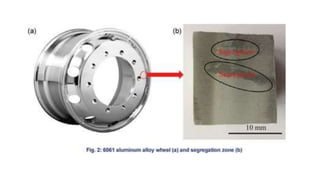
dendrites, segregation which involves change in composition, zone
formation in final structure of the casting, and microporosity
formation during shrinkage.
Dendrites in metals are multibranched crystals formed during
solidification or A dendrite in metallurgy is a characteristic tree-
like structure of crystals growing as molten metal solidifies, ,
The word dendrite comes from the Greek word “dendron”
which means a tree.
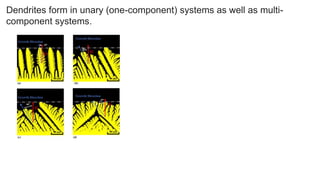
Dendrites form in unary (one-component) systems as well as multi-
component systems.
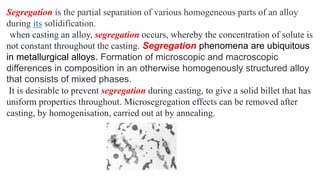
Segregation is the partial separation of various homogeneous parts of an alloy
during its solidification.
when casting an alloy, segregation occurs, whereby the concentration of solute is
not constant throughout the casting. Segregation phenomena are ubiquitous
in metallurgical alloys. Formation of microscopic and macroscopic
differences in composition in an otherwise homogenously structured alloy
that consists of mixed phases.
It is desirable to prevent segregation during casting, to give a solid billet that has
uniform properties throughout. Microsegregation effects can be removed after
casting, by homogenisation, carried out at by annealing.
Types of solidification within castings
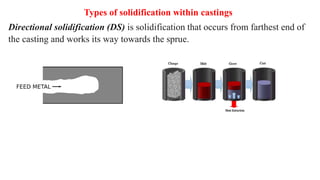
Directional solidification (DS) is solidification that occurs from farthest end of
the casting and works its way towards the sprue.
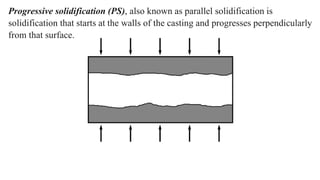
Progressive solidification (PS), also known as parallel solidification is
solidification that starts at the walls of the casting and progresses perpendicularly
from that surface.
The Importance of Solidification
Solidification controls the microstructure of the component or material formed
during casting. This microstructure is called as-solidified microstructure.
For shaped components made from casting, the assolidified microstructure is
generally completely or partly kept in the final products, so the as-solidified
microstructure can control the properties of the products when they are used.
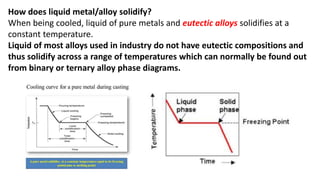
How does liquid metal/alloy solidify?
When being cooled, liquid of pure metals and eutectic alloys solidifies at a
constant temperature.
Liquid of most alloys used in industry do not have eutectic compositions and
thus solidify across a range of temperatures which can normally be found out
from binary or ternary alloy phase diagrams.
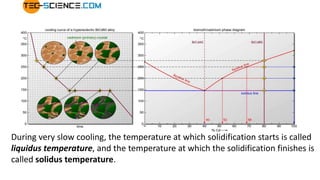
During very slow cooling, the temperature at which solidification starts is called
liquidus temperature, and the temperature at which the solidification finishes is
called solidus temperature.
Eutectics are alloys have a single melting temperature, which is usually lower
than that of any of the constitutive compounds. Eutectics form one single
common crystal when crystallized. One of the most important characteristics of
eutectics is their capability to melt/freeze congruently without phase segregation.
The eutectic point is when a solid solute, a solid solvent, and a liquid mixture all
exist in the same phase. The eutectic point is the lowest temperature at which
the liquid phase is stable at a given pressure.
A eutectic system is a homogenous, solid mixture of two or more substances
that form a super-lattice that melts or solidifies at a temperature lower than
any of the individual ingredients’ melting point. The term is most usually used
to describe a mix of metals.
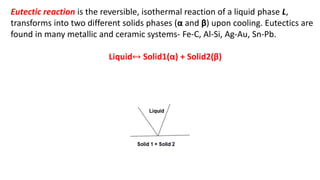
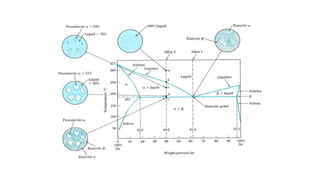
Eutectic reaction is the reversible, isothermal reaction of a liquid phase L,
transforms into two different solids phases (α and β) upon cooling. Eutectics are
found in many metallic and ceramic systems- Fe-C, Al-Si, Ag-Au, Sn-Pb.
Liquid↔ Solid1(α) + Solid2(β)
An eutectic alloy solidifies respectively melts completely at a precisely defined
temperature. Non-eutectic alloys, on the other hand, solidify or melt in a
temperature range, in a non-eutectic mixture, each component will solidify into
a lattice at its own specific temperature until the entire material solidifies.
Eutectic alloys vs non-eutectic alloys, the differences rely on at one specific
temperature or temperature range that the metal becomes a liquid.
The word “eutectic” comes from the Greek word “eutektos” which means
“easily melted”.
A eutectic-composition is an alloy of two or more metals, which, when heated
to its melting point (solidus temp.), will completely change from solid to liquid
at the same temperature (i.e., isothermally)
The word “eutectic” is used in metallurgical phase-diagrams, as well as used in
describing some of the features of metallurgical-structures within a solidified
Alloys.
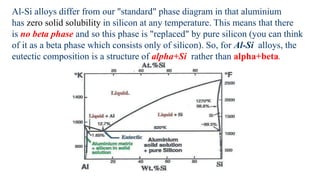
Al-Si alloys differ from our "standard" phase diagram in that aluminium
has zero solid solubility in silicon at any temperature. This means that there
is no beta phase and so this phase is "replaced" by pure silicon (you can think
of it as a beta phase which consists only of silicon). So, for Al-Si alloys, the
eutectic composition is a structure of alpha+Si rather than alpha+beta.
Rapid solidification (RS)
Rapid solidification (RS) of the light metals aluminum, magnesium, and
titanium can lead to enhanced mechanical properties which can be rationalized
in terms of the alloying behavior of these systems.
The engineering light metals, especially aluminum and magnesium, exhibit
limitations in alloying behavior and performance that identify them as particular
targets for development via rapid solidification.
Next Lecture
High pressure gas atomization of light alloys
Composites can be obtained by powder metallurgy method (a cost-effective way
to produce large quantities of complex parts and components across a variety
of industries), which can provide properties such as surface abrasion resistance,
surface friction and surface stresses at high temperatures. The technique of
powder production by powder metallurgy is done by 4 different methods. These;
mechanical ( grinding, crushing), chemical methods, electrolysis method
and atomization method. Among these production methods, gas atomization
method is most widely used to obtain fine and spherical powders.
Atomization is defined as the disintegration and solidification of molten metal
into very small droplets with water, air and gas pressures or mechanically, more
than half of the produced metal and nonmetallic powders don by gas
atomization, makes this method superior.
High pressure gas atomization (HPGA)
A technique for the manufacture of fine spherical metal powders. Supersonic gas jets are
used to disrupt a stream of liquid metal into droplets which then solidify in flight.
Because of the ease with which a liquid can be broken up into fine droplets,
atomization has become the prevailing mode of powder production of
nonferrous metals and their alloys. Atomization allows the manufacture of
rapidly solidified metal alloys. The use of rapid solidification of melts to produce
new structural and other materials with a complex of properties unachievable by
traditional metallurgy is not only a very popular subject of investigation, but also
finds a wide industrial application nowadays
Spray forming of light alloys
Spray forming, also known as spray casting, spray deposition and in-situ compaction, is a method
of casting near net shape metal components with homogeneous microstructures via the deposition of semi-solid
sprayed droplets onto a shaped substrate. In spray forming an alloy is melted, normally in an induction furnace, then
the molten metal is slowly poured through a conical tundish into a small-bore ceramic nozzle.
The gas atomised spray forming (GASF) process typically has a molten alloy flow rate of 1–20 kg/min,
although twin atomizer systems can achieve metal flow rates of up to 80 kg/min.

3rd Lecture Solidification processing of light alloys.pptx

  • 1.
    MEM 678 LightMetals and Alloys Pre-request MEM 680 * Physical metallurgy principles, *Solidification processing of light alloys, * High pressure gas atomization of light alloys, * Spray forming of light alloys, * Al alloy systems, * Physical metallurgy of Al alloys, * Structure- property relationship in Al alloys, * Structure property and applications of Al-Li alloys,
  • 2.
    Solidification processing oflight alloys Solidification Solidification is a comprehensive process of transformation of the melt of metals and alloys into a solid piece, involving formation of dendrites, segregation which involves change in composition, zone formation in final structure of the casting, and microporosity formation during shrinkage. Dendrites in metals are multibranched crystals formed during solidification or A dendrite in metallurgy is a characteristic tree- like structure of crystals growing as molten metal solidifies, , The word dendrite comes from the Greek word “dendron” which means a tree.
  • 3.
    Dendrites form inunary (one-component) systems as well as multi- component systems.
  • 4.
    Segregation is thepartial separation of various homogeneous parts of an alloy during its solidification. when casting an alloy, segregation occurs, whereby the concentration of solute is not constant throughout the casting. Segregation phenomena are ubiquitous in metallurgical alloys. Formation of microscopic and macroscopic differences in composition in an otherwise homogenously structured alloy that consists of mixed phases. It is desirable to prevent segregation during casting, to give a solid billet that has uniform properties throughout. Microsegregation effects can be removed after casting, by homogenisation, carried out at by annealing.
  • 6.
    Types of solidificationwithin castings Directional solidification (DS) is solidification that occurs from farthest end of the casting and works its way towards the sprue.
  • 7.
    Progressive solidification (PS),also known as parallel solidification is solidification that starts at the walls of the casting and progresses perpendicularly from that surface.
  • 8.
    The Importance ofSolidification Solidification controls the microstructure of the component or material formed during casting. This microstructure is called as-solidified microstructure. For shaped components made from casting, the assolidified microstructure is generally completely or partly kept in the final products, so the as-solidified microstructure can control the properties of the products when they are used.
  • 9.
    How does liquidmetal/alloy solidify? When being cooled, liquid of pure metals and eutectic alloys solidifies at a constant temperature. Liquid of most alloys used in industry do not have eutectic compositions and thus solidify across a range of temperatures which can normally be found out from binary or ternary alloy phase diagrams.
  • 10.
    During very slowcooling, the temperature at which solidification starts is called liquidus temperature, and the temperature at which the solidification finishes is called solidus temperature.
  • 11.
    Eutectics are alloyshave a single melting temperature, which is usually lower than that of any of the constitutive compounds. Eutectics form one single common crystal when crystallized. One of the most important characteristics of eutectics is their capability to melt/freeze congruently without phase segregation. The eutectic point is when a solid solute, a solid solvent, and a liquid mixture all exist in the same phase. The eutectic point is the lowest temperature at which the liquid phase is stable at a given pressure. A eutectic system is a homogenous, solid mixture of two or more substances that form a super-lattice that melts or solidifies at a temperature lower than any of the individual ingredients’ melting point. The term is most usually used to describe a mix of metals.
  • 12.
    Eutectic reaction isthe reversible, isothermal reaction of a liquid phase L, transforms into two different solids phases (α and β) upon cooling. Eutectics are found in many metallic and ceramic systems- Fe-C, Al-Si, Ag-Au, Sn-Pb. Liquid↔ Solid1(α) + Solid2(β)
  • 13.
    An eutectic alloysolidifies respectively melts completely at a precisely defined temperature. Non-eutectic alloys, on the other hand, solidify or melt in a temperature range, in a non-eutectic mixture, each component will solidify into a lattice at its own specific temperature until the entire material solidifies. Eutectic alloys vs non-eutectic alloys, the differences rely on at one specific temperature or temperature range that the metal becomes a liquid. The word “eutectic” comes from the Greek word “eutektos” which means “easily melted”. A eutectic-composition is an alloy of two or more metals, which, when heated to its melting point (solidus temp.), will completely change from solid to liquid at the same temperature (i.e., isothermally) The word “eutectic” is used in metallurgical phase-diagrams, as well as used in describing some of the features of metallurgical-structures within a solidified Alloys.
  • 15.
    Al-Si alloys differfrom our "standard" phase diagram in that aluminium has zero solid solubility in silicon at any temperature. This means that there is no beta phase and so this phase is "replaced" by pure silicon (you can think of it as a beta phase which consists only of silicon). So, for Al-Si alloys, the eutectic composition is a structure of alpha+Si rather than alpha+beta.
  • 16.
    Rapid solidification (RS) Rapidsolidification (RS) of the light metals aluminum, magnesium, and titanium can lead to enhanced mechanical properties which can be rationalized in terms of the alloying behavior of these systems. The engineering light metals, especially aluminum and magnesium, exhibit limitations in alloying behavior and performance that identify them as particular targets for development via rapid solidification.
  • 17.
  • 18.
    High pressure gasatomization of light alloys Composites can be obtained by powder metallurgy method (a cost-effective way to produce large quantities of complex parts and components across a variety of industries), which can provide properties such as surface abrasion resistance, surface friction and surface stresses at high temperatures. The technique of powder production by powder metallurgy is done by 4 different methods. These; mechanical ( grinding, crushing), chemical methods, electrolysis method and atomization method. Among these production methods, gas atomization method is most widely used to obtain fine and spherical powders. Atomization is defined as the disintegration and solidification of molten metal into very small droplets with water, air and gas pressures or mechanically, more than half of the produced metal and nonmetallic powders don by gas atomization, makes this method superior.
  • 19.
    High pressure gasatomization (HPGA) A technique for the manufacture of fine spherical metal powders. Supersonic gas jets are used to disrupt a stream of liquid metal into droplets which then solidify in flight. Because of the ease with which a liquid can be broken up into fine droplets, atomization has become the prevailing mode of powder production of nonferrous metals and their alloys. Atomization allows the manufacture of rapidly solidified metal alloys. The use of rapid solidification of melts to produce new structural and other materials with a complex of properties unachievable by traditional metallurgy is not only a very popular subject of investigation, but also finds a wide industrial application nowadays
  • 20.
    Spray forming oflight alloys Spray forming, also known as spray casting, spray deposition and in-situ compaction, is a method of casting near net shape metal components with homogeneous microstructures via the deposition of semi-solid sprayed droplets onto a shaped substrate. In spray forming an alloy is melted, normally in an induction furnace, then the molten metal is slowly poured through a conical tundish into a small-bore ceramic nozzle. The gas atomised spray forming (GASF) process typically has a molten alloy flow rate of 1–20 kg/min, although twin atomizer systems can achieve metal flow rates of up to 80 kg/min.