MNIT Jaipur
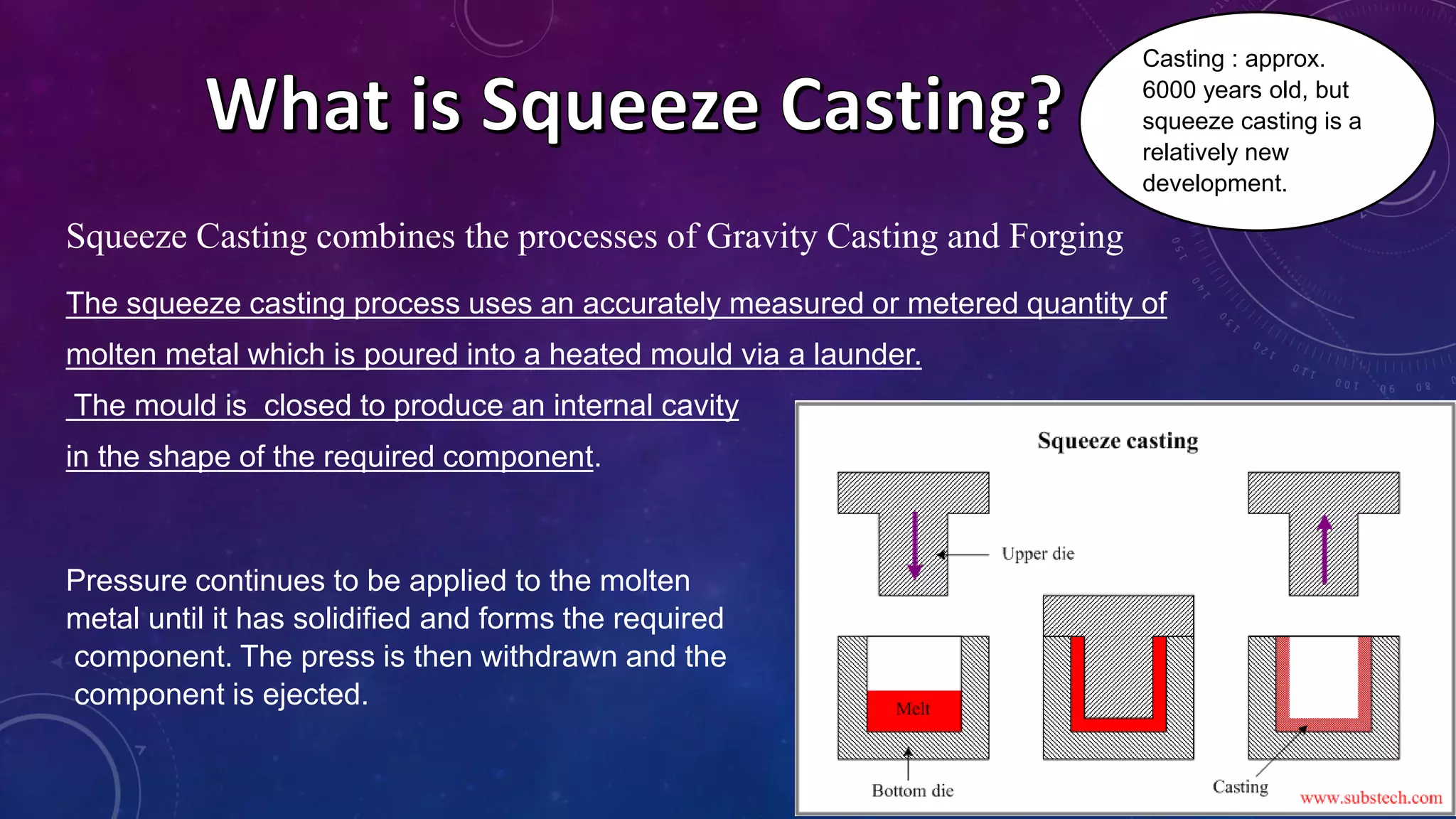
Squeeze Casting combines the processes of Gravity Casting and Forging
The squeeze casting process uses an accurately measured or metered quantity of
molten metal which is poured into a heated mould via a launder.
The mould is closed to produce an internal cavity
in the shape of the required component.
Pressure continues to be applied to the molten
metal until it has solidified and forms the required
component. The press is then withdrawn and the
component is ejected.
Casting : approx.
6000 years old, but
squeeze casting is a
relatively new
development.
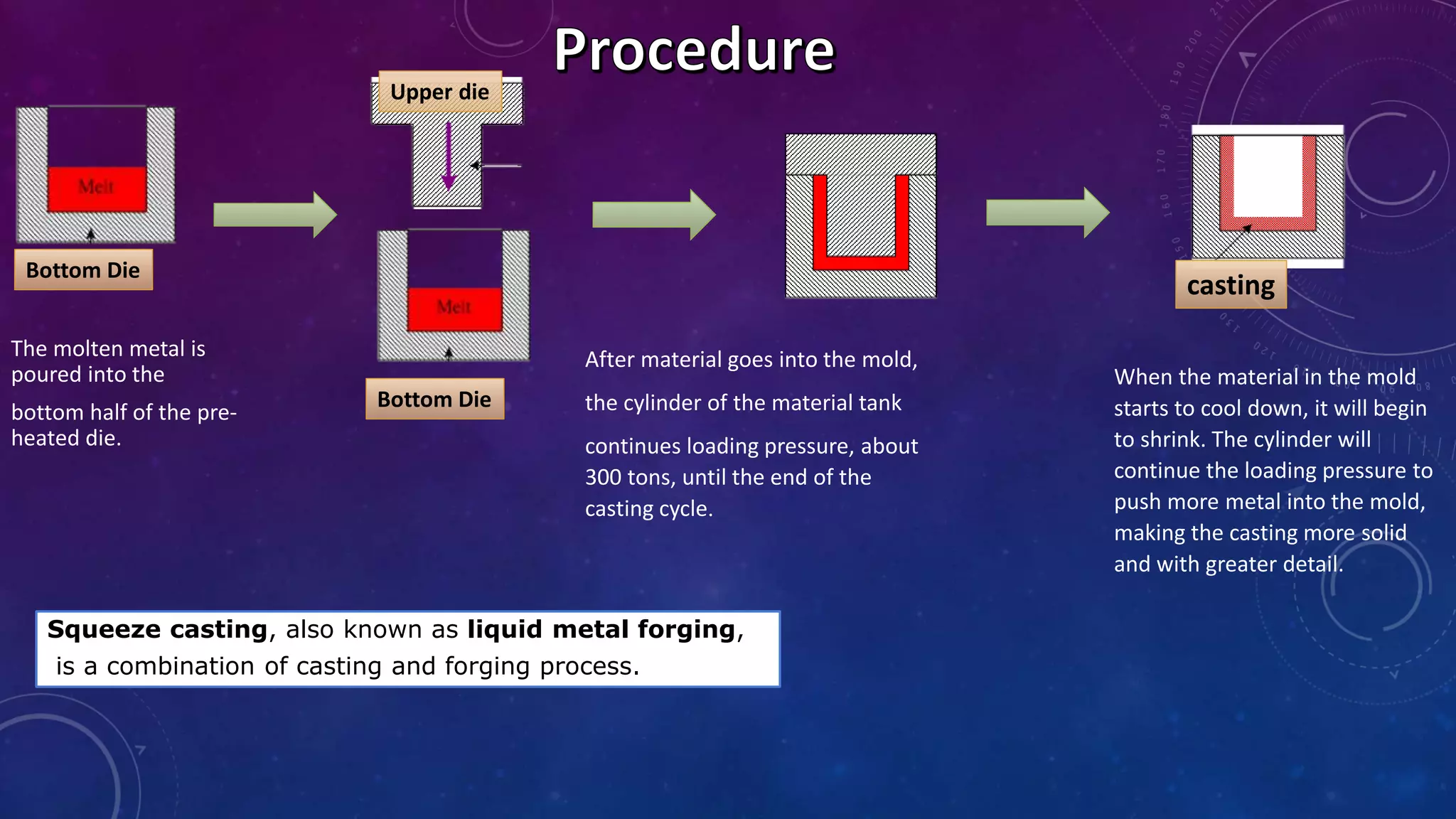
Squeeze casting, also known as liquid metal forging,
is a combination of casting and forging process.
The molten metal is
poured into the
bottom half of the pre-
heated die.
After material goes into the mold,
the cylinder of the material tank
continues loading pressure, about
300 tons, until the end of the
casting cycle.
When the material in the mold
starts to cool down, it will begin
to shrink. The cylinder will
continue the loading pressure to
push more metal into the mold,
making the casting more solid
and with greater detail.
Bottom Die
Bottom Die
Upper die
casting
Property Attained Reason
BETTER MICROSTRUCTURE Applied pressure decreases the diffusion of the melt and the stable melt with
better cooling gets a very fine grained structure
LESS CRACKS CHANCES The pressure on the melt reduces the chances of developing of crack due to
loose solidification, and reduces the chances of fracture
SMOOTH FINISHING Molten metal touches the surface of the die and then the pressure applied
makes the molten metal to be in contact with that of the surfaces perfectly,
thus a smooth surface finishing is observed
FASTER COOLING RATE cooling rate is increased by applying high pressure during solidification,
better contact between the casting and the die is improved by pressurization
-results in the foundation of fine-grained structures.
POROSITY REDUCTION Because of the high pressure applied during solidification, porosities caused
by both gas and shrinkage can be prevented or eliminated.
 Offers a broader range of shapes and components than other
manufacturing methods
 Little or no machining required post casting process
 Low levels of porosity
 Good surface texture
 Fine micro-structures with higher strength components
 No waste material, 100% utilization
Costs are very high due to complex tooling.
No flexibility as tooling is dedicated to specific
components.
Process needs to be accurately controlled which
slows the cycle time down and increases process
costs.
High costs mean high production volumes are
necessary to justify equipment investment.
Can be affected by premature chemical reaction, air
entrapment and failure to fill the cavity resulting in
reject components.
 Squeeze casting is most suited to the production of light alloy components in large production quantities
 Retractable and disposable cores can be used to create complex internal features
Both ferrous and non-ferrous materials can be produced using this method
 Light alloy castings can be produced in complex 3D shapes which are stronger than plastic equivalents.
 It has found extensive application in automotive industry in producing aluminium front steering knuckles,
chassis frames,
 Making of High capacity propellers for boat-engine.
PISTON, made by
squeeze castingCar rim
Squeeze casting

Squeeze casting

  • 1.
  • 2.
    Squeeze Casting combinesthe processes of Gravity Casting and Forging The squeeze casting process uses an accurately measured or metered quantity of molten metal which is poured into a heated mould via a launder. The mould is closed to produce an internal cavity in the shape of the required component. Pressure continues to be applied to the molten metal until it has solidified and forms the required component. The press is then withdrawn and the component is ejected. Casting : approx. 6000 years old, but squeeze casting is a relatively new development.
  • 3.
    Squeeze casting, alsoknown as liquid metal forging, is a combination of casting and forging process. The molten metal is poured into the bottom half of the pre- heated die. After material goes into the mold, the cylinder of the material tank continues loading pressure, about 300 tons, until the end of the casting cycle. When the material in the mold starts to cool down, it will begin to shrink. The cylinder will continue the loading pressure to push more metal into the mold, making the casting more solid and with greater detail. Bottom Die Bottom Die Upper die casting
  • 4.
    Property Attained Reason BETTERMICROSTRUCTURE Applied pressure decreases the diffusion of the melt and the stable melt with better cooling gets a very fine grained structure LESS CRACKS CHANCES The pressure on the melt reduces the chances of developing of crack due to loose solidification, and reduces the chances of fracture SMOOTH FINISHING Molten metal touches the surface of the die and then the pressure applied makes the molten metal to be in contact with that of the surfaces perfectly, thus a smooth surface finishing is observed FASTER COOLING RATE cooling rate is increased by applying high pressure during solidification, better contact between the casting and the die is improved by pressurization -results in the foundation of fine-grained structures. POROSITY REDUCTION Because of the high pressure applied during solidification, porosities caused by both gas and shrinkage can be prevented or eliminated.
  • 5.
     Offers abroader range of shapes and components than other manufacturing methods  Little or no machining required post casting process  Low levels of porosity  Good surface texture  Fine micro-structures with higher strength components  No waste material, 100% utilization
  • 6.
    Costs are veryhigh due to complex tooling. No flexibility as tooling is dedicated to specific components. Process needs to be accurately controlled which slows the cycle time down and increases process costs. High costs mean high production volumes are necessary to justify equipment investment. Can be affected by premature chemical reaction, air entrapment and failure to fill the cavity resulting in reject components.
  • 7.
     Squeeze castingis most suited to the production of light alloy components in large production quantities  Retractable and disposable cores can be used to create complex internal features Both ferrous and non-ferrous materials can be produced using this method  Light alloy castings can be produced in complex 3D shapes which are stronger than plastic equivalents.  It has found extensive application in automotive industry in producing aluminium front steering knuckles, chassis frames,  Making of High capacity propellers for boat-engine. PISTON, made by squeeze castingCar rim