Semi-Solid Metal Forming
Pierre Rossouw
02 December 2010

© CSIR 2010

www.csir.co.za
Outline
• Background
-

Organogram of MSM
Research Focus (ACT)

• SSM Forming
-

Background

-

CSIR’S Approach
Current Research

•
•
•
© CSIR 2010

Casting Alloys

Product Development

Wrought Alloys

Future

www.csir.co.za
Background
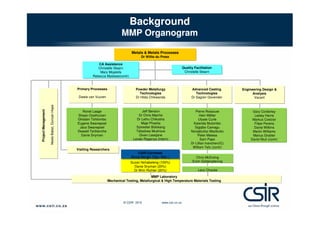
MMP Organogram
Metals & Metals Processes
Dr Willie du Preez
CA Assistance
Christelle Stearn
Mary Mojalefa
Rebecca Myelase(contr)

Primary Processes

Powder Metallurgy
Technologies
Dr Hilda Chikwanda

Neels Babst, Duncan Hope

Ronel Laage
Shaan Oosthuizen
Ghislain Tshilombo
Eugene Swanepoel
Jaco Swanepoel
Dewald Terblanche
Danie Snyman

Advanced Casting
Technologies
Dr Sagren Govender

Jeff Benson
Dr Chris Machio
Dr Lethu Chikosha
Maje Phasha
Sylvester Bolokang
Tafadzwa Mushove
Given Lesejane
Lerato Raganya (intern)

Dawie van Vuuren

Project Management

Quality Facilitation
Christelle Stearn

Pierre Rossouw
Hein Möller
Ulyate Curle
Kalenda Mutombo
Sigqibo Camagu
Nonjabuliso Mazibuko
Peter Malesa
Sam Papo
Dr Lillian Ivanchev(IC)
William Tefu (contr)

Visiting Researchers
CSIR-Cermalab
CSIR-Cermalab
Bruce Berger (Ops. Man.)
Suzan Nchabeleng (100%)
Danie Snyman (20%)
Dr Wim Richter (20%)

Chris McDuling
Erich Güldenpfennig
Levy Chauke

MMP Laboratory
Mechanical Testing, Metallurgical & High Temperature Materials Testing

© CSIR 2010

www.csir.co.za

Engineering Design &
Analysis
Vacant

Gary Corderley
Lesley Harris
Markus Coetzer
Filipe Pereira
Danie Wilkins
Martin Williams
Marius Grobler
David Ntuli (contr)
Background
Overview of Casting Research

Advanced Casting
HPDC

SSM

•New tool materials
•Improving net yield
•Foundry practice
for Al
•Development of a
VIVC HPDC Machine
•Squeeze casting
•Near Net shape
forming of AlMMCs

•SSM processing of
aluminium alloys
•Heat treatment of
SSM castings
•Development of the
CSIR-RCS
•Near Net shape
forming of AlMMCs

Funded by CSIR Parliamentary Grant
Funded by CSIR Parliamentary Grant and LMDN
Funded by DST
Funded by LMDN
© CSIR 2010

www.csir.co.za

Investment
Casting
•Titanium(90%)
•Counter gravity
casting of Aluminium
Magnesium
alloys(5%)
•Near net shape
forming of
AlMMCs(5%)
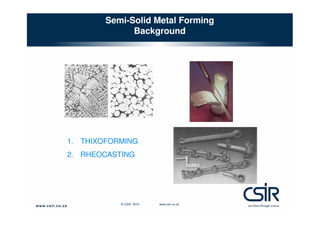
Semi-Solid Metal Forming
Background

1. THIXOFORMING
2. RHEOCASTING

© CSIR 2010

www.csir.co.za
Semi-Solid Metal Forming
Background - Potential Benefits

•

High wall thicknesses and different wall thicknesses can be
designed

•
•

Low gas porosity due to laminar filling and good airing

•
•

Production of thin walled components

•
•
•
•

Joining by LASER, MIG or WIG welding possible

Low solidification porosity due to a high solid fraction proportion
(fsolid ~50%)
Allows for the casting of wide range of alloys inclusive of high
strength wrought alloys.
Heat treatment from T0 - T7 possible
Near netshape or netshape parts production
Improved tool life

© CSIR 2010

www.csir.co.za
Semi-Solid Metal Forming
Background – Thixo VS Rheocasting
LIQUID
THIXO

RHEO

•CASTING
Known since 3000 BC

Liquidus temperature
Globular structure
formation

•SEMI-SOLID METAL
CASTING/FORMING

SEMI-SOLID

Known since 1973 AD

Solidus temperature

•HOT FORMING
Known since 3500 BC

SOLID
•COLD FORMING
Known since 4000 BC

Ambient temperature

© CSIR 2010

www.csir.co.za
Semi-Solid Metal Forming
Background- Thixoforming

SSM FEEDSTOCK

SSM FORMING PROCESS
© CSIR 2010

www.csir.co.za
Semi-Solid Metal Forming
Background- Thixoforming
Disadvantages
• High cost of feedstock material compared to normal foundry
alloys
• In order to meet production rates multiple induction heating
stations are required which requires high capital expenditure
• The scrap produced cannot be recycled on site and is also
devalued significantly
• The feedstock is supplied in specific lengths, which means
there would be additional scrap created by off cuts.
• During reheating oxidation of the billet surface occurs
therefore dies have to be designed to remove oxides during
the forming process.
• During reheating there are liquid metal losses from the billet
prior to casting.

© CSIR 2010

www.csir.co.za
Semi-Solid Metal Forming
Background- Rheocasting

Transfer

Cool

Liquid Metal

Semi-solid metal with
round grain structure
High Pressure Die Casting

© CSIR 2010

www.csir.co.za
Semi-Solid Metal Forming
Background- Rheocasting

Advantages
Cost of material same as standard
casting alloys

Disadvantages
Hydrogen Absorption
Process consistency

Semi-solid state achieved direct
from liquid.
Oxidation reduced – reduced oxide
entrapment.
Reduced loss of metal during
reheating.
SSM scrap can be recycled in
house.

© CSIR 2010

www.csir.co.za
Semi-Solid Metal Forming
Background- SSM Forming Research in SA

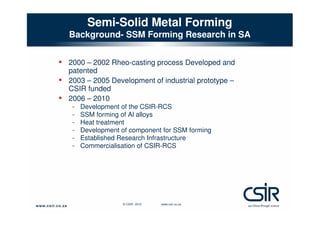
• 2000 – 2002 Rheo-casting process Developed and
•
•

patented
2003 – 2005 Development of industrial prototype –
CSIR funded
2006 – 2010

-

Development of the CSIR-RCS
SSM forming of Al alloys
Heat treatment
Development of component for SSM forming
Established Research Infrastructure
Commercialisation of CSIR-RCS

© CSIR 2010

www.csir.co.za
SSM Research at the CSIR
Goal

To provide the total SSM product
solution to the prospective client

© CSIR 2010

www.csir.co.za
SSM Research at the CSIR
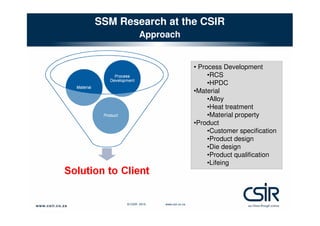
Approach

• Process Development
•RCS
•HPDC
•Material
•Alloy
•Heat treatment
•Material property
•Product
•Customer specification
•Product design
•Die design
•Product qualification
•Lifeing

© CSIR 2010

www.csir.co.za
SSM Research at the CSIR
Research Areas
Overview of SSM research
• Development of the CSIR-RCS for
commercialisation
• SSM processing of cast and wrought
aluminium alloys
• Heat treatment
• Corrosion
• Mechanical properties
• Product development

© CSIR 2010

www.csir.co.za
SSM Research at the CSIR
Infrastructure
130 Ton Shot Controlled HPDC
Machine

© CSIR 2010

CSIR – RCS Lab Prototype

www.csir.co.za
SSM Research at the CSIR
Infrastructure

© CSIR 2010

www.csir.co.za
SSM Research at the CSIR
Infrastructure
Dosing Furnace

Industrial scale prototype of
CSIR SSM billet machine

630 Ton LK shot control die casting machine
© CSIR 2010

www.csir.co.za
SSM Research at the CSIR
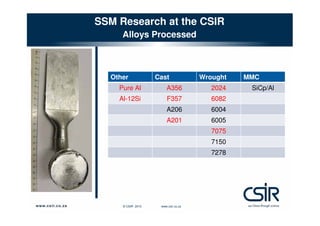
Alloys Processed

Other

Cast

Wrought

Pure Al

A356

2024

Al-12Si

F357

6082

A206

6004

A201

6005
7075
7150
7278

© CSIR 2010

www.csir.co.za

MMC
SiCp/Al
SSM Processing of Casting
Alloys

© CSIR 2010

www.csir.co.za
SSM Research at the CSIR
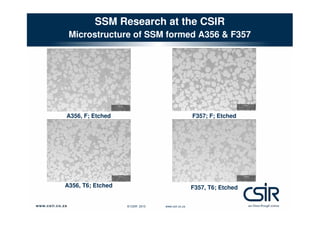
Microstructure of SSM formed A356 & F357

A356, F; Etched

F357; F; Etched

A356, T6; Etched

F357, T6; Etched
© CSIR 2010

www.csir.co.za
SSM Research at the CSIR
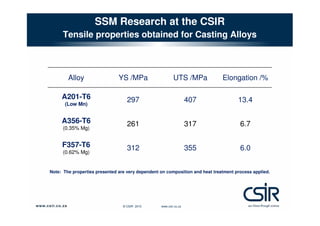
Tensile properties obtained for Casting Alloys

Alloy

YS /MPa

UTS /MPa

Elongation /%

A201-T6

297

407

13.4

261

317

6.7

312

355

6.0

(Low Mn)

A356-T6
(0.35% Mg)

F357-T6
(0.62% Mg)

Note: The properties presented are very dependent on composition and heat treatment process applied.

© CSIR 2010

www.csir.co.za
SSM Research at the CSIR
Influence of Mg on Tensile properties of A356/F357 Alloys

© CSIR 2010

www.csir.co.za
SSM Research at the CSIR
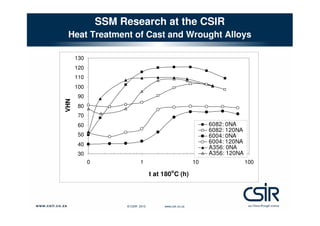
Heat Treatment of Cast and Wrought Alloys
130
120
110

VHN

100
90
80
70

6082: 0NA
6082: 120NA
6004: 0NA
6004: 120NA
A356: 0NA
A356: 120NA

60
50
40
30
0

1

10

t at 180oC (h)

© CSIR 2010

www.csir.co.za

100
SSM Processing of Wrought
Alloys

© CSIR 2010

www.csir.co.za
SSM Research at the CSIR
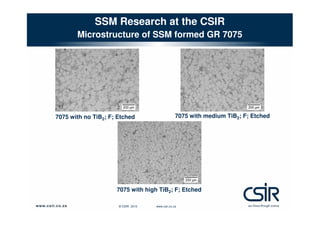
Microstructure of SSM formed GR 7075

7075 with no TiB2; F; Etched

7075 with medium TiB2; F; Etched

7075 with high TiB2; F; Etched
© CSIR 2010

www.csir.co.za
SSM Research at the CSIR
Microstructure of SSM formed GR 7075

no TiB2; T6; Etched

7075 with medium TiB2; T6; Etched

7075 with high TiB2; T6; Etched
© CSIR 2010

www.csir.co.za
SSM Research at the CSIR
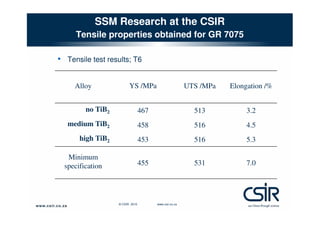
Tensile properties obtained for GR 7075

• Tensile test results; T6
YS /MPa

UTS /MPa

Elongation /%

no TiB2

467

513

3.2

medium TiB2

458

516

4.5

high TiB2

453

516

5.3

455

531

7.0

Alloy

Minimum
specification

© CSIR 2010

www.csir.co.za
SSM Research at the CSIR
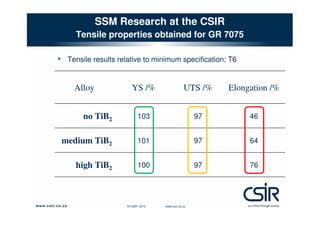
Tensile properties obtained for GR 7075

• Tensile results relative to minimum specification; T6
Alloy

YS /%

UTS /%

Elongation /%

no TiB2

103

97

46

medium TiB2

101

97

64

high TiB2

100

97

76

© CSIR 2010

www.csir.co.za
SSM Research at the CSIR
Microstructure of SSM Processed Wrought Alloys

• Microstructure: 2024

T6

F
(Etched)
© CSIR 2010

www.csir.co.za
SSM Research at the CSIR
Microstructure of SSM Processed Wrought Alloys

• Microstructure: 6082

T6

F
(Etched)
© CSIR 2010

www.csir.co.za
SSM Research at the CSIR
Microstructure of SSM Processed Wrought Alloys

• Microstructure: 7075

T6

F
(Etched)
© CSIR 2009

www.csir.co.za
SSM Research at the CSIR
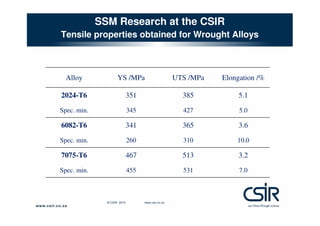
Tensile properties obtained for Wrought Alloys

Alloy

YS /MPa

UTS /MPa

Elongation /%

2024-T6

351

385

5.1

Spec. min.

345

427

5.0

6082-T6

341

365

3.6

Spec. min.

260

310

10.0

7075-T6

467

513

3.2

Spec. min.

455

531

7.0

© CSIR 2010

www.csir.co.za
SSM Research at the CSIR
Tensile properties obtained for Wrought Alloys
Tensile results relative to minimum specification

Alloy

YS /%

UTS /%

Elongation /%

2024-T6

102

90

102

6082-T6

131

118

36

7075-T6

103

97

46

© CSIR 2010

www.csir.co.za
© CSIR 2010

www.csir.co.za
SSM Research at the CSIR
Microstructure of SSM Processed High Purity Al

SSM HPDC High Purity Aluminium
© CSIR 2010

www.csir.co.za
SSM Research at the CSIR
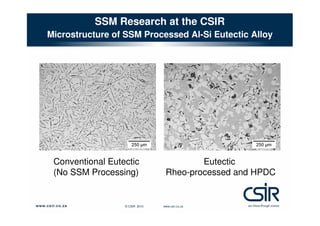
Microstructure of SSM Processed Al-Si Eutectic Alloy

Conventional Eutectic
(No SSM Processing)

© CSIR 2010

Eutectic
Rheo-processed and HPDC

www.csir.co.za
© CSIR 2010

www.csir.co.za
SSM Research at the CSIR
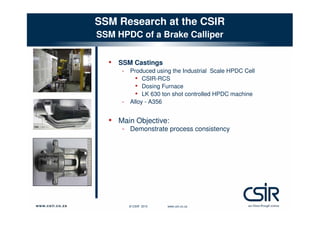
SSM HPDC of a Brake Calliper
•

SSM Castings

-

-

Produced using the Industrial Scale HPDC Cell
• CSIR-RCS
• Dosing Furnace
• LK 630 ton shot controlled HPDC machine
Alloy - A356

• Main Objective:
-

Demonstrate process consistency

© CSIR 2010

www.csir.co.za
SSM Research at the CSIR
SSM HPDC of a Brake Calliper

© CSIR 2010

www.csir.co.za
SSM Research at the CSIR
SSM HPDC of a Brake Calliper
Surface Liquid Segregation

© CSIR 2010

www.csir.co.za
SSM Research at the CSIR
SSM HPDC of a Brake Calliper
Hardness profiles through a cross section of SSM-HPDC brake calipers
F
T4 (540-1)
T4 (540-6)
T5 (180-4)
T5 (170-6)
T6(540-1,20NA,180-4)
T6(540-6,20NA,170-6)

150

VHN

130
110
90
70
50
0

2

4

6

8

10

12

Depth (mm)

© CSIR 2009

www.csir.co.za

14

16

18

20
SSM Research at the CSIR
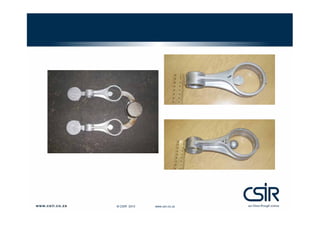
Product Development Case Study – Engine Mounting Bracket

Original component

Component redesigned
for SSM forming

© CSIR 2010

www.csir.co.za
© CSIR 2010

www.csir.co.za
SSM Research at the CSIR
Product Development Case Study – Engine Mounting Bracket
X-ray Analysis of a Casting

© CSIR 2010

www.csir.co.za
SSM Research at the CSIR
Product Development Case Study – Engine Mounting Bracket
Mechanical Properties

Tensile samples were
machined from this section

Summary of Mechanical Properties from Selected Castings
YS,
UTS,
A,
Condition
HB
MPa
MPa
%
F
71.2
104.3
180.0
5.2
T4
84.0
144.3
255.4
13.3
T6
109.7
255.5
315.2
5.38
T5
91.6
194.0
262.3
4.7
Minimum
85
167
275
1.5
requirements

© CSIR 2010

www.csir.co.za
SSM Research at the CSIR
Product Development – New Opportunities

•

Partner interest after initial discussions:

-

•

Component is identified
Al-alloy of wrought composition
Must meet minimum requirements of the customer
- Mechanical properties
- Cost
Partner to specify other applicable material properties

Intent:

-

Willing to apply CSIR-RCS technology if successful
Create manufacturing facility with jobs in South Africa
(Localisation)

© CSIR 2010

www.csir.co.za
CSIR-RCS: Large scale (2)
SSM Research at the CSIR
Product Development – New Opportunities
Preliminary Work
•

Component: Engine mounting bracket

-

•

Commercial 7075 (~ 150 kg furnace); A356
Rheo-processing parameters (pouring & SSM temp.)
HPDC shot parameters (velocity profile & intensification)
X-ray evaluation (defects)
Heat treatments (apply knowl. from plates)
Mechanical properties (compare with knowl. from plates)

Aim:

Preparation of niche component production

© CSIR 2010

www.csir.co.za
© CSIR 2010

www.csir.co.za
SSM Research at the CSIR

Future Work
•
•
•
•
•

Product development for client
SSM forming of high strength wrought alloys
Optimisation of heat treatments
Alloy development
Develop data base of mechanical properties

-

Tensile
Fatigue
Fracture

• Evaluation surface properties
-

Corrosion
Coatings

© CSIR 2010

www.csir.co.za
sgovender@csir.co.za
ucurle@csir.co.za
prossouw@csir.co.za

© CSIR 2010

www.csir.co.za

Semi solid metal forming

  • 1.
    Semi-Solid Metal Forming PierreRossouw 02 December 2010 © CSIR 2010 www.csir.co.za
  • 2.
    Outline • Background - Organogram ofMSM Research Focus (ACT) • SSM Forming - Background - CSIR’S Approach Current Research • • • © CSIR 2010 Casting Alloys Product Development Wrought Alloys Future www.csir.co.za
  • 3.
    Background MMP Organogram Metals &Metals Processes Dr Willie du Preez CA Assistance Christelle Stearn Mary Mojalefa Rebecca Myelase(contr) Primary Processes Powder Metallurgy Technologies Dr Hilda Chikwanda Neels Babst, Duncan Hope Ronel Laage Shaan Oosthuizen Ghislain Tshilombo Eugene Swanepoel Jaco Swanepoel Dewald Terblanche Danie Snyman Advanced Casting Technologies Dr Sagren Govender Jeff Benson Dr Chris Machio Dr Lethu Chikosha Maje Phasha Sylvester Bolokang Tafadzwa Mushove Given Lesejane Lerato Raganya (intern) Dawie van Vuuren Project Management Quality Facilitation Christelle Stearn Pierre Rossouw Hein Möller Ulyate Curle Kalenda Mutombo Sigqibo Camagu Nonjabuliso Mazibuko Peter Malesa Sam Papo Dr Lillian Ivanchev(IC) William Tefu (contr) Visiting Researchers CSIR-Cermalab CSIR-Cermalab Bruce Berger (Ops. Man.) Bruce Berger (Ops. Man.) Suzan Nchabeleng (100%) Danie Snyman (20%) Dr Wim Richter (20%) Chris McDuling Erich Güldenpfennig Levy Chauke MMP Laboratory Mechanical Testing, Metallurgical & High Temperature Materials Testing © CSIR 2010 www.csir.co.za Engineering Design & Analysis Vacant Gary Corderley Lesley Harris Markus Coetzer Filipe Pereira Danie Wilkins Martin Williams Marius Grobler David Ntuli (contr)
  • 4.
    Background Overview of CastingResearch Advanced Casting HPDC SSM •New tool materials •Improving net yield •Foundry practice for Al •Development of a VIVC HPDC Machine •Squeeze casting •Near Net shape forming of AlMMCs •SSM processing of aluminium alloys •Heat treatment of SSM castings •Development of the CSIR-RCS •Near Net shape forming of AlMMCs Funded by CSIR Parliamentary Grant Funded by CSIR Parliamentary Grant and LMDN Funded by DST Funded by LMDN © CSIR 2010 www.csir.co.za Investment Casting •Titanium(90%) •Counter gravity casting of Aluminium Magnesium alloys(5%) •Near net shape forming of AlMMCs(5%)
  • 5.
    Semi-Solid Metal Forming Background 1.THIXOFORMING 2. RHEOCASTING © CSIR 2010 www.csir.co.za
  • 6.
    Semi-Solid Metal Forming Background- Potential Benefits • High wall thicknesses and different wall thicknesses can be designed • • Low gas porosity due to laminar filling and good airing • • Production of thin walled components • • • • Joining by LASER, MIG or WIG welding possible Low solidification porosity due to a high solid fraction proportion (fsolid ~50%) Allows for the casting of wide range of alloys inclusive of high strength wrought alloys. Heat treatment from T0 - T7 possible Near netshape or netshape parts production Improved tool life © CSIR 2010 www.csir.co.za
  • 7.
    Semi-Solid Metal Forming Background– Thixo VS Rheocasting LIQUID THIXO RHEO •CASTING Known since 3000 BC Liquidus temperature Globular structure formation •SEMI-SOLID METAL CASTING/FORMING SEMI-SOLID Known since 1973 AD Solidus temperature •HOT FORMING Known since 3500 BC SOLID •COLD FORMING Known since 4000 BC Ambient temperature © CSIR 2010 www.csir.co.za
  • 8.
    Semi-Solid Metal Forming Background-Thixoforming SSM FEEDSTOCK SSM FORMING PROCESS © CSIR 2010 www.csir.co.za
  • 9.
    Semi-Solid Metal Forming Background-Thixoforming Disadvantages • High cost of feedstock material compared to normal foundry alloys • In order to meet production rates multiple induction heating stations are required which requires high capital expenditure • The scrap produced cannot be recycled on site and is also devalued significantly • The feedstock is supplied in specific lengths, which means there would be additional scrap created by off cuts. • During reheating oxidation of the billet surface occurs therefore dies have to be designed to remove oxides during the forming process. • During reheating there are liquid metal losses from the billet prior to casting. © CSIR 2010 www.csir.co.za
  • 10.
    Semi-Solid Metal Forming Background-Rheocasting Transfer Cool Liquid Metal Semi-solid metal with round grain structure High Pressure Die Casting © CSIR 2010 www.csir.co.za
  • 11.
    Semi-Solid Metal Forming Background-Rheocasting Advantages Cost of material same as standard casting alloys Disadvantages Hydrogen Absorption Process consistency Semi-solid state achieved direct from liquid. Oxidation reduced – reduced oxide entrapment. Reduced loss of metal during reheating. SSM scrap can be recycled in house. © CSIR 2010 www.csir.co.za
  • 12.
    Semi-Solid Metal Forming Background-SSM Forming Research in SA • 2000 – 2002 Rheo-casting process Developed and • • patented 2003 – 2005 Development of industrial prototype – CSIR funded 2006 – 2010 - Development of the CSIR-RCS SSM forming of Al alloys Heat treatment Development of component for SSM forming Established Research Infrastructure Commercialisation of CSIR-RCS © CSIR 2010 www.csir.co.za
  • 13.
    SSM Research atthe CSIR Goal To provide the total SSM product solution to the prospective client © CSIR 2010 www.csir.co.za
  • 14.
    SSM Research atthe CSIR Approach • Process Development •RCS •HPDC •Material •Alloy •Heat treatment •Material property •Product •Customer specification •Product design •Die design •Product qualification •Lifeing © CSIR 2010 www.csir.co.za
  • 15.
    SSM Research atthe CSIR Research Areas Overview of SSM research • Development of the CSIR-RCS for commercialisation • SSM processing of cast and wrought aluminium alloys • Heat treatment • Corrosion • Mechanical properties • Product development © CSIR 2010 www.csir.co.za
  • 16.
    SSM Research atthe CSIR Infrastructure 130 Ton Shot Controlled HPDC Machine © CSIR 2010 CSIR – RCS Lab Prototype www.csir.co.za
  • 17.
    SSM Research atthe CSIR Infrastructure © CSIR 2010 www.csir.co.za
  • 18.
    SSM Research atthe CSIR Infrastructure Dosing Furnace Industrial scale prototype of CSIR SSM billet machine 630 Ton LK shot control die casting machine © CSIR 2010 www.csir.co.za
  • 19.
    SSM Research atthe CSIR Alloys Processed Other Cast Wrought Pure Al A356 2024 Al-12Si F357 6082 A206 6004 A201 6005 7075 7150 7278 © CSIR 2010 www.csir.co.za MMC SiCp/Al
  • 20.
    SSM Processing ofCasting Alloys © CSIR 2010 www.csir.co.za
  • 21.
    SSM Research atthe CSIR Microstructure of SSM formed A356 & F357 A356, F; Etched F357; F; Etched A356, T6; Etched F357, T6; Etched © CSIR 2010 www.csir.co.za
  • 22.
    SSM Research atthe CSIR Tensile properties obtained for Casting Alloys Alloy YS /MPa UTS /MPa Elongation /% A201-T6 297 407 13.4 261 317 6.7 312 355 6.0 (Low Mn) A356-T6 (0.35% Mg) F357-T6 (0.62% Mg) Note: The properties presented are very dependent on composition and heat treatment process applied. © CSIR 2010 www.csir.co.za
  • 23.
    SSM Research atthe CSIR Influence of Mg on Tensile properties of A356/F357 Alloys © CSIR 2010 www.csir.co.za
  • 24.
    SSM Research atthe CSIR Heat Treatment of Cast and Wrought Alloys 130 120 110 VHN 100 90 80 70 6082: 0NA 6082: 120NA 6004: 0NA 6004: 120NA A356: 0NA A356: 120NA 60 50 40 30 0 1 10 t at 180oC (h) © CSIR 2010 www.csir.co.za 100
  • 25.
    SSM Processing ofWrought Alloys © CSIR 2010 www.csir.co.za
  • 26.
    SSM Research atthe CSIR Microstructure of SSM formed GR 7075 7075 with no TiB2; F; Etched 7075 with medium TiB2; F; Etched 7075 with high TiB2; F; Etched © CSIR 2010 www.csir.co.za
  • 27.
    SSM Research atthe CSIR Microstructure of SSM formed GR 7075 no TiB2; T6; Etched 7075 with medium TiB2; T6; Etched 7075 with high TiB2; T6; Etched © CSIR 2010 www.csir.co.za
  • 28.
    SSM Research atthe CSIR Tensile properties obtained for GR 7075 • Tensile test results; T6 YS /MPa UTS /MPa Elongation /% no TiB2 467 513 3.2 medium TiB2 458 516 4.5 high TiB2 453 516 5.3 455 531 7.0 Alloy Minimum specification © CSIR 2010 www.csir.co.za
  • 29.
    SSM Research atthe CSIR Tensile properties obtained for GR 7075 • Tensile results relative to minimum specification; T6 Alloy YS /% UTS /% Elongation /% no TiB2 103 97 46 medium TiB2 101 97 64 high TiB2 100 97 76 © CSIR 2010 www.csir.co.za
  • 30.
    SSM Research atthe CSIR Microstructure of SSM Processed Wrought Alloys • Microstructure: 2024 T6 F (Etched) © CSIR 2010 www.csir.co.za
  • 31.
    SSM Research atthe CSIR Microstructure of SSM Processed Wrought Alloys • Microstructure: 6082 T6 F (Etched) © CSIR 2010 www.csir.co.za
  • 32.
    SSM Research atthe CSIR Microstructure of SSM Processed Wrought Alloys • Microstructure: 7075 T6 F (Etched) © CSIR 2009 www.csir.co.za
  • 33.
    SSM Research atthe CSIR Tensile properties obtained for Wrought Alloys Alloy YS /MPa UTS /MPa Elongation /% 2024-T6 351 385 5.1 Spec. min. 345 427 5.0 6082-T6 341 365 3.6 Spec. min. 260 310 10.0 7075-T6 467 513 3.2 Spec. min. 455 531 7.0 © CSIR 2010 www.csir.co.za
  • 34.
    SSM Research atthe CSIR Tensile properties obtained for Wrought Alloys Tensile results relative to minimum specification Alloy YS /% UTS /% Elongation /% 2024-T6 102 90 102 6082-T6 131 118 36 7075-T6 103 97 46 © CSIR 2010 www.csir.co.za
  • 35.
  • 36.
    SSM Research atthe CSIR Microstructure of SSM Processed High Purity Al SSM HPDC High Purity Aluminium © CSIR 2010 www.csir.co.za
  • 37.
    SSM Research atthe CSIR Microstructure of SSM Processed Al-Si Eutectic Alloy Conventional Eutectic (No SSM Processing) © CSIR 2010 Eutectic Rheo-processed and HPDC www.csir.co.za
  • 38.
  • 39.
    SSM Research atthe CSIR SSM HPDC of a Brake Calliper • SSM Castings - - Produced using the Industrial Scale HPDC Cell • CSIR-RCS • Dosing Furnace • LK 630 ton shot controlled HPDC machine Alloy - A356 • Main Objective: - Demonstrate process consistency © CSIR 2010 www.csir.co.za
  • 40.
    SSM Research atthe CSIR SSM HPDC of a Brake Calliper © CSIR 2010 www.csir.co.za
  • 41.
    SSM Research atthe CSIR SSM HPDC of a Brake Calliper Surface Liquid Segregation © CSIR 2010 www.csir.co.za
  • 42.
    SSM Research atthe CSIR SSM HPDC of a Brake Calliper Hardness profiles through a cross section of SSM-HPDC brake calipers F T4 (540-1) T4 (540-6) T5 (180-4) T5 (170-6) T6(540-1,20NA,180-4) T6(540-6,20NA,170-6) 150 VHN 130 110 90 70 50 0 2 4 6 8 10 12 Depth (mm) © CSIR 2009 www.csir.co.za 14 16 18 20
  • 43.
    SSM Research atthe CSIR Product Development Case Study – Engine Mounting Bracket Original component Component redesigned for SSM forming © CSIR 2010 www.csir.co.za
  • 44.
  • 45.
    SSM Research atthe CSIR Product Development Case Study – Engine Mounting Bracket X-ray Analysis of a Casting © CSIR 2010 www.csir.co.za
  • 46.
    SSM Research atthe CSIR Product Development Case Study – Engine Mounting Bracket Mechanical Properties Tensile samples were machined from this section Summary of Mechanical Properties from Selected Castings YS, UTS, A, Condition HB MPa MPa % F 71.2 104.3 180.0 5.2 T4 84.0 144.3 255.4 13.3 T6 109.7 255.5 315.2 5.38 T5 91.6 194.0 262.3 4.7 Minimum 85 167 275 1.5 requirements © CSIR 2010 www.csir.co.za
  • 47.
    SSM Research atthe CSIR Product Development – New Opportunities • Partner interest after initial discussions: - • Component is identified Al-alloy of wrought composition Must meet minimum requirements of the customer - Mechanical properties - Cost Partner to specify other applicable material properties Intent: - Willing to apply CSIR-RCS technology if successful Create manufacturing facility with jobs in South Africa (Localisation) © CSIR 2010 www.csir.co.za
  • 48.
    CSIR-RCS: Large scale(2) SSM Research at the CSIR Product Development – New Opportunities Preliminary Work • Component: Engine mounting bracket - • Commercial 7075 (~ 150 kg furnace); A356 Rheo-processing parameters (pouring & SSM temp.) HPDC shot parameters (velocity profile & intensification) X-ray evaluation (defects) Heat treatments (apply knowl. from plates) Mechanical properties (compare with knowl. from plates) Aim: Preparation of niche component production © CSIR 2010 www.csir.co.za
  • 49.
  • 50.
    SSM Research atthe CSIR Future Work • • • • • Product development for client SSM forming of high strength wrought alloys Optimisation of heat treatments Alloy development Develop data base of mechanical properties - Tensile Fatigue Fracture • Evaluation surface properties - Corrosion Coatings © CSIR 2010 www.csir.co.za
  • 51.