Manufacturing Processes
Mrs.K.DORATHI
Dept. of Mechanical Engineering
SRI VASAVI ENGINEERING COLLEGE
Manufacturing
Manufacturing basically implies making of
goods or articles and providing services to meet
the needs of mankind.
Manufacturing process is that part of the production
process which is directly concerned with the change of
form or dimensions of the part being produced.
•Began about 5000 to 4000 B.C with the production of various
articles of wood, ceramic, stone and metal
• Derived from Latin word manu factus – meaning “made by hand”
• The word manufacture first appeared in 1567
• The word manufacturing appeared in 1683
• Production is also used interchangeably .
Evolution of Manufacturing
Traditional Manufacturing Processes
Casting
Forming
Sheet metal processing
Joining
Plastics processing
Lathe
Casting since about 4000 BC…
Ancient Greece; bronze
statue casting circa 450BC
Iron works in early Europe,
e.g. cast iron cannons from
England circa 1543
Casting Process
• Casting process is one of the earliest metal
shaping techniques known to human being.
• It means pouring molten metal into a refractory
mold cavity and allows it to solidify.
• The solidified object is taken out from the mold
either by breaking or taking the mold apart.
• The solidified object is called casting and the
technique followed in method is known as casting
process.
Six basic steps in this process:
• Place a pattern in sand to create a mold.
• Incorporate the pattern and sand in a gating
system.
• Remove the pattern.
• Fill the mold cavity with molten metal.
• Allow the metal to cool.
• Break away the sand mold and remove the
casting.
Casting Terminology
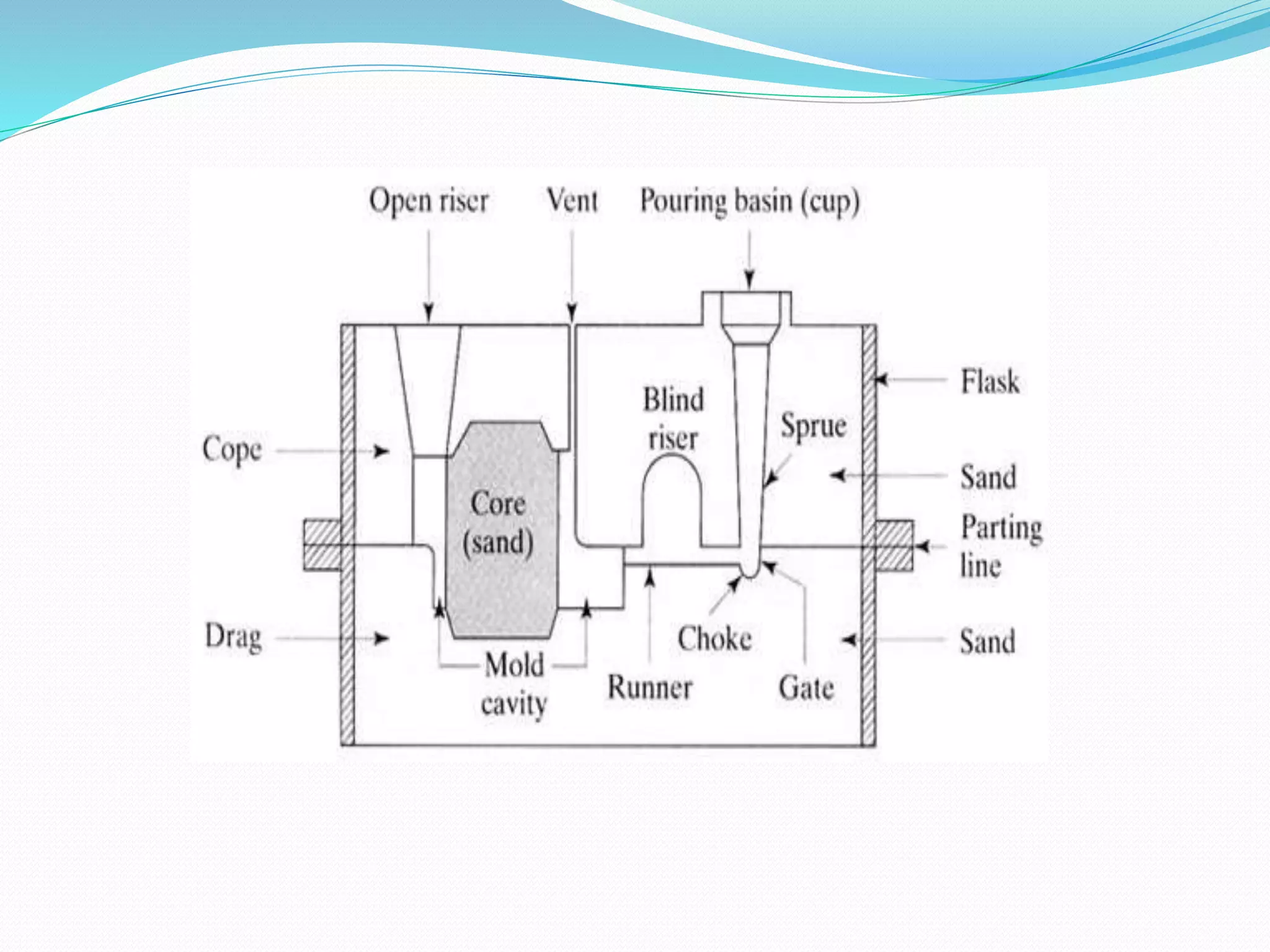
• Pattern: An approximate duplicate or true
replica of required product of casting
• Flask/Box: The rigid metal or a wooden frame
that holds the moulding material
• Cope: Top half of the moulding box
• Drag: Bottom half of the moulding box
• Core: Shape that is inserted into a mould to
produce internal features of a casting such as
holes.
Continue…..
• Riser: A vertical opening in the mould
• Act as a vent for gases
• Helps to confirm that the mould is completely
filled
• Act as a reservoir of molten metal to feed and
compensate for shrinkage during solidification
of a casting
Continue….
• Gating System: Channels used to deliver the
molten metal to the mould cavity
• Sprue: The vertical passage in the gating
system
• Runner: The horizontal channel of the gating
system
• Gate: Channel which connects runner and
mould
Advantages
• Product can be cast as one piece.
• Very heavy and bulky parts can be
manufactured
• Metals difficult to be shaped by other
manufacturing processes may be cast (eg: Cast
Iron)
• Best for mass production
• Complex shapes can be manufactured
• VERSATILE: complex geometry, internal cavities, hollow sections
• VERSATILE: small (~10 grams)  very large parts (~1000 Kg)
• ECONOMICAL: little wastage (extra metal is re-used)
• ISOTROPIC: cast parts have same properties along all directions
Disadvantages of Casting
• Casting process is a labour intensive process
• Not possible for high melting point metals
• Dimensional accuracy, surface finish and the
amount of defects depends on the casting
process
• Allowances required.
Applications
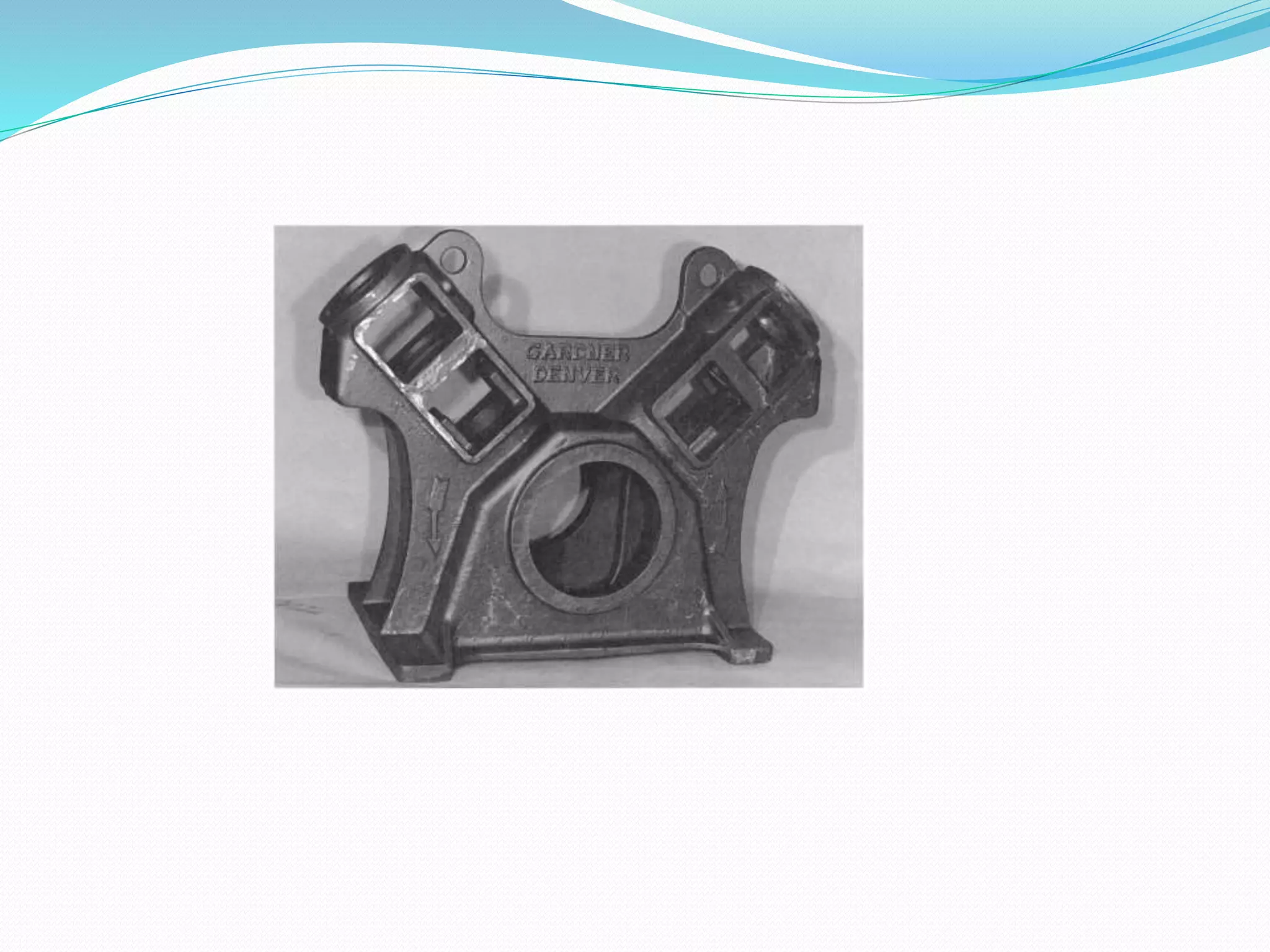
• Transportation vehicles(eg.:engines)
• Machine tool structures.
• Turbine vanes
• Mill housing
• Valves
• Sanitary fittings
• Agricultural parts
• Construction &atomic energy applications.
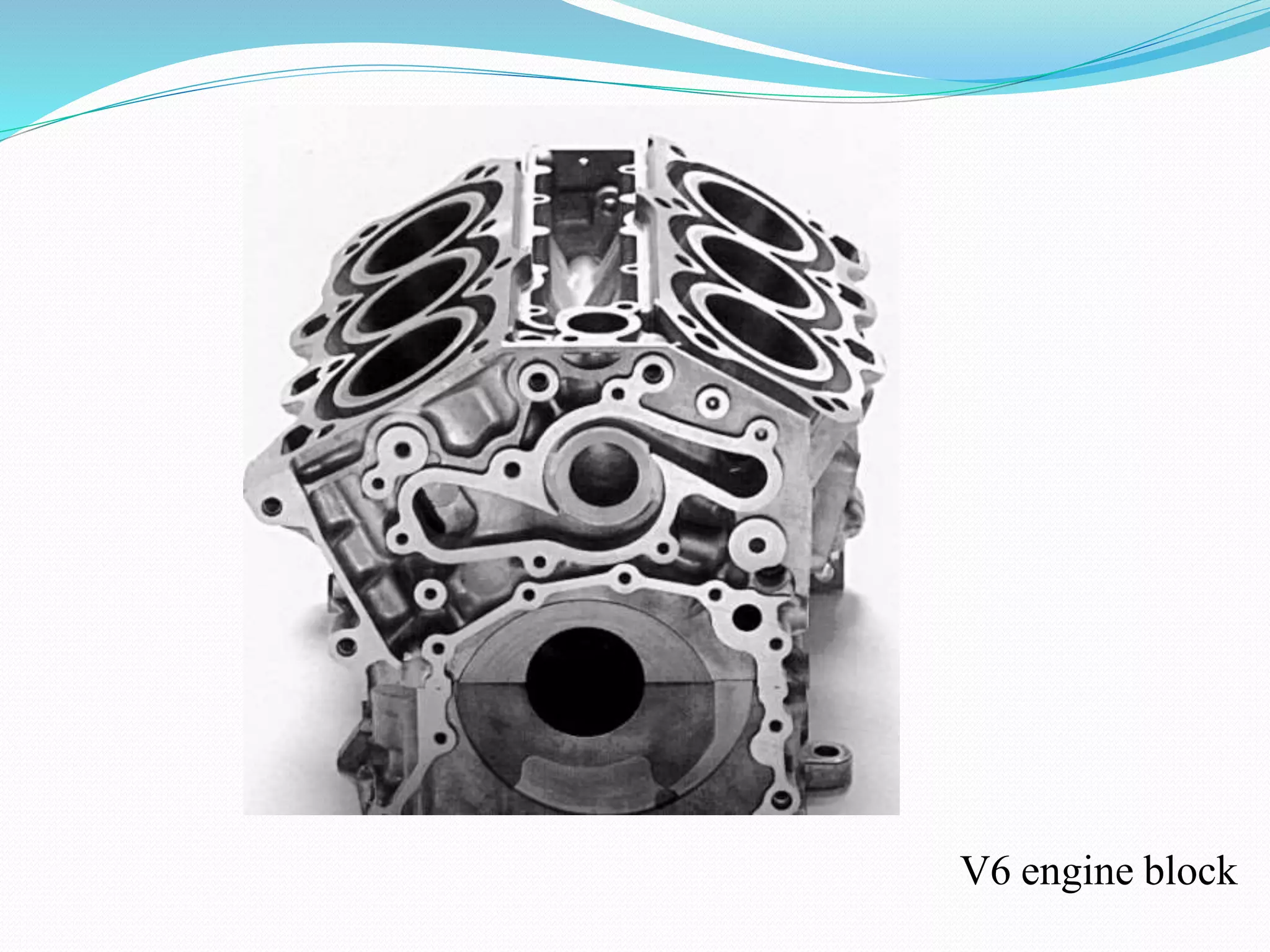
V6 engine block
Crank Shaft
AUDI engine block
BMW cylinder head
Brake assembly
Pattern
• Pattern is the principal tool during the casting
process.
• A pattern is a model or the replica of the object (to
be casted)
• It may be defined as a model or form around
which sand is packed to give rise to a cavity known
as mold cavity in which when molten metal is
poured, the result is the cast object.
• A pattern prepares a mold cavity for the purpose
of making a casting.
OBJECTIVES OF A PATTERN
• Pattern prepares a mould cavity for the purpose of making a
casting.
Pattern possesses core prints which produces seats in form of
extra recess for core placement in the mould.
It establishes the parting line and parting surfaces in the mould.
Runner, gates and riser may form a part of the pattern.
Properly constructed patterns minimize overall cost of the
casting.
Pattern may help in establishing locating pins on the mould and
therefore on the casting with a purpose to check the casting
dimensions.
Properly made pattern having finished and smooth surface
reduce casting defects.
•
•
•
•
•
•
Pattern Materials
• Wood: Inexpensive, Easily available, Light weight, easy to
shape, good surface finish, Poor wear resistance, absorb
moisture, less strength, not suitable for machine moulding,
easily repaired, warping, weaker than metallic patterns.
Eg. Shisam, kail, deodar, Teak wood, maogani.
Metal: less wear and tear, not affected by moisture, metal is
easier to shape the pattern with good precision, surface finish
•
•
and intricacy in shapes, withstand against corrosion and
handling for longer, excellent strength to weight ratio,
metallic patterns are higher cost, higher weight and tendency
of rusting.
preferred for production of castings in large quantities with
same pattern.
Eg.: cast iron, brass and bronzes and aluminum alloys
•
•
•
•
Plastic:-Plastics are getting more popularity now a days
because the patterns made of these materials are lighter,
stronger, moisture and wear resistant, non sticky to molding
sand, durable and they are not affected by the moisture of the
molding sand.
fragile, less resistant to sudden loading and their section may
need metal reinforcement.
Eg.:phenolic resin, foam plastic
•
•
• Plaster:
strength,
accurate.
Intricate shapes can be made, good compressive
expands while solidifying, less dimensionally
• •Wax: Good surface finish, high accuracy, no need to remove
from the mould, less strength.
FACTORS EFFECTING SELECTION OF
PATTERN MATERIAL
1. Number of castings to be produced. Metal pattern are preferred
when castings arerequired large in number.
2. Type of mould material used.
3. Kind of molding process.
4. Method of molding (hand or machine).
5. Degree of dimensional accuracy and surface finish required.
6. Minimum thickness required.
7. Shape, complexity and size of casting.
8. Cost of pattern and chances of repeat orders of the pattern
TYPES OF PATTERN
• Single-piece or solid pattern
• Solid pattern is made of single piece without joints, partings lines or loose
pieces.
• It is the simplest form of the pattern.
• Typical single piece pattern is shown in Fig.
• Simplest type, inexpensive used for limited production
• Two-piece or split pattern
• When solid pattern is difficult for withdrawal from the mold cavity, then
solid pattern is splited in two parts.
• Split pattern is made in two pieces which are joined at the parting line by
means of dowel pins.
• The splitting at the parting line is done to facilitate the withdrawal of the
pattern.
• A typical example is shown in Fig.
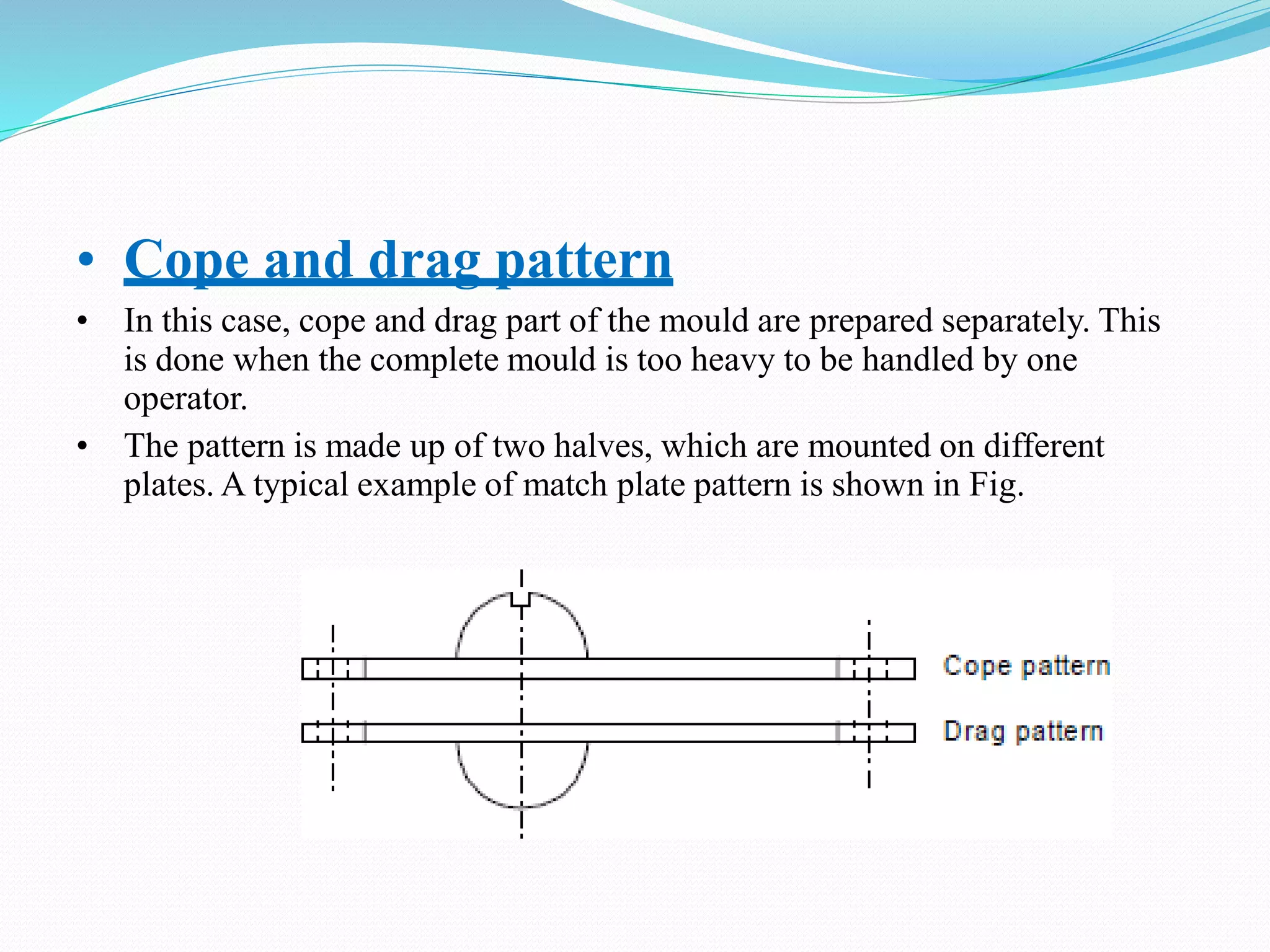
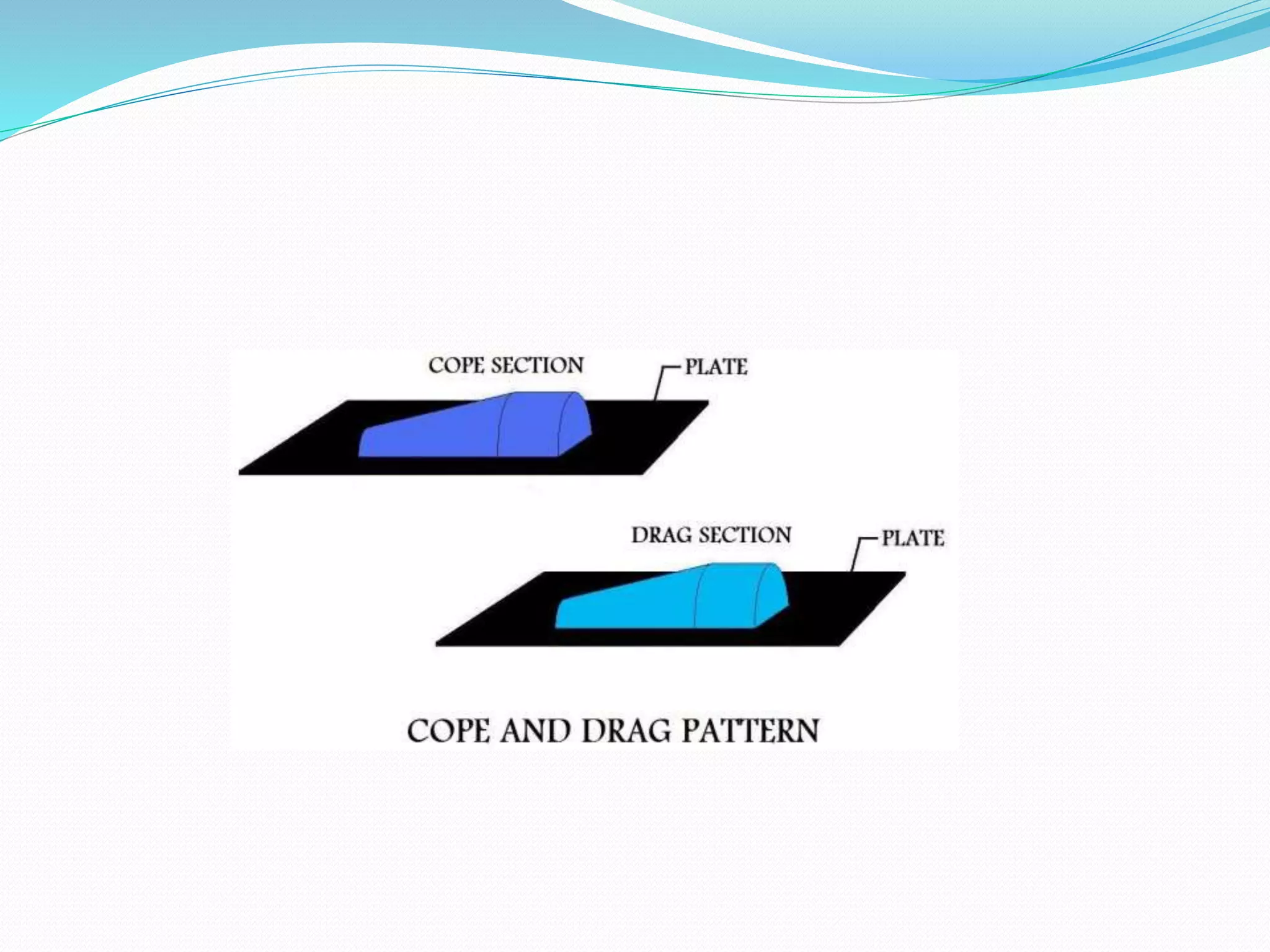
• Cope and drag pattern
• In this case, cope and drag part of the mould are prepared separately. This
is done when the complete mould is too heavy to be handled by one
operator.
• The pattern is made up of two halves, which are mounted on different
plates. A typical example of match plate pattern is shown in Fig.
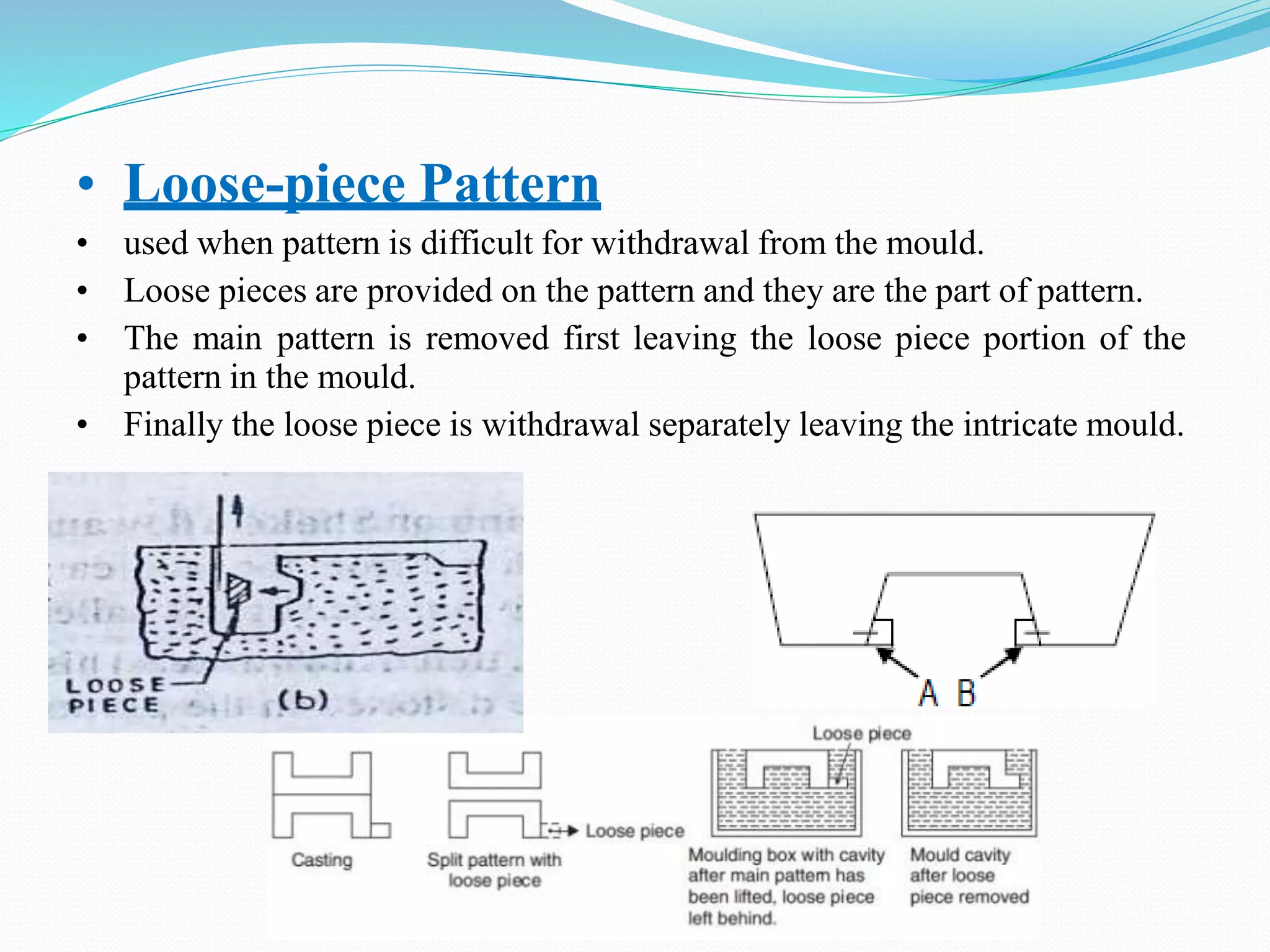
• Loose-piece Pattern
• used when pattern is difficult for withdrawal from the mould.
• Loose pieces are provided on the pattern and they are the part of pattern.
• The main pattern is removed first leaving the loose piece portion of the
pattern in the mould.
• Finally the loose piece is withdrawal separately leaving the intricate mould.
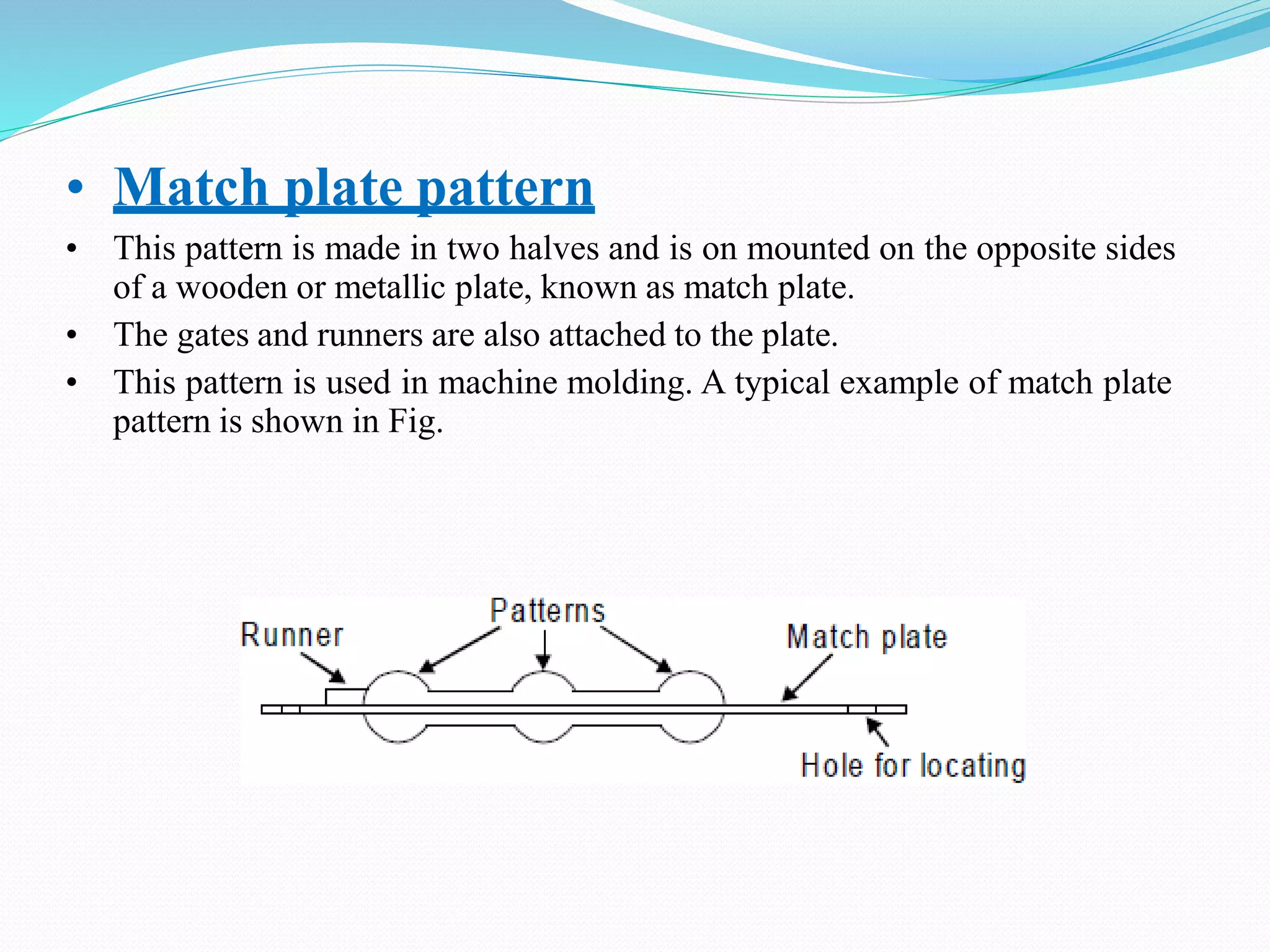
• Match plate pattern
• This pattern is made in two halves and is on mounted on the opposite sides
of a wooden or metallic plate, known as match plate.
• The gates and runners are also attached to the plate.
• This pattern is used in machine molding. A typical example of match plate
pattern is shown in Fig.
• Follow board pattern
• When the use of solid or split patterns becomes difficult, a contour
corresponding to the exact shape of one half of the pattern is made in a
wooden board, which is called a follow board and it acts as a molding
board for the first molding operation as shown in Fig.
• Gated pattern
• In the mass production of casings, multi cavity moulds are used. Such
moulds are formed by joining a number of patterns and gates and providing
a common runner for the molten metal, as shown in Fig.
• These patterns are made of metals, and metallic pieces to form gates and
runners are attached to the pattern.
• Sweep pattern
•
• Sweep patterns are used for forming large circular moulds of symmetric
kind by revolving a sweep attached to a spindle as shown in Fig.
• Sweep is a template of wood or metal and is attached to the spindle at one
edge and the other edge has a contour depending upon the desired shape of
the mould.
The pivot end is attached to a stake of metal in the center of the mould.
• Segmental pattern
• Patterns of this type are generally used for circular castings, for example
wheel rim, gear blank etc.
• Such patterns are sections of a pattern so arranged as to form a complete
• mould by being moved to form each section of the mould.
• The movement of segmental pattern is guided by the use of a central pivot.
A segment pattern for a wheel rim is shown in Fig.
• Shell pattern
• Shell patterns are used mostly for piping work or for
producing drainage fittings. This pattern consists of a thin
cylindrical or curved metal piece parted along the center line.
• The two halves of the pattern are held in alignment by dowels.
• The outside surface of the pattern is used to make the mould
for the fitting required while the inside can serve as a core box.
PATTERN ALLOWANCES
• The size of a pattern is never kept the same as that of the desired casting
because of the fact that during cooling the casting is subjected to various
effects and hence to compensate for these effects, corresponding
allowances are given in the pattern.
These various allowances given to pattern can be enumerated as, allowance
for shrinkage, allowance for machining, allowance for draft, allowance for
rapping or shake, allowance for distortion and allowance for mould wall
movement.
•
• Shrinkage Allowance
•
•
•
•
• In practice,all common cast metals shrink a significant amount when they
are cooled from the molten state. The total contraction in volume is divided
into the following parts:
1.Liquid contraction, i.e. the contraction during the period in which the
temperature of the liquid metal or alloy falls from the pouring temperature
to the liquidus temperature.
2.Contraction on cooling from the liquidus to the solidus temperature, i.e.
solidifying contraction.
3.Contraction that results there after until the temperature reaches the room
temperature. This is known as solid contraction.
The first two of the above are taken care of by proper gating and risering.
Only the last one, i.e. the solid contraction is taken care by the pattern
makers by giving a positive shrinkage allowance. This contraction
allowance is different for different metals.
• The contraction allowances for different metals and alloys such as Cast
Iron 10 mm/mt.. Brass 16 mm/mt., Aluminium Alloys. 15 mm/mt., Steel 21
mm/mt., Lead 24 mm/mt. In fact, there is a special rule known as the
pattern marks contraction rule in which the shrinkage of the casting metals
is added.
The pattern must be made over size to compensate for contraction of
liquid metal on cooling. This addition to the dimension of the pattern
is known as shrinkage allowance.
•
• Machining Allowance
•
•
It is a positive allowance
given to compensate for the amount of material that is lost in machining or
finishing the casting.
If this allowance is not given, the casting will become undersize after
machining.
this allowance depends on the size of casting, methods of machining and
the degree of finish.
value varies from 3 mm. to 18 mm.
pattern must be made over size for machining purpose
This extra amount of dimensions provided in the pattern is known as
Machining allowance.
•
•
•
•
•
• Taper allowance
•
•
•
positive allowance
given on all the vertical surfaces of pattern to make withdrawal easier.
taper on the external surfaces varies from 10 mm to 20 mm/mt. On interior
holes and recesses which are smaller in size, the taper should be around 60
mm/mt.
These values are greatly affected by the size of the pattern and the molding
method
In machine molding its, value varies from 10 mm to 50 mm/mt.
•
•
• Rapping or Shake Allowance
• Before withdrawing the pattern it is rapped and thereby the size of the
mould cavity increases.
• by rapping, the external sections move outwards increasing the size and
internal sections move inwards decreasing the size.
• insignificant in the case of small and medium size castings,
• but it is significant in the case of large castings. negative allowance pattern
is made slightly smaller in dimensions 0.5-1.0 mm.
Distortion Allowance
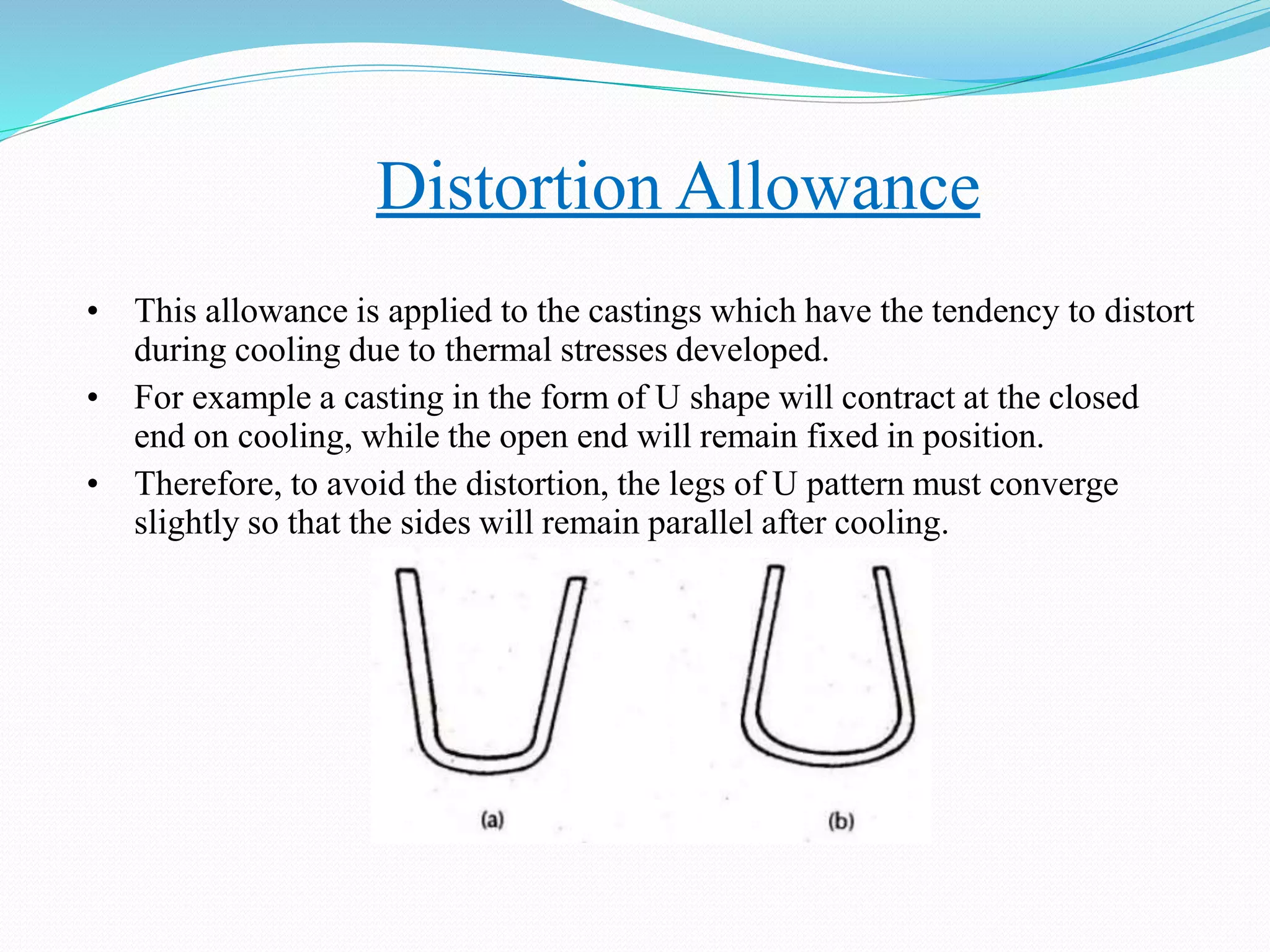
• This allowance is applied to the castings which have the tendency to distort
during cooling due to thermal stresses developed.
• For example a casting in the form of U shape will contract at the closed
end on cooling, while the open end will remain fixed in position.
• Therefore, to avoid the distortion, the legs of U pattern must converge
slightly so that the sides will remain parallel after cooling.
•
• COLOR CODIFICATION FOR PATTERNS
Surfaces to be left unfinished after casting are to be painted as
black.
• Surface to be machined are painted as red.
• Core prints are painted as yellow.
• Seats for loose pieces are painted as red stripes on yellow
background.
Mould
• Suitable and workable material possessing high
refractoriness in nature
Molding sand is the most common utilized non-metallic
molding material because of its certain inherent properties
namely,
Refractoriness,
Chemical and thermal stability at higher temperature, high
permeability and
Workability along with good strength.
Highly cheap and easily available.
•
•
•
•
MOLDING SAND
• Sources of receiving molding sands
• Beds of sea,
• Rivers,
• Lakes,
• Granulular elements of rocks,
• And deserts.
• Sources of molding sands available in India
1 Batala sand ( Punjab)
2Ganges sand (Uttar Pradesh)
3Oyaria sand (Bihar)
4 Damodar and Barakar sands (Bengal- Bihar Border)
5 Londha sand (Bombay)
6 Gigatamannu sand (Andhra Pradesh) and
7 Avadi and Veeriyambakam sand (Madras)
Types of molding sand
Natural Molding sand:
• Known as green sand
• Having appreciable amount of clay which acts as
a binder between sand grains
• Obtained by crushing and milling of soft yellow
sand stone, carboniferrous etc
• Ease of availability
• Low cost
• High flexibility
• Mostly used for ferrous and non ferrous metal casting
Synthetic sand
• known as silica sand
• not having binder(clay) in natural form
• desired strength and properties developed by separate addition
of binder like bentonite, water and other materials.
• More expensive than natural sand
Special sands
• Zicron-cores of brass and bronze casting
• Olivine-for non ferrous casting
• Chromite-for heavy steel casting
• Chrome-magnesite-used as facing materials in steel casting.
Types of moulding sand
(According to use)
Green sand
Dry sand
Facing sand
Backing sand
System sand
Parting sand
Loam sand
Core sand
Green sand
• Green sand is also known as tempered or natural sand
• mixture of silica sand with 18 to 30 percent clay, having moisture content from 6 to
8%.
• The clay and water furnish the bond for green sand. It is fine, soft, light, and
porous.
• Green sand is damp, when squeezed in the hand and it retains the shape and the
impression to give to it under pressure.
• Molds prepared by this sand are not requiring backing and hence are known as
green sand molds.
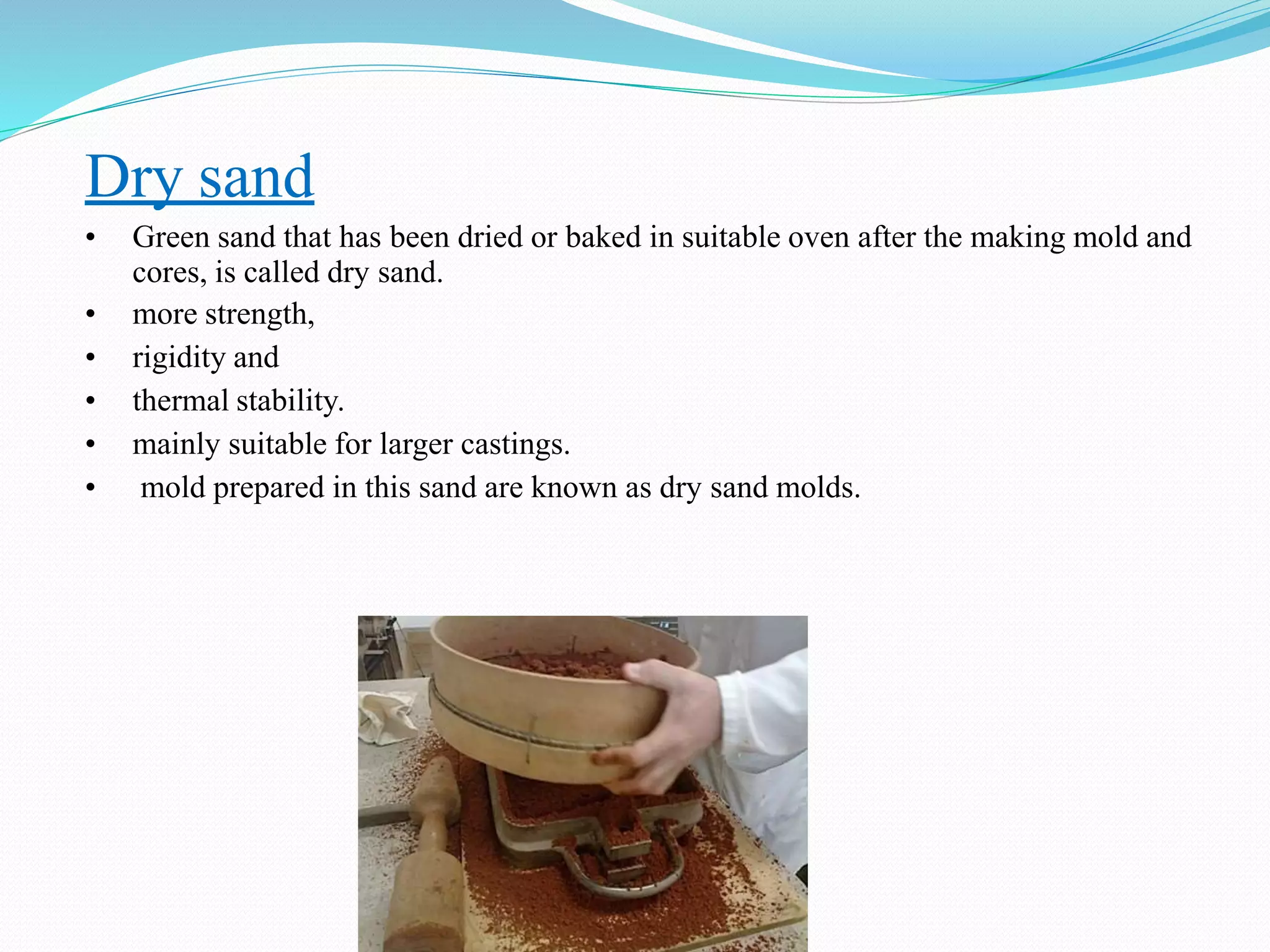
Dry sand
• Green sand that has been dried or baked in suitable oven after the making mold and
cores, is called dry sand.
• more strength,
• rigidity and
• thermal stability.
• mainly suitable for larger castings.
• mold prepared in this sand are known as dry sand molds.
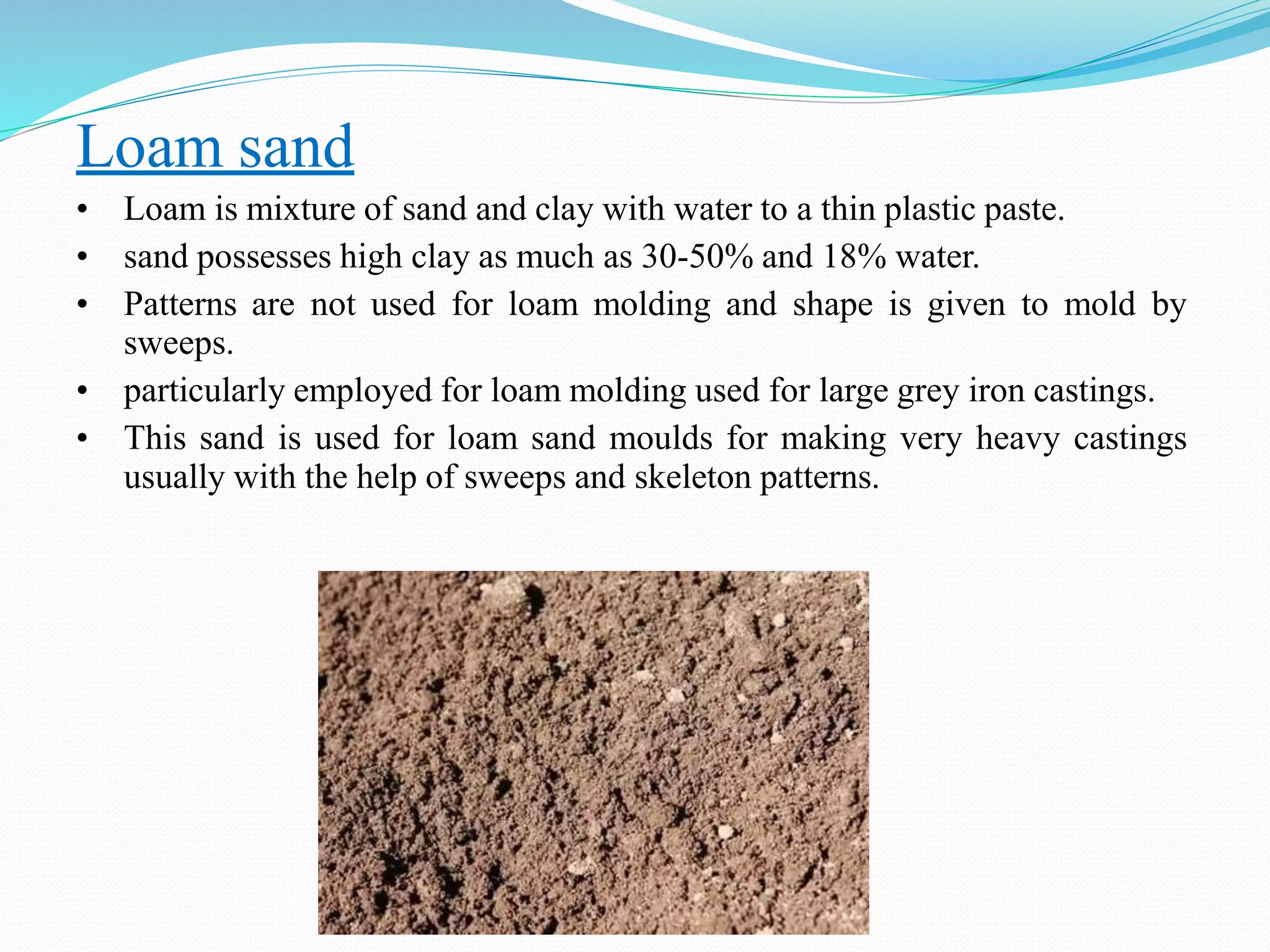
Loam sand
• Loam is mixture of sand and clay with water to a thin plastic paste.
• sand possesses high clay as much as 30-50% and 18% water.
• Patterns are not used for loam molding and shape is given to mold by
sweeps.
• particularly employed for loam molding used for large grey iron castings.
• This sand is used for loam sand moulds for making very heavy castings
usually with the help of sweeps and skeleton patterns.
Facing sand
•
• Facing sand is just prepared and forms the face of the mould.
• It is directly next to the surface of the pattern and it comes into contact
molten metal when the mould is poured.
• high strength refractoriness.
• made of silica sand and clay, without the use of used sand.
• Different forms of carbon are used to prevent the metal burning into the
sand.
• A facing sand mixture for green sand of cast iron may consist of 25% fresh
sand specially prepared and 5% sea coal.
sometimes mixed with 6-15 times as much fine molding sand to make
facings.
• The layer of facing sand in a mold usually ranges from 22-28 mm. From
10 to 15% of the whole amount of molding sand is the facing sand.
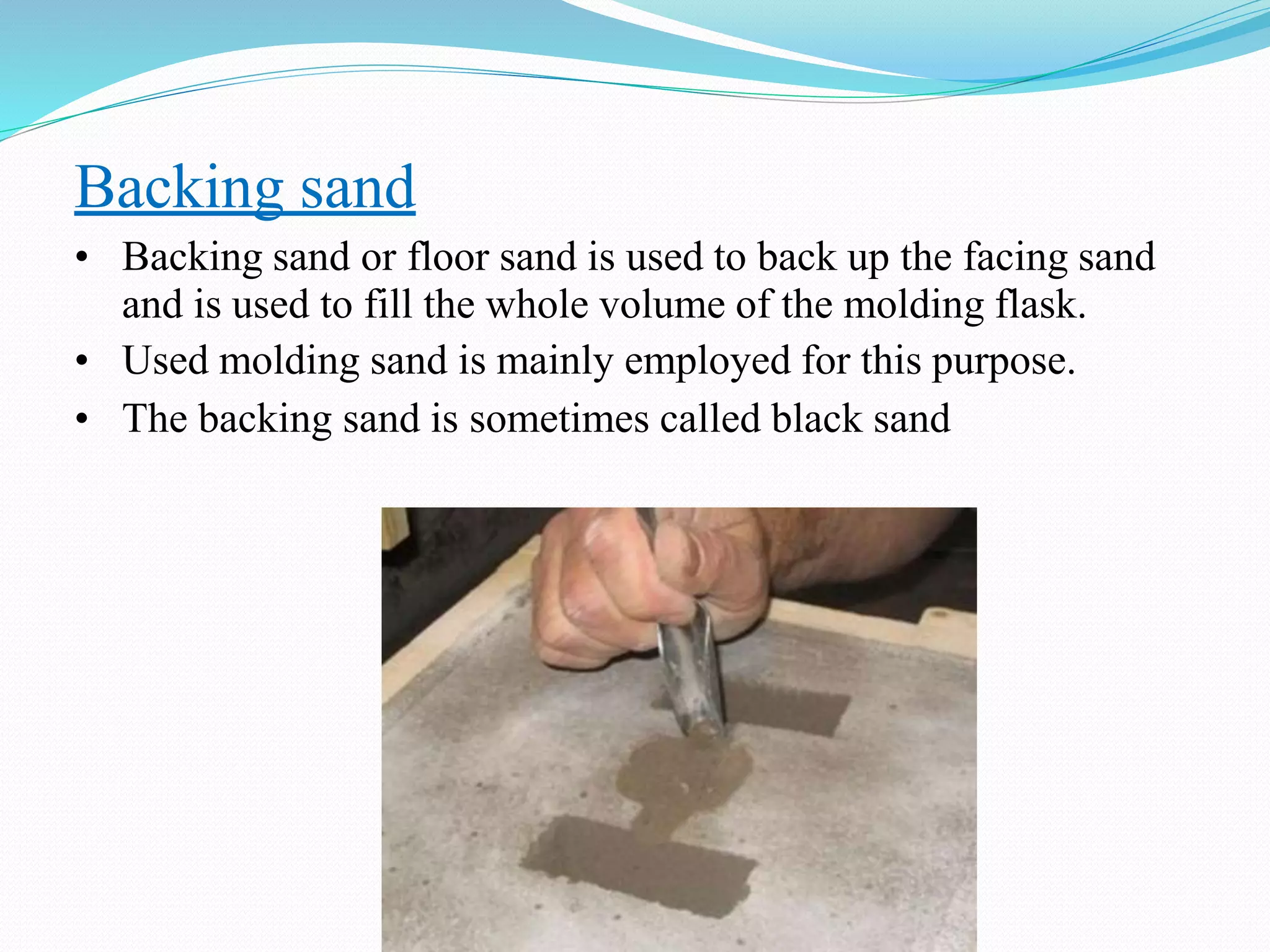
Backing sand
• Backing sand or floor sand is used to back up the facing sand
and is used to fill the whole volume of the molding flask.
• Used molding sand is mainly employed for this purpose.
• The backing sand is sometimes called black sand
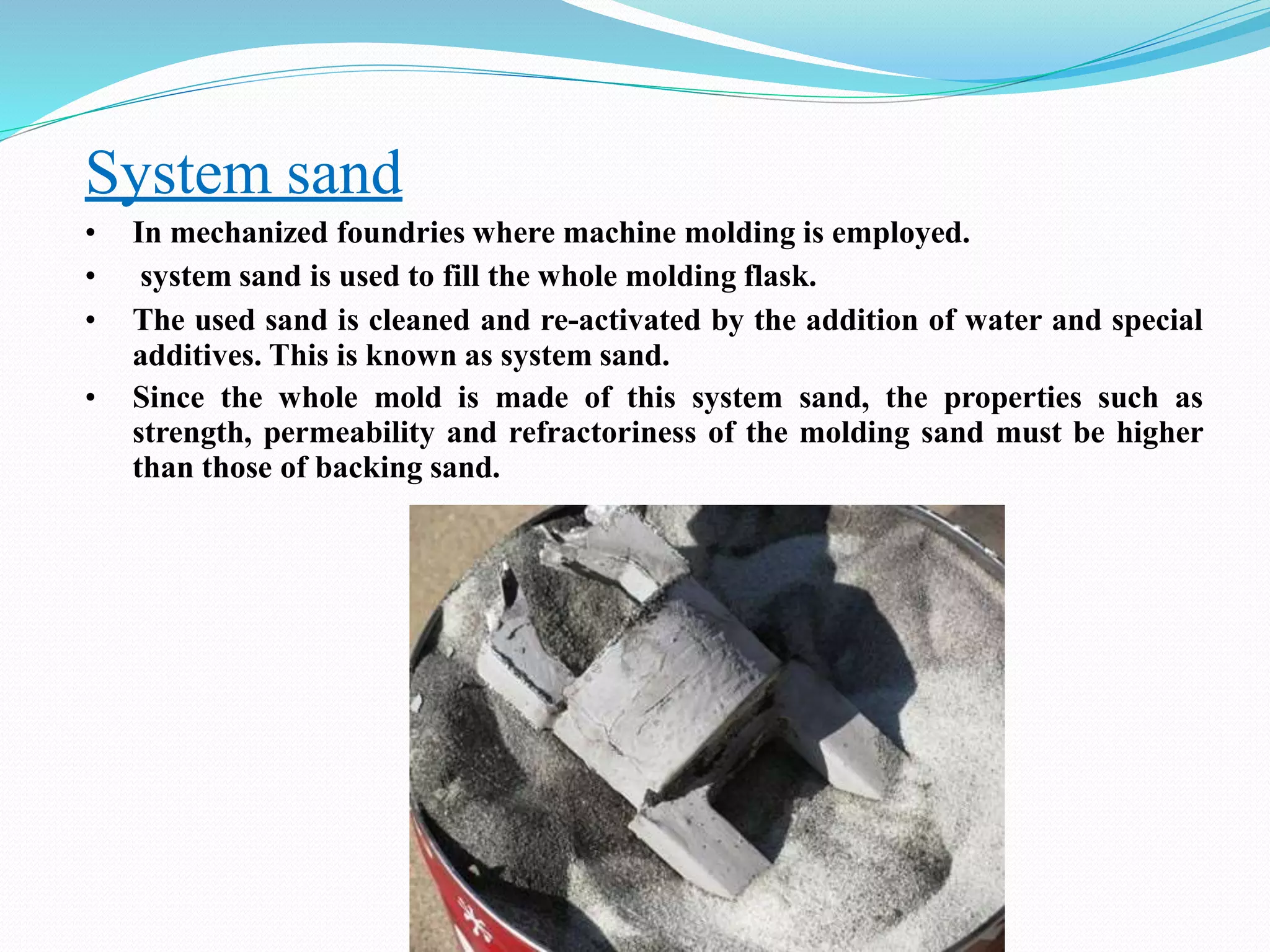
System sand
• In mechanized foundries where machine molding is employed.
• system sand is used to fill the whole molding flask.
• The used sand is cleaned and re-activated by the addition of water and special
additives. This is known as system sand.
• Since the whole mold is made of this system sand, the properties such as
strength, permeability and refractoriness of the molding sand must be higher
than those of backing sand.
Parting sand
• without binder and moisture to keep the green sand not to stick
to the pattern
• to allow the sand on the parting surface the cope and drag to
separate without clinging.
• This is clean clay-free silica sand which serves the same
purpose as parting dust.
Core sand
• is used for making cores and it is sometimes
• also known as oil sand.
• This is highly rich silica sand mixed with oil binders such as
core oil which composed of linseed oil, resin,
• light mineral oil and other bind materials.
• Pitch or flours and water may also be used in large cores for
the sake of economy.
Properties of Moulding Sand
• Refractoriness
•
•
•
•
•
•
• Refractoriness is defined as the ability of molding sand to withstand high
temperatures without breaking down or fusing thus facilitating to get sound
casting.
poor refractoriness
burn on to the casting surface and
no smooth casting surface can be obtained.
degree of refractoriness depends on the SiO2 i.e. quartz content, and the
shape and grain size of the particle.
higher the SiO2 content higher is the refractoriness of the molding
Refractoriness is measured by the sinter point of the sand rather than its
melting point.
• Permeability
• It is also termed as porosity of the molding sand in order to allow the
escape of any air, gases or moisture present or generated in the mould
when the molten metal is poured into it.
All these gaseous generated during pouring and solidification process must
escape otherwise the casting becomes defective.
Permeability is a function of grain size, grain shape, and moisture and clay
contents in the molding sand.
The extent of ramming of the sand directly affects the permeability.
•
•
•
• Cohesiveness
• It is property by virtue of which the sand grain particles interact and attract
each other within the molding sand.
Thus, the binding capability of the molding sand gets enhanced to increase
the green, dry and hot strength property of molding and core sand.
•
• Green strength
•
•
• By virtue of this property, the pattern can be taken out from the mould
without breaking the mould and also the erosion of mould wall surfaces
does not occur during the flow of molten metal.
The green sand after water has been mixed into it, must have sufficient
strength and toughness to permit the making and handling of the mould.
For this, the sand grains must be adhesive, i.e. they must be capable of
attaching themselves to another body and therefore, and sand grains having
high adhesiveness will cling to the sides of the molding box.
• Dry strength
• As soon as the molten metal is poured into the mould, the moisture in the
sand layer adjacent to the hot metal gets evaporated and this dry sand layer
must have sufficient strength to its shape in order to avoid erosion of
mould wall during the flow of molten metal.
• The dry strength also prevents the enlargement of mould cavity cause by
the metallostatic pressure of the liquid metal.
• Strength of the moulding sand depends on:
• 1. Grain size and shape
• 2. Moisture content
• 3. Density of sand after ramming
• ·The strength of the mould increases with a decrease of grain size and an increase
of clay content and density after ramming. The strength also goes down if moisture
content is higher than an optimum value.
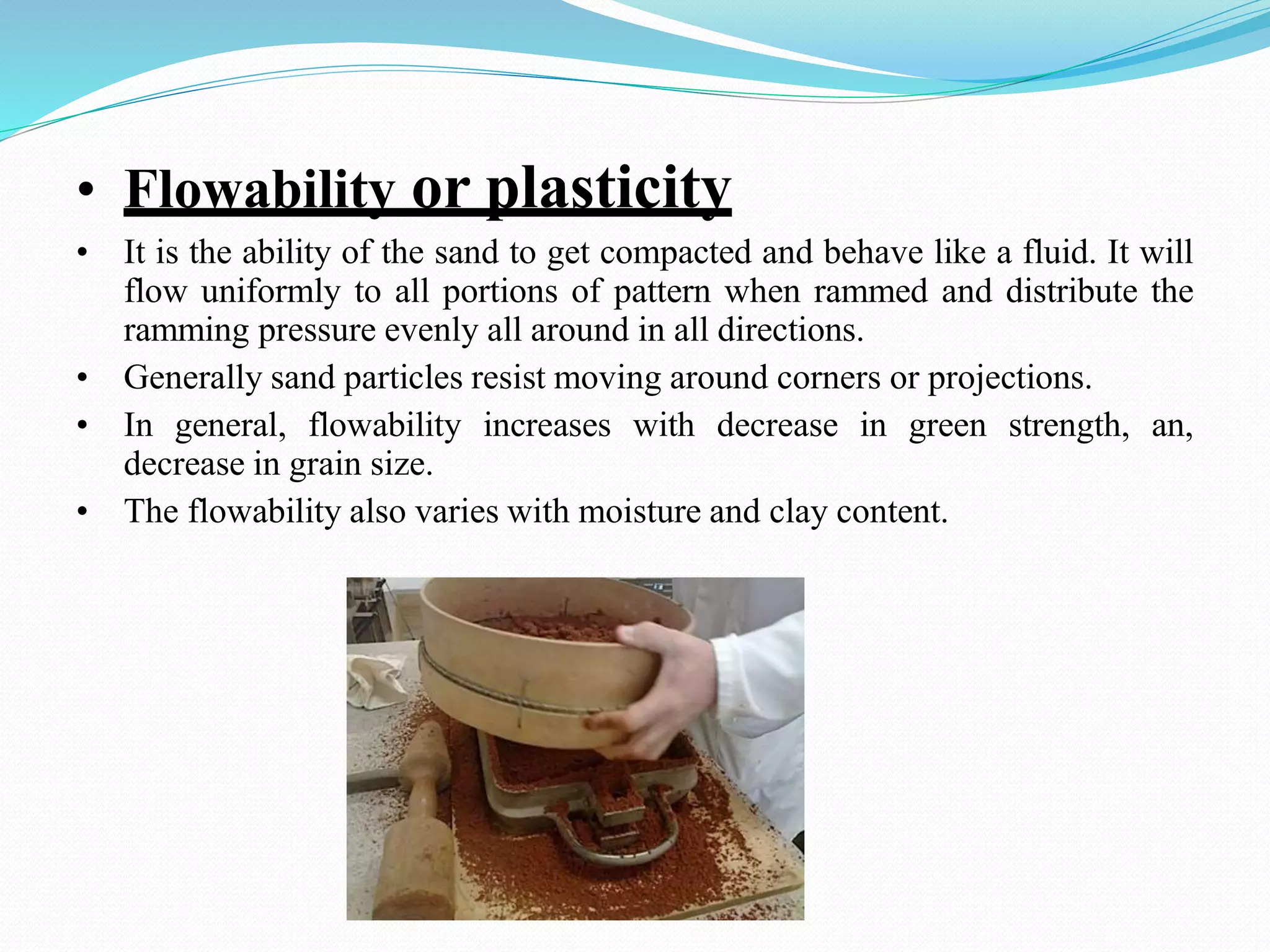
• Flowability or plasticity
• It is the ability of the sand to get compacted and behave like a fluid. It will
flow uniformly to all portions of pattern when rammed and distribute the
ramming pressure evenly all around in all directions.
• Generally sand particles resist moving around corners or projections.
• In general, flowability increases with decrease in green strength, an,
decrease in grain size.
• The flowability also varies with moisture and clay content.
• Adhesiveness
• · It is the important property of the moulding sand and it is defined as the
sand particles must be capable of adhering to another body, then only the
sand should be easily attach itself with the sides of the moulding box and
give easy of lifting and turning the box when filled with the stand.
• Collapsibility
• After the molten metal in the mould gets solidified, the sand mould must be
collapsible so that free contraction of the metal occurs and this would
naturally avoid the tearing or cracking of the contracting metal.
• In absence of this property the contraction of the metal is hindered by the
mold and thus results in tears and cracks in the casting.
• This property is highly desired in cores.
CONSTITUENTS OF MOLDING SAND
•
•
•
•
•
The main constituents of molding sand involve
silica sand,
binder,
moisture content and
additives.
• Silica sand
•
•
•
•
•
•
•
• Silica sand in form of granular quartz is the main constituent of molding
sand
having enough refractoriness
which can impart strength,
stability and
permeability to molding and core sand.
along with silica small amounts of iron oxide, alumina, lime stone,
magnesia, soda and potash are present as impurities.
The silica sand can be specified according to the size (small, medium and
large silica sand grain) and
the shape (angular, sub-angular and rounded).
Binder
•
•
In general, the binders can be either inorganic or organic substance.
The inorganic group includes clay sodium silicate and port land cement
etc.
In foundry shop, the clay acts as binder which may be Kaolonite, Ball
Clay, Fire Clay, Limonite, Fuller’s earth and Bentonite.
Binders included in the organic group are dextrin, molasses, cereal
•
•
binders, linseed oil and resins like phenol formaldehyde, urea
formaldehyde etc.
Organic binders are mostly used for core making.
Among all the above binders, the bentonite variety of clay is the most
common. However, this clay alone can not develop bonds among sand
grains without the presence of moisture in molding sand and core sand.
•
•
Moisture
•
•
•
•
•
• The amount of moisture content in the molding sand varies generally
between 2 to 8 percent.
This amount is added to the mixture of clay and silica sand for developing
bonds.
This is the amount of water required to fill the pores between the particles of
clay without separating them.
This amount of water is held rigidly by the clay and is mainly responsible for
developing the strength in the sand.
The effect of clay and water decreases permeability with increasing clay and
moisture content.
The green compressive strength first increases with the increase in clay
content, but after a certain value, it starts decreasing.
• For increasing the molding sand characteristics some other additional
materials beside basic constituents are added which are known as additives.
Additives
• Dextrin
• carbohydrates
• increases dry strength of the molds.
• Corn flour
• It belongs to the starch family of carbohydrates
• is used to increase the collapsibility of the molding and core sand.
• Coal dust
• To avoid oxidation of pouring metal
• For production of grey iron and malleable cast iron castings.
• Sea coal
• sand grains become restricted and cannot move into a dense packing pattern.
• Pitch
• form of soft coal (0.02 % to 2%)
• Wood flour:0.05 % to 2%
• To avoid expansion defects.
• increases collapsibility of both of mold and core.
• Silica flour
• added up to 3% which increases the
• hot strength and finish on the surfaces of the molds and cores.
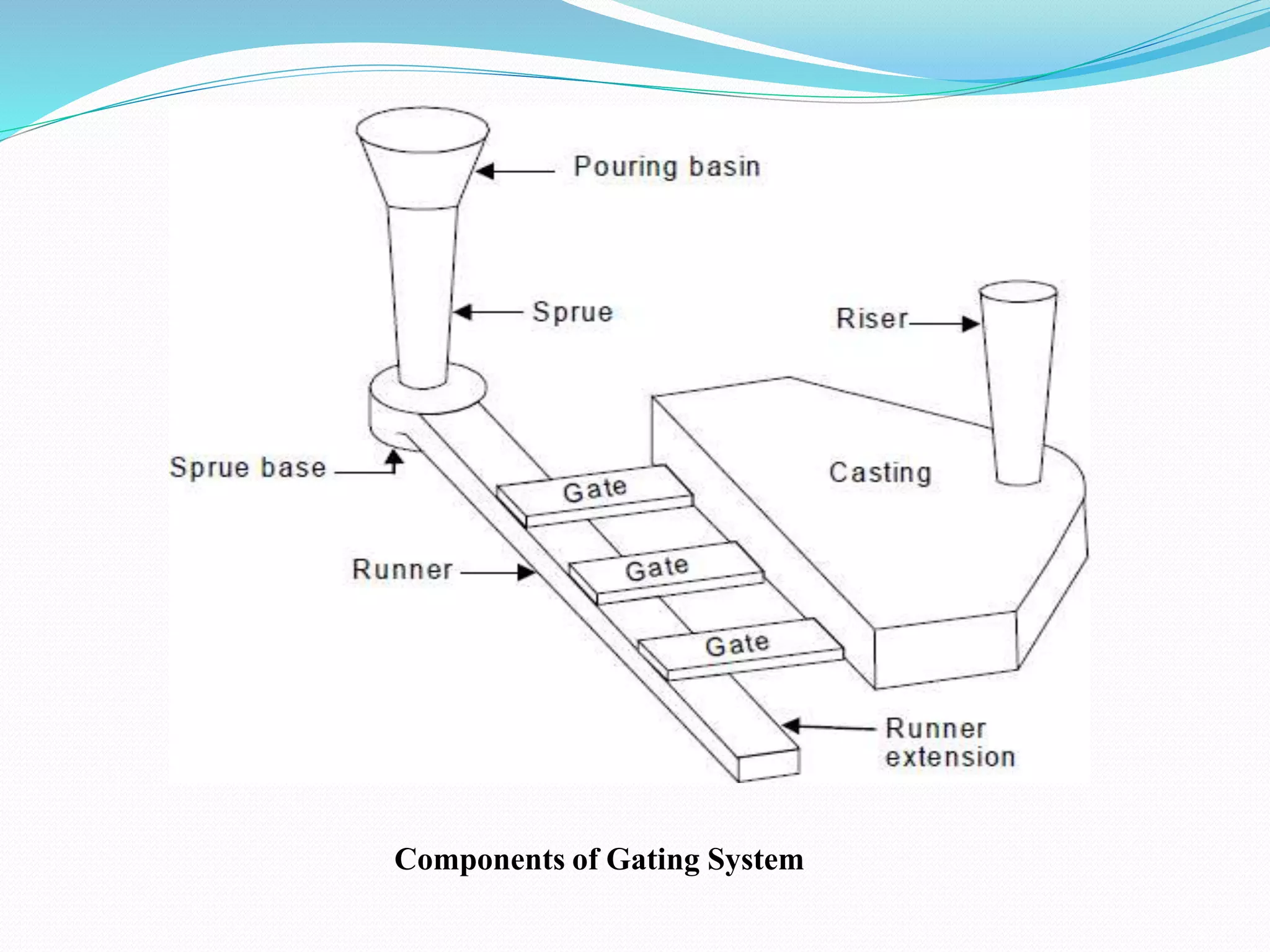
GATING SYSTEM
• The term gating system refers to all passageways
through which the molten metal passes to enter the
mould cavity.
• The gating system is composed of
 Pouring basin
 Sprue
 Runner
 Gates
 Risers
Components of Gating System
• Any gating system designed should aim at providing a defect
free casting. This can be achieved by considering following
requirements.
 A gating system should avoid sudden or right angle changes in
direction.
 Agating system should fill the mould cavity before freezing.
 The metal should flow smoothly into the mould without any
turbulence. A turbulence metal flow tends to form dross in the
mould.
 Unwanted materials such as slag, dross and other mould
materials should not be allowed to enter the mould cavity.
 The metal entry into the mould cavity should be properly
controlled in such a way that aspiration of the atmospheric air
is prevented.
 A proper thermal gradient should be maintained so that the
casting is cooled without any shrinkage cavities or distortions.
 Metal flow should be maintained in such a way that no gating
or mould erosion takes place.
 The gating system should ensure that enough molten metal
reaches the mould cavity.
 It should be economical and easy to implement and remove
casting after solidification.
• For proper functioning of the gating system, the
following factors need to be controlled.
 Type of pouring equipment, such as ladles, pouring
basin etc.
 Temperature/ Fluidity of molten metal.
 Rate of liquid metal pouring.
 Type and size of sprue.
 Type and size of runner.
 Size, number and location of gates connecting runner
and casting.
 Position of mould during pouring and solidification.
Functions of gating system
90
• Agood gating system should help easy and
complete filling of the mould cavity.
• It should fill the mould cavity with molten
metal with least amount of turbulance.
• It should prevent mould erosion.
• It should establish proper temperature gradient
in the casting.
• It should promote directional solidification.
• It should regulate the rate of flow of metal into
the mould cavity.
Defects occurring due to improper
design of gating system
91
• Oxidation of metal
• Cold shuts
• Mould erosion
• Shrinkages
• Porosity
• Misruns
• Penetration of liquid metal into mould walls.
Pouring Basins
• A pouring basin makes it easier for the ladle or
crucible operator to direct the flow of metal from
crucible to sprue.
• Helps maintaining the required rate of liquid metal
flow.
• Reduces turbulence at the sprue entrance.
• Helps separating dross, slag etc., from metal before it
enters the sprue.
•If the pouring basins are made large,
Dross and slag formation will tend to float on the surface
of the metal and may be stopped from entering the sprue and
hence the mould.
They may be filled quickly without overflowing and may
act as a reservoir of liquid metal to compensate metal
shrinkage or contraction.
Design criteria for pouring basin
• The pouring basin should be designed such that the
proper uniform flow system is rapidly established.
• This can be achieved by-
 Use of strainer core
 Use of sprue plug
• It should be easy and convenient to fill pouring basin.
Pouring Basin
 The main function of the pouring basin is to reduce the momentum
of the liquid flowing into the mould.
 To prevent the turbulence of the molten liquid the pouring basin
should be deep and the entrance into the sprue should be a smooth
radius of atleast 25 mm.
 To prevent vortex formation the pouring basin should be kept full.
Pouring Basin
 Constant flow conditions should be maintained by using a delay
screen or strainer core.
 The metal should be poured steadily into the pouring basin keeping
the lip of the ladle as close as possible.
 Pouring basins are preferable with castings in alloys which form
troublesome oxide skins (aluminium, aluminium bronze, etc..)
SPRUE
• A sprue feeds metal to runner which in turn reaches
the casting through gates.
• A sprue is tapered with its bigger end at top to receive
the liquid metal. The smaller end is connected to
runner.
Design of sprue
• As the liquid metal passes down the sprue it loses its
pressure head but gains velocity.
To reduce turbulence and promote Laminar Flow,
from the Pouring Basin, the flow begins a near
vertical incline that is acted upon by gravity and with
an accelerative gravity force
Sprue
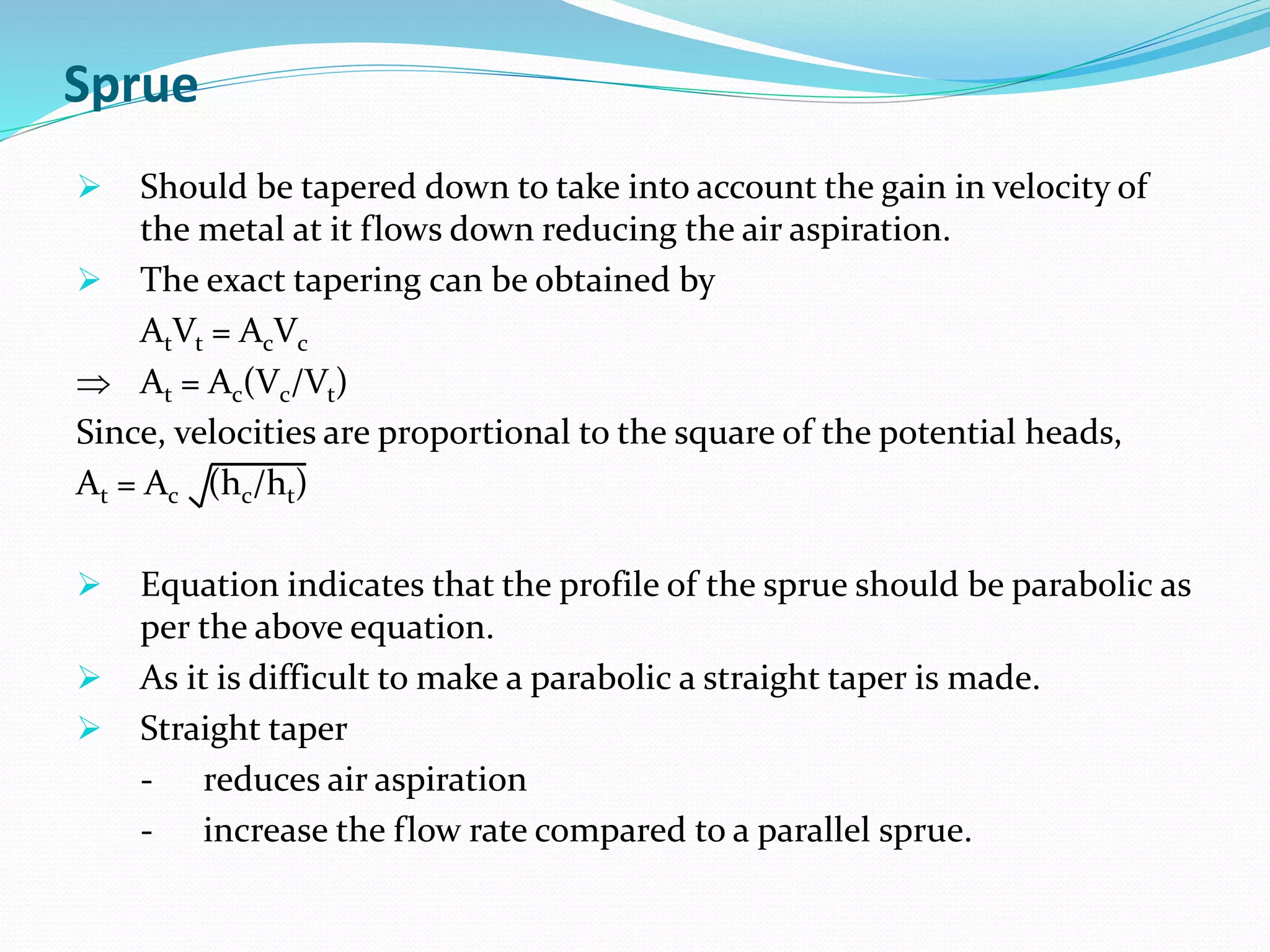
 Should be tapered down to take into account the gain in velocity of
the metal at it flows down reducing the air aspiration.
 The exact tapering can be obtained by
AtVt = AcVc
 At = Ac(Vc/Vt)
Since, velocities are proportional to the square of the potential heads,
At = Ac (hc/ht)
 Equation indicates that the profile of the sprue should be parabolic as
per the above equation.
 As it is difficult to make a parabolic a straight taper is made.
 Straight taper
- reduces air aspiration
- increase the flow rate compared to a parallel sprue.
Sprue cont…
 Should be tapered down to take into account the gain in velocity of
the metal at it flows down reducing the air aspiration.
 The exact tapering can be obtained by
AtVt = AcVc
 At = Ac(Vc/Vt)
Since, velocities are proportional to the square of the potential heads,
At = Ac (hc/ht)
H= actual sprue height
Ht = h + H
Sprue Base Well
 It is provided at the bottom of the sprue.
 It helps to reduce the velocity of the incoming metal and mold
erosion.
 General guideline,
- area of sprue base well = 5 * sprue choke area.
- well depth = runner depth
GATES
• A gate is a channel which connects runner with the
mould cavity and through which molten metal flows
to fill the mould cavity.
• A small gate is used for a casting which solidifies
slowly and vice versa.
• A gate should not have sharp edges as they may break
during pouring and sand pieces thus may be carried
with the molten metal in the mould cavity.
• Types
• Top gate
• Bottom gate
• Parting line side gate
Top gate
• A top gate is sometimes also called as Drop gate
because the molten metal just drops on the sand in the
bottom of the mould.
• Generation of favourable temperature gradients to
enable directional solidification from the casting
towards the gate which serves as a riser too.
Disadvantages
•The dropping liquid metal stream erodes the mould
surface.
•There is a lot of turbulence.
Bottom gates
• A bottom gate is made in the drag portion of the
mould.
• In a bottom gate the liquid metal fills rapidly the
bottom portion of the mould cavity and rises steadily
and gently up the mould walls.
• As comparison to top gate, bottom gate involves
little turbulence and sand erosion.
• Bottom gate produces good casting surfaces.
Disadvantages
• In bottom gates, liquid metal enters the mould cavity
at the bottom. If freezing takes place at the bottom, it
could choke off the metal flow before the mould is
full.
• A bottom gate creates an unfavourable temperature
gradient and makes it difficult to achieve directional
solidification.
PARTING LINE SIDE GATE
• Middle or side or parting gating systems combine the
characteristics of top and bottom gating systems.
• In this technique gate is provided along the parting
line such that some portion of the mould cavity will
be below the parting line and some portion will be
above the parting line.
• The cavity below the parting line will be filled by
assuming top gating and the cavity above the parting
line will be filled by assuming bottom gating.
116
ROLE OF RISER IN SAND CASTING
Metals and their alloys shrink as they cool or solidify and hence
may create a partial vacuum within the casting which leads to
casting defect known as shrinkage or void.
The primary function of riser as attached with the mould is
to feed molten metal to accommodate shrinkage occurring
during solidification of the casting.
• As shrinkage is very common casting defect in casting and
hence it should be avoided by allowing molten metal to rise in
riser after filling the mould cavity completely and supplying the
molten metal to further feed the void occurred during
solidification of the casting because of shrinkage.
• Riser also permits the escape of evolved air and
mold gases as the mold cavity is being filled with the
molten metal.
• It also indicates to the foundry man whether mold
cavity has been filled completely or not. The suitable
design of riser also helps to promote the directional
solidification and hence helps in production of
desired sound casting.
 There are different classifications for risers.
i) Top risers:-
 Risers that feed the metal casting from the top.
ii)Side risers:-
 Risers that feed the metal casting from the side.
iii)Blind risers:-
 Risers that are completely conained within the
mould.
i
v
) O
p
e n risers:-
 Risers that is open at the top to the outside
environment.
Considerations for Designing Riser
•
•
Freezing time
1 For producing sound casting, the molten metal must be fed to the mold till it
solidifies completely. This can be achieved when molten metal in riser
should freeze at slower rate than the casting.
Freezing time of molten metal should be more for risers than casting. The
quantative risering analysis developed by Caine and others can be followed
while designing risers.
Feeding range
1. When large castings are produced in complicated size, then more than one
riser are employed to feed molten metal depending upon the effective
freezing range of each riser.
2. Casting should be divided into divided into different zones so that each zone
can be feed by a separate riser.
3. Risers should be attached to that heavy section which generally solidifies last
in the casting.
4. Riser should maintain proper temperature gradients for continuous feeding
throughout freezing or solidifying.
•
•
•
•
•
•
• Feed Volume Capacity
• 1 Riser should have sufficient volume to feed the mold cavity till the
solidification of the entire casting so as to compensate the volume shrinkage
or contraction of the solidifying metal.
•
• 2 The metal is always kept in molten state at all the times in risers during
freezing of casting. This can be achieved by using exothermic compounds
and electric arc feeding arrangement. Thus it results for small riser size
and high casting yield.
3 It is very important to note that volume feed capacity riser should be based
upon freezing time and freezing demand.
• Optimum Riser Design
•
•
•
In the right amount
At the right place
At the right time
• Problems on riser design
• Risers are used to compensate for liquid shrinkage and solidification shrinkage. But
it only works if the riser cools after the rest of the casting.
• Height of cylindrical riser=1.5x Diameter of riser
• Shapes of riser-cylindrical,rectangular,spherical
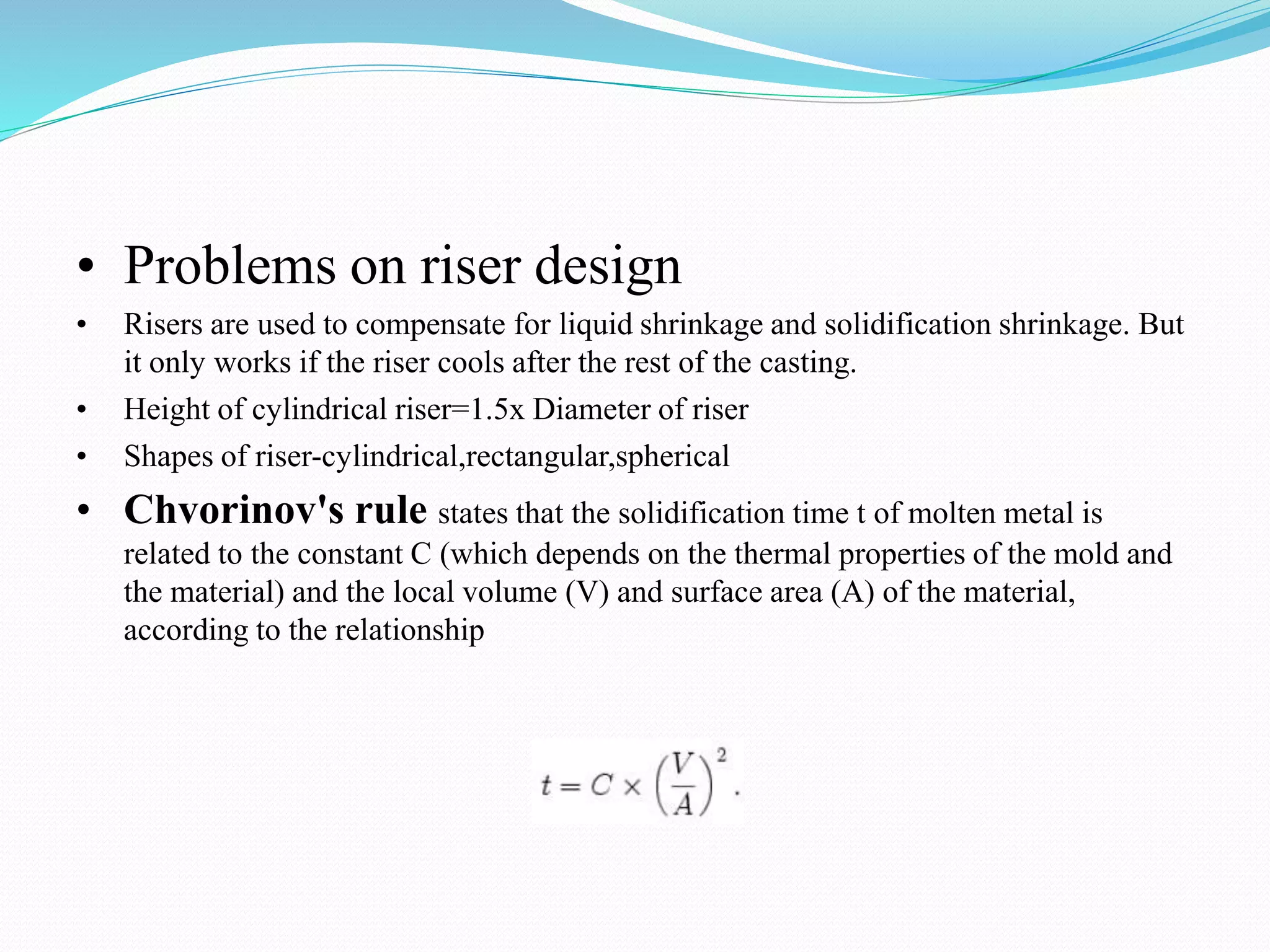
• Chvorinov's rule states that the solidification time t of molten metal is
related to the constant C (which depends on the thermal properties of the mold and
the material) and the local volume (V) and surface area (A) of the material,
according to the relationship
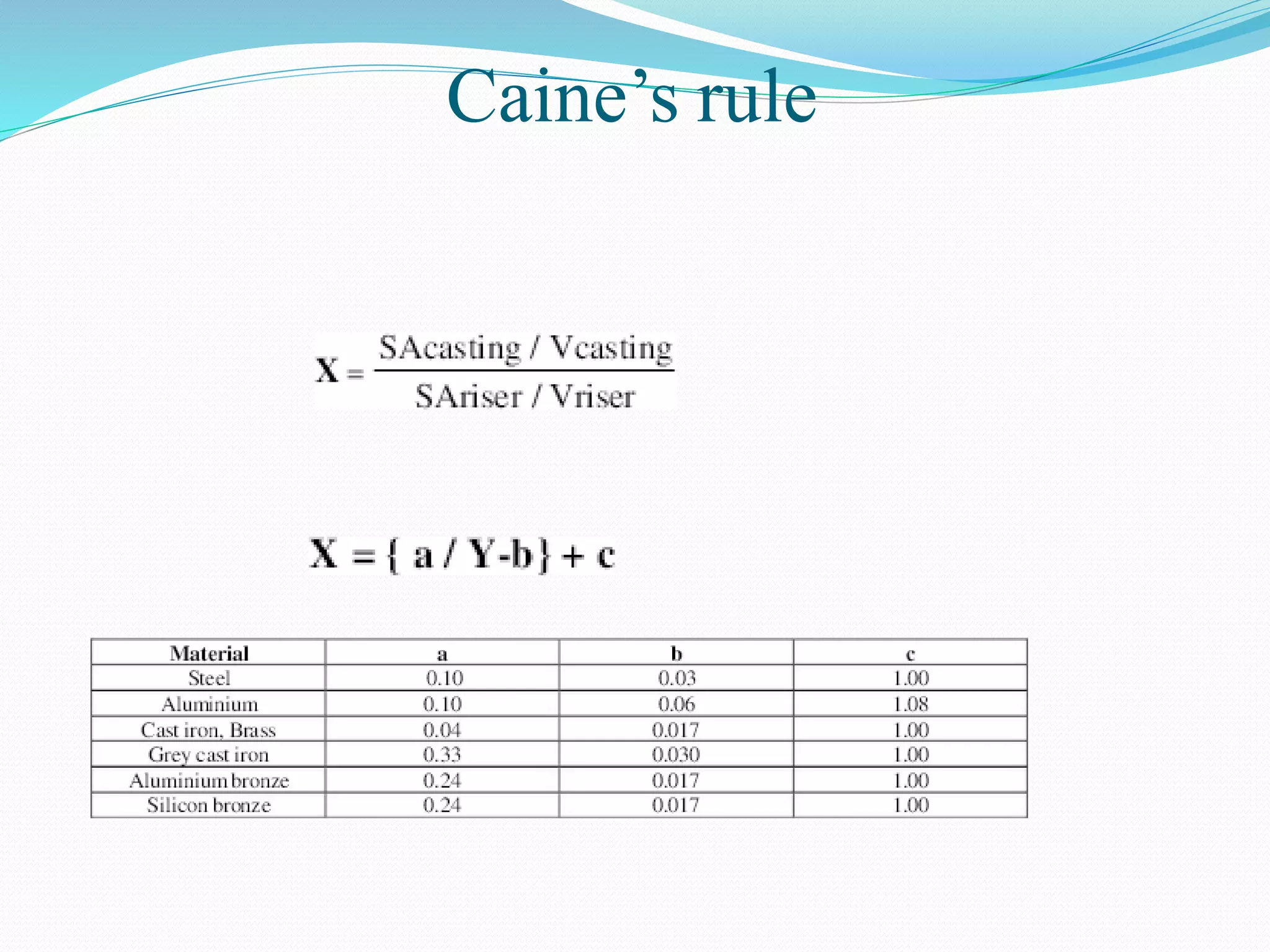
Caine’s rule
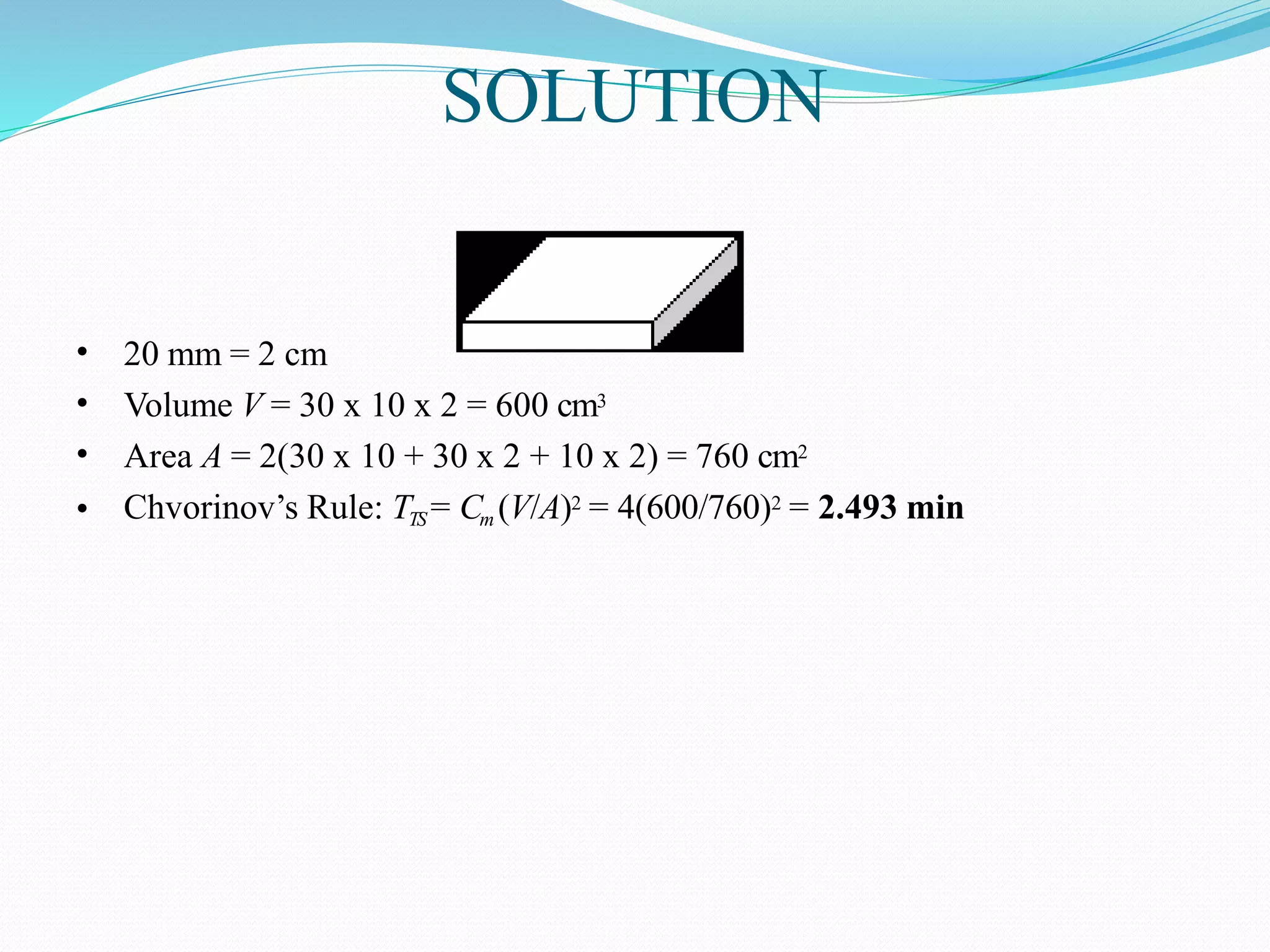
• In the casting of steel under certain mold conditions, the mold constant
in Chvorinov's Rule is known to be 4.0 min/cm2, based on previous
experience. The casting is a flat plate whose length = 30 cm, width = 10
cm, and thickness = 20 mm. Determine how long it will take for the casting
to solidify.
SOLUTION
•
•
•
•
20 mm = 2 cm
Volume V = 30 x 10 x 2 = 600 cm3
Area A = 2(30 x 10 + 30 x 2 + 10 x 2) = 760 cm2
Chvorinov’s Rule: TTS = Cm (V/A)2 = 4(600/760)2 = 2.493 min
• A disk-shaped part is to be cast out of aluminum. The diameter of the
disk= 500 mm and its thickness = 20 mm. If the mold constant = 2.0
sec/mm2 in Chvorinov's Rule, how long will it take the casting to solidify?
•
•
•
•
Solution:
Units are all in sec and mm.
R = D/2
Volume V = πR2t = πD2t/4 = π(500)2
(20)/4 = 3,926,991 mm3
Area A = 2 (πR2 ) + πDt = 2 πD2/4 + πDt =π(500)2/2 + π(500)(20) = 424,115 mm2
• Chvorinov’s Rule: TT
S = Cm(V/A)2 = 2.0(3,926,991/424,115)2 = 171.5 s = 2.86 min
• In casting experiments performed using a certain alloy and type of sand mold, it
took 155 sec for a cube-shaped casting to solidify. The cube was 50 mm on a side.
(a) Determine the value of the mold constant the mold constant
in Chvorinov's Rule. (b) If the same alloy and mold type were used, find the total
solidification time for a cylindrical casting in which the diameter = 30 mm and
length = 50 mm.
Solution:
•
•
• (a) Volume V = (50)3 = 125,000 mm3
• Area A = 6 x (50)2 = 15,000 mm2
• (V/A) = 125,000/15,000 = 8.333 mm
• Chvorinov’s Rule: TT
S = Cm(V/A)2
• Cm = TTS/(V/A)2 = 155/(8.333)2 = 2.232 s/mm2
•
• (b) Cylindrical casting with D = 30 mm and L = 50 mm.
• Volume V = πD2L/4 = π(30)2(50)/4 = 35,343 mm3
• Area A = 2 πD2/4 + πDL = π(30)2/2 + π(30)(50) = 6126 mm2
• V/A = 35,343/6126 = 5.77
• Chvorinov’s Rule: TT
S = Cm(V/A)2
• TTS= 2.232 (5.77)2 = 74.3 s = 1.24 min.
• Compare the solidification time for casting of different shapes of same volume
(cubic, cylindrical and spherical)(d=h)
Cube=0.0277s
Cylinder=0.03263s
Spherical=0.482 s
•
•
•
• Chaplets
•
•
• Chaplets are metal distance pieces inserted in a mould either to
prevent shifting of mould or locate core surfaces.
The distances pieces in form of chaplets are made of parent metal of
which the casting is.
Its main objective is to impart good alignment of mould and core
surfaces and to achieve directional solidification.
• Chills
• In some casting, it is required to produce a hard surface at a
particular place in the casting.
• At that particular position, the special mould surface for fast
extraction of heat is to be made.
• The fast heat extracting metallic materials known as chills will be
incorporated separately along with sand mould surface during
molding.
• After pouring of molten metal and during solidification, the molten
metal solidifies quickly on the metallic mould surface in comparison to
other mold sand surfaces. This imparts hardness to that particular
surface because of this special hardening treatment through fast
extracting heat from that particular portion.
Pouring time
•High pouring rates leads to mould
surface, excessive shrinkages etc.
erosion, rough
•Low pouring rate may not permit the complete filling of
the mould cavity in time if the molten metal freezes fast
and thus defects like cold shuts may develop.
•It is very necessary to know optimum pouring rate or
pouring time for metals to be cast. Optimum pouring rate
a function of casting shape and size.
• Pouring time for brass or bronze
• V
aries from 15 seconds to 45 seconds
• May be used for casting weighing less than 150 kg.
• Pouring time for steel casting
• Steel has a high freezing range as compared to other
cast alloys, it
freezing.
• Pouring time =
is poured rapidly to avoid early
seconds
W is weight of casting in lbs
K is fluidity factor
• Pouring time for gray cast iron casting
 casting weighing more than 1000 lbs.

 Casting weighing less than 1000 lbs

W is weight of casting in lbs
T is average section thickness in inches
K is fluidity factor
 3
wseconds
K0.95
T

 0.853
 wseconds
K0.95
T

 0.853
• Pouring time of light metal alloys
•Unlike steel, Al and Mg alloys are poured at a slow
rate, this is necessary to avoid turbulence, aspiration
and drossing.
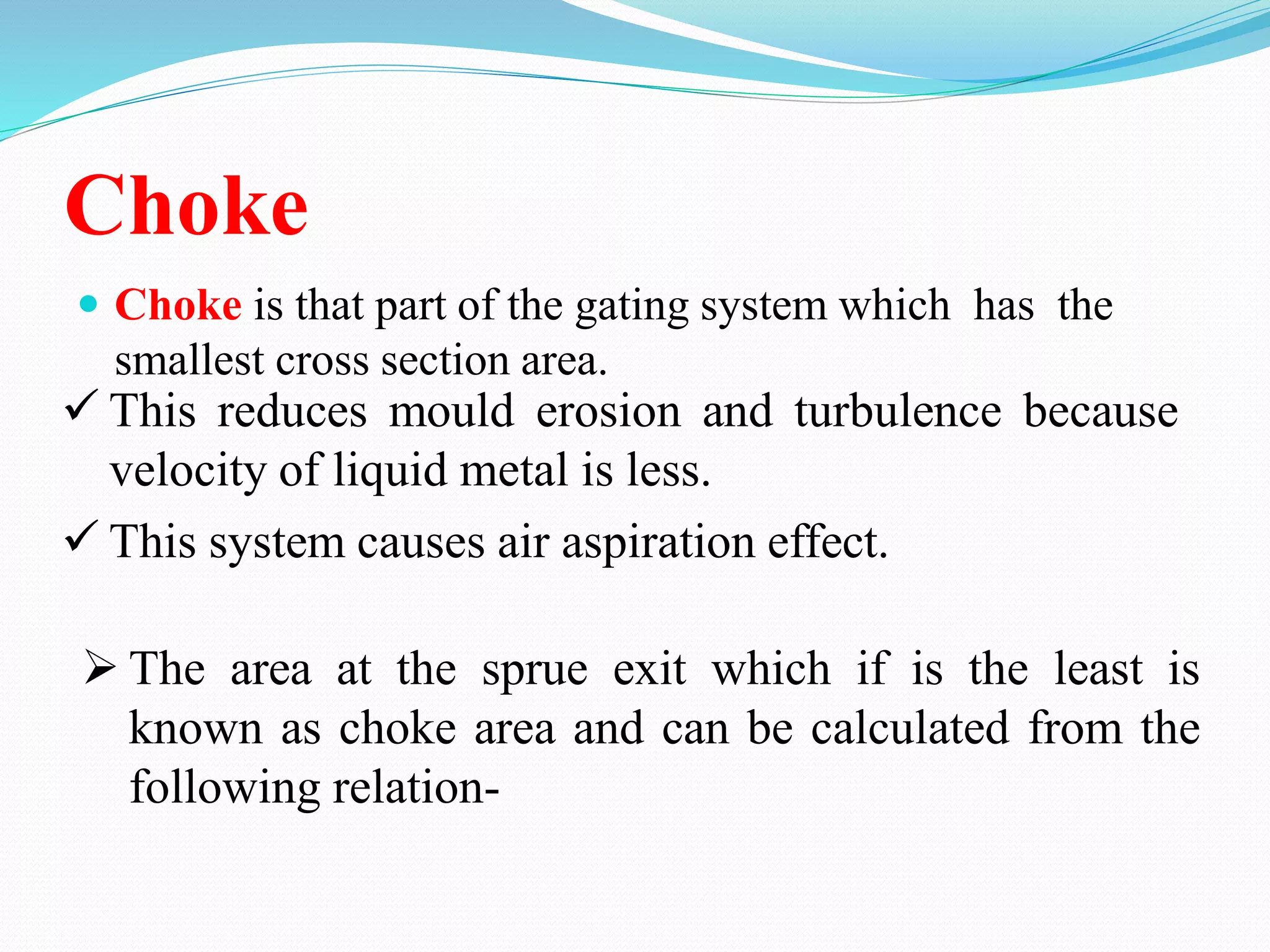
Choke
 Choke is that part of the gating system which has the
smallest cross section area.
 This reduces mould erosion and turbulence because
velocity of liquid metal is less.
 This system causes air aspiration effect.
 The area at the sprue exit which if is the least is
known as choke area and can be calculated from the
following relation-
c.dt 2 gH
A
W
C 
CA is choke area
W is the weight of casting
C is nozzle coefficient
d is density of liquid metal
t is pouring time
H effective liquid metal head
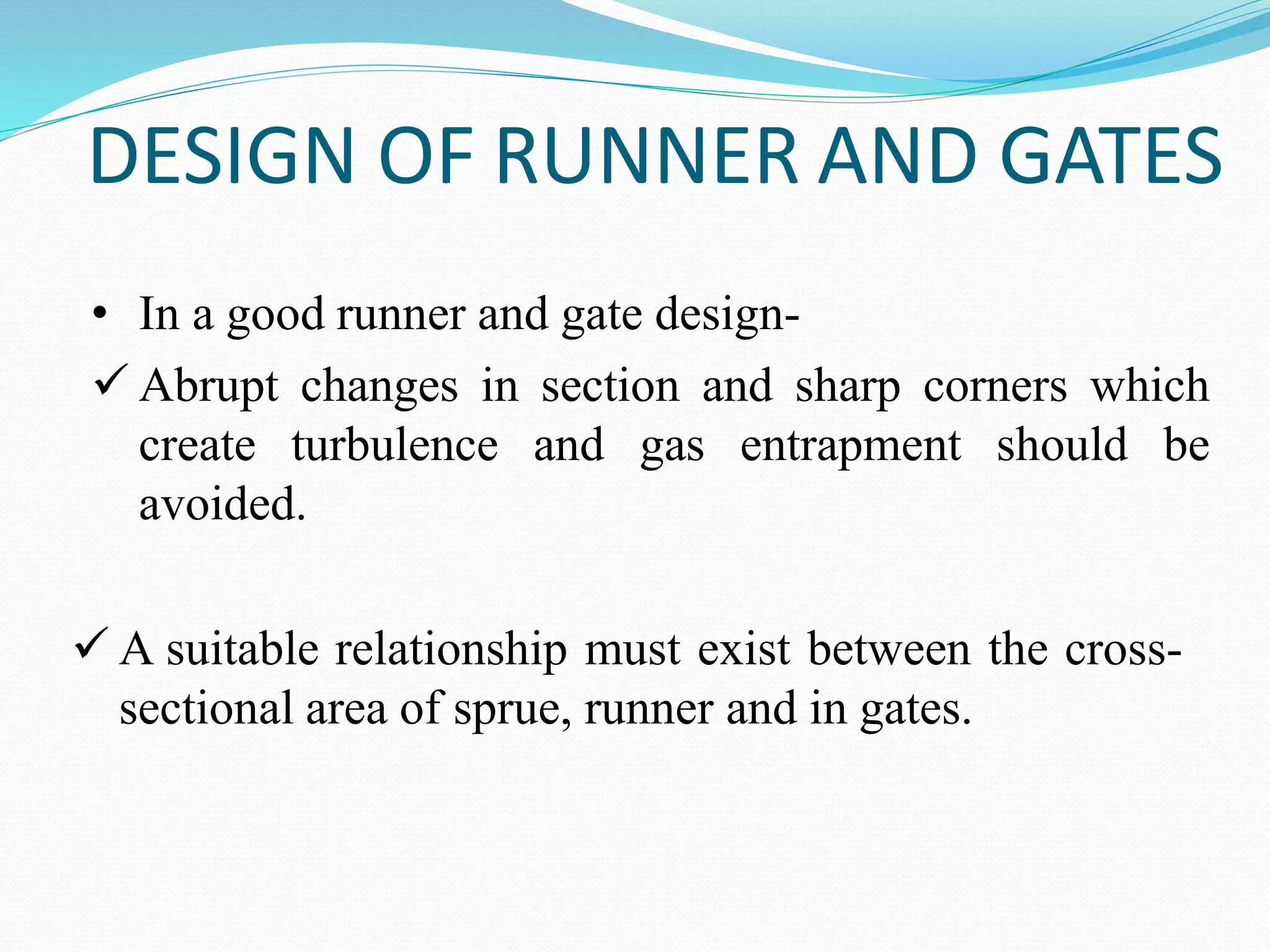
DESIGN OF RUNNER AND GATES
• In a good runner and gate design-
 Abrupt changes in section and sharp corners which
create turbulence and gas entrapment should be
avoided.
 A suitable relationship must exist between the cross-
sectional area of sprue, runner and in gates.
 Refers to the proportion of the cross-sectional area between the
sprue, runner and ingates
 Denoted as sprue area : runner area : ingate area
• Gating ratio= a:b:c where,
• a= cross-sectional area of sprue
• b= cross-sectional area of runner
• c= total cross-sectional area of ingates
 It is selected depending on the characteristics of molten metal being
cast
Factors that are considered are
- fluidity
- slag or dross forming tendency
- pouring temperature
- mould material characteristics like resistance to erosion,
scabbing tendency, green sand, CO2, dry sand, shell molded, .
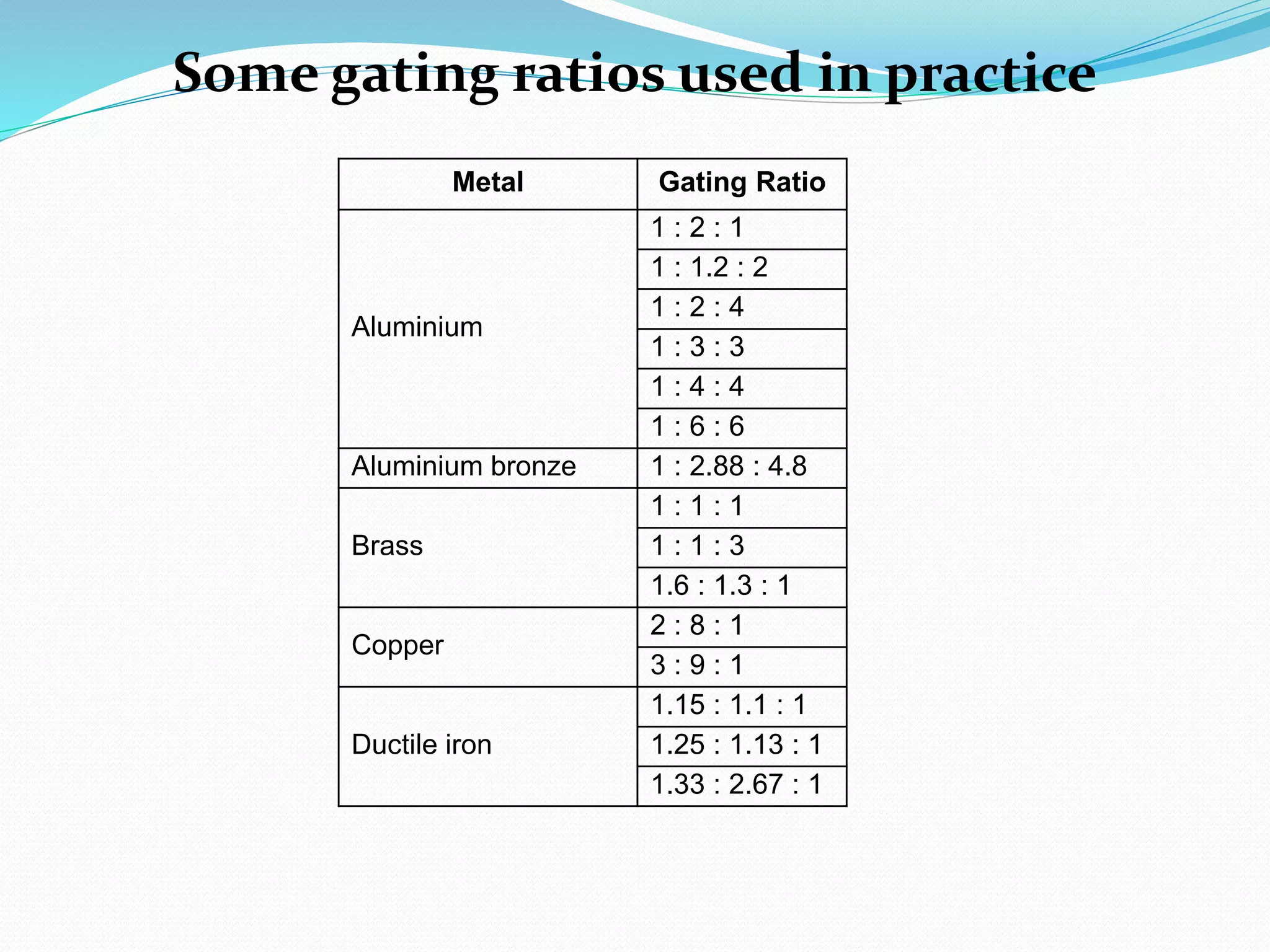
Gating Ratios
Some gating ratios used in practice
Metal Gating Ratio
Aluminium
1 : 2 : 1
1 : 1.2 : 2
1 : 2 : 4
1 : 3 : 3
1 : 4 : 4
1 : 6 : 6
Aluminium bronze 1 : 2.88 : 4.8
Brass
1 : 1 : 1
1 : 1 : 3
1.6 : 1.3 : 1
Copper
2 : 8 : 1
3 : 9 : 1
Ductile iron
1.15 : 1.1 : 1
1.25 : 1.13 : 1
1.33 : 2.67 : 1
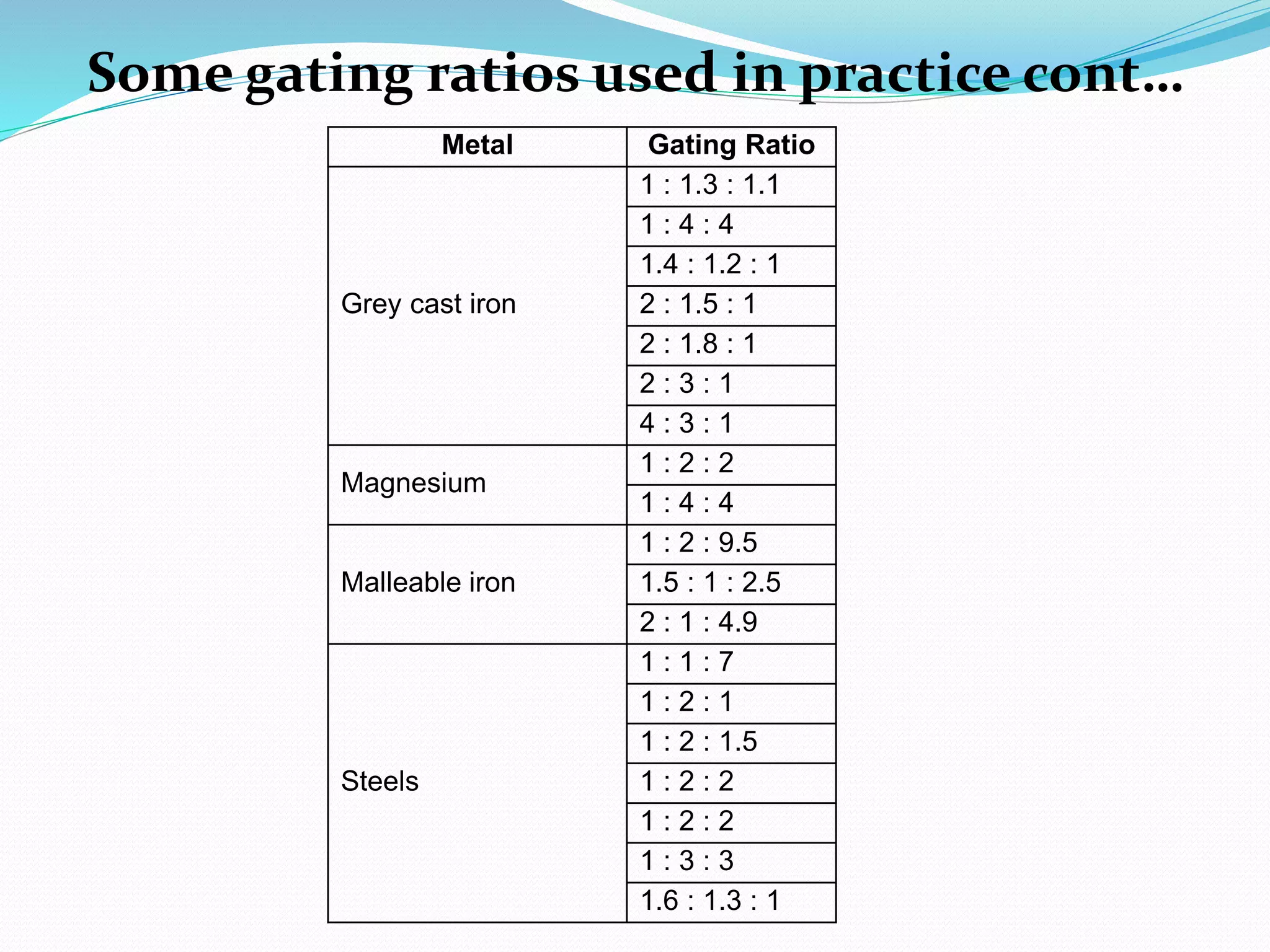
Some gating ratios used in practice cont…
Metal Gating Ratio
Grey cast iron
1 : 1.3 : 1.1
1 : 4 : 4
1.4 : 1.2 : 1
2 : 1.5 : 1
2 : 1.8 : 1
2 : 3 : 1
4 : 3 : 1
Magnesium
1 : 2 : 2
1 : 4 : 4
Malleable iron
1 : 2 : 9.5
1.5 : 1 : 2.5
2 : 1 : 4.9
Steels
1 : 1 : 7
1 : 2 : 1
1 : 2 : 1.5
1 : 2 : 2
1 : 2 : 2
1 : 3 : 3
1.6 : 1.3 : 1
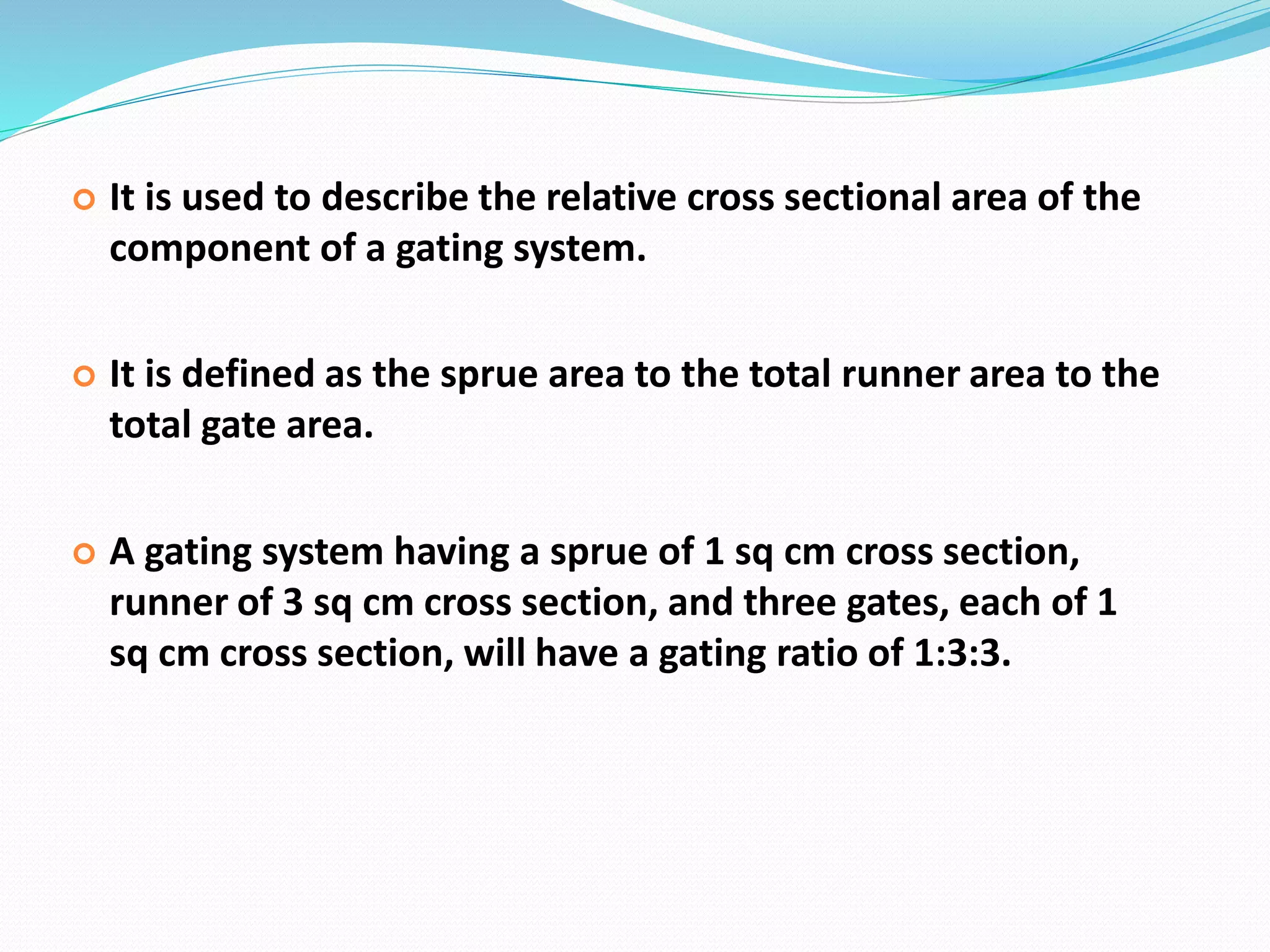
 It is used to describe the relative cross sectional area of the
component of a gating system.
 It is defined as the sprue area to the total runner area to the
total gate area.
 A gating system having a sprue of 1 sq cm cross section,
runner of 3 sq cm cross section, and three gates, each of 1
sq cm cross section, will have a gating ratio of 1:3:3.
 Depending on the gating ratio two types of gating systems
depending on the choke area:
1. Non-pressurized
2. Pressurized
Sprue
Runner
Ingate
Types of Gating Systems
15
0
• Pressurized system is referred to as “Gate control
System”, since ingates controls the flow of metal.
• Unpressurised system is referred to as “Choke Control
System”, since the choke controls the flow of metal.
• In the pressurized system high metal velocity occurs
and results in turbulence. In the case of unpressurised
system, turbulence is produced and streamline flow is
induced.
• Pressurized System Consumes less metal and yield is
more. Unpressurised system consumes more metal and
the yield will be slightly lowered.
• In the case of pressurized system, the system will
always be full of liquid metal . In the case of
unpressurised system flow is not full.
Non-pressurized gating system
 Total runner area and ingate areas higher than sprue area
 No pressure existing in the metal flow system – low turbulence
 Useful for casting – drossy metals and alloys
 Gating ratio - 1:4:4
Drawbacks
 Low casting yield-due to large metal in runners and gates
 The metal flow should be full in all elements – else - air
aspiration
Pressurized gating system
 Ingate area is the smallest – more backpressure in the system
 Turbulent metal – flows full in the system
 Not used for light alloys, suitable for ferrous castings
 Provides higher casting yield
 Gating ratio – 1:2:1
Pressurized Gating system Un Pressurized Gating system
Gate control System Choke Control System
Choke area is at the gate Choke area is at the bottom of the sprue
Velocity of the liquid metal entering into
system is more
Velocity of the liquid metal entering into
system is less
Turbulence and Splashing No Turbulence and Splashing
It can be used for casting of ferrous metals
It can be used for casting of non ferrous
metals
Density for the ferrous metals increases Density for the ferrous metals decreases
Casting yield is more Casting yield is less
No Possibility of air aspiration Possibility of air aspiration
S.N. Pressurized gating systems Unpressurized gating systems
1. Gating ratio may be of the order
of 3: 2: 1
Gating ratio may be of the order of
1: 3: 2
2. Air aspiration effect is minimum Air aspiration effect is more
3. Volume flow of liquid from
every ingate is almost equal.
Volume flow of liquid from every
ingate is different.
4. They are smaller in volume for a
given flow rate of metal.
Therefore the casting yield is
higher.
They are larger in volume because
they involve large runners and gates
as compared to pressurized system
and thus the cast yield is reduced.
5. V
elocity is high, severe
turbulence may occur at corners.
V
elocity is low and turbulence is
reduced.
 Gating ratio depends on the nature of the molten metal.
• Pressurized system is used for reactive metals like
magnesium alloy etc. Unpressurised gating system is
used for normal metals such as brass, steel, aluminium
alloy, etc.
• A Gating ratio such as 1:2:1 or 1:0.75:0.5 refers to
pressured system; whereas the gating ratio such as 1:2:2
or 1:3:3, 1:1:3, refers to unpressurised gating system.
Streamlining the gating system
• Streamlining includes-
• Removing sharp corners or junction by giving a
generous radius.
• Tapering the sprue.
• Providing radius at sprue entrance and exit.
ADVANTAGES OF STREAMLINING
• Metal turbulence is reduced.
• Air aspiration is avoided.
• Mould erosion and dross are minimized.
• Sound and clean casting are obtained.
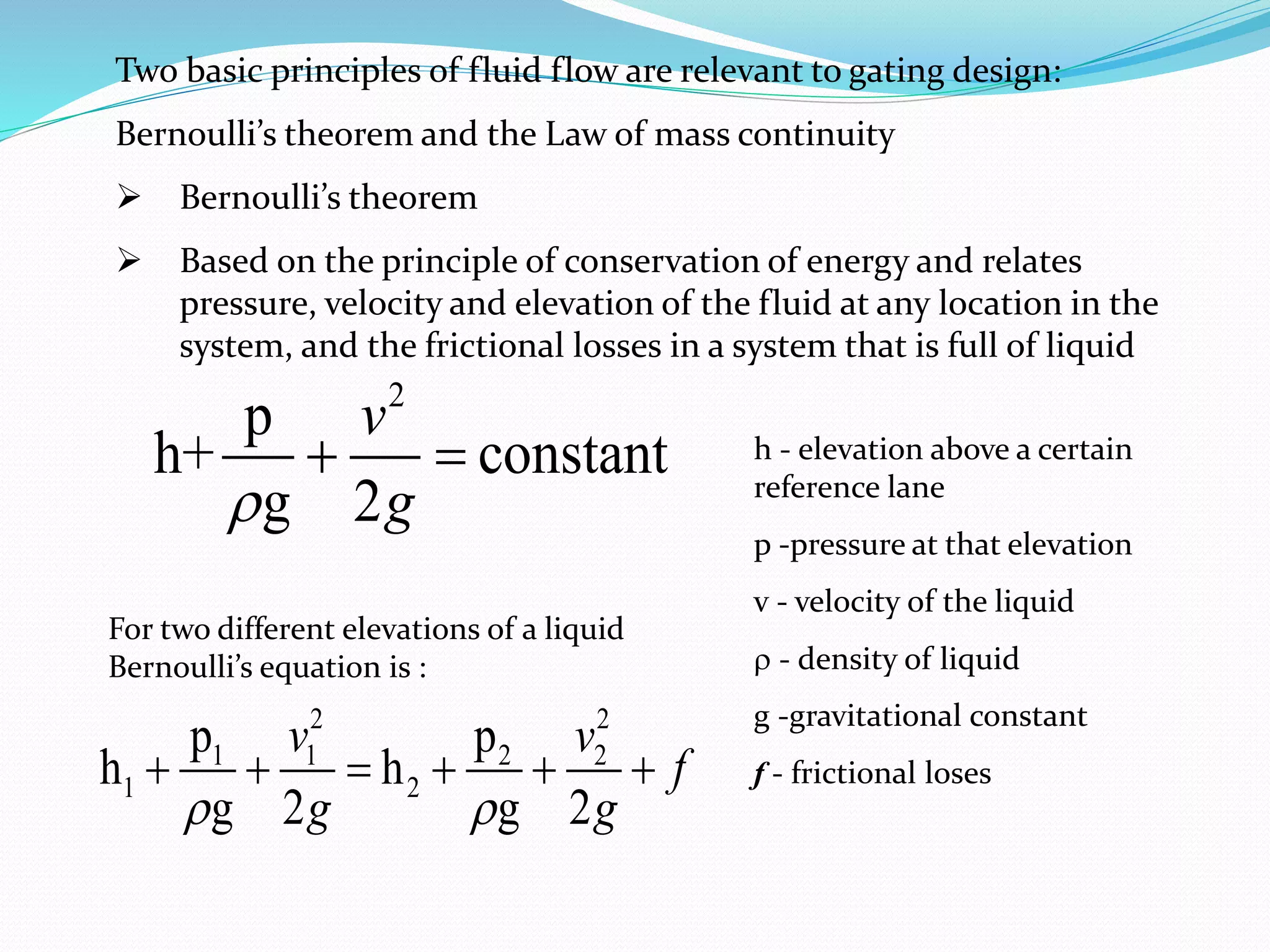
Two basic principles of fluid flow are relevant to gating design:
Bernoulli’s theorem and the Law of mass continuity
 Bernoulli’s theorem
 Based on the principle of conservation of energy and relates
pressure, velocity and elevation of the fluid at any location in the
system, and the frictional losses in a system that is full of liquid
2
p
h+ constant
g 2
v
g

  h - elevation above a certain
reference lane
p -pressure at that elevation
v - velocity of the liquid
 - density of liquid
g -gravitational constant
f - frictional loses
2 2
1 1 2 2
1 2
p p
h h
g 2 g 2
v v
f
g g
 
     
For two different elevations of a liquid
Bernoulli’s equation is :
Law of mass continuity
For incompressible liquids and in a system with impermeable walls,
the rate of flow is constant.
Q = AV=constant
For two different locations
Q = A1V1 = A2 V2
Q - Rate of flow m3/sec
A - cross-sectional area of liquid stream
V - average velocity of the liquid
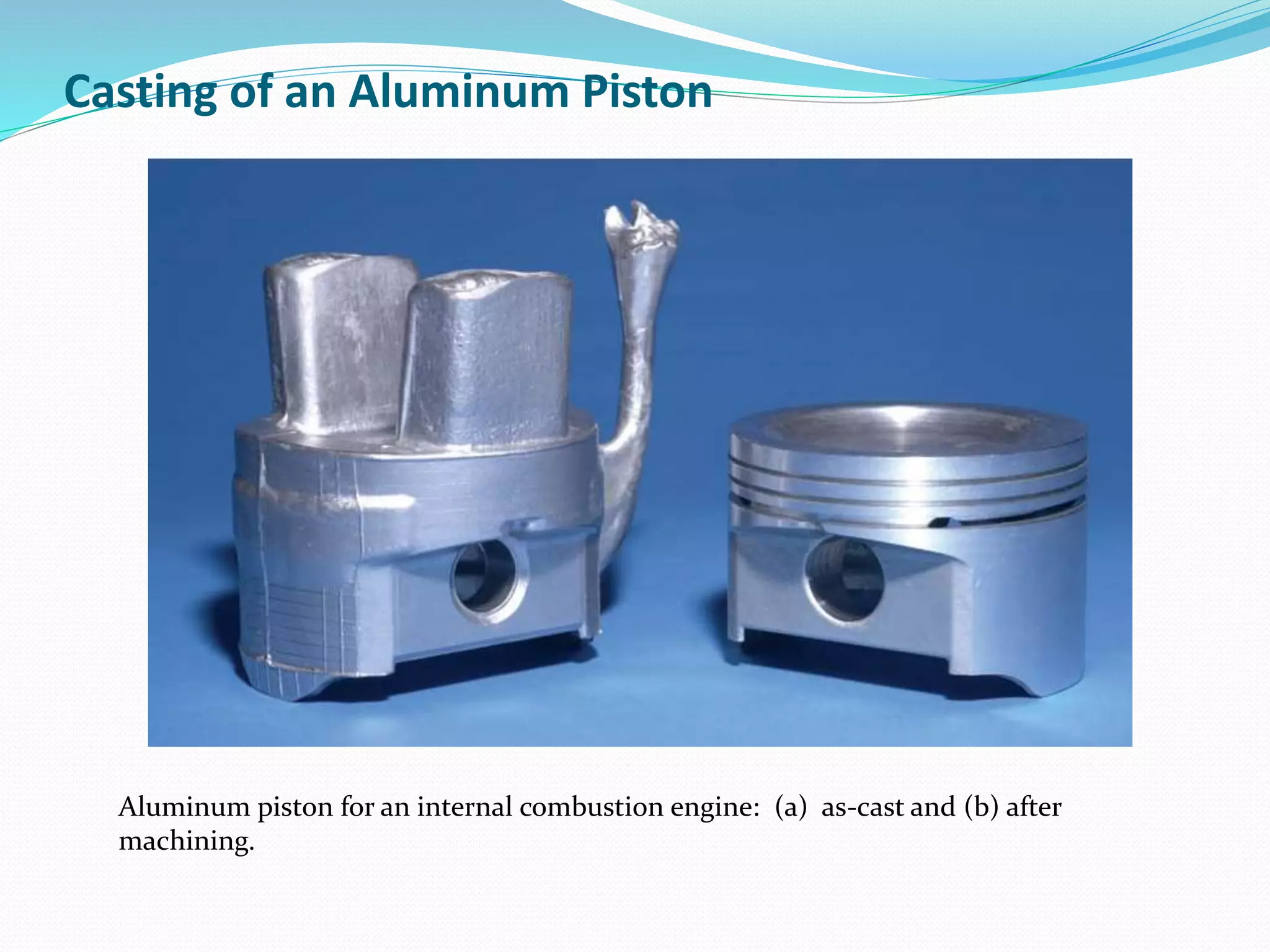
Casting of an Aluminum Piston
Aluminum piston for an internal combustion engine: (a) as-cast and (b) after
machining.

Casting process

  • 1.
    Manufacturing Processes Mrs.K.DORATHI Dept. ofMechanical Engineering SRI VASAVI ENGINEERING COLLEGE
  • 2.
    Manufacturing Manufacturing basically impliesmaking of goods or articles and providing services to meet the needs of mankind. Manufacturing process is that part of the production process which is directly concerned with the change of form or dimensions of the part being produced.
  • 3.
    •Began about 5000to 4000 B.C with the production of various articles of wood, ceramic, stone and metal • Derived from Latin word manu factus – meaning “made by hand” • The word manufacture first appeared in 1567 • The word manufacturing appeared in 1683 • Production is also used interchangeably . Evolution of Manufacturing
  • 5.
    Traditional Manufacturing Processes Casting Forming Sheetmetal processing Joining Plastics processing Lathe
  • 7.
    Casting since about4000 BC… Ancient Greece; bronze statue casting circa 450BC Iron works in early Europe, e.g. cast iron cannons from England circa 1543
  • 8.
    Casting Process • Castingprocess is one of the earliest metal shaping techniques known to human being. • It means pouring molten metal into a refractory mold cavity and allows it to solidify. • The solidified object is taken out from the mold either by breaking or taking the mold apart. • The solidified object is called casting and the technique followed in method is known as casting process.
  • 9.
    Six basic stepsin this process: • Place a pattern in sand to create a mold. • Incorporate the pattern and sand in a gating system. • Remove the pattern. • Fill the mold cavity with molten metal. • Allow the metal to cool. • Break away the sand mold and remove the casting.
  • 10.
    Casting Terminology • Pattern:An approximate duplicate or true replica of required product of casting • Flask/Box: The rigid metal or a wooden frame that holds the moulding material • Cope: Top half of the moulding box • Drag: Bottom half of the moulding box • Core: Shape that is inserted into a mould to produce internal features of a casting such as holes.
  • 12.
    Continue….. • Riser: Avertical opening in the mould • Act as a vent for gases • Helps to confirm that the mould is completely filled • Act as a reservoir of molten metal to feed and compensate for shrinkage during solidification of a casting
  • 13.
    Continue…. • Gating System:Channels used to deliver the molten metal to the mould cavity • Sprue: The vertical passage in the gating system • Runner: The horizontal channel of the gating system • Gate: Channel which connects runner and mould
  • 16.
    Advantages • Product canbe cast as one piece. • Very heavy and bulky parts can be manufactured • Metals difficult to be shaped by other manufacturing processes may be cast (eg: Cast Iron) • Best for mass production • Complex shapes can be manufactured
  • 17.
    • VERSATILE: complexgeometry, internal cavities, hollow sections • VERSATILE: small (~10 grams)  very large parts (~1000 Kg) • ECONOMICAL: little wastage (extra metal is re-used) • ISOTROPIC: cast parts have same properties along all directions
  • 18.
    Disadvantages of Casting •Casting process is a labour intensive process • Not possible for high melting point metals • Dimensional accuracy, surface finish and the amount of defects depends on the casting process • Allowances required.
  • 19.
    Applications • Transportation vehicles(eg.:engines) •Machine tool structures. • Turbine vanes • Mill housing • Valves • Sanitary fittings • Agricultural parts • Construction &atomic energy applications.
  • 20.
  • 21.
  • 22.
  • 23.
  • 24.
  • 26.
    Pattern • Pattern isthe principal tool during the casting process. • A pattern is a model or the replica of the object (to be casted) • It may be defined as a model or form around which sand is packed to give rise to a cavity known as mold cavity in which when molten metal is poured, the result is the cast object. • A pattern prepares a mold cavity for the purpose of making a casting.
  • 27.
    OBJECTIVES OF APATTERN • Pattern prepares a mould cavity for the purpose of making a casting. Pattern possesses core prints which produces seats in form of extra recess for core placement in the mould. It establishes the parting line and parting surfaces in the mould. Runner, gates and riser may form a part of the pattern. Properly constructed patterns minimize overall cost of the casting. Pattern may help in establishing locating pins on the mould and therefore on the casting with a purpose to check the casting dimensions. Properly made pattern having finished and smooth surface reduce casting defects. • • • • • •
  • 28.
    Pattern Materials • Wood:Inexpensive, Easily available, Light weight, easy to shape, good surface finish, Poor wear resistance, absorb moisture, less strength, not suitable for machine moulding, easily repaired, warping, weaker than metallic patterns. Eg. Shisam, kail, deodar, Teak wood, maogani. Metal: less wear and tear, not affected by moisture, metal is easier to shape the pattern with good precision, surface finish • • and intricacy in shapes, withstand against corrosion and handling for longer, excellent strength to weight ratio, metallic patterns are higher cost, higher weight and tendency of rusting. preferred for production of castings in large quantities with same pattern. Eg.: cast iron, brass and bronzes and aluminum alloys • • •
  • 29.
    • Plastic:-Plastics are gettingmore popularity now a days because the patterns made of these materials are lighter, stronger, moisture and wear resistant, non sticky to molding sand, durable and they are not affected by the moisture of the molding sand. fragile, less resistant to sudden loading and their section may need metal reinforcement. Eg.:phenolic resin, foam plastic • • • Plaster: strength, accurate. Intricate shapes can be made, good compressive expands while solidifying, less dimensionally • •Wax: Good surface finish, high accuracy, no need to remove from the mould, less strength.
  • 30.
    FACTORS EFFECTING SELECTIONOF PATTERN MATERIAL 1. Number of castings to be produced. Metal pattern are preferred when castings arerequired large in number. 2. Type of mould material used. 3. Kind of molding process. 4. Method of molding (hand or machine). 5. Degree of dimensional accuracy and surface finish required. 6. Minimum thickness required. 7. Shape, complexity and size of casting. 8. Cost of pattern and chances of repeat orders of the pattern
  • 31.
    TYPES OF PATTERN •Single-piece or solid pattern • Solid pattern is made of single piece without joints, partings lines or loose pieces. • It is the simplest form of the pattern. • Typical single piece pattern is shown in Fig. • Simplest type, inexpensive used for limited production
  • 32.
    • Two-piece orsplit pattern • When solid pattern is difficult for withdrawal from the mold cavity, then solid pattern is splited in two parts. • Split pattern is made in two pieces which are joined at the parting line by means of dowel pins. • The splitting at the parting line is done to facilitate the withdrawal of the pattern. • A typical example is shown in Fig.
  • 33.
    • Cope anddrag pattern • In this case, cope and drag part of the mould are prepared separately. This is done when the complete mould is too heavy to be handled by one operator. • The pattern is made up of two halves, which are mounted on different plates. A typical example of match plate pattern is shown in Fig.
  • 35.
    • Loose-piece Pattern •used when pattern is difficult for withdrawal from the mould. • Loose pieces are provided on the pattern and they are the part of pattern. • The main pattern is removed first leaving the loose piece portion of the pattern in the mould. • Finally the loose piece is withdrawal separately leaving the intricate mould.
  • 36.
    • Match platepattern • This pattern is made in two halves and is on mounted on the opposite sides of a wooden or metallic plate, known as match plate. • The gates and runners are also attached to the plate. • This pattern is used in machine molding. A typical example of match plate pattern is shown in Fig.
  • 37.
    • Follow boardpattern • When the use of solid or split patterns becomes difficult, a contour corresponding to the exact shape of one half of the pattern is made in a wooden board, which is called a follow board and it acts as a molding board for the first molding operation as shown in Fig.
  • 38.
    • Gated pattern •In the mass production of casings, multi cavity moulds are used. Such moulds are formed by joining a number of patterns and gates and providing a common runner for the molten metal, as shown in Fig. • These patterns are made of metals, and metallic pieces to form gates and runners are attached to the pattern.
  • 40.
    • Sweep pattern • •Sweep patterns are used for forming large circular moulds of symmetric kind by revolving a sweep attached to a spindle as shown in Fig. • Sweep is a template of wood or metal and is attached to the spindle at one edge and the other edge has a contour depending upon the desired shape of the mould. The pivot end is attached to a stake of metal in the center of the mould.
  • 41.
    • Segmental pattern •Patterns of this type are generally used for circular castings, for example wheel rim, gear blank etc. • Such patterns are sections of a pattern so arranged as to form a complete • mould by being moved to form each section of the mould. • The movement of segmental pattern is guided by the use of a central pivot. A segment pattern for a wheel rim is shown in Fig.
  • 42.
    • Shell pattern •Shell patterns are used mostly for piping work or for producing drainage fittings. This pattern consists of a thin cylindrical or curved metal piece parted along the center line. • The two halves of the pattern are held in alignment by dowels. • The outside surface of the pattern is used to make the mould for the fitting required while the inside can serve as a core box.
  • 44.
    PATTERN ALLOWANCES • Thesize of a pattern is never kept the same as that of the desired casting because of the fact that during cooling the casting is subjected to various effects and hence to compensate for these effects, corresponding allowances are given in the pattern. These various allowances given to pattern can be enumerated as, allowance for shrinkage, allowance for machining, allowance for draft, allowance for rapping or shake, allowance for distortion and allowance for mould wall movement. •
  • 45.
    • Shrinkage Allowance • • • • •In practice,all common cast metals shrink a significant amount when they are cooled from the molten state. The total contraction in volume is divided into the following parts: 1.Liquid contraction, i.e. the contraction during the period in which the temperature of the liquid metal or alloy falls from the pouring temperature to the liquidus temperature. 2.Contraction on cooling from the liquidus to the solidus temperature, i.e. solidifying contraction. 3.Contraction that results there after until the temperature reaches the room temperature. This is known as solid contraction. The first two of the above are taken care of by proper gating and risering. Only the last one, i.e. the solid contraction is taken care by the pattern makers by giving a positive shrinkage allowance. This contraction allowance is different for different metals.
  • 46.
    • The contractionallowances for different metals and alloys such as Cast Iron 10 mm/mt.. Brass 16 mm/mt., Aluminium Alloys. 15 mm/mt., Steel 21 mm/mt., Lead 24 mm/mt. In fact, there is a special rule known as the pattern marks contraction rule in which the shrinkage of the casting metals is added. The pattern must be made over size to compensate for contraction of liquid metal on cooling. This addition to the dimension of the pattern is known as shrinkage allowance. •
  • 47.
    • Machining Allowance • • Itis a positive allowance given to compensate for the amount of material that is lost in machining or finishing the casting. If this allowance is not given, the casting will become undersize after machining. this allowance depends on the size of casting, methods of machining and the degree of finish. value varies from 3 mm. to 18 mm. pattern must be made over size for machining purpose This extra amount of dimensions provided in the pattern is known as Machining allowance. • • • • •
  • 48.
    • Taper allowance • • • positiveallowance given on all the vertical surfaces of pattern to make withdrawal easier. taper on the external surfaces varies from 10 mm to 20 mm/mt. On interior holes and recesses which are smaller in size, the taper should be around 60 mm/mt. These values are greatly affected by the size of the pattern and the molding method In machine molding its, value varies from 10 mm to 50 mm/mt. • •
  • 49.
    • Rapping orShake Allowance • Before withdrawing the pattern it is rapped and thereby the size of the mould cavity increases. • by rapping, the external sections move outwards increasing the size and internal sections move inwards decreasing the size. • insignificant in the case of small and medium size castings, • but it is significant in the case of large castings. negative allowance pattern is made slightly smaller in dimensions 0.5-1.0 mm.
  • 50.
    Distortion Allowance • Thisallowance is applied to the castings which have the tendency to distort during cooling due to thermal stresses developed. • For example a casting in the form of U shape will contract at the closed end on cooling, while the open end will remain fixed in position. • Therefore, to avoid the distortion, the legs of U pattern must converge slightly so that the sides will remain parallel after cooling.
  • 51.
    • • COLOR CODIFICATIONFOR PATTERNS Surfaces to be left unfinished after casting are to be painted as black. • Surface to be machined are painted as red. • Core prints are painted as yellow. • Seats for loose pieces are painted as red stripes on yellow background.
  • 53.
    Mould • Suitable andworkable material possessing high refractoriness in nature Molding sand is the most common utilized non-metallic molding material because of its certain inherent properties namely, Refractoriness, Chemical and thermal stability at higher temperature, high permeability and Workability along with good strength. Highly cheap and easily available. • • • •
  • 54.
    MOLDING SAND • Sourcesof receiving molding sands • Beds of sea, • Rivers, • Lakes, • Granulular elements of rocks, • And deserts.
  • 55.
    • Sources ofmolding sands available in India 1 Batala sand ( Punjab) 2Ganges sand (Uttar Pradesh) 3Oyaria sand (Bihar) 4 Damodar and Barakar sands (Bengal- Bihar Border) 5 Londha sand (Bombay) 6 Gigatamannu sand (Andhra Pradesh) and 7 Avadi and Veeriyambakam sand (Madras)
  • 56.
  • 57.
    Natural Molding sand: •Known as green sand • Having appreciable amount of clay which acts as a binder between sand grains • Obtained by crushing and milling of soft yellow sand stone, carboniferrous etc • Ease of availability • Low cost • High flexibility • Mostly used for ferrous and non ferrous metal casting
  • 58.
    Synthetic sand • knownas silica sand • not having binder(clay) in natural form • desired strength and properties developed by separate addition of binder like bentonite, water and other materials. • More expensive than natural sand
  • 59.
    Special sands • Zicron-coresof brass and bronze casting • Olivine-for non ferrous casting • Chromite-for heavy steel casting • Chrome-magnesite-used as facing materials in steel casting.
  • 60.
    Types of mouldingsand (According to use) Green sand Dry sand Facing sand Backing sand System sand Parting sand Loam sand Core sand
  • 61.
    Green sand • Greensand is also known as tempered or natural sand • mixture of silica sand with 18 to 30 percent clay, having moisture content from 6 to 8%. • The clay and water furnish the bond for green sand. It is fine, soft, light, and porous. • Green sand is damp, when squeezed in the hand and it retains the shape and the impression to give to it under pressure. • Molds prepared by this sand are not requiring backing and hence are known as green sand molds.
  • 62.
    Dry sand • Greensand that has been dried or baked in suitable oven after the making mold and cores, is called dry sand. • more strength, • rigidity and • thermal stability. • mainly suitable for larger castings. • mold prepared in this sand are known as dry sand molds.
  • 63.
    Loam sand • Loamis mixture of sand and clay with water to a thin plastic paste. • sand possesses high clay as much as 30-50% and 18% water. • Patterns are not used for loam molding and shape is given to mold by sweeps. • particularly employed for loam molding used for large grey iron castings. • This sand is used for loam sand moulds for making very heavy castings usually with the help of sweeps and skeleton patterns.
  • 64.
    Facing sand • • Facingsand is just prepared and forms the face of the mould. • It is directly next to the surface of the pattern and it comes into contact molten metal when the mould is poured. • high strength refractoriness. • made of silica sand and clay, without the use of used sand. • Different forms of carbon are used to prevent the metal burning into the sand. • A facing sand mixture for green sand of cast iron may consist of 25% fresh sand specially prepared and 5% sea coal. sometimes mixed with 6-15 times as much fine molding sand to make facings. • The layer of facing sand in a mold usually ranges from 22-28 mm. From 10 to 15% of the whole amount of molding sand is the facing sand.
  • 66.
    Backing sand • Backingsand or floor sand is used to back up the facing sand and is used to fill the whole volume of the molding flask. • Used molding sand is mainly employed for this purpose. • The backing sand is sometimes called black sand
  • 67.
    System sand • Inmechanized foundries where machine molding is employed. • system sand is used to fill the whole molding flask. • The used sand is cleaned and re-activated by the addition of water and special additives. This is known as system sand. • Since the whole mold is made of this system sand, the properties such as strength, permeability and refractoriness of the molding sand must be higher than those of backing sand.
  • 68.
    Parting sand • withoutbinder and moisture to keep the green sand not to stick to the pattern • to allow the sand on the parting surface the cope and drag to separate without clinging. • This is clean clay-free silica sand which serves the same purpose as parting dust.
  • 69.
    Core sand • isused for making cores and it is sometimes • also known as oil sand. • This is highly rich silica sand mixed with oil binders such as core oil which composed of linseed oil, resin, • light mineral oil and other bind materials. • Pitch or flours and water may also be used in large cores for the sake of economy.
  • 70.
    Properties of MouldingSand • Refractoriness • • • • • • • Refractoriness is defined as the ability of molding sand to withstand high temperatures without breaking down or fusing thus facilitating to get sound casting. poor refractoriness burn on to the casting surface and no smooth casting surface can be obtained. degree of refractoriness depends on the SiO2 i.e. quartz content, and the shape and grain size of the particle. higher the SiO2 content higher is the refractoriness of the molding Refractoriness is measured by the sinter point of the sand rather than its melting point.
  • 71.
    • Permeability • Itis also termed as porosity of the molding sand in order to allow the escape of any air, gases or moisture present or generated in the mould when the molten metal is poured into it. All these gaseous generated during pouring and solidification process must escape otherwise the casting becomes defective. Permeability is a function of grain size, grain shape, and moisture and clay contents in the molding sand. The extent of ramming of the sand directly affects the permeability. • • •
  • 72.
    • Cohesiveness • Itis property by virtue of which the sand grain particles interact and attract each other within the molding sand. Thus, the binding capability of the molding sand gets enhanced to increase the green, dry and hot strength property of molding and core sand. •

  • 73.
    • Green strength • • •By virtue of this property, the pattern can be taken out from the mould without breaking the mould and also the erosion of mould wall surfaces does not occur during the flow of molten metal. The green sand after water has been mixed into it, must have sufficient strength and toughness to permit the making and handling of the mould. For this, the sand grains must be adhesive, i.e. they must be capable of attaching themselves to another body and therefore, and sand grains having high adhesiveness will cling to the sides of the molding box.
  • 74.
    • Dry strength •As soon as the molten metal is poured into the mould, the moisture in the sand layer adjacent to the hot metal gets evaporated and this dry sand layer must have sufficient strength to its shape in order to avoid erosion of mould wall during the flow of molten metal. • The dry strength also prevents the enlargement of mould cavity cause by the metallostatic pressure of the liquid metal.
  • 75.
    • Strength ofthe moulding sand depends on: • 1. Grain size and shape • 2. Moisture content • 3. Density of sand after ramming • ·The strength of the mould increases with a decrease of grain size and an increase of clay content and density after ramming. The strength also goes down if moisture content is higher than an optimum value.
  • 76.
    • Flowability orplasticity • It is the ability of the sand to get compacted and behave like a fluid. It will flow uniformly to all portions of pattern when rammed and distribute the ramming pressure evenly all around in all directions. • Generally sand particles resist moving around corners or projections. • In general, flowability increases with decrease in green strength, an, decrease in grain size. • The flowability also varies with moisture and clay content.
  • 77.
    • Adhesiveness • ·It is the important property of the moulding sand and it is defined as the sand particles must be capable of adhering to another body, then only the sand should be easily attach itself with the sides of the moulding box and give easy of lifting and turning the box when filled with the stand.
  • 78.
    • Collapsibility • Afterthe molten metal in the mould gets solidified, the sand mould must be collapsible so that free contraction of the metal occurs and this would naturally avoid the tearing or cracking of the contracting metal. • In absence of this property the contraction of the metal is hindered by the mold and thus results in tears and cracks in the casting. • This property is highly desired in cores.
  • 79.
    CONSTITUENTS OF MOLDINGSAND • • • • • The main constituents of molding sand involve silica sand, binder, moisture content and additives.
  • 80.
    • Silica sand • • • • • • • •Silica sand in form of granular quartz is the main constituent of molding sand having enough refractoriness which can impart strength, stability and permeability to molding and core sand. along with silica small amounts of iron oxide, alumina, lime stone, magnesia, soda and potash are present as impurities. The silica sand can be specified according to the size (small, medium and large silica sand grain) and the shape (angular, sub-angular and rounded).
  • 81.
    Binder • • In general, thebinders can be either inorganic or organic substance. The inorganic group includes clay sodium silicate and port land cement etc. In foundry shop, the clay acts as binder which may be Kaolonite, Ball Clay, Fire Clay, Limonite, Fuller’s earth and Bentonite. Binders included in the organic group are dextrin, molasses, cereal • • binders, linseed oil and resins like phenol formaldehyde, urea formaldehyde etc. Organic binders are mostly used for core making. Among all the above binders, the bentonite variety of clay is the most common. However, this clay alone can not develop bonds among sand grains without the presence of moisture in molding sand and core sand. • •
  • 82.
    Moisture • • • • • • The amountof moisture content in the molding sand varies generally between 2 to 8 percent. This amount is added to the mixture of clay and silica sand for developing bonds. This is the amount of water required to fill the pores between the particles of clay without separating them. This amount of water is held rigidly by the clay and is mainly responsible for developing the strength in the sand. The effect of clay and water decreases permeability with increasing clay and moisture content. The green compressive strength first increases with the increase in clay content, but after a certain value, it starts decreasing. • For increasing the molding sand characteristics some other additional materials beside basic constituents are added which are known as additives.
  • 83.
    Additives • Dextrin • carbohydrates •increases dry strength of the molds. • Corn flour • It belongs to the starch family of carbohydrates • is used to increase the collapsibility of the molding and core sand. • Coal dust • To avoid oxidation of pouring metal • For production of grey iron and malleable cast iron castings. • Sea coal • sand grains become restricted and cannot move into a dense packing pattern. • Pitch • form of soft coal (0.02 % to 2%) • Wood flour:0.05 % to 2% • To avoid expansion defects. • increases collapsibility of both of mold and core. • Silica flour • added up to 3% which increases the • hot strength and finish on the surfaces of the molds and cores.
  • 85.
    GATING SYSTEM • Theterm gating system refers to all passageways through which the molten metal passes to enter the mould cavity. • The gating system is composed of  Pouring basin  Sprue  Runner  Gates  Risers
  • 86.
  • 87.
    • Any gatingsystem designed should aim at providing a defect free casting. This can be achieved by considering following requirements.  A gating system should avoid sudden or right angle changes in direction.  Agating system should fill the mould cavity before freezing.  The metal should flow smoothly into the mould without any turbulence. A turbulence metal flow tends to form dross in the mould.  Unwanted materials such as slag, dross and other mould materials should not be allowed to enter the mould cavity.  The metal entry into the mould cavity should be properly controlled in such a way that aspiration of the atmospheric air is prevented.
  • 88.
     A properthermal gradient should be maintained so that the casting is cooled without any shrinkage cavities or distortions.  Metal flow should be maintained in such a way that no gating or mould erosion takes place.  The gating system should ensure that enough molten metal reaches the mould cavity.  It should be economical and easy to implement and remove casting after solidification.
  • 89.
    • For properfunctioning of the gating system, the following factors need to be controlled.  Type of pouring equipment, such as ladles, pouring basin etc.  Temperature/ Fluidity of molten metal.  Rate of liquid metal pouring.  Type and size of sprue.  Type and size of runner.  Size, number and location of gates connecting runner and casting.  Position of mould during pouring and solidification.
  • 90.
    Functions of gatingsystem 90 • Agood gating system should help easy and complete filling of the mould cavity. • It should fill the mould cavity with molten metal with least amount of turbulance. • It should prevent mould erosion. • It should establish proper temperature gradient in the casting. • It should promote directional solidification. • It should regulate the rate of flow of metal into the mould cavity.
  • 91.
    Defects occurring dueto improper design of gating system 91 • Oxidation of metal • Cold shuts • Mould erosion • Shrinkages • Porosity • Misruns • Penetration of liquid metal into mould walls.
  • 92.
  • 93.
    • A pouringbasin makes it easier for the ladle or crucible operator to direct the flow of metal from crucible to sprue. • Helps maintaining the required rate of liquid metal flow. • Reduces turbulence at the sprue entrance. • Helps separating dross, slag etc., from metal before it enters the sprue.
  • 94.
    •If the pouringbasins are made large, Dross and slag formation will tend to float on the surface of the metal and may be stopped from entering the sprue and hence the mould. They may be filled quickly without overflowing and may act as a reservoir of liquid metal to compensate metal shrinkage or contraction.
  • 95.
    Design criteria forpouring basin • The pouring basin should be designed such that the proper uniform flow system is rapidly established. • This can be achieved by-  Use of strainer core  Use of sprue plug • It should be easy and convenient to fill pouring basin.
  • 100.
    Pouring Basin  Themain function of the pouring basin is to reduce the momentum of the liquid flowing into the mould.  To prevent the turbulence of the molten liquid the pouring basin should be deep and the entrance into the sprue should be a smooth radius of atleast 25 mm.  To prevent vortex formation the pouring basin should be kept full.
  • 101.
    Pouring Basin  Constantflow conditions should be maintained by using a delay screen or strainer core.  The metal should be poured steadily into the pouring basin keeping the lip of the ladle as close as possible.  Pouring basins are preferable with castings in alloys which form troublesome oxide skins (aluminium, aluminium bronze, etc..)
  • 102.
    SPRUE • A spruefeeds metal to runner which in turn reaches the casting through gates. • A sprue is tapered with its bigger end at top to receive the liquid metal. The smaller end is connected to runner.
  • 103.
    Design of sprue •As the liquid metal passes down the sprue it loses its pressure head but gains velocity. To reduce turbulence and promote Laminar Flow, from the Pouring Basin, the flow begins a near vertical incline that is acted upon by gravity and with an accelerative gravity force
  • 104.
    Sprue  Should betapered down to take into account the gain in velocity of the metal at it flows down reducing the air aspiration.  The exact tapering can be obtained by AtVt = AcVc  At = Ac(Vc/Vt) Since, velocities are proportional to the square of the potential heads, At = Ac (hc/ht)  Equation indicates that the profile of the sprue should be parabolic as per the above equation.  As it is difficult to make a parabolic a straight taper is made.  Straight taper - reduces air aspiration - increase the flow rate compared to a parallel sprue.
  • 105.
    Sprue cont…  Shouldbe tapered down to take into account the gain in velocity of the metal at it flows down reducing the air aspiration.  The exact tapering can be obtained by AtVt = AcVc  At = Ac(Vc/Vt) Since, velocities are proportional to the square of the potential heads, At = Ac (hc/ht) H= actual sprue height Ht = h + H
  • 106.
    Sprue Base Well It is provided at the bottom of the sprue.  It helps to reduce the velocity of the incoming metal and mold erosion.  General guideline, - area of sprue base well = 5 * sprue choke area. - well depth = runner depth
  • 107.
    GATES • A gateis a channel which connects runner with the mould cavity and through which molten metal flows to fill the mould cavity. • A small gate is used for a casting which solidifies slowly and vice versa. • A gate should not have sharp edges as they may break during pouring and sand pieces thus may be carried with the molten metal in the mould cavity. • Types • Top gate • Bottom gate • Parting line side gate
  • 108.
    Top gate • Atop gate is sometimes also called as Drop gate because the molten metal just drops on the sand in the bottom of the mould. • Generation of favourable temperature gradients to enable directional solidification from the casting towards the gate which serves as a riser too.
  • 111.
    Disadvantages •The dropping liquidmetal stream erodes the mould surface. •There is a lot of turbulence.
  • 112.
    Bottom gates • Abottom gate is made in the drag portion of the mould. • In a bottom gate the liquid metal fills rapidly the bottom portion of the mould cavity and rises steadily and gently up the mould walls. • As comparison to top gate, bottom gate involves little turbulence and sand erosion. • Bottom gate produces good casting surfaces.
  • 114.
    Disadvantages • In bottomgates, liquid metal enters the mould cavity at the bottom. If freezing takes place at the bottom, it could choke off the metal flow before the mould is full. • A bottom gate creates an unfavourable temperature gradient and makes it difficult to achieve directional solidification.
  • 115.
    PARTING LINE SIDEGATE • Middle or side or parting gating systems combine the characteristics of top and bottom gating systems. • In this technique gate is provided along the parting line such that some portion of the mould cavity will be below the parting line and some portion will be above the parting line. • The cavity below the parting line will be filled by assuming top gating and the cavity above the parting line will be filled by assuming bottom gating.
  • 116.
  • 117.
    ROLE OF RISERIN SAND CASTING Metals and their alloys shrink as they cool or solidify and hence may create a partial vacuum within the casting which leads to casting defect known as shrinkage or void. The primary function of riser as attached with the mould is to feed molten metal to accommodate shrinkage occurring during solidification of the casting. • As shrinkage is very common casting defect in casting and hence it should be avoided by allowing molten metal to rise in riser after filling the mould cavity completely and supplying the molten metal to further feed the void occurred during solidification of the casting because of shrinkage.
  • 118.
    • Riser alsopermits the escape of evolved air and mold gases as the mold cavity is being filled with the molten metal. • It also indicates to the foundry man whether mold cavity has been filled completely or not. The suitable design of riser also helps to promote the directional solidification and hence helps in production of desired sound casting.
  • 119.
     There aredifferent classifications for risers. i) Top risers:-  Risers that feed the metal casting from the top. ii)Side risers:-  Risers that feed the metal casting from the side. iii)Blind risers:-  Risers that are completely conained within the mould. i v ) O p e n risers:-  Risers that is open at the top to the outside environment.
  • 121.
    Considerations for DesigningRiser • • Freezing time 1 For producing sound casting, the molten metal must be fed to the mold till it solidifies completely. This can be achieved when molten metal in riser should freeze at slower rate than the casting. Freezing time of molten metal should be more for risers than casting. The quantative risering analysis developed by Caine and others can be followed while designing risers. Feeding range 1. When large castings are produced in complicated size, then more than one riser are employed to feed molten metal depending upon the effective freezing range of each riser. 2. Casting should be divided into divided into different zones so that each zone can be feed by a separate riser. 3. Risers should be attached to that heavy section which generally solidifies last in the casting. 4. Riser should maintain proper temperature gradients for continuous feeding throughout freezing or solidifying. • • • • • •
  • 122.
    • Feed VolumeCapacity • 1 Riser should have sufficient volume to feed the mold cavity till the solidification of the entire casting so as to compensate the volume shrinkage or contraction of the solidifying metal. • • 2 The metal is always kept in molten state at all the times in risers during freezing of casting. This can be achieved by using exothermic compounds and electric arc feeding arrangement. Thus it results for small riser size and high casting yield. 3 It is very important to note that volume feed capacity riser should be based upon freezing time and freezing demand.
  • 123.
    • Optimum RiserDesign • • • In the right amount At the right place At the right time
  • 124.
    • Problems onriser design • Risers are used to compensate for liquid shrinkage and solidification shrinkage. But it only works if the riser cools after the rest of the casting. • Height of cylindrical riser=1.5x Diameter of riser • Shapes of riser-cylindrical,rectangular,spherical • Chvorinov's rule states that the solidification time t of molten metal is related to the constant C (which depends on the thermal properties of the mold and the material) and the local volume (V) and surface area (A) of the material, according to the relationship
  • 125.
  • 127.
    • In thecasting of steel under certain mold conditions, the mold constant in Chvorinov's Rule is known to be 4.0 min/cm2, based on previous experience. The casting is a flat plate whose length = 30 cm, width = 10 cm, and thickness = 20 mm. Determine how long it will take for the casting to solidify.
  • 128.
    SOLUTION • • • • 20 mm =2 cm Volume V = 30 x 10 x 2 = 600 cm3 Area A = 2(30 x 10 + 30 x 2 + 10 x 2) = 760 cm2 Chvorinov’s Rule: TTS = Cm (V/A)2 = 4(600/760)2 = 2.493 min
  • 129.
    • A disk-shapedpart is to be cast out of aluminum. The diameter of the disk= 500 mm and its thickness = 20 mm. If the mold constant = 2.0 sec/mm2 in Chvorinov's Rule, how long will it take the casting to solidify?
  • 130.
    • • • • Solution: Units are allin sec and mm. R = D/2 Volume V = πR2t = πD2t/4 = π(500)2 (20)/4 = 3,926,991 mm3 Area A = 2 (πR2 ) + πDt = 2 πD2/4 + πDt =π(500)2/2 + π(500)(20) = 424,115 mm2 • Chvorinov’s Rule: TT S = Cm(V/A)2 = 2.0(3,926,991/424,115)2 = 171.5 s = 2.86 min
  • 131.
    • In castingexperiments performed using a certain alloy and type of sand mold, it took 155 sec for a cube-shaped casting to solidify. The cube was 50 mm on a side. (a) Determine the value of the mold constant the mold constant in Chvorinov's Rule. (b) If the same alloy and mold type were used, find the total solidification time for a cylindrical casting in which the diameter = 30 mm and length = 50 mm.
  • 132.
    Solution: • • • (a) VolumeV = (50)3 = 125,000 mm3 • Area A = 6 x (50)2 = 15,000 mm2 • (V/A) = 125,000/15,000 = 8.333 mm • Chvorinov’s Rule: TT S = Cm(V/A)2 • Cm = TTS/(V/A)2 = 155/(8.333)2 = 2.232 s/mm2 • • (b) Cylindrical casting with D = 30 mm and L = 50 mm. • Volume V = πD2L/4 = π(30)2(50)/4 = 35,343 mm3 • Area A = 2 πD2/4 + πDL = π(30)2/2 + π(30)(50) = 6126 mm2 • V/A = 35,343/6126 = 5.77 • Chvorinov’s Rule: TT S = Cm(V/A)2 • TTS= 2.232 (5.77)2 = 74.3 s = 1.24 min.
  • 133.
    • Compare thesolidification time for casting of different shapes of same volume (cubic, cylindrical and spherical)(d=h) Cube=0.0277s Cylinder=0.03263s Spherical=0.482 s • • •
  • 134.
    • Chaplets • • • Chapletsare metal distance pieces inserted in a mould either to prevent shifting of mould or locate core surfaces. The distances pieces in form of chaplets are made of parent metal of which the casting is. Its main objective is to impart good alignment of mould and core surfaces and to achieve directional solidification.
  • 136.
    • Chills • Insome casting, it is required to produce a hard surface at a particular place in the casting. • At that particular position, the special mould surface for fast extraction of heat is to be made. • The fast heat extracting metallic materials known as chills will be incorporated separately along with sand mould surface during molding. • After pouring of molten metal and during solidification, the molten metal solidifies quickly on the metallic mould surface in comparison to other mold sand surfaces. This imparts hardness to that particular surface because of this special hardening treatment through fast extracting heat from that particular portion.
  • 138.
    Pouring time •High pouringrates leads to mould surface, excessive shrinkages etc. erosion, rough •Low pouring rate may not permit the complete filling of the mould cavity in time if the molten metal freezes fast and thus defects like cold shuts may develop. •It is very necessary to know optimum pouring rate or pouring time for metals to be cast. Optimum pouring rate a function of casting shape and size.
  • 139.
    • Pouring timefor brass or bronze • V aries from 15 seconds to 45 seconds • May be used for casting weighing less than 150 kg. • Pouring time for steel casting • Steel has a high freezing range as compared to other cast alloys, it freezing. • Pouring time = is poured rapidly to avoid early seconds W is weight of casting in lbs K is fluidity factor
  • 140.
    • Pouring timefor gray cast iron casting  casting weighing more than 1000 lbs.   Casting weighing less than 1000 lbs  W is weight of casting in lbs T is average section thickness in inches K is fluidity factor  3 wseconds K0.95 T   0.853  wseconds K0.95 T   0.853
  • 141.
    • Pouring timeof light metal alloys •Unlike steel, Al and Mg alloys are poured at a slow rate, this is necessary to avoid turbulence, aspiration and drossing.
  • 142.
    Choke  Choke isthat part of the gating system which has the smallest cross section area.  This reduces mould erosion and turbulence because velocity of liquid metal is less.  This system causes air aspiration effect.  The area at the sprue exit which if is the least is known as choke area and can be calculated from the following relation-
  • 143.
    c.dt 2 gH A W C CA is choke area W is the weight of casting C is nozzle coefficient d is density of liquid metal t is pouring time H effective liquid metal head
  • 144.
    DESIGN OF RUNNERAND GATES • In a good runner and gate design-  Abrupt changes in section and sharp corners which create turbulence and gas entrapment should be avoided.  A suitable relationship must exist between the cross- sectional area of sprue, runner and in gates.
  • 145.
     Refers tothe proportion of the cross-sectional area between the sprue, runner and ingates  Denoted as sprue area : runner area : ingate area • Gating ratio= a:b:c where, • a= cross-sectional area of sprue • b= cross-sectional area of runner • c= total cross-sectional area of ingates  It is selected depending on the characteristics of molten metal being cast Factors that are considered are - fluidity - slag or dross forming tendency - pouring temperature - mould material characteristics like resistance to erosion, scabbing tendency, green sand, CO2, dry sand, shell molded, . Gating Ratios
  • 146.
    Some gating ratiosused in practice Metal Gating Ratio Aluminium 1 : 2 : 1 1 : 1.2 : 2 1 : 2 : 4 1 : 3 : 3 1 : 4 : 4 1 : 6 : 6 Aluminium bronze 1 : 2.88 : 4.8 Brass 1 : 1 : 1 1 : 1 : 3 1.6 : 1.3 : 1 Copper 2 : 8 : 1 3 : 9 : 1 Ductile iron 1.15 : 1.1 : 1 1.25 : 1.13 : 1 1.33 : 2.67 : 1
  • 147.
    Some gating ratiosused in practice cont… Metal Gating Ratio Grey cast iron 1 : 1.3 : 1.1 1 : 4 : 4 1.4 : 1.2 : 1 2 : 1.5 : 1 2 : 1.8 : 1 2 : 3 : 1 4 : 3 : 1 Magnesium 1 : 2 : 2 1 : 4 : 4 Malleable iron 1 : 2 : 9.5 1.5 : 1 : 2.5 2 : 1 : 4.9 Steels 1 : 1 : 7 1 : 2 : 1 1 : 2 : 1.5 1 : 2 : 2 1 : 2 : 2 1 : 3 : 3 1.6 : 1.3 : 1
  • 148.
     It isused to describe the relative cross sectional area of the component of a gating system.  It is defined as the sprue area to the total runner area to the total gate area.  A gating system having a sprue of 1 sq cm cross section, runner of 3 sq cm cross section, and three gates, each of 1 sq cm cross section, will have a gating ratio of 1:3:3.
  • 149.
     Depending onthe gating ratio two types of gating systems depending on the choke area: 1. Non-pressurized 2. Pressurized Sprue Runner Ingate Types of Gating Systems
  • 150.
    15 0 • Pressurized systemis referred to as “Gate control System”, since ingates controls the flow of metal. • Unpressurised system is referred to as “Choke Control System”, since the choke controls the flow of metal. • In the pressurized system high metal velocity occurs and results in turbulence. In the case of unpressurised system, turbulence is produced and streamline flow is induced. • Pressurized System Consumes less metal and yield is more. Unpressurised system consumes more metal and the yield will be slightly lowered. • In the case of pressurized system, the system will always be full of liquid metal . In the case of unpressurised system flow is not full.
  • 151.
    Non-pressurized gating system Total runner area and ingate areas higher than sprue area  No pressure existing in the metal flow system – low turbulence  Useful for casting – drossy metals and alloys  Gating ratio - 1:4:4 Drawbacks  Low casting yield-due to large metal in runners and gates  The metal flow should be full in all elements – else - air aspiration Pressurized gating system  Ingate area is the smallest – more backpressure in the system  Turbulent metal – flows full in the system  Not used for light alloys, suitable for ferrous castings  Provides higher casting yield  Gating ratio – 1:2:1
  • 152.
    Pressurized Gating systemUn Pressurized Gating system Gate control System Choke Control System Choke area is at the gate Choke area is at the bottom of the sprue Velocity of the liquid metal entering into system is more Velocity of the liquid metal entering into system is less Turbulence and Splashing No Turbulence and Splashing It can be used for casting of ferrous metals It can be used for casting of non ferrous metals Density for the ferrous metals increases Density for the ferrous metals decreases Casting yield is more Casting yield is less No Possibility of air aspiration Possibility of air aspiration
  • 153.
    S.N. Pressurized gatingsystems Unpressurized gating systems 1. Gating ratio may be of the order of 3: 2: 1 Gating ratio may be of the order of 1: 3: 2 2. Air aspiration effect is minimum Air aspiration effect is more 3. Volume flow of liquid from every ingate is almost equal. Volume flow of liquid from every ingate is different. 4. They are smaller in volume for a given flow rate of metal. Therefore the casting yield is higher. They are larger in volume because they involve large runners and gates as compared to pressurized system and thus the cast yield is reduced. 5. V elocity is high, severe turbulence may occur at corners. V elocity is low and turbulence is reduced.
  • 154.
     Gating ratiodepends on the nature of the molten metal. • Pressurized system is used for reactive metals like magnesium alloy etc. Unpressurised gating system is used for normal metals such as brass, steel, aluminium alloy, etc. • A Gating ratio such as 1:2:1 or 1:0.75:0.5 refers to pressured system; whereas the gating ratio such as 1:2:2 or 1:3:3, 1:1:3, refers to unpressurised gating system.
  • 155.
    Streamlining the gatingsystem • Streamlining includes- • Removing sharp corners or junction by giving a generous radius. • Tapering the sprue. • Providing radius at sprue entrance and exit.
  • 157.
    ADVANTAGES OF STREAMLINING •Metal turbulence is reduced. • Air aspiration is avoided. • Mould erosion and dross are minimized. • Sound and clean casting are obtained.
  • 158.
    Two basic principlesof fluid flow are relevant to gating design: Bernoulli’s theorem and the Law of mass continuity  Bernoulli’s theorem  Based on the principle of conservation of energy and relates pressure, velocity and elevation of the fluid at any location in the system, and the frictional losses in a system that is full of liquid 2 p h+ constant g 2 v g    h - elevation above a certain reference lane p -pressure at that elevation v - velocity of the liquid  - density of liquid g -gravitational constant f - frictional loses 2 2 1 1 2 2 1 2 p p h h g 2 g 2 v v f g g         For two different elevations of a liquid Bernoulli’s equation is :
  • 159.
    Law of masscontinuity For incompressible liquids and in a system with impermeable walls, the rate of flow is constant. Q = AV=constant For two different locations Q = A1V1 = A2 V2 Q - Rate of flow m3/sec A - cross-sectional area of liquid stream V - average velocity of the liquid
  • 160.
    Casting of anAluminum Piston Aluminum piston for an internal combustion engine: (a) as-cast and (b) after machining.