MALE AND
FEMALE
The Roles of Hormones in the Male and Female
Reproductive System
John Milbar A. Tumanday
Science Class Grade 10
REVIEW
REVIEW
REVIEW
REVIEW
REVIEW
REVIEW
REVIEW
REVIEW
REVIEW
EXTERNAL
ORGANS
1. PENIS
2. SCROTUM
3. TESTES (TESTICLES)
PARTS OF PENIS
1. ROOT
2. BODY (SHAFT)
3. GLANS (HEAD)
INTERNAL
ORGANS
1. URETHRA
2. EPIDIDYMIS
3. VAS DEFERENS
4. SEMINAL VESICLES
5. PROSTATE GLAND
6. BULBOURETHRAL GLAND
LESSON
OBJECTIVES
Understand the concept
of male reproductive
system;
Identify the different
parts in the male
reproductive system;
and
State at least two (2)
importance in studying
the male reproductive
system and the roles of
hormones in the male
and female reproductive
system.
GUESS ME!
+ OS + - a
1ST WORD
+ =
+ OS + - a
1ST WORD
+ = Testosterone
- CH + - CW
2ND WORD
+ =
- DER
- CH + - CW
2ND WORD
+ =
- DER Estrogen
=
- ress + - ch
3RD WORD
+ - a +
=
- ress + - ch
3RD WORD
+ - a + Progesterone
It regulates the development of
the male sex organ in embryo.
Progesterone
It regulates the development of
the male sex organ in embryo.
Progesterone
It regulates the development
of female secondary sex
characteristics at puberty
Progesterone
It regulates the development
of female secondary sex
characteristics at puberty
Progesterone
It controls the development of
endometrium during menstrual
cycle and maintenance of uterus
during pregnancy.
Progesterone
It controls the development of
endometrium during menstrual
cycle and maintenance of uterus
during pregnancy.
Progesterone
It stimulates the production
of milk in the mammary gland.
Progesterone
It stimulates the production
of milk in the mammary gland.
Progesterone
It stimulates ovulation, maturation
of egg cell, progesterone
production in females.
Progesterone
It stimulates ovulation, maturation
of egg cell, progesterone
production in females.
Progesterone
CONNECT THE
HORMONE!
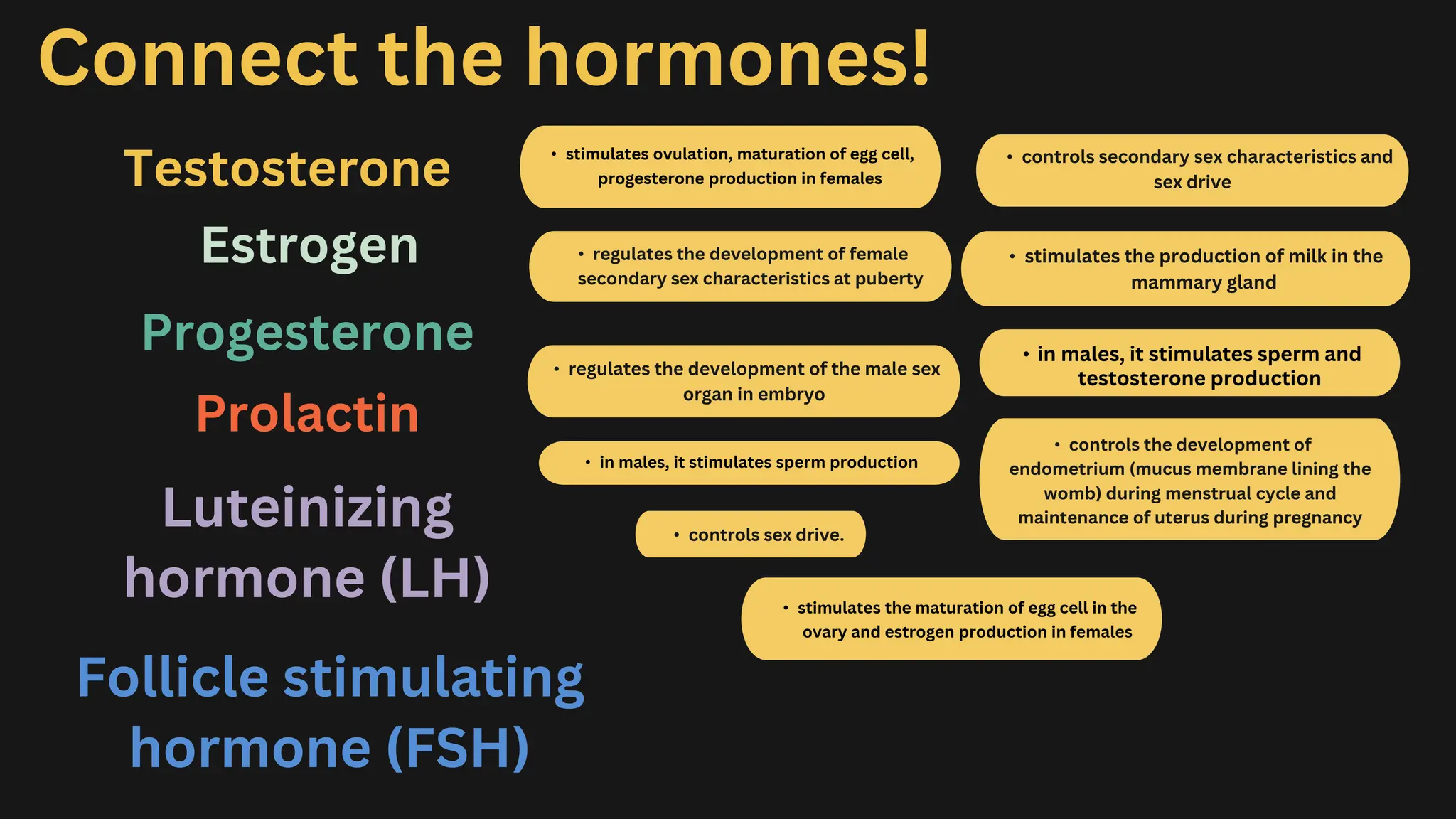
Connect the hormones!
• controls secondary sex characteristics and
sex drive
• regulates the development of the male sex
organ in embryo
• regulates the development of female
secondary sex characteristics at puberty
• controls sex drive.
• controls the development of
endometrium (mucus membrane lining the
womb) during menstrual cycle and
maintenance of uterus during pregnancy
• stimulates the production of milk in the
mammary gland
Testosterone
Estrogen
Progesterone
Prolactin
Luteinizing
hormone (LH)
Follicle stimulating
hormone (FSH)
• stimulates ovulation, maturation of egg cell,
progesterone production in females
• in males, it stimulates sperm and
testosterone production
• stimulates the maturation of egg cell in the
ovary and estrogen production in females
• in males, it stimulates sperm production
Connect the hormones!
controls secondary sex
characteristics and sex
drive
• controls sex drive.
Testosterone
Estrogen
Progesterone
Prolactin
Luteinizing
hormone (LH)
Follicle stimulating
hormone (FSH)
Connect the hormones!
controls secondary sex
characteristics and sex
drive
• controls sex drive.
Testosterone
Estrogen
Progesterone
Prolactin
Luteinizing
hormone (LH)
Follicle stimulating
hormone (FSH)
regulates the
development of the male
sex organ in embryo
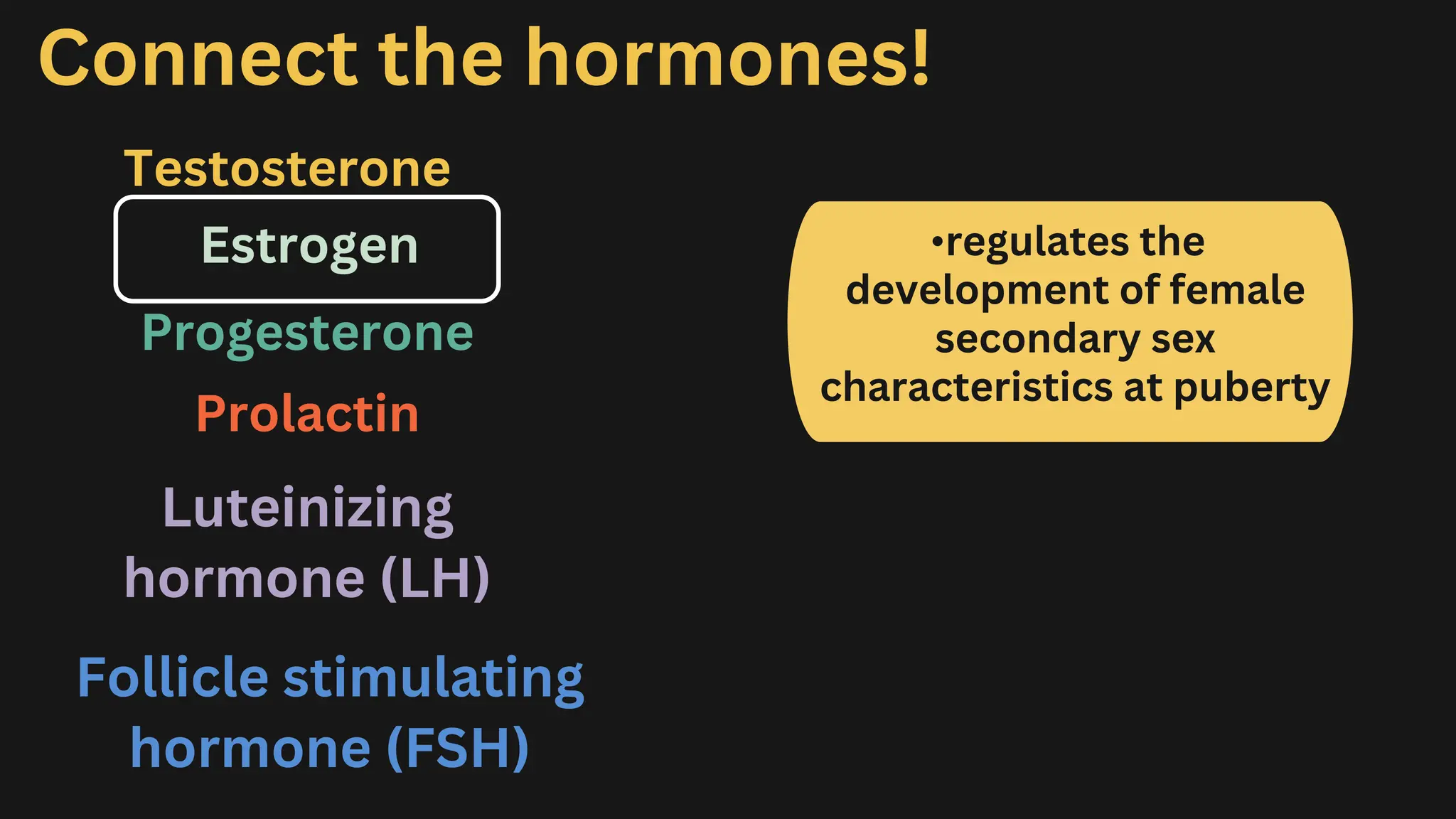
Connect the hormones!
•regulates the
development of female
secondary sex
characteristics at puberty
• controls sex drive.
Testosterone
Estrogen
Progesterone
Prolactin
Luteinizing
hormone (LH)
Follicle stimulating
hormone (FSH)
•controls sex drive.
Connect the hormones!
•regulates the
development of female
secondary sex
characteristics at puberty
• controls sex drive.
Testosterone
Estrogen
Progesterone
Prolactin
Luteinizing
hormone (LH)
Follicle stimulating
hormone (FSH)
•controls sex drive.
Connect the hormones!
•controls the development of
endometrium (mucus
membrane lining the womb)
during menstrual cycle and
maintenance of uterus during
pregnancy
Testosterone
Estrogen
Progesterone
Prolactin
Luteinizing
hormone (LH)
Follicle stimulating
hormone (FSH)
•controls sex drive.
Connect the hormones!
stimulates the
production of milk in
the mammary gland
Testosterone
Estrogen
Progesterone
Prolactin
Luteinizing
hormone (LH)
Follicle stimulating
hormone (FSH)
Connect the hormones!
• stimulates ovulation, maturation of
egg cell, progesterone production in
females
Testosterone
Estrogen
Progesterone
Prolactin
Luteinizing
hormone (LH)
Follicle stimulating
hormone (FSH)
Connect the hormones!
• stimulates ovulation, maturation of
egg cell, progesterone production in
females
Testosterone
Estrogen
Progesterone
Prolactin
Luteinizing
hormone (LH)
Follicle stimulating
hormone (FSH)
•in males, it stimulates sperm
and testosterone production
Connect the hormones!
• stimulates the maturation of egg cell
in the ovary and estrogen
production in females
Testosterone
Estrogen
Progesterone
Prolactin
Luteinizing
hormone (LH)
Follicle stimulating
hormone (FSH)
Connect the hormones!
• stimulates the maturation of egg cell
in the ovary and estrogen
production in females
Testosterone
Estrogen
Progesterone
Prolactin
Luteinizing
hormone (LH)
Follicle stimulating
hormone (FSH)
•in males, it stimulates sperm
production
MALE AND
FEMALE
The Roles of Hormones in the Male and Female
Reproductive System
John Milbar A. Tumanday
Science Class Grade 10
Hormones
Hormones are chemical substances
secreted by the endocrine glands that
have specific regulatory effects on cells
in the different parts of the body. The
endocrine glands contain hormone-
containing vesicles that release
hormones directly into the bloodstream
going into the target cells. Hormones
play an important role in both male and
female reproductive systems.
Hypothalamus
The hypothalamus is the main
regulatory center for maintaining
homeostasis in the body found in
the frontal region of the brain that
receives and sends nerve signal
through its neurosecretory cells
to many endocrine glands to give
directions, primarily the pituitary
gland.
The pituitary gland is a small pea-
shaped gland connected to the
hypothalamus by the pituitary
stalk and it is divided into two
regions - anterior and posterior
lobes. Both the pituitary gland
and hypothalamus connect the
nervous and endocrine systems.
Pituitary gland
The hypothalamus and the pituitary gland both affect the
male and female reproductive system to secrete sex
hormones which led to the control of the development of
sex characteristics. The hypothalamus secretes more
gonadropin-releasing hormone (GnRH) at the onset of
puberty which stimulates the anterior pituitary gland to
release two hormones namely the luteinizing hormone (LH)
and the follicle stimulating hormone (FSH). Both hormones
are present in males and females. The release of these two
hormones also marks the beginning of sexual maturity.
Hypothalamus & Pituitary Gland
Roles of Hormones in Male
Reproductive System
In males, the LH directs the specialized cells in the testes to
secrete testosterone. It also triggers the spermatogonia to
divide and produce spermatids. The male reproductive system
has prostate glands. The secondary male characteristics
development like growth of body hair is stimulated by
testosterone. Chemicals from these glands nourish the sperm
cells and help them mature. The production of sperm cells and
the release of semen can be regulated by hormones or special
chemicals that come from the testis, the brain and the
pituitary gland. These hormones keep the reproductive system
properly functioning.
Roles of Hormones in Males
Roles of Hormones in Female Reproductive System
The female reproductive system, just like
the male reproductive system, is also
regulated by hormones. The LH stimulates
the gonads to produce sex hormones and
the release of the egg cell from the ovary.
The follicle stimulating hormones (FSH)
stimulates the sex organs to produce
gametes or sex cells. While other
hormones prepare the uterus so a baby
can grow in it, other hormones still control
the stretching of the uterus during
pregnancy.
Roles of Hormones in Female Reproductive System
The two hormones; LH and FSH also
stimulate the ovaries to produce
estrogen and progesterone that are
also responsible to produce ova or
mature egg cells.
Roles of Hormones in Male and Female
Reproductive System
Roles of Hormones in Male and Female
Reproductive System
Roles of Hormones in Male and Female
Reproductive System
Video:
MALE AND
FEMALE
The Roles of Hormones in the Male and Female
Reproductive System
John Milbar A. Tumanday
Science Class Grade 10

Roles-of-Hormones-in-the-Male-and-Female-Reproductive-System-Copy.pptx

  • 1.
    MALE AND FEMALE The Rolesof Hormones in the Male and Female Reproductive System John Milbar A. Tumanday Science Class Grade 10
  • 2.
  • 3.
  • 4.
  • 5.
  • 6.
  • 7.
  • 8.
  • 9.
  • 10.
  • 11.
  • 12.
    PARTS OF PENIS 1.ROOT 2. BODY (SHAFT) 3. GLANS (HEAD)
  • 13.
    INTERNAL ORGANS 1. URETHRA 2. EPIDIDYMIS 3.VAS DEFERENS 4. SEMINAL VESICLES 5. PROSTATE GLAND 6. BULBOURETHRAL GLAND
  • 14.
    LESSON OBJECTIVES Understand the concept ofmale reproductive system; Identify the different parts in the male reproductive system; and State at least two (2) importance in studying the male reproductive system and the roles of hormones in the male and female reproductive system.
  • 15.
  • 16.
    + OS +- a 1ST WORD + =
  • 17.
    + OS +- a 1ST WORD + = Testosterone
  • 18.
    - CH +- CW 2ND WORD + = - DER
  • 19.
    - CH +- CW 2ND WORD + = - DER Estrogen
  • 20.
    = - ress +- ch 3RD WORD + - a +
  • 21.
    = - ress +- ch 3RD WORD + - a + Progesterone
  • 22.
    It regulates thedevelopment of the male sex organ in embryo. Progesterone
  • 23.
    It regulates thedevelopment of the male sex organ in embryo. Progesterone
  • 24.
    It regulates thedevelopment of female secondary sex characteristics at puberty Progesterone
  • 25.
    It regulates thedevelopment of female secondary sex characteristics at puberty Progesterone
  • 26.
    It controls thedevelopment of endometrium during menstrual cycle and maintenance of uterus during pregnancy. Progesterone
  • 27.
    It controls thedevelopment of endometrium during menstrual cycle and maintenance of uterus during pregnancy. Progesterone
  • 28.
    It stimulates theproduction of milk in the mammary gland. Progesterone
  • 29.
    It stimulates theproduction of milk in the mammary gland. Progesterone
  • 30.
    It stimulates ovulation,maturation of egg cell, progesterone production in females. Progesterone
  • 31.
    It stimulates ovulation,maturation of egg cell, progesterone production in females. Progesterone
  • 32.
  • 33.
    Connect the hormones! •controls secondary sex characteristics and sex drive • regulates the development of the male sex organ in embryo • regulates the development of female secondary sex characteristics at puberty • controls sex drive. • controls the development of endometrium (mucus membrane lining the womb) during menstrual cycle and maintenance of uterus during pregnancy • stimulates the production of milk in the mammary gland Testosterone Estrogen Progesterone Prolactin Luteinizing hormone (LH) Follicle stimulating hormone (FSH) • stimulates ovulation, maturation of egg cell, progesterone production in females • in males, it stimulates sperm and testosterone production • stimulates the maturation of egg cell in the ovary and estrogen production in females • in males, it stimulates sperm production
  • 34.
    Connect the hormones! controlssecondary sex characteristics and sex drive • controls sex drive. Testosterone Estrogen Progesterone Prolactin Luteinizing hormone (LH) Follicle stimulating hormone (FSH)
  • 35.
    Connect the hormones! controlssecondary sex characteristics and sex drive • controls sex drive. Testosterone Estrogen Progesterone Prolactin Luteinizing hormone (LH) Follicle stimulating hormone (FSH) regulates the development of the male sex organ in embryo
  • 36.
    Connect the hormones! •regulatesthe development of female secondary sex characteristics at puberty • controls sex drive. Testosterone Estrogen Progesterone Prolactin Luteinizing hormone (LH) Follicle stimulating hormone (FSH) •controls sex drive.
  • 37.
    Connect the hormones! •regulatesthe development of female secondary sex characteristics at puberty • controls sex drive. Testosterone Estrogen Progesterone Prolactin Luteinizing hormone (LH) Follicle stimulating hormone (FSH) •controls sex drive.
  • 38.
    Connect the hormones! •controlsthe development of endometrium (mucus membrane lining the womb) during menstrual cycle and maintenance of uterus during pregnancy Testosterone Estrogen Progesterone Prolactin Luteinizing hormone (LH) Follicle stimulating hormone (FSH) •controls sex drive.
  • 39.
    Connect the hormones! stimulatesthe production of milk in the mammary gland Testosterone Estrogen Progesterone Prolactin Luteinizing hormone (LH) Follicle stimulating hormone (FSH)
  • 40.
    Connect the hormones! •stimulates ovulation, maturation of egg cell, progesterone production in females Testosterone Estrogen Progesterone Prolactin Luteinizing hormone (LH) Follicle stimulating hormone (FSH)
  • 41.
    Connect the hormones! •stimulates ovulation, maturation of egg cell, progesterone production in females Testosterone Estrogen Progesterone Prolactin Luteinizing hormone (LH) Follicle stimulating hormone (FSH) •in males, it stimulates sperm and testosterone production
  • 42.
    Connect the hormones! •stimulates the maturation of egg cell in the ovary and estrogen production in females Testosterone Estrogen Progesterone Prolactin Luteinizing hormone (LH) Follicle stimulating hormone (FSH)
  • 43.
    Connect the hormones! •stimulates the maturation of egg cell in the ovary and estrogen production in females Testosterone Estrogen Progesterone Prolactin Luteinizing hormone (LH) Follicle stimulating hormone (FSH) •in males, it stimulates sperm production
  • 44.
    MALE AND FEMALE The Rolesof Hormones in the Male and Female Reproductive System John Milbar A. Tumanday Science Class Grade 10
  • 45.
    Hormones Hormones are chemicalsubstances secreted by the endocrine glands that have specific regulatory effects on cells in the different parts of the body. The endocrine glands contain hormone- containing vesicles that release hormones directly into the bloodstream going into the target cells. Hormones play an important role in both male and female reproductive systems.
  • 46.
    Hypothalamus The hypothalamus isthe main regulatory center for maintaining homeostasis in the body found in the frontal region of the brain that receives and sends nerve signal through its neurosecretory cells to many endocrine glands to give directions, primarily the pituitary gland.
  • 47.
    The pituitary glandis a small pea- shaped gland connected to the hypothalamus by the pituitary stalk and it is divided into two regions - anterior and posterior lobes. Both the pituitary gland and hypothalamus connect the nervous and endocrine systems. Pituitary gland
  • 48.
    The hypothalamus andthe pituitary gland both affect the male and female reproductive system to secrete sex hormones which led to the control of the development of sex characteristics. The hypothalamus secretes more gonadropin-releasing hormone (GnRH) at the onset of puberty which stimulates the anterior pituitary gland to release two hormones namely the luteinizing hormone (LH) and the follicle stimulating hormone (FSH). Both hormones are present in males and females. The release of these two hormones also marks the beginning of sexual maturity. Hypothalamus & Pituitary Gland
  • 49.
    Roles of Hormonesin Male Reproductive System
  • 50.
    In males, theLH directs the specialized cells in the testes to secrete testosterone. It also triggers the spermatogonia to divide and produce spermatids. The male reproductive system has prostate glands. The secondary male characteristics development like growth of body hair is stimulated by testosterone. Chemicals from these glands nourish the sperm cells and help them mature. The production of sperm cells and the release of semen can be regulated by hormones or special chemicals that come from the testis, the brain and the pituitary gland. These hormones keep the reproductive system properly functioning. Roles of Hormones in Males
  • 51.
    Roles of Hormonesin Female Reproductive System The female reproductive system, just like the male reproductive system, is also regulated by hormones. The LH stimulates the gonads to produce sex hormones and the release of the egg cell from the ovary. The follicle stimulating hormones (FSH) stimulates the sex organs to produce gametes or sex cells. While other hormones prepare the uterus so a baby can grow in it, other hormones still control the stretching of the uterus during pregnancy.
  • 52.
    Roles of Hormonesin Female Reproductive System The two hormones; LH and FSH also stimulate the ovaries to produce estrogen and progesterone that are also responsible to produce ova or mature egg cells.
  • 54.
    Roles of Hormonesin Male and Female Reproductive System
  • 55.
    Roles of Hormonesin Male and Female Reproductive System
  • 56.
    Roles of Hormonesin Male and Female Reproductive System
  • 57.
  • 58.
    MALE AND FEMALE The Rolesof Hormones in the Male and Female Reproductive System John Milbar A. Tumanday Science Class Grade 10