PREPARED BY: PAULA CARMELA MENDOZA
JOYCE PANANGUI
1. TEAWINGHER –
ANSWER: WEATHERING
1. SCOSPRE –
ANSWER: PROCESS
1. FZEERE–
ANSWER: FREEZE
1. MILACCHE–
ANSWER: CHEMICAL
1. HYSACILP RO NICEMCHALA –
ANSWER: PHYSICAL OR MECHANICAL
Let’s try to answer this one;
What is exogenic processes?
Exogenic processes are process that take place at or near the Earth’s surface that makes the Surface
wear away. Exogenic processes are very destructive, they are responsible for Degration and
sculpting the Earth’s surface.
TYPES OF EXOGENIC PROCESSES
• WEATHERING,
•EROSION,
•MASS WASTING AND
•SEDIMENTATION
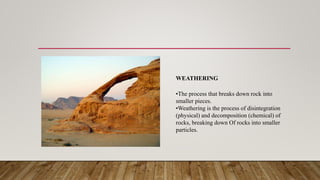
WEATHERING
•The process that breaks down rock into
smaller pieces.
•Weathering is the process of disintegration
(physical) and decomposition (chemical) of
rocks, breaking down Of rocks into smaller
particles.
There are two types of weathering;
•Mechanical (physical) weathering
• Chemical weathering
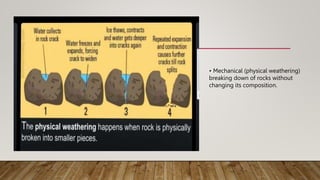
• Mechanical (physical weathering)
breaking down of rocks without
changing its composition.
FACTOR THAT AFFECTS PHYSICAL WEATHERING;
• Ice wedging
• Release pressure
• Growth of plants
• Animals
• Abrasion
ICE WEDGING (FROST WEDGING)
•H2O seeps in rock, expand,
crack rock into smaller piece.
•when water gets inside the
joints, alternate freezing and
thawing episodes the rock
apart.
RELEASE PRESSURE
Surface rock erodes, rock
flakes like onion layers.
GROWTH OF PLANTS
Roots grow into cracks,
and push rocks apart.
ANIMALS
Burrow and
push apart
rocks.
ABRASION
Sand and rock carried by wind, water, ice
wears away Surface rocs when rocks
collide. Most common in windy area.
• Salt crystal growth- force exerted by salt
crystal that formed as water evaporates
from pore spaces or cracks in rocks can
cause the rock to fall apart
Biological activities
plants and animals as agents of mechanical
weathering
•There are changes in
composition of rocks due
to chemical reaction
Major process of chemical weathering?
The major process of chemical weathering include: oxidization, dissolution, hydrolysis.
Oxidation is a reaction with oxygen to form an oxide.
hydrolysis is reaction with water, and carbonation is a reaction with CO2 to form a
carbonate. In hydrolysis, the chemical bonds of a mineral are broken down by water,
creating a decomposition reaction.
hydro- means water and -lysis means decomposition.
Dissolution- This process occurs when water comes into contact with rocks and dissolves
the minerals that make up that rock into individual elements.
FACTORS THAT AFFECT THE TYPE, EXTENT, AND
RATE AT WHICH WEATHERING TAKES PLACE:
a. Climate - areas that are cold and dry tend to have slow rates of chemical weathering and
weathering is mostly physical; chemical weathering is most active in areas with high
temperature and rainfall
b. Rock type - the minerals that constitute rocks have different susceptibilities to weathering.
Those that are most stable to surface conditions will be the most resistant to weathering.
Thus, olivine for example which crystallizes at high temperature conditions will weather first
than quartz which crystallizes at lower temperature conditions.
c. Rock structure-rate of weathering is affected by the presence of joints, folds, faults, bedding
planes through which agents of weathering enter a rock mass. Highly-jointed/fractured rocks
disintegrate faster than a solid mass of rock of the same dimension.
d. . Topography-weathering occurs more quickly on a steep slope than on a gentle one e. Time-
length of exposure to agents of weather determines the degree of weathering of a rock
SUMMARY
Exogenic processes are process that take place at or near the Earth’s surface that makes
the Surface wear away.
Types of exogenic processes are; weathering, erosion, mass wasting and
sedimentation.
Weathering is The process that breaks down rock into smaller pieces. There are two
types of weathering. The mechanical and chemical weathering.
Mechanical (physical weathering) breaking down of rocks without changing its
composition. Ice wedging, release pressure, Growth of plant, animal, abrasion,
Crystal salt growth and biological activities are the factors that affect physical
weathering.
Chemical weathering There are changes in composition of rocks due to chemical
reaction.
The major process of chemical weathering include: oxidization, dissolution,
hydrolysis.
AGENTS OF EROSION
• Water
• Wind
• Ice
• Gravity
EROSION BY WATER
EROSION BY WATER
Erosion by water changes the shape of
geallines. Waves constantly ergh gainst
shores. They pound ocks into pebbles and
reduce ebbles to sand. Water sometimes
kes sand away from beaches. This maves
the coastline farther inland.
EROSION BY WIND
EROSION BY WIND
Erosion by wind carries dust,
sand, and volcanic ash from one
place to another. Wind can
sometimes blow sand into
towering dunes.
EROSION BY ICE
EROSION BY ICE
ice can rode the land. In frigid areas and on some
Erosion by mountaintops, glaciers move slowly
downhill and across the land. As they move, they
pick up everything in their path, from tiny grains of
sand to huge boulders.
EROSION BY GRAVITY
EROSION BY GRAVITY
Gravity pulls any loose bits down
the side of a hill or mountain.
Gravity Erosion is better known as
Mass Movement.
Presentation-5.pptx
Presentation-5.pptx
Presentation-5.pptx
Presentation-5.pptx
Presentation-5.pptx
Presentation-5.pptx
Presentation-5.pptx
Presentation-5.pptx
Presentation-5.pptx
Presentation-5.pptx
Presentation-5.pptx
Presentation-5.pptx
Presentation-5.pptx
Presentation-5.pptx
Presentation-5.pptx

Presentation-5.pptx

  • 2.
    PREPARED BY: PAULACARMELA MENDOZA JOYCE PANANGUI
  • 3.
    1. TEAWINGHER – ANSWER:WEATHERING 1. SCOSPRE – ANSWER: PROCESS 1. FZEERE– ANSWER: FREEZE 1. MILACCHE– ANSWER: CHEMICAL 1. HYSACILP RO NICEMCHALA – ANSWER: PHYSICAL OR MECHANICAL Let’s try to answer this one;
  • 4.
    What is exogenicprocesses? Exogenic processes are process that take place at or near the Earth’s surface that makes the Surface wear away. Exogenic processes are very destructive, they are responsible for Degration and sculpting the Earth’s surface.
  • 5.
    TYPES OF EXOGENICPROCESSES • WEATHERING, •EROSION, •MASS WASTING AND •SEDIMENTATION
  • 6.
    WEATHERING •The process thatbreaks down rock into smaller pieces. •Weathering is the process of disintegration (physical) and decomposition (chemical) of rocks, breaking down Of rocks into smaller particles.
  • 7.
    There are twotypes of weathering; •Mechanical (physical) weathering • Chemical weathering
  • 8.
    • Mechanical (physicalweathering) breaking down of rocks without changing its composition.
  • 9.
    FACTOR THAT AFFECTSPHYSICAL WEATHERING; • Ice wedging • Release pressure • Growth of plants • Animals • Abrasion
  • 10.
    ICE WEDGING (FROSTWEDGING) •H2O seeps in rock, expand, crack rock into smaller piece. •when water gets inside the joints, alternate freezing and thawing episodes the rock apart.
  • 11.
    RELEASE PRESSURE Surface rockerodes, rock flakes like onion layers.
  • 12.
    GROWTH OF PLANTS Rootsgrow into cracks, and push rocks apart.
  • 13.
  • 14.
    ABRASION Sand and rockcarried by wind, water, ice wears away Surface rocs when rocks collide. Most common in windy area.
  • 15.
    • Salt crystalgrowth- force exerted by salt crystal that formed as water evaporates from pore spaces or cracks in rocks can cause the rock to fall apart
  • 16.
    Biological activities plants andanimals as agents of mechanical weathering
  • 17.
    •There are changesin composition of rocks due to chemical reaction
  • 18.
    Major process ofchemical weathering? The major process of chemical weathering include: oxidization, dissolution, hydrolysis.
  • 19.
    Oxidation is areaction with oxygen to form an oxide. hydrolysis is reaction with water, and carbonation is a reaction with CO2 to form a carbonate. In hydrolysis, the chemical bonds of a mineral are broken down by water, creating a decomposition reaction. hydro- means water and -lysis means decomposition. Dissolution- This process occurs when water comes into contact with rocks and dissolves the minerals that make up that rock into individual elements.
  • 20.
    FACTORS THAT AFFECTTHE TYPE, EXTENT, AND RATE AT WHICH WEATHERING TAKES PLACE: a. Climate - areas that are cold and dry tend to have slow rates of chemical weathering and weathering is mostly physical; chemical weathering is most active in areas with high temperature and rainfall b. Rock type - the minerals that constitute rocks have different susceptibilities to weathering. Those that are most stable to surface conditions will be the most resistant to weathering. Thus, olivine for example which crystallizes at high temperature conditions will weather first than quartz which crystallizes at lower temperature conditions. c. Rock structure-rate of weathering is affected by the presence of joints, folds, faults, bedding planes through which agents of weathering enter a rock mass. Highly-jointed/fractured rocks disintegrate faster than a solid mass of rock of the same dimension. d. . Topography-weathering occurs more quickly on a steep slope than on a gentle one e. Time- length of exposure to agents of weather determines the degree of weathering of a rock
  • 22.
    SUMMARY Exogenic processes areprocess that take place at or near the Earth’s surface that makes the Surface wear away. Types of exogenic processes are; weathering, erosion, mass wasting and sedimentation. Weathering is The process that breaks down rock into smaller pieces. There are two types of weathering. The mechanical and chemical weathering. Mechanical (physical weathering) breaking down of rocks without changing its composition. Ice wedging, release pressure, Growth of plant, animal, abrasion, Crystal salt growth and biological activities are the factors that affect physical weathering.
  • 23.
    Chemical weathering Thereare changes in composition of rocks due to chemical reaction. The major process of chemical weathering include: oxidization, dissolution, hydrolysis.
  • 25.
    AGENTS OF EROSION •Water • Wind • Ice • Gravity
  • 26.
    EROSION BY WATER EROSIONBY WATER Erosion by water changes the shape of geallines. Waves constantly ergh gainst shores. They pound ocks into pebbles and reduce ebbles to sand. Water sometimes kes sand away from beaches. This maves the coastline farther inland.
  • 27.
    EROSION BY WIND EROSIONBY WIND Erosion by wind carries dust, sand, and volcanic ash from one place to another. Wind can sometimes blow sand into towering dunes.
  • 28.
    EROSION BY ICE EROSIONBY ICE ice can rode the land. In frigid areas and on some Erosion by mountaintops, glaciers move slowly downhill and across the land. As they move, they pick up everything in their path, from tiny grains of sand to huge boulders.
  • 29.
    EROSION BY GRAVITY EROSIONBY GRAVITY Gravity pulls any loose bits down the side of a hill or mountain. Gravity Erosion is better known as Mass Movement.