Quarter 3
MODULE
4.1
Protein
Synthesis
At the end of our lessons, you are
expected to be able to:
Explain how protein is made
using information from DNA.
(S10LT-IIId-37)
Specifically, you should be able
to:
Compare and contrast DNA
and RNA in terms of
a. function
b. structure
c. location
1.
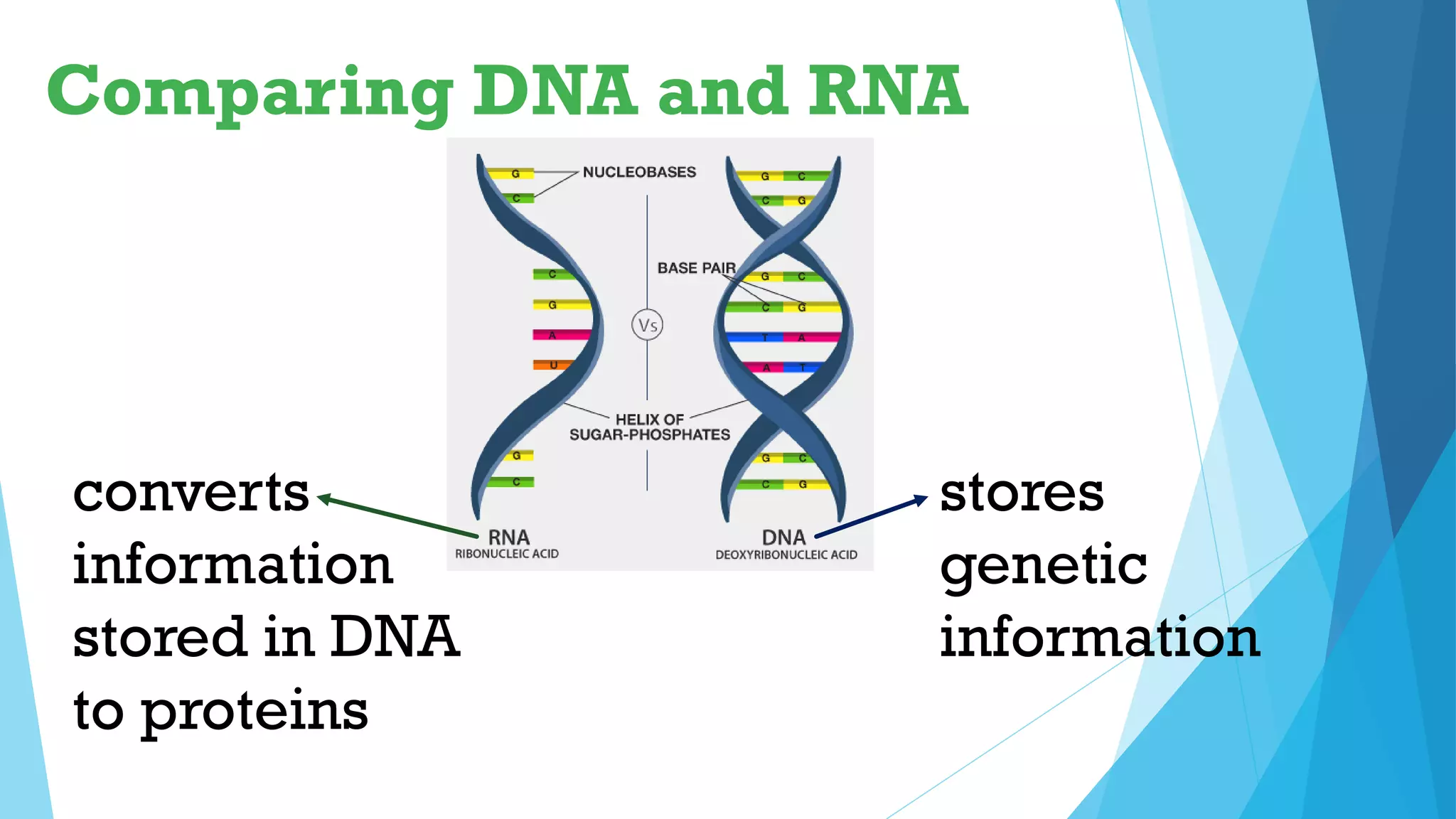
Comparing DNA and RNA
stores
genetic
information
converts
information
stored in DNA
to proteins
Comparing DNA and RNA
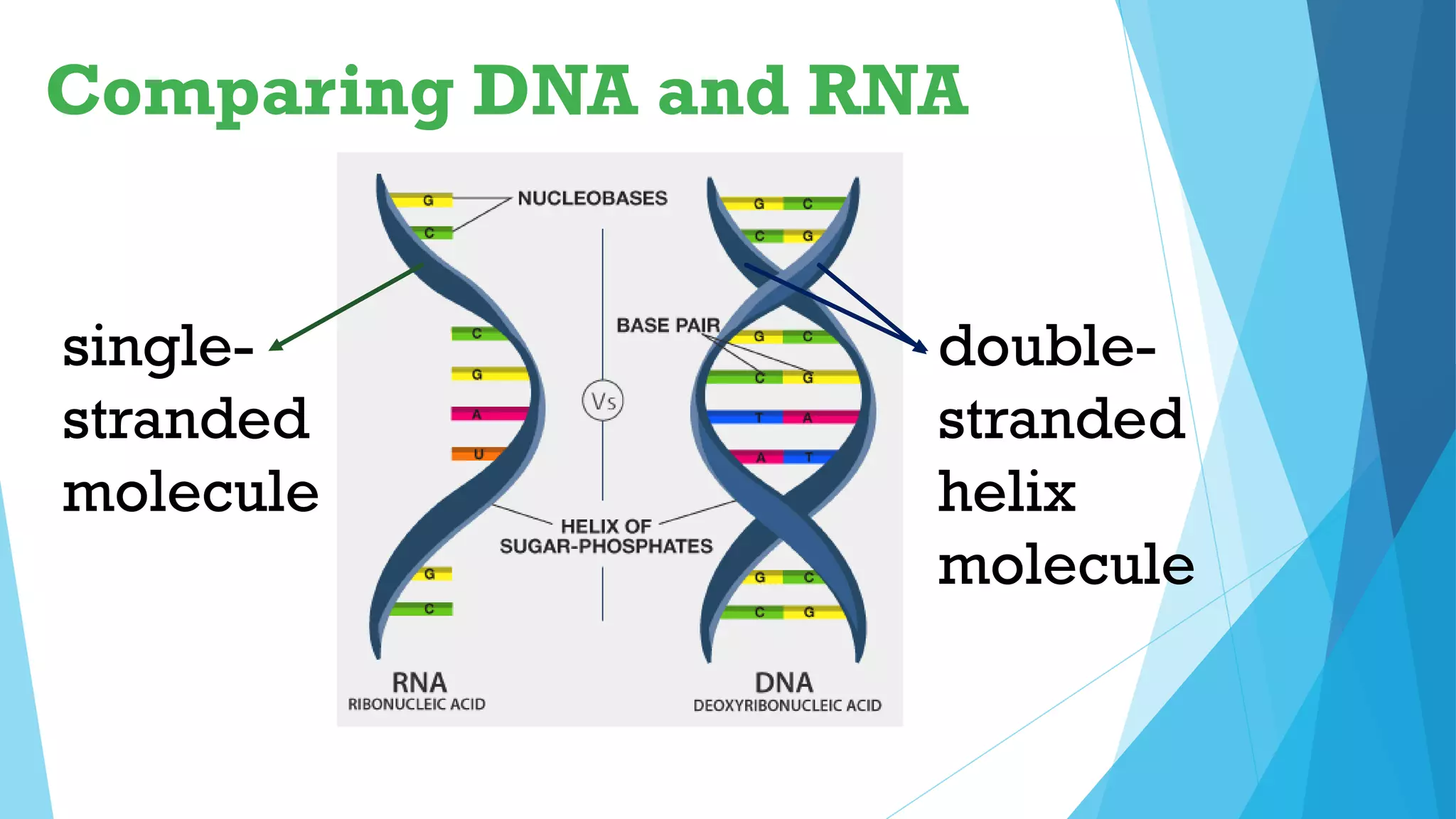
double-
stranded
helix
molecule
single-
stranded
molecule
Comparing DNA and RNA
DNA RNA
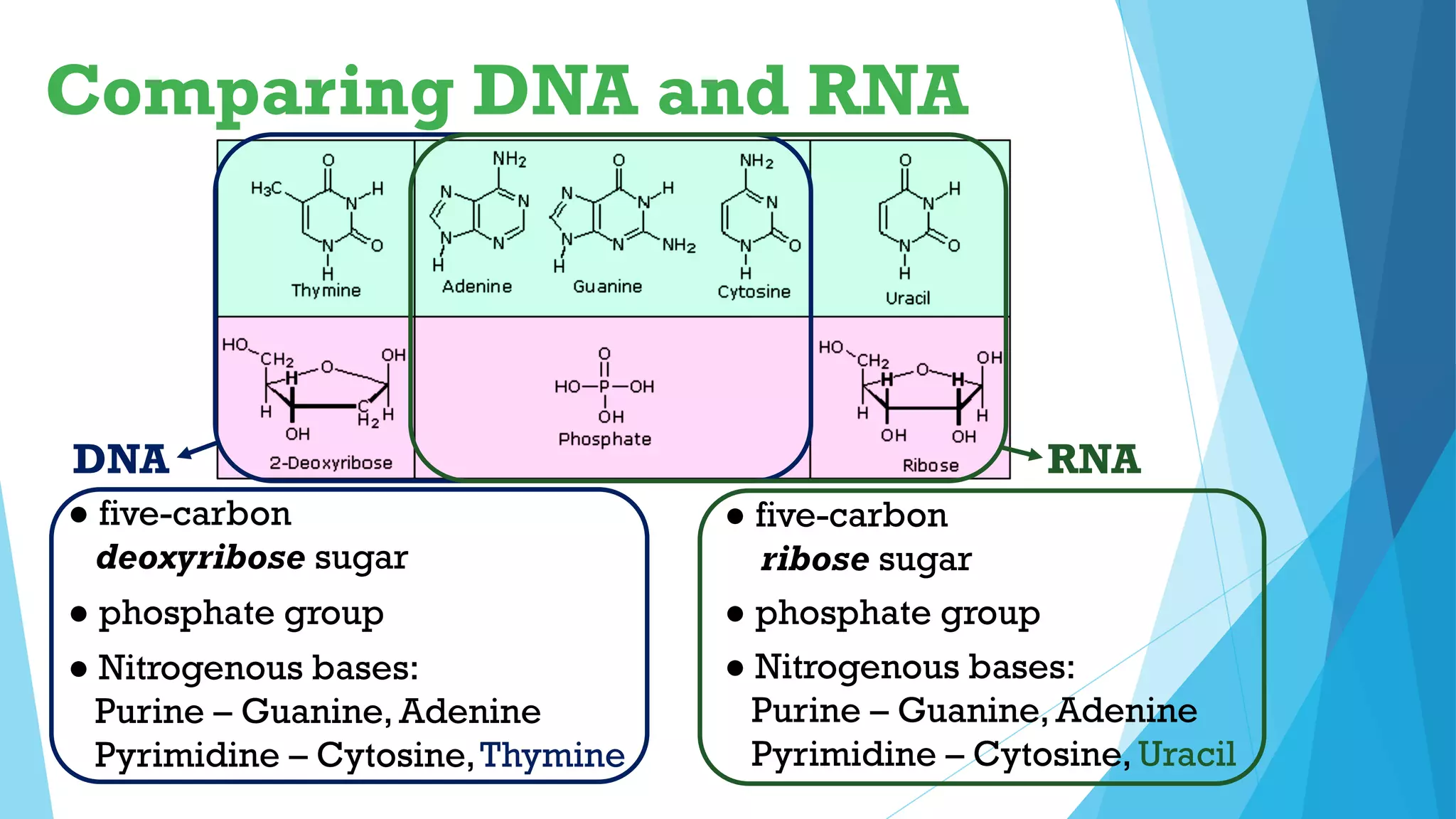
● five-carbon
deoxyribose sugar
● phosphate group
● Nitrogenous bases:
Purine – Guanine, Adenine
Pyrimidine – Cytosine,Thymine
● five-carbon
ribose sugar
● phosphate group
● Nitrogenous bases:
Purine – Guanine, Adenine
Pyrimidine – Cytosine, Uracil
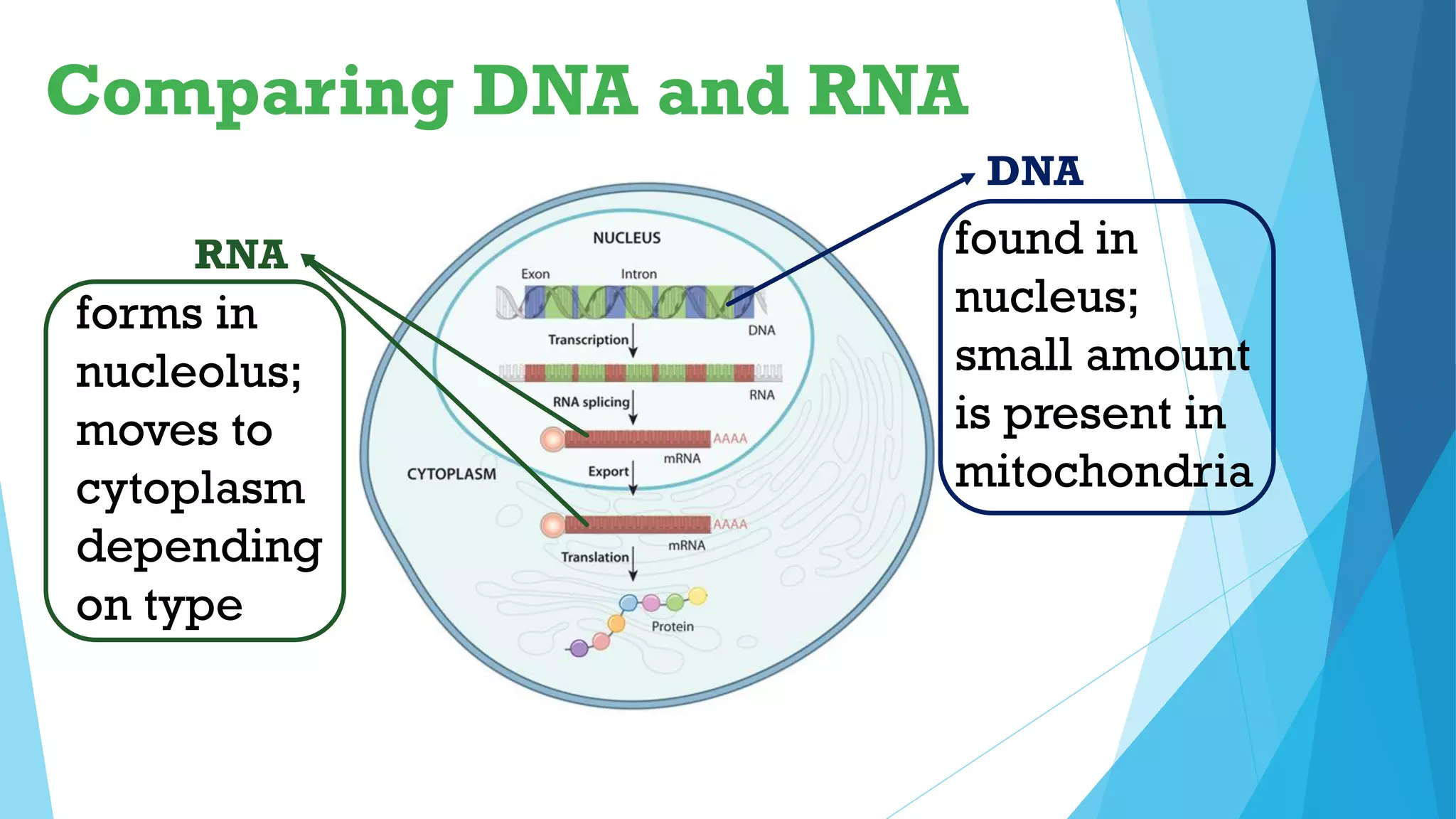
DNA
RNA found in
nucleus;
small amount
is present in
mitochondria
forms in
nucleolus;
moves to
cytoplasm
depending
on type
Comparing DNA and RNA
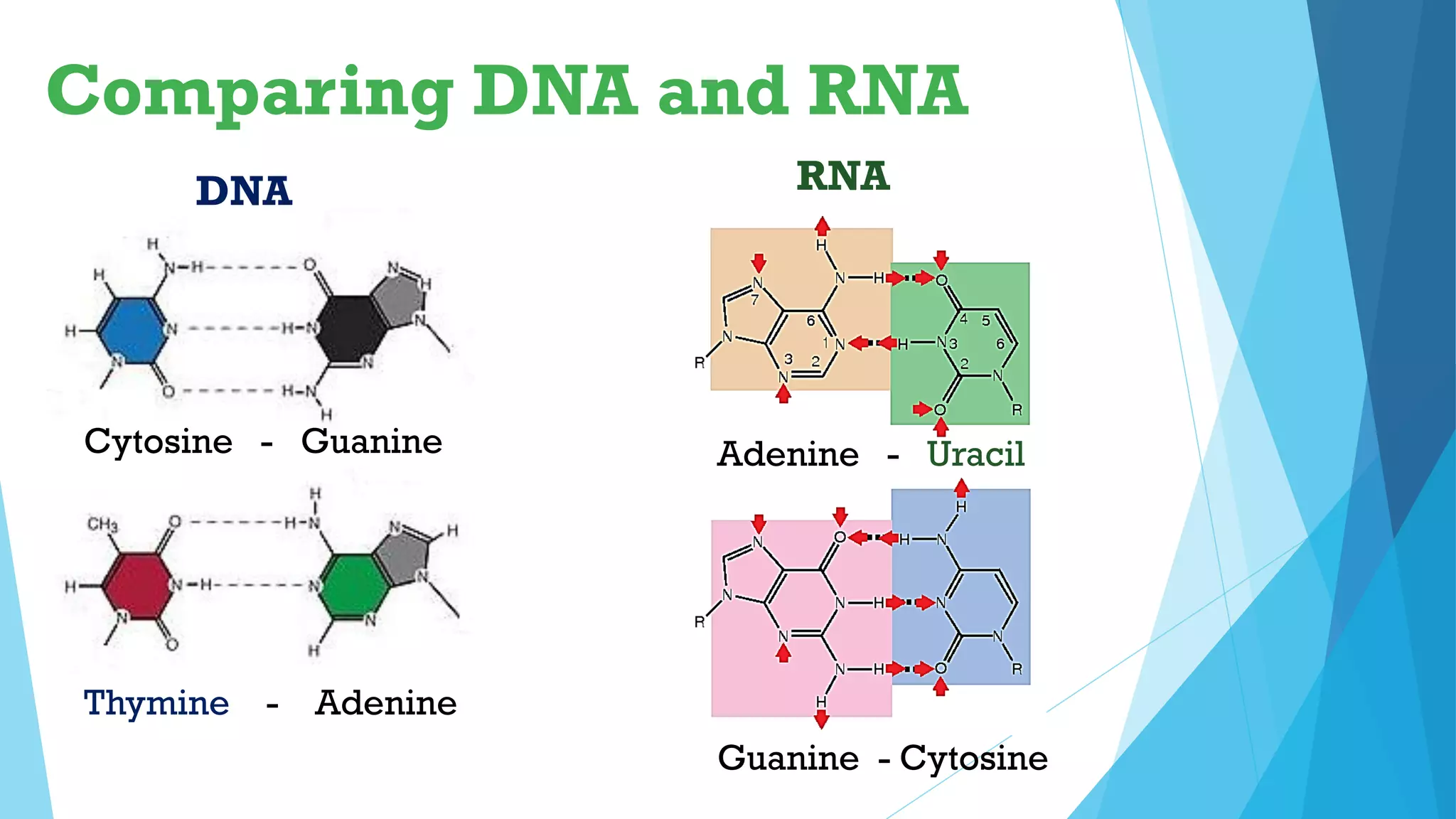
RNA
DNA
Cytosine - Guanine
Thymine - Adenine
Guanine - Cytosine
Adenine - Uracil
DNA and RNA are strings of
nucleotides which are
composed of phosphate
group, sugar and nitrogenous
base.There are two kinds of
nitrogen containing bases –
the and .
Purines Pyrimidines
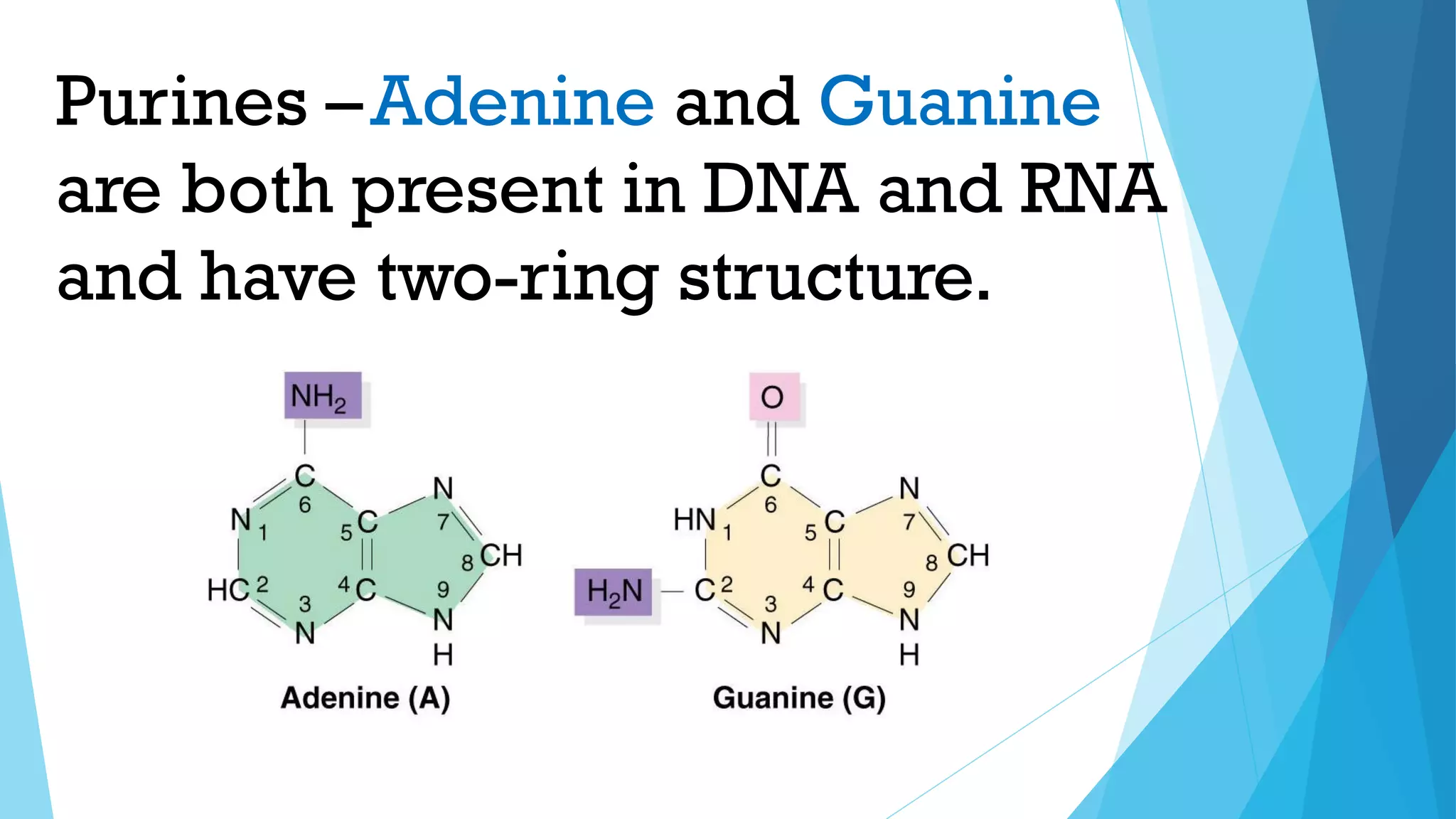
Purines –
are both present in DNA and RNA
and have two-ring structure.
Adenine and Guanine
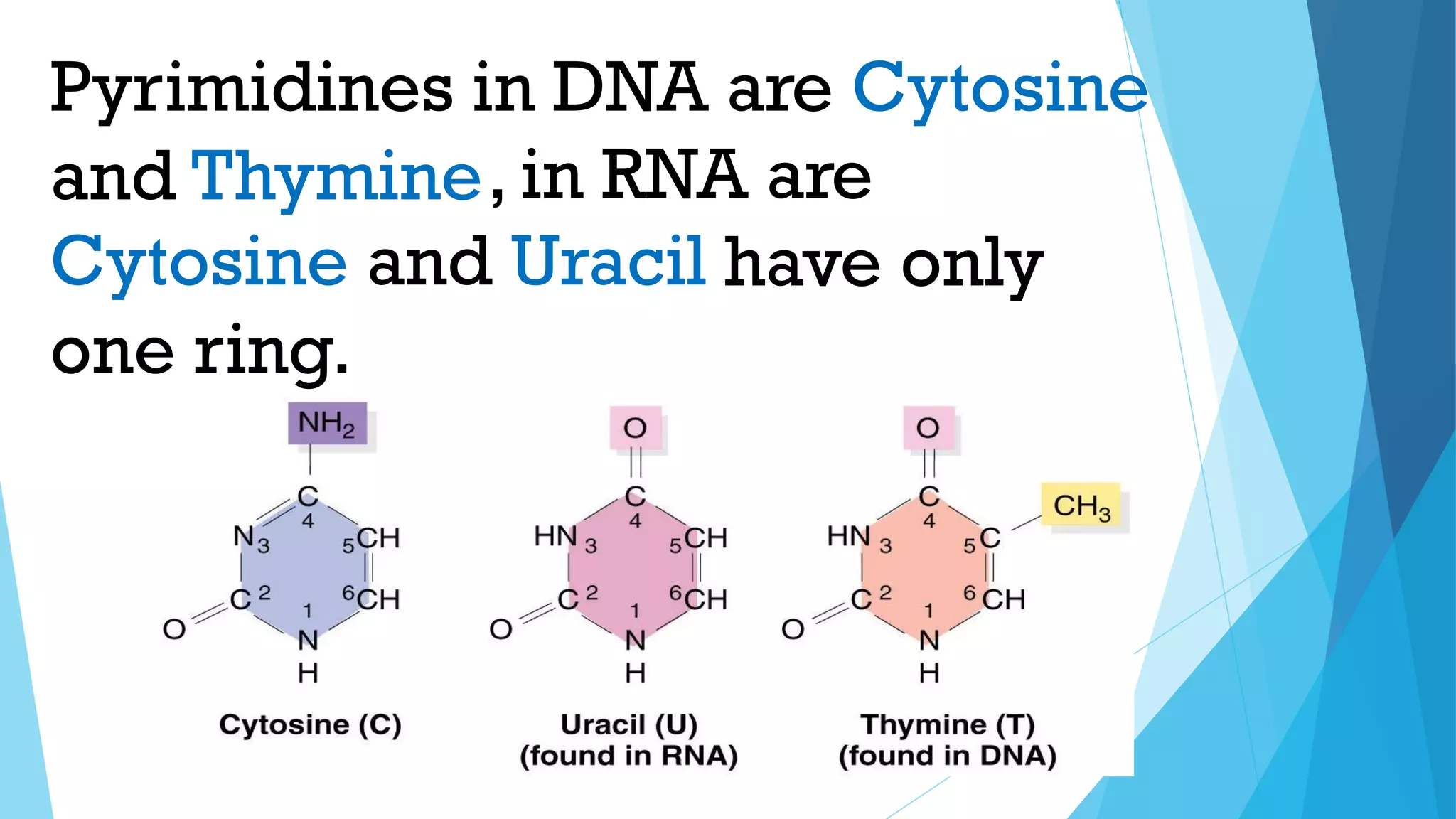
Pyrimidines in DNA are
, in RNA are
have only
one ring.
Cytosine
and Thymine
Cytosine and Uracil
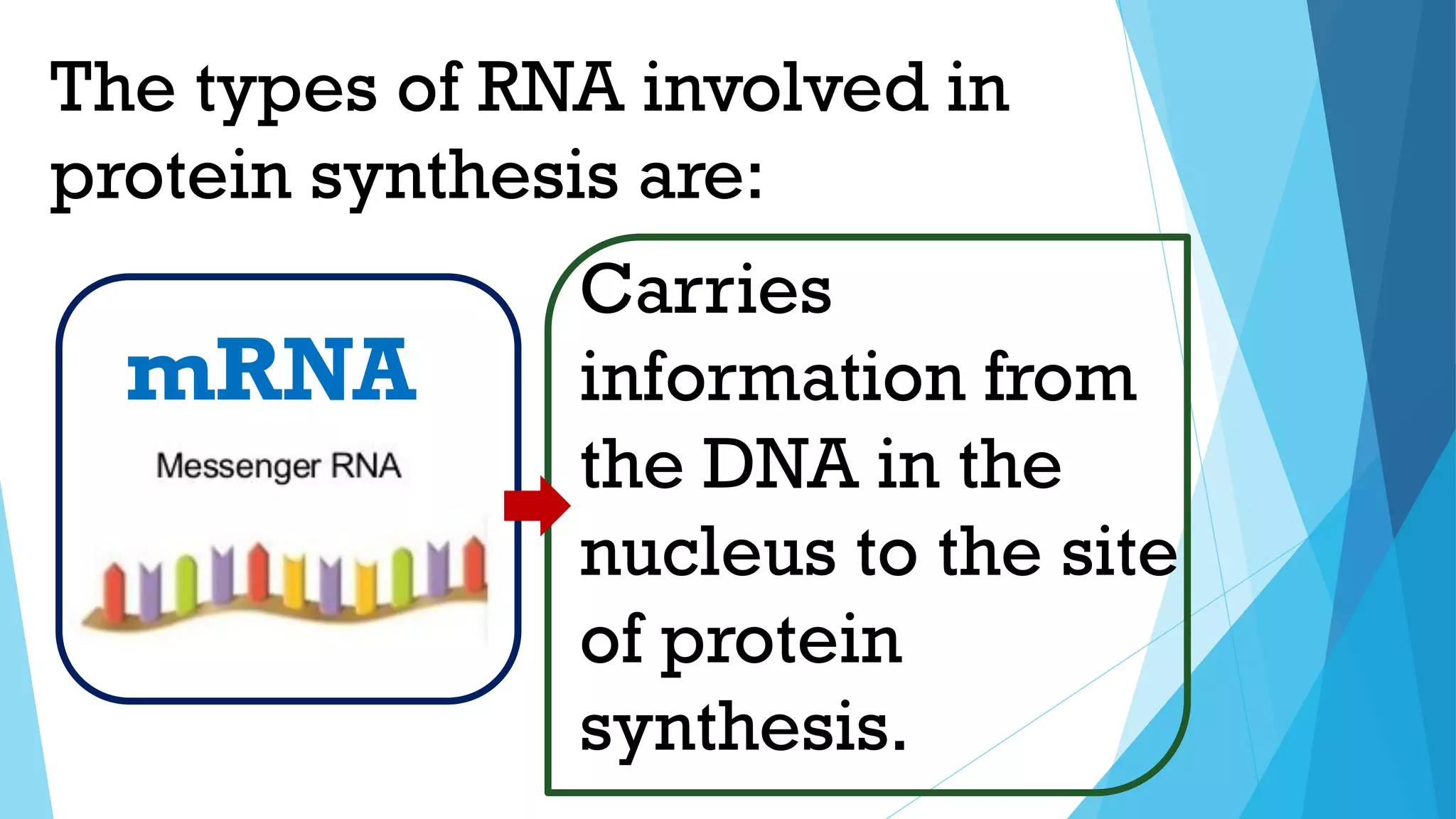
The types of RNA involved in
protein synthesis are:
mRNA
Carries
information from
the DNA in the
nucleus to the site
of protein
synthesis.
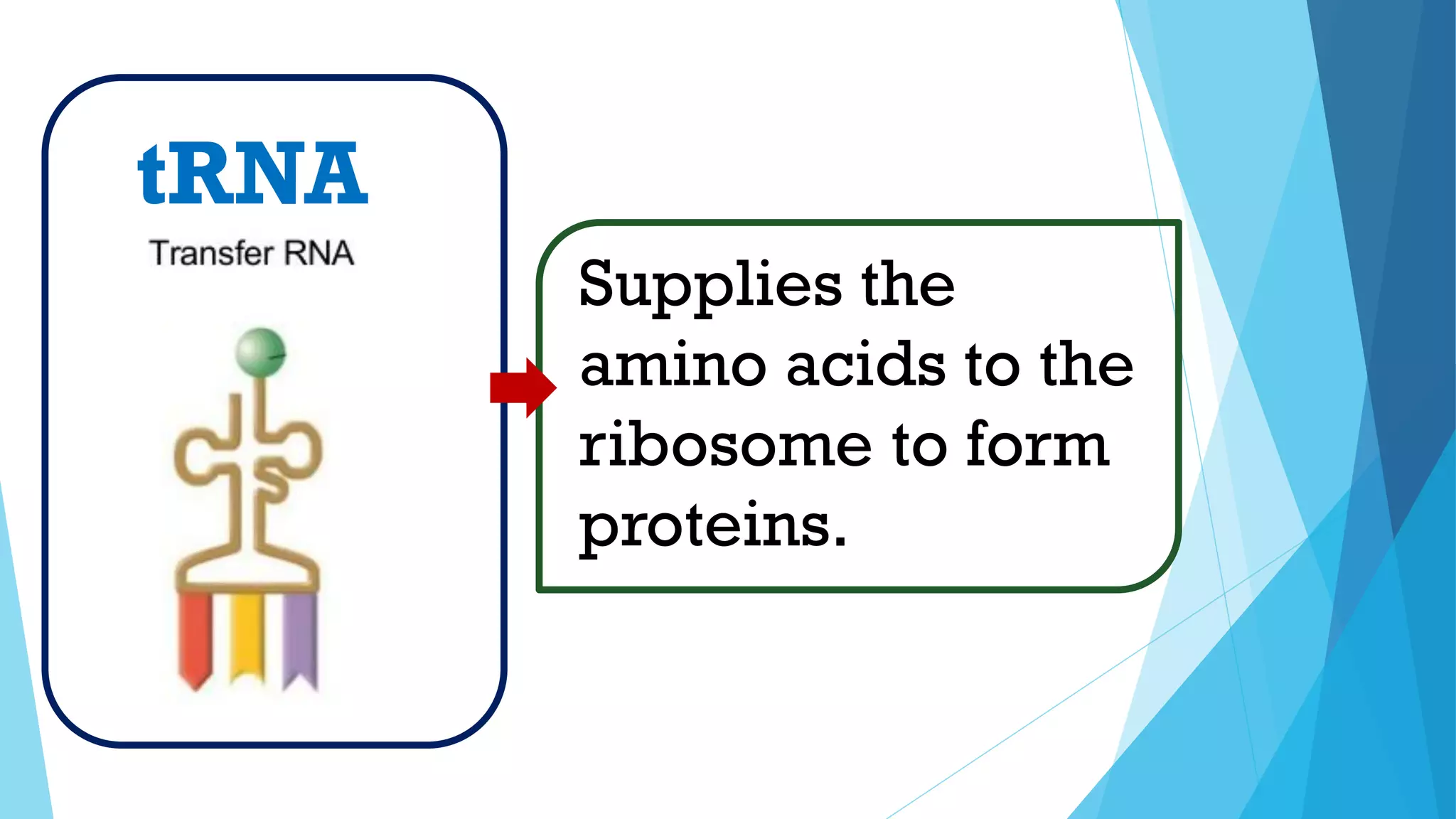
Supplies the
amino acids to the
ribosome to form
proteins.
tRNA
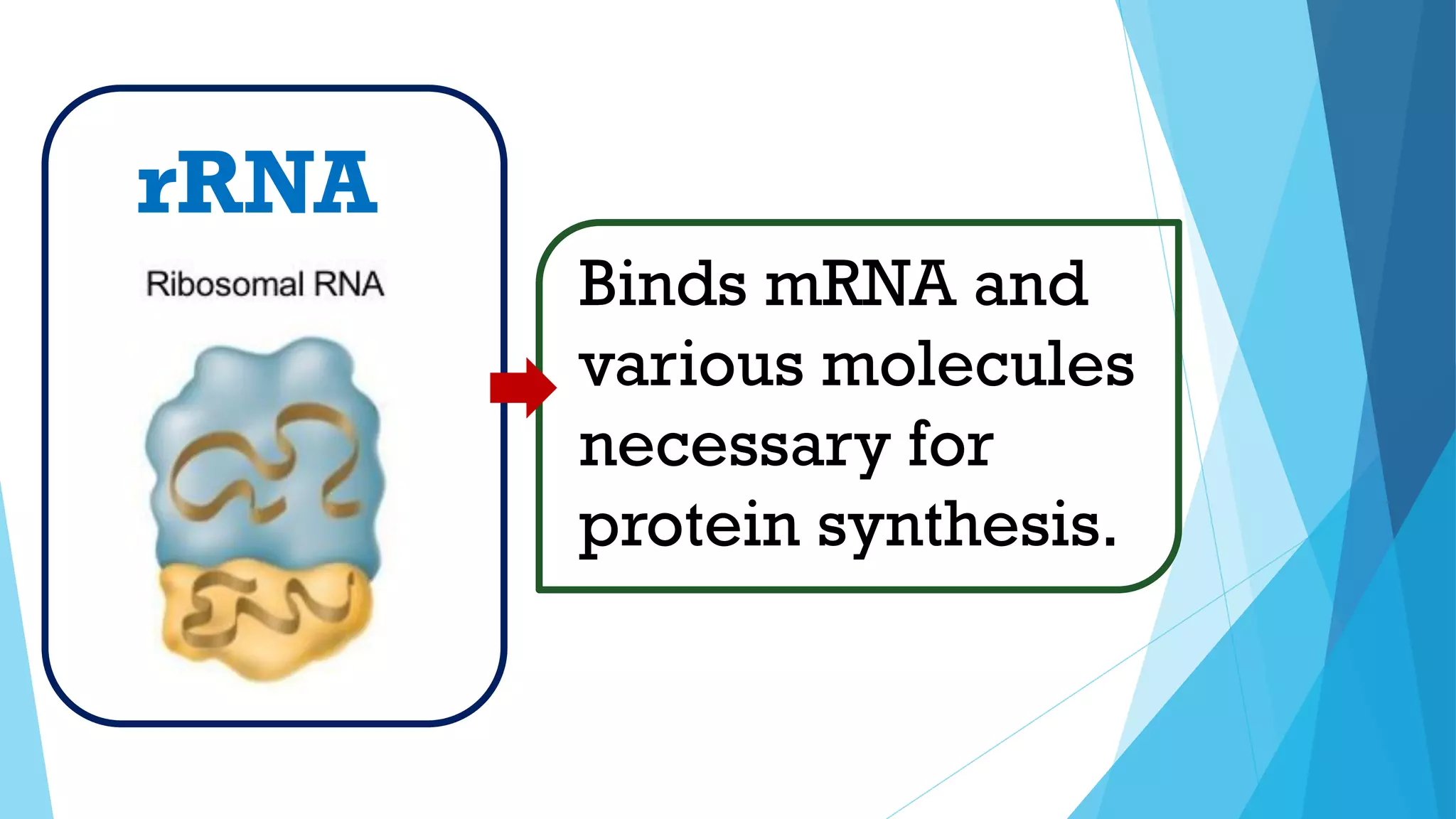
Binds mRNA and
various molecules
necessary for
protein synthesis.
rRNA
At the end of our lessons, you are
expected to be able to:
Explain how protein is made
using information from DNA.
(S10LT-IIId-37)
Specifically,you should be able to:
1. describe the transcription and
translation processes;
2. determine the sequence of
amino acids produced by a
DNA sequence; and
3. appreciate the importance of
genetic code.
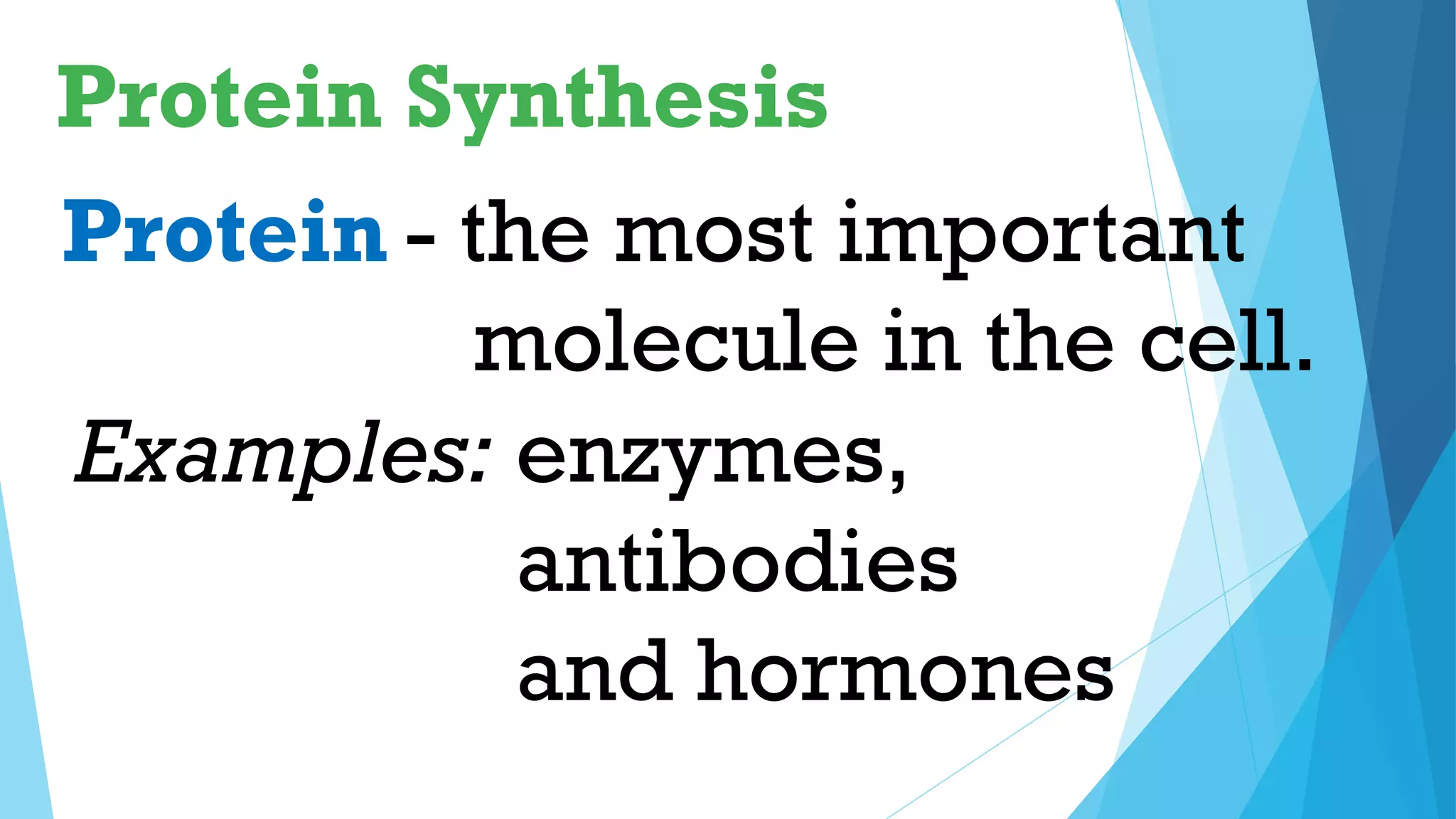
Protein Synthesis
- the most important
molecule in the cell.
enzymes,
antibodies
and hormones
Protein
Examples:
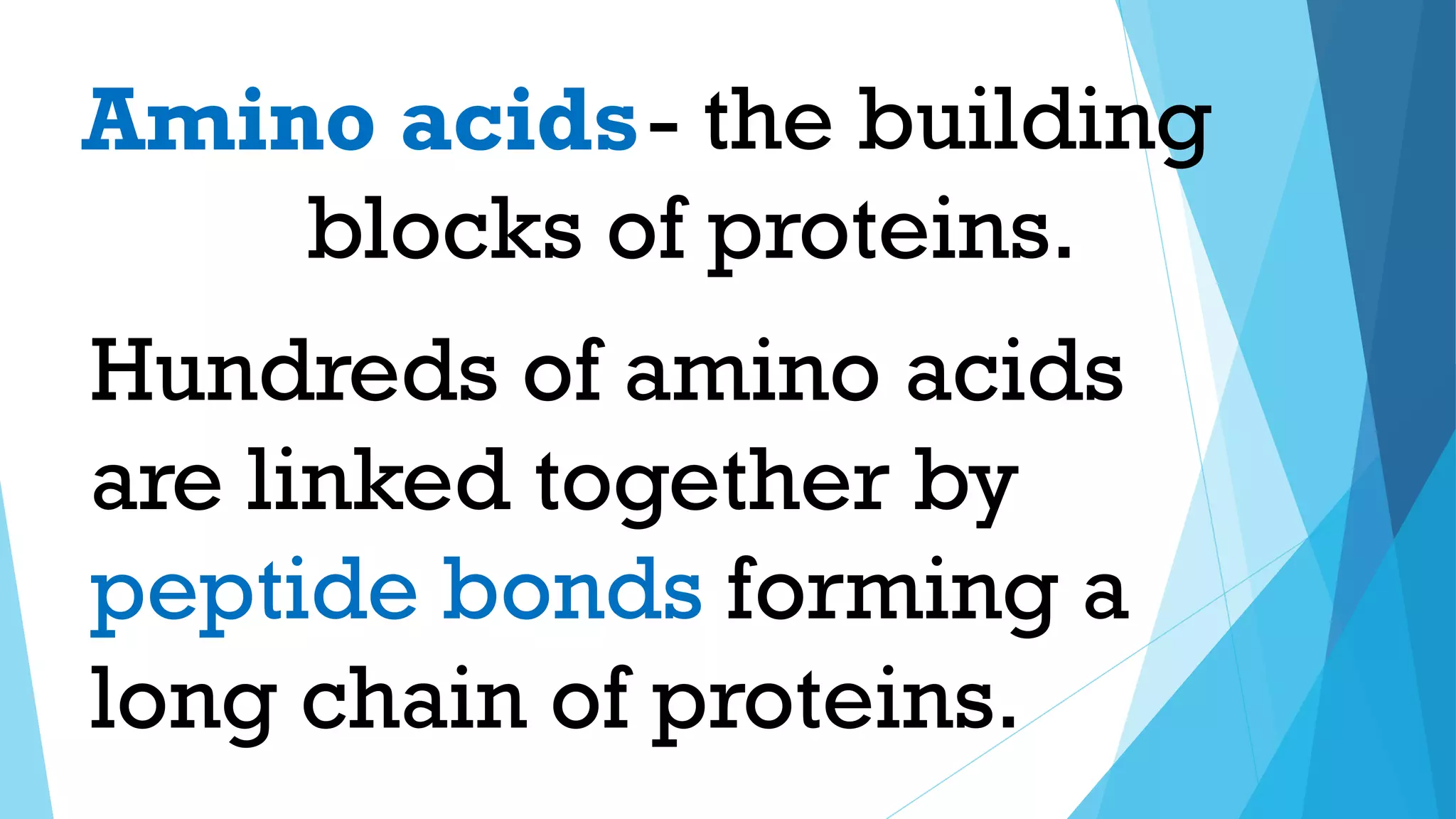
Hundreds of amino acids
are linked together by
peptide bonds forming a
long chain of proteins.
- the building
blocks of proteins.
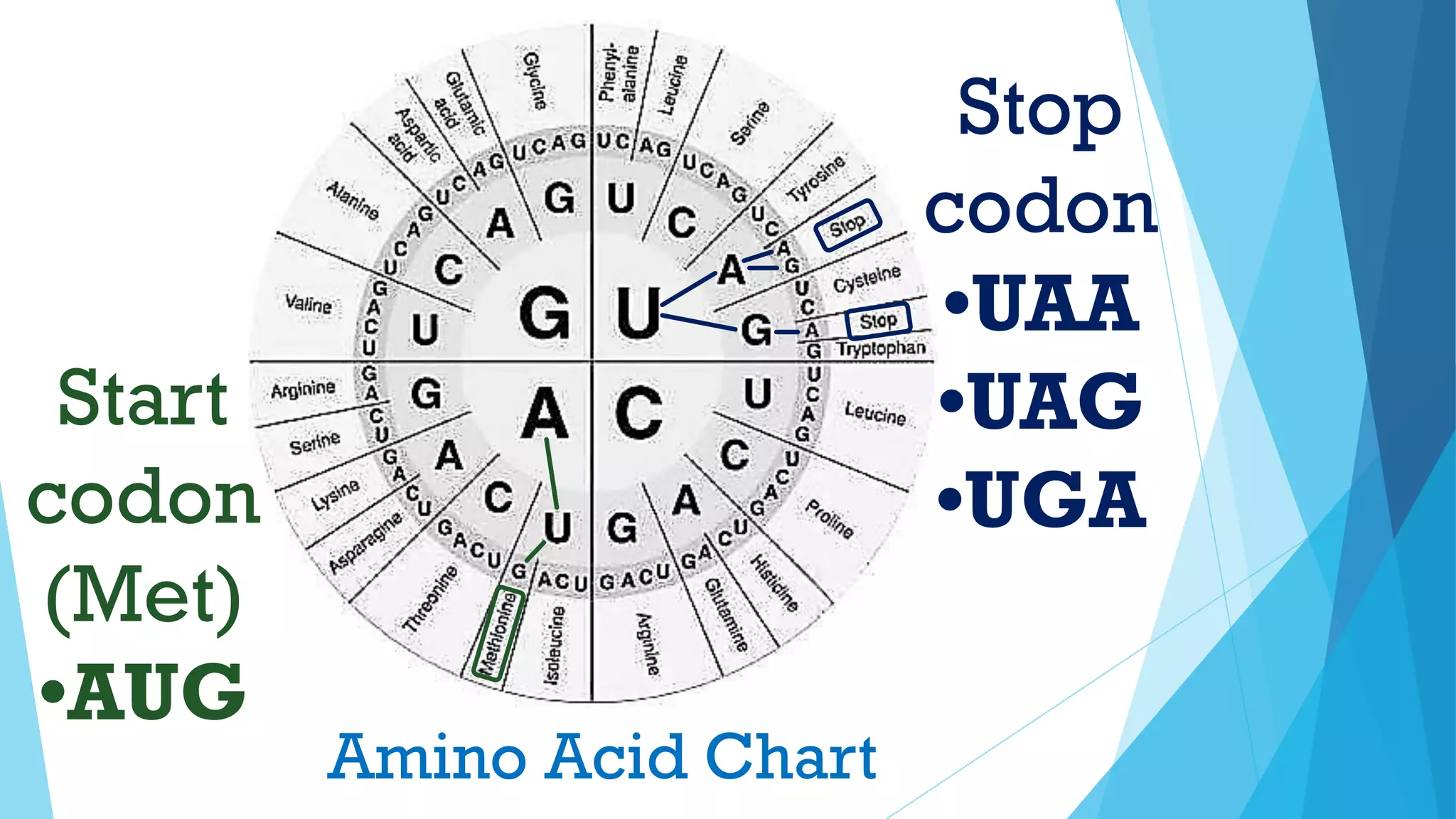
Amino acids
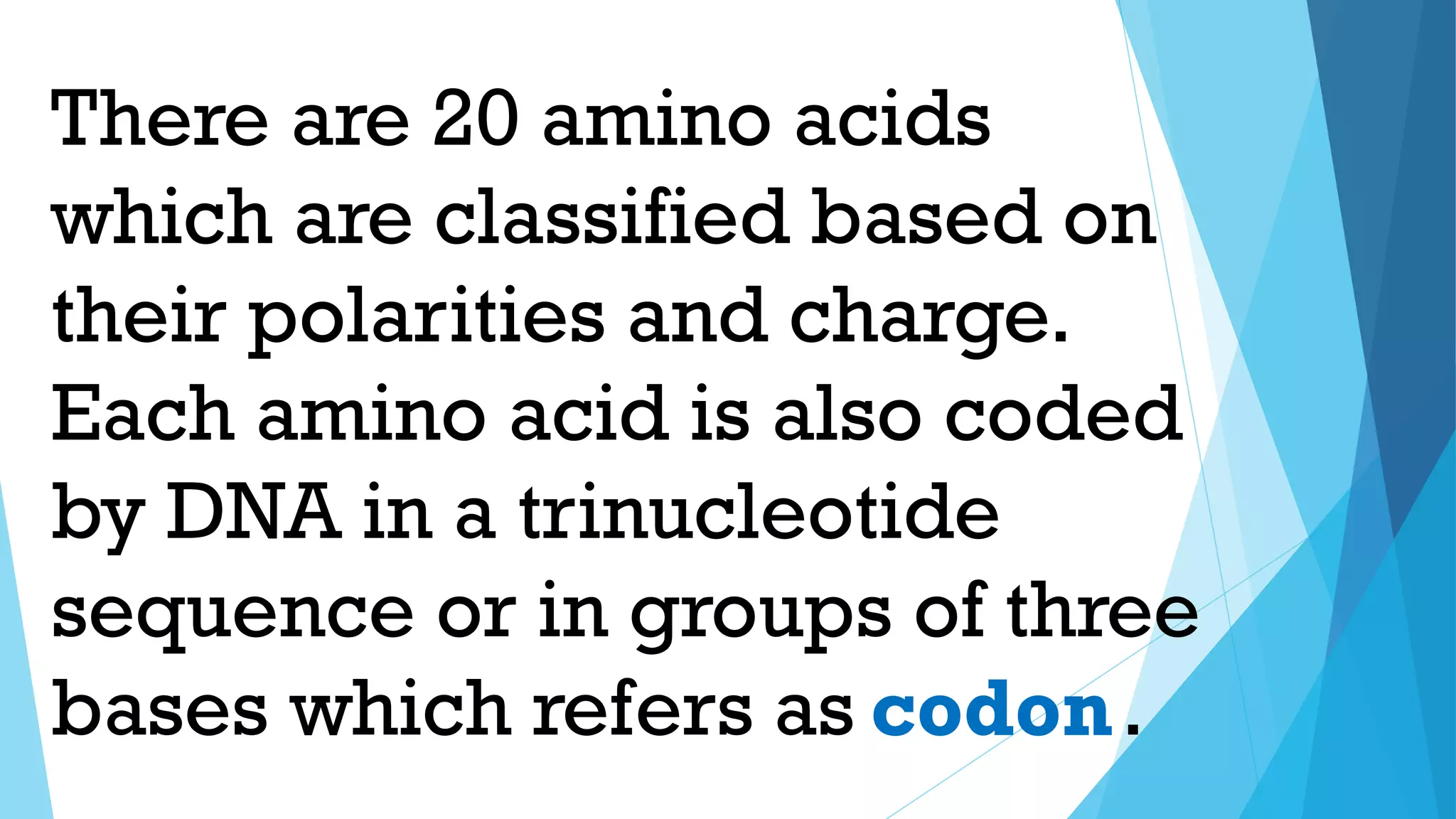
There are 20 amino acids
which are classified based on
their polarities and charge.
Each amino acid is also coded
by DNA in a trinucleotide
sequence or in groups of three
bases which refers as .
codon
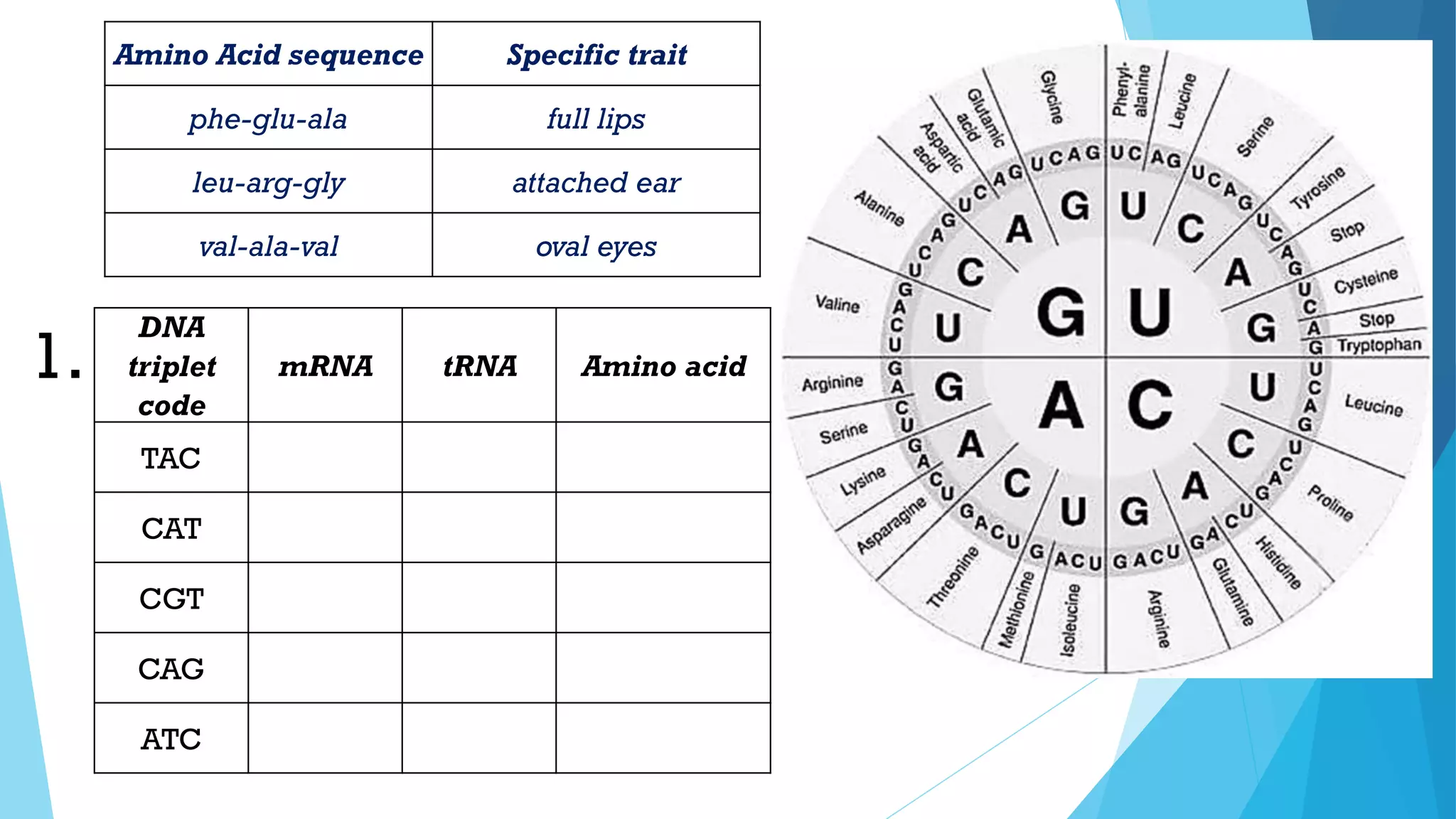
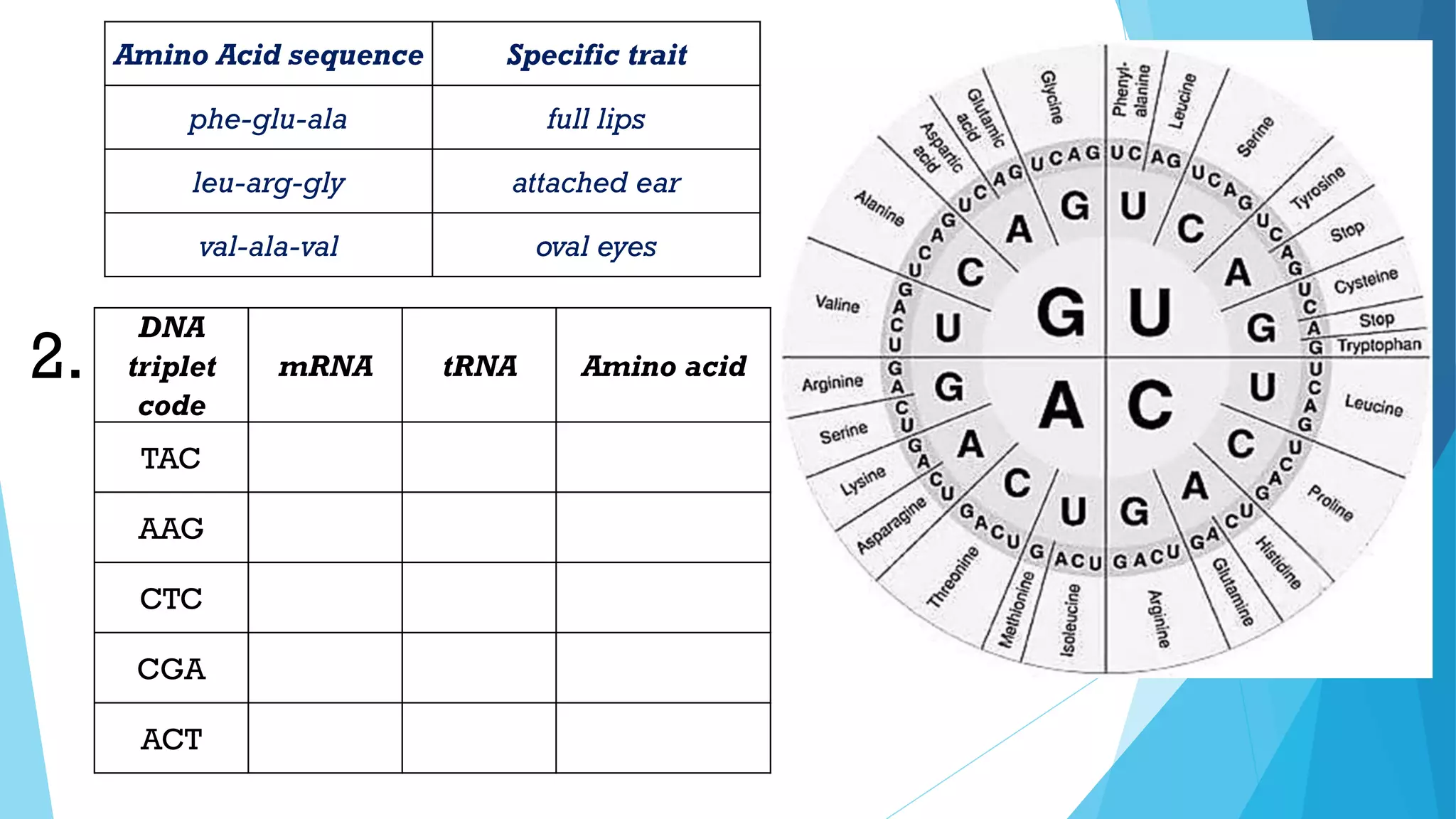
Amino Acid Chart
Start
codon
(Met)
•AUG
Stop
codon
•UAA
•UAG
•UGA
- process of making
proteins.
Protein Synthesis
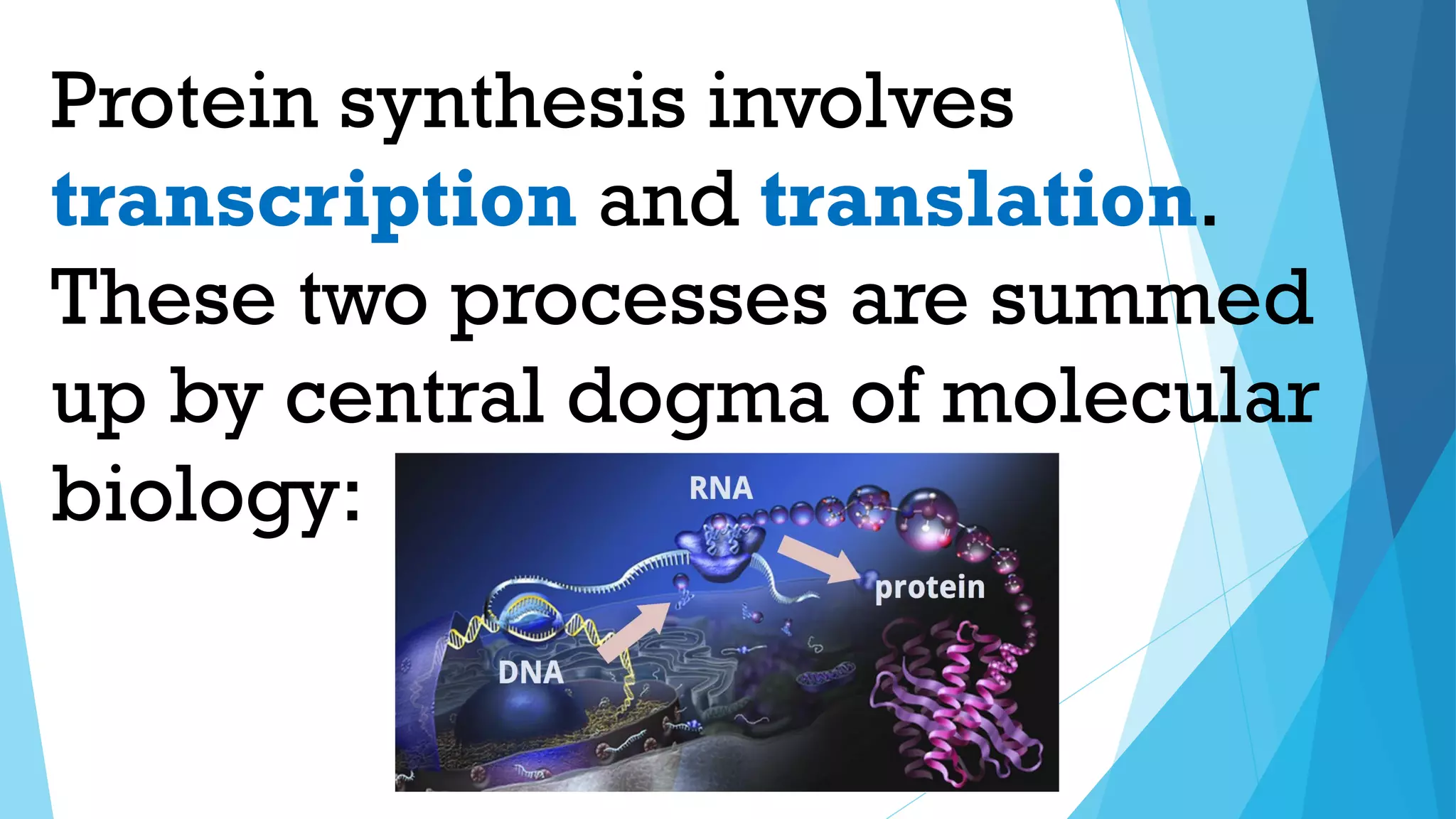
Protein synthesis involves
transcription and translation.
These two processes are summed
up by central dogma of molecular
biology:
Steps in Protein Synthesis
- involves the
transfer of genetic information in
DNA to mRNA which happens
inside the nucleus.
1. Transcription
Transcription takes place in
three steps: initiation,
elongation and termination.
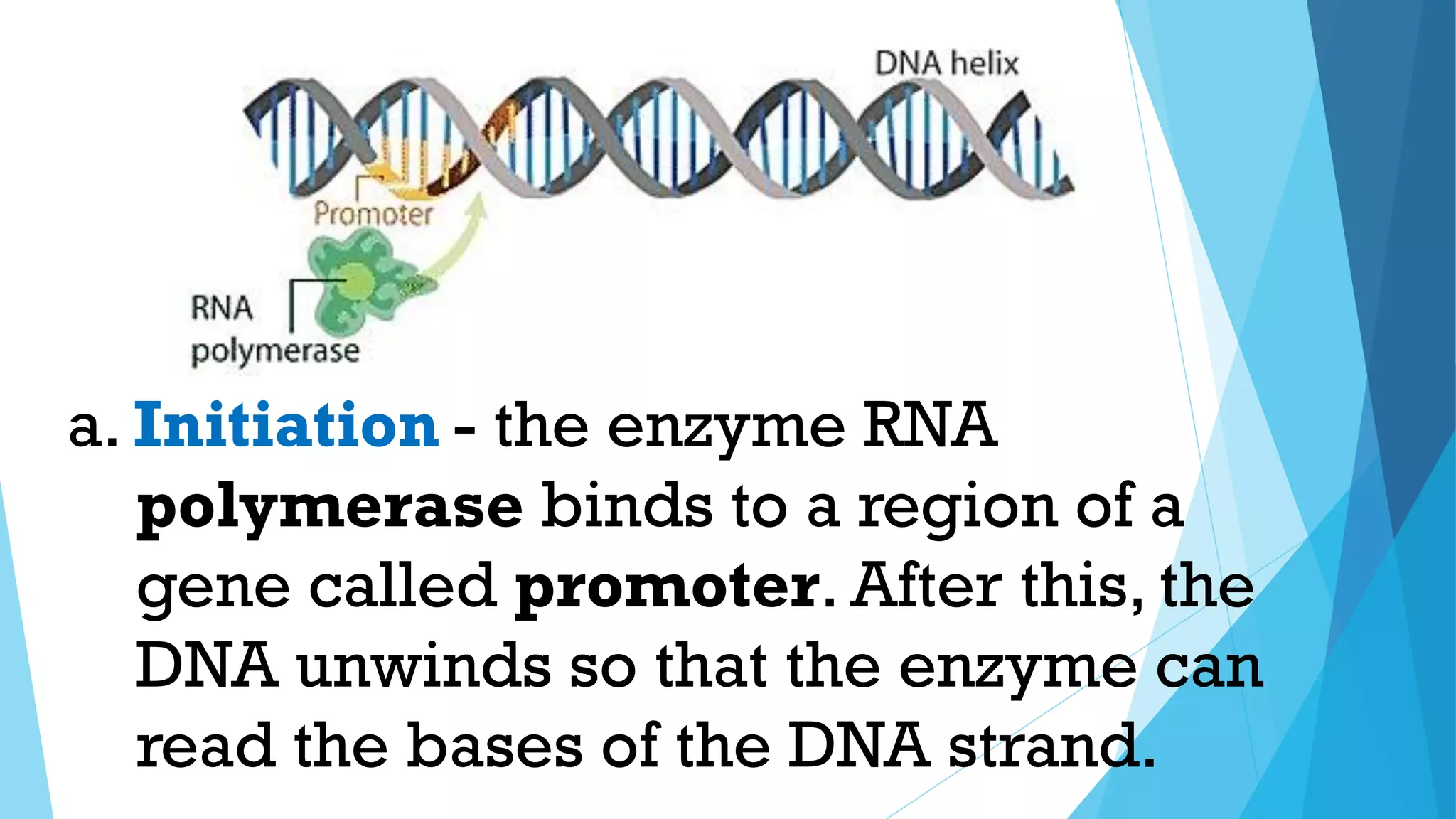
- the enzyme RNA
polymerase binds to a region of a
gene called promoter. After this, the
DNA unwinds so that the enzyme can
read the bases of the DNA strand.
a. Initiation
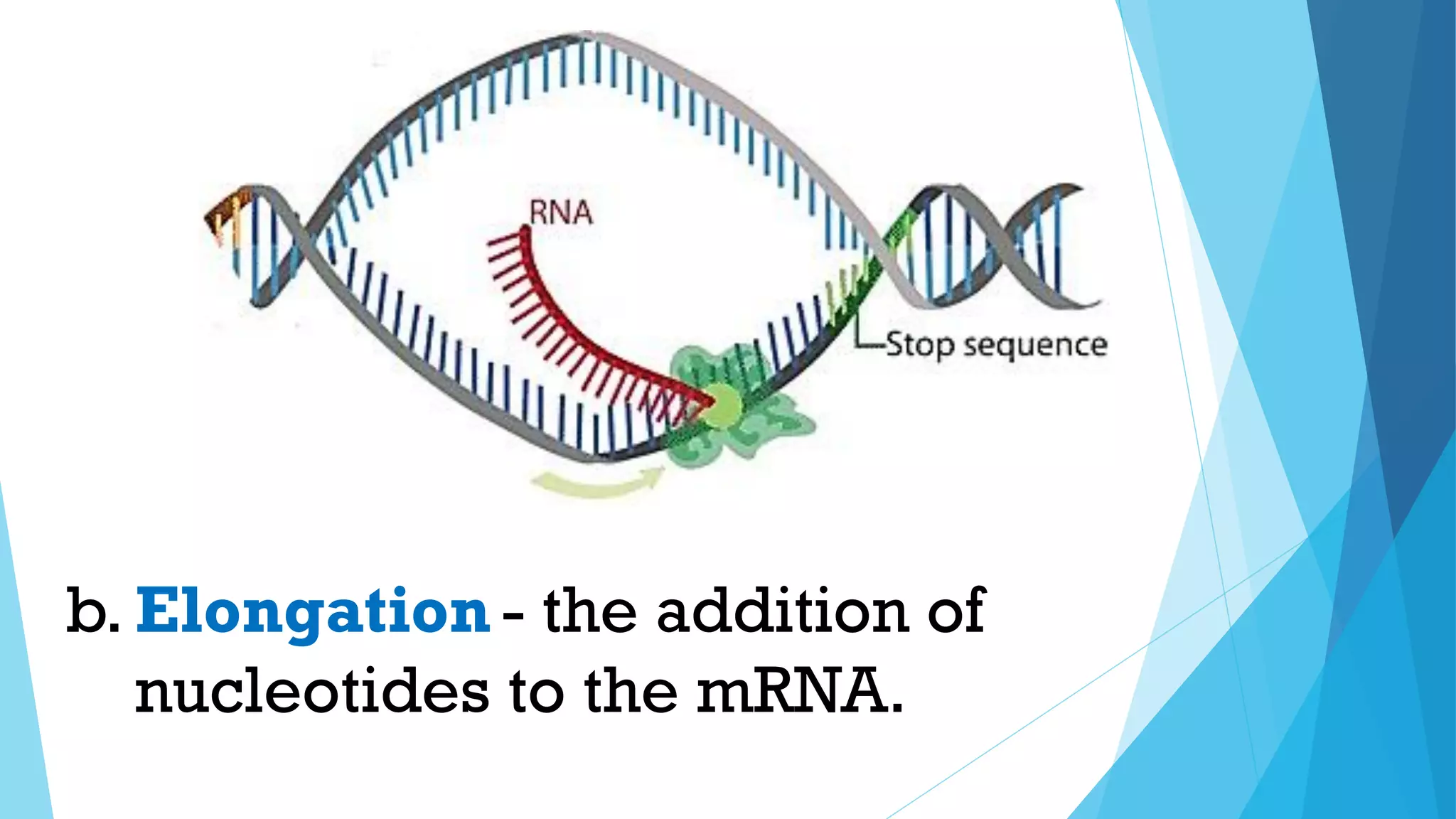
- the addition of
nucleotides to the mRNA.
b. Elongation
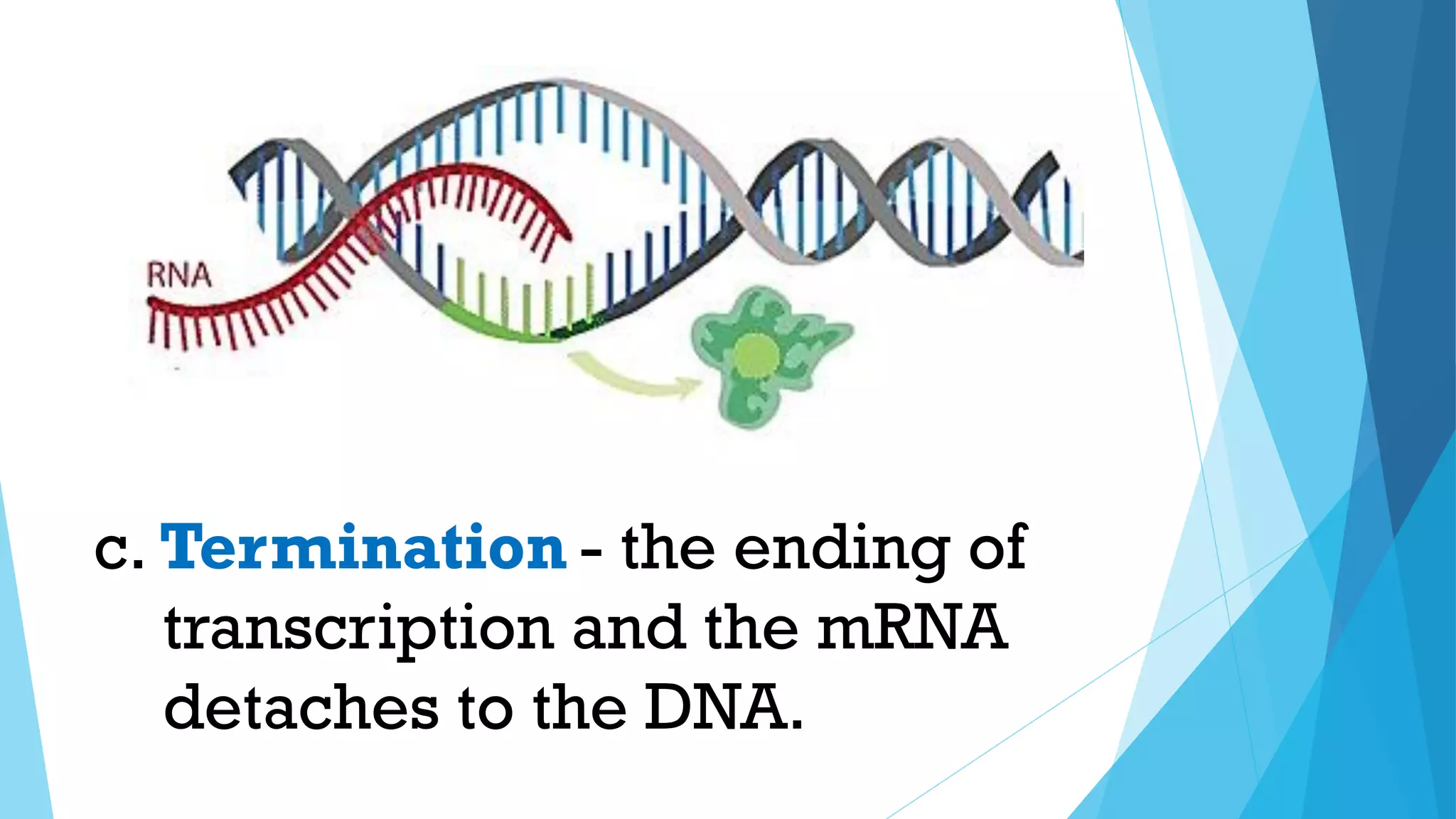
- the ending of
transcription and the mRNA
detaches to the DNA.
c. Termination
After the termination stage, the
new mRNA is not yet ready for
translation, it must undergo
more processes before it
leaves the nucleus.These
processes are the following:
Processing of mRNA
- modification or
change of some of the
nucleotides in mRNA.
b. Editing
- the removal of
introns in the mRNA. Introns
are the non-coding regions
while the coding regions are
called Exons.
a. Splicing
- adds a tail
to the mRNA.The tail consists
of a string of adenine bases. It
signals the end of mRNA. It is
also involved in exporting
mRNA from the nucleus, and it
protects mRNA from enzymes
that might break it down.
c. Polyadenylation
- the process in
which the genetic code in mRNA
is read to make a protein.
2. Translation
After mRNA leaves the nucleus, it moves
to a ribosome, which consists of rRNA
and proteins.The ribosome reads the
sequence of codons in mRNA, and
molecules of tRNA bring amino acids to
the ribosome in the correct sequence.
In order to start the translation
process, the following molecules
are required: mRNA template,
ribosomes, tRNA, and various
enzymatic factors.
Just like the transcription, this
process takes place in three steps:
initiation, elongation and
termination.
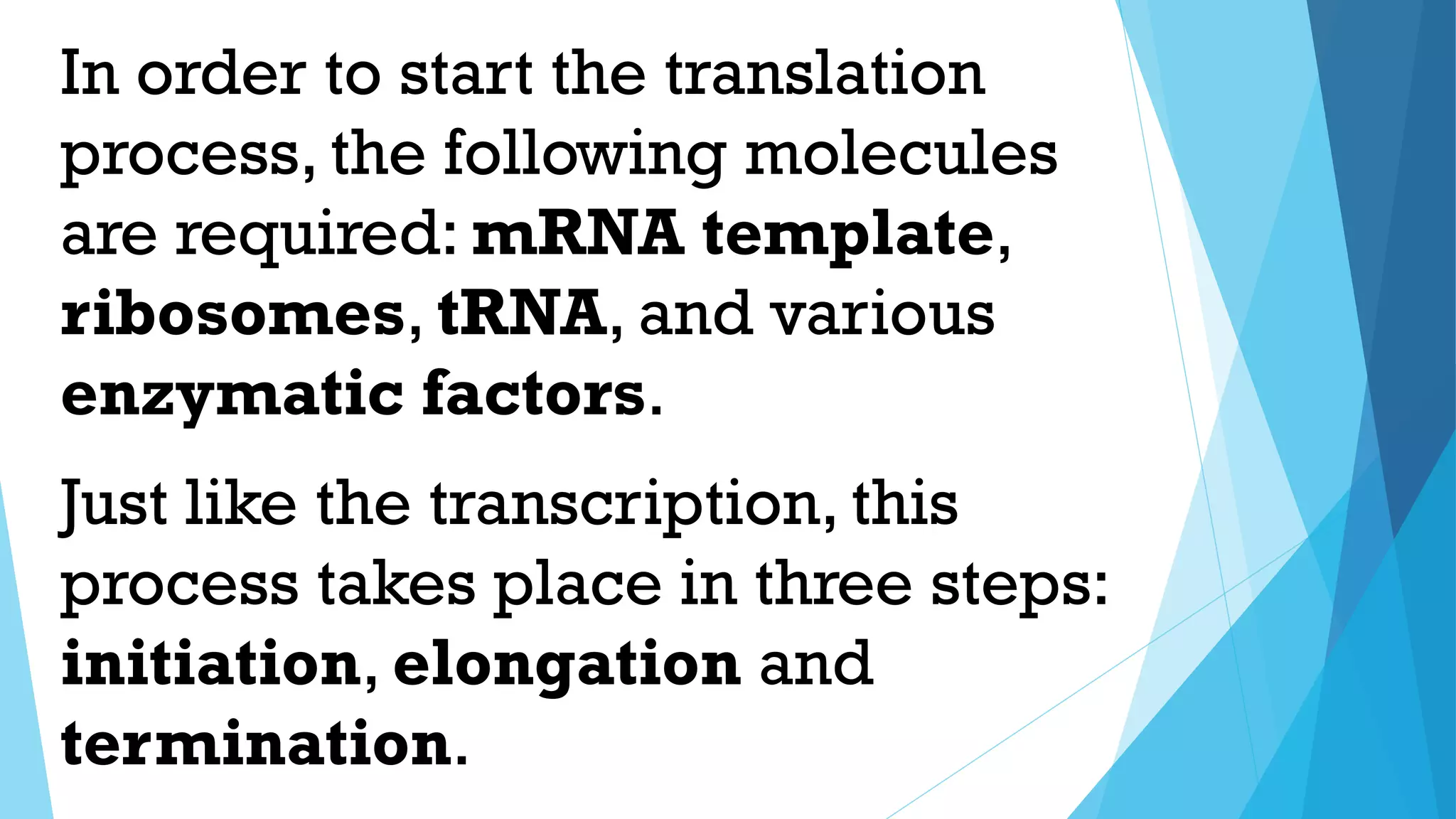
- transitional complex
forms and tRNA brings the first amino
acid (Methionine) in polypeptide
chain to bind to start codon on mRNA.
a. Initiation
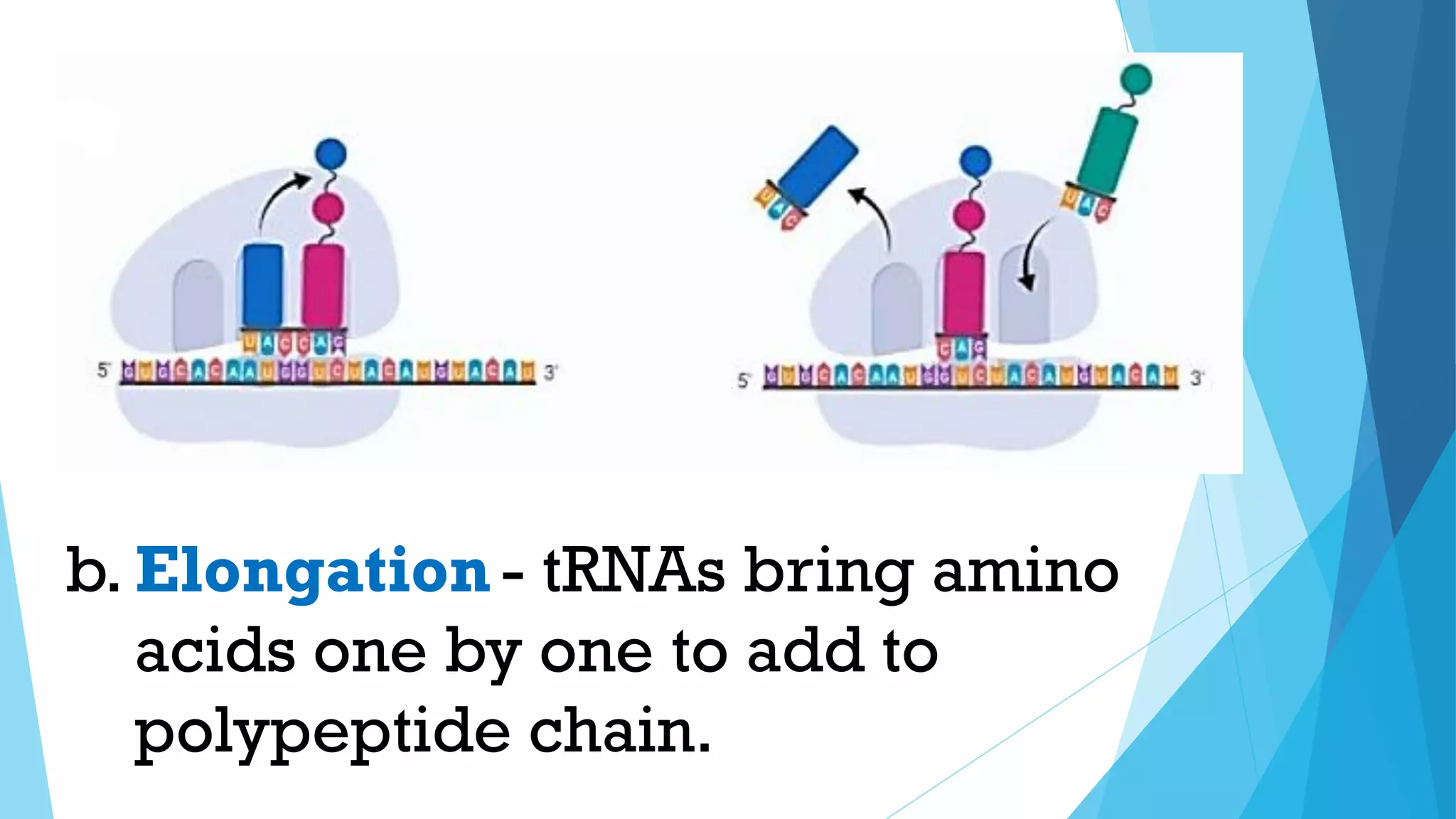
- tRNAs bring amino
acids one by one to add to
polypeptide chain.
b. Elongation
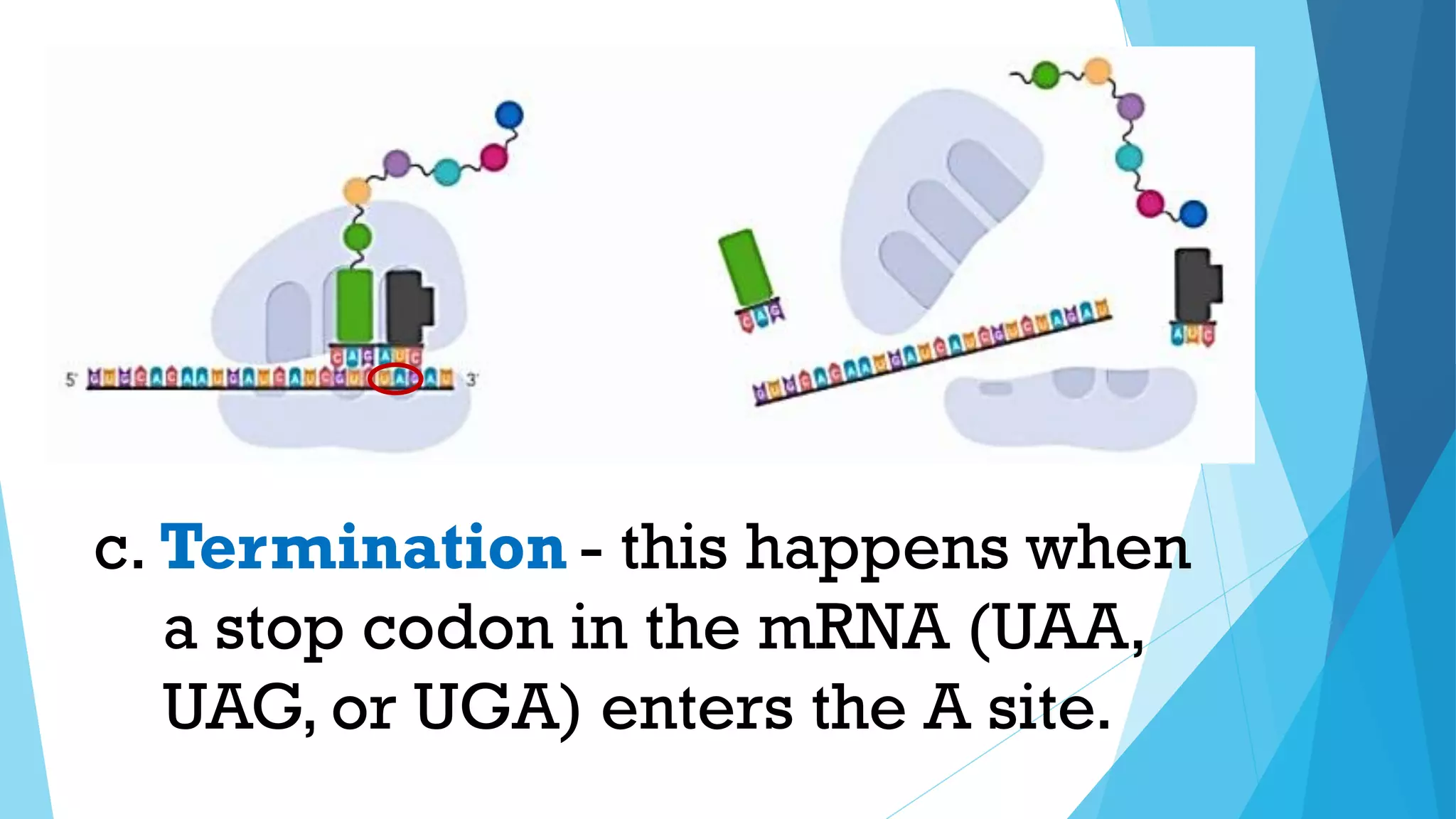
- this happens when
a stop codon in the mRNA (UAA,
UAG, or UGA) enters the A site.
c. Termination
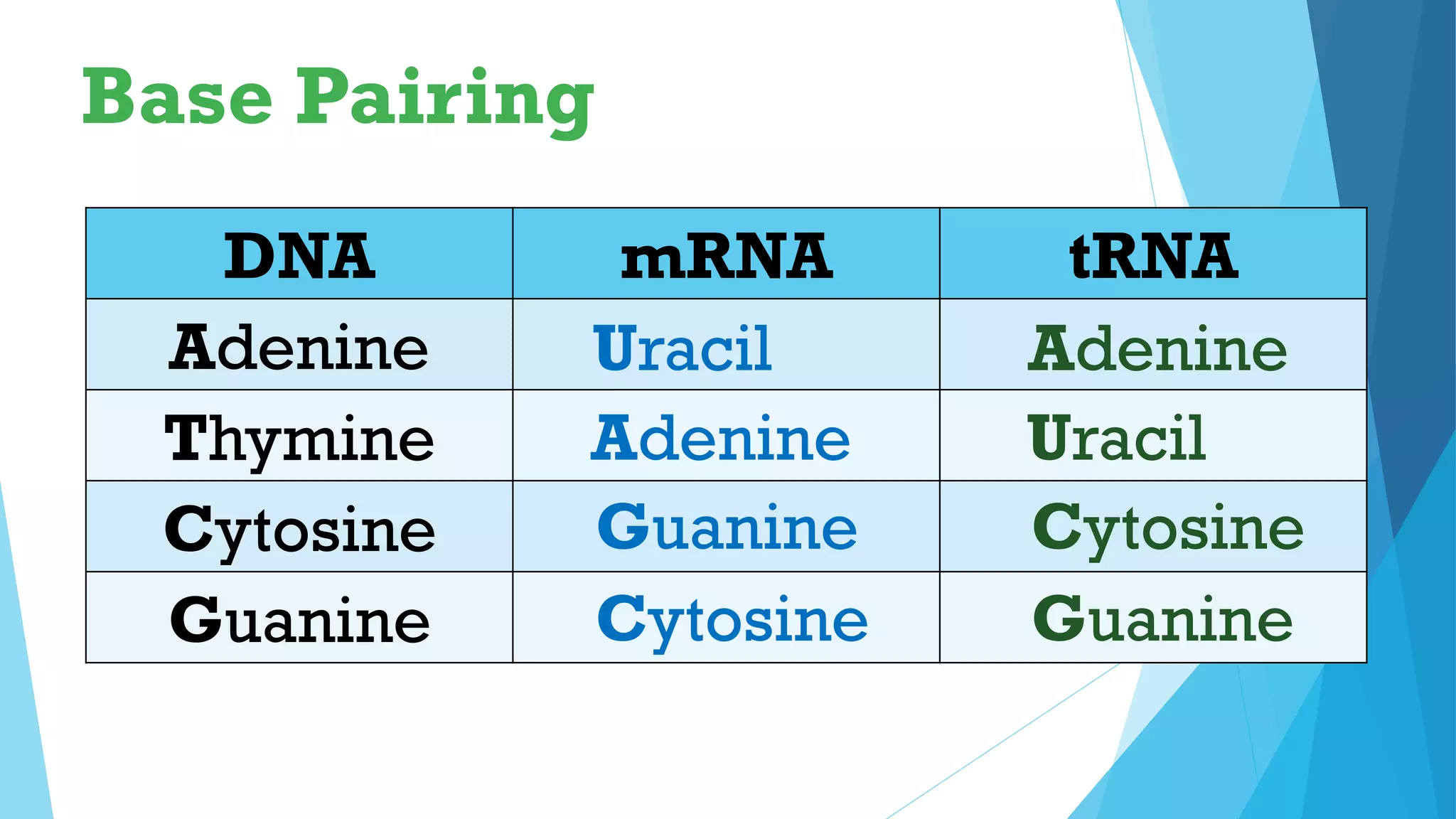
Base Pairing
DNA mRNA tRNA
Adenine
Thymine
Cytosine
Guanine
Uracil Adenine
Adenine Uracil
Guanine Cytosine
Cytosine Guanine
Exercise: Decoding DNA Sequence
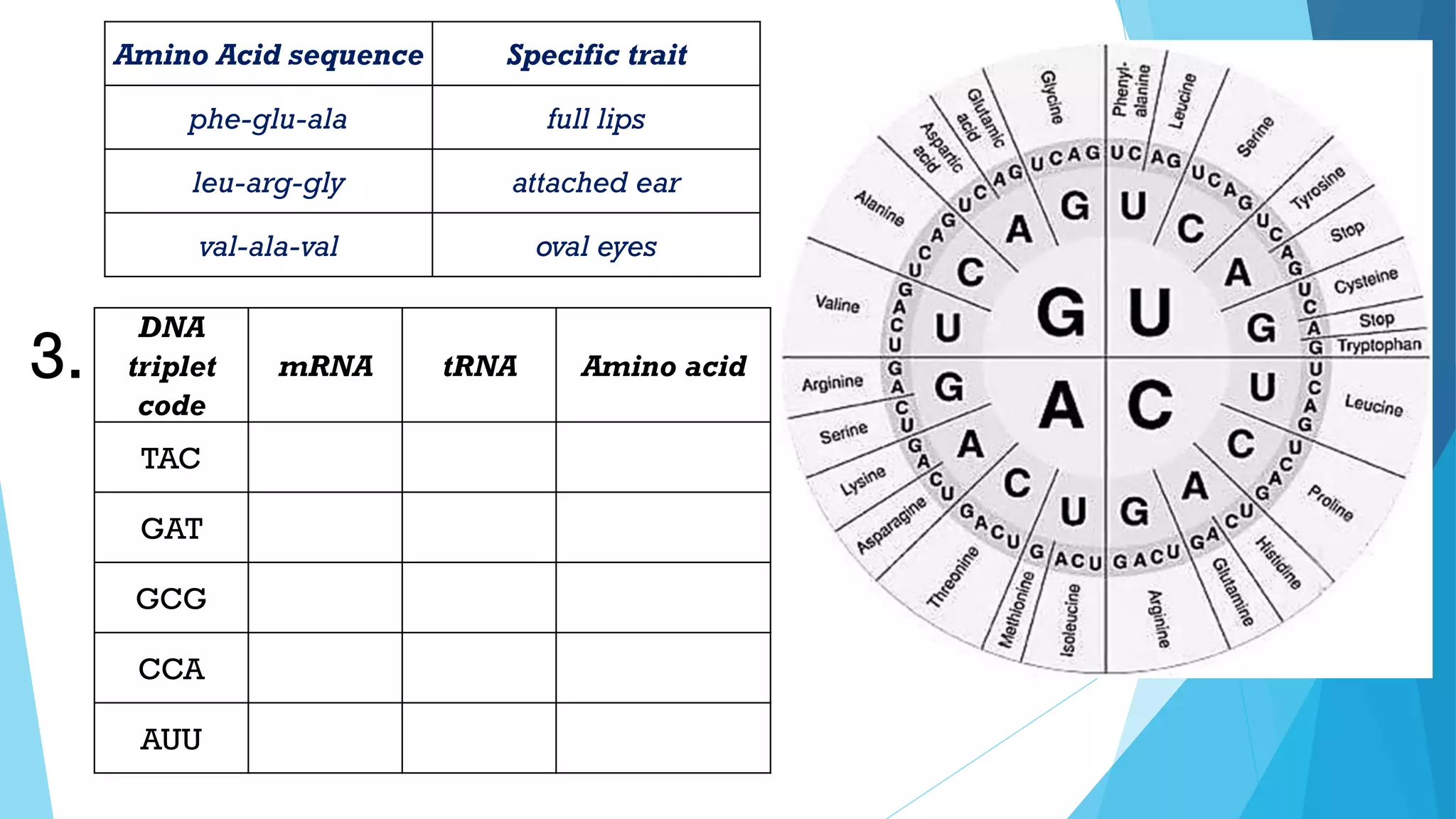
Given on the table are DNA
sequence. Determine the RNA
complementary strand, then use the
codon chart to determine the amino
acid sequence.Then, identify the
specific trait for the amino acid
sequence.
Amino Acid sequence Specific trait
phe-glu-ala full lips
leu-arg-gly attached ear
val-ala-val oval eyes
DNA
triplet
code
mRNA tRNA Amino acid
TAC
CAT
CGT
CAG
ATC
1.
Amino Acid sequence Specific trait
phe-glu-ala full lips
leu-arg-gly attached ear
val-ala-val oval eyes
DNA
triplet
code
mRNA tRNA Amino acid
TAC
AAG
CTC
CGA
ACT
2.
Amino Acid sequence Specific trait
phe-glu-ala full lips
leu-arg-gly attached ear
val-ala-val oval eyes
DNA
triplet
code
mRNA tRNA Amino acid
TAC
GAT
GCG
CCA
AUU
3.
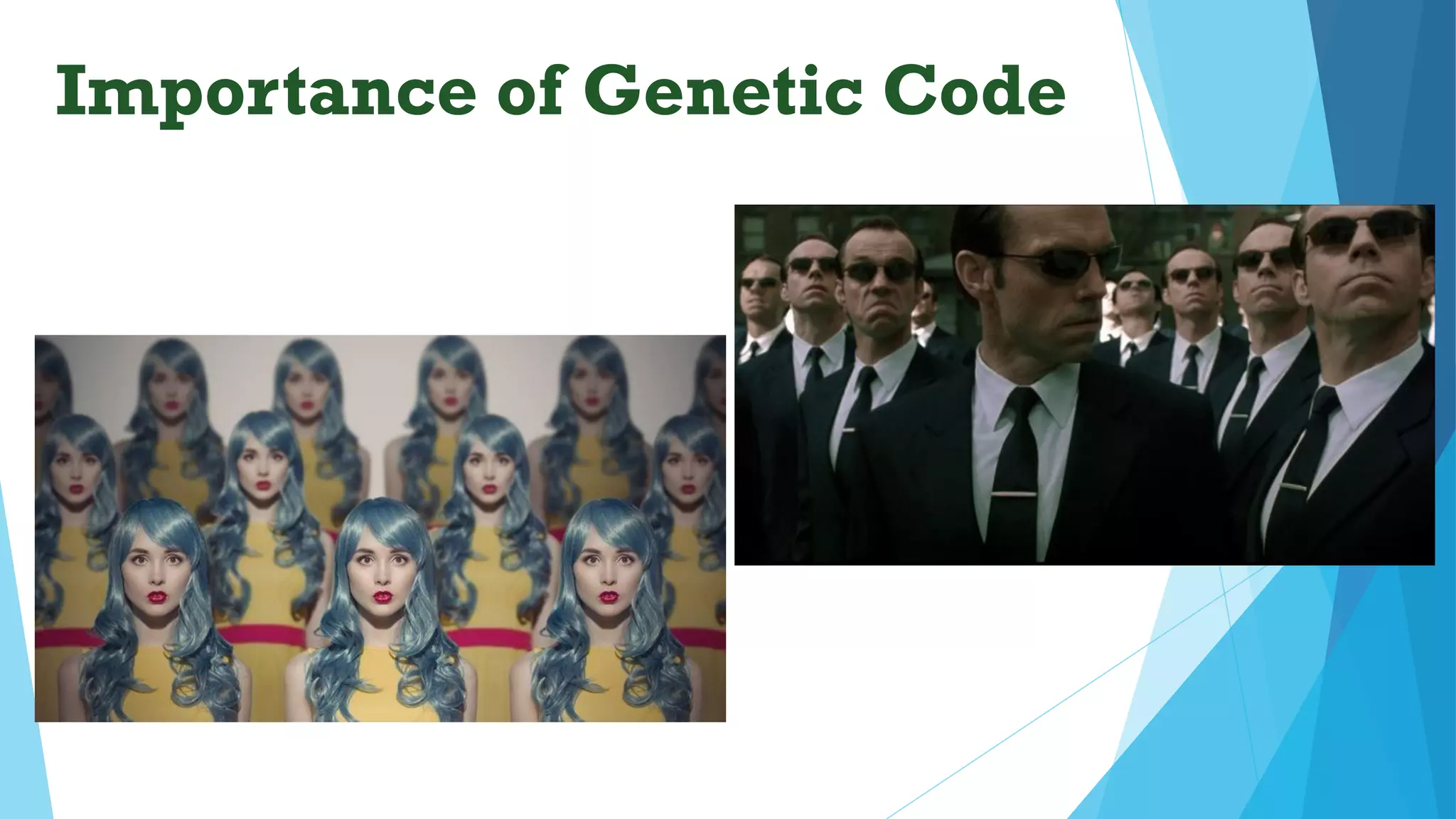
Importance of Genetic Code
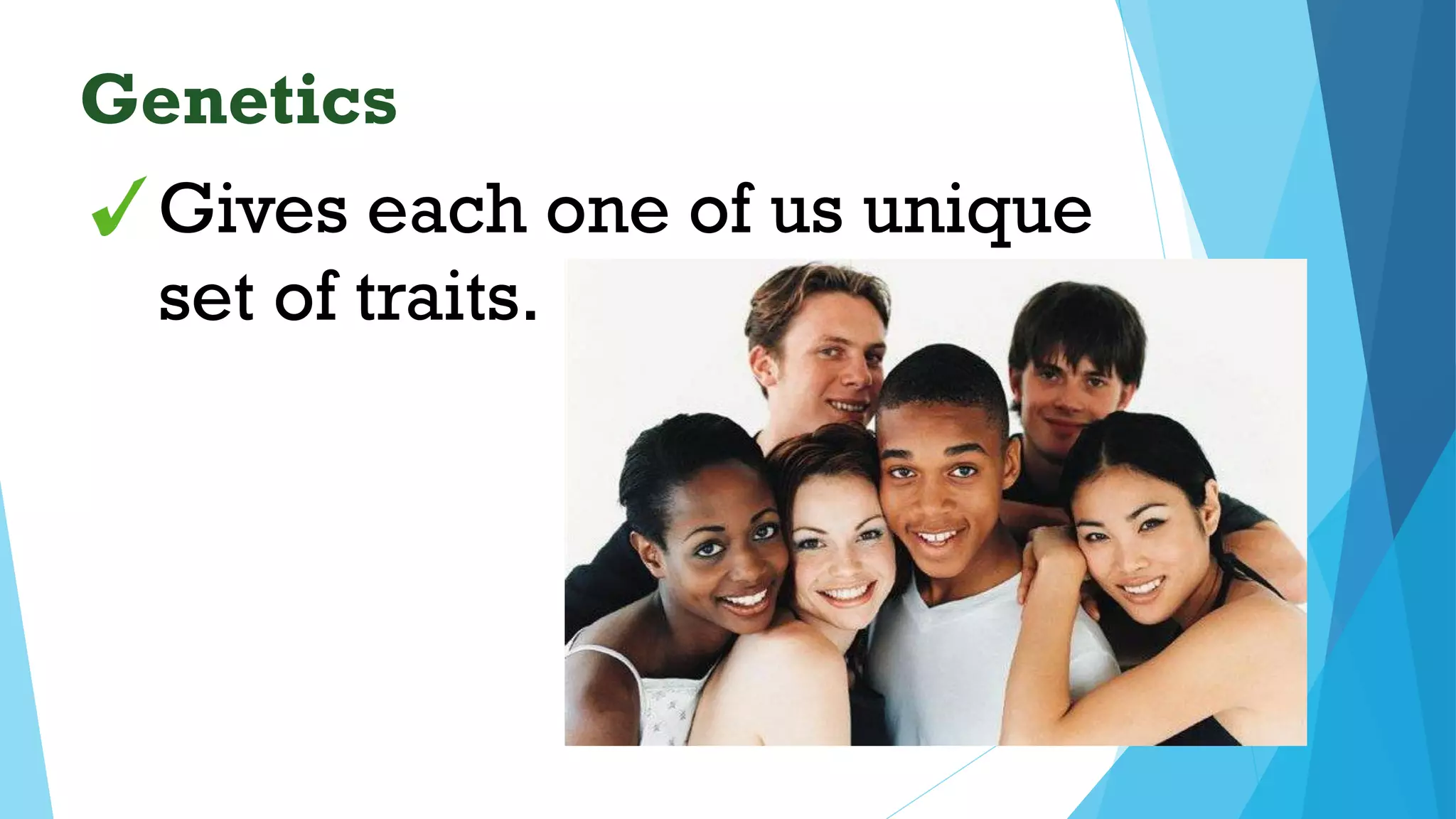
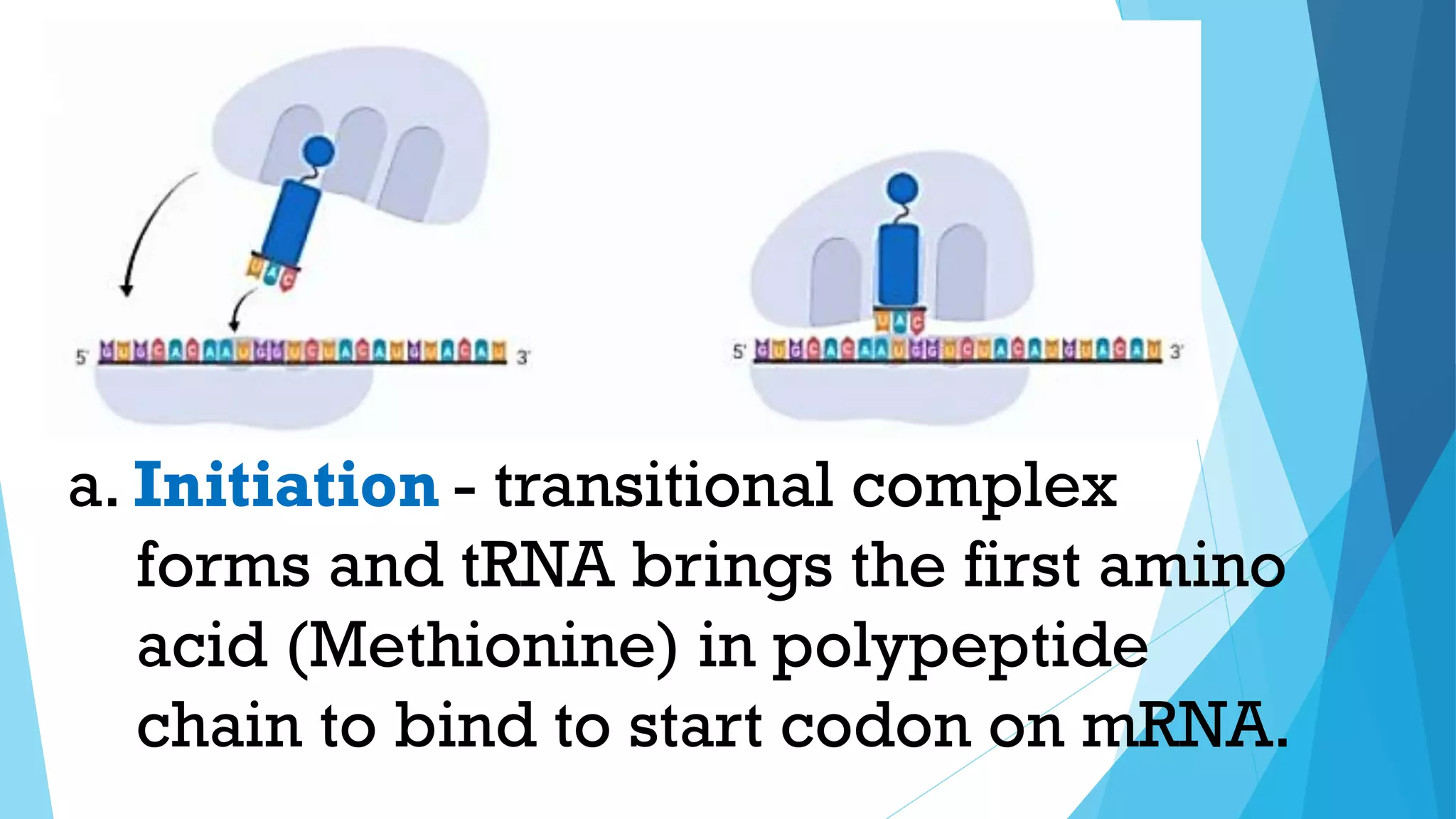
Gives each one of us unique
set of traits.
Genetics
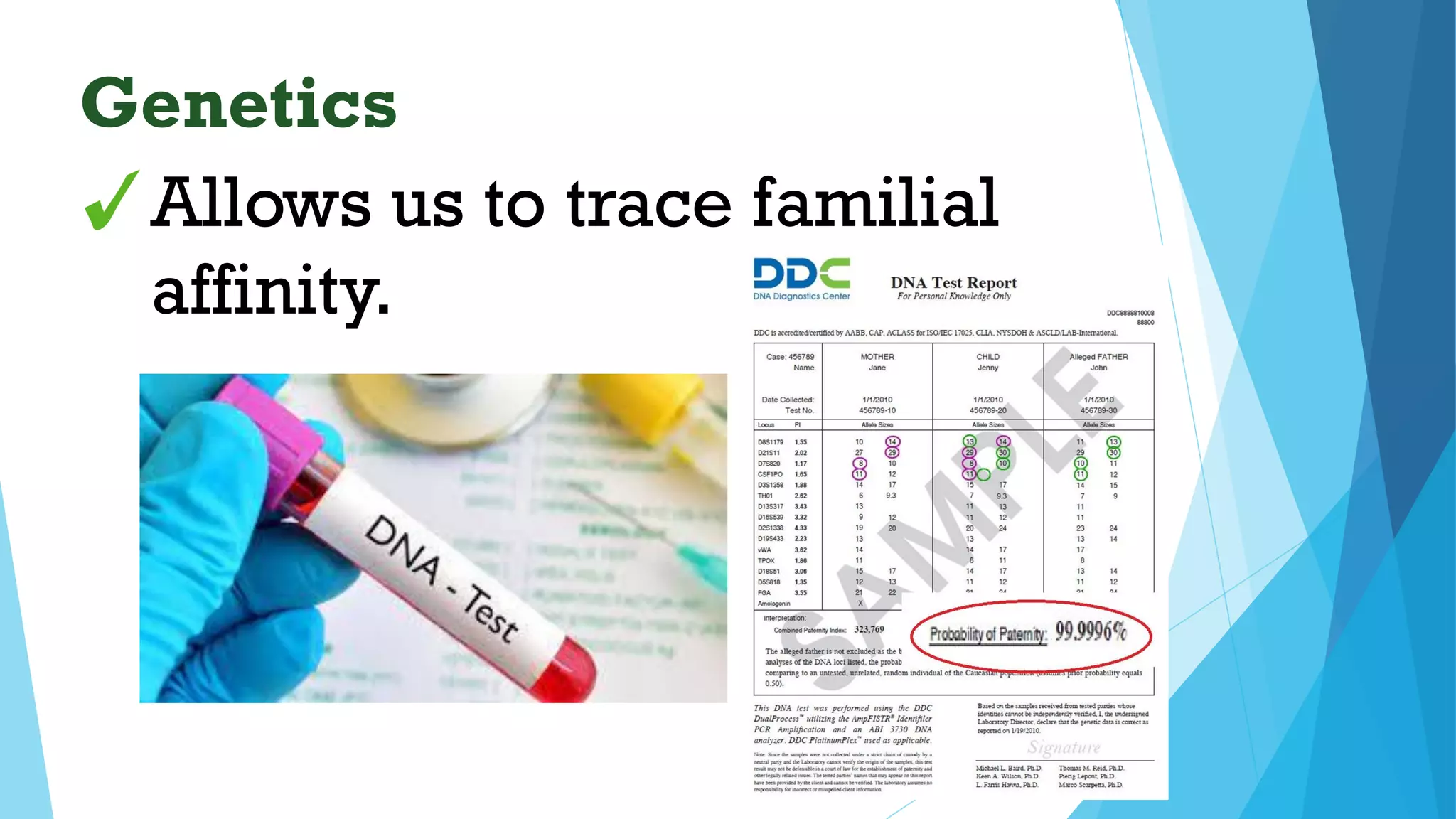
Allows us to trace familial
affinity.
Genetics
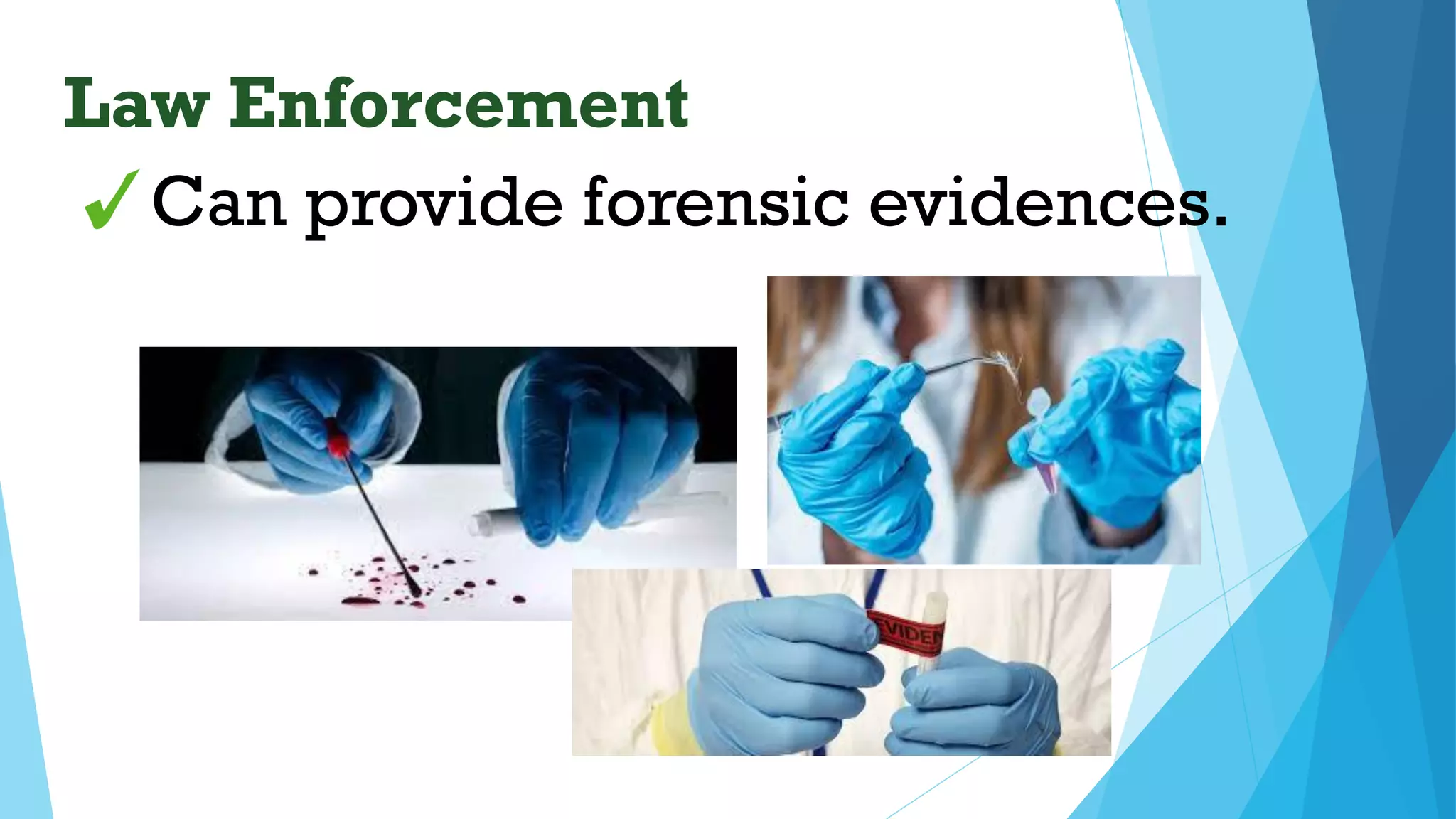
Can provide forensic evidences.
Law Enforcement
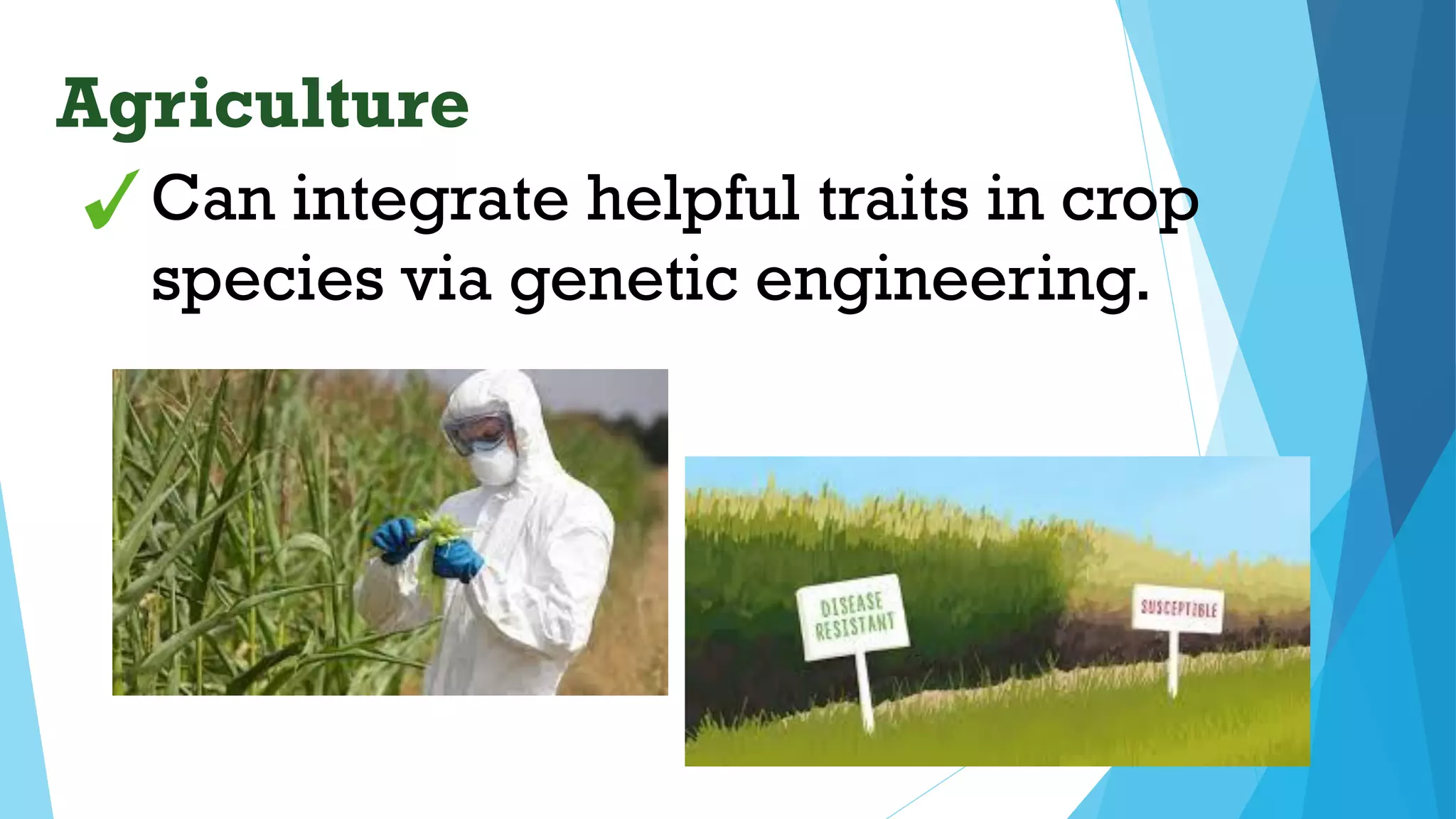
Can integrate helpful traits in crop
species via genetic engineering.
Agriculture
References:
https://byjus.com/biology/difference-between-dna-and-rna/
Science – Grade 10 Alternative Delivery Mode
Quarter 3 – Module 4.1: Protein Synthesis
Printed Materials:
Electronic Sources:
https://www.nature.com/scitable/topicpage/gene-expression-14121669/
https://www.biologyexams4u.com/2014/12/different-types-of-rna-in-cell.html
https://www.boyertownasd.org/cms/lib07/PA01916192/Centricity/Domain/743/
4.%20Codon%20WS.pdf
DepEd Science Grade 10 Learner’s Material (pp. 263-281)
https://flexbooks.ck12.org/cbook/ck-12-college-human-biology-flexbook-
2.0/section/5.6/primary/lesson/protein-synthesis-chumbio/
https://byjus.com/biology/difference-between-dna-and-rna/

Q3 W3 Ppt 4.1 Protein Synthesis-1.pdf

  • 1.
  • 2.
    At the endof our lessons, you are expected to be able to: Explain how protein is made using information from DNA. (S10LT-IIId-37)
  • 3.
    Specifically, you shouldbe able to: Compare and contrast DNA and RNA in terms of a. function b. structure c. location 1.
  • 4.
    Comparing DNA andRNA stores genetic information converts information stored in DNA to proteins
  • 5.
    Comparing DNA andRNA double- stranded helix molecule single- stranded molecule
  • 6.
    Comparing DNA andRNA DNA RNA ● five-carbon deoxyribose sugar ● phosphate group ● Nitrogenous bases: Purine – Guanine, Adenine Pyrimidine – Cytosine,Thymine ● five-carbon ribose sugar ● phosphate group ● Nitrogenous bases: Purine – Guanine, Adenine Pyrimidine – Cytosine, Uracil
  • 7.
    DNA RNA found in nucleus; smallamount is present in mitochondria forms in nucleolus; moves to cytoplasm depending on type Comparing DNA and RNA
  • 8.
    Comparing DNA andRNA RNA DNA Cytosine - Guanine Thymine - Adenine Guanine - Cytosine Adenine - Uracil
  • 9.
    DNA and RNAare strings of nucleotides which are composed of phosphate group, sugar and nitrogenous base.There are two kinds of nitrogen containing bases – the and . Purines Pyrimidines
  • 10.
    Purines – are bothpresent in DNA and RNA and have two-ring structure. Adenine and Guanine
  • 11.
    Pyrimidines in DNAare , in RNA are have only one ring. Cytosine and Thymine Cytosine and Uracil
  • 12.
    The types ofRNA involved in protein synthesis are: mRNA Carries information from the DNA in the nucleus to the site of protein synthesis.
  • 13.
    Supplies the amino acidsto the ribosome to form proteins. tRNA
  • 14.
    Binds mRNA and variousmolecules necessary for protein synthesis. rRNA
  • 15.
    At the endof our lessons, you are expected to be able to: Explain how protein is made using information from DNA. (S10LT-IIId-37)
  • 16.
    Specifically,you should beable to: 1. describe the transcription and translation processes; 2. determine the sequence of amino acids produced by a DNA sequence; and 3. appreciate the importance of genetic code.
  • 18.
    Protein Synthesis - themost important molecule in the cell. enzymes, antibodies and hormones Protein Examples:
  • 19.
    Hundreds of aminoacids are linked together by peptide bonds forming a long chain of proteins. - the building blocks of proteins. Amino acids
  • 20.
    There are 20amino acids which are classified based on their polarities and charge. Each amino acid is also coded by DNA in a trinucleotide sequence or in groups of three bases which refers as . codon
  • 21.
  • 22.
    - process ofmaking proteins. Protein Synthesis
  • 23.
    Protein synthesis involves transcriptionand translation. These two processes are summed up by central dogma of molecular biology:
  • 24.
    Steps in ProteinSynthesis - involves the transfer of genetic information in DNA to mRNA which happens inside the nucleus. 1. Transcription Transcription takes place in three steps: initiation, elongation and termination.
  • 25.
    - the enzymeRNA polymerase binds to a region of a gene called promoter. After this, the DNA unwinds so that the enzyme can read the bases of the DNA strand. a. Initiation
  • 26.
    - the additionof nucleotides to the mRNA. b. Elongation
  • 27.
    - the endingof transcription and the mRNA detaches to the DNA. c. Termination
  • 28.
    After the terminationstage, the new mRNA is not yet ready for translation, it must undergo more processes before it leaves the nucleus.These processes are the following: Processing of mRNA
  • 29.
    - modification or changeof some of the nucleotides in mRNA. b. Editing - the removal of introns in the mRNA. Introns are the non-coding regions while the coding regions are called Exons. a. Splicing
  • 30.
    - adds atail to the mRNA.The tail consists of a string of adenine bases. It signals the end of mRNA. It is also involved in exporting mRNA from the nucleus, and it protects mRNA from enzymes that might break it down. c. Polyadenylation
  • 31.
    - the processin which the genetic code in mRNA is read to make a protein. 2. Translation After mRNA leaves the nucleus, it moves to a ribosome, which consists of rRNA and proteins.The ribosome reads the sequence of codons in mRNA, and molecules of tRNA bring amino acids to the ribosome in the correct sequence.
  • 32.
    In order tostart the translation process, the following molecules are required: mRNA template, ribosomes, tRNA, and various enzymatic factors. Just like the transcription, this process takes place in three steps: initiation, elongation and termination.
  • 33.
    - transitional complex formsand tRNA brings the first amino acid (Methionine) in polypeptide chain to bind to start codon on mRNA. a. Initiation
  • 34.
    - tRNAs bringamino acids one by one to add to polypeptide chain. b. Elongation
  • 35.
    - this happenswhen a stop codon in the mRNA (UAA, UAG, or UGA) enters the A site. c. Termination
  • 36.
    Base Pairing DNA mRNAtRNA Adenine Thymine Cytosine Guanine Uracil Adenine Adenine Uracil Guanine Cytosine Cytosine Guanine
  • 37.
    Exercise: Decoding DNASequence Given on the table are DNA sequence. Determine the RNA complementary strand, then use the codon chart to determine the amino acid sequence.Then, identify the specific trait for the amino acid sequence.
  • 38.
    Amino Acid sequenceSpecific trait phe-glu-ala full lips leu-arg-gly attached ear val-ala-val oval eyes DNA triplet code mRNA tRNA Amino acid TAC CAT CGT CAG ATC 1.
  • 39.
    Amino Acid sequenceSpecific trait phe-glu-ala full lips leu-arg-gly attached ear val-ala-val oval eyes DNA triplet code mRNA tRNA Amino acid TAC AAG CTC CGA ACT 2.
  • 40.
    Amino Acid sequenceSpecific trait phe-glu-ala full lips leu-arg-gly attached ear val-ala-val oval eyes DNA triplet code mRNA tRNA Amino acid TAC GAT GCG CCA AUU 3.
  • 41.
  • 42.
    Gives each oneof us unique set of traits. Genetics
  • 43.
    Allows us totrace familial affinity. Genetics
  • 44.
    Can provide forensicevidences. Law Enforcement
  • 45.
    Can integrate helpfultraits in crop species via genetic engineering. Agriculture
  • 46.
    References: https://byjus.com/biology/difference-between-dna-and-rna/ Science – Grade10 Alternative Delivery Mode Quarter 3 – Module 4.1: Protein Synthesis Printed Materials: Electronic Sources: https://www.nature.com/scitable/topicpage/gene-expression-14121669/ https://www.biologyexams4u.com/2014/12/different-types-of-rna-in-cell.html https://www.boyertownasd.org/cms/lib07/PA01916192/Centricity/Domain/743/ 4.%20Codon%20WS.pdf DepEd Science Grade 10 Learner’s Material (pp. 263-281) https://flexbooks.ck12.org/cbook/ck-12-college-human-biology-flexbook- 2.0/section/5.6/primary/lesson/protein-synthesis-chumbio/ https://byjus.com/biology/difference-between-dna-and-rna/