THIOPENTONE
Guided by
Dr. Abhay Bodhey
Presented by
Dr. Upendra
INTRODUCTION
 Sulphur derivative of Barbituric Acid.
i.e. Thio barbiturate.
 Ultra short acting barbiturate.
 Synthesised by Tabern and Volwiler in 1935.
 Introduce clinically by Ralph waters and John Lundy
for induction of anaesthesia.
Poor analgesic, weak muscle relaxant.
Commonest inducing agent used.
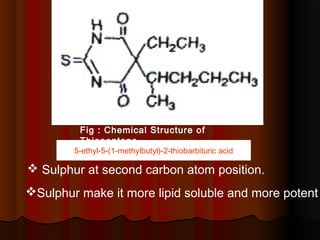
Fig : Chemical Structure of
Thiopentone
Sulphur make it more lipid soluble and more potent
 Sulphur at second carbon atom position.
5-ethyl-5-(1-methylbutyl)-2-thiobarbituric acid
PROPERTIES
Highly soluble in water / NS yielding highly
alkaline solution,stable for 48 hrs.
 Must be prepared freshly.
 Powder form stable at room temperature.
 Refrigerated solution stable up to 2 week.
PROPERTIES
pH of 2.5% solution is 10.5.
 Commercial preparation contain it sodium
salt with anhydrous sodium carbonate to
prevent ppt.of acid form.
 Available as 0.5 gm and 1 gm powder for
reconstitution.
• Refrigerated solutions- stable upto 2
weeks
PHARMACOKINETICS
 Onset of action of i.v. injection - 10-20 sec.
peak 30-40 sec. duration for awakening 5-15
min.
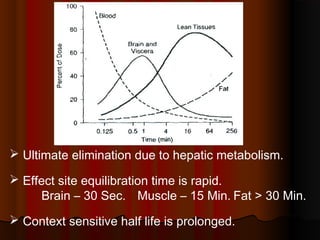
Prompt awakening after single i.v. inj. is due to
rapid redistribution to lean body tissue (muscle)
Volume of distribution is 2.5 Lit. per Kg.
 Ultimate elimination due to hepatic metabolism.
 Effect site equilibration time is rapid.
Brain – 30 Sec. Muscle – 15 Min. Fat > 30 Min.
 Context sensitive half life is prolonged.
TERMINATION OF ACTION
1) Redistribution
a) Lipid solubility (most important factor)
 High Lipid Solubility makes it to cross blood brain
barrier & lean body tissue rapidly.
b) Protein Binding
 Highly bound to albumin & other plasma protein.
 72 – 86% Binding.
 Only unbound fraction crosses Blood-Brain-Barrier.
 Affected by physiological PH. Disease state &
parallels lipid solubility
 Hepatic disease & chronic renal disease decrease
protein Binding, increase free form.
c) Ionization
 Only non-ionized part crosses Blood-Brain-Barrier.
 Thiopentone has PKA 7.6 so 61% of it is
non-ionized at physiologic PH
 As PH decreases (acidosis) non-ionized form
increases.
 Metabolism induced changes in PH affect more.
 Rapid distribution half life – 8.5 Min.
 Slow distribution half life – 62.7 Min
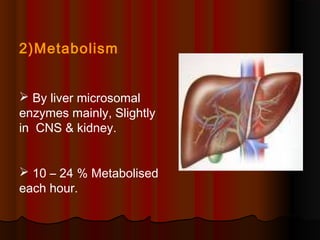
2)Metabolism
 By liver microsomal
enzymes mainly, Slightly
in CNS & kidney.
 10 – 24 % Metabolised
each hour.
 By oxidation, dealkylation & conjugation to
hydroxy Thiopental & carboxylic acid derivatives
more water soluble & excreted rapidly.
 Affect by hepatic enzyme activity more than
blood flow.
 Metabolism at 4-5 mg./Kg. dose exhibits first
order kinetics.
 At very high doses (300-600 mg/Kg.)
exhibit zero order kinetics.
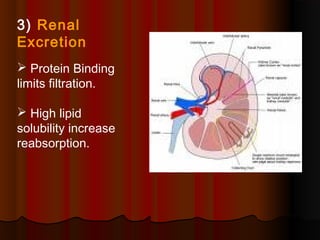
3) Renal
Excretion
 Protein Binding
limits filtration.
 High lipid
solubility increase
reabsorption.
Elimination Half Life 11.6 Hours
Low elimination clearance(3.4ml/kg/min)
Prolonged in obese patient & pregnancy.
Short in paediatric patient.
MECHANISM OF
ACTION Sedation & Hypnosis by interaction with
inhibitory neurotransmitters GABA on GABAA
receptor.
 GABA facilitatory & GABA mimetic action.
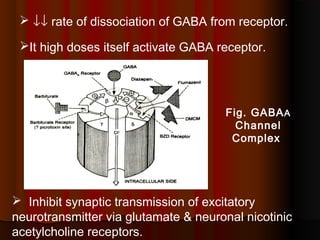
 GABAA receptor has 5 glycoprotein sub unit.
 Increases GABA mediated
transmembrane conductance of Cl– ion,
Causes hyperpolarization & inhibition of post
synaptic neuron.
 ↓↓ rate of dissociation of GABA from receptor.
It high doses itself activate GABA receptor.
Fig. GABAA
Channel
Complex
 Inhibit synaptic transmission of excitatory
neurotransmitter via glutamate & neuronal nicotinic
acetylcholine receptors.
PHARMACODYNAMI
CS
Central nervous system
Dose dependent effect
sedation → sleep →
anaesthesia → coma.
 Acts on Reticular Activating System & Thalamus.
 Induces General Anaesthesia → loss of
consciousness, amnesia & ↓↓ response to pain
R.S. & C.V.S. depression.
 Depresses transmission in sympathetic nervous
system, ↓↓ BP.
 Dose related ↓↓ CMRO2, reduces metabolic
activity, neuronal signalling & impulse trafficking.
↓↓ CMRO2
↓
↑↑ cerebral vascular resistance
↓
↓↓ cerebral blood flow
↓
↓↓ Intracranial pressure
 Somatosensory, Brainstem auditory & visual
evoked potential are depressed.
 ↓↓ burst suppression, protect in profound
hypotension.
↓↓ infract size in cerebral emboli & temporary
focal ischemia.
High doses desulfurationHigh doses desulfuration
pentobarbitalpentobarbital
(long lasting CNS Depressant)(long lasting CNS Depressant)
Respiratory system .
 Neurogenic, Hypercapnic
& hypoxic drive
depressed.
 Depression of medullary &
pontine ventilatory
centres.
 Apnoea likely in presence
of narcotics.
Cough & laryngeal reflexes not depressed
until high doses given.
 Bronchospasm & laryngospasm likely in
light plane, added by sympathetic depression
Cardiovascular system
 At 5 mg/Kg doses, 10-20
mmHg ↓↓ in BP due to
sympathetic blockade.
 Compensated by carotid sinus
baroreceptor mediated ↑↑ in
peripheral sympathetic nervous
system activity.
 Leads to unchanged myocardial contractility &
15 – 20 beats/min ↑↑ in Heart Rate.
 Direct myocardial depression occurs at doses used
to ↓↓ intracranial pressure.
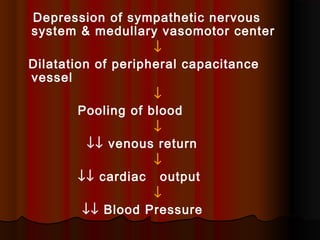
Depression of sympathetic nervous
system & medullary vasomotor center
↓
Dilatation of peripheral capacitance
vessel
↓
Pooling of blood
↓
↓↓ venous return
↓
↓↓ cardiac output
↓
↓↓ Blood Pressure
 Changes exaggerated in hypovolemic patient,
patient on B-blocker drugs & centrally acting anti
hypertensive.
Skeletal muscle
↓↓ Neuro muscular excitability.
5) Kidney
↓↓ blood flow & GFR .
6) Suppression of adrenal cortex &
↓↓ cortisol level, but it is reversible.
7) Liver
 ↓↓ hepatic blood flow
 Induction of microsomal enzyme & increase
metabolism of drugs,
For Ex. Oral-anticoagulant, Phenytoin, TCA,
Vit. K, Bile Salt, corticosteroid.
 ↑↑ Glucouronyl transferase activity.
 ↑↑ δ aminolavilunate activity & precipitate
porphyria’s.
Placental transfer occurs but drug
metabolised by foetal liver & diluted by its
blood volume so less depression.
CLINICAL USES
1) Induction
 3 – 5 mg/Kg. produces unconsciousness in 30 sec.
with smooth induction & rapid emergence.
 Loss of eyelid reflex & corneal reflex used for
testing induction.
 Consciousness regained 10-20 Min. but residual
CNS depression persist for more than 12 Hours.
 Dose requirement ↓↓ in early pregnancy, ↑↑ child
with thermal injury.
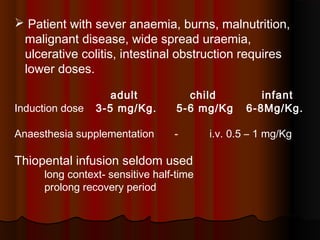
 Patient with sever anaemia, burns, malnutrition,
malignant disease, wide spread uraemia,
ulcerative colitis, intestinal obstruction requires
lower doses.
adult child infant
Induction dose 3-5 mg/Kg. 5-6 mg/Kg 6-8Mg/Kg.
Anaesthesia supplementation - i.v. 0.5 – 1 mg/Kg
Thiopental infusion seldom used
long context- sensitive half-time
prolong recovery period
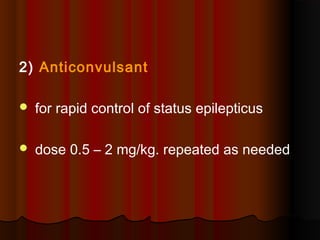
2) Anticonvulsant
 for rapid control of status epilepticus
 dose 0.5 – 2 mg/kg. repeated as needed
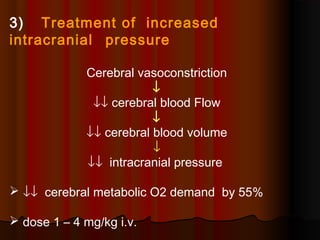
3) Treatment of increased
intracranial pressure
Cerebral vasoconstriction
↓
↓↓ cerebral blood Flow
↓
↓↓ cerebral blood volume
↓
↓↓ intracranial pressure
 ↓↓ cerebral metabolic O2 demand by 55%
 dose 1 – 4 mg/kg i.v.
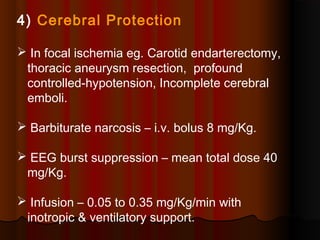
4) Cerebral Protection
 In focal ischemia eg. Carotid endarterectomy,
thoracic aneurysm resection, profound
controlled-hypotension, Incomplete cerebral
emboli.
 Barbiturate narcosis – i.v. bolus 8 mg/Kg.
 EEG burst suppression – mean total dose 40
mg/Kg.
 Infusion – 0.05 to 0.35 mg/Kg/min with
inotropic & ventilatory support.
SIDE EFFECTS
 Garlic onion taste.
 Allergic reaction.
 Local tissue reactions & necrosis.
 Urticarial rash, facial edema, hives, bronchospasm
& anaphylaxis.
 Pain at injection site.
Cardiovascular system
Cardiovascular depression
a) Peripheral vasodilation & pooling of blood - ↓↓ BP.
b) ↓↓ availability of Ca++ to myofibrils-↓↓ contractility.
c) Direct negative inotropic action, ↓↓ ventricular filling.
 These changes more when i.v. bolus given
 If given to hypovolemic patient, reduces cardiac output
(69%), in patient without compensatory mechanism
cardiovascular collapse.
Respiratory System
 Dose related respiratory depression
 Transient apnea, patient with chronic lung
disease more susceptible.
 Laryngospasm, bronchospasm.
Central nervous system
 Emergence delirium, prolonged somnolence &
recovery, Headache
Gastro-intestinal system
Nausea, Emesis, Salivation
Dermatologic
Phlebitis, necrosis, gangrene.
.
Contraindications
 Patient with respiratory obstruction &
inadequate airway.
 Cardiovascular instability & shock.
 Status asthmaticus.
 Porphyria’s eg. Acute intermittent, variegate
porphyria, hereditary copro-porphyria
Known hypersensitivity.
CAUTION
 Hypertension, hypovolemia, ischemic heart
disease,
 Acute adrenocortical insufficiency, Addison’s
disease,
myxedema.
 Uraemia, septicaemia, hepatic dysfunction.
.
Accidental Intrarterial injectionAccidental Intrarterial injection
Intense vasoconstrictionIntense vasoconstriction
ThrombosisThrombosis
Tissue necrosisTissue necrosis
TreatmentTreatment
Intrarterial admininistration ofIntrarterial admininistration of
Lignocaine(procaine).Lignocaine(procaine).
HeparinisationHeparinisation
Sympathectomy(stellate ganlion block,Sympathectomy(stellate ganlion block,
brachial plexus block).brachial plexus block).
 Thiopentone solution is highly alkaline
incompatible
for mixture with drug such as opioid
catecholamines neuromuscular blocking drugs as
these are acidic in nature.
 Probenecid prolongs action, aminophylline
antagonize.
 CNS depressant eg. narcotics, sedative, hypnotic,
alcohol, volatile anaesthetic agent prolongs &
potentiate its actions.
INTERACTIONS
Induces metabolism of oral anticoagulants,
digoxin, B-blocker, corticosteroids, quinidine,
theophylline.
 Action prolonged by MAO inhibitors,
chloramphenicol.
Dose should be reduced
 In geriatric- 30- 40% decrease central
compartment volume & slowed redistribution
 Hypovolemic Patient,
High risk surgery patient with concomitant
use of narcotic & sedatives

Thiopentone upendra

  • 1.
    THIOPENTONE Guided by Dr. AbhayBodhey Presented by Dr. Upendra
  • 2.
    INTRODUCTION  Sulphur derivativeof Barbituric Acid. i.e. Thio barbiturate.  Ultra short acting barbiturate.  Synthesised by Tabern and Volwiler in 1935.  Introduce clinically by Ralph waters and John Lundy for induction of anaesthesia.
  • 3.
    Poor analgesic, weakmuscle relaxant. Commonest inducing agent used.
  • 4.
    Fig : ChemicalStructure of Thiopentone Sulphur make it more lipid soluble and more potent  Sulphur at second carbon atom position. 5-ethyl-5-(1-methylbutyl)-2-thiobarbituric acid
  • 5.
    PROPERTIES Highly soluble inwater / NS yielding highly alkaline solution,stable for 48 hrs.  Must be prepared freshly.  Powder form stable at room temperature.  Refrigerated solution stable up to 2 week.
  • 6.
    PROPERTIES pH of 2.5%solution is 10.5.  Commercial preparation contain it sodium salt with anhydrous sodium carbonate to prevent ppt.of acid form.  Available as 0.5 gm and 1 gm powder for reconstitution. • Refrigerated solutions- stable upto 2 weeks
  • 7.
    PHARMACOKINETICS  Onset ofaction of i.v. injection - 10-20 sec. peak 30-40 sec. duration for awakening 5-15 min. Prompt awakening after single i.v. inj. is due to rapid redistribution to lean body tissue (muscle) Volume of distribution is 2.5 Lit. per Kg.
  • 8.
     Ultimate eliminationdue to hepatic metabolism.  Effect site equilibration time is rapid. Brain – 30 Sec. Muscle – 15 Min. Fat > 30 Min.  Context sensitive half life is prolonged.
  • 9.
    TERMINATION OF ACTION 1)Redistribution a) Lipid solubility (most important factor)  High Lipid Solubility makes it to cross blood brain barrier & lean body tissue rapidly. b) Protein Binding  Highly bound to albumin & other plasma protein.  72 – 86% Binding.  Only unbound fraction crosses Blood-Brain-Barrier.
  • 10.
     Affected byphysiological PH. Disease state & parallels lipid solubility  Hepatic disease & chronic renal disease decrease protein Binding, increase free form. c) Ionization  Only non-ionized part crosses Blood-Brain-Barrier.  Thiopentone has PKA 7.6 so 61% of it is non-ionized at physiologic PH  As PH decreases (acidosis) non-ionized form increases.  Metabolism induced changes in PH affect more.
  • 11.
     Rapid distributionhalf life – 8.5 Min.  Slow distribution half life – 62.7 Min
  • 12.
    2)Metabolism  By livermicrosomal enzymes mainly, Slightly in CNS & kidney.  10 – 24 % Metabolised each hour.
  • 13.
     By oxidation,dealkylation & conjugation to hydroxy Thiopental & carboxylic acid derivatives more water soluble & excreted rapidly.  Affect by hepatic enzyme activity more than blood flow.  Metabolism at 4-5 mg./Kg. dose exhibits first order kinetics.  At very high doses (300-600 mg/Kg.) exhibit zero order kinetics.
  • 14.
    3) Renal Excretion  ProteinBinding limits filtration.  High lipid solubility increase reabsorption.
  • 15.
    Elimination Half Life11.6 Hours Low elimination clearance(3.4ml/kg/min) Prolonged in obese patient & pregnancy. Short in paediatric patient.
  • 16.
    MECHANISM OF ACTION Sedation& Hypnosis by interaction with inhibitory neurotransmitters GABA on GABAA receptor.  GABA facilitatory & GABA mimetic action.  GABAA receptor has 5 glycoprotein sub unit.  Increases GABA mediated transmembrane conductance of Cl– ion, Causes hyperpolarization & inhibition of post synaptic neuron.
  • 17.
     ↓↓ rateof dissociation of GABA from receptor. It high doses itself activate GABA receptor. Fig. GABAA Channel Complex  Inhibit synaptic transmission of excitatory neurotransmitter via glutamate & neuronal nicotinic acetylcholine receptors.
  • 18.
    PHARMACODYNAMI CS Central nervous system Dosedependent effect sedation → sleep → anaesthesia → coma.
  • 19.
     Acts onReticular Activating System & Thalamus.  Induces General Anaesthesia → loss of consciousness, amnesia & ↓↓ response to pain R.S. & C.V.S. depression.  Depresses transmission in sympathetic nervous system, ↓↓ BP.
  • 20.
     Dose related↓↓ CMRO2, reduces metabolic activity, neuronal signalling & impulse trafficking. ↓↓ CMRO2 ↓ ↑↑ cerebral vascular resistance ↓ ↓↓ cerebral blood flow ↓ ↓↓ Intracranial pressure  Somatosensory, Brainstem auditory & visual evoked potential are depressed.
  • 21.
     ↓↓ burstsuppression, protect in profound hypotension. ↓↓ infract size in cerebral emboli & temporary focal ischemia.
  • 22.
    High doses desulfurationHighdoses desulfuration pentobarbitalpentobarbital (long lasting CNS Depressant)(long lasting CNS Depressant)
  • 23.
    Respiratory system . Neurogenic, Hypercapnic & hypoxic drive depressed.  Depression of medullary & pontine ventilatory centres.  Apnoea likely in presence of narcotics.
  • 24.
    Cough & laryngealreflexes not depressed until high doses given.  Bronchospasm & laryngospasm likely in light plane, added by sympathetic depression
  • 25.
    Cardiovascular system  At5 mg/Kg doses, 10-20 mmHg ↓↓ in BP due to sympathetic blockade.  Compensated by carotid sinus baroreceptor mediated ↑↑ in peripheral sympathetic nervous system activity.
  • 26.
     Leads tounchanged myocardial contractility & 15 – 20 beats/min ↑↑ in Heart Rate.  Direct myocardial depression occurs at doses used to ↓↓ intracranial pressure.
  • 27.
    Depression of sympatheticnervous system & medullary vasomotor center ↓ Dilatation of peripheral capacitance vessel ↓ Pooling of blood ↓ ↓↓ venous return ↓ ↓↓ cardiac output ↓ ↓↓ Blood Pressure
  • 28.
     Changes exaggeratedin hypovolemic patient, patient on B-blocker drugs & centrally acting anti hypertensive. Skeletal muscle ↓↓ Neuro muscular excitability.
  • 29.
    5) Kidney ↓↓ bloodflow & GFR . 6) Suppression of adrenal cortex & ↓↓ cortisol level, but it is reversible.
  • 30.
    7) Liver  ↓↓hepatic blood flow  Induction of microsomal enzyme & increase metabolism of drugs, For Ex. Oral-anticoagulant, Phenytoin, TCA, Vit. K, Bile Salt, corticosteroid.  ↑↑ Glucouronyl transferase activity.  ↑↑ δ aminolavilunate activity & precipitate porphyria’s.
  • 31.
    Placental transfer occursbut drug metabolised by foetal liver & diluted by its blood volume so less depression.
  • 32.
    CLINICAL USES 1) Induction 3 – 5 mg/Kg. produces unconsciousness in 30 sec. with smooth induction & rapid emergence.  Loss of eyelid reflex & corneal reflex used for testing induction.  Consciousness regained 10-20 Min. but residual CNS depression persist for more than 12 Hours.  Dose requirement ↓↓ in early pregnancy, ↑↑ child with thermal injury.
  • 33.
     Patient withsever anaemia, burns, malnutrition, malignant disease, wide spread uraemia, ulcerative colitis, intestinal obstruction requires lower doses. adult child infant Induction dose 3-5 mg/Kg. 5-6 mg/Kg 6-8Mg/Kg. Anaesthesia supplementation - i.v. 0.5 – 1 mg/Kg Thiopental infusion seldom used long context- sensitive half-time prolong recovery period
  • 34.
    2) Anticonvulsant  forrapid control of status epilepticus  dose 0.5 – 2 mg/kg. repeated as needed
  • 35.
    3) Treatment ofincreased intracranial pressure Cerebral vasoconstriction ↓ ↓↓ cerebral blood Flow ↓ ↓↓ cerebral blood volume ↓ ↓↓ intracranial pressure  ↓↓ cerebral metabolic O2 demand by 55%  dose 1 – 4 mg/kg i.v.
  • 36.
    4) Cerebral Protection In focal ischemia eg. Carotid endarterectomy, thoracic aneurysm resection, profound controlled-hypotension, Incomplete cerebral emboli.  Barbiturate narcosis – i.v. bolus 8 mg/Kg.  EEG burst suppression – mean total dose 40 mg/Kg.  Infusion – 0.05 to 0.35 mg/Kg/min with inotropic & ventilatory support.
  • 37.
    SIDE EFFECTS  Garliconion taste.  Allergic reaction.  Local tissue reactions & necrosis.  Urticarial rash, facial edema, hives, bronchospasm & anaphylaxis.  Pain at injection site.
  • 38.
    Cardiovascular system Cardiovascular depression a)Peripheral vasodilation & pooling of blood - ↓↓ BP. b) ↓↓ availability of Ca++ to myofibrils-↓↓ contractility. c) Direct negative inotropic action, ↓↓ ventricular filling.  These changes more when i.v. bolus given  If given to hypovolemic patient, reduces cardiac output (69%), in patient without compensatory mechanism cardiovascular collapse.
  • 39.
    Respiratory System  Doserelated respiratory depression  Transient apnea, patient with chronic lung disease more susceptible.  Laryngospasm, bronchospasm. Central nervous system  Emergence delirium, prolonged somnolence & recovery, Headache
  • 40.
    Gastro-intestinal system Nausea, Emesis,Salivation Dermatologic Phlebitis, necrosis, gangrene. .
  • 41.
    Contraindications  Patient withrespiratory obstruction & inadequate airway.  Cardiovascular instability & shock.  Status asthmaticus.  Porphyria’s eg. Acute intermittent, variegate porphyria, hereditary copro-porphyria Known hypersensitivity.
  • 42.
    CAUTION  Hypertension, hypovolemia,ischemic heart disease,  Acute adrenocortical insufficiency, Addison’s disease, myxedema.  Uraemia, septicaemia, hepatic dysfunction. .
  • 43.
    Accidental Intrarterial injectionAccidentalIntrarterial injection Intense vasoconstrictionIntense vasoconstriction ThrombosisThrombosis Tissue necrosisTissue necrosis
  • 44.
    TreatmentTreatment Intrarterial admininistration ofIntrarterialadmininistration of Lignocaine(procaine).Lignocaine(procaine). HeparinisationHeparinisation Sympathectomy(stellate ganlion block,Sympathectomy(stellate ganlion block, brachial plexus block).brachial plexus block).
  • 45.
     Thiopentone solutionis highly alkaline incompatible for mixture with drug such as opioid catecholamines neuromuscular blocking drugs as these are acidic in nature.  Probenecid prolongs action, aminophylline antagonize.  CNS depressant eg. narcotics, sedative, hypnotic, alcohol, volatile anaesthetic agent prolongs & potentiate its actions. INTERACTIONS
  • 46.
    Induces metabolism oforal anticoagulants, digoxin, B-blocker, corticosteroids, quinidine, theophylline.  Action prolonged by MAO inhibitors, chloramphenicol.
  • 47.
    Dose should bereduced  In geriatric- 30- 40% decrease central compartment volume & slowed redistribution  Hypovolemic Patient, High risk surgery patient with concomitant use of narcotic & sedatives