
PRE-ANAESTHETIC
CHECKUP AND
PREMEDICATION
Dr. Archana Vaidya,
Lecturer,
Dept. of Anaesthesia,
GMCH, Nagpur
INTRODUCTION
The role of anesthesiologist is that of consultant to surgeon in
reference to pharmacology & physiology, as in O.T. he is supposed to
manage physiological dysfunction, pharmacological needs & medical
complications.
For this reason he should know the patient in detail.
GOAL OF PREOPERATIVE MEDICAL ASSESSMENT:
1. To reduce the morbidity of surgery.
2. To increase the quality & decrease cost of perioperative care.
3. To return the pt to desirable function as quickly as possible.
Anaesthetist’s visit prior to surgery helps in allaying
patient’s fear about anesthesia and surgery.
 He explains the plan of anesthesia whether regional or
general & perioperative care (depending on the type of
surgery).
 Still inadequate preop evaluation is one of the top
three causes of lawsuit against anesthesiologist.
HISTORY TAKING:
1. H/O Presenting complaints
• H/O cough with / without expectoration
• H/O cold,fever
• H/O breathlessness , chest pain , palpitations
• History of recent medical care, medication or allergies
include type of drug, dose & it’s frequency.
2. Surgical history- previous operations, type of anesthesia,
any problem with it. Any family member with anesthesia
problem.
3. Allergic history
Eg. – Pt. Having allergy to sulfa drug may have
allergic reaction to thiopentone.
 4. History of addiction
 Smoking : quantity in packs per day and duration of
smoking.
 Deleterious effects of smoking
i) Vascular disease of peripheral, coronary & cerebral
circulation.
ii) Chronic bronchitis
iii) Carcinoma of lung, oesophagus, stomach, urinary
bladder.
 -Advised to stop smoking before surgery minimum
about 6 weeks.
BENEFICIAL EFFECT OF CESSATION OF SMOKING PRIOR TO
SURGERY:
12-24 hours → COHb & Nicotine levels ↓
48-72 hours → COHb normalise & ciliary function improving.
1-2 Wk’s → Sputum production decreases
4-6 Wk’s → PFT’s improve if deranged
6-8 Wk’s → immune fun & drug metabolism normalise
8-12 Wk’s → Overall postop morbidity ↓
b) Alcohol:- Leads to induction of liver enzymes & tolerance to
anesthetic drug.
c) Tobacco use.
5. Menstrual & obstetric history in female patients
SYSTEMIC ASSESSMENT
I) CARDIOVASCULAR DISEASES :
 Cardiovascular reserve : Ask about maximum distance pt. can
walk, greatest no. of floor can climb without need to stop.
 Recent / past myocardial infarction.
 Chest pain, chest heaviness, chest tightness.
 H/o swelling over ankles.
 Shortness of breath.
 H/o high BP or medication to prevent high BP.
 H/o use of more than one pillow for sleep at night.
RESPIRATORY AND AIRWAY PROBLEMS :
-Enquire about upper resp. tract infection – as acute URTI lead to
bronchospasm, laryngospasm, ↑ secretions.
-Adequate mouth opening, loose teeth, dentures
HEPATIC & GI DISEASES
•Hepatic diseases contribute to abnormal clotting &
pharmacokinetic.
•GI disease increases risk for aspiration – gastroparesis associated
solid food in stomach & IBD with arthritis in the neck.
•H/o hepatitis,jaundice, liver diseases, malaria
•H/o change in bowel habit
BLEEDING PROBLEMS
H/o blood transfusion & its complication.
Family history of serious bleeding problem.
H/o of bleeding from cuts nose bleeds, minor bruises, tooth
extractions or surgery.
NEUROLOGICAL DISASES
H/o convulsion, stroke, paralysis.
H/o numbness, tingling, sensation in arm or leg.
H/o taking antidepressant, anticonvulsant, sedative.
MUSCULOSKELETAL DISEASES
H/o Arthritis, low back pain, pain pills.
RENAL DISEASES
Produces anaemia, electrolyte disturbances, abnormality in
drug metabolism and excretion.
H/o adequate urine output.
ENDOCRINE DISTURBANCES
H/o polyuria, polydipsia
H/o recurrent headache, ↑ sweating, flushing of face.
H/o cold / warm in tolerance, muscle cramps in legs to rule out
thyroid disorders.
SENSITIVE AREAS
concern with pregnancy & possibility of pregnancy in minor,
haemoglobinopathy, potential for AIDS.
H/o exposure to blood, semen, urine or saliva of any one likely to
have AIDS
High risk groups for AIDS – bi sexual, homosexual, sex with
prostitutes within last 18 yrs.
PHYSICAL EXAMINATION
Detailed examination of CVS, RS & airway is important.
Vital signs noted properly.
- Pulse : Rate, Rhythm, Volume, Peripheral pulse, condition of
vessel wall, presence of collapsing pulse.
- Blood pressure : from both hands with proper size cuff.
- Temperature : Core body temp.
Respiratory rate & Pattern.
Jugular venous pressure : Normal 3-4 cm
Elevated – Rt heart failure, tricuspid stenosis, cardiac tamponade
Nails & eyes - Pallor, cyanosis, icterus, clubbing.
State of nutrition : malnourished or obese.
Presence or absence of lymph node enlargement.
• EXAMINATION OF RESPIRATORY SYSTEM
• EXAMINATION OF CARDIOVASCULAR SYSTEM
• EXAMINATION OF ABDOMEN
• EXAMINATION OF CENTRAL NERVOUS SYSTEM
• EXAMINATION OF SPINE- for abnormality or
infection.
MAJOR CRITERIA
- Orthopnea
- Paroxysmal nocturnal dyspnea.
- Neck vein distension.
- Basal rales.
- Cardiomegaly
- Acute pul oedema.
- S3 gallop.
- JVP increased.
- Hepatojugular reflex.
SIGNS OF CCF
- MINOR CRITERIA
- Ankle oedema.
- night cough.
- hepatomegaly.
- exertional dyspnea.
- tachycardia.
EXAMINATION OF AIRWAY :
- Should be done properly to avoid airway obstruction & detect difficult intubation.
- Methods to detect difficult airway
1. Distance between – From inside chin & hyoid bone at least 2 finger breadth.
2. Mallampati Classification :
This is determined by asking the patient to sit in front of anestesiologist and
asking him to open the mouth widely with tongue protruding.
Grades
I
II
III
IV
Structures to be visualized
→ Post pharyngeal wall, uvula, faucial piller, soft palate, hard palate
→ Faucial pillers & soft palate, hard palate.
→ Soft palate
→ Only hard palate. (Samson’s Young Modifications)
3. Thyromental Distance : Distance between thyroid notch & tip of jaw.
<6 cm → Difficult Airway.
LABORATORY INVESTIGATIONS :
Routine :
1. Hemoglobin or haematocrit
2. Urine – albumin ,sugar, ketones
3. Blood group
Special :
Blood Urea Nitrogen & S. creatinine
LFT
chest X-ray
Electrocardiogram
Blood Sugar Level Estimation
Coagulation test (PT, PTT)
Sickle status
PFT
2D Echocardiogram
ASA PHYSICAL STATUS CLASSIFICATION
In 1961, ASA adopted physical status classification system of assessing a
pt preopatively, co-relate with periop mortality rate.
CLASS
1.
2.
3.
4.
5
6
E
DEFINITION
→ A normal healthy pt.
→ A pt with mild systemic disease no functional limitation.
→ Moderate to severe systemic disease with some fictional limitation.
→ Severe systemic diseases that is constant threat to life functionally
incapacitated.
→ A moribund pt who is not expected to survive 24 hrs with /without surgery.
→ Brain dead for organ harvested
→ If procedure is emergency.
PEDIATRIC AIRWAY EVALUATION :
-Pediatric airway differ from adult airway
- Have large head and tongue.
- Narrow nasal passage
- Anterior and Cephald larynx
- Long epiglottis, short trachea & neck.
- Nasal breathers untill abt 5 yrs.
- Cricoid cartilage (Subglottis) narrowest part.
- Chances of accidental extubation more common with head
movements.
Note : in pediatric patients H/o immunization.
PEROP MEDICATION INSTRUCTION GUIDE LINE –
1.medication to be continued on day of Surgery.
anti hypertensive
diuretics
cardiac medication (digoxin)
antidepressant – antianxiety
thyroid, asthma medication
steroids (oral & inhaled)
2. Discontinue 7 days before: aspirin
3. NSAIDS – discontinue 48 hrs before plastic retinal surgery.
4. Oral hypoglycemic drugs discontinue on day of surgery.
5. Insulin – 1/3 dose in morning
6. Warfarin – discontinue 4 days before Sx.
7. Heparin – 4 – 6 hrs before surgery.
8. MAO Inhibitors – 2 weeks before surgery.
PREOPERATING FASTING
Risk of Hypoglycemia & dehydration in prolonged fasting.
Should be minimum 4 hrs for clear fluids and milk.
6 hrs for solid food.
To prevent regurgitation and aspiration.
INFORMED CONSENT
- Obtained from all pt
- Invalid if taken after pre medication
- Of parents or guardian in < 18 yrs & mentally ill pt.
- If parent or guardian not contacted from district medical officer in emergency.
-Administration of various drugs beforeAdministration of various drugs before
induction of anaesthesia.induction of anaesthesia.
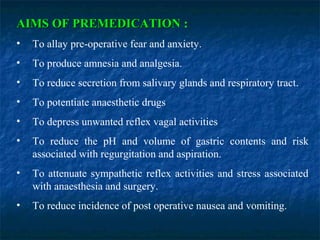
AIMS OF PREMEDICATIONAIMS OF PREMEDICATION :
• To allay pre-operative fear and anxiety.
• To produce amnesia and analgesia.
• To reduce secretion from salivary glands and respiratory tract.
• To potentiate anaesthetic drugs
• To depress unwanted reflex vagal activities
• To reduce the pH and volume of gastric contents and risk
associated with regurgitation and aspiration.
• To attenuate sympathetic reflex activities and stress associated
with anaesthesia and surgery.
• To reduce incidence of post operative nausea and vomiting.
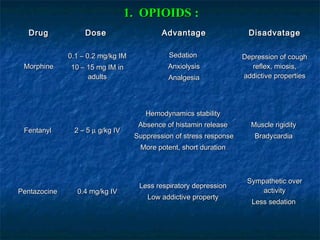
DrugDrug DoseDose AdvantageAdvantage DisadvatageDisadvatage
MorphineMorphine
0.1 – 0.2 mg/kg IM0.1 – 0.2 mg/kg IM
10 – 15 mg IM in10 – 15 mg IM in
adultsadults
SedationSedation
AnxiolysisAnxiolysis
AnalgesiaAnalgesia
Depression of coughDepression of cough
reflex, miosis,reflex, miosis,
addictive propertiesaddictive properties
FentanylFentanyl 2 – 52 – 5 µµ g/kg IVg/kg IV
Hemodynamics stabilityHemodynamics stability
Absence of histamin releaseAbsence of histamin release
Suppression of stress responseSuppression of stress response
More potent, short durationMore potent, short duration
Muscle rigidityMuscle rigidity
BradycardiaBradycardia
PentazocinePentazocine 0.4 mg/kg IV0.4 mg/kg IV
Less respiratory depressionLess respiratory depression
Low addictive propertyLow addictive property
Sympathetic overSympathetic over
activityactivity
Less sedationLess sedation
1. OPIOIDS1. OPIOIDS :
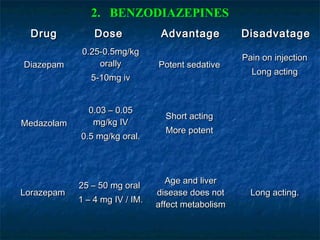
2. BENZODIAZEPINES
DrugDrug DoseDose AdvantageAdvantage DisadvatageDisadvatage
DiazepamDiazepam
0.25-0.5mg/kg0.25-0.5mg/kg
orallyorally
5-10mg iv5-10mg iv
Potent sedativePotent sedative
Pain on injectionPain on injection
Long actingLong acting
MedazolamMedazolam
0.03 – 0.050.03 – 0.05
mg/kg IVmg/kg IV
0.5 mg/kg oral.0.5 mg/kg oral.
Short actingShort acting
More potentMore potent
LorazepamLorazepam
25 – 50 mg oral25 – 50 mg oral
1 – 4 mg IV / IM.1 – 4 mg IV / IM.
Age and liverAge and liver
disease does notdisease does not
affect metabolismaffect metabolism
Long acting.Long acting.
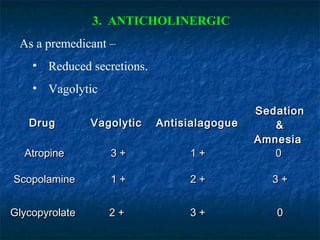
3. ANTICHOLINERGIC
As a premedicant –
• Reduced secretions.
• Vagolytic
DrugDrug VagolyticVagolytic AntisialagogueAntisialagogue
SedationSedation
&&
AmnesiaAmnesia
AtropineAtropine 3 +3 + 1 +1 + 00
ScopolamineScopolamine 1 +1 + 2 +2 + 3 +3 +
GlycopyrolateGlycopyrolate 2 +2 + 3 +3 + 00
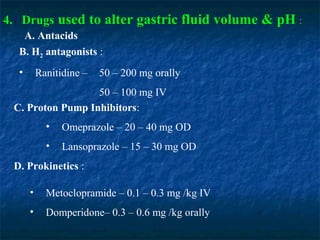
A. Antacids
B. H2 antagonists :
• Ranitidine – 50 – 200 mg orally
50 – 100 mg IV
C. Proton Pump Inhibitors:
• Omeprazole – 20 – 40 mg OD
• Lansoprazole – 15 – 30 mg OD
D. Prokinetics :
• Metoclopramide – 0.1 – 0.3 mg /kg IV
• Domperidone– 0.3 – 0.6 mg /kg orally
4. Drugs used to alter gastric fluid volume & pH :
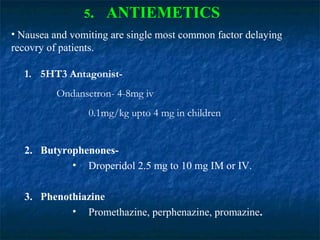
5. ANTIEMETICS
• Nausea and vomiting are single most common factor delaying
recovry of patients.
1. 5HT3 Antagonist-
Ondansetron- 4-8mg iv
0.1mg/kg upto 4 mg in children
2. Butyrophenones-
• Droperidol 2.5 mg to 10 mg IM or IV.
3. Phenothiazine
• Promethazine, perphenazine, promazine.
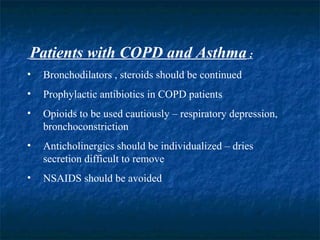
Patients with COPD and Asthma :
• Bronchodilators , steroids should be continued
• Prophylactic antibiotics in COPD patients
• Opioids to be used cautiously – respiratory depression,
bronchoconstriction
• Anticholinergics should be individualized – dries
secretion difficult to remove
• NSAIDS should be avoided
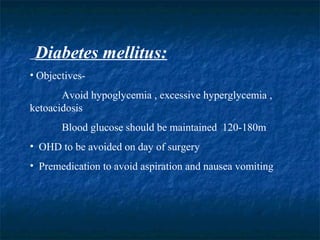
Diabetes mellitus:
• Objectives-
Avoid hypoglycemia , excessive hyperglycemia ,
ketoacidosis
Blood glucose should be maintained 120-180m
• OHD to be avoided on day of surgery
• Premedication to avoid aspiration and nausea vomiting
PREMEDICATION IN OBSTRETIC
ANAESTHESIA
• Patients are at risk of aspiration due to –
 Progesterone delays gastric emptying
 Gravid uterus
 Drugs esp opioids
• Opioids and BZD may cause adverse effect on neonate
• Amnesia – woman may not be able to remember her
birthing experiences
PREMEDICATION IN PAEDIATRIC PATIENTS
• Premedication in infants-
•Infant less than 6 months don not require sedative
premedication
•Antisialogouges no longer required in neonate
•Premedication in children-
• Aims –
• To get calm and comfortable child in operating room
• To decrease secretions
• To obtund vagal reflexes
• To avoid post op. behavioral disturbances
• Considering fear for needles , routes other than im / iv
prefered
1.Sedatives and hypnotics-
Midazolam- most commanly used
0.5-0.75mg/kg orally 20 mins prior
0.2-0.3mg/kg intrnasal
0.4-0.5mg/kg per rectally
Trichlophos- 75-100mg/kg orally
2. Analgesics-
Paracetamol syrup-5-10mg/kg
10-15mg/kg rectally
Diclofenac- 1.5mg/kg rectally
3. Opioids-
OTFC-in the form of lollypop
4. Ketamine- 6mg/kg orally
3mg/kg intranasally
3-5mg/kg im
5. Anticholinergics - Preffered, along with ketamine
Atropine- 0.02mg/kg im/iv
glycopyrrolate - 4-8ug/kg im/iv
Pac  premedication  -dr.vaidya

Pac premedication -dr.vaidya

  • 1.
    PRE-ANAESTHETIC CHECKUP AND PREMEDICATION Dr. ArchanaVaidya, Lecturer, Dept. of Anaesthesia, GMCH, Nagpur
  • 2.
    INTRODUCTION The role ofanesthesiologist is that of consultant to surgeon in reference to pharmacology & physiology, as in O.T. he is supposed to manage physiological dysfunction, pharmacological needs & medical complications. For this reason he should know the patient in detail. GOAL OF PREOPERATIVE MEDICAL ASSESSMENT: 1. To reduce the morbidity of surgery. 2. To increase the quality & decrease cost of perioperative care. 3. To return the pt to desirable function as quickly as possible.
  • 3.
    Anaesthetist’s visit priorto surgery helps in allaying patient’s fear about anesthesia and surgery.  He explains the plan of anesthesia whether regional or general & perioperative care (depending on the type of surgery).  Still inadequate preop evaluation is one of the top three causes of lawsuit against anesthesiologist.
  • 4.
    HISTORY TAKING: 1. H/OPresenting complaints • H/O cough with / without expectoration • H/O cold,fever • H/O breathlessness , chest pain , palpitations • History of recent medical care, medication or allergies include type of drug, dose & it’s frequency. 2. Surgical history- previous operations, type of anesthesia, any problem with it. Any family member with anesthesia problem. 3. Allergic history Eg. – Pt. Having allergy to sulfa drug may have allergic reaction to thiopentone.
  • 5.
     4. Historyof addiction  Smoking : quantity in packs per day and duration of smoking.  Deleterious effects of smoking i) Vascular disease of peripheral, coronary & cerebral circulation. ii) Chronic bronchitis iii) Carcinoma of lung, oesophagus, stomach, urinary bladder.  -Advised to stop smoking before surgery minimum about 6 weeks.
  • 6.
    BENEFICIAL EFFECT OFCESSATION OF SMOKING PRIOR TO SURGERY: 12-24 hours → COHb & Nicotine levels ↓ 48-72 hours → COHb normalise & ciliary function improving. 1-2 Wk’s → Sputum production decreases 4-6 Wk’s → PFT’s improve if deranged 6-8 Wk’s → immune fun & drug metabolism normalise 8-12 Wk’s → Overall postop morbidity ↓ b) Alcohol:- Leads to induction of liver enzymes & tolerance to anesthetic drug. c) Tobacco use. 5. Menstrual & obstetric history in female patients
  • 7.
    SYSTEMIC ASSESSMENT I) CARDIOVASCULARDISEASES :  Cardiovascular reserve : Ask about maximum distance pt. can walk, greatest no. of floor can climb without need to stop.  Recent / past myocardial infarction.  Chest pain, chest heaviness, chest tightness.  H/o swelling over ankles.  Shortness of breath.  H/o high BP or medication to prevent high BP.  H/o use of more than one pillow for sleep at night.
  • 8.
    RESPIRATORY AND AIRWAYPROBLEMS : -Enquire about upper resp. tract infection – as acute URTI lead to bronchospasm, laryngospasm, ↑ secretions. -Adequate mouth opening, loose teeth, dentures HEPATIC & GI DISEASES •Hepatic diseases contribute to abnormal clotting & pharmacokinetic. •GI disease increases risk for aspiration – gastroparesis associated solid food in stomach & IBD with arthritis in the neck. •H/o hepatitis,jaundice, liver diseases, malaria •H/o change in bowel habit
  • 9.
    BLEEDING PROBLEMS H/o bloodtransfusion & its complication. Family history of serious bleeding problem. H/o of bleeding from cuts nose bleeds, minor bruises, tooth extractions or surgery. NEUROLOGICAL DISASES H/o convulsion, stroke, paralysis. H/o numbness, tingling, sensation in arm or leg. H/o taking antidepressant, anticonvulsant, sedative.
  • 10.
    MUSCULOSKELETAL DISEASES H/o Arthritis,low back pain, pain pills. RENAL DISEASES Produces anaemia, electrolyte disturbances, abnormality in drug metabolism and excretion. H/o adequate urine output. ENDOCRINE DISTURBANCES H/o polyuria, polydipsia H/o recurrent headache, ↑ sweating, flushing of face. H/o cold / warm in tolerance, muscle cramps in legs to rule out thyroid disorders.
  • 11.
    SENSITIVE AREAS concern withpregnancy & possibility of pregnancy in minor, haemoglobinopathy, potential for AIDS. H/o exposure to blood, semen, urine or saliva of any one likely to have AIDS High risk groups for AIDS – bi sexual, homosexual, sex with prostitutes within last 18 yrs. PHYSICAL EXAMINATION Detailed examination of CVS, RS & airway is important. Vital signs noted properly. - Pulse : Rate, Rhythm, Volume, Peripheral pulse, condition of vessel wall, presence of collapsing pulse. - Blood pressure : from both hands with proper size cuff. - Temperature : Core body temp.
  • 12.
    Respiratory rate &Pattern. Jugular venous pressure : Normal 3-4 cm Elevated – Rt heart failure, tricuspid stenosis, cardiac tamponade Nails & eyes - Pallor, cyanosis, icterus, clubbing. State of nutrition : malnourished or obese. Presence or absence of lymph node enlargement. • EXAMINATION OF RESPIRATORY SYSTEM • EXAMINATION OF CARDIOVASCULAR SYSTEM • EXAMINATION OF ABDOMEN • EXAMINATION OF CENTRAL NERVOUS SYSTEM • EXAMINATION OF SPINE- for abnormality or infection.
  • 13.
    MAJOR CRITERIA - Orthopnea -Paroxysmal nocturnal dyspnea. - Neck vein distension. - Basal rales. - Cardiomegaly - Acute pul oedema. - S3 gallop. - JVP increased. - Hepatojugular reflex. SIGNS OF CCF - MINOR CRITERIA - Ankle oedema. - night cough. - hepatomegaly. - exertional dyspnea. - tachycardia.
  • 14.
    EXAMINATION OF AIRWAY: - Should be done properly to avoid airway obstruction & detect difficult intubation. - Methods to detect difficult airway 1. Distance between – From inside chin & hyoid bone at least 2 finger breadth. 2. Mallampati Classification : This is determined by asking the patient to sit in front of anestesiologist and asking him to open the mouth widely with tongue protruding. Grades I II III IV Structures to be visualized → Post pharyngeal wall, uvula, faucial piller, soft palate, hard palate → Faucial pillers & soft palate, hard palate. → Soft palate → Only hard palate. (Samson’s Young Modifications) 3. Thyromental Distance : Distance between thyroid notch & tip of jaw. <6 cm → Difficult Airway.
  • 15.
    LABORATORY INVESTIGATIONS : Routine: 1. Hemoglobin or haematocrit 2. Urine – albumin ,sugar, ketones 3. Blood group Special : Blood Urea Nitrogen & S. creatinine LFT chest X-ray Electrocardiogram Blood Sugar Level Estimation Coagulation test (PT, PTT) Sickle status PFT 2D Echocardiogram
  • 16.
    ASA PHYSICAL STATUSCLASSIFICATION In 1961, ASA adopted physical status classification system of assessing a pt preopatively, co-relate with periop mortality rate. CLASS 1. 2. 3. 4. 5 6 E DEFINITION → A normal healthy pt. → A pt with mild systemic disease no functional limitation. → Moderate to severe systemic disease with some fictional limitation. → Severe systemic diseases that is constant threat to life functionally incapacitated. → A moribund pt who is not expected to survive 24 hrs with /without surgery. → Brain dead for organ harvested → If procedure is emergency.
  • 17.
    PEDIATRIC AIRWAY EVALUATION: -Pediatric airway differ from adult airway - Have large head and tongue. - Narrow nasal passage - Anterior and Cephald larynx - Long epiglottis, short trachea & neck. - Nasal breathers untill abt 5 yrs. - Cricoid cartilage (Subglottis) narrowest part. - Chances of accidental extubation more common with head movements. Note : in pediatric patients H/o immunization.
  • 18.
    PEROP MEDICATION INSTRUCTIONGUIDE LINE – 1.medication to be continued on day of Surgery. anti hypertensive diuretics cardiac medication (digoxin) antidepressant – antianxiety thyroid, asthma medication steroids (oral & inhaled) 2. Discontinue 7 days before: aspirin 3. NSAIDS – discontinue 48 hrs before plastic retinal surgery. 4. Oral hypoglycemic drugs discontinue on day of surgery. 5. Insulin – 1/3 dose in morning 6. Warfarin – discontinue 4 days before Sx. 7. Heparin – 4 – 6 hrs before surgery. 8. MAO Inhibitors – 2 weeks before surgery.
  • 19.
    PREOPERATING FASTING Risk ofHypoglycemia & dehydration in prolonged fasting. Should be minimum 4 hrs for clear fluids and milk. 6 hrs for solid food. To prevent regurgitation and aspiration. INFORMED CONSENT - Obtained from all pt - Invalid if taken after pre medication - Of parents or guardian in < 18 yrs & mentally ill pt. - If parent or guardian not contacted from district medical officer in emergency.
  • 20.
    -Administration of variousdrugs beforeAdministration of various drugs before induction of anaesthesia.induction of anaesthesia.
  • 21.
    AIMS OF PREMEDICATIONAIMSOF PREMEDICATION : • To allay pre-operative fear and anxiety. • To produce amnesia and analgesia. • To reduce secretion from salivary glands and respiratory tract. • To potentiate anaesthetic drugs • To depress unwanted reflex vagal activities • To reduce the pH and volume of gastric contents and risk associated with regurgitation and aspiration. • To attenuate sympathetic reflex activities and stress associated with anaesthesia and surgery. • To reduce incidence of post operative nausea and vomiting.
  • 22.
    DrugDrug DoseDose AdvantageAdvantageDisadvatageDisadvatage MorphineMorphine 0.1 – 0.2 mg/kg IM0.1 – 0.2 mg/kg IM 10 – 15 mg IM in10 – 15 mg IM in adultsadults SedationSedation AnxiolysisAnxiolysis AnalgesiaAnalgesia Depression of coughDepression of cough reflex, miosis,reflex, miosis, addictive propertiesaddictive properties FentanylFentanyl 2 – 52 – 5 µµ g/kg IVg/kg IV Hemodynamics stabilityHemodynamics stability Absence of histamin releaseAbsence of histamin release Suppression of stress responseSuppression of stress response More potent, short durationMore potent, short duration Muscle rigidityMuscle rigidity BradycardiaBradycardia PentazocinePentazocine 0.4 mg/kg IV0.4 mg/kg IV Less respiratory depressionLess respiratory depression Low addictive propertyLow addictive property Sympathetic overSympathetic over activityactivity Less sedationLess sedation 1. OPIOIDS1. OPIOIDS :
  • 23.
    2. BENZODIAZEPINES DrugDrug DoseDoseAdvantageAdvantage DisadvatageDisadvatage DiazepamDiazepam 0.25-0.5mg/kg0.25-0.5mg/kg orallyorally 5-10mg iv5-10mg iv Potent sedativePotent sedative Pain on injectionPain on injection Long actingLong acting MedazolamMedazolam 0.03 – 0.050.03 – 0.05 mg/kg IVmg/kg IV 0.5 mg/kg oral.0.5 mg/kg oral. Short actingShort acting More potentMore potent LorazepamLorazepam 25 – 50 mg oral25 – 50 mg oral 1 – 4 mg IV / IM.1 – 4 mg IV / IM. Age and liverAge and liver disease does notdisease does not affect metabolismaffect metabolism Long acting.Long acting.
  • 24.
    3. ANTICHOLINERGIC As apremedicant – • Reduced secretions. • Vagolytic DrugDrug VagolyticVagolytic AntisialagogueAntisialagogue SedationSedation && AmnesiaAmnesia AtropineAtropine 3 +3 + 1 +1 + 00 ScopolamineScopolamine 1 +1 + 2 +2 + 3 +3 + GlycopyrolateGlycopyrolate 2 +2 + 3 +3 + 00
  • 25.
    A. Antacids B. H2antagonists : • Ranitidine – 50 – 200 mg orally 50 – 100 mg IV C. Proton Pump Inhibitors: • Omeprazole – 20 – 40 mg OD • Lansoprazole – 15 – 30 mg OD D. Prokinetics : • Metoclopramide – 0.1 – 0.3 mg /kg IV • Domperidone– 0.3 – 0.6 mg /kg orally 4. Drugs used to alter gastric fluid volume & pH :
  • 26.
    5. ANTIEMETICS • Nauseaand vomiting are single most common factor delaying recovry of patients. 1. 5HT3 Antagonist- Ondansetron- 4-8mg iv 0.1mg/kg upto 4 mg in children 2. Butyrophenones- • Droperidol 2.5 mg to 10 mg IM or IV. 3. Phenothiazine • Promethazine, perphenazine, promazine.
  • 27.
    Patients with COPDand Asthma : • Bronchodilators , steroids should be continued • Prophylactic antibiotics in COPD patients • Opioids to be used cautiously – respiratory depression, bronchoconstriction • Anticholinergics should be individualized – dries secretion difficult to remove • NSAIDS should be avoided
  • 28.
    Diabetes mellitus: • Objectives- Avoidhypoglycemia , excessive hyperglycemia , ketoacidosis Blood glucose should be maintained 120-180m • OHD to be avoided on day of surgery • Premedication to avoid aspiration and nausea vomiting
  • 29.
    PREMEDICATION IN OBSTRETIC ANAESTHESIA •Patients are at risk of aspiration due to –  Progesterone delays gastric emptying  Gravid uterus  Drugs esp opioids • Opioids and BZD may cause adverse effect on neonate • Amnesia – woman may not be able to remember her birthing experiences
  • 30.
    PREMEDICATION IN PAEDIATRICPATIENTS • Premedication in infants- •Infant less than 6 months don not require sedative premedication •Antisialogouges no longer required in neonate •Premedication in children- • Aims – • To get calm and comfortable child in operating room • To decrease secretions • To obtund vagal reflexes • To avoid post op. behavioral disturbances
  • 31.
    • Considering fearfor needles , routes other than im / iv prefered 1.Sedatives and hypnotics- Midazolam- most commanly used 0.5-0.75mg/kg orally 20 mins prior 0.2-0.3mg/kg intrnasal 0.4-0.5mg/kg per rectally Trichlophos- 75-100mg/kg orally 2. Analgesics- Paracetamol syrup-5-10mg/kg 10-15mg/kg rectally Diclofenac- 1.5mg/kg rectally
  • 32.
    3. Opioids- OTFC-in theform of lollypop 4. Ketamine- 6mg/kg orally 3mg/kg intranasally 3-5mg/kg im 5. Anticholinergics - Preffered, along with ketamine Atropine- 0.02mg/kg im/iv glycopyrrolate - 4-8ug/kg im/iv