ATROPINE AND
GLYCOPYRROLATE
Guided by :
Dr Modak Madam
Presented by :
Dr Vinayak
9th October 2007
Structure Activity Relationship
Routes of Administration
Pharmacokinetics
Mechanism of Action
Pharmacodynamics
Clinical Uses
Overdose
Structure Activity
Relationship
• Prototype drug of
the class of
anticholinergic drugs.
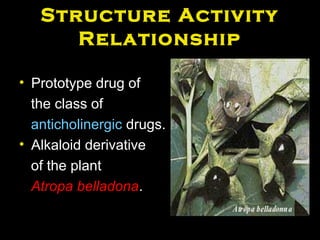
• Alkaloid derivative
of the plant
Atropa belladona.
• Ester of Tropic acid and Tropine.
• A racemic mixture of equal
quantities of levorotatory and
dextrorotatory isomers,but
anticholinergic activity is in
levorotatory form.
• Presence of a hydroxyl group in
the acyl portion of the ester is
essential for activity.
Routes of
Administration
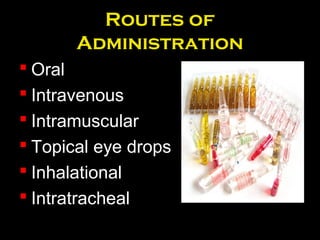
 Oral
 Intravenous
 Intramuscular
 Topical eye drops
 Inhalational
 Intratracheal
Pharmacokinetics
• Rapidly absorbed from GIT.
• Penetrates cornea freely.
• 50% metabolized in liver and the rest
excreted unchanged in urine.
Onset of Action:
IV:45-60 seconds
IM:5-40 minutes
Oral:0.5-2 hrs
Intratracheal:10-20 seconds
Inhalational :3-5 minutes
Peak effect: IV:2min.
Inhalational:2 hrs.
Duration of Action:
IV/IM:
Vagal blockade- 1-2 hrs
Antisialogogue-4 hrs.
Inhalational:Vagal blockade- 3-6 hrs.
• Elimination half time-2.3 hrs.
Drug interactions:
Additive anticholinergic effects with
Antihistaminics,Phenothiazines,Tricyclic
antidepressants,Procainamide,Quinidine,MAO
inhibitors,Benzodiazepines,
Antipsychotics.
Increase in intraocular tension: enhanced by
Nitrates,Nitrites,Alkalinizing
agents,Disopyramide,Corticosteroids,
Haloperidol.
Potentiates Sympathomimetics.
Antagonizes Anticholinesterases and
Metoclopramide
Adverse effects:
 Cardiovascular-
tachycardia,bradycardia,palpitations.
 Pulmonary-respiratory depression.
 CNS-central anticholinergic syndrome i.e.
restlessness,confusion,hallucinations to
somnolence and unconsciousness.
 GUT -urinary hesitancy,retention.
 GIT-Gastroesophageal reflux.
 Ocular:blurred vision,increased intraocular
pressure.
 Skin:urticaria.
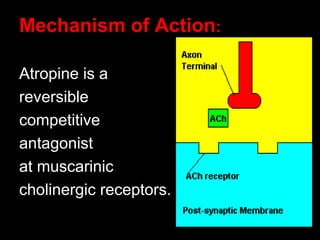
Mechanism of Action:
Atropine is a
reversible
competitive
antagonist
at muscarinic
cholinergic receptors.
PHARMACODYNAMICS
Central nervous system:
• Being a tertiary amine and hence lipid soluble, it
easily crosses the blood-brain barrier.
• Therapeutic doses:only mild central excitation
due to stimulation of medullary and higher
cerebral centres.
• Toxicdoses:restlessness,irritability,disorientation,
hallucinations or delirium.
• Still larger doses cause stimulation followed by
depression leading to circulatory collapse and
coma.
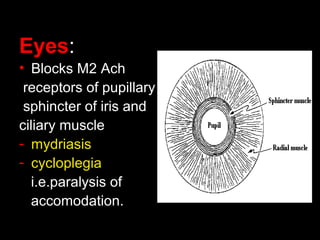
Eyes:
• Blocks M2 Ach
receptors of pupillary
sphincter of iris and
ciliary muscle
- mydriasis
- cycloplegia
i.e.paralysis of
accomodation.
• Conventional systemic doses - little
ocular effect.
• Closed angle glaucoma
-relaxed ciliary muscles occlude
angular space
-Mydriasis obstructs passage of
intraocular fluid into veins - increase
in IOP.
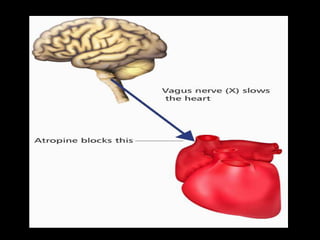
Cardiovascular System:
• Dominant effect:Tachycardia by blocking vagal effects
on M2 Ach receptors on SA node.
• But HR often decreases transiently with average
clinical doses[0.4-0.6mg] - due to blockade of inhibitory
presynaptic M1 acetylcholine receptors on vagal nerve
endings - increased acetylcholine release
• HR slowing rarely marked (4-8 beats/min)and
usually absent after rapid I.V. injection.
• Influence on HR - most noticeable in young adults
as vagal tone is considerable.
• In infants and elderly-large doses fail to cause
tachycardia.
• It also shortens AV conduction time and functional
refractory period of AV node.
Respiratory system
• Inhibits M2 and M3 Ach receptors in
airway smooth muscle to produce
bronchodilation,decreasing airway
resistance and increasing dead space.
• Also inhibits M3 receptors making
secretions of nose,mouth,pharynx and
bronchi scanty and viscid.
• Inhibits Bronchoconstriction caused by
Histamine,Bradykinin released in asthma.
Gastrointestinal Tract
• Inhibits M2 receptors and M3 receptors causing
relaxation of gut smooth muscle and inhibits gut
secretions respectively.
• Though it completely abolishes the effect of ACh
and other parasympathomimetics on gut,it only
incompletely inhibits effects of vagal impulses:
because preganglionic vagal fibres that
innervate GIT synapse not only at postganglionic
cholinergic fibres,but also with noncholinergic
intramural neurons which form the enteric
plexus,utilising Neurotransmitters like
5HT,Dopamine and peptides.
Urinary and Biliary Tract:
• Decreased Tone and amplitude of
Contraction.
Glands:
• Salivary secretions mediated by M3
receptors completely abolished.
• Gastric secretions during Cephalic and
fasting phase reduced,but intestinal phase
only partially inhibited.
• Small doses inhibit sweat glands, making
skin hot and dry.
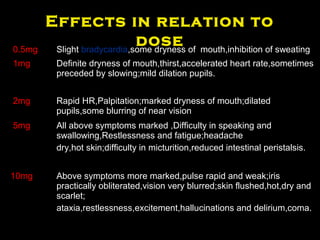
Effects in relation to
dose0.5mg Slight bradycardia,some dryness of mouth,inhibition of sweating
1mg Definite dryness of mouth,thirst,accelerated heart rate,sometimes
preceded by slowing;mild dilation pupils.
2mg Rapid HR,Palpitation;marked dryness of mouth;dilated
pupils,some blurring of near vision
5mg All above symptoms marked ,Difficulty in speaking and
swallowing,Restlessness and fatigue;headache
dry,hot skin;difficulty in micturition,reduced intestinal peristalsis.
10mg Above symptoms more marked,pulse rapid and weak;iris
practically obliterated,vision very blurred;skin flushed,hot,dry and
scarlet;
ataxia,restlessness,excitement,hallucinations and delirium,coma.
CLINICAL USES
PREOPERATIVE MEDICATION:
 Historically,atropine was given i.m. before induction to protect the
heart from vagal reflexes and to prevent excess salivary secretion.
 Currently used anesthetic agents are not predictably associated with
these effects hence not mandatory to include an anticholinergic in
preop medication.
 Hence most likely goal is to produce sedation or antisialogogue
effect.
DOSAGE:
Adults:
i.v./i.m.-0.4-1mg
Orally-0.4-0.6mg every 4-6 hrs
Children:
i.v.-10-20mcg/kg[min 0.1mg]
Oral-30 mcg/kg every 4-6hrs.
TREATMENT OF REFLEX MEDIATED
BRADYCARDIA
Anticholinergics are the drugs of choice.
Atropine in a dose of 15-70mcg/kg i.v.
increases heart rate by blocking ACh
effect on SAnode.
REVERSAL OF NEUROMUSCULAR
BLOCKADE
Antagonism of Nondepolarising NM blocking
drugs with an anticholinesterase requires the
use of Atropine to prevent parasympathomimetic
effects of the anticholinesterase.
Depending on the speed of onset of
Anticholinesterase action, Atropine[rapid onset]
or glycopyrrolate[slow onset] is selected.
DOSAGE:0.015mg/kg with
neostigmine[i.v.0.05mg/kg] or
edrophonium[i.v.0.5-1mg/kg]
BRONCHODILATION
• Atropine,1-2mg/kg diluted in 3-5ml NS can be
administered via nebuliser to treat bronchial
asthma.
OTHER USES OF ANTICHOLINERGICS :
• Biliary and Ureteric smooth muscle relaxation.
• Mydriasis and cycloplegia
• Antagonism of gastric H+ ion secretion.
• Management of Parkinson’s disease and
treating extrapyramidal side effects of
antidopaminergic drugs.
• Treatment of hiccups [atropine 0.5 mgi.v.
terminates hiccups following LMA insertion].
ATROPINE OVERDOSE
MANIFESTATIONS:
 Dry mouth ,difficulty in swallowing and talking.
 Vision is very blurred,with photophobia.
 Dry,flushed ,hot skin,with rash especially over face neck
and upper chest.
 Temperature is raised due to inhibition of sweating and
small children are more prone to this “atropine fever”.
 Minute ventilation is increased due to CNS stimulation
and increased physiological dead space.
 Fatal events are seizures,coma and medullary
ventilatory centre paralysis.
TREATMENT: Physostigmine,15-60mcg/kg i.v.
• Repeated doses may be necessary every 4-6hrly since it
is metabolised rapidly
GLYCOPYRROLATE
STRUCTURE ACTIVITY
RELATIONSHIP
• Glycopyrrolate is a semi synthetic quaternary
ammonium anticholinergic.
• Due to its polarity, it resists passage through the
blood brain barrier,hence no CNS effects.
MECHANISM OF ACTION:
• It is similar to atropine.
PHARMACOKINETICS
Onset of action:
i.v.:2-3min.
I.m./s.c.:15-30min
Inhalational:3-5min
Oral-1 hour.
• Peak effect:
i.v.:5min
i.m./s.c.:30-45min
Inhalational:1-2hrs.
Duration of action:
• i.v.:vagal blockade:2-3 hrs,
antisialogogue:7hrs,
• Oral:vagal blockade:3-6hrs.
• Clearance from plasma more rapid than
atropine-1.25hrs,nearly 80% excreted
unchanged in urine.
Toxicity:
• Mental confusion,especially in
elderly,poorly absorbed orally.
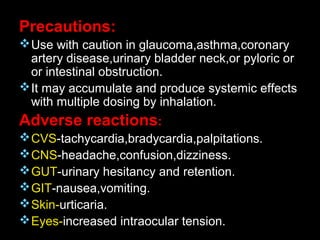
Precautions:
Use with caution in glaucoma,asthma,coronary
artery disease,urinary bladder neck,or pyloric or
or intestinal obstruction.
It may accumulate and produce systemic effects
with multiple dosing by inhalation.
Adverse reactions:
CVS-tachycardia,bradycardia,palpitations.
CNS-headache,confusion,dizziness.
GUT-urinary hesitancy and retention.
GIT-nausea,vomiting.
Skin-urticaria.
Eyes-increased intraocular tension.
PHARMACODYNAMICS
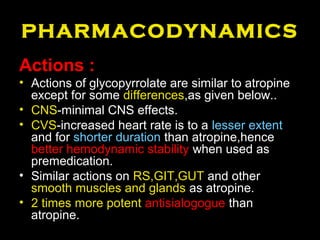
Actions :
• Actions of glycopyrrolate are similar to atropine
except for some differences,as given below..
• CNS-minimal CNS effects.
• CVS-increased heart rate is to a lesser extent
and for shorter duration than atropine,hence
better hemodynamic stability when used as
premedication.
• Similar actions on RS,GIT,GUT and other
smooth muscles and glands as atropine.
• 2 times more potent antisialogogue than
atropine.
CLINICAL USES
PREOPERATIVE MEDICATION
 It is now preferred to atropine as:
• No CNS cognitive effects.
As per BJA 1987[vol.59,966-969],no cognitive changes
after surgery were seen with glycopyrrolate as preop
medication,while with atropine significant short term
memory deficit was seen.
• CVS effects are less pronounced and for shorter
duration than atropine,hence more stable
hemodynamically.
Dosage:
• i.v./i.m./s.c.:0.1-0.2mg[4-6mcg/kg]
• Orally:50 mcg[1mcg/kg].
REVERSAL OF NEUROMUSCULAR
BLOCKADE
• Glycopyrrolate is used when slow onset[2-3min]
of action is desired,as with neostigmine.
• Impairment of parasympathetic nervous system
control of HR is of shorter duration than
atropine,hence preferable for patients at risk for
CVS complications like cardiac dysrhythmias in
response to myocardial ischemia and decreased
survival after MI.
Dosage:
• 0.01mg/kg with iv neostigmine 0.05mg/kg[0.2mg
for each 1mg of neostigmine] or iv
pyridostigmine 0.25mg/kg.
BRONCHODILATION:
• Inhalation ,0.4-0.8mg every 8hrs.
Other uses:
• It is used as a mydriatic in ophthalmologic
procedures like fundoscopy.
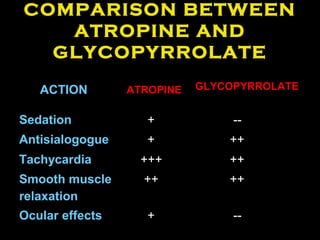
COMPARISON BETWEEN
ATROPINE AND
GLYCOPYRROLATE
ACTION ATROPINE GLYCOPYRROLATE
Sedation + --
Antisialogogue + ++
Tachycardia +++ ++
Smooth muscle
relaxation
++ ++
Ocular effects + --
THANK
YOU

Vinayak atropine glyco

  • 1.
    ATROPINE AND GLYCOPYRROLATE Guided by: Dr Modak Madam Presented by : Dr Vinayak 9th October 2007
  • 2.
    Structure Activity Relationship Routesof Administration Pharmacokinetics Mechanism of Action Pharmacodynamics Clinical Uses Overdose
  • 4.
    Structure Activity Relationship • Prototypedrug of the class of anticholinergic drugs. • Alkaloid derivative of the plant Atropa belladona.
  • 5.
    • Ester ofTropic acid and Tropine. • A racemic mixture of equal quantities of levorotatory and dextrorotatory isomers,but anticholinergic activity is in levorotatory form. • Presence of a hydroxyl group in the acyl portion of the ester is essential for activity.
  • 6.
    Routes of Administration  Oral Intravenous  Intramuscular  Topical eye drops  Inhalational  Intratracheal
  • 7.
    Pharmacokinetics • Rapidly absorbedfrom GIT. • Penetrates cornea freely. • 50% metabolized in liver and the rest excreted unchanged in urine. Onset of Action: IV:45-60 seconds IM:5-40 minutes Oral:0.5-2 hrs Intratracheal:10-20 seconds Inhalational :3-5 minutes
  • 8.
    Peak effect: IV:2min. Inhalational:2hrs. Duration of Action: IV/IM: Vagal blockade- 1-2 hrs Antisialogogue-4 hrs. Inhalational:Vagal blockade- 3-6 hrs. • Elimination half time-2.3 hrs.
  • 9.
    Drug interactions: Additive anticholinergiceffects with Antihistaminics,Phenothiazines,Tricyclic antidepressants,Procainamide,Quinidine,MAO inhibitors,Benzodiazepines, Antipsychotics. Increase in intraocular tension: enhanced by Nitrates,Nitrites,Alkalinizing agents,Disopyramide,Corticosteroids, Haloperidol. Potentiates Sympathomimetics. Antagonizes Anticholinesterases and Metoclopramide
  • 10.
    Adverse effects:  Cardiovascular- tachycardia,bradycardia,palpitations. Pulmonary-respiratory depression.  CNS-central anticholinergic syndrome i.e. restlessness,confusion,hallucinations to somnolence and unconsciousness.  GUT -urinary hesitancy,retention.  GIT-Gastroesophageal reflux.  Ocular:blurred vision,increased intraocular pressure.  Skin:urticaria.
  • 11.
    Mechanism of Action: Atropineis a reversible competitive antagonist at muscarinic cholinergic receptors.
  • 12.
    PHARMACODYNAMICS Central nervous system: •Being a tertiary amine and hence lipid soluble, it easily crosses the blood-brain barrier. • Therapeutic doses:only mild central excitation due to stimulation of medullary and higher cerebral centres. • Toxicdoses:restlessness,irritability,disorientation, hallucinations or delirium. • Still larger doses cause stimulation followed by depression leading to circulatory collapse and coma.
  • 13.
    Eyes: • Blocks M2Ach receptors of pupillary sphincter of iris and ciliary muscle - mydriasis - cycloplegia i.e.paralysis of accomodation.
  • 14.
    • Conventional systemicdoses - little ocular effect. • Closed angle glaucoma -relaxed ciliary muscles occlude angular space -Mydriasis obstructs passage of intraocular fluid into veins - increase in IOP.
  • 15.
    Cardiovascular System: • Dominanteffect:Tachycardia by blocking vagal effects on M2 Ach receptors on SA node. • But HR often decreases transiently with average clinical doses[0.4-0.6mg] - due to blockade of inhibitory presynaptic M1 acetylcholine receptors on vagal nerve endings - increased acetylcholine release • HR slowing rarely marked (4-8 beats/min)and usually absent after rapid I.V. injection. • Influence on HR - most noticeable in young adults as vagal tone is considerable. • In infants and elderly-large doses fail to cause tachycardia. • It also shortens AV conduction time and functional refractory period of AV node.
  • 17.
    Respiratory system • InhibitsM2 and M3 Ach receptors in airway smooth muscle to produce bronchodilation,decreasing airway resistance and increasing dead space. • Also inhibits M3 receptors making secretions of nose,mouth,pharynx and bronchi scanty and viscid. • Inhibits Bronchoconstriction caused by Histamine,Bradykinin released in asthma.
  • 18.
    Gastrointestinal Tract • InhibitsM2 receptors and M3 receptors causing relaxation of gut smooth muscle and inhibits gut secretions respectively. • Though it completely abolishes the effect of ACh and other parasympathomimetics on gut,it only incompletely inhibits effects of vagal impulses: because preganglionic vagal fibres that innervate GIT synapse not only at postganglionic cholinergic fibres,but also with noncholinergic intramural neurons which form the enteric plexus,utilising Neurotransmitters like 5HT,Dopamine and peptides.
  • 19.
    Urinary and BiliaryTract: • Decreased Tone and amplitude of Contraction. Glands: • Salivary secretions mediated by M3 receptors completely abolished. • Gastric secretions during Cephalic and fasting phase reduced,but intestinal phase only partially inhibited. • Small doses inhibit sweat glands, making skin hot and dry.
  • 20.
    Effects in relationto dose0.5mg Slight bradycardia,some dryness of mouth,inhibition of sweating 1mg Definite dryness of mouth,thirst,accelerated heart rate,sometimes preceded by slowing;mild dilation pupils. 2mg Rapid HR,Palpitation;marked dryness of mouth;dilated pupils,some blurring of near vision 5mg All above symptoms marked ,Difficulty in speaking and swallowing,Restlessness and fatigue;headache dry,hot skin;difficulty in micturition,reduced intestinal peristalsis. 10mg Above symptoms more marked,pulse rapid and weak;iris practically obliterated,vision very blurred;skin flushed,hot,dry and scarlet; ataxia,restlessness,excitement,hallucinations and delirium,coma.
  • 21.
    CLINICAL USES PREOPERATIVE MEDICATION: Historically,atropine was given i.m. before induction to protect the heart from vagal reflexes and to prevent excess salivary secretion.  Currently used anesthetic agents are not predictably associated with these effects hence not mandatory to include an anticholinergic in preop medication.  Hence most likely goal is to produce sedation or antisialogogue effect. DOSAGE: Adults: i.v./i.m.-0.4-1mg Orally-0.4-0.6mg every 4-6 hrs Children: i.v.-10-20mcg/kg[min 0.1mg] Oral-30 mcg/kg every 4-6hrs.
  • 22.
    TREATMENT OF REFLEXMEDIATED BRADYCARDIA Anticholinergics are the drugs of choice. Atropine in a dose of 15-70mcg/kg i.v. increases heart rate by blocking ACh effect on SAnode.
  • 23.
    REVERSAL OF NEUROMUSCULAR BLOCKADE Antagonismof Nondepolarising NM blocking drugs with an anticholinesterase requires the use of Atropine to prevent parasympathomimetic effects of the anticholinesterase. Depending on the speed of onset of Anticholinesterase action, Atropine[rapid onset] or glycopyrrolate[slow onset] is selected. DOSAGE:0.015mg/kg with neostigmine[i.v.0.05mg/kg] or edrophonium[i.v.0.5-1mg/kg]
  • 24.
    BRONCHODILATION • Atropine,1-2mg/kg dilutedin 3-5ml NS can be administered via nebuliser to treat bronchial asthma. OTHER USES OF ANTICHOLINERGICS : • Biliary and Ureteric smooth muscle relaxation. • Mydriasis and cycloplegia • Antagonism of gastric H+ ion secretion. • Management of Parkinson’s disease and treating extrapyramidal side effects of antidopaminergic drugs. • Treatment of hiccups [atropine 0.5 mgi.v. terminates hiccups following LMA insertion].
  • 25.
    ATROPINE OVERDOSE MANIFESTATIONS:  Drymouth ,difficulty in swallowing and talking.  Vision is very blurred,with photophobia.  Dry,flushed ,hot skin,with rash especially over face neck and upper chest.  Temperature is raised due to inhibition of sweating and small children are more prone to this “atropine fever”.  Minute ventilation is increased due to CNS stimulation and increased physiological dead space.  Fatal events are seizures,coma and medullary ventilatory centre paralysis. TREATMENT: Physostigmine,15-60mcg/kg i.v. • Repeated doses may be necessary every 4-6hrly since it is metabolised rapidly
  • 26.
    GLYCOPYRROLATE STRUCTURE ACTIVITY RELATIONSHIP • Glycopyrrolateis a semi synthetic quaternary ammonium anticholinergic. • Due to its polarity, it resists passage through the blood brain barrier,hence no CNS effects. MECHANISM OF ACTION: • It is similar to atropine.
  • 27.
    PHARMACOKINETICS Onset of action: i.v.:2-3min. I.m./s.c.:15-30min Inhalational:3-5min Oral-1hour. • Peak effect: i.v.:5min i.m./s.c.:30-45min Inhalational:1-2hrs.
  • 28.
    Duration of action: •i.v.:vagal blockade:2-3 hrs, antisialogogue:7hrs, • Oral:vagal blockade:3-6hrs. • Clearance from plasma more rapid than atropine-1.25hrs,nearly 80% excreted unchanged in urine. Toxicity: • Mental confusion,especially in elderly,poorly absorbed orally.
  • 29.
    Precautions: Use with cautionin glaucoma,asthma,coronary artery disease,urinary bladder neck,or pyloric or or intestinal obstruction. It may accumulate and produce systemic effects with multiple dosing by inhalation. Adverse reactions: CVS-tachycardia,bradycardia,palpitations. CNS-headache,confusion,dizziness. GUT-urinary hesitancy and retention. GIT-nausea,vomiting. Skin-urticaria. Eyes-increased intraocular tension.
  • 30.
    PHARMACODYNAMICS Actions : • Actionsof glycopyrrolate are similar to atropine except for some differences,as given below.. • CNS-minimal CNS effects. • CVS-increased heart rate is to a lesser extent and for shorter duration than atropine,hence better hemodynamic stability when used as premedication. • Similar actions on RS,GIT,GUT and other smooth muscles and glands as atropine. • 2 times more potent antisialogogue than atropine.
  • 31.
    CLINICAL USES PREOPERATIVE MEDICATION It is now preferred to atropine as: • No CNS cognitive effects. As per BJA 1987[vol.59,966-969],no cognitive changes after surgery were seen with glycopyrrolate as preop medication,while with atropine significant short term memory deficit was seen. • CVS effects are less pronounced and for shorter duration than atropine,hence more stable hemodynamically. Dosage: • i.v./i.m./s.c.:0.1-0.2mg[4-6mcg/kg] • Orally:50 mcg[1mcg/kg].
  • 32.
    REVERSAL OF NEUROMUSCULAR BLOCKADE •Glycopyrrolate is used when slow onset[2-3min] of action is desired,as with neostigmine. • Impairment of parasympathetic nervous system control of HR is of shorter duration than atropine,hence preferable for patients at risk for CVS complications like cardiac dysrhythmias in response to myocardial ischemia and decreased survival after MI. Dosage: • 0.01mg/kg with iv neostigmine 0.05mg/kg[0.2mg for each 1mg of neostigmine] or iv pyridostigmine 0.25mg/kg.
  • 33.
    BRONCHODILATION: • Inhalation ,0.4-0.8mgevery 8hrs. Other uses: • It is used as a mydriatic in ophthalmologic procedures like fundoscopy.
  • 34.
    COMPARISON BETWEEN ATROPINE AND GLYCOPYRROLATE ACTIONATROPINE GLYCOPYRROLATE Sedation + -- Antisialogogue + ++ Tachycardia +++ ++ Smooth muscle relaxation ++ ++ Ocular effects + --
  • 35.