Intraveous anestheticsDr.Hussam Alsharani          Dr.Osama IbrahimAnesthesia  resident            Assistant professorAnesthesia  d. KKUH          Anesthesia  d. KKUH
Ideal IV anesthetics:1-Drug compatibility (water solubility) and stability in solution.2-lake pain on injection , veno irritation , and local tissue damage.3-low potential to release histamine.4-rabid and smooth onset of action  without excitatory activity.5-rabid metabolism to inactive metabolites.6-a steep dose to minimize  titratability and tissue accumulation.7-lake of acute cardiovascular  and respiratory depression.8-decrease in cerebral metabolism and intracranial pressure.9-rabid and smooth return to consciousness .10-abcense of post operative nausea , vomiting, amnesia , psychoimetic reaction , dizziness , headache , and prolonged sedation.
Pharmacokinetics:Anesthesia is produced by diffusion of drug from arterial blood across the blood brain barrier in to  the brain which regulated by the following factors:-protein binding: unbound drug is free to cross BBB.-blood flow to the brain.-extracellular PH and Pka of the drug: nonionized.-solubility of the drug in lipid and water: high lipid solubility  enhances transfer in to the brain.-speed of  injection.
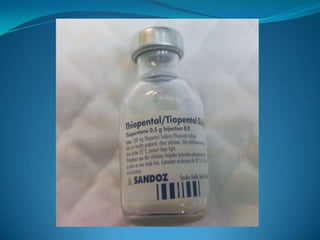
Barbiturates (Thiopental):-available as  sodium salts (yellowish powder).-bitter taste + smell of garlic.-solution of thiobarbiturates are stable for 2 weeks.-ph of solution of thiopental  (2.5%) is 9.-does not cause pain on injection.-metabolized in liver  to hydroxythiopental and    carboxylic acid.-produce anesthesia in less than 30 sec after iv injection.-induction dose: 3-5 mg/kg  in adults                             5-6 mg/kg  in children                             6-8 mg/kg in infants-recovery after 10 min
-produce decrease in CPF there by lowering ICP.-widely used to  improve brain relaxation  during  neurosurgery  and to improve cerebral infusion  pressure   after  acute brain injury-It  cause dose dependent anticonvulsant activity.-dose dependent  respiratory  depression.-it cause decrease in cardiac output and ABP.-early absence in eyelidreflex.
-tissue necrosis: median nerve damage may be occur  after extravenous injection in the  antecubital fossa if perivenous injection occurred the needle should be  left in place and injection of hyaloronidase.-intra-arterial injection: pt usually complains of  burning pain + intense        in this case:             -stop injection.             -leave needle in artery.             -administrate papaverine 20 mg.             -heparin should be given iv and orally.             -stellate  ganglion or brachial plexus block               may reduce arterial spasm.
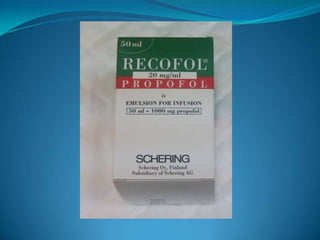
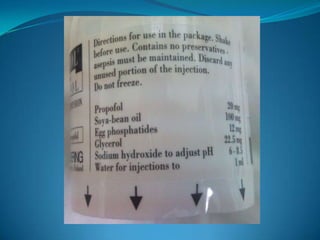
Propofol:-(2,6-dispropylphenol).-pain on injection  32-67% of patients.-t1/2  is 1-8 min (Barash 2009).-elimination half time 2-24 min.-metabolized in liver to sulfate and glucuronic  acid which   are eliminated by kidney.-extra hepatic rout of elimination by lungs.-anesthesia is induced in 20-40 sec after iv administration.-we can monitor the onset by loss of verbal contact.-induction dose 1.5 – 2.5 mg/kg.-children require bigger dose.-euphoria effect.
-propofol  decrease  CPF and ICP.-excitatory motor activity without EEG changes.-dose and concentration dependent cardiovascular depression.-dose dependent respiratory depression with apnea.-antiemetic effects  (10-20 mg  to treat nausea  and emesis  in the early post operative period.-antidopamenergic   which lead to euphoria.-it decrease the pruritus  produced by spinal opioids.-agent of choice in malignant hyperthermia  suspictable pt.-Propofol syndrome : after high dose infusion of propofol  for  long time – myocardial failure – metabolic acidosis –  rabdomyolysis.
Propofol has no effect on bronchial muscle tone and laryngospasm  is particularly uncommon .The suppression of laryngeal reflex  and low incidence of coughing or laryngospasm when a laryngeal mask airway (LMA) is introduced , and propofol is regarded by most anesthetists as the drug of choice for induction  of anesthesia when LMA is to be used.
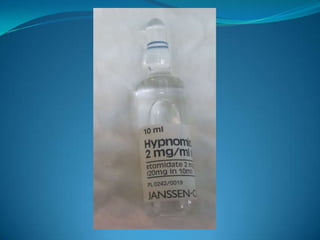
Etomidate:-carboxylated  imidazole.-ph 6.9 , pain on injection , venoirritation.-induction dose : 0.2-0.3 mg/kg.-involuntary myoclonic movement are common at induction.-metabolism in liver.-it decrease CPF and ICP.-inhibitory effect on adrenocortical synthetic  function (5-8 h  after single use)-inhibit platelet function.-minimal cardiorespiratory depression .-does not induce histamine release.-high incidence of post op nausea and emesis .
Absolute  contraindication:        -airway obstruction.        -prophyria.         -adrenal impairment.        -long term infusion in ICU (increase infection                                                            and mortality).
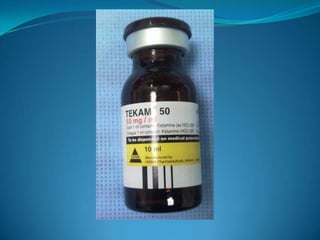
Kitamine:-Arylcyclohexylamine.-water  soluble compound.-potent anesthetics and analgesic properties +amnesia .-metabolized by liver to norkitamine which excreted by  kidney.-elimination half life 2-4 h .-dose dependent CNS depression + stimulation of limbic s.-induction dose: 1-2 mg/kg IV.                             4-8mg/kg IM.-duration of action: 10-20min –full orientation require more 60 – 90 min
-high incidence of psychomimetic  reactions (namely ,  hallucination , nightmares , altered short term memory  , and cognition).-ketamine  increase CPF and ICP .-bronchodilatory activity - minimal respiratory depression.-increase oral secretion.-cardiovascular stimulation + increase peripheral resistant.-not recommended in severe coronary artery disease.-increase pulmonary artery pressure (contraindicated   in poor right ventricular reserve.
Indications:  -high risk pt: shocked patients.  -pediatric anesthesia.  -difficult locations: site of accidents.  -developing countries: where anesthetic    equipment and trained staff in short supply.
Benzodiazepines:-medazolam , lorazepam , diazepam and antagonist    flumazenil.-metabolized in liver , excreted by kidney.-short acting:   midazolam  -  flumazenil.-intermediate: diazepam.-long acting:    lorazepam.-only midazolam can given by continuous infusion.-all benzodiazepines produce: anxiolytic,  anterograde  amnesia, sedative, hypnotic, anticonvulsant, and spinally mediated muscle relaxant properties.
-dose dependent respiratory depression.-it depress the swallowing reflex  and depress upper  airway reflex activity.-produce decrease in systemic vascular resistant and  blood pressure in large doses.-specific antagonist :flumazenil
Dexmedetomidine:-alpha 2 adreno receptor agonist.-approved by FDA for the short term less than 24 h sedation of the mechanically ventilated pt in ICU.-unique type of  sedation-analgesia with less respiratory depression + amnestic affect .-it produce hypotension and bradycardia more than  diazepines.-infusion rate 0.2-0.6 mcg/kg/h.-improve post op pain control after major surgery.-slower onset and offset than propofol , sedation   like midazolam.            -high cost.
Thank you

IV anesthetic

  • 1.
    Intraveous anestheticsDr.Hussam Alsharani Dr.Osama IbrahimAnesthesia resident Assistant professorAnesthesia d. KKUH Anesthesia d. KKUH
  • 2.
    Ideal IV anesthetics:1-Drugcompatibility (water solubility) and stability in solution.2-lake pain on injection , veno irritation , and local tissue damage.3-low potential to release histamine.4-rabid and smooth onset of action without excitatory activity.5-rabid metabolism to inactive metabolites.6-a steep dose to minimize titratability and tissue accumulation.7-lake of acute cardiovascular and respiratory depression.8-decrease in cerebral metabolism and intracranial pressure.9-rabid and smooth return to consciousness .10-abcense of post operative nausea , vomiting, amnesia , psychoimetic reaction , dizziness , headache , and prolonged sedation.
  • 4.
    Pharmacokinetics:Anesthesia is producedby diffusion of drug from arterial blood across the blood brain barrier in to the brain which regulated by the following factors:-protein binding: unbound drug is free to cross BBB.-blood flow to the brain.-extracellular PH and Pka of the drug: nonionized.-solubility of the drug in lipid and water: high lipid solubility enhances transfer in to the brain.-speed of injection.
  • 6.
    Barbiturates (Thiopental):-available as sodium salts (yellowish powder).-bitter taste + smell of garlic.-solution of thiobarbiturates are stable for 2 weeks.-ph of solution of thiopental (2.5%) is 9.-does not cause pain on injection.-metabolized in liver to hydroxythiopental and carboxylic acid.-produce anesthesia in less than 30 sec after iv injection.-induction dose: 3-5 mg/kg in adults 5-6 mg/kg in children 6-8 mg/kg in infants-recovery after 10 min
  • 7.
    -produce decrease inCPF there by lowering ICP.-widely used to improve brain relaxation during neurosurgery and to improve cerebral infusion pressure after acute brain injury-It cause dose dependent anticonvulsant activity.-dose dependent respiratory depression.-it cause decrease in cardiac output and ABP.-early absence in eyelidreflex.
  • 8.
    -tissue necrosis: mediannerve damage may be occur after extravenous injection in the antecubital fossa if perivenous injection occurred the needle should be left in place and injection of hyaloronidase.-intra-arterial injection: pt usually complains of burning pain + intense in this case: -stop injection. -leave needle in artery. -administrate papaverine 20 mg. -heparin should be given iv and orally. -stellate ganglion or brachial plexus block may reduce arterial spasm.
  • 11.
    Propofol:-(2,6-dispropylphenol).-pain on injection 32-67% of patients.-t1/2 is 1-8 min (Barash 2009).-elimination half time 2-24 min.-metabolized in liver to sulfate and glucuronic acid which are eliminated by kidney.-extra hepatic rout of elimination by lungs.-anesthesia is induced in 20-40 sec after iv administration.-we can monitor the onset by loss of verbal contact.-induction dose 1.5 – 2.5 mg/kg.-children require bigger dose.-euphoria effect.
  • 12.
    -propofol decrease CPF and ICP.-excitatory motor activity without EEG changes.-dose and concentration dependent cardiovascular depression.-dose dependent respiratory depression with apnea.-antiemetic effects (10-20 mg to treat nausea and emesis in the early post operative period.-antidopamenergic which lead to euphoria.-it decrease the pruritus produced by spinal opioids.-agent of choice in malignant hyperthermia suspictable pt.-Propofol syndrome : after high dose infusion of propofol for long time – myocardial failure – metabolic acidosis – rabdomyolysis.
  • 13.
    Propofol has noeffect on bronchial muscle tone and laryngospasm is particularly uncommon .The suppression of laryngeal reflex and low incidence of coughing or laryngospasm when a laryngeal mask airway (LMA) is introduced , and propofol is regarded by most anesthetists as the drug of choice for induction of anesthesia when LMA is to be used.
  • 15.
    Etomidate:-carboxylated imidazole.-ph6.9 , pain on injection , venoirritation.-induction dose : 0.2-0.3 mg/kg.-involuntary myoclonic movement are common at induction.-metabolism in liver.-it decrease CPF and ICP.-inhibitory effect on adrenocortical synthetic function (5-8 h after single use)-inhibit platelet function.-minimal cardiorespiratory depression .-does not induce histamine release.-high incidence of post op nausea and emesis .
  • 16.
    Absolute contraindication: -airway obstruction. -prophyria. -adrenal impairment. -long term infusion in ICU (increase infection and mortality).
  • 18.
    Kitamine:-Arylcyclohexylamine.-water solublecompound.-potent anesthetics and analgesic properties +amnesia .-metabolized by liver to norkitamine which excreted by kidney.-elimination half life 2-4 h .-dose dependent CNS depression + stimulation of limbic s.-induction dose: 1-2 mg/kg IV. 4-8mg/kg IM.-duration of action: 10-20min –full orientation require more 60 – 90 min
  • 19.
    -high incidence ofpsychomimetic reactions (namely , hallucination , nightmares , altered short term memory , and cognition).-ketamine increase CPF and ICP .-bronchodilatory activity - minimal respiratory depression.-increase oral secretion.-cardiovascular stimulation + increase peripheral resistant.-not recommended in severe coronary artery disease.-increase pulmonary artery pressure (contraindicated in poor right ventricular reserve.
  • 20.
    Indications: -highrisk pt: shocked patients. -pediatric anesthesia. -difficult locations: site of accidents. -developing countries: where anesthetic equipment and trained staff in short supply.
  • 21.
    Benzodiazepines:-medazolam , lorazepam, diazepam and antagonist flumazenil.-metabolized in liver , excreted by kidney.-short acting: midazolam - flumazenil.-intermediate: diazepam.-long acting: lorazepam.-only midazolam can given by continuous infusion.-all benzodiazepines produce: anxiolytic, anterograde amnesia, sedative, hypnotic, anticonvulsant, and spinally mediated muscle relaxant properties.
  • 22.
    -dose dependent respiratorydepression.-it depress the swallowing reflex and depress upper airway reflex activity.-produce decrease in systemic vascular resistant and blood pressure in large doses.-specific antagonist :flumazenil
  • 23.
    Dexmedetomidine:-alpha 2 adrenoreceptor agonist.-approved by FDA for the short term less than 24 h sedation of the mechanically ventilated pt in ICU.-unique type of sedation-analgesia with less respiratory depression + amnestic affect .-it produce hypotension and bradycardia more than diazepines.-infusion rate 0.2-0.6 mcg/kg/h.-improve post op pain control after major surgery.-slower onset and offset than propofol , sedation like midazolam. -high cost.
  • 24.