Intravenous Anesthetic
Agents
Introduction
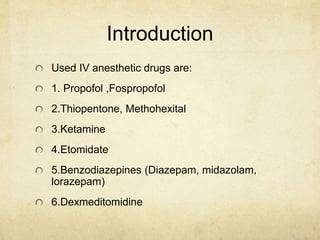
Used IV anesthetic drugs are:
1. Propofol ,Fospropofol
2.Thiopentone, Methohexital
3.Ketamine
4.Etomidate
5.Benzodiazepines (Diazepam, midazolam,
lorazepam)
6.Dexmeditomidine
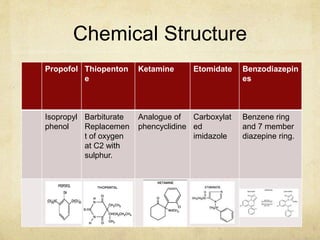
Chemical Structure
Propofol Thiopenton
e
Ketamine Etomidate Benzodiazepin
es
Isopropyl
phenol
Barbiturate
Replacemen
t of oxygen
at C2 with
sulphur.
Analogue of
phencyclidine
Carboxylat
ed
imidazole
Benzene ring
and 7 member
diazepine ring.
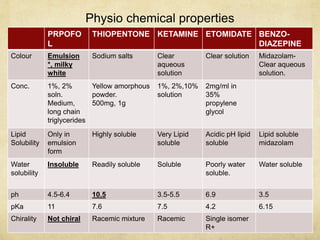
Physio chemical properties
PRPOFO
L
THIOPENTONE KETAMINE ETOMIDATE BENZO-
DIAZEPINE
Colour Emulsion
*, milky
white
Sodium salts Clear
aqueous
solution
Clear solution Midazolam-
Clear aqueous
solution.
Conc. 1%, 2%
soln.
Medium,
long chain
triglycerides
Yellow amorphous
powder.
500mg, 1g
1%, 2%,10%
solution
2mg/ml in
35%
propylene
glycol
Lipid
Solubility
Only in
emulsion
form
Highly soluble Very Lipid
soluble
Acidic pH lipid
soluble
Lipid soluble
midazolam
Water
solubility
Insoluble Readily soluble Soluble Poorly water
soluble.
Water soluble
ph 4.5-6.4 10.5 3.5-5.5 6.9 3.5
pKa 11 7.6 7.5 4.2 6.15
Chirality Not chiral Racemic mixture Racemic Single isomer
R+
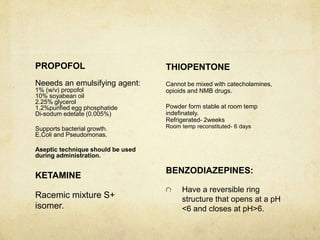
PROPOFOL
Neeeds an emulsifying agent:
1% (w/v) propofol
10% soyabean oil
2.25% glycerol
1.2%purified egg phosphatide
Di-sodum edetate (0.005%)
Supports bacterial growth.
E.Coli and Pseudomonas.
Aseptic technique should be used
during administration.
KETAMINE
Racemic mixture S+
isomer.
THIOPENTONE
Cannot be mixed with catecholamines,
opioids and NMB drugs.
Powder form stable at room temp
indefinately.
Refrigerated- 2weeks
Room temp reconstituted- 6 days
BENZODIAZEPINES:
Have a reversible ring
structure that opens at a pH
<6 and closes at pH>6.
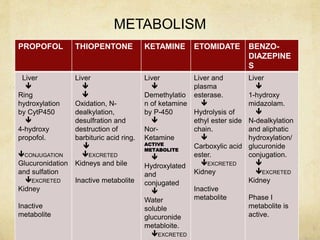
METABOLISM
PROPOFOL THIOPENTONE KETAMINE ETOMIDATE BENZO-
DIAZEPINE
S
Liver

Ring
hydroxylation
by CytP450

4-hydroxy
propofol.
CONJUGATION
Glucuronidation
and sulfation
EXCRETED
Kidney
Inactive
metabolite
Liver


Oxidation, N-
dealkylation,
desulfration and
destruction of
barbituric acid ring.

EXCRETED
Kidneys and bile
Inactive metabolite
Liver

Demethylatio
n of ketamine
by P-450

Nor-
Ketamine
ACTIVE
METABOLITE

Hydroxylated
and
conjugated

Water
soluble
glucuronide
metabloite.
EXCRETED
Liver and
plasma
esterase.

Hydrolysis of
ethyl ester side
chain.

Carboxylic acid
ester.
EXCRETED
Kidney
Inactive
metabolite
Liver

1-hydroxy
midazolam.

N-dealkylation
and aliphatic
hydroxylation/
glucuronide
conjugation.

EXCRETED
Kidney
Phase I
metabolite is
active.
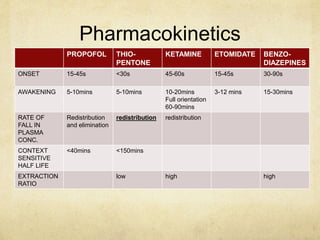
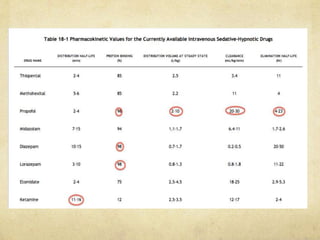
Pharmacokinetics
PROPOFOL THIO-
PENTONE
KETAMINE ETOMIDATE BENZO-
DIAZEPINES
ONSET 15-45s <30s 45-60s 15-45s 30-90s
AWAKENING 5-10mins 5-10mins 10-20mins
Full orientation
60-90mins
3-12 mins 15-30mins
RATE OF
FALL IN
PLASMA
CONC.
Redistribution
and elimination
redistribution redistribution
CONTEXT
SENSITIVE
HALF LIFE
<40mins <150mins
EXTRACTION
RATIO
low high high
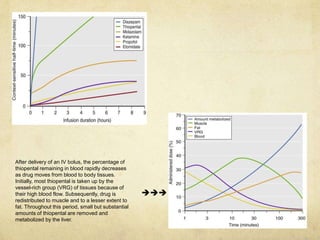
After delivery of an IV bolus, the percentage of
thiopental remaining in blood rapidly decreases
as drug moves from blood to body tissues.
Initially, most thiopental is taken up by the
vessel-rich group (VRG) of tissues because of
their high blood flow. Subsequently, drug is
redistributed to muscle and to a lesser extent to
fat. Throughout this period, small but substantial
amounts of thiopental are removed and
metabolized by the liver.

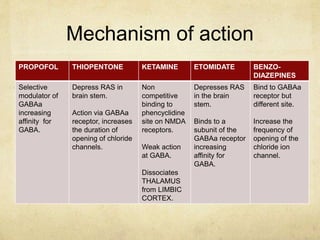
Mechanism of action
PROPOFOL THIOPENTONE KETAMINE ETOMIDATE BENZO-
DIAZEPINES
Selective
modulator of
GABAa
increasing
affinity for
GABA.
Depress RAS in
brain stem.
Action via GABAa
receptor, increases
the duration of
opening of chloride
channels.
Non
competitive
binding to
phencyclidine
site on NMDA
receptors.
Weak action
at GABA.
Dissociates
THALAMUS
from LIMBIC
CORTEX.
Depresses RAS
in the brain
stem.
Binds to a
subunit of the
GABAa receptor
increasing
affinity for
GABA.
Bind to GABAa
receptor but
different site.
Increase the
frequency of
opening of the
chloride ion
channel.
SYSTEMIC EFFECTS
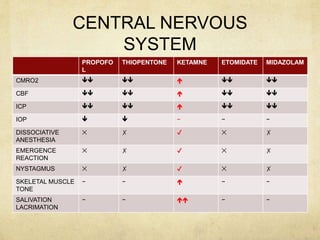
CENTRAL NERVOUS
SYSTEM
PROPOFO
L
THIOPENTONE KETAMNE ETOMIDATE MIDAZOLAM
CMRO2     
CBF     
ICP     
IOP   − − −
DISSOCIATIVE
ANESTHESIA
✕ ✗ ✔ ✕ ✗
EMERGENCE
REACTION
✕ ✗ ✔ ✕ ✗
NYSTAGMUS ✕ ✗ ✔ ✕ ✗
SKELETAL MUSCLE
TONE
− −  − −
SALIVATION
LACRIMATION
− −  − −
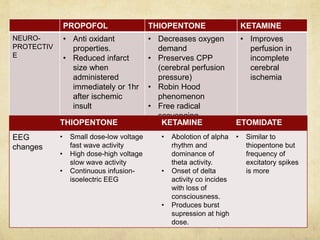
PROPOFOL THIOPENTONE KETAMINE
NEURO-
PROTECTIV
E
• Anti oxidant
properties.
• Reduced infarct
size when
administered
immediately or 1hr
after ischemic
insult
• Decreases oxygen
demand
• Preserves CPP
(cerebral perfusion
pressure)
• Robin Hood
phenomenon
• Free radical
scavenging
• Improves
perfusion in
incomplete
cerebral
ischemia
THIOPENTONE KETAMINE ETOMIDATE
EEG
changes
• Small dose-low voltage
fast wave activity
• High dose-high voltage
slow wave activity
• Continuous infusion-
isoelectric EEG
• Abolotion of alpha
rhythm and
dominance of
theta activity.
• Onset of delta
activity co incides
with loss of
consciousness.
• Produces burst
supression at high
dose.
• Similar to
thiopentone but
frequency of
excitatory spikes
is more
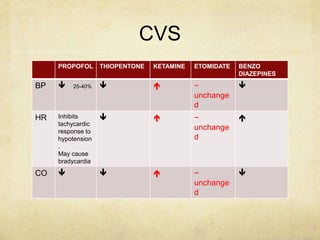
CVS
PROPOFOL THIOPENTONE KETAMINE ETOMIDATE BENZO
DIAZEPINES
BP  25-40%   −
unchange
d

HR Inhibits
tachycardic
response to
hypotension
.
May cause
bradycardia
  −
unchange
d

CO    −
unchange
d

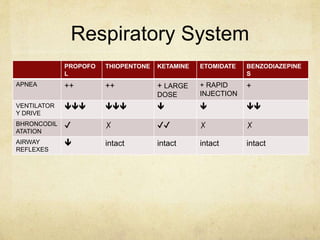
Respiratory System
PROPOFO
L
THIOPENTONE KETAMINE ETOMIDATE BENZODIAZEPINE
S
APNEA ++ ++ + LARGE
DOSE
+ RAPID
INJECTION
+
VENTILATOR
Y DRIVE
    
BHRONCODIL
ATATION
✔ ✗ ✔✔ ✗ ✗
AIRWAY
REFLEXES
 intact intact intact intact
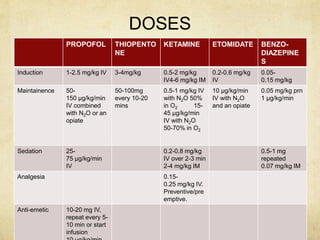
DOSES
PROPOFOL THIOPENTO
NE
KETAMINE ETOMIDATE BENZO-
DIAZEPINE
S
Induction 1-2.5 mg/kg IV 3-4mg/kg 0.5-2 mg/kg
IV4-6 mg/kg IM
0.2-0.6 mg/kg
IV
0.05-
0.15 mg/kg
Maintainence 50-
150 µg/kg/min
IV combined
with N2O or an
opiate
50-100mg
every 10-20
mins
0.5-1 mg/kg IV
with N2O 50%
in O2 15-
45 µg/kg/min
IV with N2O
50-70% in O2
10 µg/kg/min
IV with N2O
and an opiate
0.05 mg/kg prn
1 µg/kg/min
Sedation 25-
75 µg/kg/min
IV
0.2-0.8 mg/kg
IV over 2-3 min
2-4 mg/kg IM
0.5-1 mg
repeated
0.07 mg/kg IM
Analgesia 0.15-
0.25 mg/kg IV.
Preventive/pre
emptive.
Anti-emetic 10-20 mg IV,
repeat every 5-
10 min or start
infusion
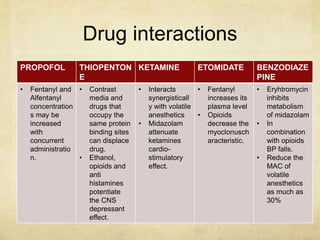
Drug interactions
PROPOFOL THIOPENTON
E
KETAMINE ETOMIDATE BENZODIAZE
PINE
• Fentanyl and
Alfentanyl
concentration
s may be
increased
with
concurrent
administratio
n.
• Contrast
media and
drugs that
occupy the
same protein
binding sites
can displace
drug.
• Ethanol,
opioids and
anti
histamines
potentiate
the CNS
depressant
effect.
• Interacts
synergisticall
y with volatile
anesthetics
• Midazolam
attenuate
ketamines
cardio-
stimulatory
effect.
• Fentanyl
increases its
plasma level
• Opioids
decrease the
myoclonusch
aracteristic.
• Eryhtromycin
inhibits
metabolism
of midazolam
• In
combination
with opioids
BP falls.
• Reduce the
MAC of
volatile
anesthetics
as much as
30%
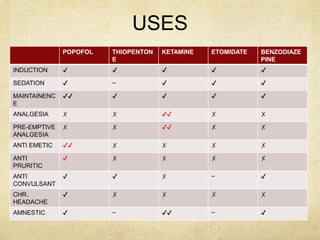
USES
POPOFOL THIOPENTON
E
KETAMINE ETOMIDATE BENZODIAZE
PINE
INDUCTION ✔ ✔ ✔ ✔ ✔
SEDATION ✔ − ✔ ✔ ✔
MAINTAINENC
E
✔✔ ✔ ✔ ✔ ✔
ANALGESIA ✗ ✗ ✔✔ ✗ ✗
PRE-EMPTIVE
ANALGESIA
✗ ✗ ✔✔ ✗ ✗
ANTI EMETIC ✔✔ ✗ ✗ ✗ ✗
ANTI
PRURITIC
✔ ✗ ✗ ✗ ✗
ANTI
CONVULSANT
✔ ✔ ✗ − ✔
CHR.
HEADACHE
✔ ✗ ✗ ✗ ✗
AMNESTIC ✔ − ✔✔ − ✔
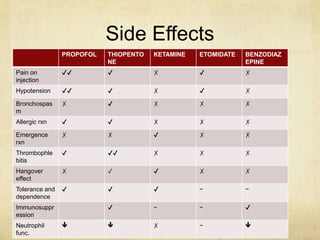
Side Effects
PROPOFOL THIOPENTO
NE
KETAMINE ETOMIDATE BENZODIAZ
EPINE
Pain on
injection
✔✔ ✔ ✗ ✔ ✗
Hypotension ✔✔ ✔ ✗ ✔ ✗
Bronchospas
m
✗ ✔ ✗ ✗ ✗
Allergic rxn ✔ ✔ ✗ ✗ ✗
Emergence
rxn
✗ ✗ ✔ ✗ ✗
Thrombophle
bitis
✔ ✔✔ ✗ ✗ ✗
Hangover
effect
✗ ✓ ✔ ✗ ✗
Tolerance and
dependence
✔ ✔ ✔ − −
Immunosuppr
ession
✔ − − ✔
Neutrophil
func.
  ✗ − 
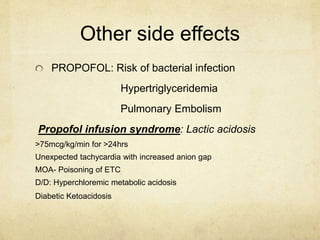
Other side effects
PROPOFOL: Risk of bacterial infection
Hypertriglyceridemia
Pulmonary Embolism
Propofol infusion syndrome: Lactic acidosis
>75mcg/kg/min for >24hrs
Unexpected tachycardia with increased anion gap
MOA- Poisoning of ETC
D/D: Hyperchloremic metabolic acidosis
Diabetic Ketoacidosis
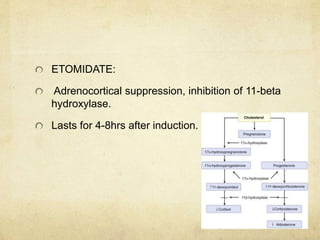
ETOMIDATE:
Adrenocortical suppression, inhibition of 11-beta
hydroxylase.
Lasts for 4-8hrs after induction.
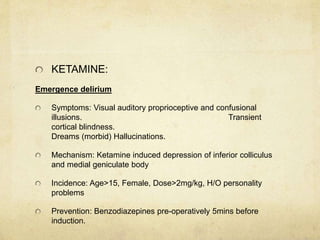
KETAMINE:
Emergence delirium
Symptoms: Visual auditory proprioceptive and confusional
illusions. Transient
cortical blindness.
Dreams (morbid) Hallucinations.
Mechanism: Ketamine induced depression of inferior colliculus
and medial geniculate body
Incidence: Age>15, Female, Dose>2mg/kg, H/O personality
problems
Prevention: Benzodiazepines pre-operatively 5mins before
induction.
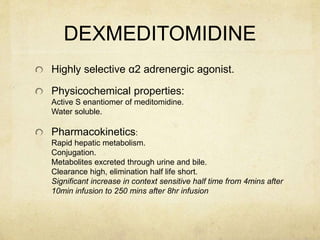
DEXMEDITOMIDINE
Highly selective α2 adrenergic agonist.
Physicochemical properties:
Active S enantiomer of meditomidine.
Water soluble.
Pharmacokinetics:
Rapid hepatic metabolism.
Conjugation.
Metabolites excreted through urine and bile.
Clearance high, elimination half life short.
Significant increase in context sensitive half time from 4mins after
10min infusion to 250 mins after 8hr infusion
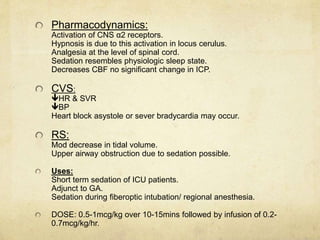
Pharmacodynamics:
Activation of CNS α2 receptors.
Hypnosis is due to this activation in locus cerulus.
Analgesia at the level of spinal cord.
Sedation resembles physiologic sleep state.
Decreases CBF no significant change in ICP.
CVS:
HR & SVR
BP
Heart block asystole or sever bradycardia may occur.
RS:
Mod decrease in tidal volume.
Upper airway obstruction due to sedation possible.
Uses:
Short term sedation of ICU patients.
Adjunct to GA.
Sedation during fiberoptic intubation/ regional anesthesia.
DOSE: 0.5-1mcg/kg over 10-15mins followed by infusion of 0.2-
0.7mcg/kg/hr.
References
Millers 7th edition
Clinical Anesthesiology- Morgan 5th edition
Stoeltings handbook of pharmacology and
physiology in anesthetic practice. 4th edition
Clinical Anesthesia Barash 7th edition
Iv anaesthetics

Iv anaesthetics

  • 1.
  • 2.
    Introduction Used IV anestheticdrugs are: 1. Propofol ,Fospropofol 2.Thiopentone, Methohexital 3.Ketamine 4.Etomidate 5.Benzodiazepines (Diazepam, midazolam, lorazepam) 6.Dexmeditomidine
  • 3.
    Chemical Structure Propofol Thiopenton e KetamineEtomidate Benzodiazepin es Isopropyl phenol Barbiturate Replacemen t of oxygen at C2 with sulphur. Analogue of phencyclidine Carboxylat ed imidazole Benzene ring and 7 member diazepine ring.
  • 4.
    Physio chemical properties PRPOFO L THIOPENTONEKETAMINE ETOMIDATE BENZO- DIAZEPINE Colour Emulsion *, milky white Sodium salts Clear aqueous solution Clear solution Midazolam- Clear aqueous solution. Conc. 1%, 2% soln. Medium, long chain triglycerides Yellow amorphous powder. 500mg, 1g 1%, 2%,10% solution 2mg/ml in 35% propylene glycol Lipid Solubility Only in emulsion form Highly soluble Very Lipid soluble Acidic pH lipid soluble Lipid soluble midazolam Water solubility Insoluble Readily soluble Soluble Poorly water soluble. Water soluble ph 4.5-6.4 10.5 3.5-5.5 6.9 3.5 pKa 11 7.6 7.5 4.2 6.15 Chirality Not chiral Racemic mixture Racemic Single isomer R+
  • 5.
    PROPOFOL Neeeds an emulsifyingagent: 1% (w/v) propofol 10% soyabean oil 2.25% glycerol 1.2%purified egg phosphatide Di-sodum edetate (0.005%) Supports bacterial growth. E.Coli and Pseudomonas. Aseptic technique should be used during administration. KETAMINE Racemic mixture S+ isomer. THIOPENTONE Cannot be mixed with catecholamines, opioids and NMB drugs. Powder form stable at room temp indefinately. Refrigerated- 2weeks Room temp reconstituted- 6 days BENZODIAZEPINES: Have a reversible ring structure that opens at a pH <6 and closes at pH>6.
  • 6.
    METABOLISM PROPOFOL THIOPENTONE KETAMINEETOMIDATE BENZO- DIAZEPINE S Liver  Ring hydroxylation by CytP450  4-hydroxy propofol. CONJUGATION Glucuronidation and sulfation EXCRETED Kidney Inactive metabolite Liver   Oxidation, N- dealkylation, desulfration and destruction of barbituric acid ring.  EXCRETED Kidneys and bile Inactive metabolite Liver  Demethylatio n of ketamine by P-450  Nor- Ketamine ACTIVE METABOLITE  Hydroxylated and conjugated  Water soluble glucuronide metabloite. EXCRETED Liver and plasma esterase.  Hydrolysis of ethyl ester side chain.  Carboxylic acid ester. EXCRETED Kidney Inactive metabolite Liver  1-hydroxy midazolam.  N-dealkylation and aliphatic hydroxylation/ glucuronide conjugation.  EXCRETED Kidney Phase I metabolite is active.
  • 7.
    Pharmacokinetics PROPOFOL THIO- PENTONE KETAMINE ETOMIDATEBENZO- DIAZEPINES ONSET 15-45s <30s 45-60s 15-45s 30-90s AWAKENING 5-10mins 5-10mins 10-20mins Full orientation 60-90mins 3-12 mins 15-30mins RATE OF FALL IN PLASMA CONC. Redistribution and elimination redistribution redistribution CONTEXT SENSITIVE HALF LIFE <40mins <150mins EXTRACTION RATIO low high high
  • 8.
    After delivery ofan IV bolus, the percentage of thiopental remaining in blood rapidly decreases as drug moves from blood to body tissues. Initially, most thiopental is taken up by the vessel-rich group (VRG) of tissues because of their high blood flow. Subsequently, drug is redistributed to muscle and to a lesser extent to fat. Throughout this period, small but substantial amounts of thiopental are removed and metabolized by the liver. 
  • 10.
    Mechanism of action PROPOFOLTHIOPENTONE KETAMINE ETOMIDATE BENZO- DIAZEPINES Selective modulator of GABAa increasing affinity for GABA. Depress RAS in brain stem. Action via GABAa receptor, increases the duration of opening of chloride channels. Non competitive binding to phencyclidine site on NMDA receptors. Weak action at GABA. Dissociates THALAMUS from LIMBIC CORTEX. Depresses RAS in the brain stem. Binds to a subunit of the GABAa receptor increasing affinity for GABA. Bind to GABAa receptor but different site. Increase the frequency of opening of the chloride ion channel.
  • 11.
  • 12.
    CENTRAL NERVOUS SYSTEM PROPOFO L THIOPENTONE KETAMNEETOMIDATE MIDAZOLAM CMRO2      CBF      ICP      IOP   − − − DISSOCIATIVE ANESTHESIA ✕ ✗ ✔ ✕ ✗ EMERGENCE REACTION ✕ ✗ ✔ ✕ ✗ NYSTAGMUS ✕ ✗ ✔ ✕ ✗ SKELETAL MUSCLE TONE − −  − − SALIVATION LACRIMATION − −  − −
  • 13.
    PROPOFOL THIOPENTONE KETAMINE NEURO- PROTECTIV E •Anti oxidant properties. • Reduced infarct size when administered immediately or 1hr after ischemic insult • Decreases oxygen demand • Preserves CPP (cerebral perfusion pressure) • Robin Hood phenomenon • Free radical scavenging • Improves perfusion in incomplete cerebral ischemia THIOPENTONE KETAMINE ETOMIDATE EEG changes • Small dose-low voltage fast wave activity • High dose-high voltage slow wave activity • Continuous infusion- isoelectric EEG • Abolotion of alpha rhythm and dominance of theta activity. • Onset of delta activity co incides with loss of consciousness. • Produces burst supression at high dose. • Similar to thiopentone but frequency of excitatory spikes is more
  • 14.
    CVS PROPOFOL THIOPENTONE KETAMINEETOMIDATE BENZO DIAZEPINES BP  25-40%   − unchange d  HR Inhibits tachycardic response to hypotension . May cause bradycardia   − unchange d  CO    − unchange d 
  • 15.
    Respiratory System PROPOFO L THIOPENTONE KETAMINEETOMIDATE BENZODIAZEPINE S APNEA ++ ++ + LARGE DOSE + RAPID INJECTION + VENTILATOR Y DRIVE      BHRONCODIL ATATION ✔ ✗ ✔✔ ✗ ✗ AIRWAY REFLEXES  intact intact intact intact
  • 16.
    DOSES PROPOFOL THIOPENTO NE KETAMINE ETOMIDATEBENZO- DIAZEPINE S Induction 1-2.5 mg/kg IV 3-4mg/kg 0.5-2 mg/kg IV4-6 mg/kg IM 0.2-0.6 mg/kg IV 0.05- 0.15 mg/kg Maintainence 50- 150 µg/kg/min IV combined with N2O or an opiate 50-100mg every 10-20 mins 0.5-1 mg/kg IV with N2O 50% in O2 15- 45 µg/kg/min IV with N2O 50-70% in O2 10 µg/kg/min IV with N2O and an opiate 0.05 mg/kg prn 1 µg/kg/min Sedation 25- 75 µg/kg/min IV 0.2-0.8 mg/kg IV over 2-3 min 2-4 mg/kg IM 0.5-1 mg repeated 0.07 mg/kg IM Analgesia 0.15- 0.25 mg/kg IV. Preventive/pre emptive. Anti-emetic 10-20 mg IV, repeat every 5- 10 min or start infusion
  • 17.
    Drug interactions PROPOFOL THIOPENTON E KETAMINEETOMIDATE BENZODIAZE PINE • Fentanyl and Alfentanyl concentration s may be increased with concurrent administratio n. • Contrast media and drugs that occupy the same protein binding sites can displace drug. • Ethanol, opioids and anti histamines potentiate the CNS depressant effect. • Interacts synergisticall y with volatile anesthetics • Midazolam attenuate ketamines cardio- stimulatory effect. • Fentanyl increases its plasma level • Opioids decrease the myoclonusch aracteristic. • Eryhtromycin inhibits metabolism of midazolam • In combination with opioids BP falls. • Reduce the MAC of volatile anesthetics as much as 30%
  • 18.
    USES POPOFOL THIOPENTON E KETAMINE ETOMIDATEBENZODIAZE PINE INDUCTION ✔ ✔ ✔ ✔ ✔ SEDATION ✔ − ✔ ✔ ✔ MAINTAINENC E ✔✔ ✔ ✔ ✔ ✔ ANALGESIA ✗ ✗ ✔✔ ✗ ✗ PRE-EMPTIVE ANALGESIA ✗ ✗ ✔✔ ✗ ✗ ANTI EMETIC ✔✔ ✗ ✗ ✗ ✗ ANTI PRURITIC ✔ ✗ ✗ ✗ ✗ ANTI CONVULSANT ✔ ✔ ✗ − ✔ CHR. HEADACHE ✔ ✗ ✗ ✗ ✗ AMNESTIC ✔ − ✔✔ − ✔
  • 19.
    Side Effects PROPOFOL THIOPENTO NE KETAMINEETOMIDATE BENZODIAZ EPINE Pain on injection ✔✔ ✔ ✗ ✔ ✗ Hypotension ✔✔ ✔ ✗ ✔ ✗ Bronchospas m ✗ ✔ ✗ ✗ ✗ Allergic rxn ✔ ✔ ✗ ✗ ✗ Emergence rxn ✗ ✗ ✔ ✗ ✗ Thrombophle bitis ✔ ✔✔ ✗ ✗ ✗ Hangover effect ✗ ✓ ✔ ✗ ✗ Tolerance and dependence ✔ ✔ ✔ − − Immunosuppr ession ✔ − − ✔ Neutrophil func.   ✗ − 
  • 20.
    Other side effects PROPOFOL:Risk of bacterial infection Hypertriglyceridemia Pulmonary Embolism Propofol infusion syndrome: Lactic acidosis >75mcg/kg/min for >24hrs Unexpected tachycardia with increased anion gap MOA- Poisoning of ETC D/D: Hyperchloremic metabolic acidosis Diabetic Ketoacidosis
  • 21.
    ETOMIDATE: Adrenocortical suppression, inhibitionof 11-beta hydroxylase. Lasts for 4-8hrs after induction.
  • 22.
    KETAMINE: Emergence delirium Symptoms: Visualauditory proprioceptive and confusional illusions. Transient cortical blindness. Dreams (morbid) Hallucinations. Mechanism: Ketamine induced depression of inferior colliculus and medial geniculate body Incidence: Age>15, Female, Dose>2mg/kg, H/O personality problems Prevention: Benzodiazepines pre-operatively 5mins before induction.
  • 23.
    DEXMEDITOMIDINE Highly selective α2adrenergic agonist. Physicochemical properties: Active S enantiomer of meditomidine. Water soluble. Pharmacokinetics: Rapid hepatic metabolism. Conjugation. Metabolites excreted through urine and bile. Clearance high, elimination half life short. Significant increase in context sensitive half time from 4mins after 10min infusion to 250 mins after 8hr infusion
  • 24.
    Pharmacodynamics: Activation of CNSα2 receptors. Hypnosis is due to this activation in locus cerulus. Analgesia at the level of spinal cord. Sedation resembles physiologic sleep state. Decreases CBF no significant change in ICP. CVS: HR & SVR BP Heart block asystole or sever bradycardia may occur. RS: Mod decrease in tidal volume. Upper airway obstruction due to sedation possible. Uses: Short term sedation of ICU patients. Adjunct to GA. Sedation during fiberoptic intubation/ regional anesthesia. DOSE: 0.5-1mcg/kg over 10-15mins followed by infusion of 0.2- 0.7mcg/kg/hr.
  • 25.
    References Millers 7th edition ClinicalAnesthesiology- Morgan 5th edition Stoeltings handbook of pharmacology and physiology in anesthetic practice. 4th edition Clinical Anesthesia Barash 7th edition