How to manage a UX team
(without losing your mind!)
March 22-26, 2007
IA Summit, Las Vegas
Katrina Alcorn
Principal, User Experience and Content, Hot Studio, Inc.
Agenda
Hiring
Inspiring
Firing
Keeping yourself motivated
About me
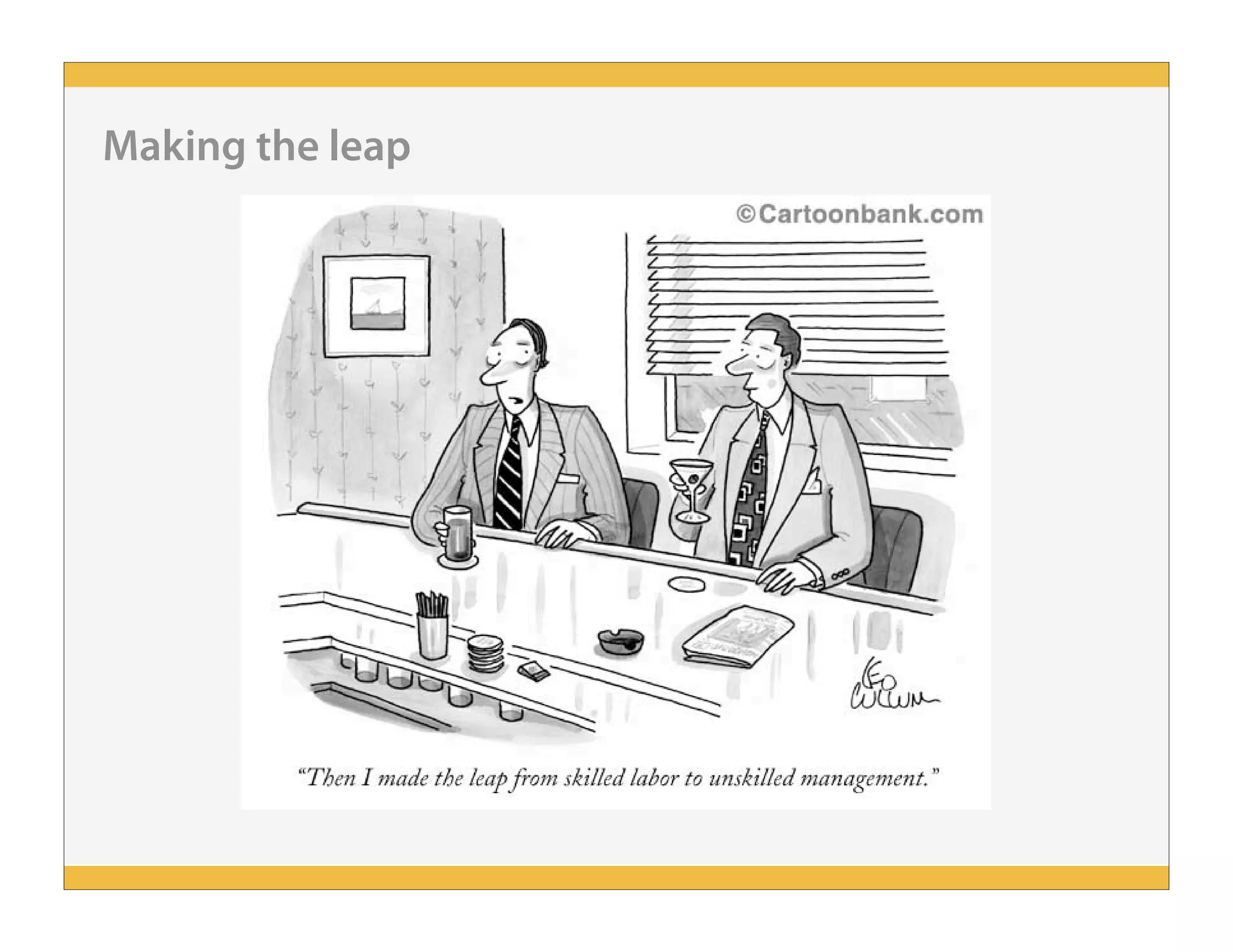
Making the leap
ka
ducer
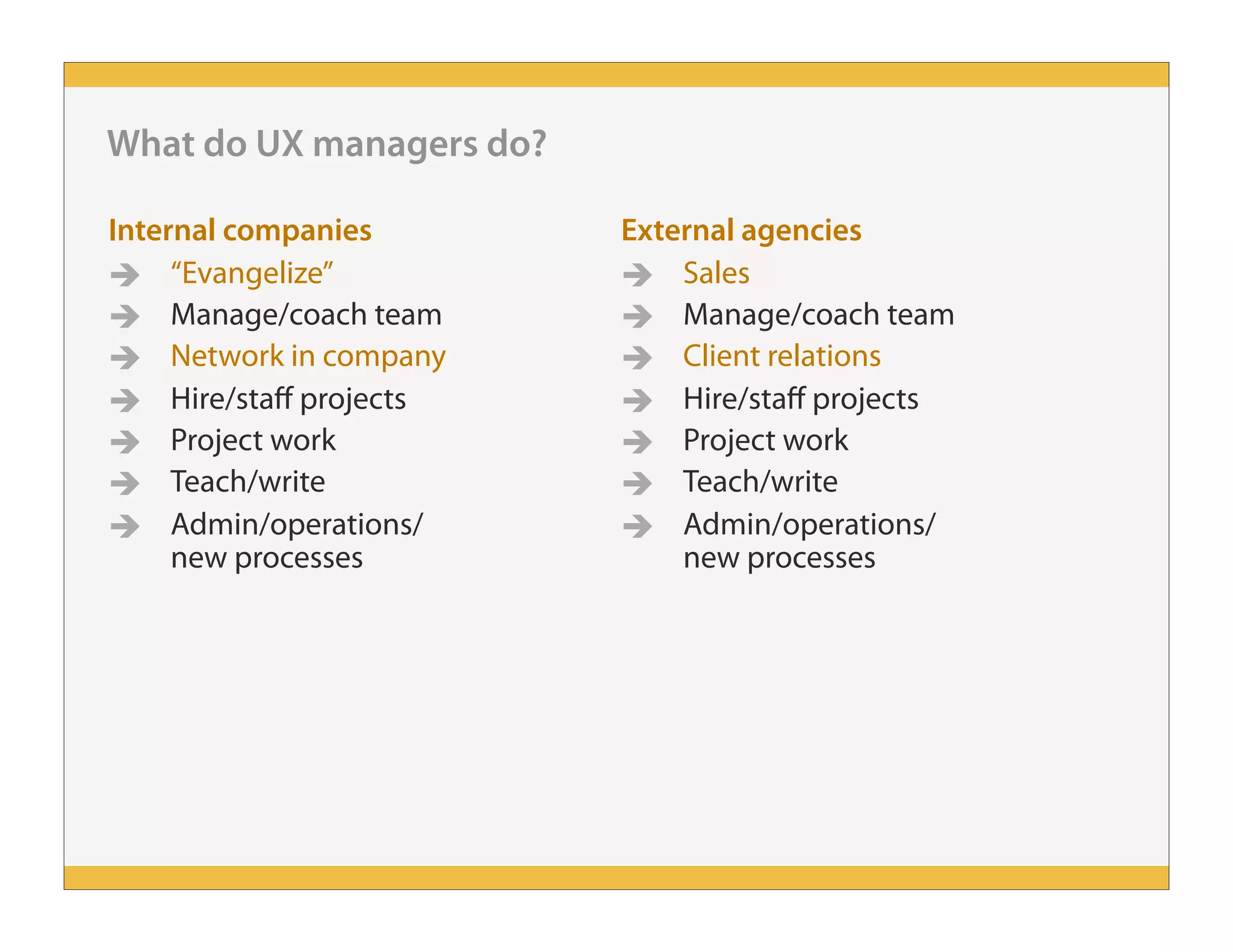
What do UX managers do?
Internal companies
 “Evangelize”
 Manage/coach team
 Network in company
 Hire/staff projects
 Project work
 Teach/write
 Admin/operations/
new processes
External agencies
 Sales
 Manage/coach team
 Client relations
 Hire/staff projects
 Project work
 Teach/write
 Admin/operations/
new processes
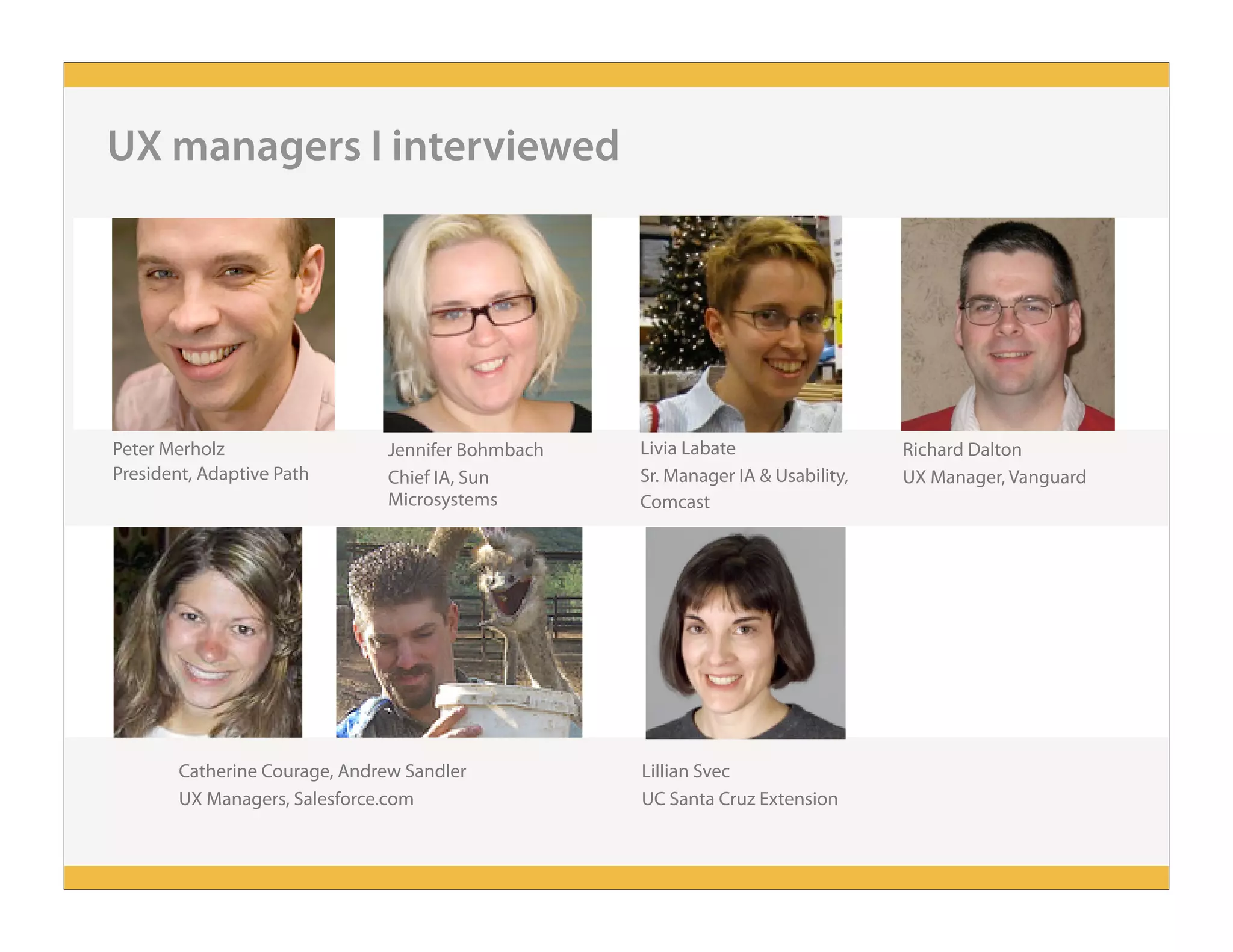
UX managers I interviewed
Peter Merholz
President, Adaptive Path
Jennifer Bohmbach
Chief IA, Sun
Microsystems
Richard Dalton
UX Manager, Vanguard
Livia Labate
Sr. Manager IA & Usability,
Comcast
Catherine Courage, Andrew Sandler
UX Managers, Salesforce.com
Lillian Svec
UC Santa Cruz Extension
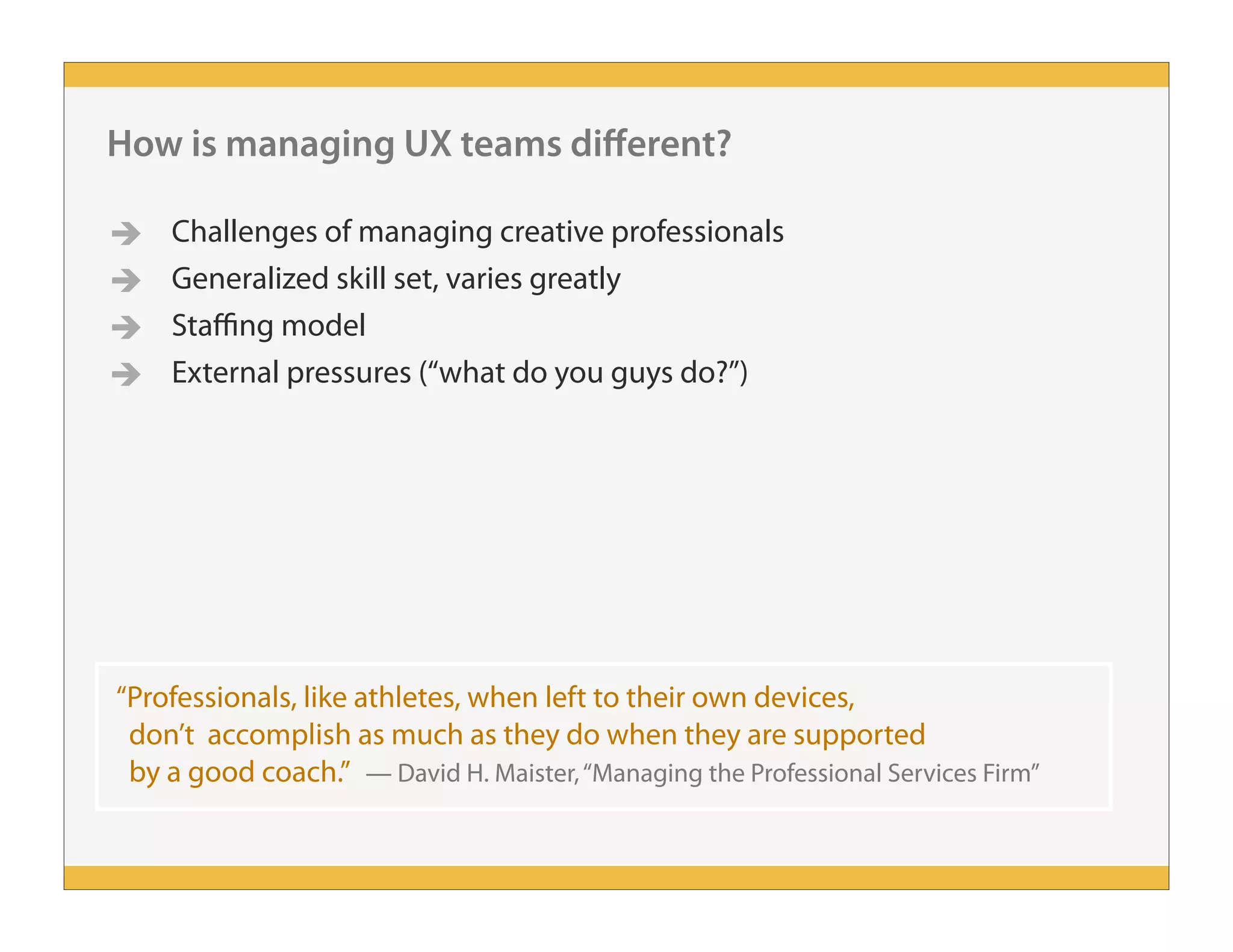
How is managing UX teams different?
 Challenges of managing creative professionals
 Generalized skill set, varies greatly
 Staffing model
 External pressures (“what do you guys do?”)
“Professionals, like athletes, when left to their own devices,
don’t accomplish as much as they do when they are supported
by a good coach.” — David H. Maister,“Managing the Professional Services Firm”
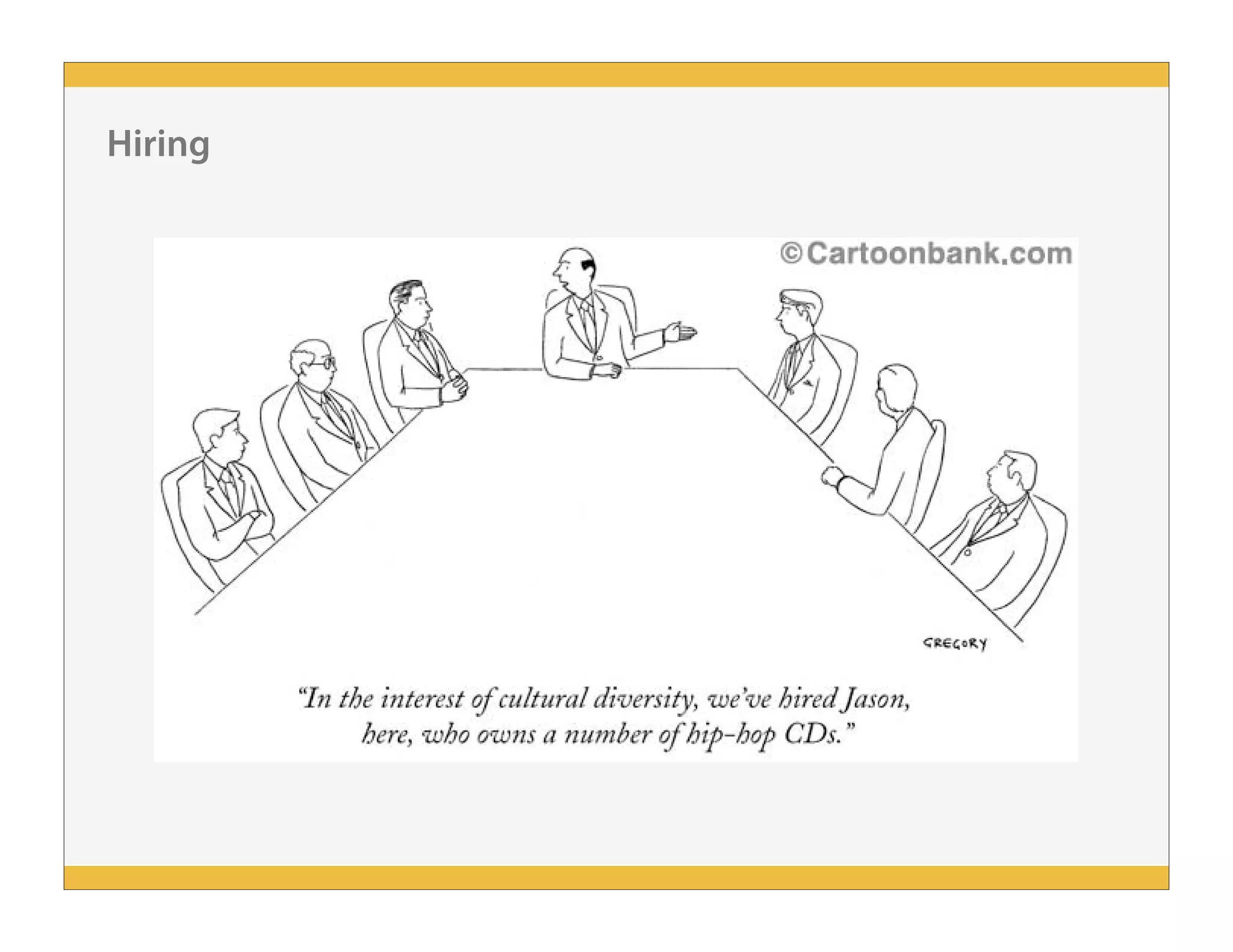
Hiring
 Personal networks only go so far
 We’ve found some great people using resources:
Craigslist (believe it or not)
Industry groups like ASIS-T, IA Institute
LinkedIn
 Others swear by
Recruiting fairs at ID
Lots and lots of networking
Internships
Look for people transitioning from other fields
 Think of hiring as an ongoing process
Where do you find people?
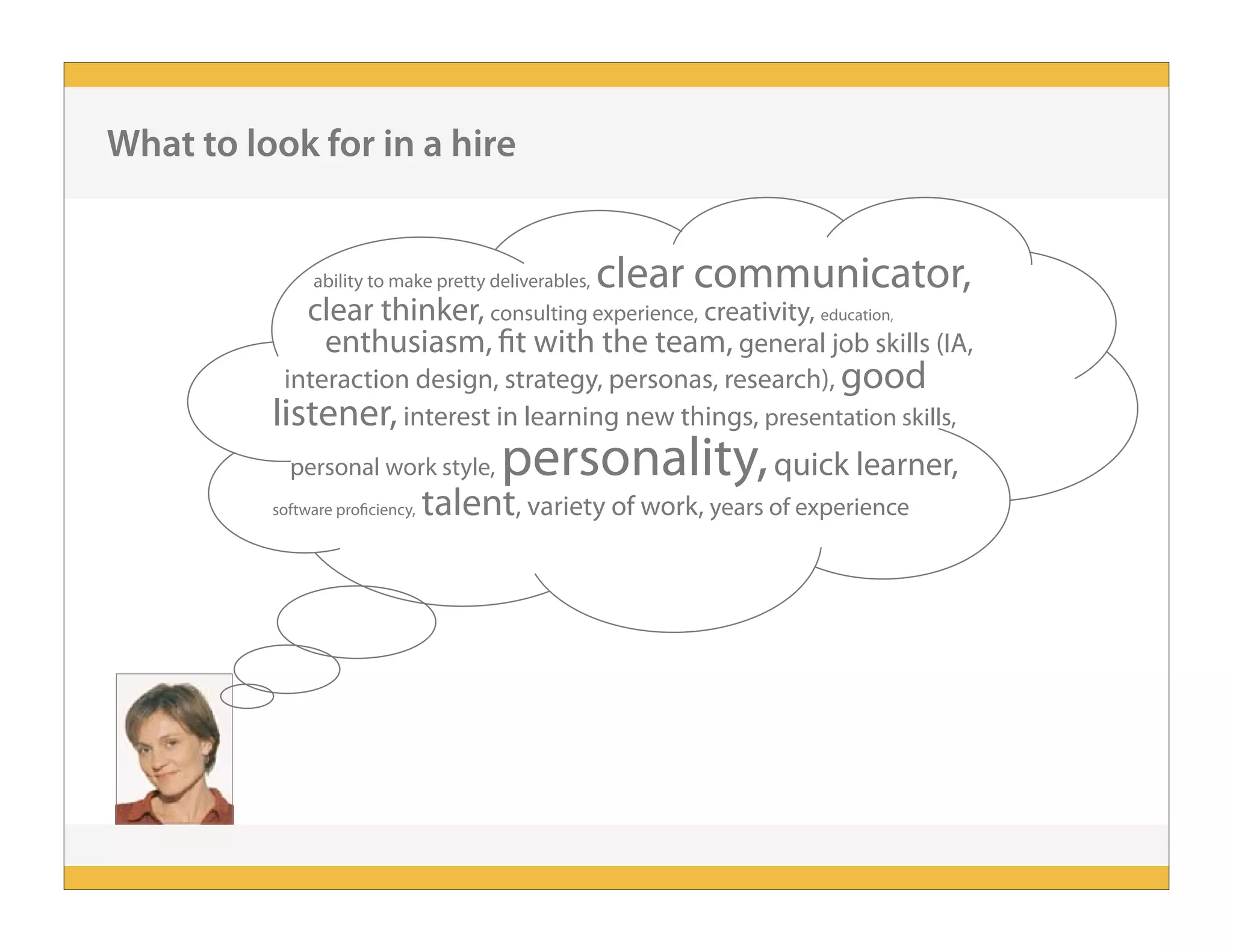
ability to make pretty deliverables, clear communicator,
clear thinker, consulting experience, creativity, education,
enthusiasm, fit with the team, general job skills (IA,
interaction design, strategy, personas, research), good
listener, interest in learning new things, presentation skills,
personal work style, personality,quick learner,
software proficiency, talent, variety of work, years of experience
What to look for in a hire
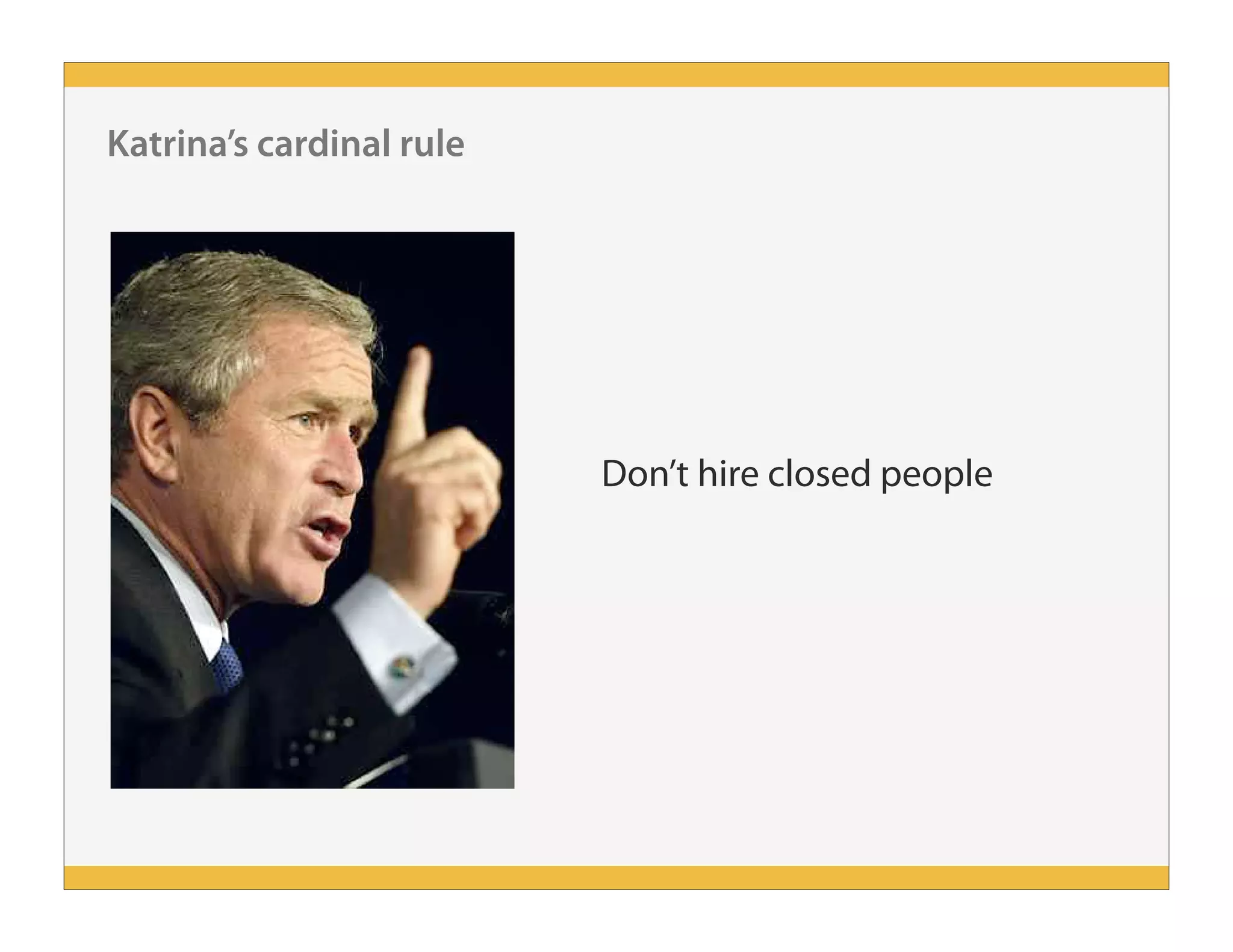
Katrina’s cardinal rule
Don’t hire closed people
What to look for in a hire
 “Passion is tops. They need to have a love for the work.”— Peter
 “Good critical thinkers. People who get the big picture.”— Jennifer
 “Good communication. If you can’t communicate effectively,
you can’t do your job.”— Catherine
 “At Salesforce, everybody codes. You have to have technical
competence.”— Andrew
 “A serious commitment to the IA community.”— Livia
 “Soft skills! We work in teams a lot. You have to collaborate well.”
— Richard
 “With researchers, you want them to be flexible and creative about how
they conduct their research. Rigorous academics aren’t enough.”—
Lillian
*see Jared Spool’s thoughts about generalists versus specialists
http://www.uie.com/brainsparks/2006/09/08/specialists-vs-generalists/
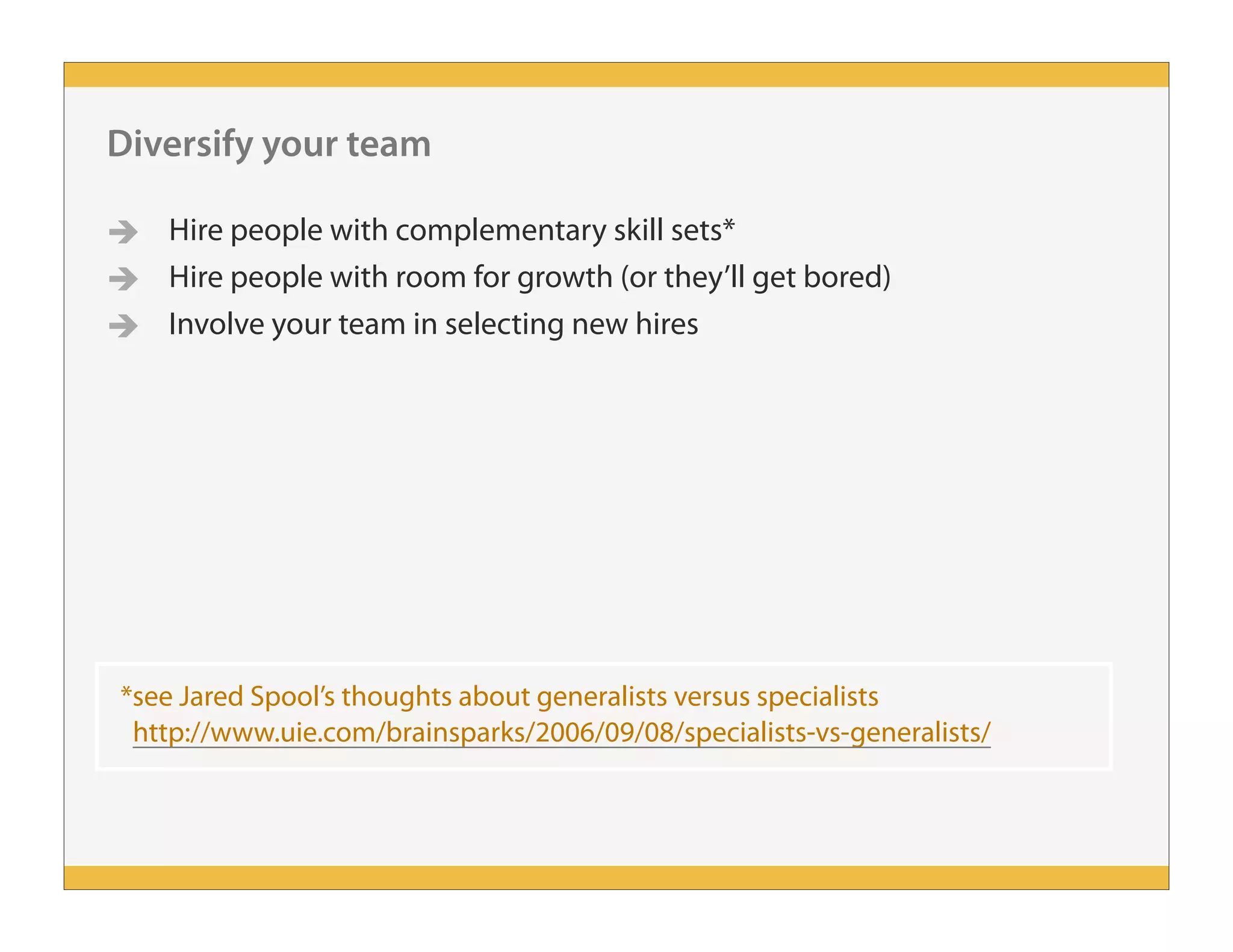
Diversify your team
 Hire people with complementary skill sets*
 Hire people with room for growth (or they’ll get bored)
 Involve your team in selecting new hires
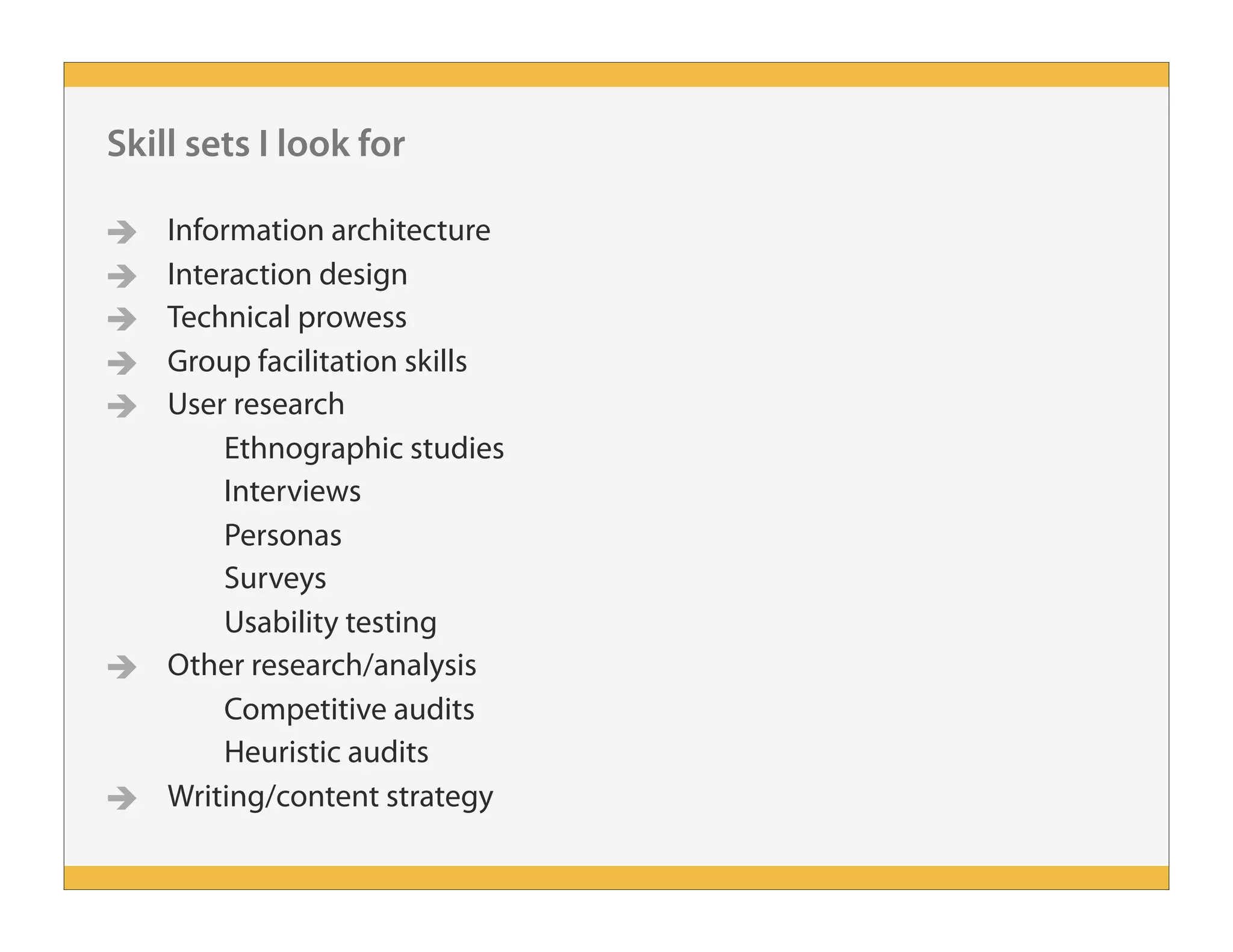
Skill sets I look for
 Information architecture
 Interaction design
 Technical prowess
 Group facilitation skills
 User research
Ethnographic studies
Interviews
Personas
Surveys
Usability testing
 Other research/analysis
Competitive audits
Heuristic audits
 Writing/content strategy
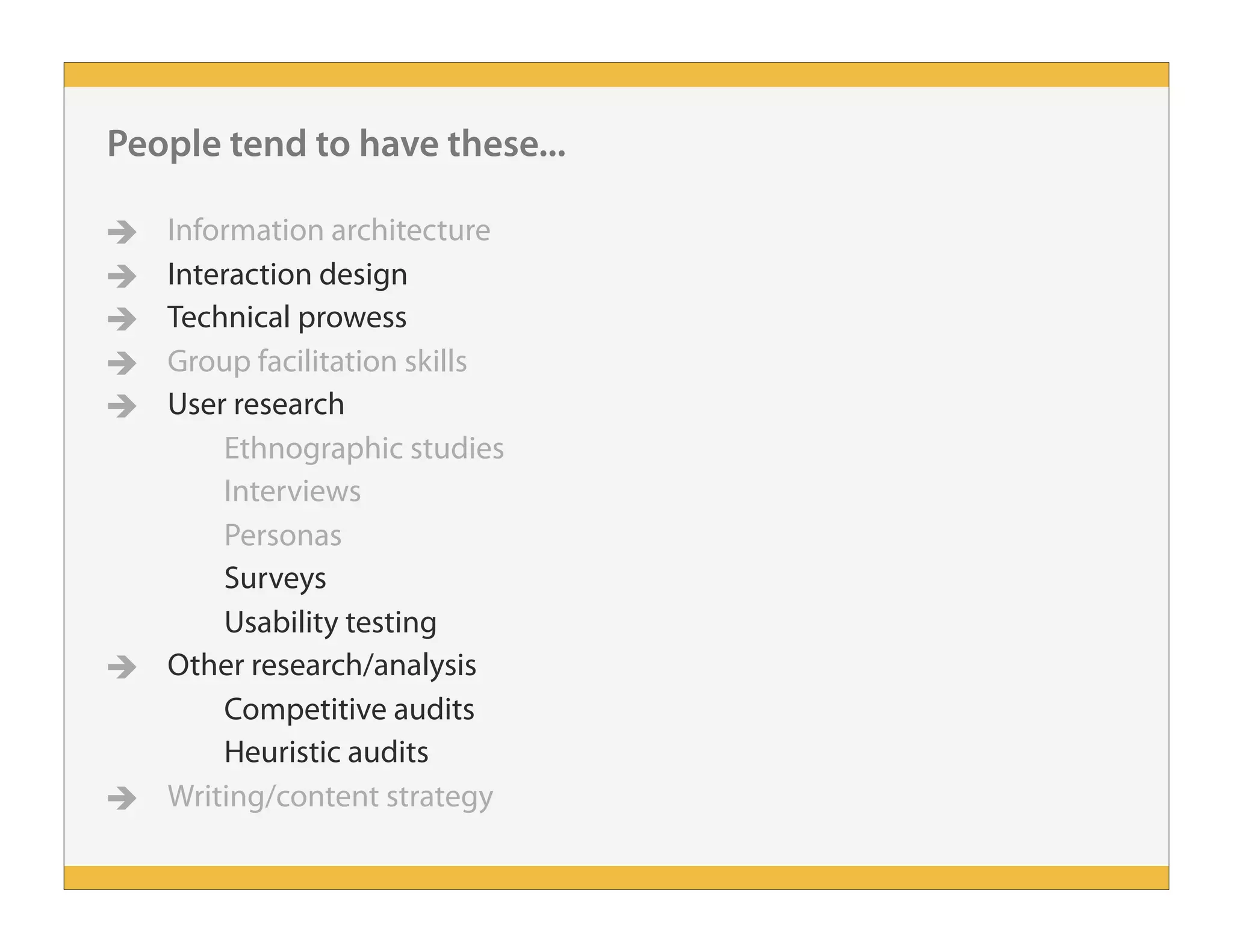
People tend to have these...
 Information architecture
 Interaction design
 Technical prowess
 Group facilitation skills
 User research
Ethnographic studies
Interviews
Personas
Surveys
Usability testing
 Other research/analysis
Competitive audits
Heuristic audits
 Writing/content strategy
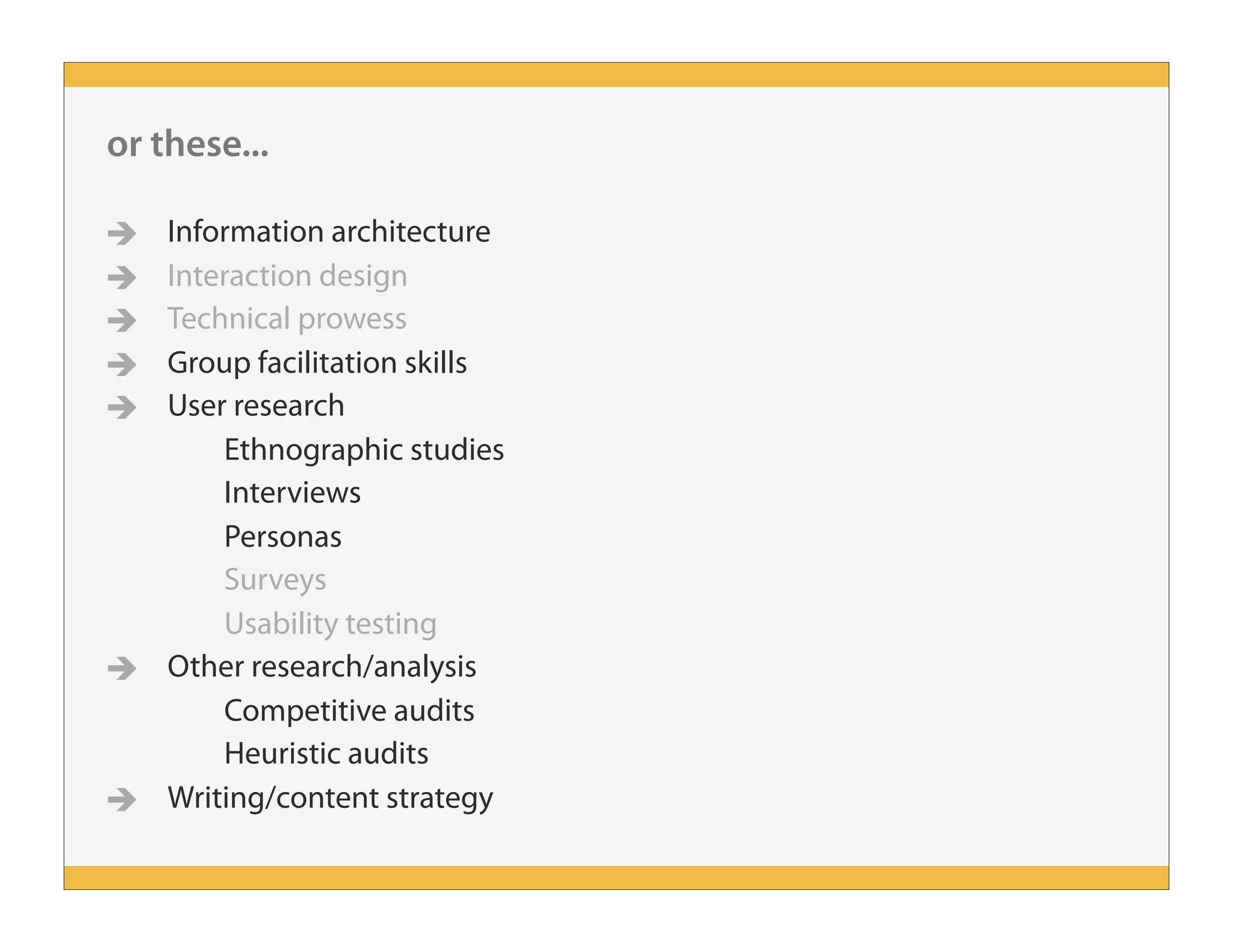
or these...
 Information architecture
 Interaction design
 Technical prowess
 Group facilitation skills
 User research
Ethnographic studies
Interviews
Personas
Surveys
Usability testing
 Other research/analysis
Competitive audits
Heuristic audits
 Writing/content strategy
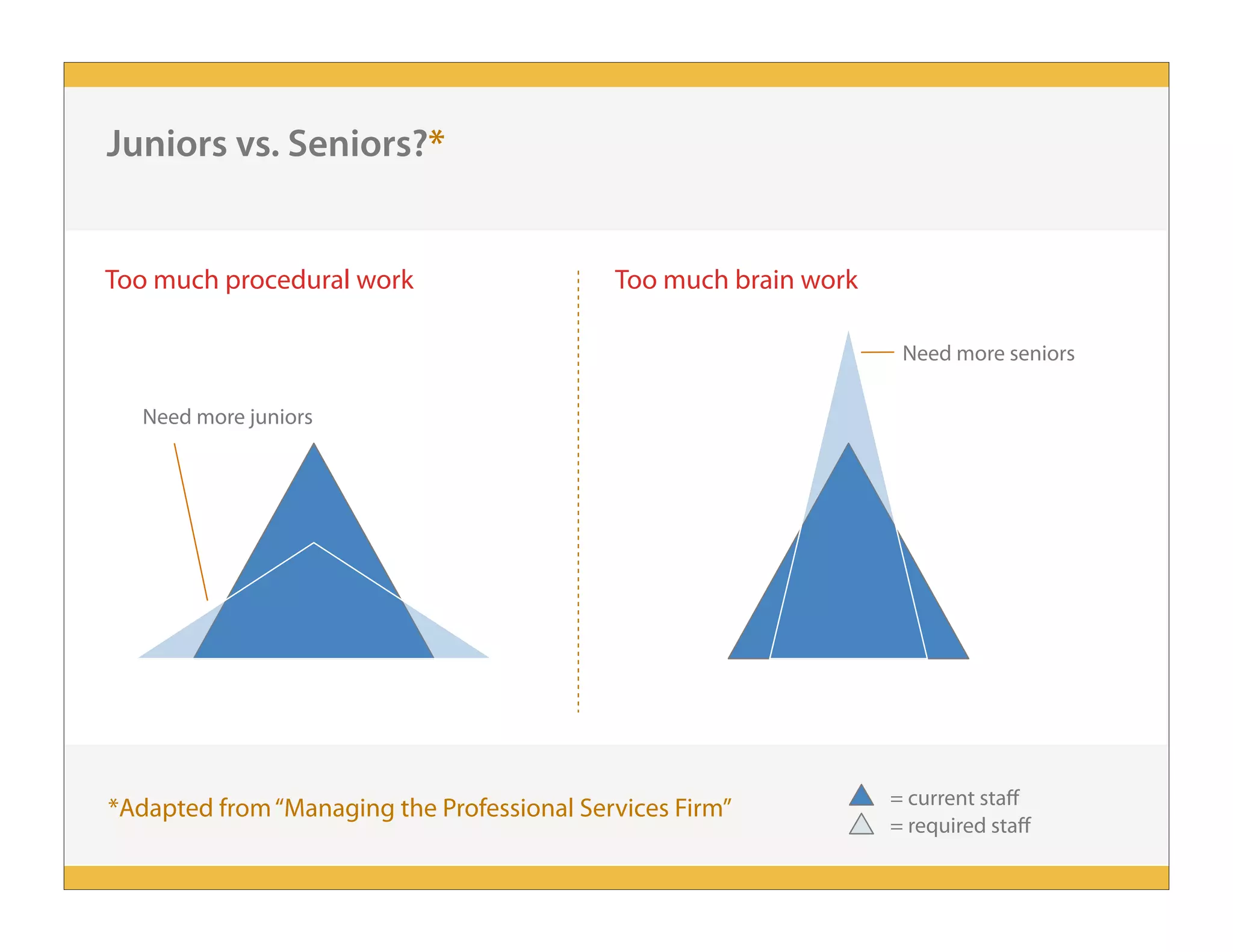
Juniors vs. Seniors?*
*Adapted from“Managing the Professional Services Firm”
Too much procedural work Too much brain work
= current staff
= required staff
Need more juniors
Need more seniors
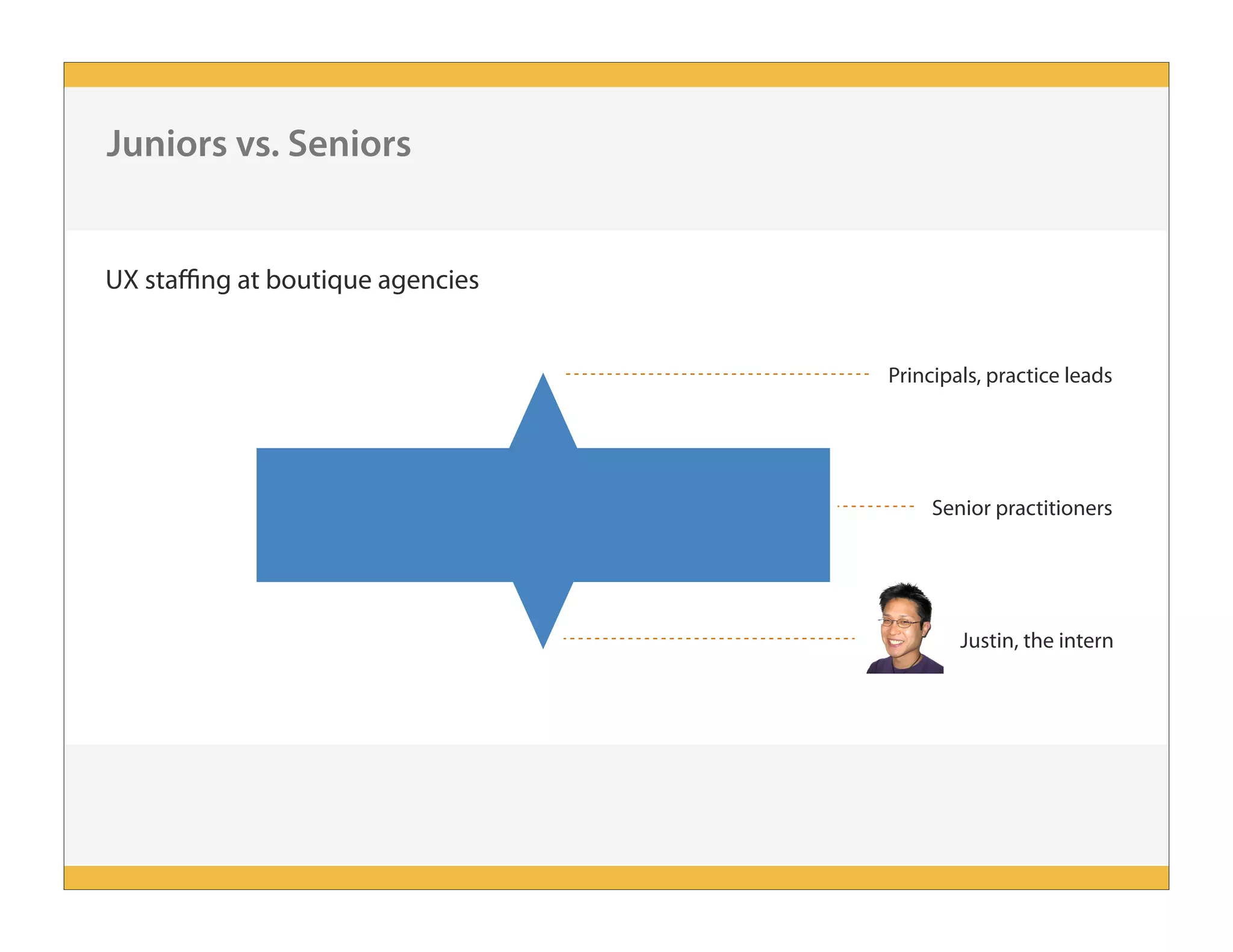
Juniors vs. Seniors
UX staffing at boutique agencies
Principals, practice leads
Senior practitioners
Justin, the intern
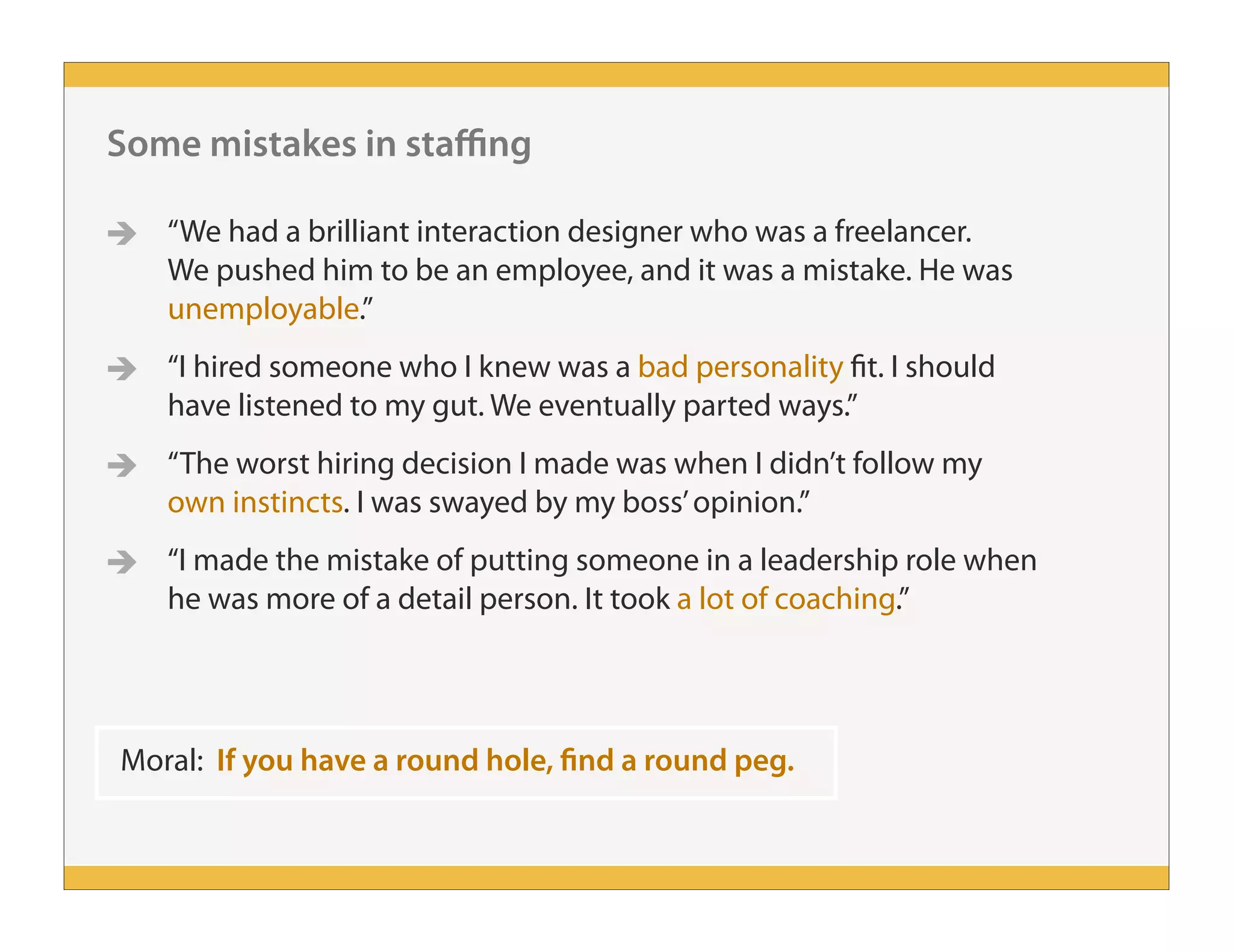
Some mistakes in staffing
 “We had a brilliant interaction designer who was a freelancer.
We pushed him to be an employee, and it was a mistake. He was
unemployable.”
 “I hired someone who I knew was a bad personality fit. I should
have listened to my gut. We eventually parted ways.”
 “The worst hiring decision I made was when I didn’t follow my
own instincts. I was swayed by my boss’opinion.”
 “I made the mistake of putting someone in a leadership role when
he was more of a detail person. It took a lot of coaching.”
Moral: If you have a round hole, find a round peg.
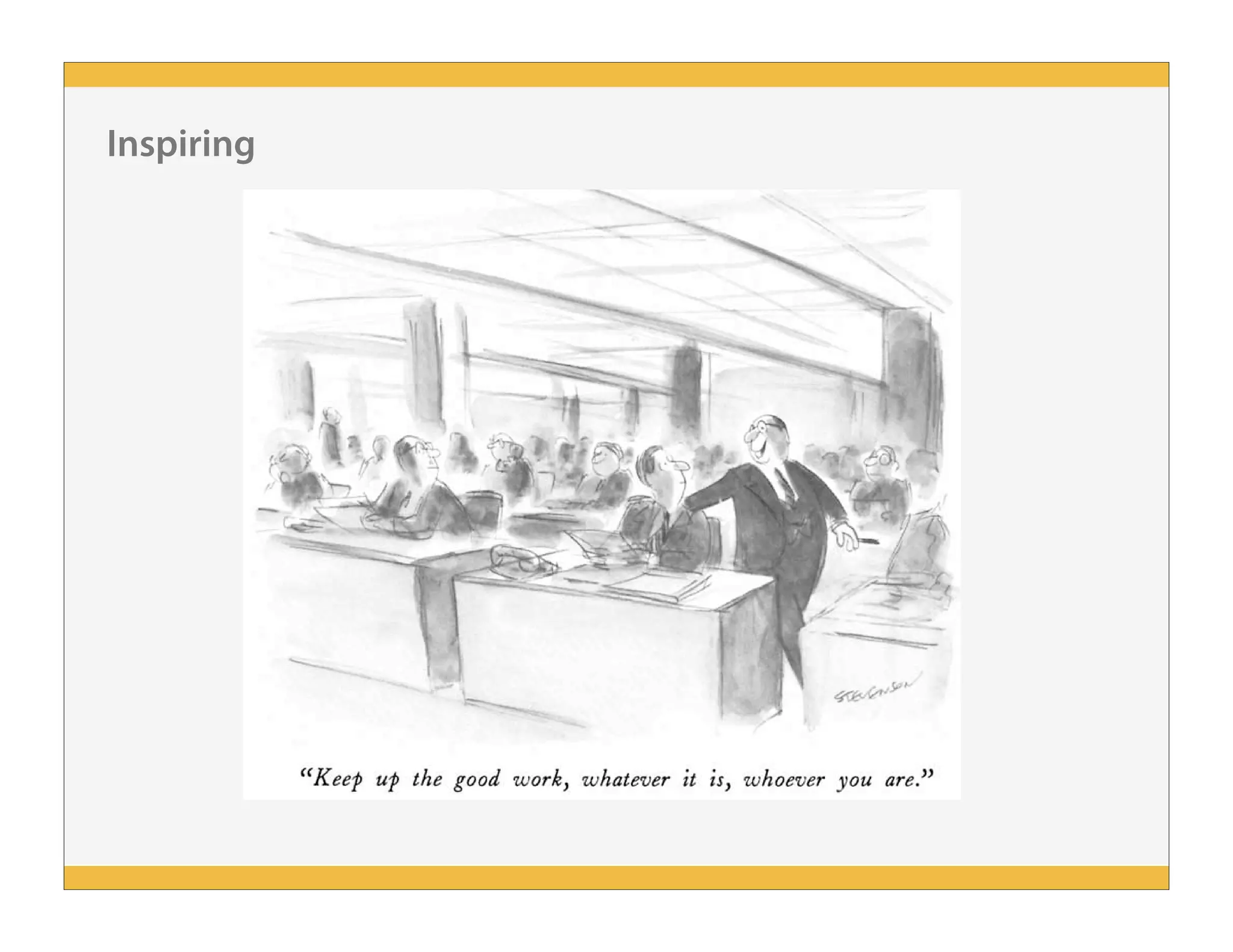
Inspiring
Bad boss behavior
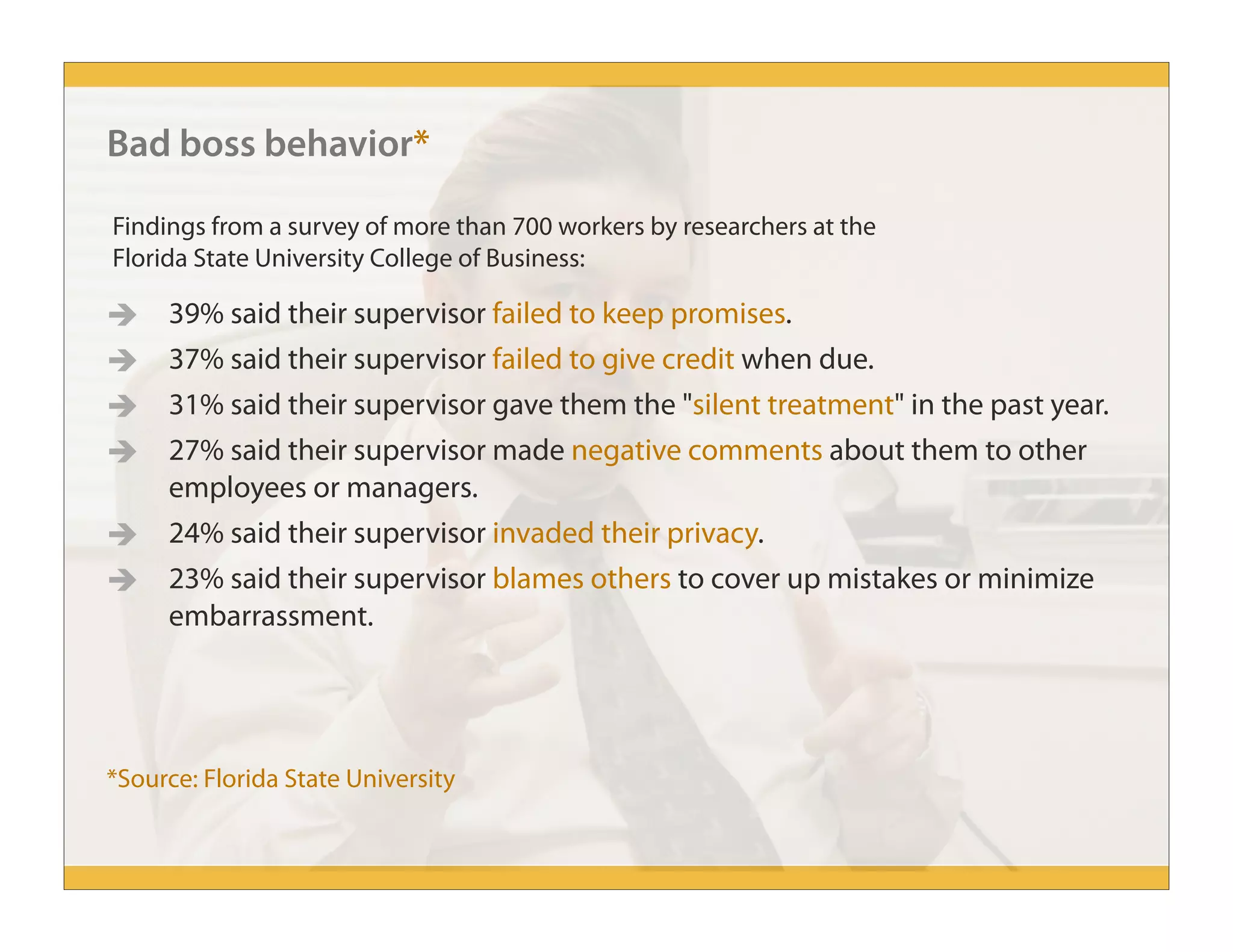
Bad boss behavior*
 39% said their supervisor failed to keep promises.
 37% said their supervisor failed to give credit when due.
 31% said their supervisor gave them the "silent treatment" in the past year.
 27% said their supervisor made negative comments about them to other
employees or managers.
 24% said their supervisor invaded their privacy.
 23% said their supervisor blames others to cover up mistakes or minimize
embarrassment.
*Source: Florida State University
Findings from a survey of more than 700 workers by researchers at the
Florida State University College of Business:
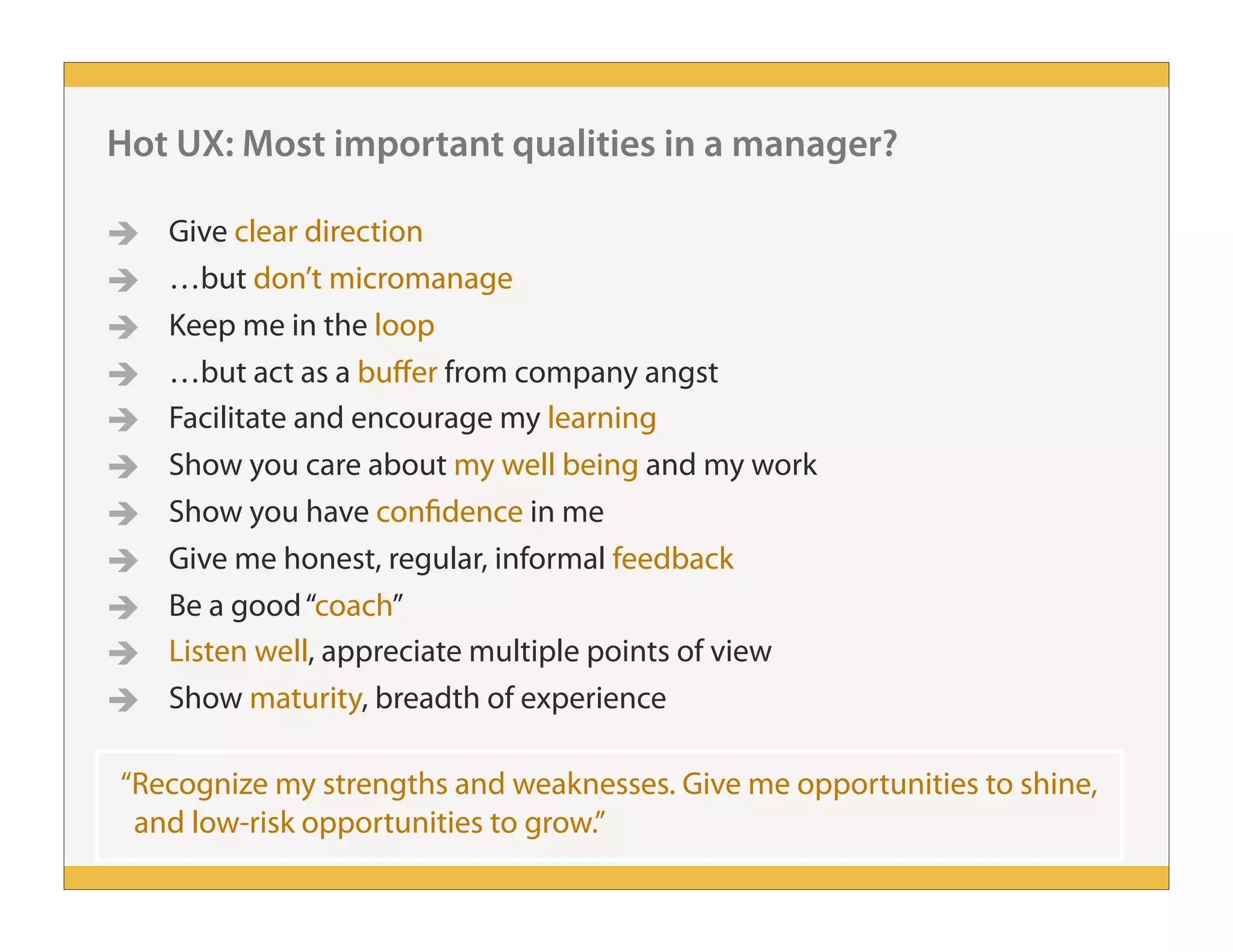
 Give clear direction
 …but don’t micromanage
 Keep me in the loop
 …but act as a buffer from company angst
 Facilitate and encourage my learning
 Show you care about my well being and my work
 Show you have confidence in me
 Give me honest, regular, informal feedback
 Be a good“coach”
 Listen well, appreciate multiple points of view
 Show maturity, breadth of experience
Hot UX: Most important qualities in a manager?
“Recognize my strengths and weaknesses. Give me opportunities to shine,
and low-risk opportunities to grow.”
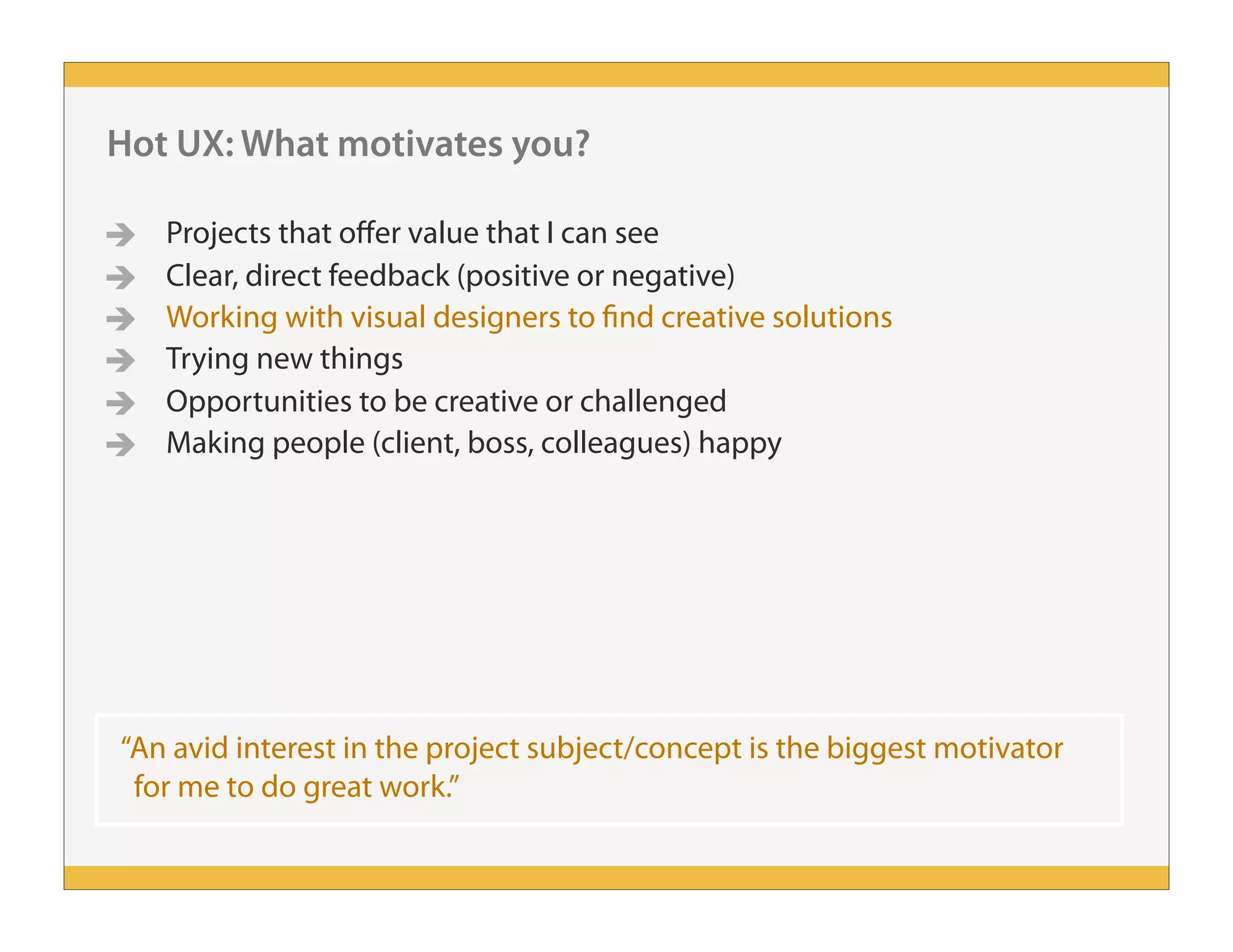
 Projects that offer value that I can see
 Clear, direct feedback (positive or negative)
 Working with visual designers to find creative solutions
 Trying new things
 Opportunities to be creative or challenged
 Making people (client, boss, colleagues) happy
Hot UX: What motivates you?
“An avid interest in the project subject/concept is the biggest motivator
for me to do great work.”
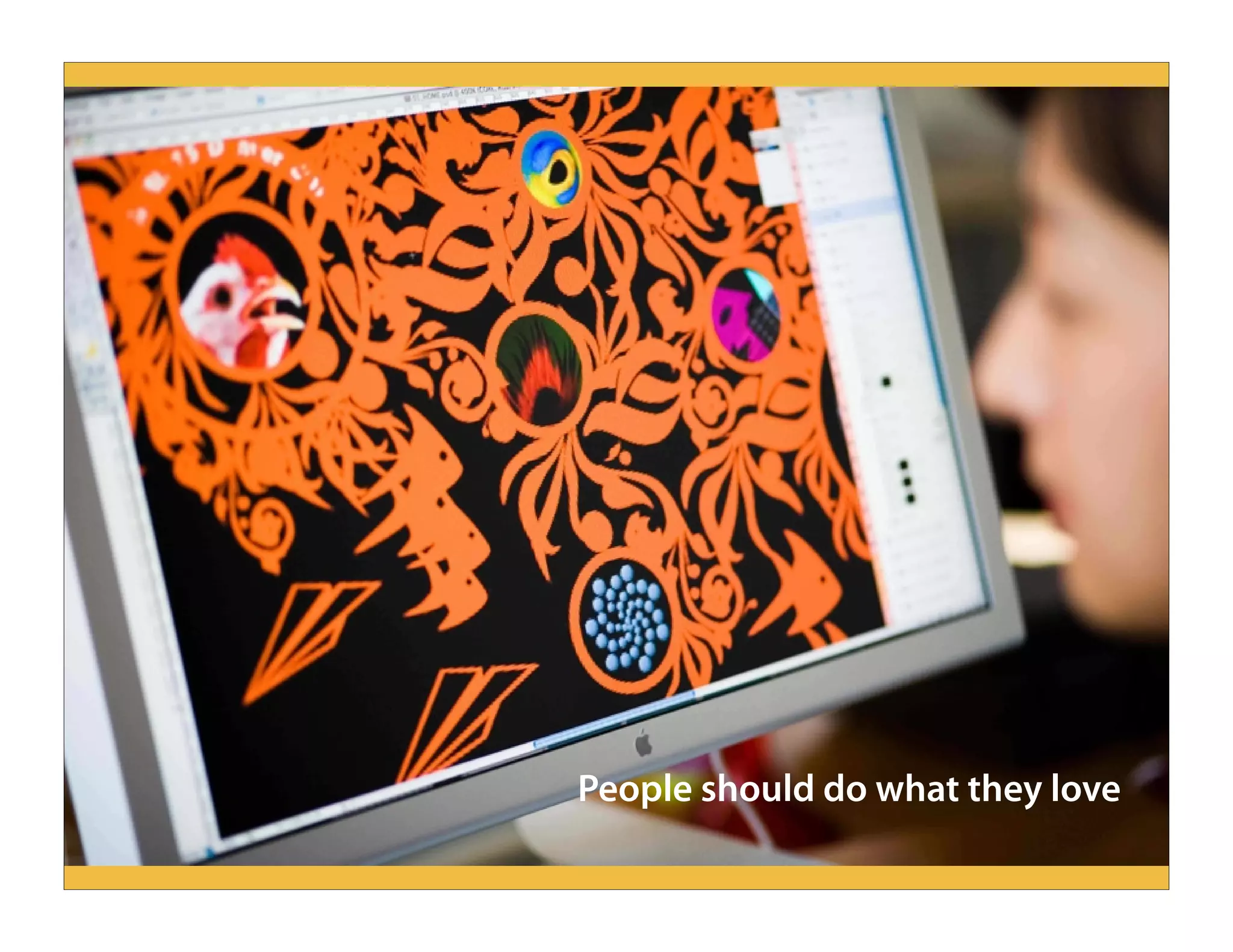
People should do what they love
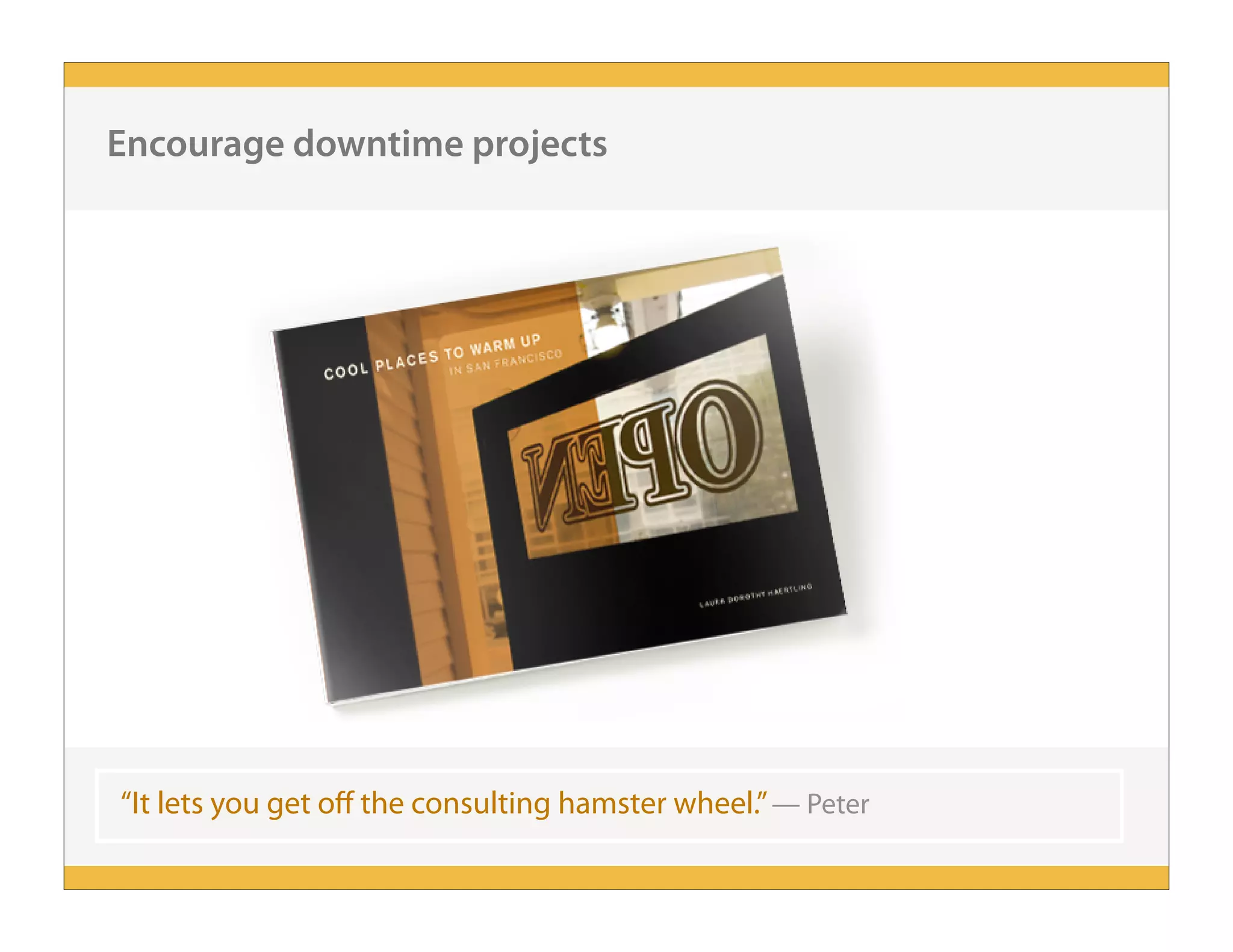
“It lets you get off the consulting hamster wheel.”— Peter
Encourage downtime projects
Encourage group learning
 Weekly team meetings
 Takes classes, go to conferences, report back
 Host an off-site
 “Innovation exercises”
“Vanguard is a pretty progressive place for encouraging people to do
the right thing. I can count on one hand the times people brought me
a suggestion and I had to say no.”— Richard Dalton, Vanguard
Design
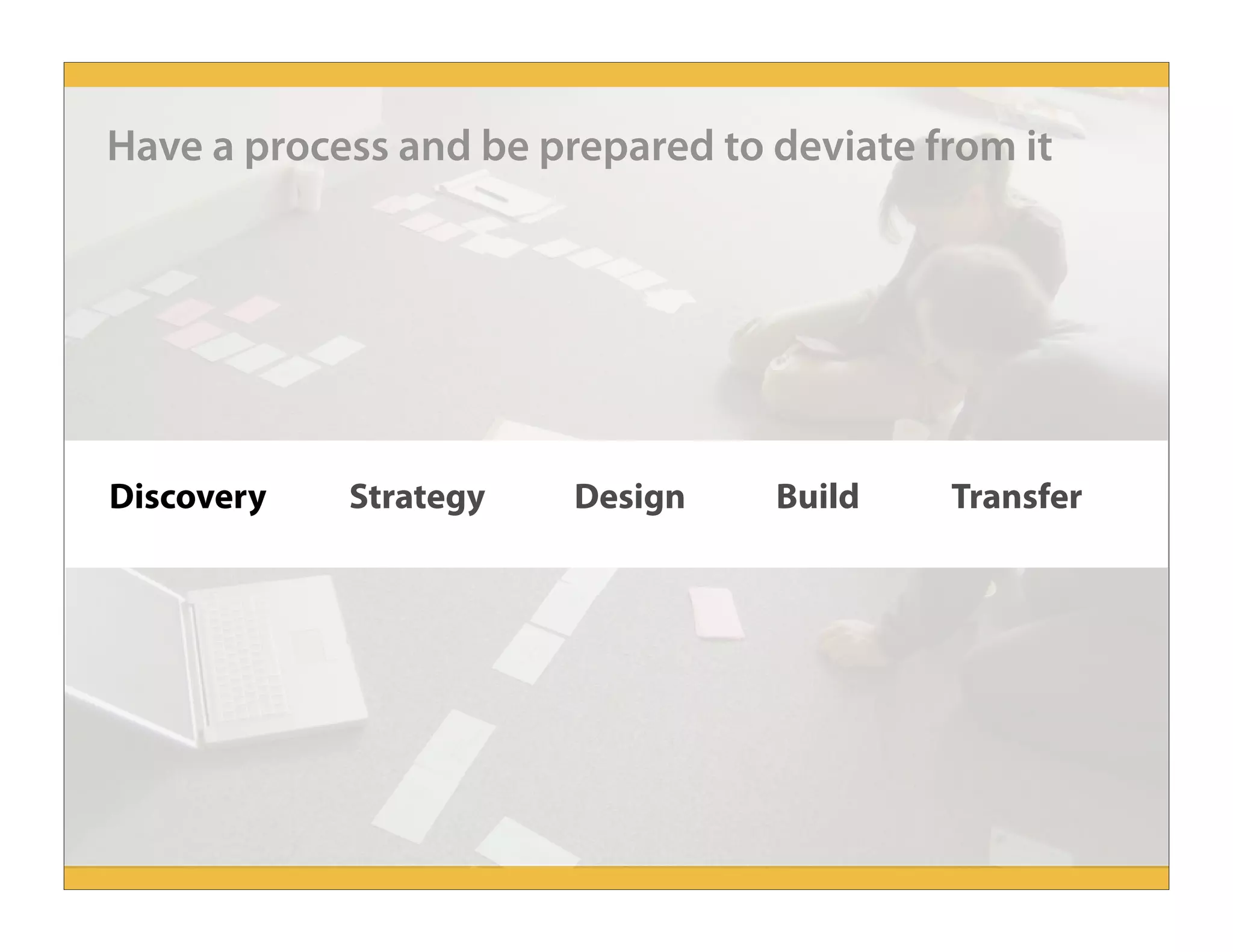
Have a process and be prepared to deviate from it
Discovery Strategy Build Transfer
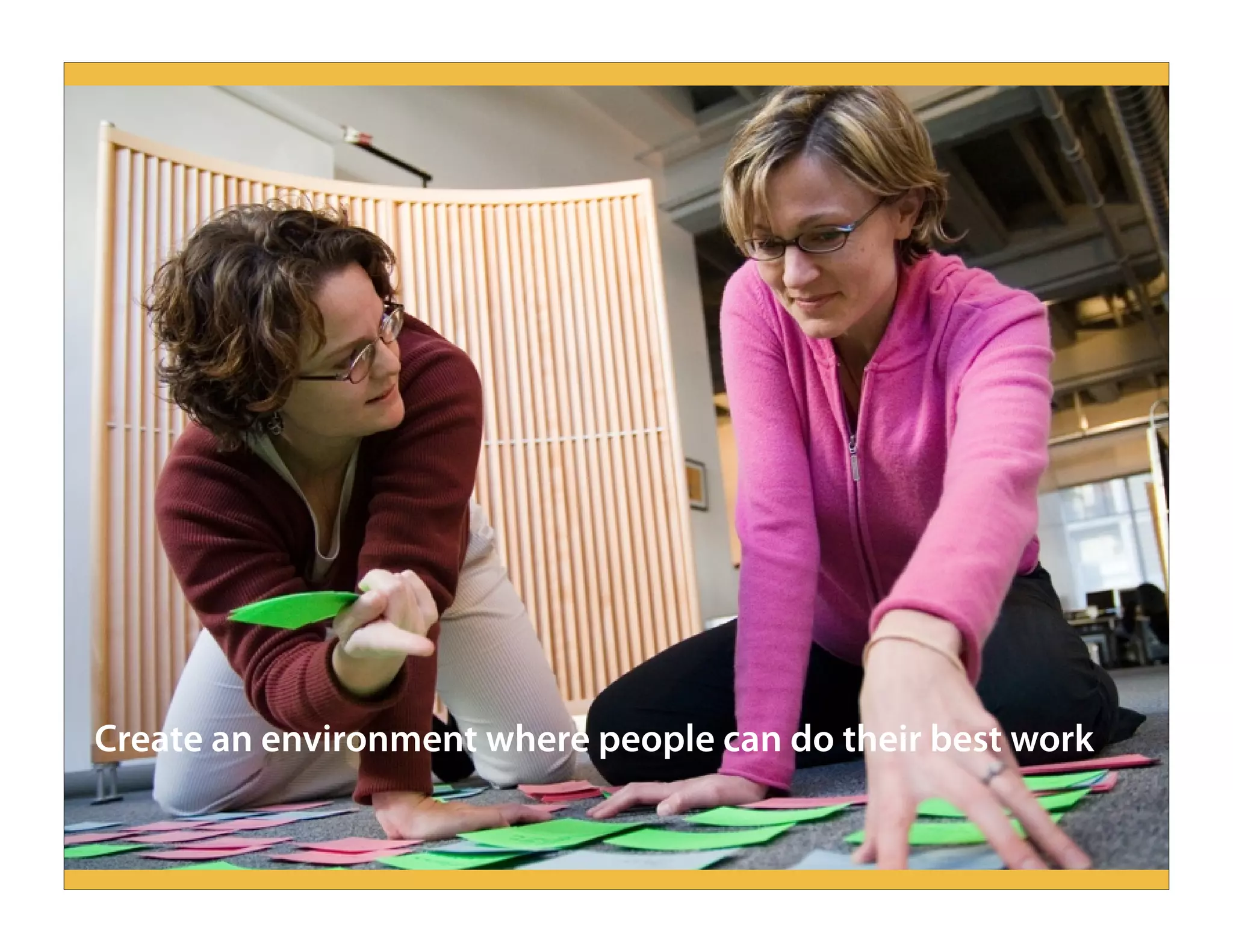
Create an environment where people can do their best work
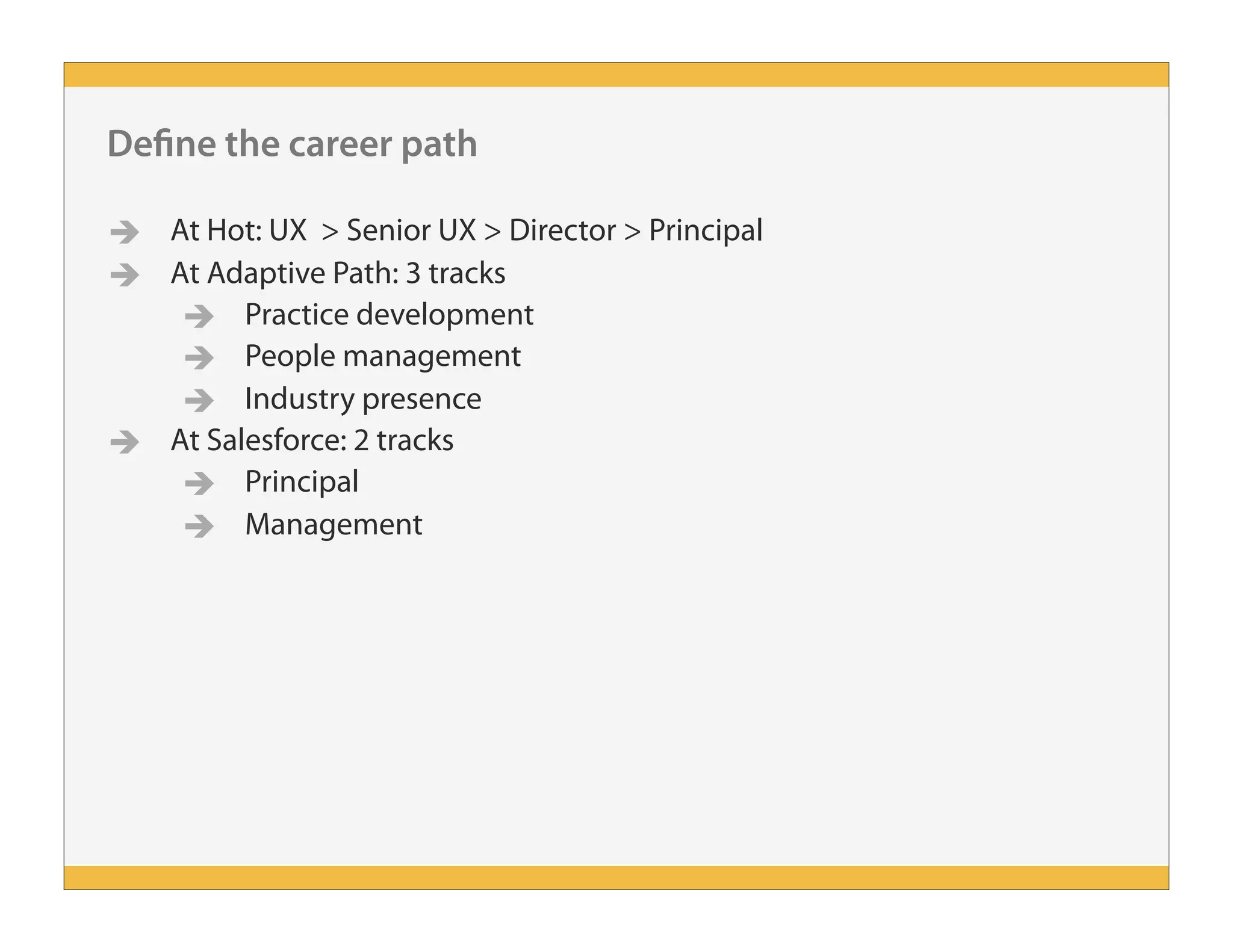
 At Hot: UX > Senior UX > Director > Principal
 At Adaptive Path: 3 tracks
 Practice development
 People management
 Industry presence
 At Salesforce: 2 tracks
 Principal
 Management
Define the career path
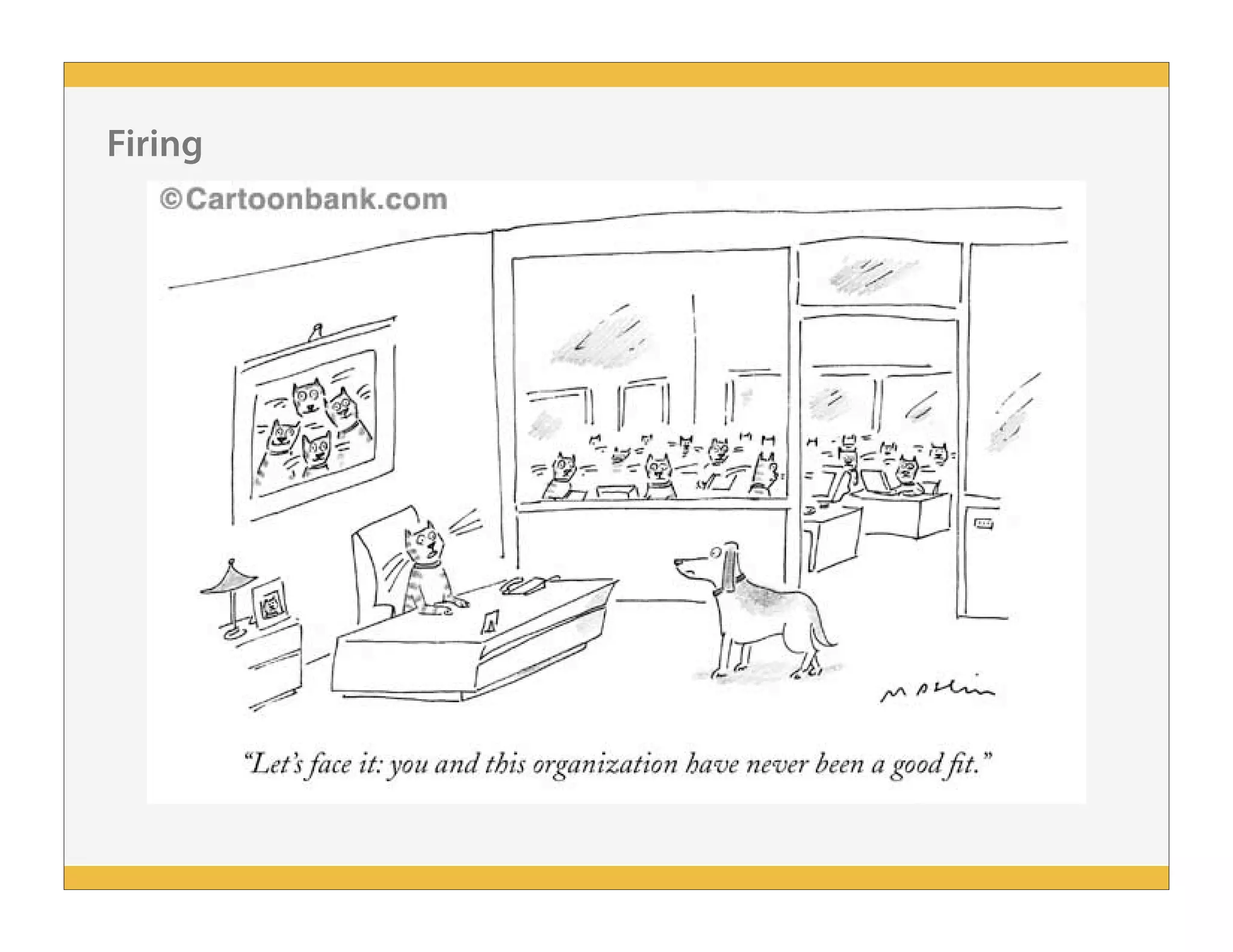
Firing
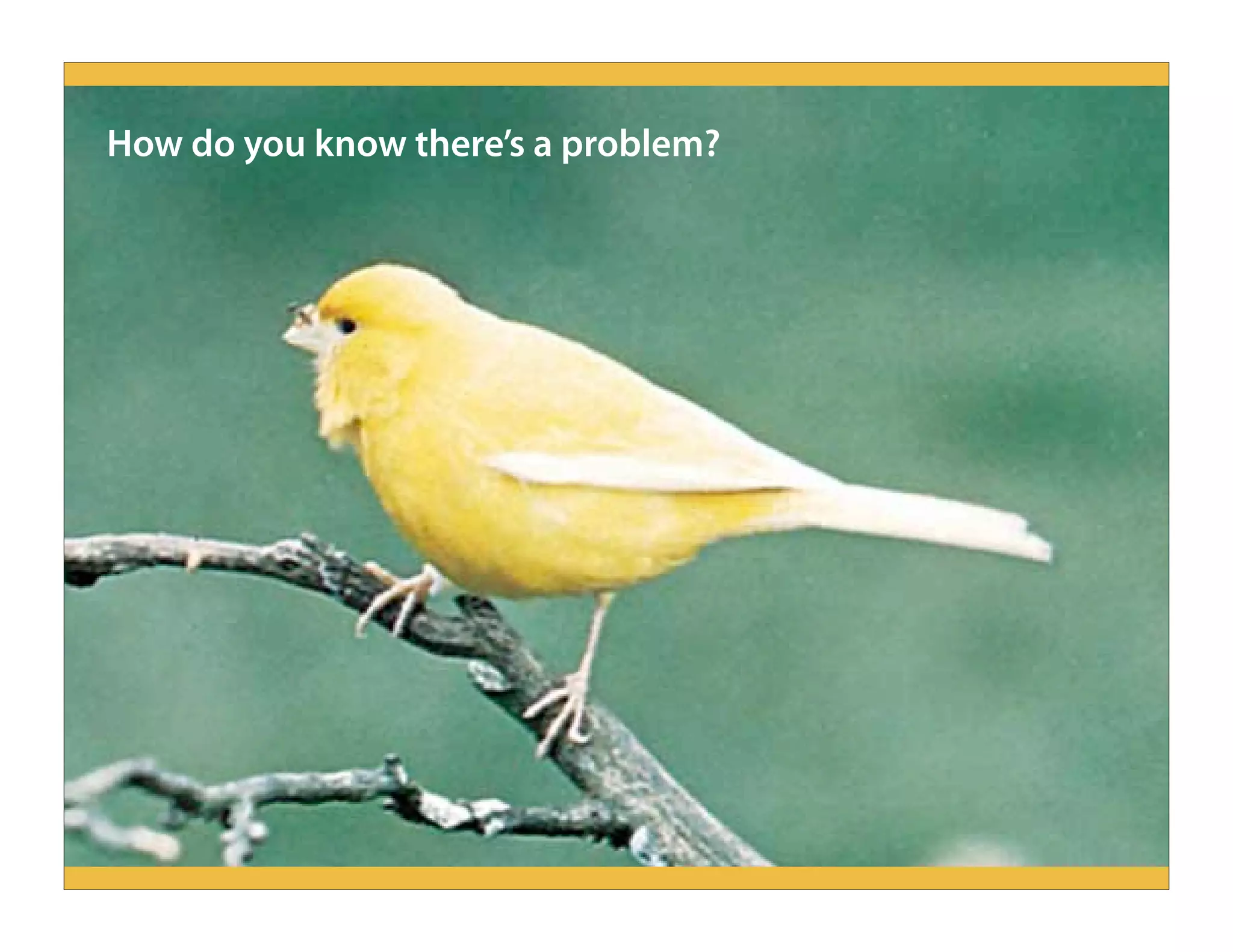
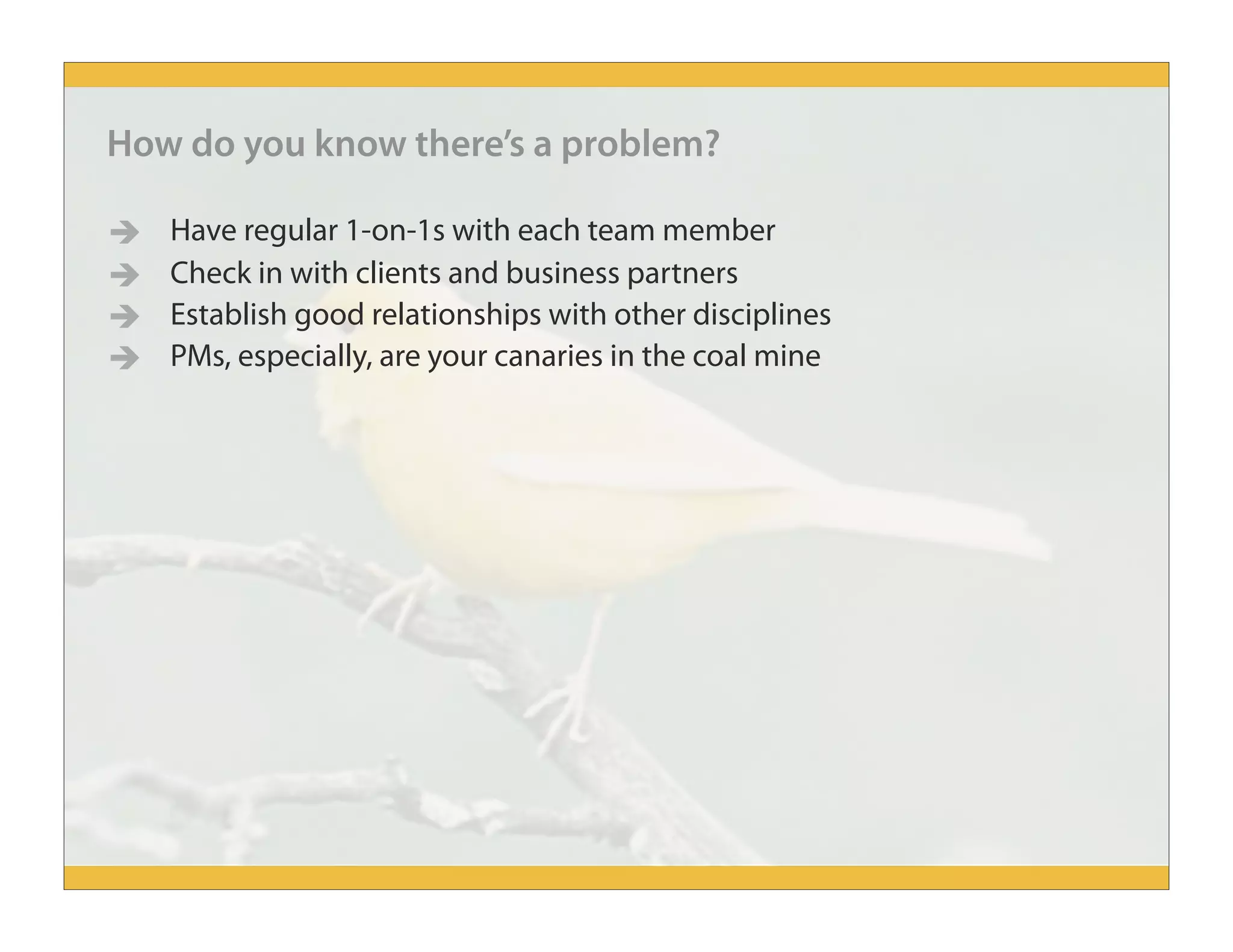
How do you know there’s a problem?
 Have regular 1-on-1s with each team member
 Check in with clients and business partners
 Establish good relationships with other disciplines
 PMs, especially, are your canaries in the coal mine
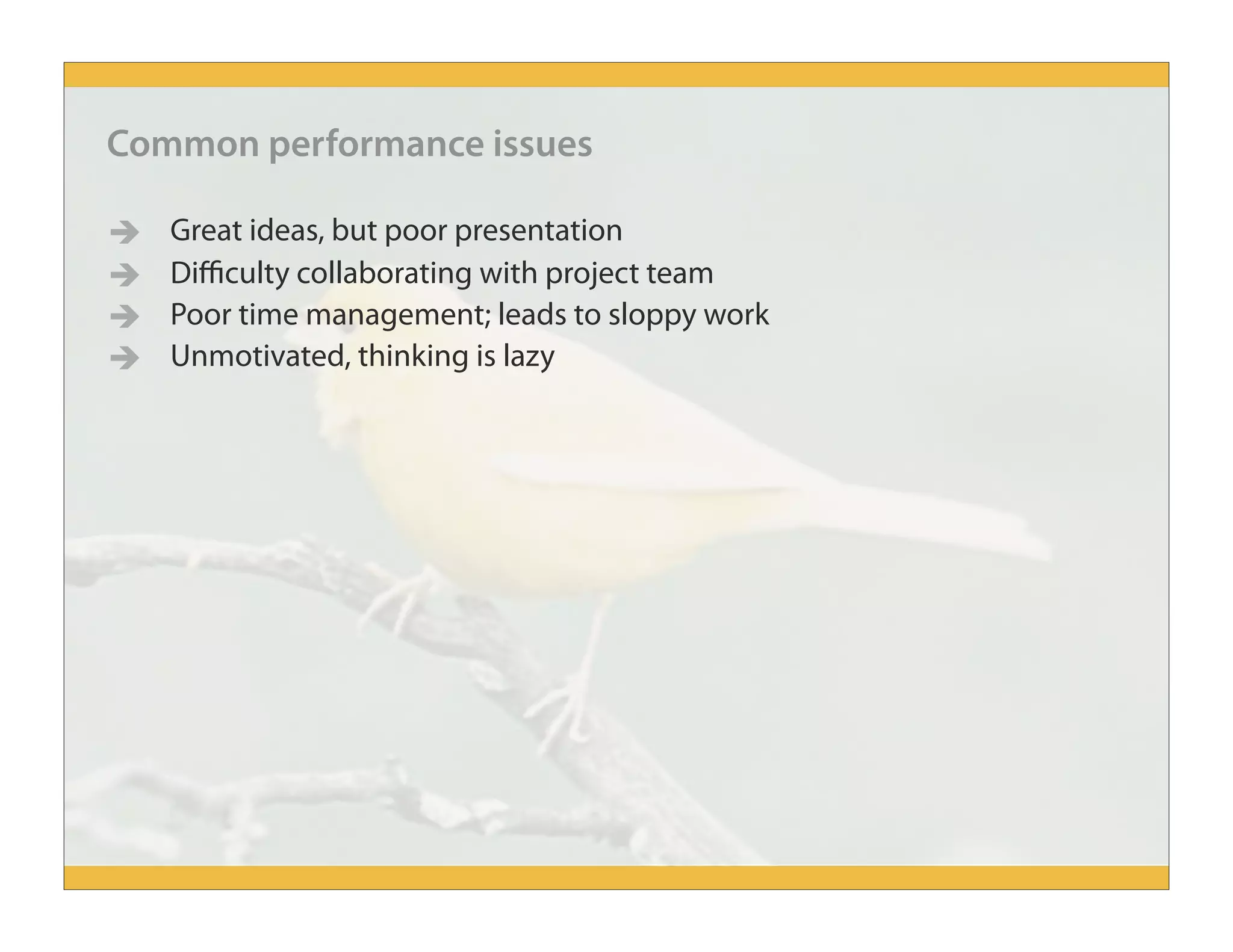
 Great ideas, but poor presentation
 Difficulty collaborating with project team
 Poor time management; leads to sloppy work
 Unmotivated, thinking is lazy
Common performance issues
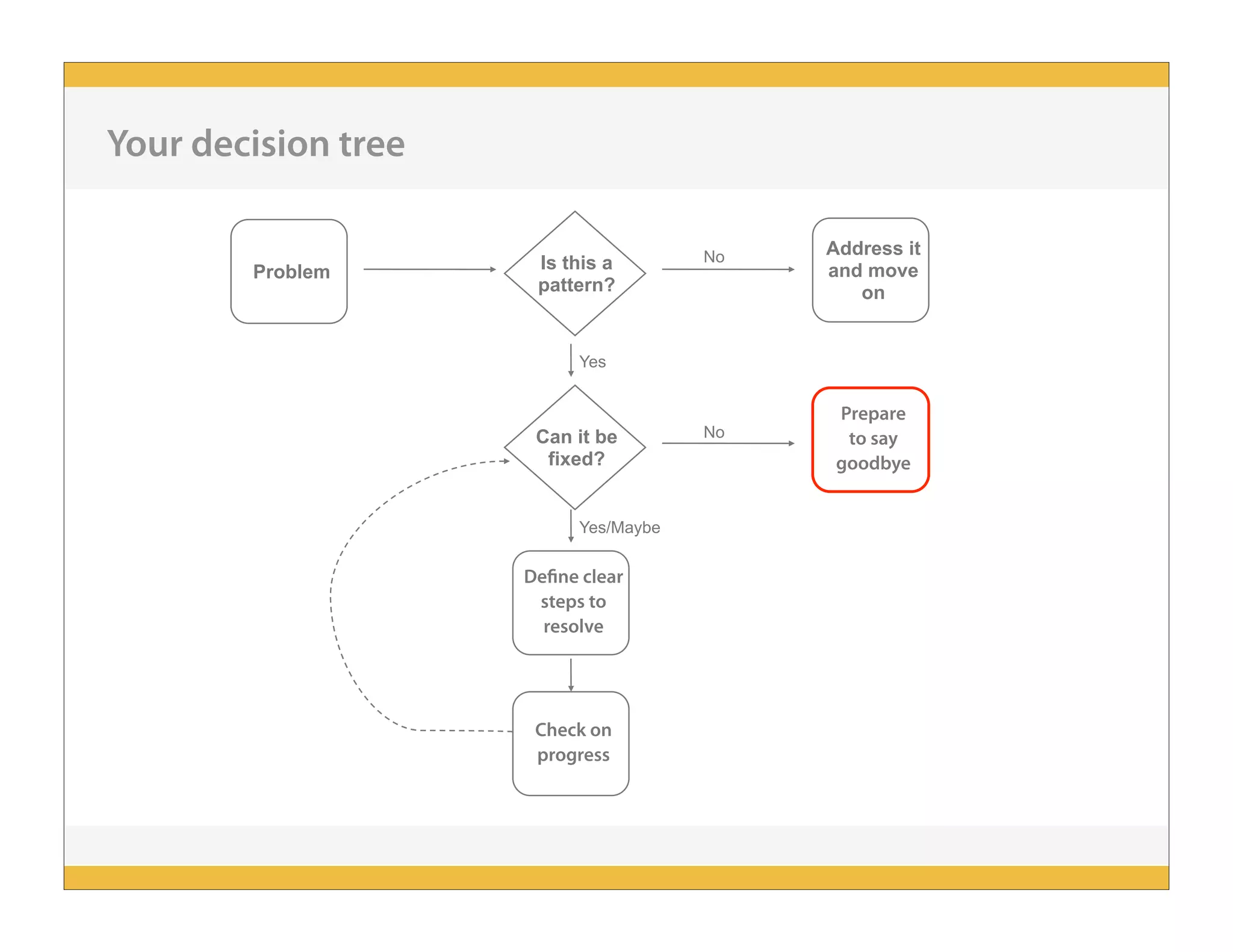
Problem Is this a
pattern?
Address it
and move
on
Can it be
fixed?
Prepare
to say
goodbye
Define clear
steps to
resolve
Check on
progress
No
Yes/Maybe
Yes
No
Your decision tree
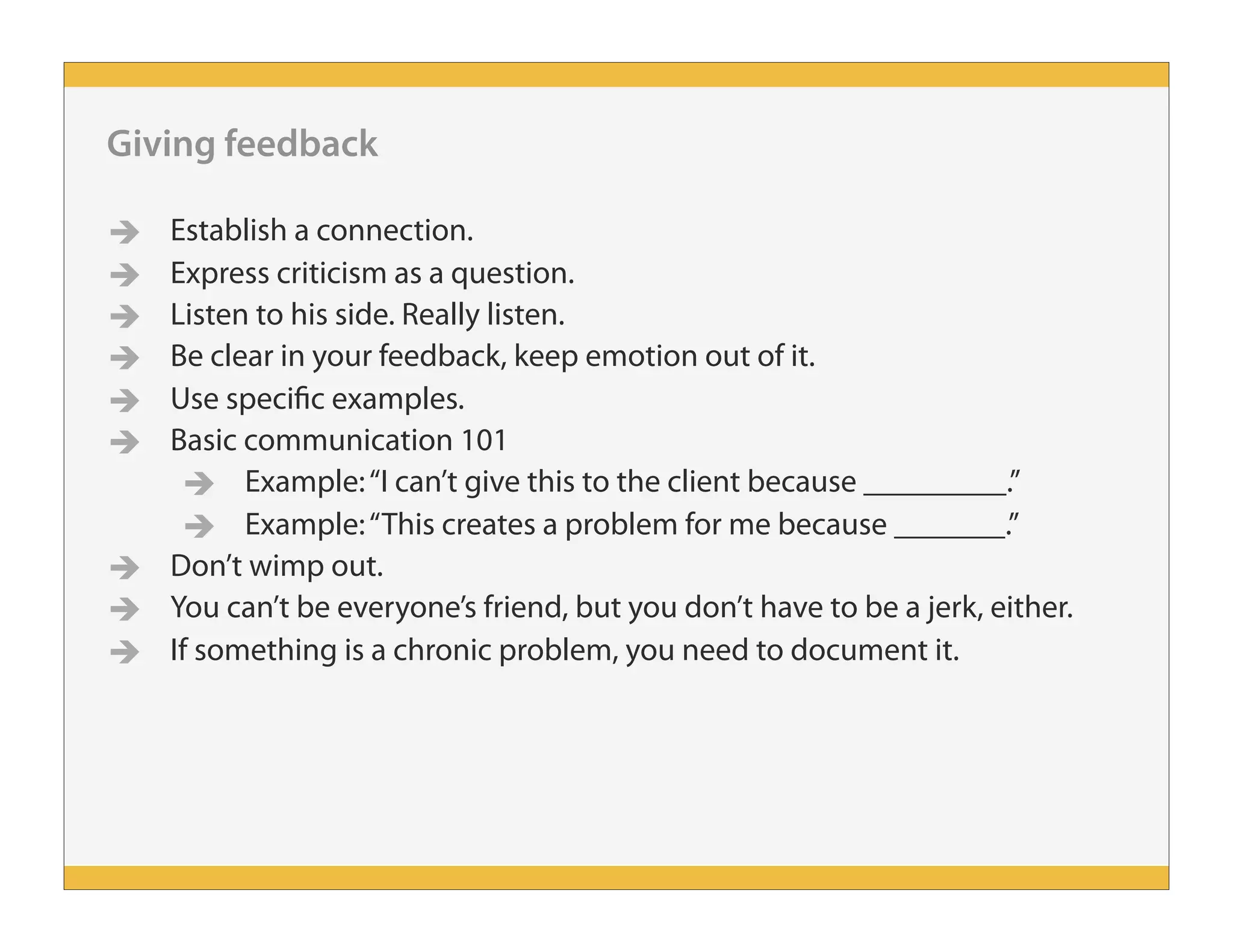
Giving feedback
 Establish a connection.
 Express criticism as a question.
 Listen to his side. Really listen.
 Be clear in your feedback, keep emotion out of it.
 Use specific examples.
 Basic communication 101
 Example:“I can’t give this to the client because _________.”
 Example:“This creates a problem for me because _______.”
 Don’t wimp out.
 You can’t be everyone’s friend, but you don’t have to be a jerk, either.
 If something is a chronic problem, you need to document it.
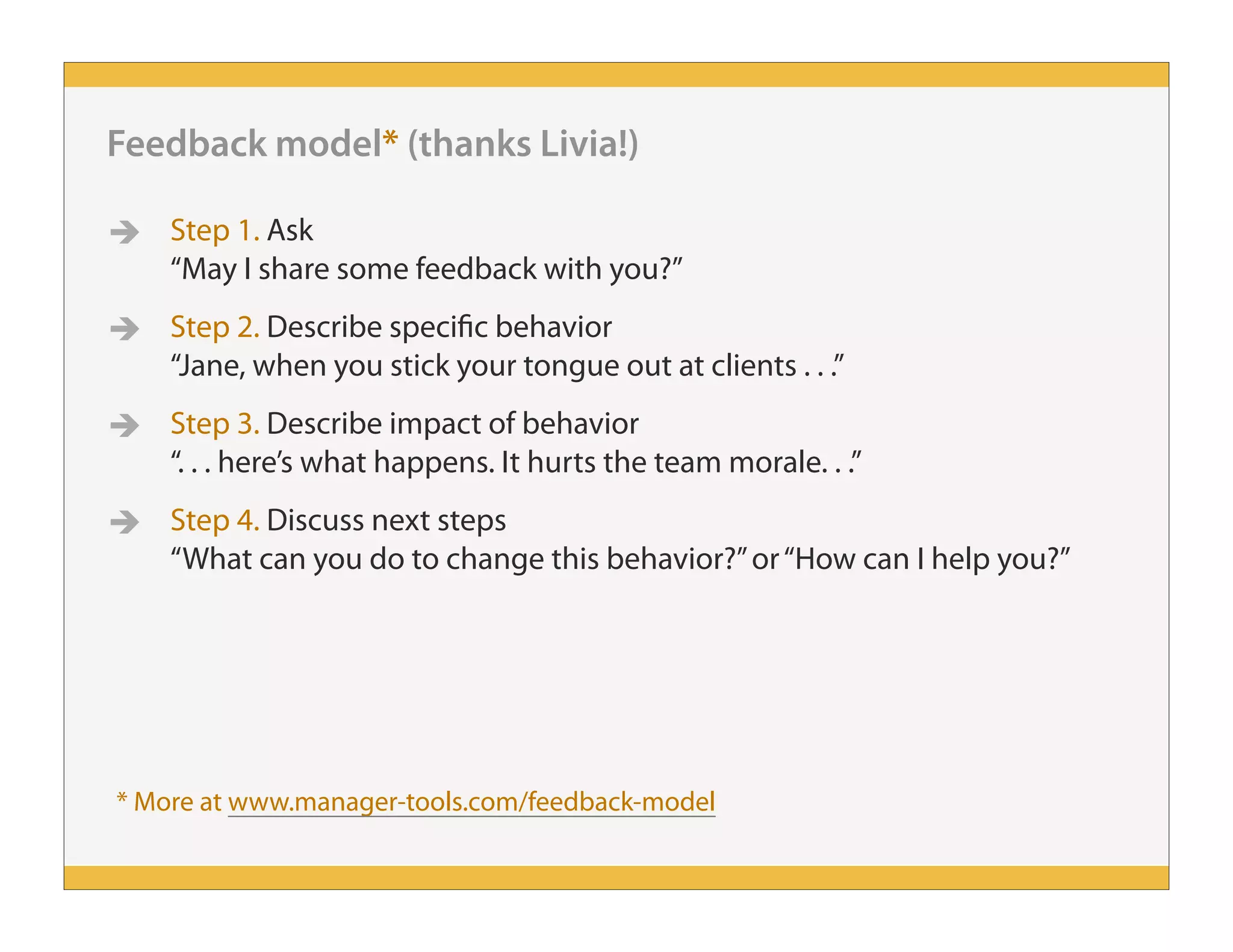
Feedback model* (thanks Livia!)
 Step 1. Ask
“May I share some feedback with you?”
 Step 2. Describe specific behavior
“Jane, when you stick your tongue out at clients . . .”
 Step 3. Describe impact of behavior
“. . . here’s what happens. It hurts the team morale. . .”
 Step 4. Discuss next steps
“What can you do to change this behavior?”or“How can I help you?”
* More at www.manager-tools.com/feedback-model
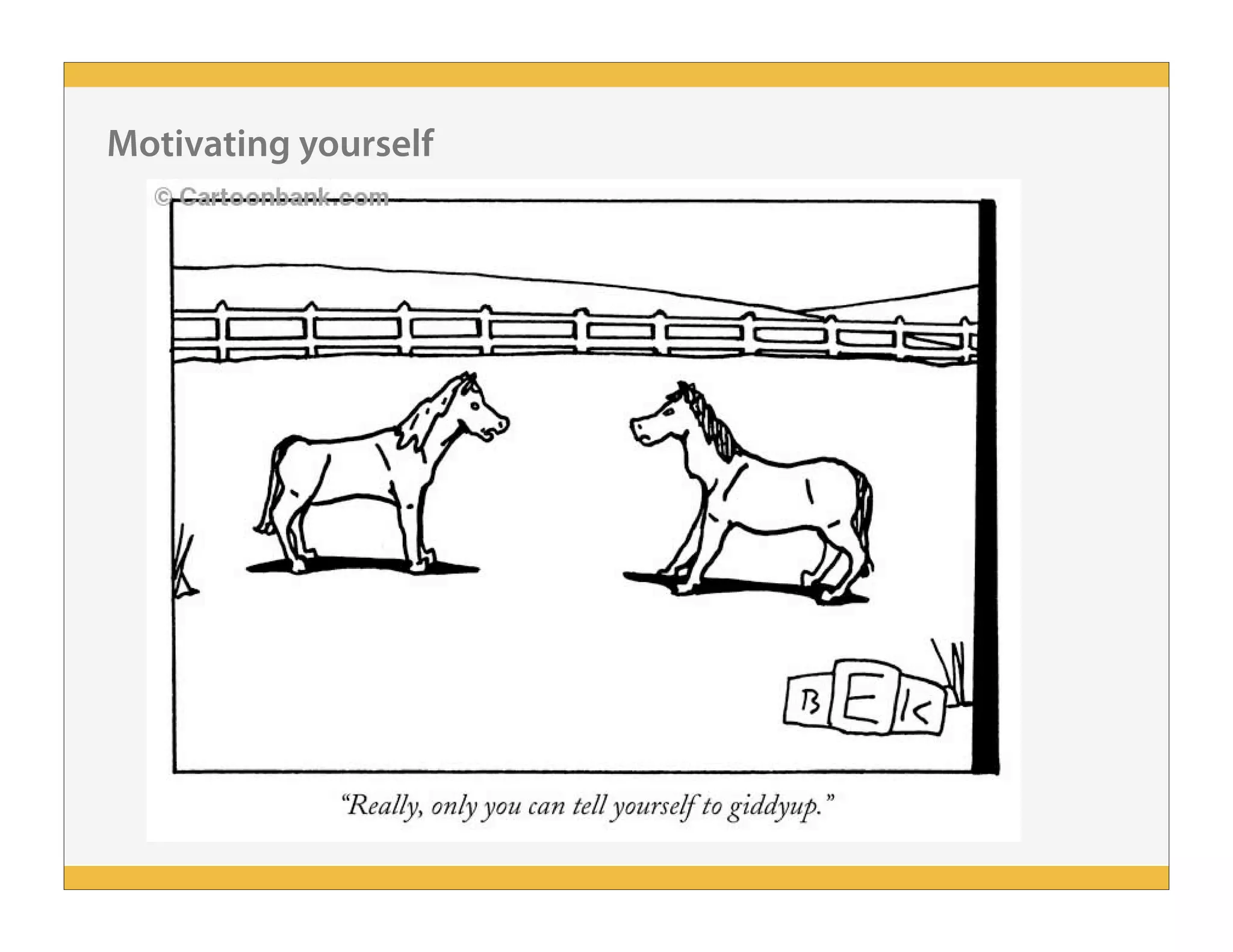
Motivating yourself
What’s it really like?
“When you’re a manager,
you’re very aware of how
the sausage gets made.
You have to be
comfortable with that.”
— Peter
“…for the typical manager of professionals, the day is broken up
into numerous small chunks of amazing diversity: dealing with a
disgruntled client, handling the personal problems of a staff member,
analyzing financial reports, interviewing a potential new recruit,
approving various administrative arrangements, working on a new
business presentation, and a thousand other matters, each of which
must, in rapid succession, command the manager’s full attention.”
— David H. Maister,“Managing the Professional Services Firm”
What’s it really like?
Be prepared to make some sacrifices
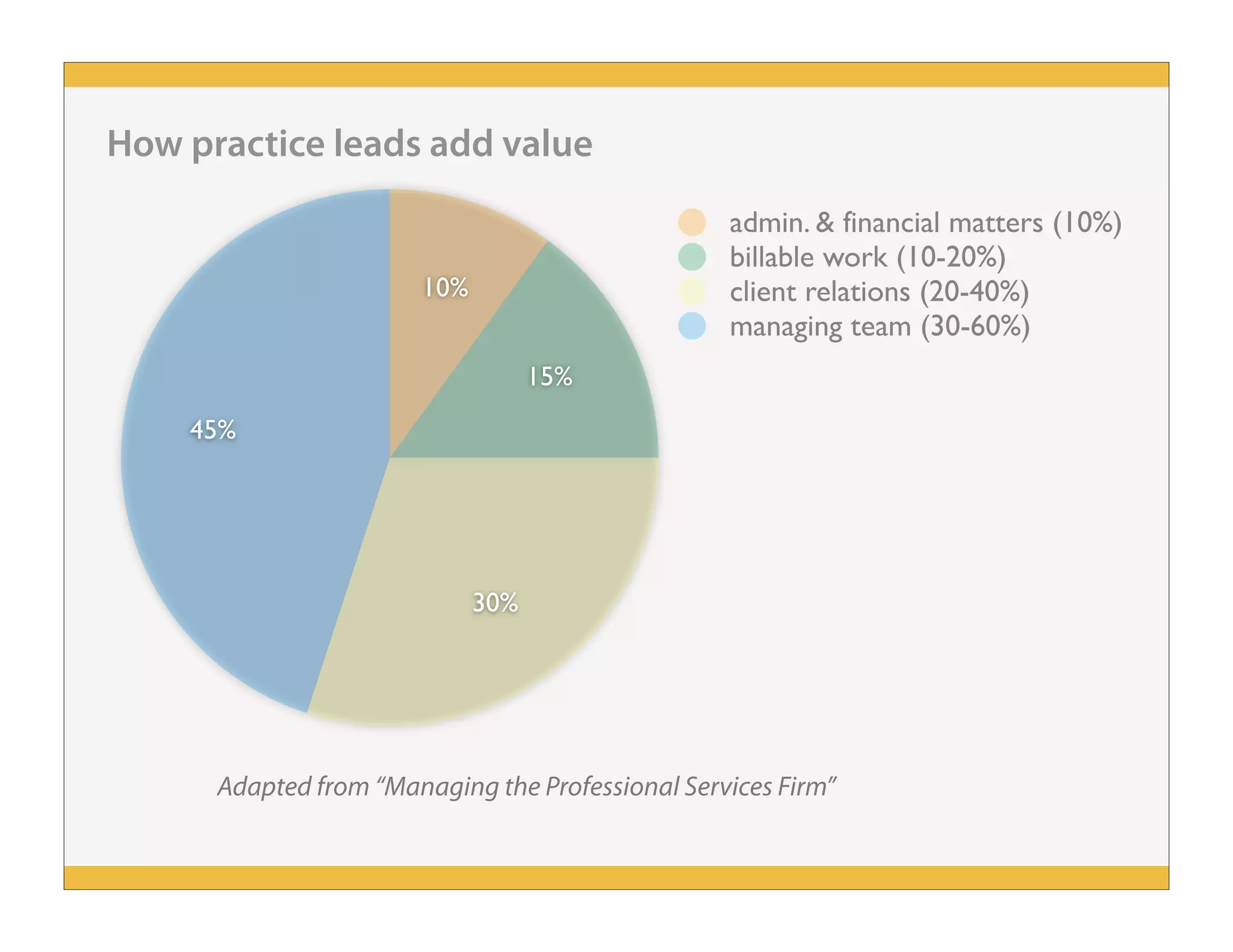
Adapted from “Managing the Professional Services Firm”
How practice leads add value
45%
30%
15%
10%
admin. & financial matters (10%)
billable work (10-20%)
client relations (20-40%)
managing team (30-60%)
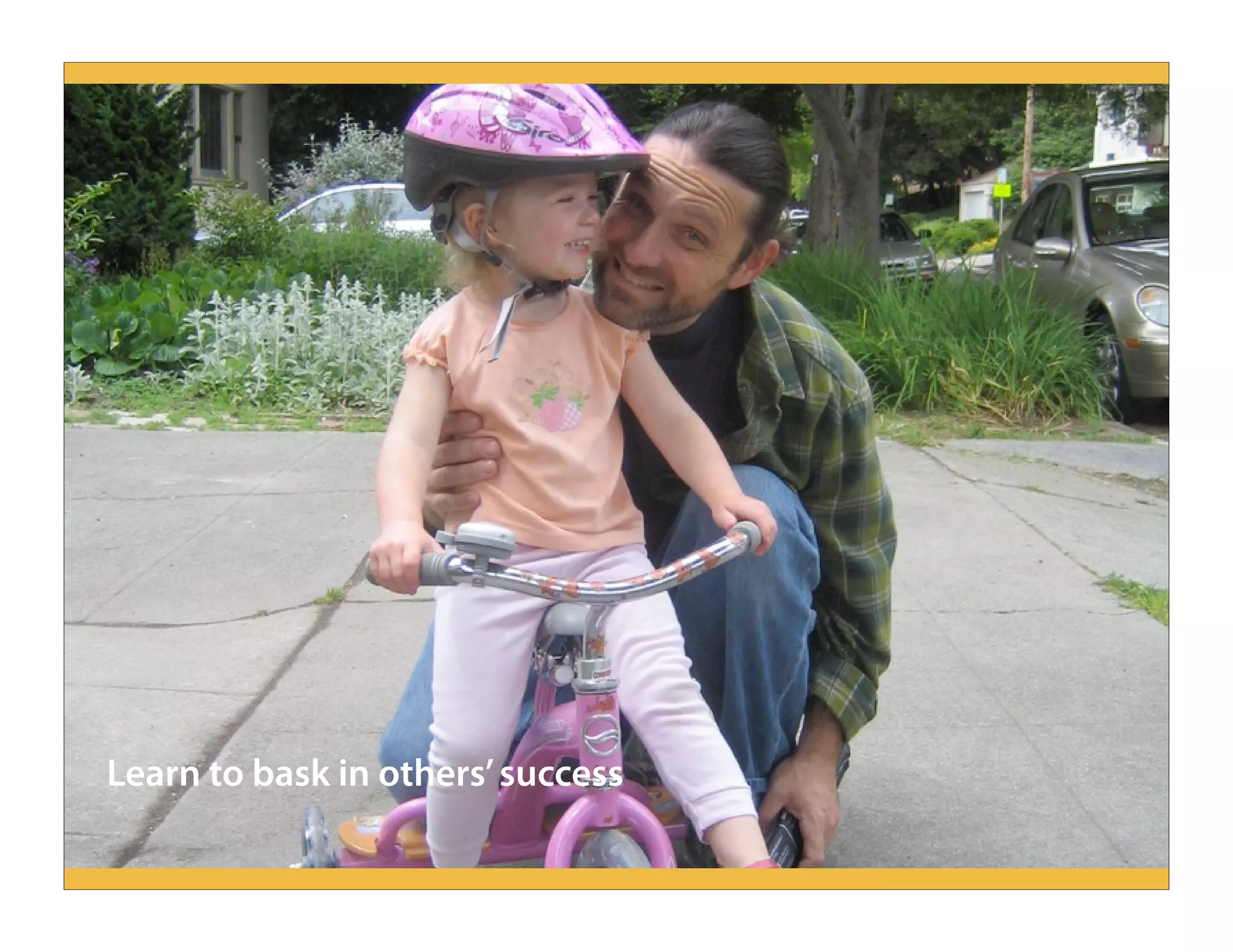
Learn to bask in others’success
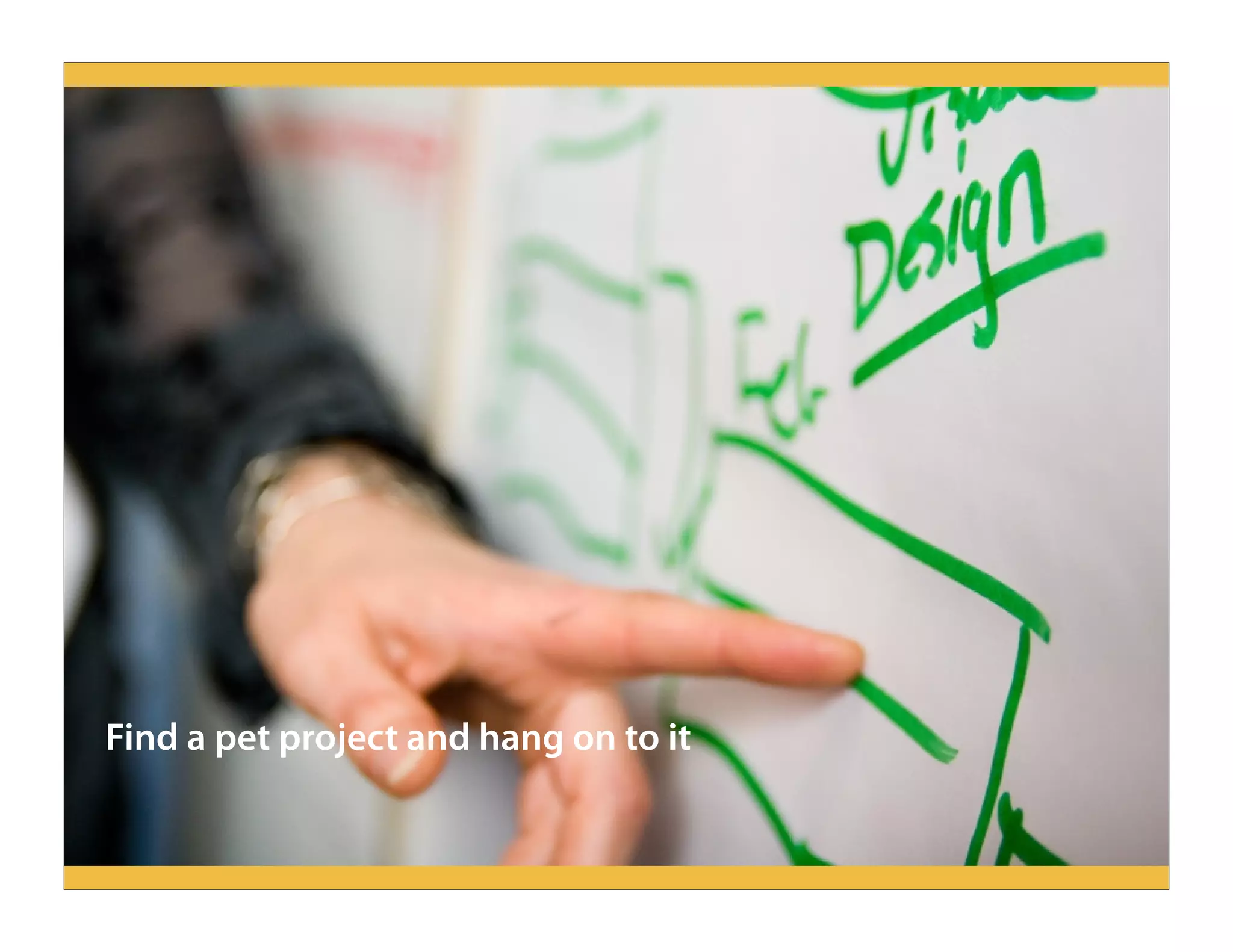
Find a pet project and hang on to it
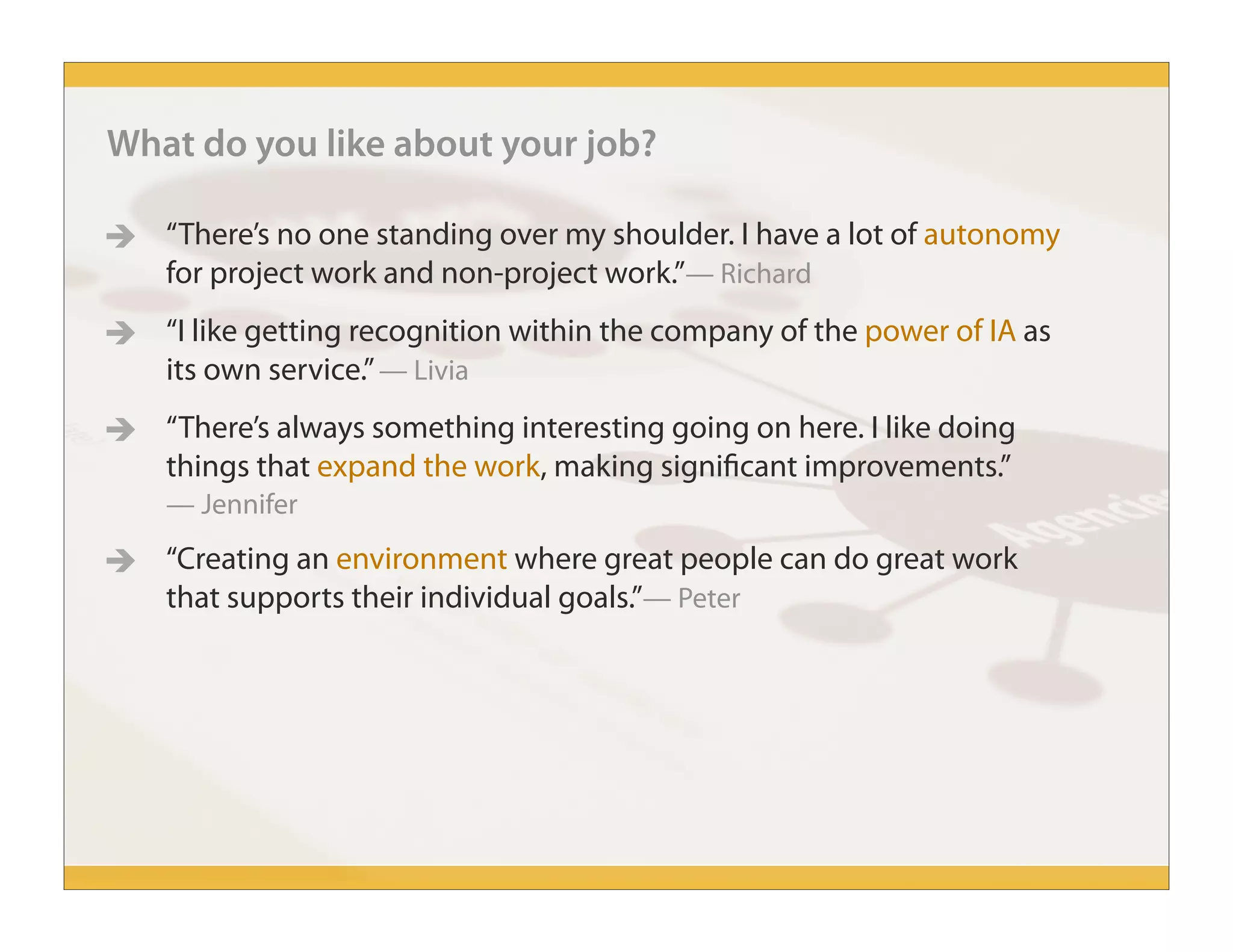
What do you like about your job?
 “There’s no one standing over my shoulder. I have a lot of autonomy
for project work and non-project work.”— Richard
 “I like getting recognition within the company of the power of IA as
its own service.”— Livia
 “There’s always something interesting going on here. I like doing
things that expand the work, making significant improvements.”
— Jennifer
 “Creating an environment where great people can do great work
that supports their individual goals.”— Peter
Other resources
 “Managing the Professional Services Firm,”by David H. Maister
 Design Management Institute, www.dmi.org
 www.manager-tools.com
 “Getting Things Done: the Art of Stress-free Productivity,”by David
Allen
 “First Break All the Rules: What the World’s Greatest Managers Do
Differently,”by Marcus Buckingham and Curt Coffman
Thanks!
March 22-26, 2007
IA Summit, Las Vegas
Katrina Alcorn
Principal, User Experience and Content, Hot Studio, Inc.

How to Manage a UX Team (without losing your mind!)

  • 1.
    How to managea UX team (without losing your mind!) March 22-26, 2007 IA Summit, Las Vegas Katrina Alcorn Principal, User Experience and Content, Hot Studio, Inc.
  • 2.
  • 3.
  • 5.
  • 6.
    What do UXmanagers do? Internal companies  “Evangelize”  Manage/coach team  Network in company  Hire/staff projects  Project work  Teach/write  Admin/operations/ new processes External agencies  Sales  Manage/coach team  Client relations  Hire/staff projects  Project work  Teach/write  Admin/operations/ new processes
  • 7.
    UX managers Iinterviewed Peter Merholz President, Adaptive Path Jennifer Bohmbach Chief IA, Sun Microsystems Richard Dalton UX Manager, Vanguard Livia Labate Sr. Manager IA & Usability, Comcast Catherine Courage, Andrew Sandler UX Managers, Salesforce.com Lillian Svec UC Santa Cruz Extension
  • 8.
    How is managingUX teams different?  Challenges of managing creative professionals  Generalized skill set, varies greatly  Staffing model  External pressures (“what do you guys do?”) “Professionals, like athletes, when left to their own devices, don’t accomplish as much as they do when they are supported by a good coach.” — David H. Maister,“Managing the Professional Services Firm”
  • 9.
  • 10.
     Personal networksonly go so far  We’ve found some great people using resources: Craigslist (believe it or not) Industry groups like ASIS-T, IA Institute LinkedIn  Others swear by Recruiting fairs at ID Lots and lots of networking Internships Look for people transitioning from other fields  Think of hiring as an ongoing process Where do you find people?
  • 11.
    ability to makepretty deliverables, clear communicator, clear thinker, consulting experience, creativity, education, enthusiasm, fit with the team, general job skills (IA, interaction design, strategy, personas, research), good listener, interest in learning new things, presentation skills, personal work style, personality,quick learner, software proficiency, talent, variety of work, years of experience What to look for in a hire
  • 12.
  • 13.
    What to lookfor in a hire  “Passion is tops. They need to have a love for the work.”— Peter  “Good critical thinkers. People who get the big picture.”— Jennifer  “Good communication. If you can’t communicate effectively, you can’t do your job.”— Catherine  “At Salesforce, everybody codes. You have to have technical competence.”— Andrew  “A serious commitment to the IA community.”— Livia  “Soft skills! We work in teams a lot. You have to collaborate well.” — Richard  “With researchers, you want them to be flexible and creative about how they conduct their research. Rigorous academics aren’t enough.”— Lillian
  • 14.
    *see Jared Spool’sthoughts about generalists versus specialists http://www.uie.com/brainsparks/2006/09/08/specialists-vs-generalists/ Diversify your team  Hire people with complementary skill sets*  Hire people with room for growth (or they’ll get bored)  Involve your team in selecting new hires
  • 15.
    Skill sets Ilook for  Information architecture  Interaction design  Technical prowess  Group facilitation skills  User research Ethnographic studies Interviews Personas Surveys Usability testing  Other research/analysis Competitive audits Heuristic audits  Writing/content strategy
  • 16.
    People tend tohave these...  Information architecture  Interaction design  Technical prowess  Group facilitation skills  User research Ethnographic studies Interviews Personas Surveys Usability testing  Other research/analysis Competitive audits Heuristic audits  Writing/content strategy
  • 17.
    or these...  Informationarchitecture  Interaction design  Technical prowess  Group facilitation skills  User research Ethnographic studies Interviews Personas Surveys Usability testing  Other research/analysis Competitive audits Heuristic audits  Writing/content strategy
  • 18.
    Juniors vs. Seniors?* *Adaptedfrom“Managing the Professional Services Firm” Too much procedural work Too much brain work = current staff = required staff Need more juniors Need more seniors
  • 19.
    Juniors vs. Seniors UXstaffing at boutique agencies Principals, practice leads Senior practitioners Justin, the intern
  • 20.
    Some mistakes instaffing  “We had a brilliant interaction designer who was a freelancer. We pushed him to be an employee, and it was a mistake. He was unemployable.”  “I hired someone who I knew was a bad personality fit. I should have listened to my gut. We eventually parted ways.”  “The worst hiring decision I made was when I didn’t follow my own instincts. I was swayed by my boss’opinion.”  “I made the mistake of putting someone in a leadership role when he was more of a detail person. It took a lot of coaching.” Moral: If you have a round hole, find a round peg.
  • 21.
  • 22.
  • 23.
    Bad boss behavior* 39% said their supervisor failed to keep promises.  37% said their supervisor failed to give credit when due.  31% said their supervisor gave them the "silent treatment" in the past year.  27% said their supervisor made negative comments about them to other employees or managers.  24% said their supervisor invaded their privacy.  23% said their supervisor blames others to cover up mistakes or minimize embarrassment. *Source: Florida State University Findings from a survey of more than 700 workers by researchers at the Florida State University College of Business:
  • 24.
     Give cleardirection  …but don’t micromanage  Keep me in the loop  …but act as a buffer from company angst  Facilitate and encourage my learning  Show you care about my well being and my work  Show you have confidence in me  Give me honest, regular, informal feedback  Be a good“coach”  Listen well, appreciate multiple points of view  Show maturity, breadth of experience Hot UX: Most important qualities in a manager? “Recognize my strengths and weaknesses. Give me opportunities to shine, and low-risk opportunities to grow.”
  • 25.
     Projects thatoffer value that I can see  Clear, direct feedback (positive or negative)  Working with visual designers to find creative solutions  Trying new things  Opportunities to be creative or challenged  Making people (client, boss, colleagues) happy Hot UX: What motivates you? “An avid interest in the project subject/concept is the biggest motivator for me to do great work.”
  • 26.
    People should dowhat they love
  • 27.
    “It lets youget off the consulting hamster wheel.”— Peter Encourage downtime projects
  • 28.
    Encourage group learning Weekly team meetings  Takes classes, go to conferences, report back  Host an off-site  “Innovation exercises” “Vanguard is a pretty progressive place for encouraging people to do the right thing. I can count on one hand the times people brought me a suggestion and I had to say no.”— Richard Dalton, Vanguard
  • 29.
    Design Have a processand be prepared to deviate from it Discovery Strategy Build Transfer
  • 30.
    Create an environmentwhere people can do their best work
  • 31.
     At Hot:UX > Senior UX > Director > Principal  At Adaptive Path: 3 tracks  Practice development  People management  Industry presence  At Salesforce: 2 tracks  Principal  Management Define the career path
  • 32.
  • 33.
    How do youknow there’s a problem?
  • 34.
    How do youknow there’s a problem?  Have regular 1-on-1s with each team member  Check in with clients and business partners  Establish good relationships with other disciplines  PMs, especially, are your canaries in the coal mine
  • 35.
     Great ideas,but poor presentation  Difficulty collaborating with project team  Poor time management; leads to sloppy work  Unmotivated, thinking is lazy Common performance issues
  • 36.
    Problem Is thisa pattern? Address it and move on Can it be fixed? Prepare to say goodbye Define clear steps to resolve Check on progress No Yes/Maybe Yes No Your decision tree
  • 37.
    Giving feedback  Establisha connection.  Express criticism as a question.  Listen to his side. Really listen.  Be clear in your feedback, keep emotion out of it.  Use specific examples.  Basic communication 101  Example:“I can’t give this to the client because _________.”  Example:“This creates a problem for me because _______.”  Don’t wimp out.  You can’t be everyone’s friend, but you don’t have to be a jerk, either.  If something is a chronic problem, you need to document it.
  • 38.
    Feedback model* (thanksLivia!)  Step 1. Ask “May I share some feedback with you?”  Step 2. Describe specific behavior “Jane, when you stick your tongue out at clients . . .”  Step 3. Describe impact of behavior “. . . here’s what happens. It hurts the team morale. . .”  Step 4. Discuss next steps “What can you do to change this behavior?”or“How can I help you?” * More at www.manager-tools.com/feedback-model
  • 39.
  • 40.
    What’s it reallylike? “When you’re a manager, you’re very aware of how the sausage gets made. You have to be comfortable with that.” — Peter
  • 41.
    “…for the typicalmanager of professionals, the day is broken up into numerous small chunks of amazing diversity: dealing with a disgruntled client, handling the personal problems of a staff member, analyzing financial reports, interviewing a potential new recruit, approving various administrative arrangements, working on a new business presentation, and a thousand other matters, each of which must, in rapid succession, command the manager’s full attention.” — David H. Maister,“Managing the Professional Services Firm” What’s it really like?
  • 42.
    Be prepared tomake some sacrifices
  • 43.
    Adapted from “Managingthe Professional Services Firm” How practice leads add value 45% 30% 15% 10% admin. & financial matters (10%) billable work (10-20%) client relations (20-40%) managing team (30-60%)
  • 44.
    Learn to baskin others’success
  • 45.
    Find a petproject and hang on to it
  • 46.
    What do youlike about your job?  “There’s no one standing over my shoulder. I have a lot of autonomy for project work and non-project work.”— Richard  “I like getting recognition within the company of the power of IA as its own service.”— Livia  “There’s always something interesting going on here. I like doing things that expand the work, making significant improvements.” — Jennifer  “Creating an environment where great people can do great work that supports their individual goals.”— Peter
  • 47.
    Other resources  “Managingthe Professional Services Firm,”by David H. Maister  Design Management Institute, www.dmi.org  www.manager-tools.com  “Getting Things Done: the Art of Stress-free Productivity,”by David Allen  “First Break All the Rules: What the World’s Greatest Managers Do Differently,”by Marcus Buckingham and Curt Coffman
  • 48.
    Thanks! March 22-26, 2007 IASummit, Las Vegas Katrina Alcorn Principal, User Experience and Content, Hot Studio, Inc.