@joegerstandt
joegerstandt.com
     twitter.com/joegerstandt
linkedin.com/in/joegerstandt
  facebook.com/joegerstandt
   youtube.com/joegerstandt
       joegerstandt.com/blog
           slideshare.net/joeg
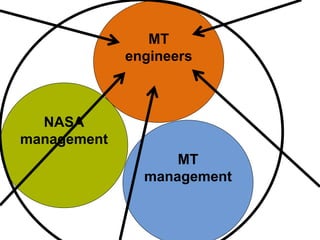
MT
engineers
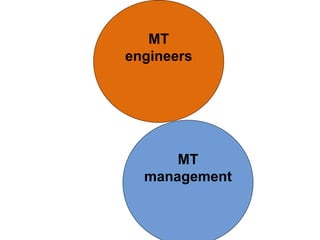
MT
engineers


      MT
  management
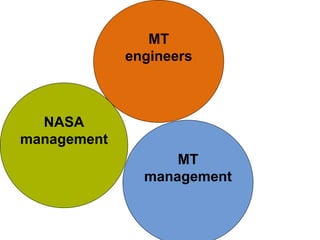
MT
             engineers


  NASA
management
                   MT
               management
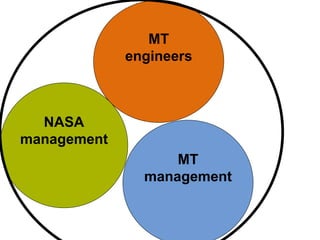
MT
             engineers


  NASA
management
                   MT
               management
MT
             engineers


  NASA
management
                   MT
               management
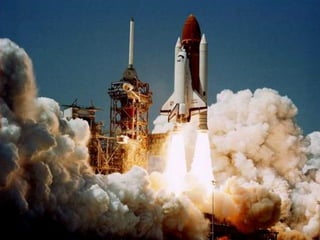
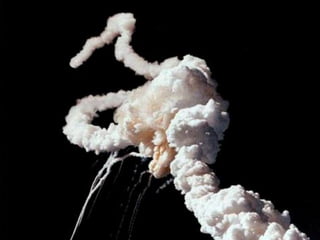
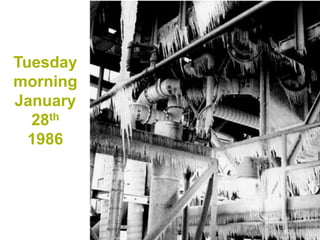
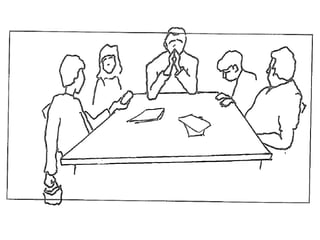
Tuesday
morning
January
  28th
  1986
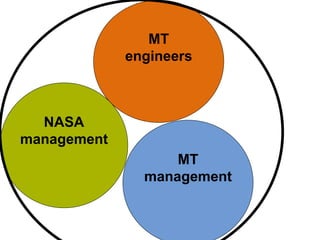
MT
             engineers


  NASA
management
                   MT
               management
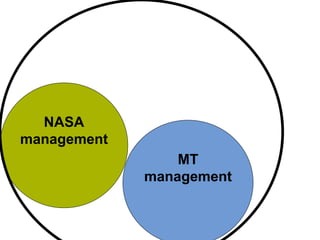
NASA
management
                 MT
             management
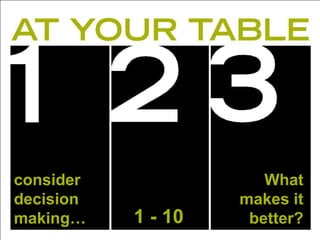
consider               What
decision            makes it
making…    1 - 10    better?
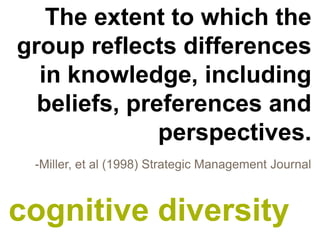
The extent to which the
group reflects differences
  in knowledge, including
  beliefs, preferences and
              perspectives.
 -Miller, et al (1998) Strategic Management Journal


cognitive diversity
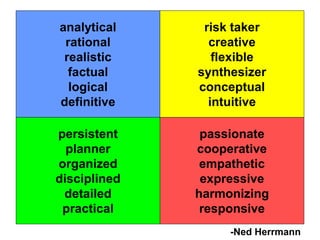
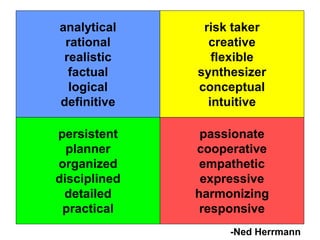
analytical     risk taker
 rational       creative
 realistic       flexible
  factual     synthesizer
  logical     conceptual
definitive      intuitive

persistent     passionate
  planner     cooperative
organized      empathetic
disciplined    expressive
 detailed     harmonizing
 practical     responsive
                   -Ned Herrmann
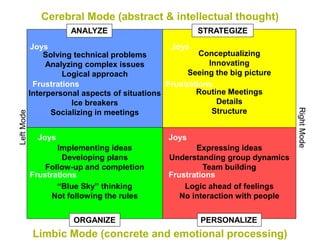
Cerebral Mode (abstract & intellectual thought)
                       ANALYZE                          STRATEGIZE

             Joys                                Joys
                Solving technical problems               Conceptualizing
                 Analyzing complex issues                  Innovating
                      Logical approach                Seeing the big picture
              Frustrations                      Frustrations
            Interpersonal aspects of situations         Routine Meetings
                        Ice breakers                         Details


                                                                                Right Mode
                  Socializing in meetings                   Structure
Left Mode


              Joys                              Joys
                   Implementing ideas                  Expressing ideas
                     Developing plans           Understanding group dynamics
                Follow-up and completion                 Team building
            Frustrations                        Frustrations
                   “Blue Sky” thinking              Logic ahead of feelings
                  Not following the rules          No interaction with people


                       ORGANIZE                          PERSONALIZE
             Limbic Mode (concrete and emotional processing)
analytical     risk taker
 rational       creative
 realistic       flexible
  factual     synthesizer
  logical     conceptual
definitive      intuitive

persistent     passionate
  planner     cooperative
organized      empathetic
disciplined    expressive
 detailed     harmonizing
 practical     responsive
                   -Ned Herrmann
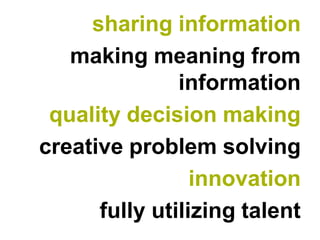
sharing information
   making meaning from
               information
 quality decision making
creative problem solving
                 innovation
      fully utilizing talent
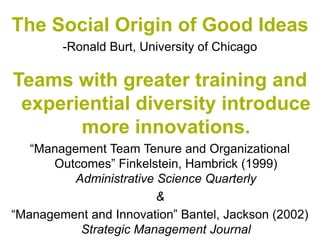
The Social Origin of Good Ideas
        -Ronald Burt, University of Chicago

Teams with greater training and
 experiential diversity introduce
       more innovations.
   “Management Team Tenure and Organizational
      Outcomes” Finkelstein, Hambrick (1999)
          Administrative Science Quarterly
                         &
“Management and Innovation” Bantel, Jackson (2002)
           Strategic Management Journal
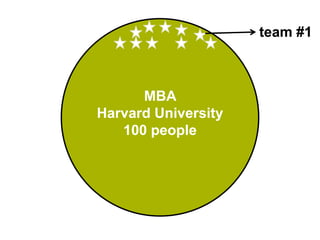
MBA
Harvard University
   100 people
team #1


      MBA
Harvard University
   100 people
team #1


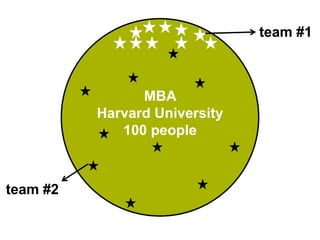
                MBA
          Harvard University
             100 people


team #2
team #1
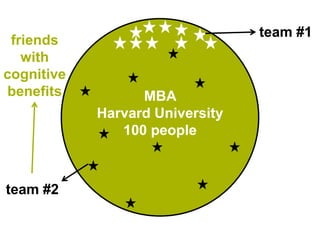
 friends
   with
cognitive
benefits          MBA
            Harvard University
               100 people


team #2
recombine
    &
synthesize
If everyone is
thinking the same
   thing, someone
   isn’t thinking at
                 all.
         -General George S. Patton
but…
team #1


This team greatly
overrates its own
problem solving
    capacity.
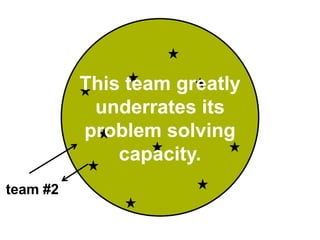
This team greatly
           underrates its
          problem solving
              capacity.
team #2
What’s in the
 (cognitive)
  toolbox?
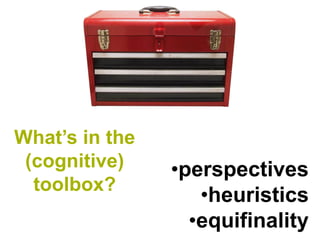
What’s in the
 (cognitive)    •perspectives
  toolbox?
                   •heuristics
                  •equifinality
perspectives
Perspectives are ways of
 representing situations
 and problems, how we
  organize knowledge.
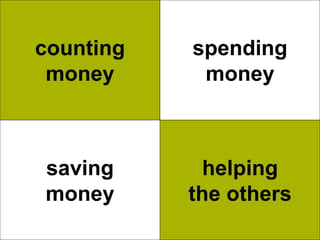
counting   spending
 money      money


saving       helping
money      the others
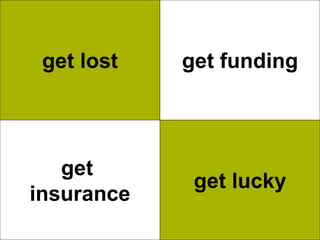
get lost   get funding


   get
             get lucky
insurance
-Thomas Kuhn, The Structure of Scientific Revolutions


“…almost always, those
who achieve fundamental
inventions of a new
paradigm have been
either very young or very
new to the field whose
paradigm they change.”
Do you seek out other perspectives?

               peers
        other departments
            customers
        other organizations
         other professions
heuristics
    Heuristics are ways of
     generating solutions.
  Heuristics can vary in their
sophistication, and they can be
    immediate reactions to
 situations or simple rules of
            thumb.
…if you do not
know the answer,
  choose “C”
please add these numbers…


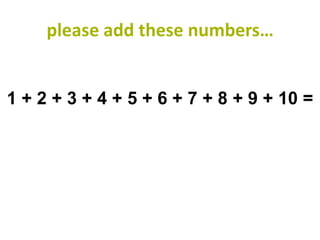
1 + 2 + 3 + 4 + 5 + 6 + 7 + 8 + 9 + 10 =
please add these numbers…


1 + 2 + 3 + 4 + 5 + 6 + 7 + 8 + 9 + 10 =


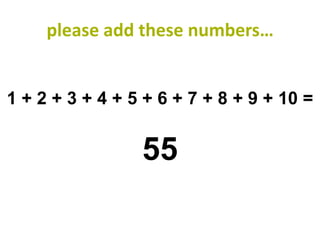
                 55
please add these numbers…


1 + 2 + 3 + 4 + 5 + 6 + 7 + 8 + 9 + 10 =


                 55
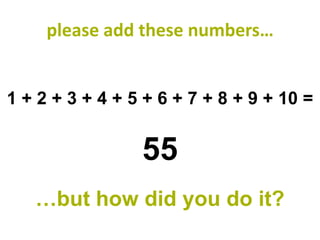
   …but how did you do it?
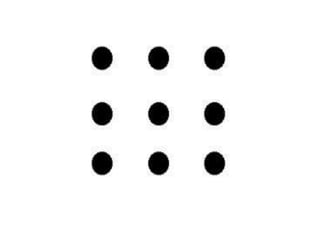
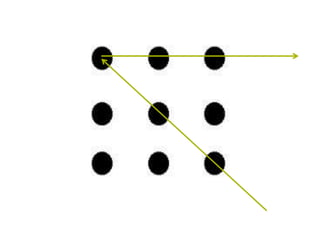
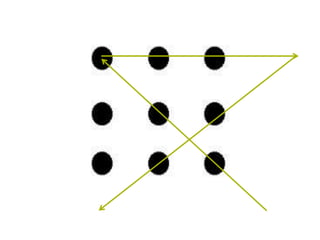
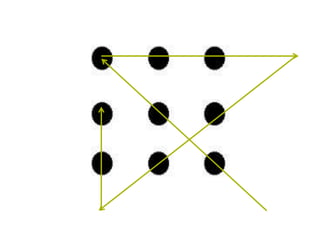
Draw a 9 dot matrix on a blank
paper …
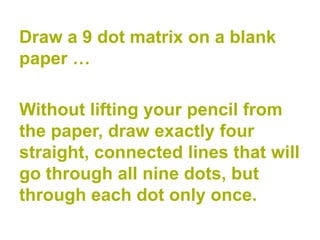
Draw a 9 dot matrix on a blank
paper …

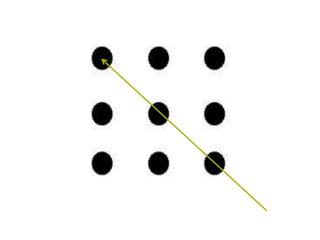
Without lifting your pencil from
the paper, draw exactly four
straight, connected lines that will
go through all nine dots, but
through each dot only once.
Plan a
meeting.
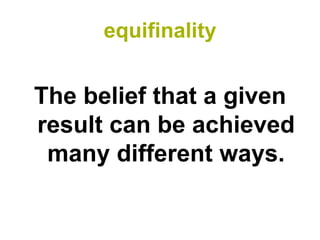
equifinality


The belief that a given
result can be achieved
 many different ways.
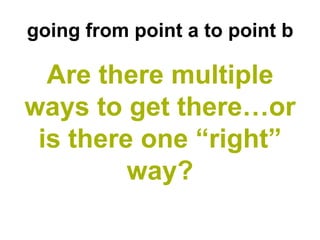
going from point a to point b

  Are there multiple
ways to get there…or
 is there one “right”
         way?
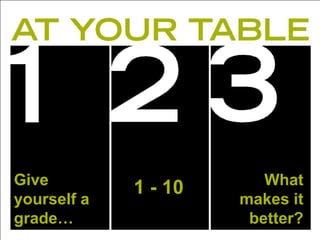
Give                     What
             1 - 10
yourself a            makes it
grade…                 better?
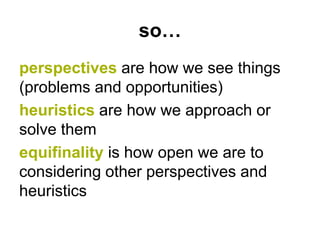
so…
perspectives are how we see things
(problems and opportunities)
heuristics are how we approach or
solve them
equifinality is how open we are to
considering other perspectives and
heuristics
who


      how
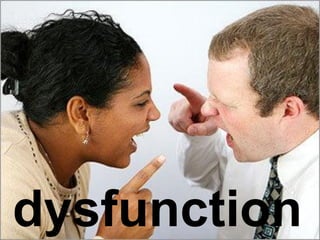
dysfunction
dysfunctional   dysfunctional
 agreement      disagreement
also
dysfunction
dysfunctional
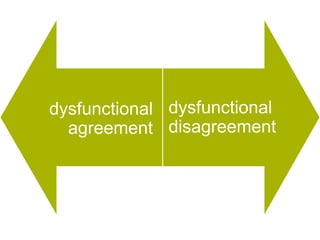
dysfunctional     dysfunctional
 agreement
     agreement    disagreement
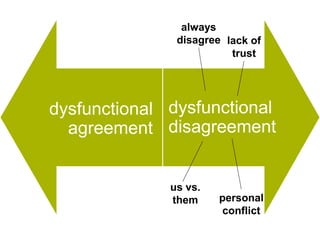
always
                   disagree lack of
                             trust


  dysfunctional
dysfunctional     dysfunctional
 agreement
     agreement    disagreement


                  us vs.
                  them     personal
                           conflict
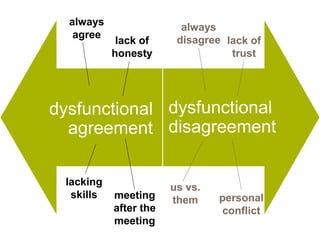
always
                            always
     agree
               lack of     disagree lack of
              honesty                trust


  dysfunctional
dysfunctional             dysfunctional
 agreement
     agreement            disagreement

    lacking
                          us vs.
     skills   meeting     them     personal
              after the            conflict
              meeting
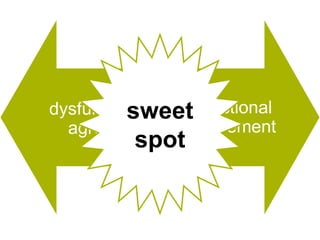
dysfunctional dysfunctional
dysfunctionalsweet
     agreement disagreement
 agreement
            spot
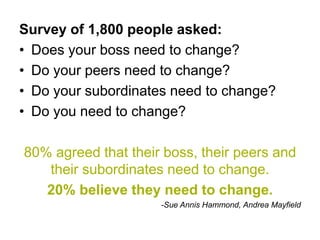
Survey of 1,800 people asked:
• Does your boss need to change?
• Do your peers need to change?
• Do your subordinates need to change?
• Do you need to change?

80% agreed that their boss, their peers and
   their subordinates need to change.
   20% believe they need to change.
                     -Sue Annis Hammond, Andrea Mayfield
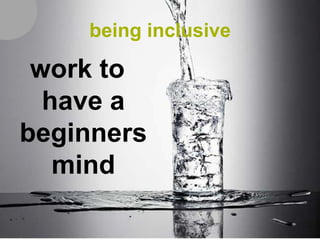
being inclusive

 work to
  have a
beginners
   mind
being inclusive


       seek out &
         protect
         novelty
being inclusive


          listen
         actively
being inclusive

convey & invite
being inclusive

express clearly and
    completely
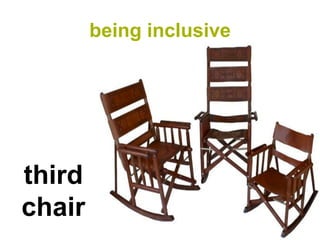
being inclusive


third
chair
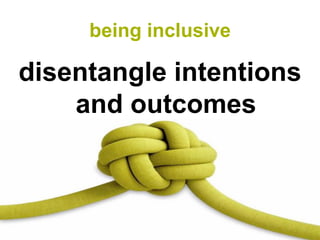
being inclusive

disentangle intentions
    and outcomes
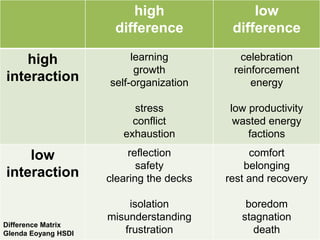
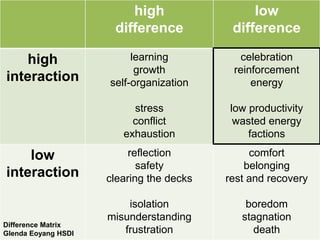
high                  low
                      difference           difference

   high                   learning           celebration
                           growth          reinforcement
interaction          self-organization         energy

                          stress          low productivity
                          conflict         wasted energy
                        exhaustion            factions

    low                   reflection           comfort
                            safety            belonging
interaction          clearing the decks   rest and recovery

                         isolation            boredom
                     misunderstanding        stagnation
Difference Matrix
Glenda Eoyang HSDI      frustration            death
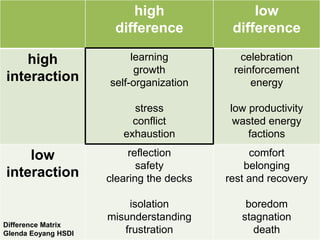
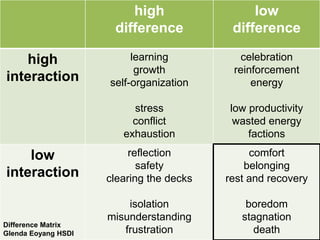
high                  low
                      difference           difference

   high                   learning           celebration
                           growth          reinforcement
interaction          self-organization         energy

                          stress          low productivity
                          conflict         wasted energy
                        exhaustion            factions

    low                   reflection           comfort
                            safety            belonging
interaction          clearing the decks   rest and recovery

                         isolation            boredom
                     misunderstanding        stagnation
Difference Matrix
Glenda Eoyang HSDI      frustration            death
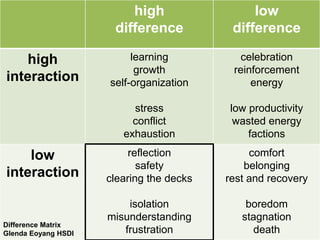
high                  low
                      difference           difference

   high                   learning           celebration
                           growth          reinforcement
interaction          self-organization         energy

                          stress          low productivity
                          conflict         wasted energy
                        exhaustion            factions

    low                   reflection           comfort
                            safety            belonging
interaction          clearing the decks   rest and recovery

                         isolation            boredom
                     misunderstanding        stagnation
Difference Matrix
Glenda Eoyang HSDI      frustration            death
high                  low
                      difference           difference

   high                   learning           celebration
                           growth          reinforcement
interaction          self-organization         energy

                          stress          low productivity
                          conflict         wasted energy
                        exhaustion            factions

    low                   reflection           comfort
                            safety            belonging
interaction          clearing the decks   rest and recovery

                         isolation            boredom
                     misunderstanding        stagnation
Difference Matrix
Glenda Eoyang HSDI      frustration            death
high                  low
                      difference           difference

   high                   learning           celebration
                           growth          reinforcement
interaction          self-organization         energy

                          stress          low productivity
                          conflict         wasted energy
                        exhaustion            factions

    low                   reflection           comfort
                            safety            belonging
interaction          clearing the decks   rest and recovery

                         isolation            boredom
                     misunderstanding        stagnation
Difference Matrix
Glenda Eoyang HSDI      frustration            death
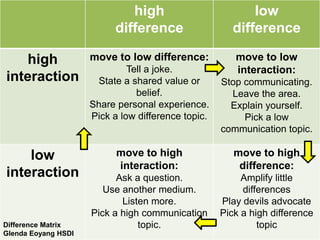
high                        low
                           difference                 difference

   high              move to low difference:           move to low
                              Tell a joke.             interaction:
interaction            State a shared value or      Stop communicating.
                                belief.               Leave the area.
                     Share personal experience.       Explain yourself.
                     Pick a low difference topic.        Pick a low
                                                    communication topic.

    low                    move to high                move to high
                           interaction:                 difference:
interaction                Ask a question.               Amplify little
                        Use another medium.              differences
                            Listen more.            Play devils advocate
                     Pick a high communication      Pick a high difference
Difference Matrix               topic.                       topic
Glenda Eoyang HSDI
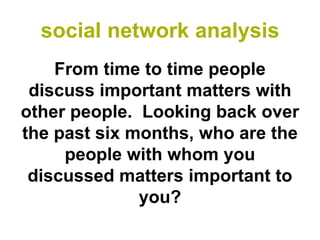
social network analysis
    From time to time people
 discuss important matters with
other people. Looking back over
the past six months, who are the
     people with whom you
 discussed matters important to
              you?
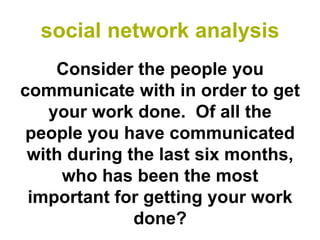
social network analysis
     Consider the people you
communicate with in order to get
    your work done. Of all the
 people you have communicated
 with during the last six months,
     who has been the most
 important for getting your work
              done?
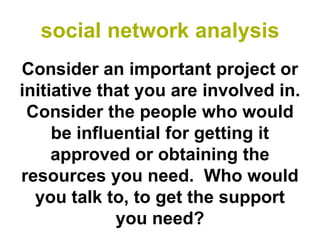
social network analysis
Consider an important project or
initiative that you are involved in.
 Consider the people who would
     be influential for getting it
     approved or obtaining the
resources you need. Who would
  you talk to, to get the support
             you need?
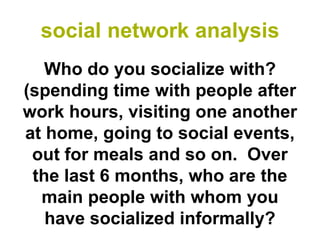
social network analysis
   Who do you socialize with?
(spending time with people after
work hours, visiting one another
at home, going to social events,
 out for meals and so on. Over
 the last 6 months, who are the
  main people with whom you
   have socialized informally?
Where do good ideas come
   from? That is simple…from
differences. Creativity comes
 from unlikely juxtapositions.
     The best way to maximize
    differences is to mix ages,
      cultures and disciplines.
          -Nicolas Negroponte, founder MIT Media Lab
www.joegerstandt.com
  joe.gerstandt@gmail.com
 www.twitter.com/joegerstandt
www.linkedin.com/in/joegerstandt
www.facebook.com/joegerstandt


 402.740.7081
resources
• The Difference: How the Power of Diversity
  Creates Better Groups, Firms, Schools, and
  Societies | Scott Page

• The Wisdom of Crowds | James Surowiecki

• A Whole New Mind | Daniel Pink

• The Medici Effect | Frans Johansson

• The Geography of Thought | Richard Nisbett
resources
• Achieving Success Through Social
  Capital: Tapping Hidden Resources in
  Your Personal and Business Network |
  Wayne E. Baker

• The Whole Brain Business Book
  Ned Herrmann

• Competitive Advantage Through People:
  Unleashing the Power of the Work Force |
  Jeffrey Pfeffer
joegerstandt.com
     twitter.com/joegerstandt
linkedin.com/in/joegerstandt
  facebook.com/joegerstandt
   youtube.com/joegerstandt
       joegerstandt.com/blog
           slideshare.net/joeg

diversity + inclusion = innovation (HRAGD)

  • 1.
  • 2.
    joegerstandt.com twitter.com/joegerstandt linkedin.com/in/joegerstandt facebook.com/joegerstandt youtube.com/joegerstandt joegerstandt.com/blog slideshare.net/joeg
  • 5.
  • 6.
    MT engineers MT management
  • 7.
    MT engineers NASA management MT management
  • 8.
    MT engineers NASA management MT management
  • 9.
    MT engineers NASA management MT management
  • 10.
  • 11.
    MT engineers NASA management MT management
  • 12.
    NASA management MT management
  • 13.
    consider What decision makes it making… 1 - 10 better?
  • 14.
    The extent towhich the group reflects differences in knowledge, including beliefs, preferences and perspectives. -Miller, et al (1998) Strategic Management Journal cognitive diversity
  • 15.
    analytical risk taker rational creative realistic flexible factual synthesizer logical conceptual definitive intuitive persistent passionate planner cooperative organized empathetic disciplined expressive detailed harmonizing practical responsive -Ned Herrmann
  • 16.
    Cerebral Mode (abstract& intellectual thought) ANALYZE STRATEGIZE Joys Joys Solving technical problems Conceptualizing Analyzing complex issues Innovating Logical approach Seeing the big picture Frustrations Frustrations Interpersonal aspects of situations Routine Meetings Ice breakers Details Right Mode Socializing in meetings Structure Left Mode Joys Joys Implementing ideas Expressing ideas Developing plans Understanding group dynamics Follow-up and completion Team building Frustrations Frustrations “Blue Sky” thinking Logic ahead of feelings Not following the rules No interaction with people ORGANIZE PERSONALIZE Limbic Mode (concrete and emotional processing)
  • 17.
    analytical risk taker rational creative realistic flexible factual synthesizer logical conceptual definitive intuitive persistent passionate planner cooperative organized empathetic disciplined expressive detailed harmonizing practical responsive -Ned Herrmann
  • 19.
    sharing information making meaning from information quality decision making creative problem solving innovation fully utilizing talent
  • 20.
    The Social Originof Good Ideas -Ronald Burt, University of Chicago Teams with greater training and experiential diversity introduce more innovations. “Management Team Tenure and Organizational Outcomes” Finkelstein, Hambrick (1999) Administrative Science Quarterly & “Management and Innovation” Bantel, Jackson (2002) Strategic Management Journal
  • 21.
  • 22.
    team #1 MBA Harvard University 100 people
  • 23.
    team #1 MBA Harvard University 100 people team #2
  • 24.
    team #1 friends with cognitive benefits MBA Harvard University 100 people team #2
  • 27.
    recombine & synthesize
  • 29.
    If everyone is thinkingthe same thing, someone isn’t thinking at all. -General George S. Patton
  • 30.
  • 31.
    team #1 This teamgreatly overrates its own problem solving capacity.
  • 32.
    This team greatly underrates its problem solving capacity. team #2
  • 33.
    What’s in the (cognitive) toolbox?
  • 34.
    What’s in the (cognitive) •perspectives toolbox? •heuristics •equifinality
  • 35.
    perspectives Perspectives are waysof representing situations and problems, how we organize knowledge.
  • 39.
    counting spending money money saving helping money the others
  • 40.
    get lost get funding get get lucky insurance
  • 41.
    -Thomas Kuhn, TheStructure of Scientific Revolutions “…almost always, those who achieve fundamental inventions of a new paradigm have been either very young or very new to the field whose paradigm they change.”
  • 42.
    Do you seekout other perspectives? peers other departments customers other organizations other professions
  • 43.
    heuristics Heuristics are ways of generating solutions. Heuristics can vary in their sophistication, and they can be immediate reactions to situations or simple rules of thumb.
  • 44.
    …if you donot know the answer, choose “C”
  • 45.
    please add thesenumbers…
  • 46.
    please add thesenumbers… 1 + 2 + 3 + 4 + 5 + 6 + 7 + 8 + 9 + 10 =
  • 47.
    please add thesenumbers… 1 + 2 + 3 + 4 + 5 + 6 + 7 + 8 + 9 + 10 = 55
  • 48.
    please add thesenumbers… 1 + 2 + 3 + 4 + 5 + 6 + 7 + 8 + 9 + 10 = 55 …but how did you do it?
  • 49.
    Draw a 9dot matrix on a blank paper …
  • 51.
    Draw a 9dot matrix on a blank paper … Without lifting your pencil from the paper, draw exactly four straight, connected lines that will go through all nine dots, but through each dot only once.
  • 56.
  • 57.
    equifinality The belief thata given result can be achieved many different ways.
  • 58.
    going from pointa to point b Are there multiple ways to get there…or is there one “right” way?
  • 60.
    Give What 1 - 10 yourself a makes it grade… better?
  • 61.
    so… perspectives are howwe see things (problems and opportunities) heuristics are how we approach or solve them equifinality is how open we are to considering other perspectives and heuristics
  • 62.
    who how
  • 64.
  • 65.
    dysfunctional dysfunctional agreement disagreement
  • 67.
  • 68.
    dysfunctional dysfunctional dysfunctional agreement agreement disagreement
  • 69.
    always disagree lack of trust dysfunctional dysfunctional dysfunctional agreement agreement disagreement us vs. them personal conflict
  • 70.
    always always agree lack of disagree lack of honesty trust dysfunctional dysfunctional dysfunctional agreement agreement disagreement lacking us vs. skills meeting them personal after the conflict meeting
  • 71.
    dysfunctional dysfunctional dysfunctionalsweet agreement disagreement agreement spot
  • 72.
    Survey of 1,800people asked: • Does your boss need to change? • Do your peers need to change? • Do your subordinates need to change? • Do you need to change? 80% agreed that their boss, their peers and their subordinates need to change. 20% believe they need to change. -Sue Annis Hammond, Andrea Mayfield
  • 73.
    being inclusive workto have a beginners mind
  • 74.
    being inclusive seek out & protect novelty
  • 75.
    being inclusive listen actively
  • 76.
  • 77.
  • 78.
  • 79.
  • 80.
    high low difference difference high learning celebration growth reinforcement interaction self-organization energy stress low productivity conflict wasted energy exhaustion factions low reflection comfort safety belonging interaction clearing the decks rest and recovery isolation boredom misunderstanding stagnation Difference Matrix Glenda Eoyang HSDI frustration death
  • 81.
    high low difference difference high learning celebration growth reinforcement interaction self-organization energy stress low productivity conflict wasted energy exhaustion factions low reflection comfort safety belonging interaction clearing the decks rest and recovery isolation boredom misunderstanding stagnation Difference Matrix Glenda Eoyang HSDI frustration death
  • 82.
    high low difference difference high learning celebration growth reinforcement interaction self-organization energy stress low productivity conflict wasted energy exhaustion factions low reflection comfort safety belonging interaction clearing the decks rest and recovery isolation boredom misunderstanding stagnation Difference Matrix Glenda Eoyang HSDI frustration death
  • 83.
    high low difference difference high learning celebration growth reinforcement interaction self-organization energy stress low productivity conflict wasted energy exhaustion factions low reflection comfort safety belonging interaction clearing the decks rest and recovery isolation boredom misunderstanding stagnation Difference Matrix Glenda Eoyang HSDI frustration death
  • 84.
    high low difference difference high learning celebration growth reinforcement interaction self-organization energy stress low productivity conflict wasted energy exhaustion factions low reflection comfort safety belonging interaction clearing the decks rest and recovery isolation boredom misunderstanding stagnation Difference Matrix Glenda Eoyang HSDI frustration death
  • 85.
    high low difference difference high move to low difference: move to low Tell a joke. interaction: interaction State a shared value or Stop communicating. belief. Leave the area. Share personal experience. Explain yourself. Pick a low difference topic. Pick a low communication topic. low move to high move to high interaction: difference: interaction Ask a question. Amplify little Use another medium. differences Listen more. Play devils advocate Pick a high communication Pick a high difference Difference Matrix topic. topic Glenda Eoyang HSDI
  • 86.
    social network analysis From time to time people discuss important matters with other people. Looking back over the past six months, who are the people with whom you discussed matters important to you?
  • 87.
    social network analysis Consider the people you communicate with in order to get your work done. Of all the people you have communicated with during the last six months, who has been the most important for getting your work done?
  • 88.
    social network analysis Consideran important project or initiative that you are involved in. Consider the people who would be influential for getting it approved or obtaining the resources you need. Who would you talk to, to get the support you need?
  • 89.
    social network analysis Who do you socialize with? (spending time with people after work hours, visiting one another at home, going to social events, out for meals and so on. Over the last 6 months, who are the main people with whom you have socialized informally?
  • 90.
    Where do goodideas come from? That is simple…from differences. Creativity comes from unlikely juxtapositions. The best way to maximize differences is to mix ages, cultures and disciplines. -Nicolas Negroponte, founder MIT Media Lab
  • 91.
    www.joegerstandt.com joe.gerstandt@gmail.com www.twitter.com/joegerstandt www.linkedin.com/in/joegerstandt www.facebook.com/joegerstandt 402.740.7081
  • 92.
    resources • The Difference:How the Power of Diversity Creates Better Groups, Firms, Schools, and Societies | Scott Page • The Wisdom of Crowds | James Surowiecki • A Whole New Mind | Daniel Pink • The Medici Effect | Frans Johansson • The Geography of Thought | Richard Nisbett
  • 93.
    resources • Achieving SuccessThrough Social Capital: Tapping Hidden Resources in Your Personal and Business Network | Wayne E. Baker • The Whole Brain Business Book Ned Herrmann • Competitive Advantage Through People: Unleashing the Power of the Work Force | Jeffrey Pfeffer
  • 94.
    joegerstandt.com twitter.com/joegerstandt linkedin.com/in/joegerstandt facebook.com/joegerstandt youtube.com/joegerstandt joegerstandt.com/blog slideshare.net/joeg