OLA Super Conference 2011 d m A Planning & Management Services Inc. Library Strategic Planning Feb 2011 Presentation Notes from: OLA Conference: Feb. 5, 2011 Copyright: dmA Planning and Management Services – Not to be reprinted, circulated or presented without the prior written permission of the d m A.
A Lost Opportunity? All planning is a good thing  There are good Strategic Plans But there are also good plans that are  Not  Strategic Plans – and that is the lost opportunity
My Presentation Planning 101 – Master Plans vs. Strategic Plans  Strategic Plans – The Essential Elements  Avoiding Lost Opportunities - -Why Strategic Plans Fails
PART ONE PLANNING 101 – Strategic Plans, Master Plans and Management Plans
Three Simple Questions What Do We Hope to Accomplish by Providing Library Services? What Do We Need to Provide? How Should We Provide It?
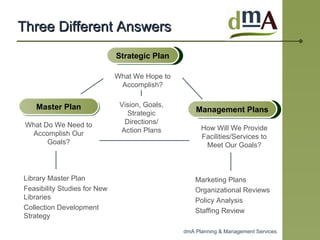
Three Different Answers What Do We Need to Accomplish Our Goals? Library Master Plan  Feasibility Studies for New Libraries  Collection Development Strategy How Will We Provide Facilities/Services to Meet Our Goals? Marketing Plans Organizational Reviews Policy Analysis Staffing Review What We Hope to Accomplish? Vision, Goals, Strategic Directions/ Action Plans Strategic Plan Management Plans Master Plan
PART TWO THE ESSENTIAL COMPONENTS OF STRATEGIC PLANNING
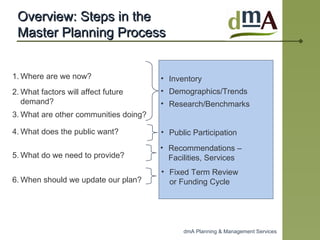
Overview: Steps in the  Master Planning Process Where are we now? What factors will affect future demand? What are other communities doing? What does the public want? What do we need to provide? When should we update our plan? Inventory Demographics/Trends Research/Benchmarks Public Participation Recommendations –Facilities, Services Fixed Term Review or Funding Cycle
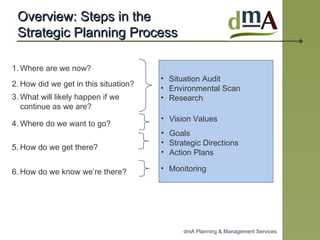
Overview: Steps in the  Strategic Planning Process Where are we now? How did we get in this situation? What will likely happen if we continue as we are? Where do we want to go? How do we get there? How do we know we’re there? Situation Audit Environmental Scan Research Vision Values Goals Strategic Directions Action Plans Monitoring
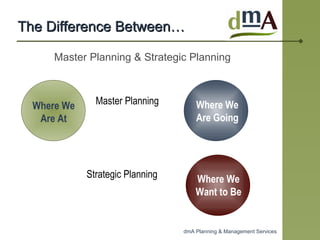
The Difference Between… Master Planning Strategic Planning Where We Are At Where We Are Going Master Planning & Strategic Planning Where We Want to Be
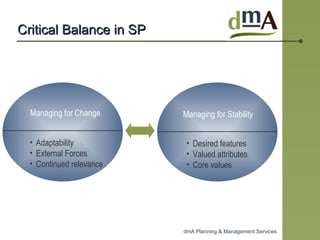
Critical Balance in SP Managing for Stability Desired features Valued attributes Core values Managing for Change Adaptability External Forces Continued relevance
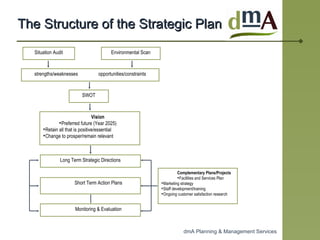
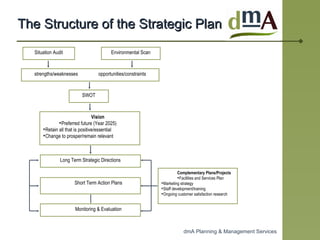
The Structure of the Strategic Plan SWOT Situation Audit Environmental Scan strengths/weaknesses opportunities/constraints Vision Preferred future (Year 2025) Retain all that is positive/essential Change to prosper/remain relevant Long Term Strategic Directions Short Term Action Plans Monitoring & Evaluation Complementary Plans/Projects Facilities and Services Plan Marketing strategy Staff development/training Ongoing customer satisfaction research
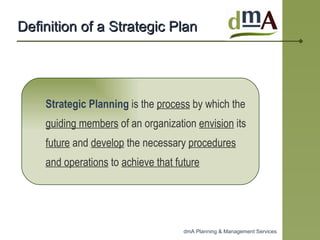
Definition of a Strategic Plan Strategic Planning   is the  process  by which the  guiding members  of an organization  envision  its  future  and  develop  the necessary  procedures and operations  to  achieve that future
PART FOUR LOST OPPORTUNITIES – WHY STRATEGIC PLANS FAIL
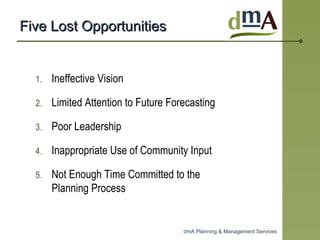
Five Lost Opportunities Ineffective Vision Limited Attention to Future Forecasting  Poor Leadership Inappropriate Use of Community Input  Not Enough Time Committed to the Planning Process
Why We Fail: Lost Opportunity 1 Ineffective Vision
“ Vision statements … are also the most overused, abused, and poorly written part of strategic planning you will ever see” Peter Wright http://www.planningbootcamp.com
What a Vision is NOT Lazy  – a tagline or slogan  Familiar  – a description of your library today Boring  – unimaginative, unexciting, uninspiring  Self-Serving  – focused on past accomplishments rather than future expectations (dreams)
An Effective Vision Addresses the SW and the OT in the SWOT Communicates a Clear Picture of a Preferred Future  Focused on the Need for Major Changes Directly Tied to Goals / Strategic Directions and Ultimately Recommendations
Why We Fail: Lost Opportunity 2 Limited Attention to Future Forecasting
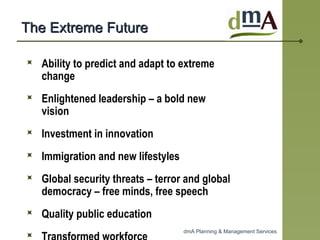
The Extreme Future  Ability to predict and adapt to extreme change Enlightened leadership – a bold new vision Investment in innovation  Immigration and new lifestyles  Global security threats – terror and global democracy – free minds, free speech Quality public education  Transformed workforce
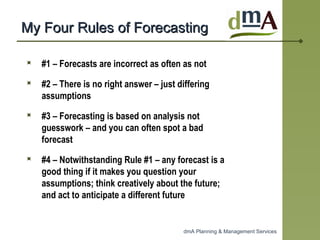
My Four Rules of Forecasting #1 – Forecasts are incorrect as often as not #2 – There is no right answer – just differing assumptions #3 – Forecasting is based on analysis not guesswork – and you can often spot a bad forecast #4 – Notwithstanding Rule #1 – any forecast is a good thing if it makes you question your assumptions; think creatively about the future; and act to anticipate a different future
Why We Fail: Lost Opportunity 3 Poor Leadership
Leadership in Strategic Planning   “ The only way a leader is going to translate a vision into reality – an ability that is the essence of leadership – is to anchor, implement and execute that vision through a variety of policies, practices, procedures and systems that will bring in people and empower them to implement the vision”.   Warren Bennis
Why We Fail: Lost Opportunity 4 Inappropriate Use of Community Input
Community Consultation  “ Consultation with the public at large, and other stakeholders, is a key element of this Plan”.  RFP for a Library Strategic Plan
Why We Fail: Lost Opportunity 5 Not Enough Time Committed to the Plan
The Structure of the Strategic Plan SWOT Situation Audit Environmental Scan strengths/weaknesses opportunities/constraints Vision Preferred future (Year 2025) Retain all that is positive/essential Change to prosper/remain relevant Long Term Strategic Directions Short Term Action Plans Monitoring & Evaluation Complementary Plans/Projects Facilities and Services Plan Marketing strategy Staff development/training Ongoing customer satisfaction research
Summing Up
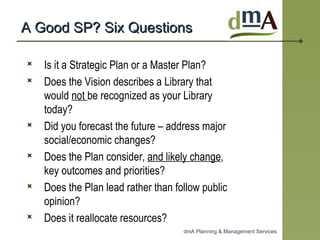
A Good SP? Six Questions  Is it a Strategic Plan or a Master Plan? Does the Vision describes a Library that would  not  be recognized as your Library today?  Did you forecast the future – address major social/economic changes?  Does the Plan consider,  and likely change , key outcomes and priorities? Does the Plan lead rather than follow public opinion? Does it reallocate resources?
Thank You &  Your Questions

Jim morgenstern strat planning presentation distribution copy

  • 1.
    OLA Super Conference2011 d m A Planning & Management Services Inc. Library Strategic Planning Feb 2011 Presentation Notes from: OLA Conference: Feb. 5, 2011 Copyright: dmA Planning and Management Services – Not to be reprinted, circulated or presented without the prior written permission of the d m A.
  • 2.
    A Lost Opportunity?All planning is a good thing There are good Strategic Plans But there are also good plans that are Not Strategic Plans – and that is the lost opportunity
  • 3.
    My Presentation Planning101 – Master Plans vs. Strategic Plans Strategic Plans – The Essential Elements Avoiding Lost Opportunities - -Why Strategic Plans Fails
  • 4.
    PART ONE PLANNING101 – Strategic Plans, Master Plans and Management Plans
  • 5.
    Three Simple QuestionsWhat Do We Hope to Accomplish by Providing Library Services? What Do We Need to Provide? How Should We Provide It?
  • 6.
    Three Different AnswersWhat Do We Need to Accomplish Our Goals? Library Master Plan Feasibility Studies for New Libraries Collection Development Strategy How Will We Provide Facilities/Services to Meet Our Goals? Marketing Plans Organizational Reviews Policy Analysis Staffing Review What We Hope to Accomplish? Vision, Goals, Strategic Directions/ Action Plans Strategic Plan Management Plans Master Plan
  • 7.
    PART TWO THEESSENTIAL COMPONENTS OF STRATEGIC PLANNING
  • 8.
    Overview: Steps inthe Master Planning Process Where are we now? What factors will affect future demand? What are other communities doing? What does the public want? What do we need to provide? When should we update our plan? Inventory Demographics/Trends Research/Benchmarks Public Participation Recommendations –Facilities, Services Fixed Term Review or Funding Cycle
  • 9.
    Overview: Steps inthe Strategic Planning Process Where are we now? How did we get in this situation? What will likely happen if we continue as we are? Where do we want to go? How do we get there? How do we know we’re there? Situation Audit Environmental Scan Research Vision Values Goals Strategic Directions Action Plans Monitoring
  • 10.
    The Difference Between…Master Planning Strategic Planning Where We Are At Where We Are Going Master Planning & Strategic Planning Where We Want to Be
  • 11.
    Critical Balance inSP Managing for Stability Desired features Valued attributes Core values Managing for Change Adaptability External Forces Continued relevance
  • 12.
    The Structure ofthe Strategic Plan SWOT Situation Audit Environmental Scan strengths/weaknesses opportunities/constraints Vision Preferred future (Year 2025) Retain all that is positive/essential Change to prosper/remain relevant Long Term Strategic Directions Short Term Action Plans Monitoring & Evaluation Complementary Plans/Projects Facilities and Services Plan Marketing strategy Staff development/training Ongoing customer satisfaction research
  • 13.
    Definition of aStrategic Plan Strategic Planning is the process by which the guiding members of an organization envision its future and develop the necessary procedures and operations to achieve that future
  • 14.
    PART FOUR LOSTOPPORTUNITIES – WHY STRATEGIC PLANS FAIL
  • 15.
    Five Lost OpportunitiesIneffective Vision Limited Attention to Future Forecasting Poor Leadership Inappropriate Use of Community Input Not Enough Time Committed to the Planning Process
  • 16.
    Why We Fail:Lost Opportunity 1 Ineffective Vision
  • 17.
    “ Vision statements… are also the most overused, abused, and poorly written part of strategic planning you will ever see” Peter Wright http://www.planningbootcamp.com
  • 18.
    What a Visionis NOT Lazy – a tagline or slogan Familiar – a description of your library today Boring – unimaginative, unexciting, uninspiring Self-Serving – focused on past accomplishments rather than future expectations (dreams)
  • 19.
    An Effective VisionAddresses the SW and the OT in the SWOT Communicates a Clear Picture of a Preferred Future Focused on the Need for Major Changes Directly Tied to Goals / Strategic Directions and Ultimately Recommendations
  • 20.
    Why We Fail:Lost Opportunity 2 Limited Attention to Future Forecasting
  • 21.
    The Extreme Future Ability to predict and adapt to extreme change Enlightened leadership – a bold new vision Investment in innovation Immigration and new lifestyles Global security threats – terror and global democracy – free minds, free speech Quality public education Transformed workforce
  • 22.
    My Four Rulesof Forecasting #1 – Forecasts are incorrect as often as not #2 – There is no right answer – just differing assumptions #3 – Forecasting is based on analysis not guesswork – and you can often spot a bad forecast #4 – Notwithstanding Rule #1 – any forecast is a good thing if it makes you question your assumptions; think creatively about the future; and act to anticipate a different future
  • 23.
    Why We Fail:Lost Opportunity 3 Poor Leadership
  • 24.
    Leadership in StrategicPlanning “ The only way a leader is going to translate a vision into reality – an ability that is the essence of leadership – is to anchor, implement and execute that vision through a variety of policies, practices, procedures and systems that will bring in people and empower them to implement the vision”. Warren Bennis
  • 25.
    Why We Fail:Lost Opportunity 4 Inappropriate Use of Community Input
  • 26.
    Community Consultation “ Consultation with the public at large, and other stakeholders, is a key element of this Plan”. RFP for a Library Strategic Plan
  • 27.
    Why We Fail:Lost Opportunity 5 Not Enough Time Committed to the Plan
  • 28.
    The Structure ofthe Strategic Plan SWOT Situation Audit Environmental Scan strengths/weaknesses opportunities/constraints Vision Preferred future (Year 2025) Retain all that is positive/essential Change to prosper/remain relevant Long Term Strategic Directions Short Term Action Plans Monitoring & Evaluation Complementary Plans/Projects Facilities and Services Plan Marketing strategy Staff development/training Ongoing customer satisfaction research
  • 29.
  • 30.
    A Good SP?Six Questions Is it a Strategic Plan or a Master Plan? Does the Vision describes a Library that would not be recognized as your Library today? Did you forecast the future – address major social/economic changes? Does the Plan consider, and likely change , key outcomes and priorities? Does the Plan lead rather than follow public opinion? Does it reallocate resources?
  • 31.
    Thank You & Your Questions