Appreciative Inquiry (AI)
As a means of affecting change, Appreciative Inquiry shifts
the focus from a deficit model that seeks first to identify
problems and then potential solutions, to a model that
recognizes the plentiful potential that already exists within
our organization.
Appreciative Inquiry and the
School Improvement Planning
Process
“The BIP states a commitment to an
appreciative, collaborative, inquiry-based
approach to improvement; this requires a
multi-faceted approach to indicators of
success, employing both quantitative and
qualitative data.”
-- BIP Presentation to P/VP October 2010
To incorporate an Appreciative Inquiry approach to
School Improvement Planning, consider the
following 5 guiding principles:
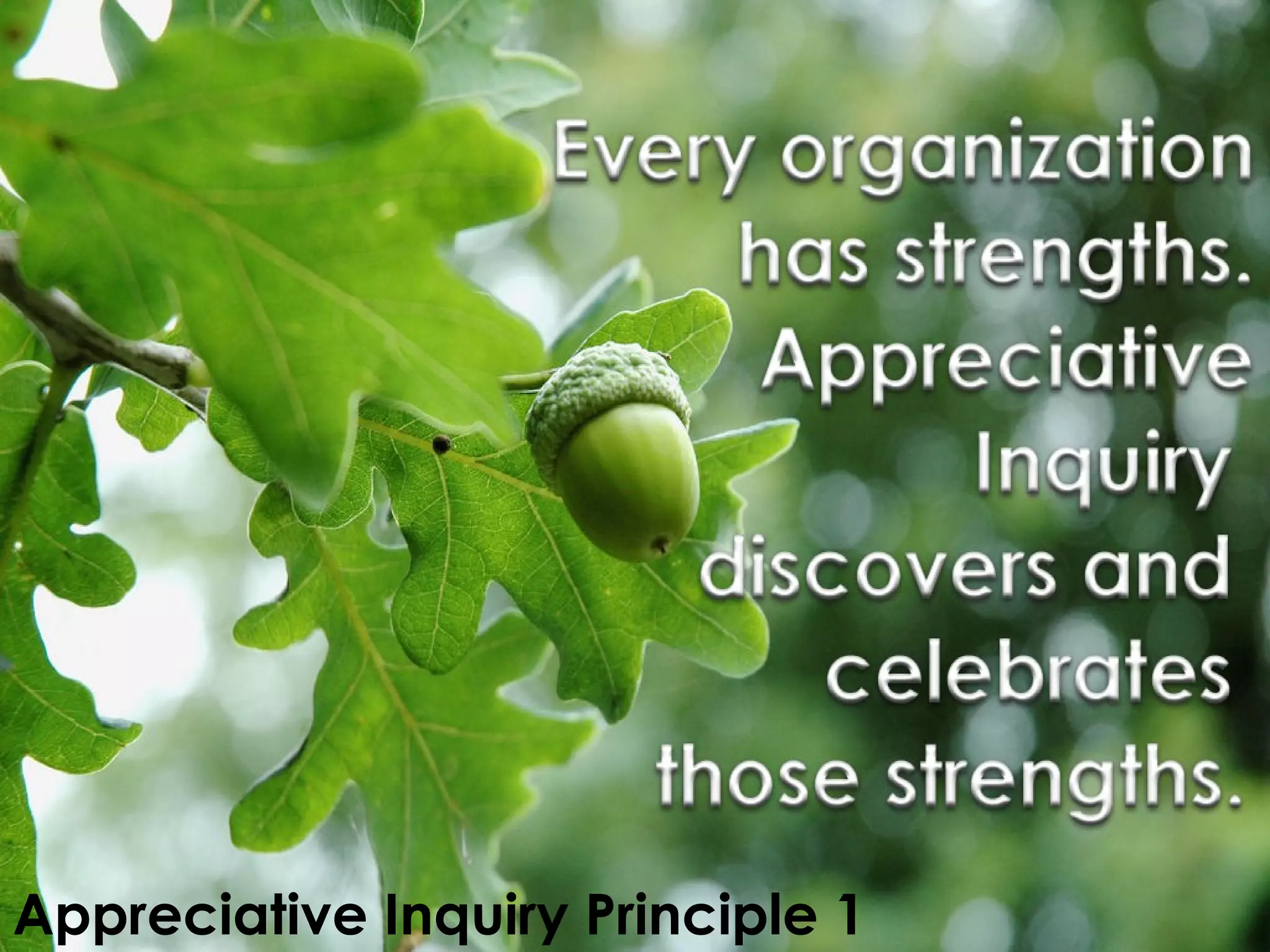
Appreciative Inquiry Principle 1
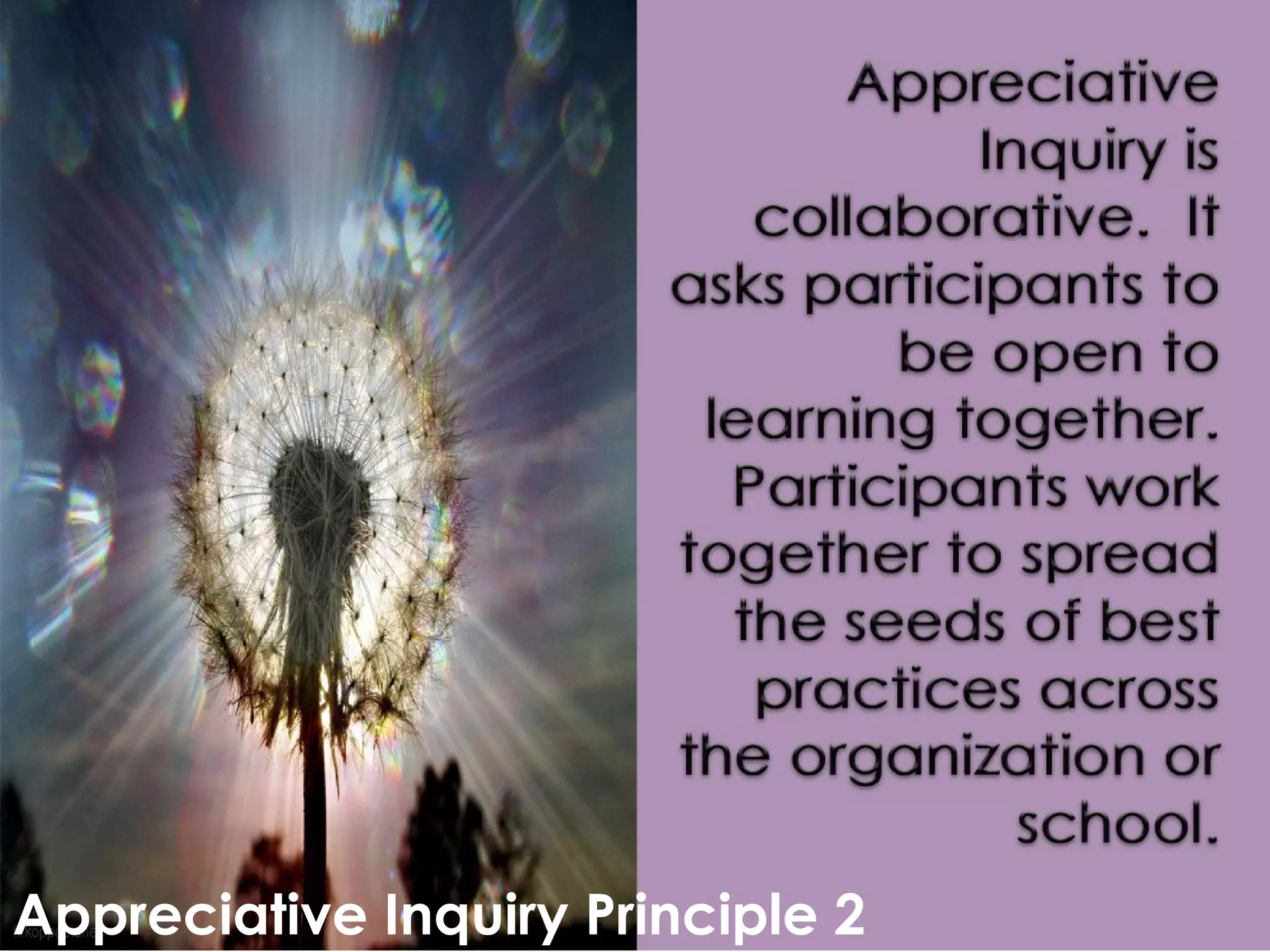
Appreciative Inquiry Principle 2Appreciative Inquiry Principle 2
Appreciative Inquiry Principle 3Appreciative Inquiry Principle 3
Appreciative Inquiry Principle 4
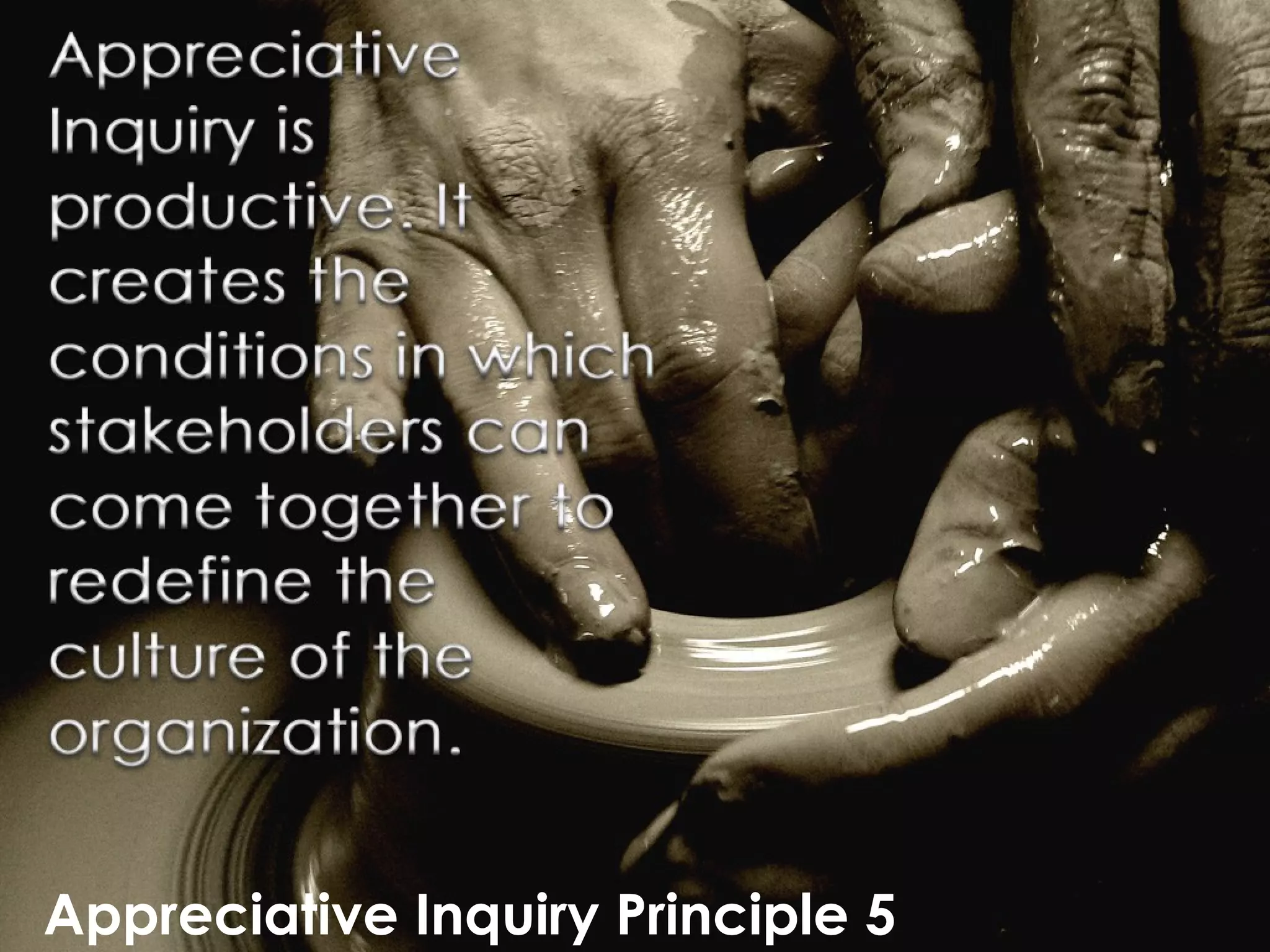
Appreciative Inquiry Principle 5
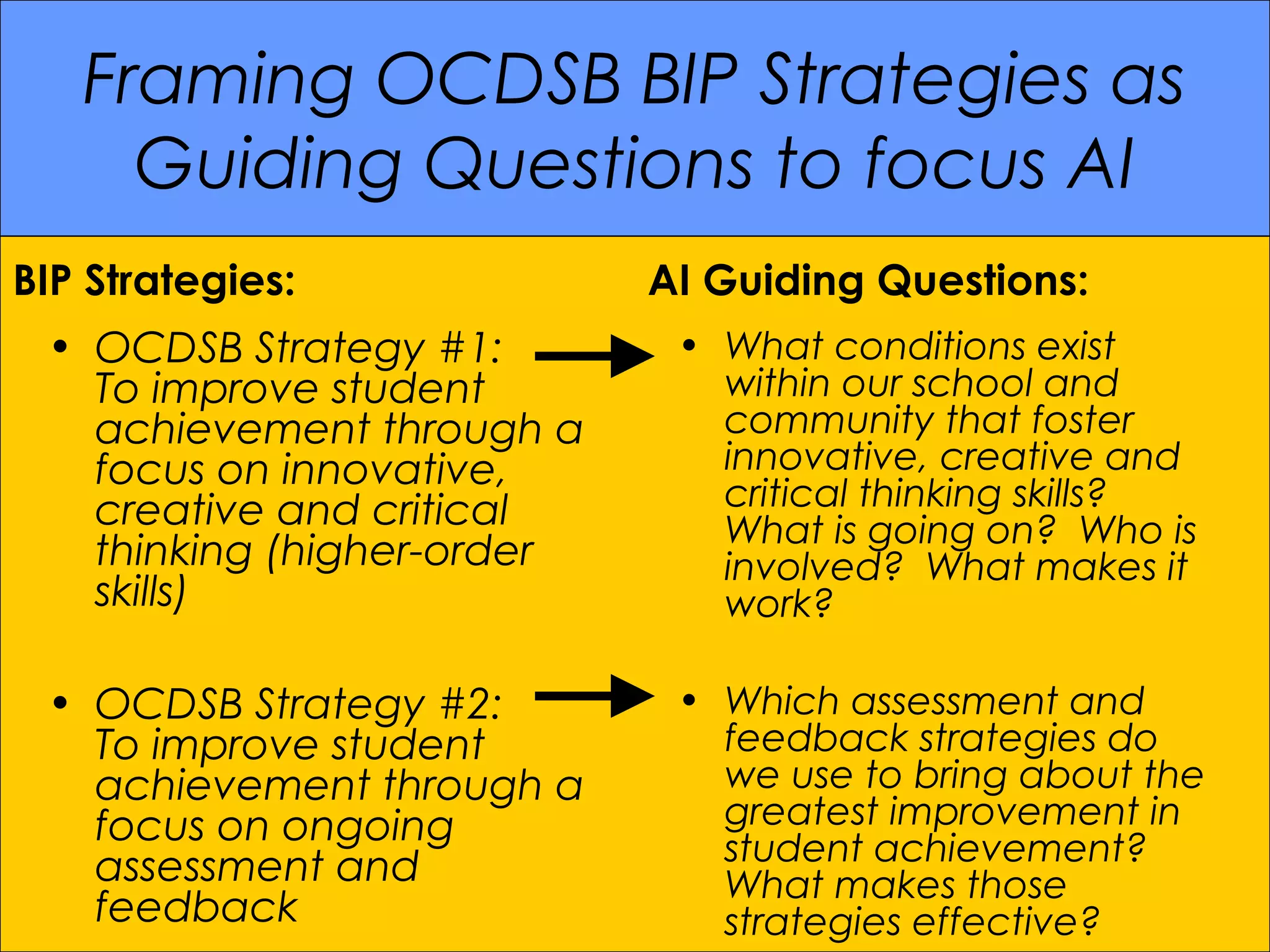
Framing OCDSB BIP Strategies as
Guiding Questions to focus AI
• OCDSB Strategy #1:
To improve student
achievement through a
focus on innovative,
creative and critical
thinking (higher-order
skills)
• OCDSB Strategy #2:
To improve student
achievement through a
focus on ongoing
assessment and
feedback
• What conditions exist
within our school and
community that foster
innovative, creative and
critical thinking skills?
What is going on? Who is
involved? What makes it
work?
• Which assessment and
feedback strategies do
we use to bring about the
greatest improvement in
student achievement?
What makes those
strategies effective?
BIP Strategies: AI Guiding Questions:
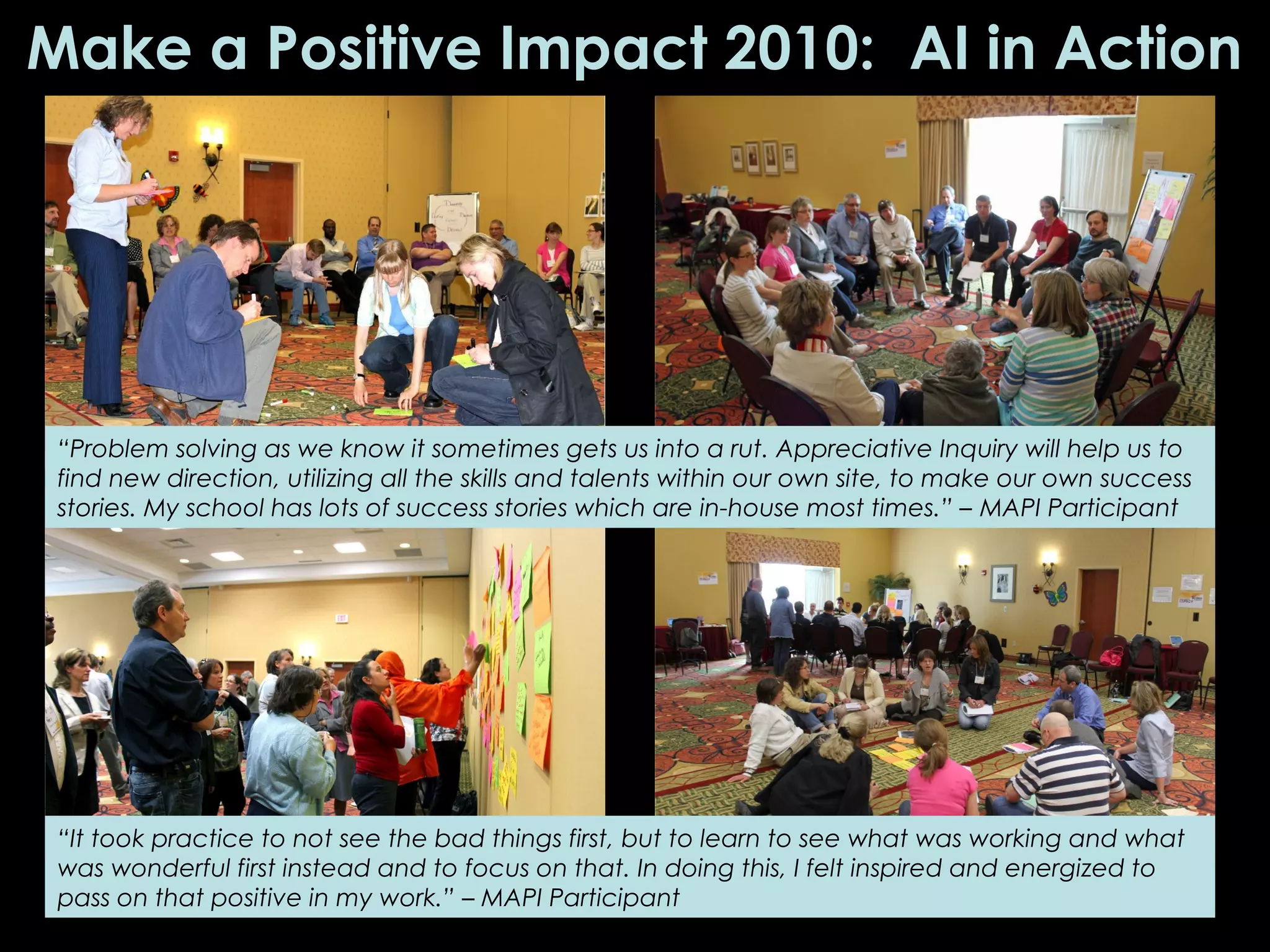
Make a Positive Impact 2010: AI in Action
“Problem solving as we know it sometimes gets us into a rut. Appreciative Inquiry will help us to
find new direction, utilizing all the skills and talents within our own site, to make our own success
stories. My school has lots of success stories which are in-house most times.” – MAPI Participant
“It took practice to not see the bad things first, but to learn to see what was working and what
was wonderful first instead and to focus on that. In doing this, I felt inspired and energized to
pass on that positive in my work.” – MAPI Participant
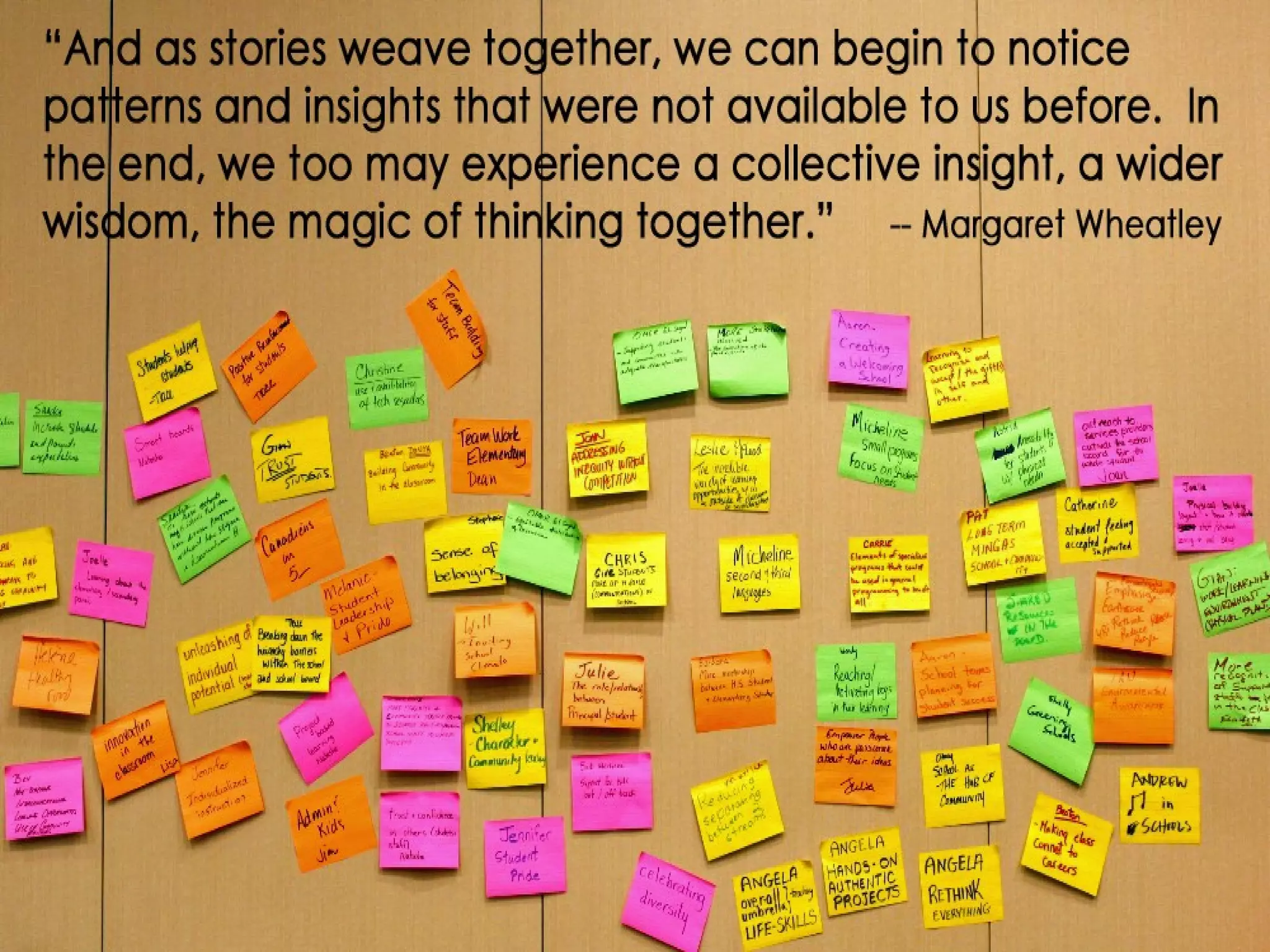
“When we
deliberately seek
out and notice
those qualities that
we hold in high
estimation, our act
of noticing and
valuing actually
amplifies those
qualities and
increases their
value.”
-- Barrett & Fry
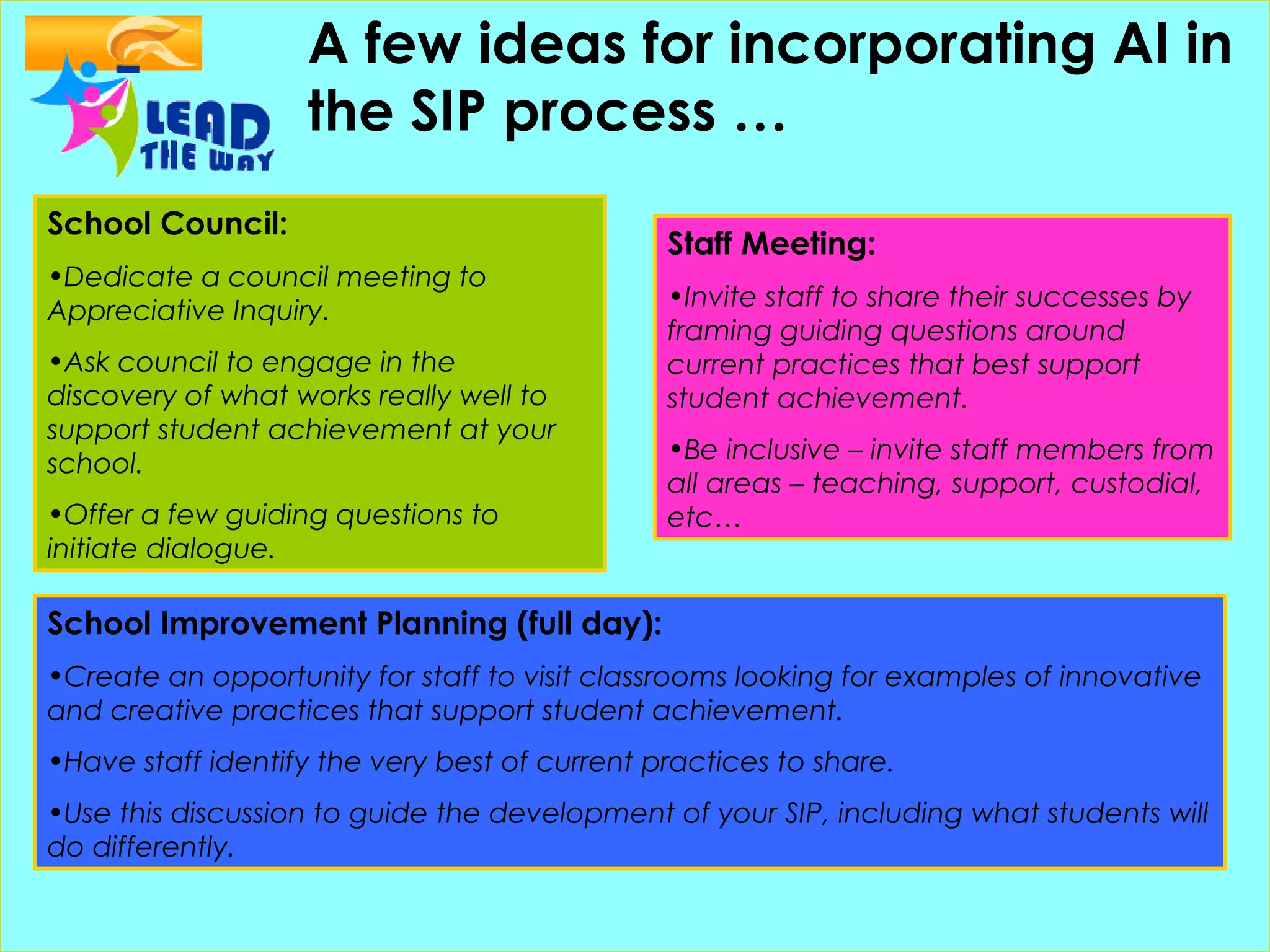
A few ideas for incorporating AI in
the SIP process …
School Council:
•Dedicate a council meeting to
Appreciative Inquiry.
•Ask council to engage in the
discovery of what works really well to
support student achievement at your
school.
•Offer a few guiding questions to
initiate dialogue.
Staff Meeting:
•Invite staff to share their successes by
framing guiding questions around
current practices that best support
student achievement.
•Be inclusive – invite staff members from
all areas – teaching, support, custodial,
etc…
School Improvement Planning (full day):
•Create an opportunity for staff to visit classrooms looking for examples of innovative
and creative practices that support student achievement.
•Have staff identify the very best of current practices to share.
•Use this discussion to guide the development of your SIP, including what students will
do differently.
Appreciative Inquiry Presentation

Appreciative Inquiry Presentation

  • 2.
    Appreciative Inquiry (AI) Asa means of affecting change, Appreciative Inquiry shifts the focus from a deficit model that seeks first to identify problems and then potential solutions, to a model that recognizes the plentiful potential that already exists within our organization.
  • 3.
    Appreciative Inquiry andthe School Improvement Planning Process “The BIP states a commitment to an appreciative, collaborative, inquiry-based approach to improvement; this requires a multi-faceted approach to indicators of success, employing both quantitative and qualitative data.” -- BIP Presentation to P/VP October 2010
  • 4.
    To incorporate anAppreciative Inquiry approach to School Improvement Planning, consider the following 5 guiding principles:
  • 5.
  • 6.
    Appreciative Inquiry Principle2Appreciative Inquiry Principle 2
  • 7.
    Appreciative Inquiry Principle3Appreciative Inquiry Principle 3
  • 8.
  • 9.
  • 10.
    Framing OCDSB BIPStrategies as Guiding Questions to focus AI • OCDSB Strategy #1: To improve student achievement through a focus on innovative, creative and critical thinking (higher-order skills) • OCDSB Strategy #2: To improve student achievement through a focus on ongoing assessment and feedback • What conditions exist within our school and community that foster innovative, creative and critical thinking skills? What is going on? Who is involved? What makes it work? • Which assessment and feedback strategies do we use to bring about the greatest improvement in student achievement? What makes those strategies effective? BIP Strategies: AI Guiding Questions:
  • 11.
    Make a PositiveImpact 2010: AI in Action “Problem solving as we know it sometimes gets us into a rut. Appreciative Inquiry will help us to find new direction, utilizing all the skills and talents within our own site, to make our own success stories. My school has lots of success stories which are in-house most times.” – MAPI Participant “It took practice to not see the bad things first, but to learn to see what was working and what was wonderful first instead and to focus on that. In doing this, I felt inspired and energized to pass on that positive in my work.” – MAPI Participant
  • 13.
    “When we deliberately seek outand notice those qualities that we hold in high estimation, our act of noticing and valuing actually amplifies those qualities and increases their value.” -- Barrett & Fry
  • 14.
    A few ideasfor incorporating AI in the SIP process … School Council: •Dedicate a council meeting to Appreciative Inquiry. •Ask council to engage in the discovery of what works really well to support student achievement at your school. •Offer a few guiding questions to initiate dialogue. Staff Meeting: •Invite staff to share their successes by framing guiding questions around current practices that best support student achievement. •Be inclusive – invite staff members from all areas – teaching, support, custodial, etc… School Improvement Planning (full day): •Create an opportunity for staff to visit classrooms looking for examples of innovative and creative practices that support student achievement. •Have staff identify the very best of current practices to share. •Use this discussion to guide the development of your SIP, including what students will do differently.