PART 10
THINKING
SECTIONS
Ѱ
10
Psychology, Twelfth Edition (Myers, D. G.)
© T.G. Lane 2018
PART9
• Differentiate between concepts and prototypes.
• Discuss how algorithms and heuristics can be used to
solve problems.
• Explain what effect insight has on the brain.
• Discuss how intuition, availability heuristic, overconfidence,
belief perseverance, and framing can effect one’s decisions
and judgments.
• Discuss how confirmation bias and mental sets interfere
with solving a problem correctly.
• Explain how convergent and divergent thinking differ
and how humans develop creativity.
© T.G. Lane 2018
MEMORY
CHAPTER8
SECTION
MEMORY
© T.G. Lane 2018
1
What is cognition, and what are the functions of concepts?
• Psychologists who study cognition focus on the mental act-
ivities associated with thinking, knowing, remembering, and
communicating information; one of these activities is forming
concepts which simplify one’s thinking (e.g. different chairs).
© T.G. Lane 2018
PART10:THINKINGCONCEPTS
• concept: a mental grouping of similar objects,
events, ideas, or people (i.e. into categories)
• We often form our concepts by developing
prototypes (e.g. a tomato– fruit or vegetable).
• prototype: a mental image or best
example of a category; a quick and easy
method for sorting items into categories
PART10
SECTION
THINKING
© T.G. Lane 2018
2
© T.G. Lane 2018
What cognitive strategies assist our problem solving, and what obsta-
cles hinder it?
• One tribute to one’s rationality is one’s problem-solving skills.
PROBLEM SOLVING: STRATEGIES AND OBSTACLESPART9:THINKING
• Some problems are solved using trial and error, while other
problems may be solved using algorithms and heuristics.
• algorithms: a methodical, logical rule or procedure
that guarantees solving a particular problem
• heuristics: a simple thinking strategy that often
allows us to make judgments and solve problems
efficiently; usually speedier but also more error-
prone
2
© T.G. Lane 2018
• Sometimes individuals puzzle over a problem and the pieces
suddenly fall together in a flash of insight—an abrupt, true-
seeming, and often satisfying solution.
PROBLEM SOLVING: STRATEGIES AND OBSTACLESPART9:THINKING
• insight: a sudden realization of a problem’s solution;
contrasts with strategy-based solutions
• Teams of researchers have identified brain activity associated with
sudden flashes of insight; insight strikes suddenly, with no prior
sense of “getting warmer” or feeling close to a solution; when the
answer pops into mind, one feels a happy sense of satisfaction.
2
© T.G. Lane 2018
• Inventive as humans are, other cognitive tendencies may lead one
astray as a result of confirmation bias.
PROBLEM SOLVING: STRATEGIES AND OBSTACLESPART9:THINKING
• confirmation bias: a tendency to search for information
that supports one’s preconceptions and to ignore or
distort contradictory evidence
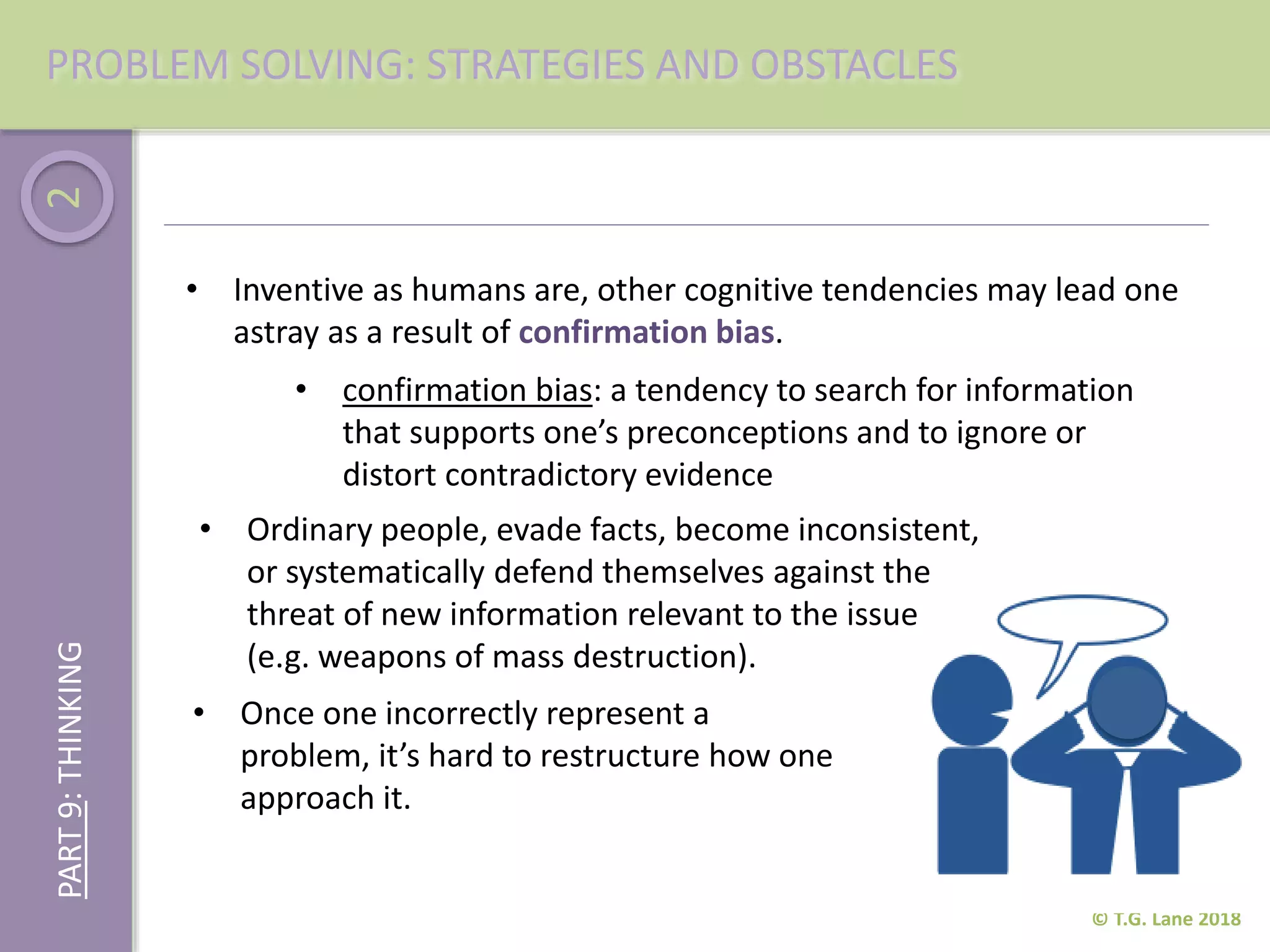
• Ordinary people, evade facts, become inconsistent,
or systematically defend themselves against the
threat of new information relevant to the issue
(e.g. weapons of mass destruction).
• Once one incorrectly represent a
problem, it’s hard to restructure how one
approach it.
2
© T.G. Lane 2018
• Humans often struggle with fixation—an inability to see a problem
from a fresh perspective; a prime example of fixation is mental
set.
PROBLEM SOLVING: STRATEGIES AND OBSTACLESPART9:THINKING
• mental set: a tendency to approach a problem in one
particular way, often a way that has been successful in
the past
• A mental set predisposes how one thinks; sometimes this can be
an obstacle to problem solving.
Example:
• O-T-T-F-?-?-?
• J-F-M-A-?-?-?
PART10
SECTION
MEMORY
© T.G. Lane 2018
3
• When making each day’s hundreds of judgments and
decisions, one seldom takes the time and effort to reason
systematically but rather relies on intuition.
© T.G. Lane 2018
FORMING GOOD AND BAD DECISIONS…
• intuition: an effortless, immediate, automatic feeling or
thought, as contrasted with explicit, conscious
reasoning
PART10:THINKING
What is intuition, and how can the availability heuristic, overconfidence,
belief prevalence, and framing influence our decisions and judgment?
3
• When we need to act quickly, the mental shortcuts we call
heuristics enable snap judgments; thanks to the mind’s
automatic information processing, intuitive judgments are
instantaneous.
© T.G. Lane 2018
FORMING GOOD AND BAD DECISIONS…
• availability heuristic: estimating the likelihood of events
based on their availability in memory; if instances come
readily to mind (perhaps because of their vividness),
one presumes such events are common
PART10:THINKING
THE AVAILABILITY HEURISTIC
• These generally helpful shortcuts can lead even the smartest
people into dumb decision– an availability heuristic is at play
(e.g. fear of flying vs. driving).
3
• Sometimes one’s judgments and decisions go off track simply
because individuals are more confident (or overconfident) than
correct (e.g. students underestimating the time needed to
complete assignments).
© T.G. Lane 2018
FORMING GOOD AND BAD DECISIONS…
• overconfidence: the tendency to be more confident
than correct—to overestimate the accuracy of our
beliefs and judgments
PART10:THINKING
OVERCONFIDENCE
• Given prompt and clear feedback, as weather
forecasters receive after each day’s predictions,
one can learn to be more realistic about the
accuracy of one’s judgments.
3
• Human’s overconfidence is startling; equally so is one’s belief
perseverance (e.g. views on capital punishment).
© T.G. Lane 2018
FORMING GOOD AND BAD DECISIONS…
• belief perseverance: clinging to one’s initial conceptions
after the basis on which they were formed has been
discredited
PART10:THINKING
BELIEF PERSEVERANCE
• Given prompt and clear feedback, as weather
forecasters receive after each day’s predictions,
one can learn to be more realistic about the
accuracy of one’s judgments.
• To rein in belief perseverance, a simple remedy
exists: Consider the opposite (review evidence for
the opposing side).
3
• Along with belief perseverance, framing can also effect one’s
decisions and judgements on a particular matter.
© T.G. Lane 2018
FORMING GOOD AND BAD DECISIONS…
• framing: the way an issue is posed; how an issue is
framed can significantly affect decisions and
judgments
PART10:THINKING
THE EFFECTS OF FRAMING
• Framing can be a powerful persuasion tool (e.g. condoms
effectiveness; 95% success rate vs. 5% failure rate)
4
• Intuition is analysis “frozen into habit”.
THE PERILS AND POWERS OF INTUITION
© T.G. Lane 2018
THINKING CREATIVELYPART10:THINKING
How do smart thinkers use intuition?
• Intuition is usually adaptive, enabling quick reactions.
• Intuition is huge.
• It is implicit knowledge—what one has learned and
recorded in one’s brains but can’t fully explain (e.g.
skilled athletes react without thinking).
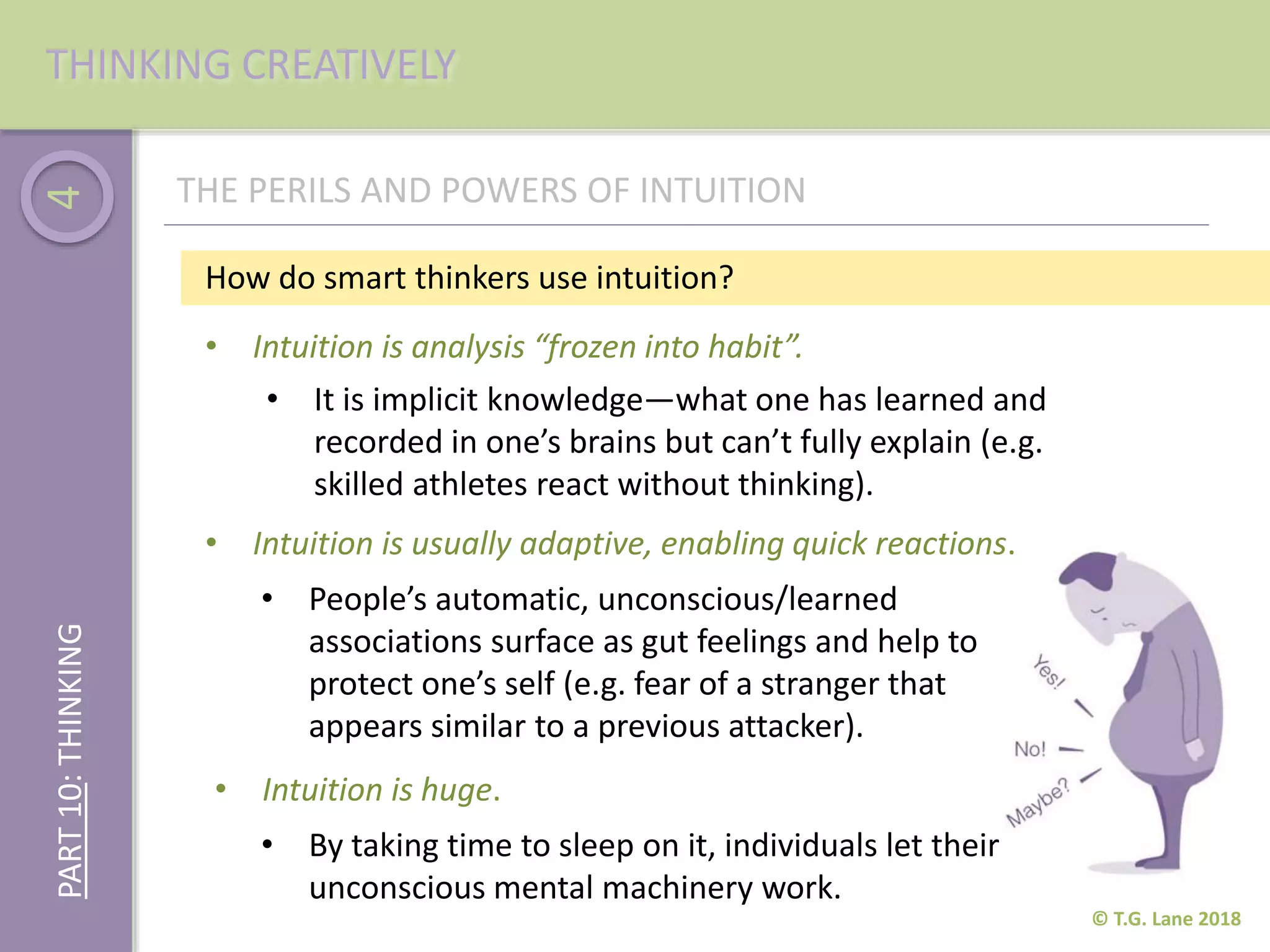
• People’s automatic, unconscious/learned
associations surface as gut feelings and help to
protect one’s self (e.g. fear of a stranger that
appears similar to a previous attacker).
• By taking time to sleep on it, individuals let their
unconscious mental machinery work.
PART10
SECTION
MEMORY
© T.G. Lane 2018
4
© T.G. Lane 2018
THINKING CREATIVELYPART10:THINKING
• Creativity is the ability to produce ideas that are both novel
(unique) and valuable
• Intelligence tests, which are intended to assess
aptitude and typically demand a single correct
answer, require convergent thinking.
• Creative tests require divergent thinking.
• convergent thinking: narrowing the available problem
solutions to determine the single best solution.
• divergent thinking: expanding the number of possible
problem solutions; creative thinking that diverges in
different directions (e.g. uses for a brick)
4
© T.G. Lane 2018
THINKING CREATIVELYPART10:THINKING
What is creativity, and what fosters it?
• Some researchers believe that creativity has five components:
1. Expertise
2. Imaginative thinking skills
3. A venturesome personality
4. Intrinsic motivation
5. A creative environment
• For those seeking to boost the creative process,
research offers some ideas:
1. Develop one’s expertise
2. Allow time for incubation
3. Set aside time for the mind to roam freely
4. Experience other cultures and ways of thinking

Part 10 (Thinking)

  • 1.
    PART 10 THINKING SECTIONS Ѱ 10 Psychology, TwelfthEdition (Myers, D. G.) © T.G. Lane 2018
  • 2.
    PART9 • Differentiate betweenconcepts and prototypes. • Discuss how algorithms and heuristics can be used to solve problems. • Explain what effect insight has on the brain. • Discuss how intuition, availability heuristic, overconfidence, belief perseverance, and framing can effect one’s decisions and judgments. • Discuss how confirmation bias and mental sets interfere with solving a problem correctly. • Explain how convergent and divergent thinking differ and how humans develop creativity. © T.G. Lane 2018 MEMORY
  • 3.
  • 4.
    1 What is cognition,and what are the functions of concepts? • Psychologists who study cognition focus on the mental act- ivities associated with thinking, knowing, remembering, and communicating information; one of these activities is forming concepts which simplify one’s thinking (e.g. different chairs). © T.G. Lane 2018 PART10:THINKINGCONCEPTS • concept: a mental grouping of similar objects, events, ideas, or people (i.e. into categories) • We often form our concepts by developing prototypes (e.g. a tomato– fruit or vegetable). • prototype: a mental image or best example of a category; a quick and easy method for sorting items into categories
  • 5.
  • 6.
    2 © T.G. Lane2018 What cognitive strategies assist our problem solving, and what obsta- cles hinder it? • One tribute to one’s rationality is one’s problem-solving skills. PROBLEM SOLVING: STRATEGIES AND OBSTACLESPART9:THINKING • Some problems are solved using trial and error, while other problems may be solved using algorithms and heuristics. • algorithms: a methodical, logical rule or procedure that guarantees solving a particular problem • heuristics: a simple thinking strategy that often allows us to make judgments and solve problems efficiently; usually speedier but also more error- prone
  • 7.
    2 © T.G. Lane2018 • Sometimes individuals puzzle over a problem and the pieces suddenly fall together in a flash of insight—an abrupt, true- seeming, and often satisfying solution. PROBLEM SOLVING: STRATEGIES AND OBSTACLESPART9:THINKING • insight: a sudden realization of a problem’s solution; contrasts with strategy-based solutions • Teams of researchers have identified brain activity associated with sudden flashes of insight; insight strikes suddenly, with no prior sense of “getting warmer” or feeling close to a solution; when the answer pops into mind, one feels a happy sense of satisfaction.
  • 8.
    2 © T.G. Lane2018 • Inventive as humans are, other cognitive tendencies may lead one astray as a result of confirmation bias. PROBLEM SOLVING: STRATEGIES AND OBSTACLESPART9:THINKING • confirmation bias: a tendency to search for information that supports one’s preconceptions and to ignore or distort contradictory evidence • Ordinary people, evade facts, become inconsistent, or systematically defend themselves against the threat of new information relevant to the issue (e.g. weapons of mass destruction). • Once one incorrectly represent a problem, it’s hard to restructure how one approach it.
  • 9.
    2 © T.G. Lane2018 • Humans often struggle with fixation—an inability to see a problem from a fresh perspective; a prime example of fixation is mental set. PROBLEM SOLVING: STRATEGIES AND OBSTACLESPART9:THINKING • mental set: a tendency to approach a problem in one particular way, often a way that has been successful in the past • A mental set predisposes how one thinks; sometimes this can be an obstacle to problem solving. Example: • O-T-T-F-?-?-? • J-F-M-A-?-?-?
  • 10.
  • 11.
    3 • When makingeach day’s hundreds of judgments and decisions, one seldom takes the time and effort to reason systematically but rather relies on intuition. © T.G. Lane 2018 FORMING GOOD AND BAD DECISIONS… • intuition: an effortless, immediate, automatic feeling or thought, as contrasted with explicit, conscious reasoning PART10:THINKING What is intuition, and how can the availability heuristic, overconfidence, belief prevalence, and framing influence our decisions and judgment?
  • 12.
    3 • When weneed to act quickly, the mental shortcuts we call heuristics enable snap judgments; thanks to the mind’s automatic information processing, intuitive judgments are instantaneous. © T.G. Lane 2018 FORMING GOOD AND BAD DECISIONS… • availability heuristic: estimating the likelihood of events based on their availability in memory; if instances come readily to mind (perhaps because of their vividness), one presumes such events are common PART10:THINKING THE AVAILABILITY HEURISTIC • These generally helpful shortcuts can lead even the smartest people into dumb decision– an availability heuristic is at play (e.g. fear of flying vs. driving).
  • 13.
    3 • Sometimes one’sjudgments and decisions go off track simply because individuals are more confident (or overconfident) than correct (e.g. students underestimating the time needed to complete assignments). © T.G. Lane 2018 FORMING GOOD AND BAD DECISIONS… • overconfidence: the tendency to be more confident than correct—to overestimate the accuracy of our beliefs and judgments PART10:THINKING OVERCONFIDENCE • Given prompt and clear feedback, as weather forecasters receive after each day’s predictions, one can learn to be more realistic about the accuracy of one’s judgments.
  • 14.
    3 • Human’s overconfidenceis startling; equally so is one’s belief perseverance (e.g. views on capital punishment). © T.G. Lane 2018 FORMING GOOD AND BAD DECISIONS… • belief perseverance: clinging to one’s initial conceptions after the basis on which they were formed has been discredited PART10:THINKING BELIEF PERSEVERANCE • Given prompt and clear feedback, as weather forecasters receive after each day’s predictions, one can learn to be more realistic about the accuracy of one’s judgments. • To rein in belief perseverance, a simple remedy exists: Consider the opposite (review evidence for the opposing side).
  • 15.
    3 • Along withbelief perseverance, framing can also effect one’s decisions and judgements on a particular matter. © T.G. Lane 2018 FORMING GOOD AND BAD DECISIONS… • framing: the way an issue is posed; how an issue is framed can significantly affect decisions and judgments PART10:THINKING THE EFFECTS OF FRAMING • Framing can be a powerful persuasion tool (e.g. condoms effectiveness; 95% success rate vs. 5% failure rate)
  • 16.
    4 • Intuition isanalysis “frozen into habit”. THE PERILS AND POWERS OF INTUITION © T.G. Lane 2018 THINKING CREATIVELYPART10:THINKING How do smart thinkers use intuition? • Intuition is usually adaptive, enabling quick reactions. • Intuition is huge. • It is implicit knowledge—what one has learned and recorded in one’s brains but can’t fully explain (e.g. skilled athletes react without thinking). • People’s automatic, unconscious/learned associations surface as gut feelings and help to protect one’s self (e.g. fear of a stranger that appears similar to a previous attacker). • By taking time to sleep on it, individuals let their unconscious mental machinery work.
  • 17.
  • 18.
    4 © T.G. Lane2018 THINKING CREATIVELYPART10:THINKING • Creativity is the ability to produce ideas that are both novel (unique) and valuable • Intelligence tests, which are intended to assess aptitude and typically demand a single correct answer, require convergent thinking. • Creative tests require divergent thinking. • convergent thinking: narrowing the available problem solutions to determine the single best solution. • divergent thinking: expanding the number of possible problem solutions; creative thinking that diverges in different directions (e.g. uses for a brick)
  • 19.
    4 © T.G. Lane2018 THINKING CREATIVELYPART10:THINKING What is creativity, and what fosters it? • Some researchers believe that creativity has five components: 1. Expertise 2. Imaginative thinking skills 3. A venturesome personality 4. Intrinsic motivation 5. A creative environment • For those seeking to boost the creative process, research offers some ideas: 1. Develop one’s expertise 2. Allow time for incubation 3. Set aside time for the mind to roam freely 4. Experience other cultures and ways of thinking