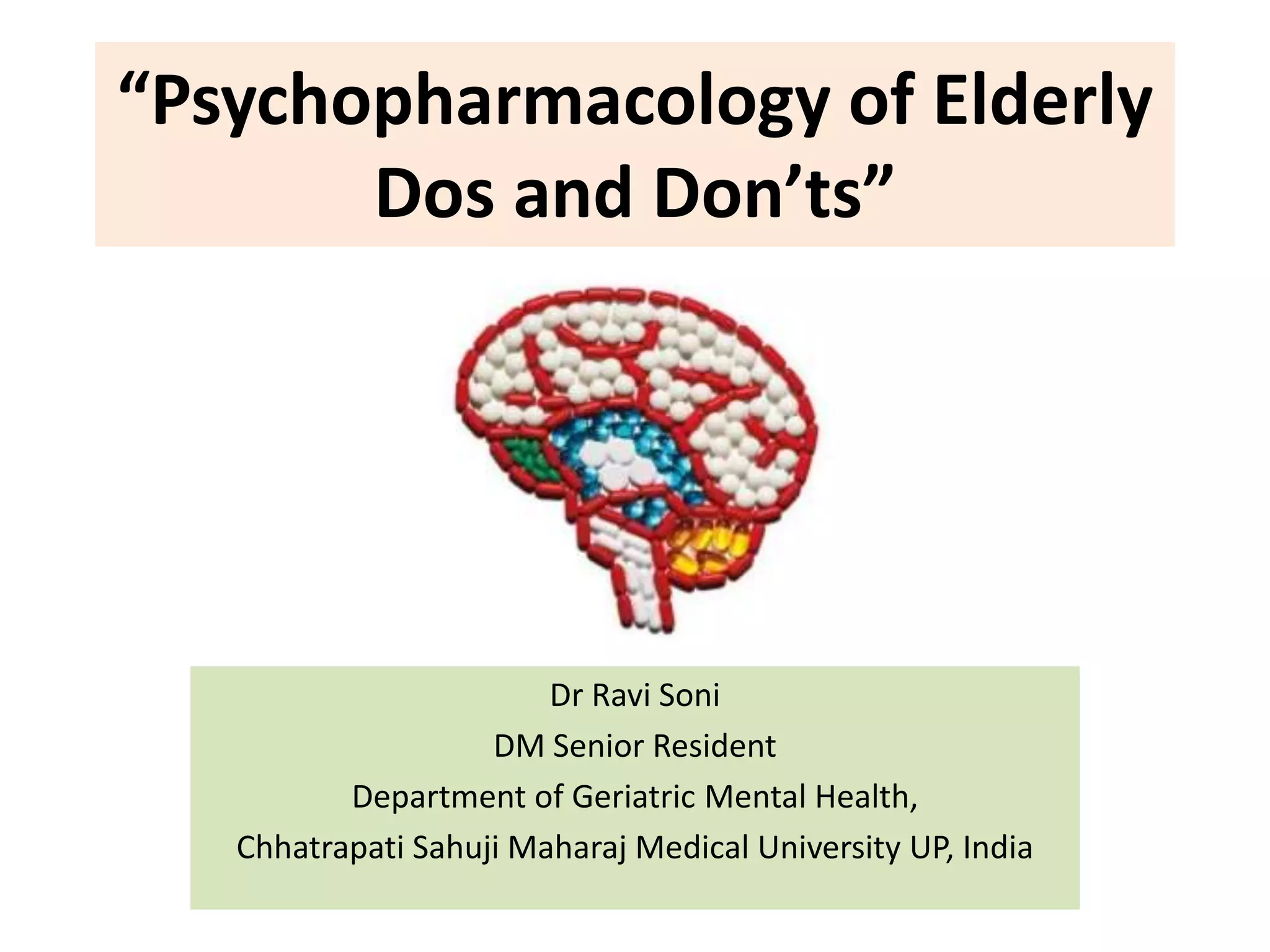
“Psychopharmacology of Elderly
Dos and Don’ts”
Dr Ravi Soni
DM Senior Resident
Department of Geriatric Mental Health,
Chhatrapati Sahuji Maharaj Medical University UP, India
Objectives
1. To Understand key issues in geriatric
pharmacotherapy
2. To Understand the effect age on pharmacokinetics
and pharmacodynamics
3. To Discuss risk factors for adverse drug events and
ways to mitigate them
4. To Understand the principles of drug prescribing
for older patients
The Aging Imperative
• Persons aged 60y and
older constitute 13% of
the population and
purchase 33% of all
prescription medications
• By 2040, 25% of the
population will purchase
50% of all prescription
drugs
Challenges of Geriatric
Pharmacotherapy
• New drugs available each year
• FDA approved and off-label indications are expanding
• Advanced understanding of drug-drug interactions
• Increasing popularity of “nutriceuticals”
• Multiple co-morbid states
• Polypharmacy
• Medication compliance
• Effects of aging physiology on drug therapy
• Medication cost
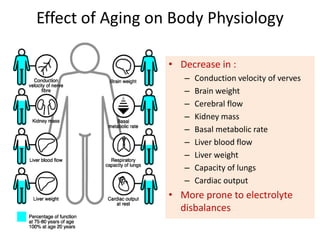
Effect of Aging on Body Physiology
• Decrease in :
– Conduction velocity of verves
– Brain weight
– Cerebral flow
– Kidney mass
– Basal metabolic rate
– Liver blood flow
– Liver weight
– Capacity of lungs
– Cardiac output
• More prone to electrolyte
disbalances
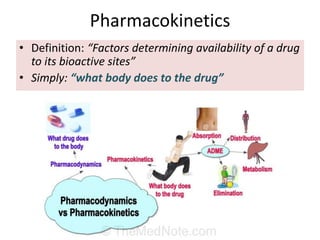
Pharmacokinetics
• Definition: “Factors determining availability of a drug
to its bioactive sites”
• Simply: “what body does to the drug”
Pharmacokinetics (PK)
• Absorption
– bioavailability: the fraction of a drug dose reaching the systemic
circulation
• Distribution
– locations in the body a drug penetrates. It is expressed as volume per
weight (e.g. L/kg)
• Metabolism
– Drug’s conversion to alternate compounds which may be
pharmacologically active or inactive
• Elimination
– a drug’s final route(s) of exit from the body. It is expressed in terms of
half-life or clearance
1. Peak Plasma level : Time between admin of drug and
appearance of peak concentration
2. Half life: Time taken in half of the drug peak plasma level
to be metabolized and excreted
3. Steady State Plasma level : Is achieved when drug is
administered repeatedly at time intervals shorter than the
half life. In about 5-6 half lives the drug will reach 97% of
steady state plasma level
4. First pass effect: Amount wasted in portal/ hepatic
circulation due to metabolism.
5. Clearance: Amount of drug excreted in each unit of time.
6. Protein Binding: Most drugs bind to plasma proteins such
as albumin and 1-acid glycoprotein (AGP) to some degree.
– This becomes clinically important as it is assumed that only
unbound (free) drug is available for binding to receptors, being
metabolized by enzymes, and eliminated from the body.
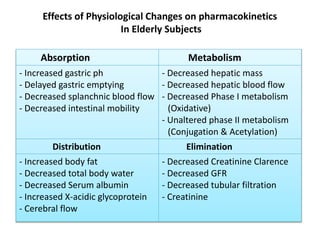
Basic Pharmacokinetic Issues
Absorption Metabolism
- Increased gastric ph
- Delayed gastric emptying
- Decreased splanchnic blood flow
- Decreased intestinal mobility
- Decreased hepatic mass
- Decreased hepatic blood flow
- Decreased Phase I metabolism
(Oxidative)
- Unaltered phase II metabolism
(Conjugation & Acetylation)
Distribution Elimination
- Increased body fat
- Decreased total body water
- Decreased Serum albumin
- Increased X-acidic glycoprotein
- Cerebral flow
- Decreased Creatinine Clarence
- Decreased GFR
- Decreased tubular filtration
- Creatinine
Effects of Physiological Changes on pharmacokinetics
In Elderly Subjects
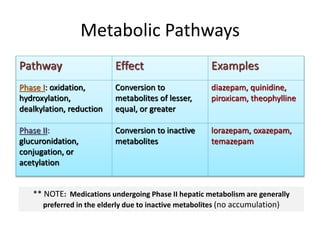
Metabolic Pathways
Pathway Effect Examples
Phase I: oxidation,
hydroxylation,
dealkylation, reduction
Conversion to
metabolites of lesser,
equal, or greater
diazepam, quinidine,
piroxicam, theophylline
Phase II:
glucuronidation,
conjugation, or
acetylation
Conversion to inactive
metabolites
lorazepam, oxazepam,
temazepam
** NOTE: Medications undergoing Phase II hepatic metabolism are generally
preferred in the elderly due to inactive metabolites (no accumulation)
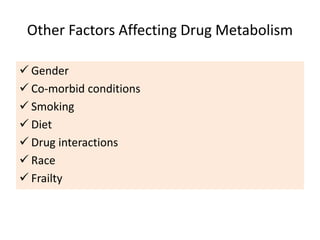
Other Factors Affecting Drug Metabolism
 Gender
 Co-morbid conditions
 Smoking
 Diet
 Drug interactions
 Race
 Frailty
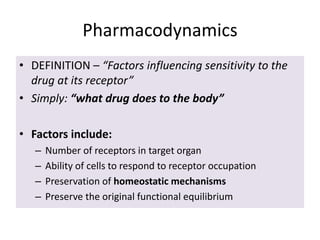
Pharmacodynamics
• DEFINITION – “Factors influencing sensitivity to the
drug at its receptor”
• Simply: “what drug does to the body”
• Factors include:
– Number of receptors in target organ
– Ability of cells to respond to receptor occupation
– Preservation of homeostatic mechanisms
– Preserve the original functional equilibrium
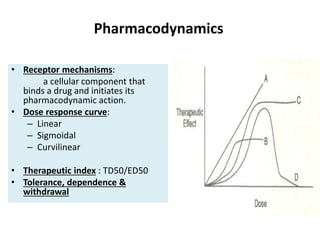
Pharmacodynamics
• Receptor mechanisms:
a cellular component that
binds a drug and initiates its
pharmacodynamic action.
• Dose response curve:
– Linear
– Sigmoidal
– Curvilinear
• Therapeutic index : TD50/ED50
• Tolerance, dependence &
withdrawal
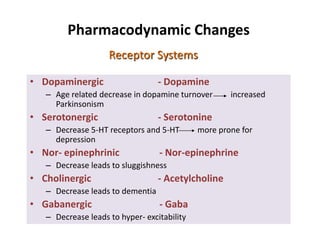
Pharmacodynamic Changes
• Dopaminergic - Dopamine
– Age related decrease in dopamine turnover increased
Parkinsonism
• Serotonergic - Serotonine
– Decrease 5-HT receptors and 5-HT more prone for
depression
• Nor- epinephrinic - Nor-epinephrine
– Decrease leads to sluggishness
• Cholinergic - Acetylcholine
– Decrease leads to dementia
• Gabanergic - Gaba
– Decrease leads to hyper- excitability
Receptor Systems
PK and PD Summary
• PK and PD changes generally result in
decreased clearance and increased sensitivity
to medications in older adults
• Use of lower doses, longer intervals, slower
titration are helpful in decreasing the risk of
drug intolerance and toxicity
• Careful monitoring is necessary to ensure
successful outcomes
Optimal Pharmacotherapy
• Balance between overprescribing and
underprescribing
– Correct drug
– Correct dose
– Targets appropriate condition
– Correct titration and monitoring
Avoid “a pill for every ill”
Always consider non-pharmacologic therapy
Consequences of Overprescribing
• Adverse drug events (ADEs)
• Drug interactions
• Duplication of drug therapy
• Decreased quality of life
• Unnecessary cost
• Medication non-adherence
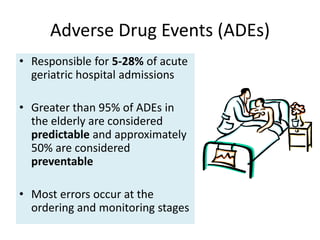
Adverse Drug Events (ADEs)
• Responsible for 5-28% of acute
geriatric hospital admissions
• Greater than 95% of ADEs in
the elderly are considered
predictable and approximately
50% are considered
preventable
• Most errors occur at the
ordering and monitoring stages
Most Common Medications Associated with
ADEs in the Elderly
• Opioid analgesics
• NSAIDs
• Anticholinergics
• Benzodiazepines
• Also: cardiovascular agents, CNS agents, and
musculoskeletal agents
Adverse Drug Reaction Risk Factors in Older Outpatients. Am J Ger Pharmacotherapy 2003;1(2):82-89.
Patient Risk Factors for ADEs
• Polypharmacy
• Multiple co-morbid conditions
• Prior adverse drug event
• Low body weight or body mass index
• Age > 85 years
• Estimated CrCl <50 mL/min
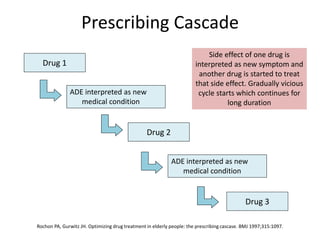
Prescribing Cascade
Drug 1
ADE interpreted as new
medical condition
Drug 2
ADE interpreted as new
medical condition
Drug 3
Rochon PA, Gurwitz JH. Optimizing drug treatment in elderly people: the prescribing cascase. BMJ 1997;315:1097.
Side effect of one drug is
interpreted as new symptom and
another drug is started to treat
that side effect. Gradually vicious
cycle starts which continues for
long duration
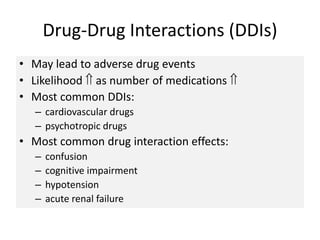
Drug-Drug Interactions (DDIs)
• May lead to adverse drug events
• Likelihood  as number of medications 
• Most common DDIs:
– cardiovascular drugs
– psychotropic drugs
• Most common drug interaction effects:
– confusion
– cognitive impairment
– hypotension
– acute renal failure
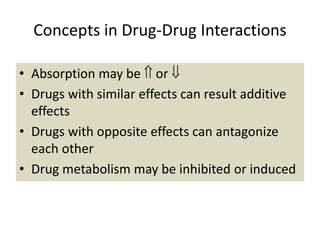
Concepts in Drug-Drug Interactions
• Absorption may be  or 
• Drugs with similar effects can result additive
effects
• Drugs with opposite effects can antagonize
each other
• Drug metabolism may be inhibited or induced
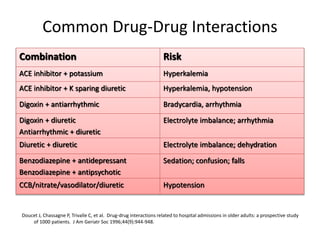
Common Drug-Drug Interactions
Combination Risk
ACE inhibitor + potassium Hyperkalemia
ACE inhibitor + K sparing diuretic Hyperkalemia, hypotension
Digoxin + antiarrhythmic Bradycardia, arrhythmia
Digoxin + diuretic
Antiarrhythmic + diuretic
Electrolyte imbalance; arrhythmia
Diuretic + diuretic Electrolyte imbalance; dehydration
Benzodiazepine + antidepressant
Benzodiazepine + antipsychotic
Sedation; confusion; falls
CCB/nitrate/vasodilator/diuretic Hypotension
Doucet J, Chassagne P, Trivalle C, et al. Drug-drug interactions related to hospital admissions in older adults: a prospective study
of 1000 patients. J Am Geriatr Soc 1996;44(9):944-948.
Drug-Disease Interactions
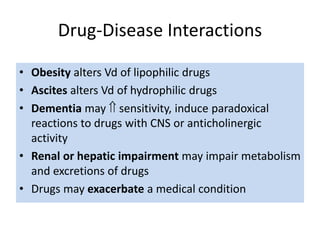
• Obesity alters Vd of lipophilic drugs
• Ascites alters Vd of hydrophilic drugs
• Dementia may  sensitivity, induce paradoxical
reactions to drugs with CNS or anticholinergic
activity
• Renal or hepatic impairment may impair metabolism
and excretions of drugs
• Drugs may exacerbate a medical condition
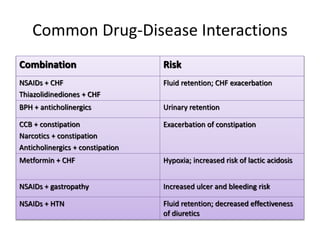
Common Drug-Disease Interactions
Combination Risk
NSAIDs + CHF
Thiazolidinediones + CHF
Fluid retention; CHF exacerbation
BPH + anticholinergics Urinary retention
CCB + constipation
Narcotics + constipation
Anticholinergics + constipation
Exacerbation of constipation
Metformin + CHF Hypoxia; increased risk of lactic acidosis
NSAIDs + gastropathy Increased ulcer and bleeding risk
NSAIDs + HTN Fluid retention; decreased effectiveness
of diuretics
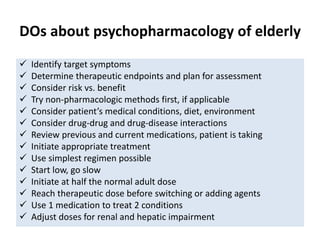
DOs about psychopharmacology of elderly
 Identify target symptoms
 Determine therapeutic endpoints and plan for assessment
 Consider risk vs. benefit
 Try non-pharmacologic methods first, if applicable
 Consider patient’s medical conditions, diet, environment
 Consider drug-drug and drug-disease interactions
 Review previous and current medications, patient is taking
 Initiate appropriate treatment
 Use simplest regimen possible
 Start low, go slow
 Initiate at half the normal adult dose
 Reach therapeutic dose before switching or adding agents
 Use 1 medication to treat 2 conditions
 Adjust doses for renal and hepatic impairment
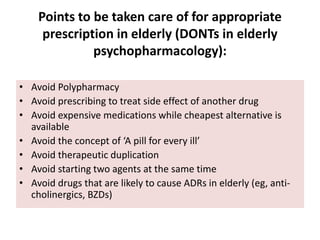
Points to be taken care of for appropriate
prescription in elderly (DONTs in elderly
psychopharmacology):
• Avoid Polypharmacy
• Avoid prescribing to treat side effect of another drug
• Avoid expensive medications while cheapest alternative is
available
• Avoid the concept of ‘A pill for every ill’
• Avoid therapeutic duplication
• Avoid starting two agents at the same time
• Avoid drugs that are likely to cause ADRs in elderly (eg, anti-
cholinergics, BZDs)
Preventing Polypharmacy
• Review medications regularly and each time a
new medication started or dose is changed
• Maintain accurate medication records (include
vitamins, OTCs, and herbals)
• “Brown-bag”
‘Concept of Brown bag’: During each
visit of the patient, he is asked to bring
all medication, he is currently taking
which includes all psychotropics,
medications for chronic medical illnesses
in old age and also the OTC drugs
Non-Adherence
• Rate may be as high as 50% in the elderly
• Factors in non-adherence
– Financial, cognitive, or functional status
– Beliefs and understanding about disease and
medications
Enhancing Medication Adherence
• Avoid newer, more expensive medications
that are not shown to be superior to less
expensive generic alternatives
• Simplify the regimen
• Educate patient on medication purpose,
benefits, safety, and potential ADEs
Summary
• Successful pharmacotherapy means using the
correct drug at the correct dose for the correct
indication in an individual patient
• Age alters PK and PD
• ADEs are common among the elderly
• Risk of ADEs can be minimized by appropriate
prescribing
K.G. Medical University UP, Lucknow
INDIA

Psychopharmacology in elderly

  • 1.
    “Psychopharmacology of Elderly Dosand Don’ts” Dr Ravi Soni DM Senior Resident Department of Geriatric Mental Health, Chhatrapati Sahuji Maharaj Medical University UP, India
  • 2.
    Objectives 1. To Understandkey issues in geriatric pharmacotherapy 2. To Understand the effect age on pharmacokinetics and pharmacodynamics 3. To Discuss risk factors for adverse drug events and ways to mitigate them 4. To Understand the principles of drug prescribing for older patients
  • 3.
    The Aging Imperative •Persons aged 60y and older constitute 13% of the population and purchase 33% of all prescription medications • By 2040, 25% of the population will purchase 50% of all prescription drugs
  • 4.
    Challenges of Geriatric Pharmacotherapy •New drugs available each year • FDA approved and off-label indications are expanding • Advanced understanding of drug-drug interactions • Increasing popularity of “nutriceuticals” • Multiple co-morbid states • Polypharmacy • Medication compliance • Effects of aging physiology on drug therapy • Medication cost
  • 5.
    Effect of Agingon Body Physiology • Decrease in : – Conduction velocity of verves – Brain weight – Cerebral flow – Kidney mass – Basal metabolic rate – Liver blood flow – Liver weight – Capacity of lungs – Cardiac output • More prone to electrolyte disbalances
  • 6.
    Pharmacokinetics • Definition: “Factorsdetermining availability of a drug to its bioactive sites” • Simply: “what body does to the drug”
  • 7.
    Pharmacokinetics (PK) • Absorption –bioavailability: the fraction of a drug dose reaching the systemic circulation • Distribution – locations in the body a drug penetrates. It is expressed as volume per weight (e.g. L/kg) • Metabolism – Drug’s conversion to alternate compounds which may be pharmacologically active or inactive • Elimination – a drug’s final route(s) of exit from the body. It is expressed in terms of half-life or clearance
  • 8.
    1. Peak Plasmalevel : Time between admin of drug and appearance of peak concentration 2. Half life: Time taken in half of the drug peak plasma level to be metabolized and excreted 3. Steady State Plasma level : Is achieved when drug is administered repeatedly at time intervals shorter than the half life. In about 5-6 half lives the drug will reach 97% of steady state plasma level 4. First pass effect: Amount wasted in portal/ hepatic circulation due to metabolism. 5. Clearance: Amount of drug excreted in each unit of time. 6. Protein Binding: Most drugs bind to plasma proteins such as albumin and 1-acid glycoprotein (AGP) to some degree. – This becomes clinically important as it is assumed that only unbound (free) drug is available for binding to receptors, being metabolized by enzymes, and eliminated from the body. Basic Pharmacokinetic Issues
  • 9.
    Absorption Metabolism - Increasedgastric ph - Delayed gastric emptying - Decreased splanchnic blood flow - Decreased intestinal mobility - Decreased hepatic mass - Decreased hepatic blood flow - Decreased Phase I metabolism (Oxidative) - Unaltered phase II metabolism (Conjugation & Acetylation) Distribution Elimination - Increased body fat - Decreased total body water - Decreased Serum albumin - Increased X-acidic glycoprotein - Cerebral flow - Decreased Creatinine Clarence - Decreased GFR - Decreased tubular filtration - Creatinine Effects of Physiological Changes on pharmacokinetics In Elderly Subjects
  • 10.
    Metabolic Pathways Pathway EffectExamples Phase I: oxidation, hydroxylation, dealkylation, reduction Conversion to metabolites of lesser, equal, or greater diazepam, quinidine, piroxicam, theophylline Phase II: glucuronidation, conjugation, or acetylation Conversion to inactive metabolites lorazepam, oxazepam, temazepam ** NOTE: Medications undergoing Phase II hepatic metabolism are generally preferred in the elderly due to inactive metabolites (no accumulation)
  • 11.
    Other Factors AffectingDrug Metabolism  Gender  Co-morbid conditions  Smoking  Diet  Drug interactions  Race  Frailty
  • 12.
    Pharmacodynamics • DEFINITION –“Factors influencing sensitivity to the drug at its receptor” • Simply: “what drug does to the body” • Factors include: – Number of receptors in target organ – Ability of cells to respond to receptor occupation – Preservation of homeostatic mechanisms – Preserve the original functional equilibrium
  • 13.
    Pharmacodynamics • Receptor mechanisms: acellular component that binds a drug and initiates its pharmacodynamic action. • Dose response curve: – Linear – Sigmoidal – Curvilinear • Therapeutic index : TD50/ED50 • Tolerance, dependence & withdrawal
  • 14.
    Pharmacodynamic Changes • Dopaminergic- Dopamine – Age related decrease in dopamine turnover increased Parkinsonism • Serotonergic - Serotonine – Decrease 5-HT receptors and 5-HT more prone for depression • Nor- epinephrinic - Nor-epinephrine – Decrease leads to sluggishness • Cholinergic - Acetylcholine – Decrease leads to dementia • Gabanergic - Gaba – Decrease leads to hyper- excitability Receptor Systems
  • 15.
    PK and PDSummary • PK and PD changes generally result in decreased clearance and increased sensitivity to medications in older adults • Use of lower doses, longer intervals, slower titration are helpful in decreasing the risk of drug intolerance and toxicity • Careful monitoring is necessary to ensure successful outcomes
  • 16.
    Optimal Pharmacotherapy • Balancebetween overprescribing and underprescribing – Correct drug – Correct dose – Targets appropriate condition – Correct titration and monitoring Avoid “a pill for every ill” Always consider non-pharmacologic therapy
  • 17.
    Consequences of Overprescribing •Adverse drug events (ADEs) • Drug interactions • Duplication of drug therapy • Decreased quality of life • Unnecessary cost • Medication non-adherence
  • 18.
    Adverse Drug Events(ADEs) • Responsible for 5-28% of acute geriatric hospital admissions • Greater than 95% of ADEs in the elderly are considered predictable and approximately 50% are considered preventable • Most errors occur at the ordering and monitoring stages
  • 19.
    Most Common MedicationsAssociated with ADEs in the Elderly • Opioid analgesics • NSAIDs • Anticholinergics • Benzodiazepines • Also: cardiovascular agents, CNS agents, and musculoskeletal agents Adverse Drug Reaction Risk Factors in Older Outpatients. Am J Ger Pharmacotherapy 2003;1(2):82-89.
  • 20.
    Patient Risk Factorsfor ADEs • Polypharmacy • Multiple co-morbid conditions • Prior adverse drug event • Low body weight or body mass index • Age > 85 years • Estimated CrCl <50 mL/min
  • 21.
    Prescribing Cascade Drug 1 ADEinterpreted as new medical condition Drug 2 ADE interpreted as new medical condition Drug 3 Rochon PA, Gurwitz JH. Optimizing drug treatment in elderly people: the prescribing cascase. BMJ 1997;315:1097. Side effect of one drug is interpreted as new symptom and another drug is started to treat that side effect. Gradually vicious cycle starts which continues for long duration
  • 22.
    Drug-Drug Interactions (DDIs) •May lead to adverse drug events • Likelihood  as number of medications  • Most common DDIs: – cardiovascular drugs – psychotropic drugs • Most common drug interaction effects: – confusion – cognitive impairment – hypotension – acute renal failure
  • 23.
    Concepts in Drug-DrugInteractions • Absorption may be  or  • Drugs with similar effects can result additive effects • Drugs with opposite effects can antagonize each other • Drug metabolism may be inhibited or induced
  • 24.
    Common Drug-Drug Interactions CombinationRisk ACE inhibitor + potassium Hyperkalemia ACE inhibitor + K sparing diuretic Hyperkalemia, hypotension Digoxin + antiarrhythmic Bradycardia, arrhythmia Digoxin + diuretic Antiarrhythmic + diuretic Electrolyte imbalance; arrhythmia Diuretic + diuretic Electrolyte imbalance; dehydration Benzodiazepine + antidepressant Benzodiazepine + antipsychotic Sedation; confusion; falls CCB/nitrate/vasodilator/diuretic Hypotension Doucet J, Chassagne P, Trivalle C, et al. Drug-drug interactions related to hospital admissions in older adults: a prospective study of 1000 patients. J Am Geriatr Soc 1996;44(9):944-948.
  • 25.
    Drug-Disease Interactions • Obesityalters Vd of lipophilic drugs • Ascites alters Vd of hydrophilic drugs • Dementia may  sensitivity, induce paradoxical reactions to drugs with CNS or anticholinergic activity • Renal or hepatic impairment may impair metabolism and excretions of drugs • Drugs may exacerbate a medical condition
  • 26.
    Common Drug-Disease Interactions CombinationRisk NSAIDs + CHF Thiazolidinediones + CHF Fluid retention; CHF exacerbation BPH + anticholinergics Urinary retention CCB + constipation Narcotics + constipation Anticholinergics + constipation Exacerbation of constipation Metformin + CHF Hypoxia; increased risk of lactic acidosis NSAIDs + gastropathy Increased ulcer and bleeding risk NSAIDs + HTN Fluid retention; decreased effectiveness of diuretics
  • 27.
    DOs about psychopharmacologyof elderly  Identify target symptoms  Determine therapeutic endpoints and plan for assessment  Consider risk vs. benefit  Try non-pharmacologic methods first, if applicable  Consider patient’s medical conditions, diet, environment  Consider drug-drug and drug-disease interactions  Review previous and current medications, patient is taking  Initiate appropriate treatment  Use simplest regimen possible  Start low, go slow  Initiate at half the normal adult dose  Reach therapeutic dose before switching or adding agents  Use 1 medication to treat 2 conditions  Adjust doses for renal and hepatic impairment
  • 28.
    Points to betaken care of for appropriate prescription in elderly (DONTs in elderly psychopharmacology): • Avoid Polypharmacy • Avoid prescribing to treat side effect of another drug • Avoid expensive medications while cheapest alternative is available • Avoid the concept of ‘A pill for every ill’ • Avoid therapeutic duplication • Avoid starting two agents at the same time • Avoid drugs that are likely to cause ADRs in elderly (eg, anti- cholinergics, BZDs)
  • 29.
    Preventing Polypharmacy • Reviewmedications regularly and each time a new medication started or dose is changed • Maintain accurate medication records (include vitamins, OTCs, and herbals) • “Brown-bag” ‘Concept of Brown bag’: During each visit of the patient, he is asked to bring all medication, he is currently taking which includes all psychotropics, medications for chronic medical illnesses in old age and also the OTC drugs
  • 30.
    Non-Adherence • Rate maybe as high as 50% in the elderly • Factors in non-adherence – Financial, cognitive, or functional status – Beliefs and understanding about disease and medications
  • 31.
    Enhancing Medication Adherence •Avoid newer, more expensive medications that are not shown to be superior to less expensive generic alternatives • Simplify the regimen • Educate patient on medication purpose, benefits, safety, and potential ADEs
  • 32.
    Summary • Successful pharmacotherapymeans using the correct drug at the correct dose for the correct indication in an individual patient • Age alters PK and PD • ADEs are common among the elderly • Risk of ADEs can be minimized by appropriate prescribing
  • 33.
    K.G. Medical UniversityUP, Lucknow INDIA