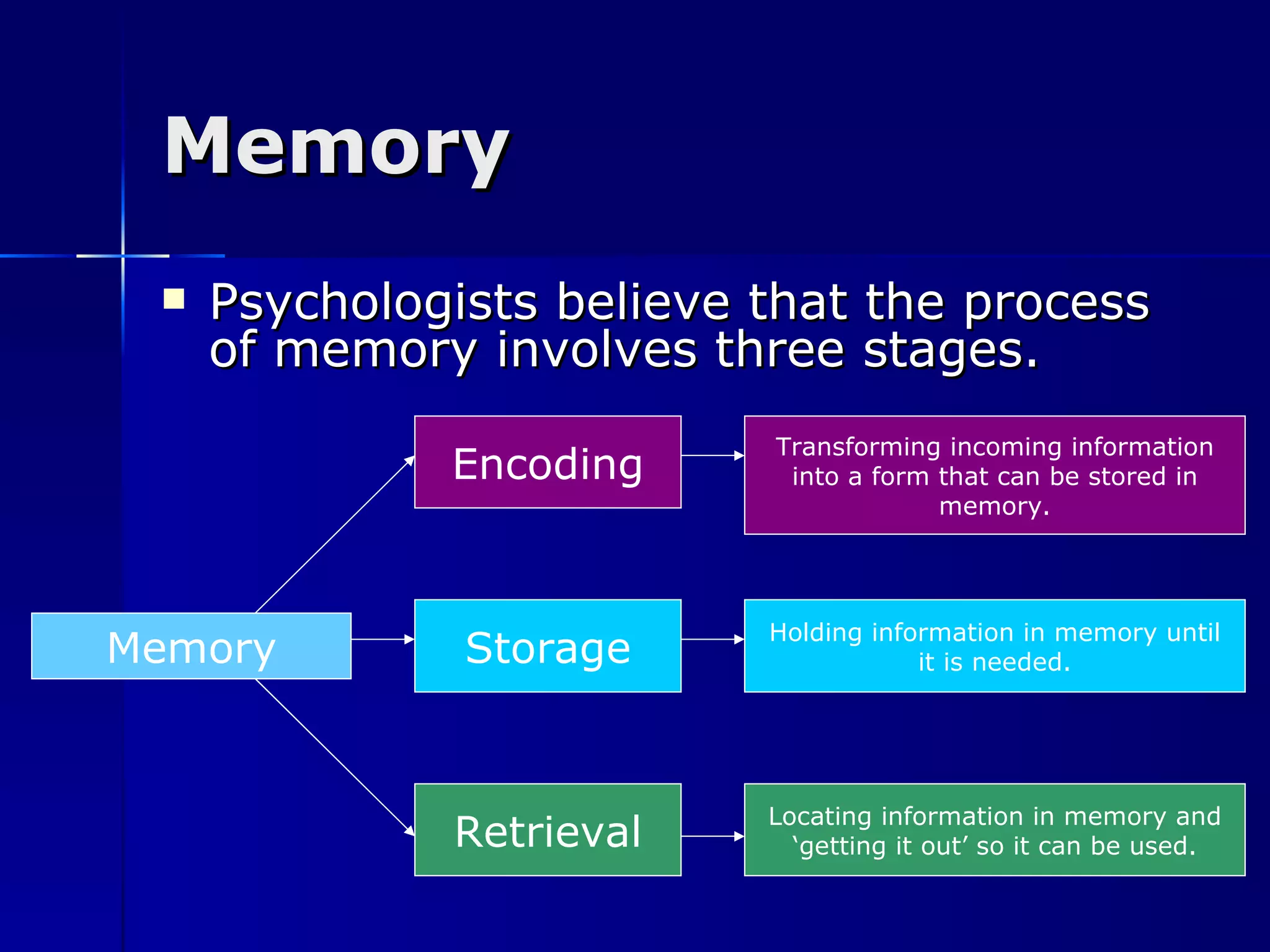
Memory Psychologists believe that the process of memory involves three stages. Memory Encoding Storage Retrieval Transforming incoming information into a form that can be stored in memory. Holding information in memory until it is needed. Locating information in memory and ‘getting it out’ so it can be used.
Encoding In every situation your brain has to process all the information you receive. Information is changed so that we can make sense of it. This process is known as encoding. Encoding is the process of representing an item in some form in the memory; it may be in the form of a “sound” heard in the mind, a “picture” seen in the mind or a “meaning” held in the mind. Imagine you have called directory enquires for a telephone number. As the recorded voice tells you the number (“the number you require is ….”) can you think how you keep it in your memory whilst writing it down?
Most people say it over to themselves until they have written it down. This is an example of encoding the information. In this case, it is encoded in the form of a sound. You “hear” your voice in your head whilst you repeat it.  Psychologists often refer to this as  acoustic encoding .
Storage The information that has been encoded is then stored so that it is available for use sometime in the future. We store different types of information in different ways.
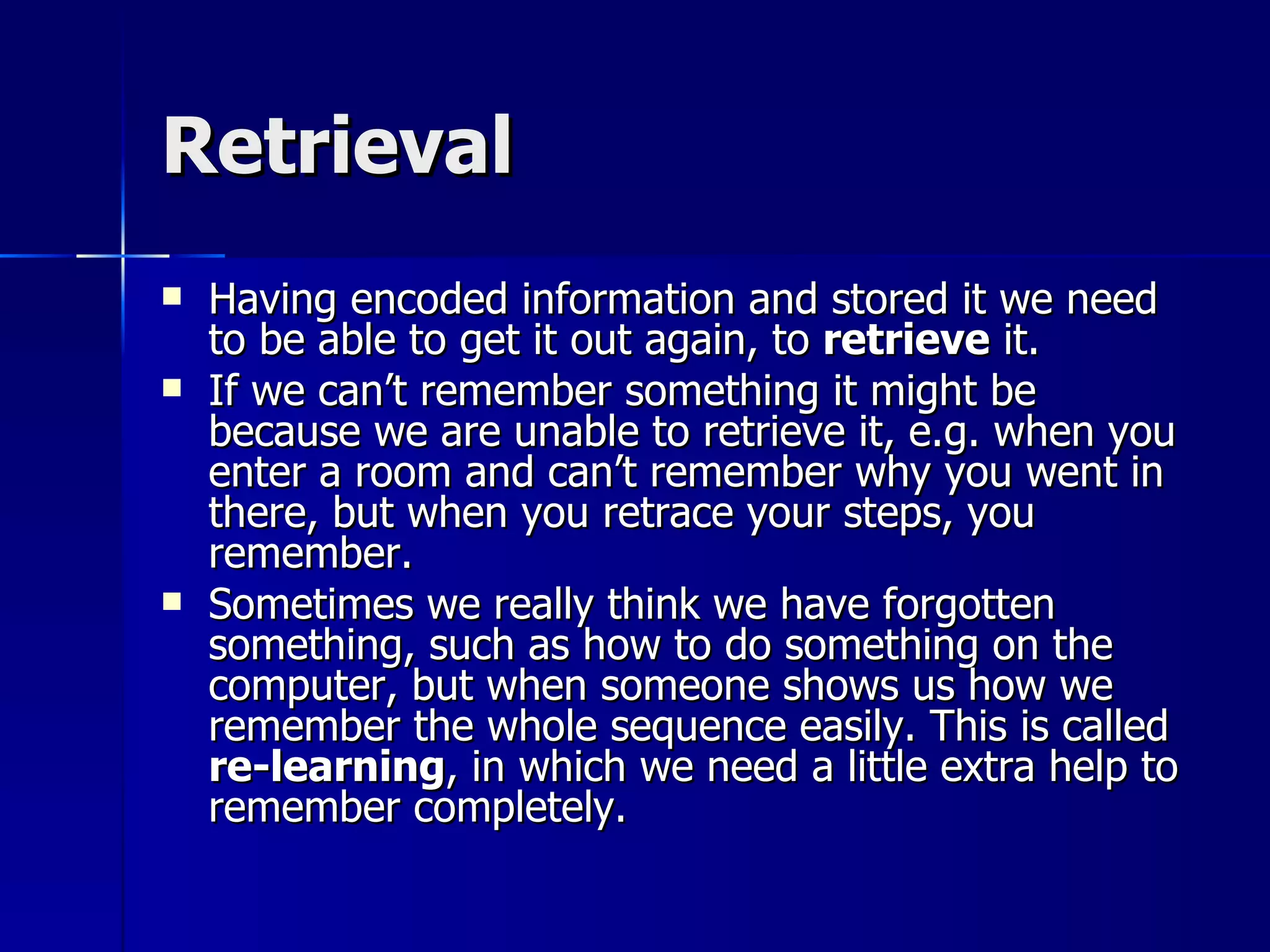
Retrieval Having encoded information and stored it we need to be able to get it out again, to  retrieve  it. If we can’t remember something it might be because we are unable to retrieve it, e.g. when you enter a room and can’t remember why you went in there, but when you retrace your steps, you remember. Sometimes we really think we have forgotten something, such as how to do something on the computer, but when someone shows us how we remember the whole sequence easily. This is called  re-learning , in which we need a little extra help to remember completely.
Definition Memory is the mental process involved in  coding ,  storing  and  retrieving  information.
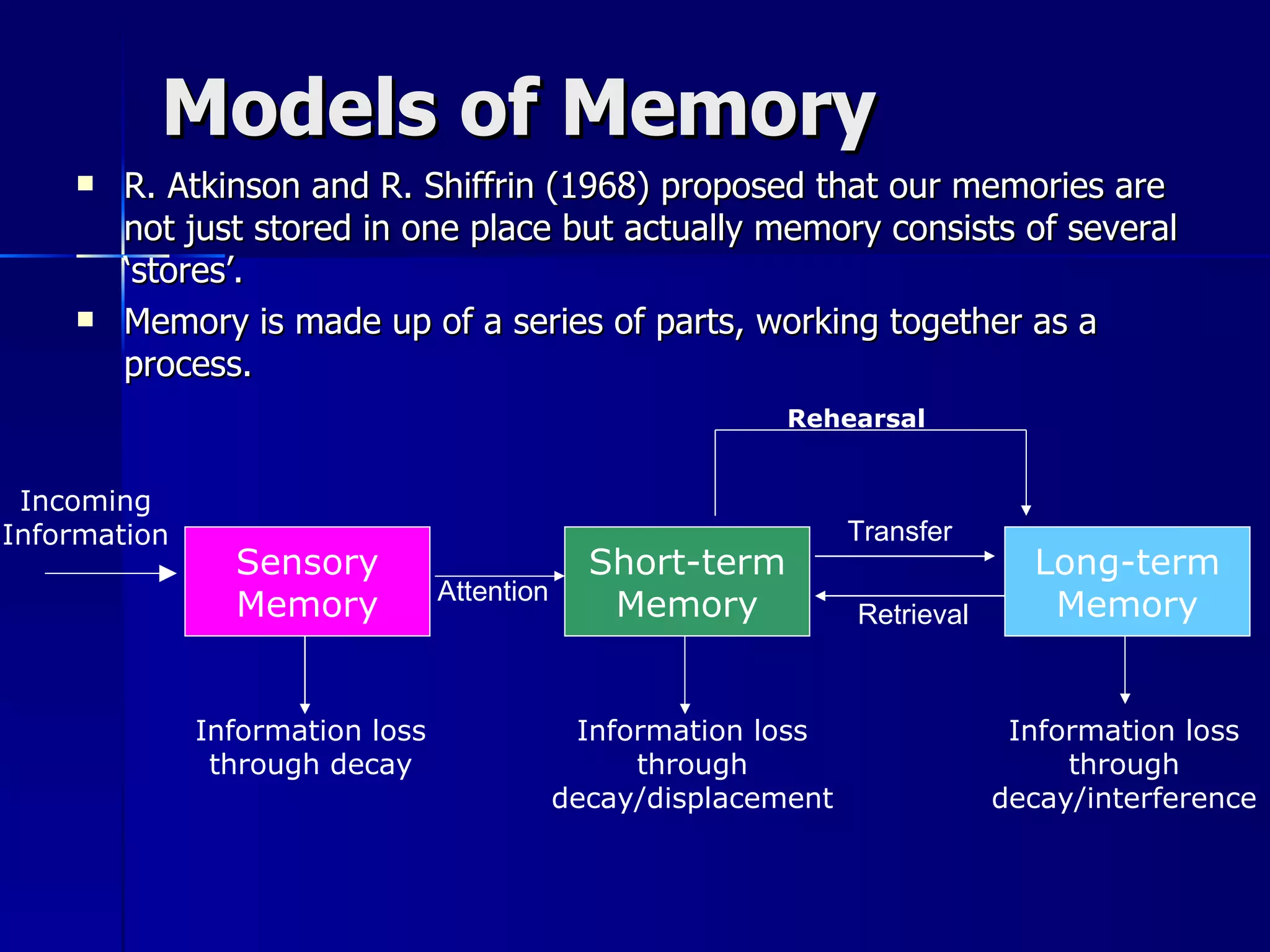
Models of Memory R. Atkinson and R. Shiffrin (1968) proposed that our memories are not just stored in one place but actually memory consists of several ‘stores’. Memory is made up of a series of parts, working together as a process. Sensory Memory Long-term Memory Short-term Memory Information loss through decay Information loss through decay/displacement Information loss through decay/interference Rehearsal Incoming Information Attention Retrieval Transfer
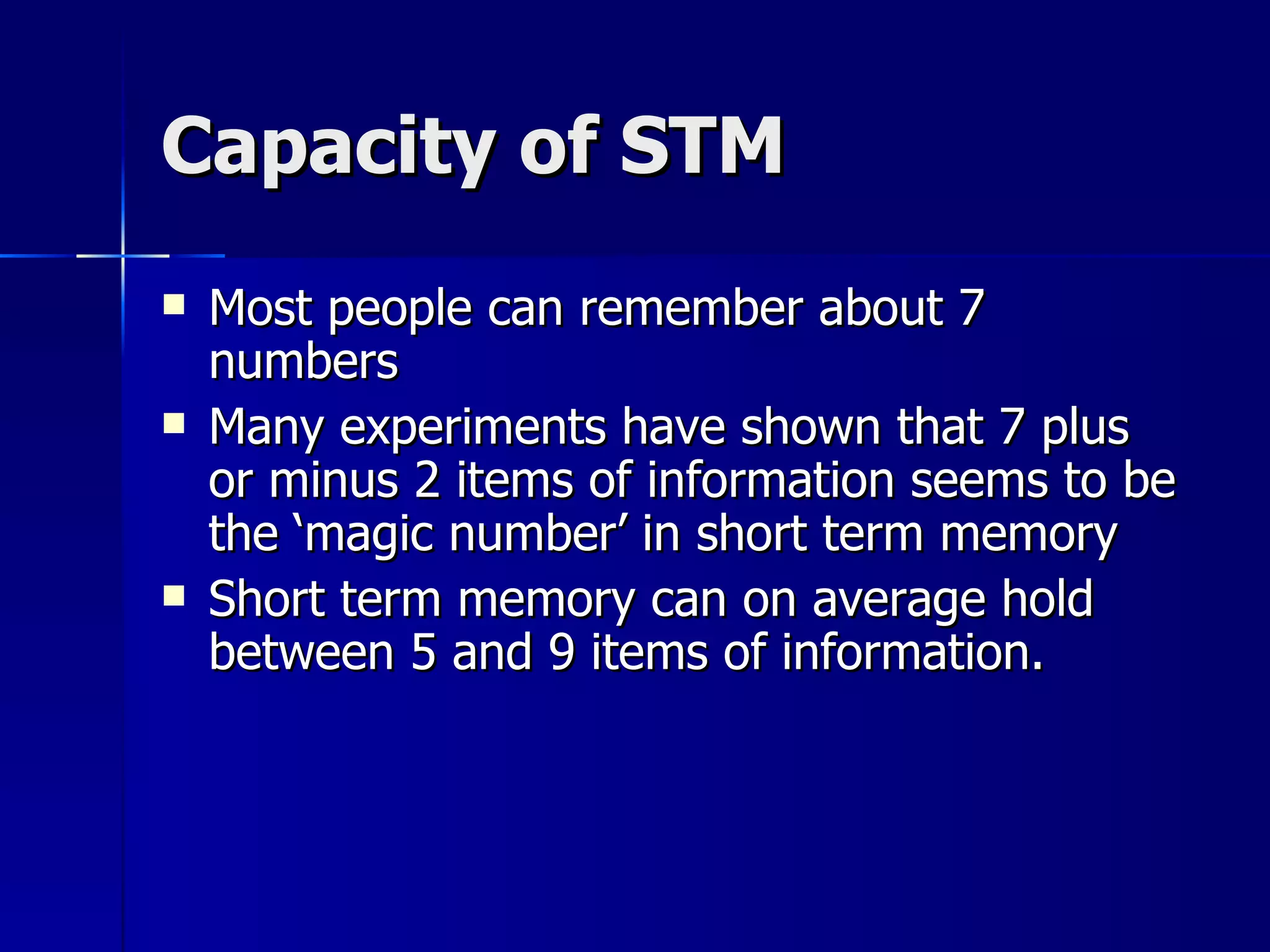
Capacity of STM Most people can remember about 7 numbers Many experiments have shown that 7 plus or minus 2 items of information seems to be the ‘magic number’ in short term memory Short term memory can on average hold between 5 and 9 items of information.
Capacity of LTM LTM contains vast amounts of information so it is not possible to measure its capacity. Most psychologists would agree that there is no upper limit – we are always capable of learning more.
Duration of STM Short-term memory is called short term because information is kept there for a short time. When you carried out your rehearsal task you could see that without rehearsal the words were forgotten very quickly. It is thought that information is kept in STM for around 15 to 30 seconds.
Duration of LTM The duration of LTM seems only to be limited by the length of human life. Many people in their old age can readily recall events from their childhood. Some items last for a few minutes (just long enough to be LTM), some for a few hours, some for a few days, months, years or a whole lifetime. Information in LTM does not need to be rehearsed to be remembered.
Encoding in STM and LTM It appears that STM and LTM make use of all three types of encoding. However it has been noted that they each rely on one type the most heavily. Baddeley carried out a study to identify the type of encoding that each type of memory relies on the most. Read the research on your worksheet and answer the questions that follow to identify which type of encoding is primarily used by which type of memory.

Atkinson & Shiffrin

  • 1.
    Memory Psychologists believethat the process of memory involves three stages. Memory Encoding Storage Retrieval Transforming incoming information into a form that can be stored in memory. Holding information in memory until it is needed. Locating information in memory and ‘getting it out’ so it can be used.
  • 2.
    Encoding In everysituation your brain has to process all the information you receive. Information is changed so that we can make sense of it. This process is known as encoding. Encoding is the process of representing an item in some form in the memory; it may be in the form of a “sound” heard in the mind, a “picture” seen in the mind or a “meaning” held in the mind. Imagine you have called directory enquires for a telephone number. As the recorded voice tells you the number (“the number you require is ….”) can you think how you keep it in your memory whilst writing it down?
  • 3.
    Most people sayit over to themselves until they have written it down. This is an example of encoding the information. In this case, it is encoded in the form of a sound. You “hear” your voice in your head whilst you repeat it. Psychologists often refer to this as acoustic encoding .
  • 4.
    Storage The informationthat has been encoded is then stored so that it is available for use sometime in the future. We store different types of information in different ways.
  • 5.
    Retrieval Having encodedinformation and stored it we need to be able to get it out again, to retrieve it. If we can’t remember something it might be because we are unable to retrieve it, e.g. when you enter a room and can’t remember why you went in there, but when you retrace your steps, you remember. Sometimes we really think we have forgotten something, such as how to do something on the computer, but when someone shows us how we remember the whole sequence easily. This is called re-learning , in which we need a little extra help to remember completely.
  • 6.
    Definition Memory isthe mental process involved in coding , storing and retrieving information.
  • 7.
    Models of MemoryR. Atkinson and R. Shiffrin (1968) proposed that our memories are not just stored in one place but actually memory consists of several ‘stores’. Memory is made up of a series of parts, working together as a process. Sensory Memory Long-term Memory Short-term Memory Information loss through decay Information loss through decay/displacement Information loss through decay/interference Rehearsal Incoming Information Attention Retrieval Transfer
  • 8.
    Capacity of STMMost people can remember about 7 numbers Many experiments have shown that 7 plus or minus 2 items of information seems to be the ‘magic number’ in short term memory Short term memory can on average hold between 5 and 9 items of information.
  • 9.
    Capacity of LTMLTM contains vast amounts of information so it is not possible to measure its capacity. Most psychologists would agree that there is no upper limit – we are always capable of learning more.
  • 10.
    Duration of STMShort-term memory is called short term because information is kept there for a short time. When you carried out your rehearsal task you could see that without rehearsal the words were forgotten very quickly. It is thought that information is kept in STM for around 15 to 30 seconds.
  • 11.
    Duration of LTMThe duration of LTM seems only to be limited by the length of human life. Many people in their old age can readily recall events from their childhood. Some items last for a few minutes (just long enough to be LTM), some for a few hours, some for a few days, months, years or a whole lifetime. Information in LTM does not need to be rehearsed to be remembered.
  • 12.
    Encoding in STMand LTM It appears that STM and LTM make use of all three types of encoding. However it has been noted that they each rely on one type the most heavily. Baddeley carried out a study to identify the type of encoding that each type of memory relies on the most. Read the research on your worksheet and answer the questions that follow to identify which type of encoding is primarily used by which type of memory.

Editor's Notes

  • #8 Information from all around us comes into our sensory memory. Some of the information we may be interested in and pay attention to. All the other information is lost. The information we have paid attention to is then transferred to our short-term memory. Our short term memories can only hold a certain amount of information for a short time after this new memories push out the others and they are lost. Information that is rehearsed will be transferred to long term memory where it is available for use indefinitely and can be retrieved for use at a later time.