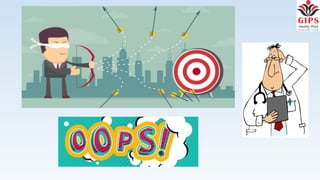
Common Avoidable
Mistakes while Prescribing
in Elderly
Dr. Ravi Soni
DM Geriatric Psychiatry
Consultant Geriatric Psychiatrist
GIPS Hospital & De-addiction Center
Disclaim
er
All the Case vignettes and Prescription
Scenarios shown here are Hypothetical
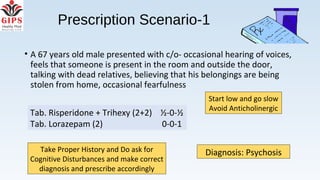
Prescription Scenario-1
• A 67 years old male presented with c/o- occasional hearing of voices,
feels that someone is present in the room and outside the door,
talking with dead relatives, believing that his belongings are being
stolen from home, occasional fearfulness
Diagnosis: PsychosisTake Proper History and Do ask for
Cognitive Disturbances and make correct
diagnosis and prescribe accordingly
Start low and go slow
Avoid Anticholinergic
Tab. Risperidone + Trihexy (2+2) ½-0-½
Tab. Lorazepam (2) 0-0-1
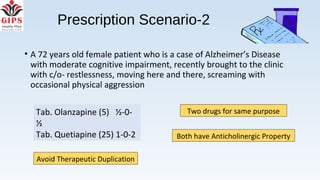
Prescription Scenario-2
• A 72 years old female patient who is a case of Alzheimer’s Disease
with moderate cognitive impairment, recently brought to the clinic
with c/o- restlessness, moving here and there, screaming with
occasional physical aggression
Two drugs for same purpose
Both have Anticholinergic Property
Tab. Olanzapine (5) ½-0-
½
Tab. Quetiapine (25) 1-0-2
Avoid Therapeutic Duplication
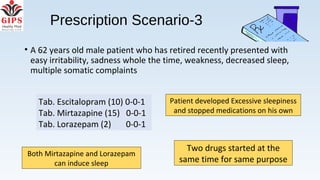
Prescription Scenario-3
• A 62 years old male patient who has retired recently presented with
easy irritability, sadness whole the time, weakness, decreased sleep,
multiple somatic complaints
Two drugs started at the
same time for same purpose
Both Mirtazapine and Lorazepam
can induce sleep
Patient developed Excessive sleepiness
and stopped medications on his own
Tab. Escitalopram (10) 0-0-1
Tab. Mirtazapine (15) 0-0-1
Tab. Lorazepam (2) 0-0-1
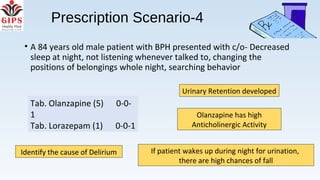
Prescription Scenario-4
• A 84 years old male patient with BPH presented with c/o- Decreased
sleep at night, not listening whenever talked to, changing the
positions of belongings whole night, searching behavior
Urinary Retention developed
Olanzapine has high
Anticholinergic Activity
If patient wakes up during night for urination,
there are high chances of fall
Identify the cause of Delirium
Tab. Olanzapine (5) 0-0-
1
Tab. Lorazepam (1) 0-0-1
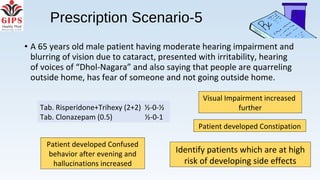
• A 65 years old male patient having moderate hearing impairment and
blurring of vision due to cataract, presented with irritability, hearing
of voices of “Dhol-Nagara” and also saying that people are quarreling
outside home, has fear of someone and not going outside home.
Prescription Scenario-5
Visual Impairment increased
further
Patient developed Constipation
Patient developed Confused
behavior after evening and
hallucinations increased
Tab. Risperidone+Trihexy (2+2) ½-0-½
Tab. Clonazepam (0.5) ½-0-1
Identify patients which are at high
risk of developing side effects
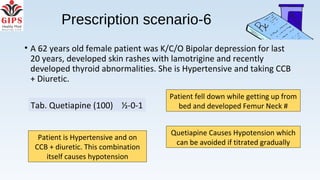
Prescription scenario-6
• A 62 years old female patient was K/C/O Bipolar depression for last
20 years, developed skin rashes with lamotrigine and recently
developed thyroid abnormalities. She is Hypertensive and taking CCB
+ Diuretic.
Patient fell down while getting up from
bed and developed Femur Neck #
Quetiapine Causes Hypotension which
can be avoided if titrated gradually
Patient is Hypertensive and on
CCB + diuretic. This combination
itself causes hypotension
Tab. Quetiapine (100) ½-0-1
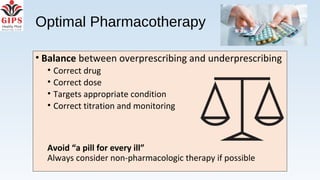
Optimal Pharmacotherapy
• Balance between overprescribing and underprescribing
• Correct drug
• Correct dose
• Targets appropriate condition
• Correct titration and monitoring
Avoid “a pill for every ill”
Always consider non-pharmacologic therapy if possible
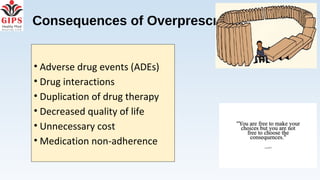
Consequences of Overprescribing
• Adverse drug events (ADEs)
• Drug interactions
• Duplication of drug therapy
• Decreased quality of life
• Unnecessary cost
• Medication non-adherence
Most Common Medications Associated with ADEs in
the Elderly
• Opioid analgesics
• NSAIDs
• Anticholinergics
• Benzodiazepines
• Also: cardiovascular agents, CNS agents, and musculoskeletal
agents
Adverse Drug Reaction Risk Factors in Older Outpatients. Am J Ger Pharmacotherapy 2003;1(2):82-89.
Patient Risk Factors for ADEs
• Polypharmacy
• Multiple co-morbid conditions
• Compromised Cognitive Functions
• Prior adverse drug event
• Low body weight or body mass index
• Age > 85 years
• Estimated CrCl <50 mL/min
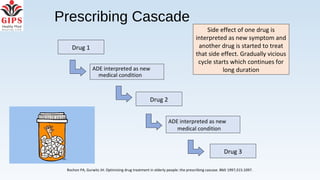
Prescribing Cascade
Drug 1
ADE interpreted as new
medical condition
Drug 2
ADE interpreted as new
medical condition
Drug 3
Rochon PA, Gurwitz JH. Optimizing drug treatment in elderly people: the prescribing cascase. BMJ 1997;315:1097.
Side effect of one drug is
interpreted as new symptom and
another drug is started to treat
that side effect. Gradually vicious
cycle starts which continues for
long duration
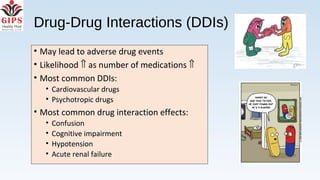
Drug-Drug Interactions (DDIs)
• May lead to adverse drug events
• Likelihood ⇑ as number of medications ⇑
• Most common DDIs:
• Cardiovascular drugs
• Psychotropic drugs
• Most common drug interaction effects:
• Confusion
• Cognitive impairment
• Hypotension
• Acute renal failure
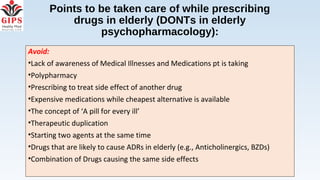
Points to be taken care of while prescribing
drugs in elderly (DONTs in elderly
psychopharmacology):
Avoid:
•Lack of awareness of Medical Illnesses and Medications pt is taking
•Polypharmacy
•Prescribing to treat side effect of another drug
•Expensive medications while cheapest alternative is available
•The concept of ‘A pill for every ill’
•Therapeutic duplication
•Starting two agents at the same time
•Drugs that are likely to cause ADRs in elderly (e.g., Anticholinergics, BZDs)
•Combination of Drugs causing the same side effects
Thanking you for your
Patience

Common avoidable mistakes while prescribing in elderly

  • 1.
    Common Avoidable Mistakes whilePrescribing in Elderly Dr. Ravi Soni DM Geriatric Psychiatry Consultant Geriatric Psychiatrist GIPS Hospital & De-addiction Center
  • 2.
    Disclaim er All the Casevignettes and Prescription Scenarios shown here are Hypothetical
  • 3.
    Prescription Scenario-1 • A67 years old male presented with c/o- occasional hearing of voices, feels that someone is present in the room and outside the door, talking with dead relatives, believing that his belongings are being stolen from home, occasional fearfulness Diagnosis: PsychosisTake Proper History and Do ask for Cognitive Disturbances and make correct diagnosis and prescribe accordingly Start low and go slow Avoid Anticholinergic Tab. Risperidone + Trihexy (2+2) ½-0-½ Tab. Lorazepam (2) 0-0-1
  • 4.
    Prescription Scenario-2 • A72 years old female patient who is a case of Alzheimer’s Disease with moderate cognitive impairment, recently brought to the clinic with c/o- restlessness, moving here and there, screaming with occasional physical aggression Two drugs for same purpose Both have Anticholinergic Property Tab. Olanzapine (5) ½-0- ½ Tab. Quetiapine (25) 1-0-2 Avoid Therapeutic Duplication
  • 5.
    Prescription Scenario-3 • A62 years old male patient who has retired recently presented with easy irritability, sadness whole the time, weakness, decreased sleep, multiple somatic complaints Two drugs started at the same time for same purpose Both Mirtazapine and Lorazepam can induce sleep Patient developed Excessive sleepiness and stopped medications on his own Tab. Escitalopram (10) 0-0-1 Tab. Mirtazapine (15) 0-0-1 Tab. Lorazepam (2) 0-0-1
  • 6.
    Prescription Scenario-4 • A84 years old male patient with BPH presented with c/o- Decreased sleep at night, not listening whenever talked to, changing the positions of belongings whole night, searching behavior Urinary Retention developed Olanzapine has high Anticholinergic Activity If patient wakes up during night for urination, there are high chances of fall Identify the cause of Delirium Tab. Olanzapine (5) 0-0- 1 Tab. Lorazepam (1) 0-0-1
  • 7.
    • A 65years old male patient having moderate hearing impairment and blurring of vision due to cataract, presented with irritability, hearing of voices of “Dhol-Nagara” and also saying that people are quarreling outside home, has fear of someone and not going outside home. Prescription Scenario-5 Visual Impairment increased further Patient developed Constipation Patient developed Confused behavior after evening and hallucinations increased Tab. Risperidone+Trihexy (2+2) ½-0-½ Tab. Clonazepam (0.5) ½-0-1 Identify patients which are at high risk of developing side effects
  • 8.
    Prescription scenario-6 • A62 years old female patient was K/C/O Bipolar depression for last 20 years, developed skin rashes with lamotrigine and recently developed thyroid abnormalities. She is Hypertensive and taking CCB + Diuretic. Patient fell down while getting up from bed and developed Femur Neck # Quetiapine Causes Hypotension which can be avoided if titrated gradually Patient is Hypertensive and on CCB + diuretic. This combination itself causes hypotension Tab. Quetiapine (100) ½-0-1
  • 9.
    Optimal Pharmacotherapy • Balancebetween overprescribing and underprescribing • Correct drug • Correct dose • Targets appropriate condition • Correct titration and monitoring Avoid “a pill for every ill” Always consider non-pharmacologic therapy if possible
  • 10.
    Consequences of Overprescribing •Adverse drug events (ADEs) • Drug interactions • Duplication of drug therapy • Decreased quality of life • Unnecessary cost • Medication non-adherence
  • 11.
    Most Common MedicationsAssociated with ADEs in the Elderly • Opioid analgesics • NSAIDs • Anticholinergics • Benzodiazepines • Also: cardiovascular agents, CNS agents, and musculoskeletal agents Adverse Drug Reaction Risk Factors in Older Outpatients. Am J Ger Pharmacotherapy 2003;1(2):82-89.
  • 12.
    Patient Risk Factorsfor ADEs • Polypharmacy • Multiple co-morbid conditions • Compromised Cognitive Functions • Prior adverse drug event • Low body weight or body mass index • Age > 85 years • Estimated CrCl <50 mL/min
  • 13.
    Prescribing Cascade Drug 1 ADEinterpreted as new medical condition Drug 2 ADE interpreted as new medical condition Drug 3 Rochon PA, Gurwitz JH. Optimizing drug treatment in elderly people: the prescribing cascase. BMJ 1997;315:1097. Side effect of one drug is interpreted as new symptom and another drug is started to treat that side effect. Gradually vicious cycle starts which continues for long duration
  • 14.
    Drug-Drug Interactions (DDIs) •May lead to adverse drug events • Likelihood ⇑ as number of medications ⇑ • Most common DDIs: • Cardiovascular drugs • Psychotropic drugs • Most common drug interaction effects: • Confusion • Cognitive impairment • Hypotension • Acute renal failure
  • 15.
    Points to betaken care of while prescribing drugs in elderly (DONTs in elderly psychopharmacology): Avoid: •Lack of awareness of Medical Illnesses and Medications pt is taking •Polypharmacy •Prescribing to treat side effect of another drug •Expensive medications while cheapest alternative is available •The concept of ‘A pill for every ill’ •Therapeutic duplication •Starting two agents at the same time •Drugs that are likely to cause ADRs in elderly (e.g., Anticholinergics, BZDs) •Combination of Drugs causing the same side effects
  • 16.
    Thanking you foryour Patience