(I.S.F. COLLEGE OF PHARMACY MOGA)
Presented by-
Atul Chaudhary
M.PhaRm. First Year
PHARMACEUTICS
 Chromatography is a laboratory technique for
the separation of a mixture. The mixture is dissolved in a
fluid called the mobile phase, which carries it through a
structure holding another material called the stationary
phase. The separation is based on differential
partitioning between the mobile and stationary phases
Subtle differences in a compound's partition coefficient
result in differential retention on the stationary phase
and thus affect the separation2/7/2020 2T.L.C. ASSIGNMENT
 Thin-layer chromatography (TLC) is a widely
employed laboratory technique used to separate
different biochemicals on the basis of their relative
attractions to the stationary and mobile phases.
 TLC is very versatile; multiple samples can be
separated simultaneously on the same layer, making
it very useful for screening applications such as
testing drug levels and water purity.
2/7/2020 3T.L.C. ASSIGNMENT
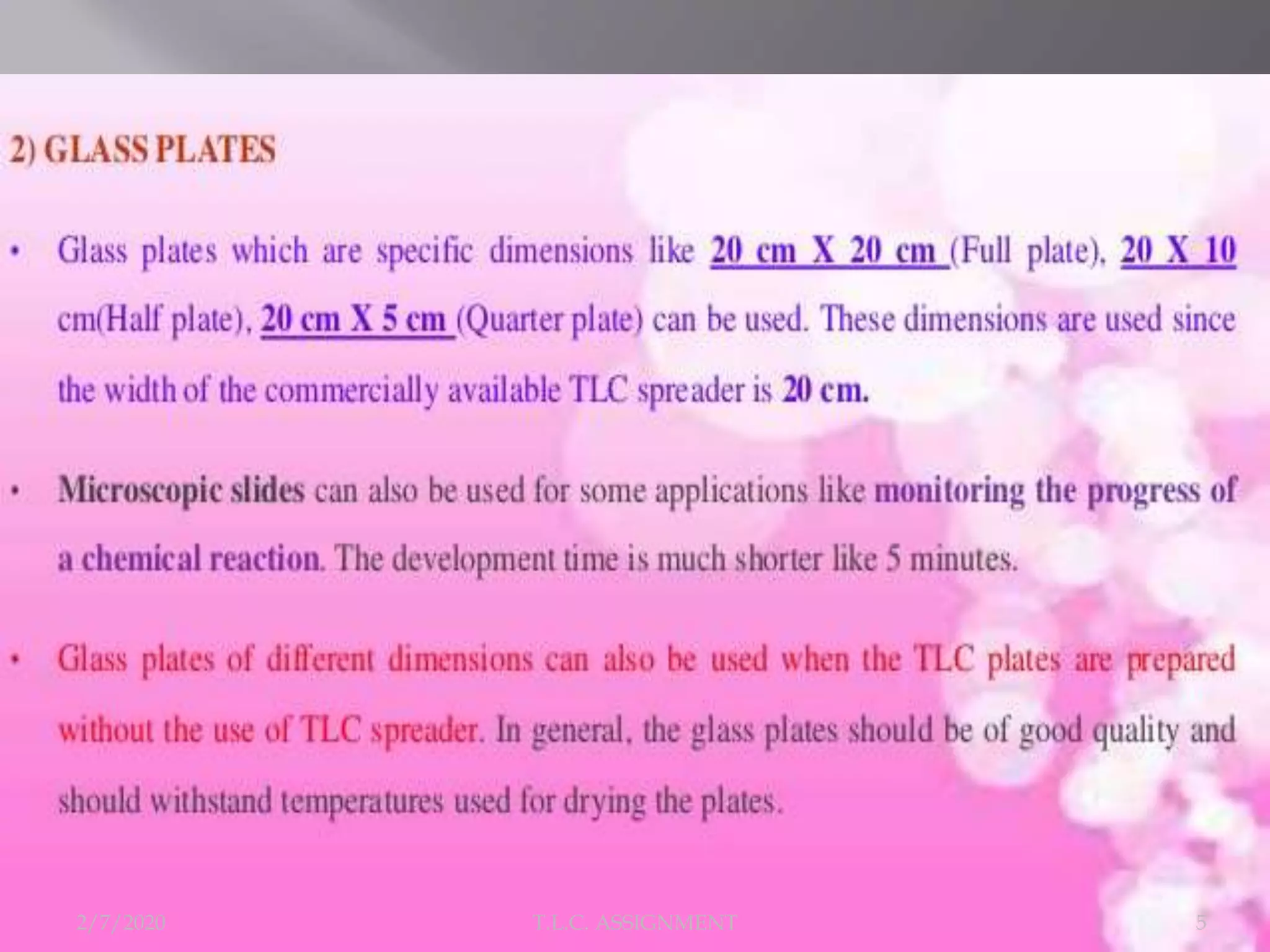
2/7/2020 4T.L.C. ASSIGNMENT
2/7/2020 5T.L.C. ASSIGNMENT
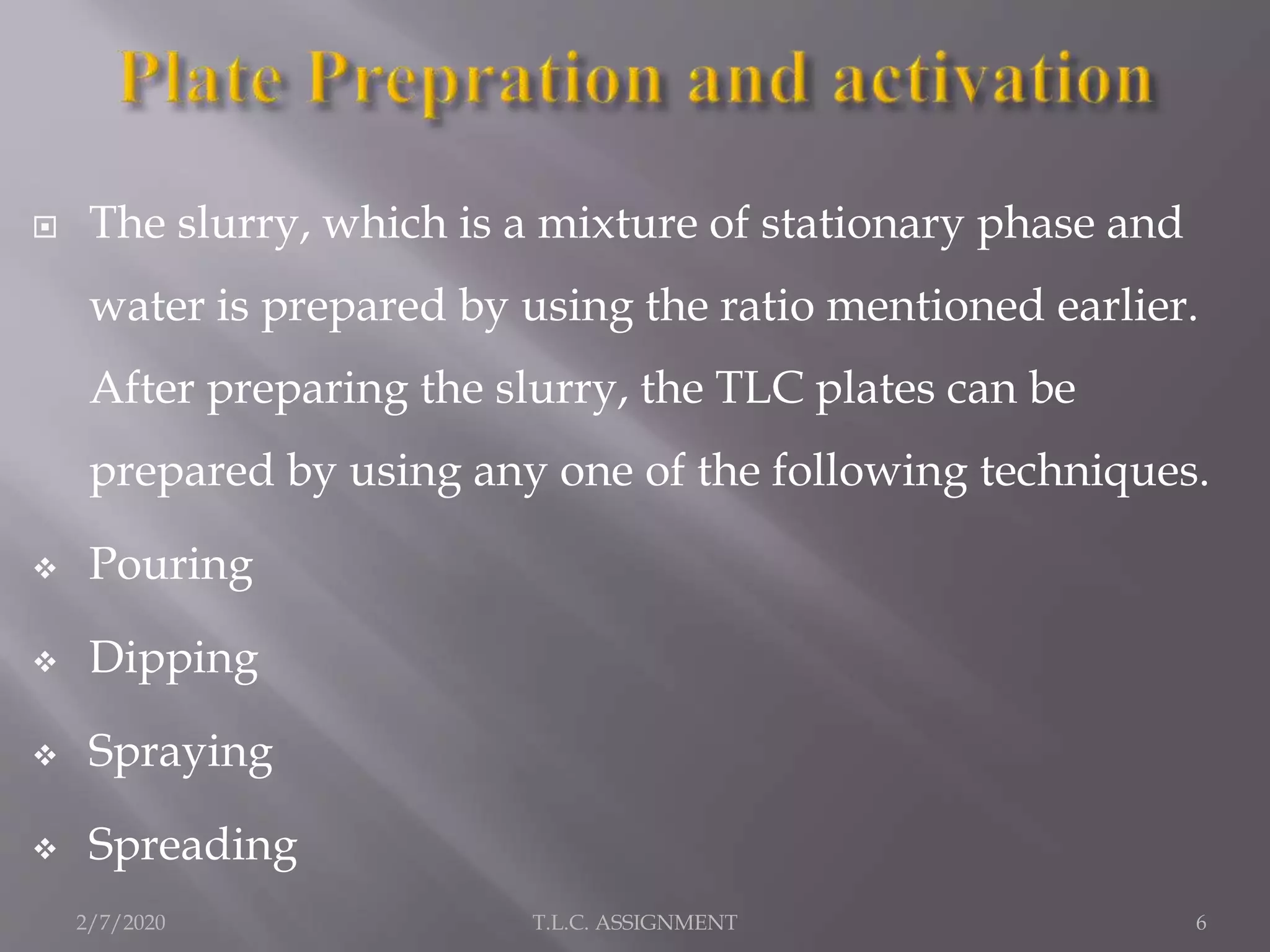
 The slurry, which is a mixture of stationary phase and
water is prepared by using the ratio mentioned earlier.
After preparing the slurry, the TLC plates can be
prepared by using any one of the following techniques.
 Pouring
 Dipping
 Spraying
 Spreading
2/7/2020 6T.L.C. ASSIGNMENT
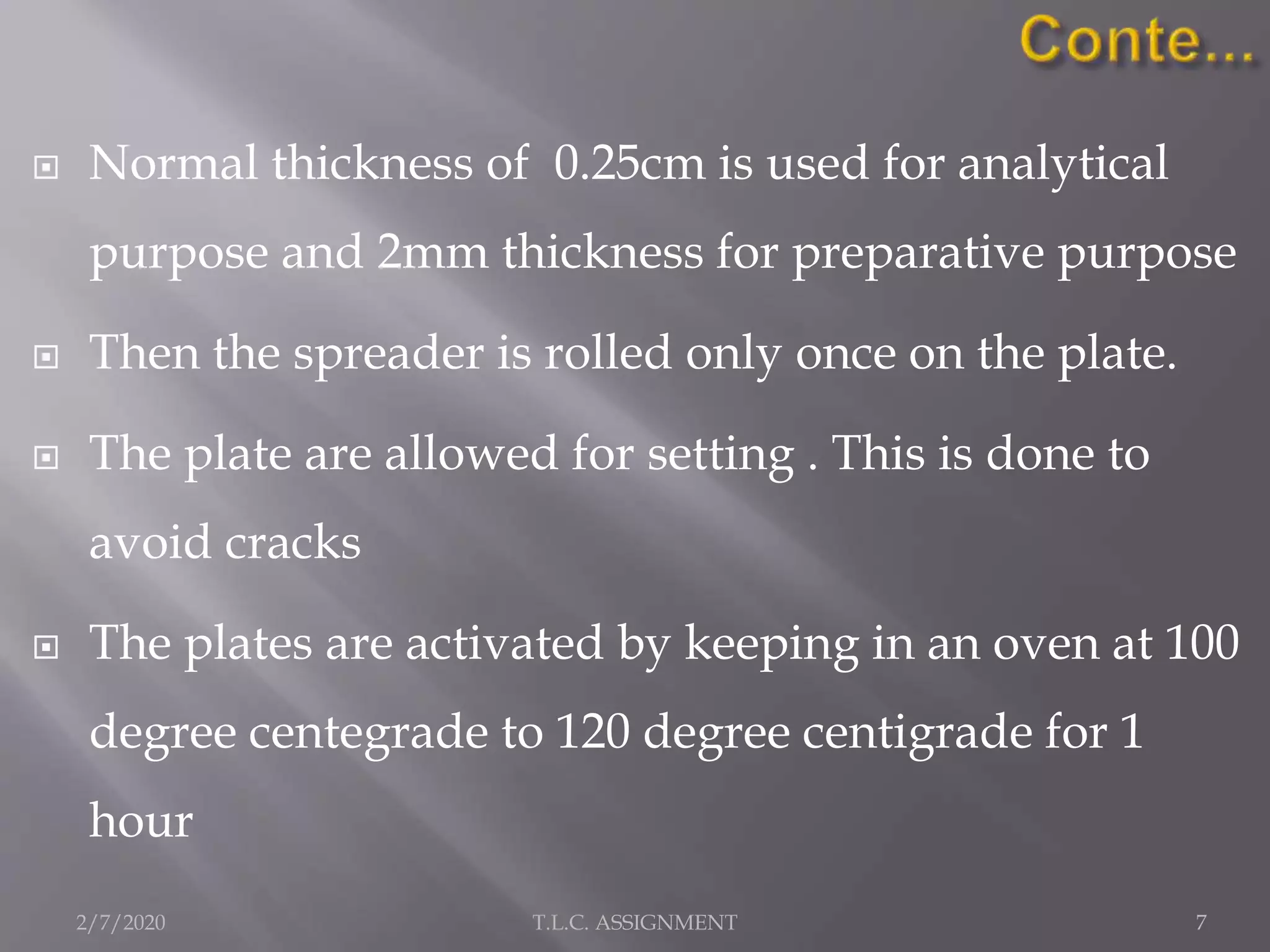
 Normal thickness of 0.25cm is used for analytical
purpose and 2mm thickness for preparative purpose
 Then the spreader is rolled only once on the plate.
 The plate are allowed for setting . This is done to
avoid cracks
 The plates are activated by keeping in an oven at 100
degree centegrade to 120 degree centigrade for 1
hour
2/7/2020 7T.L.C. ASSIGNMENT
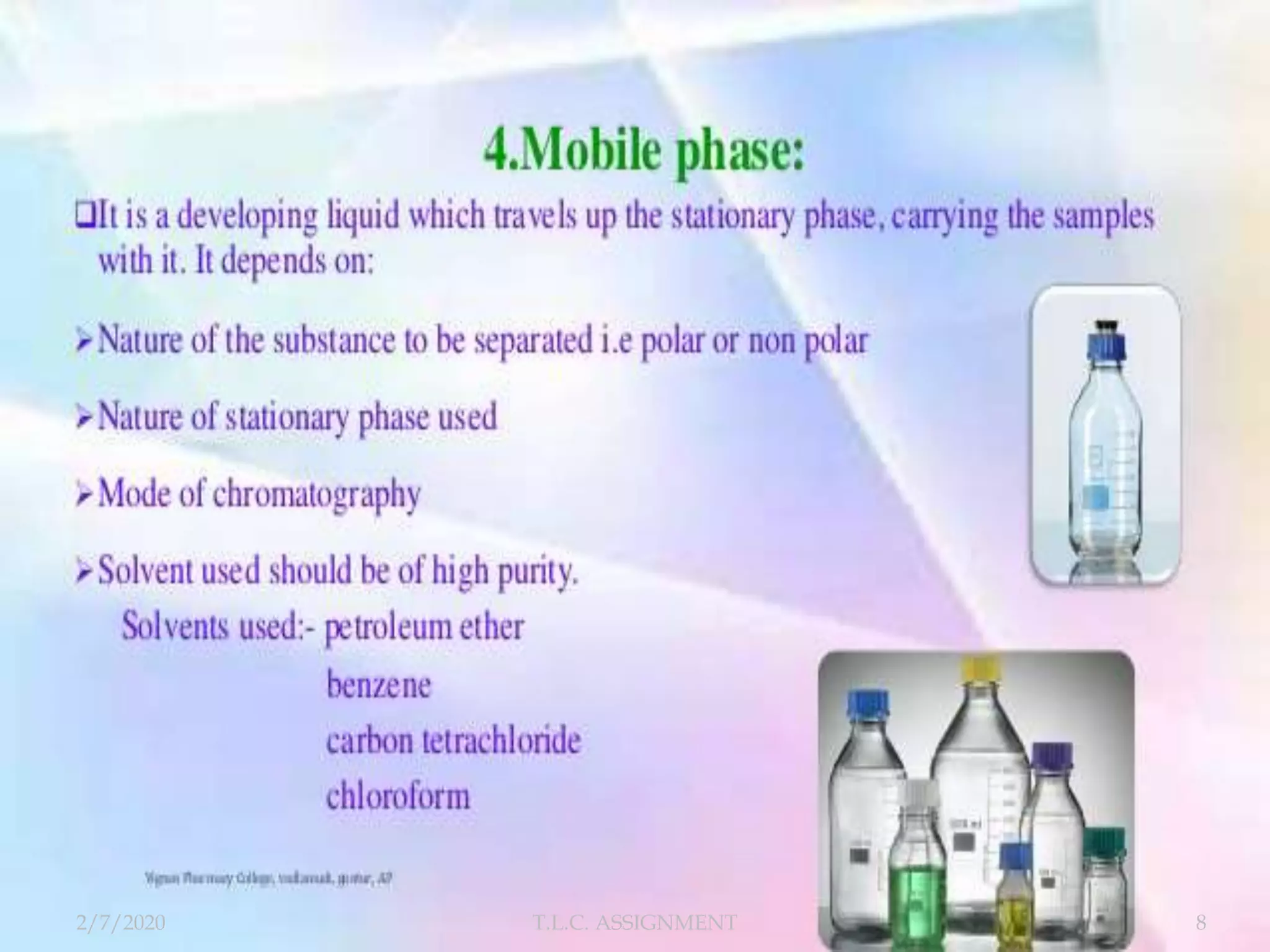
2/7/2020 8T.L.C. ASSIGNMENT
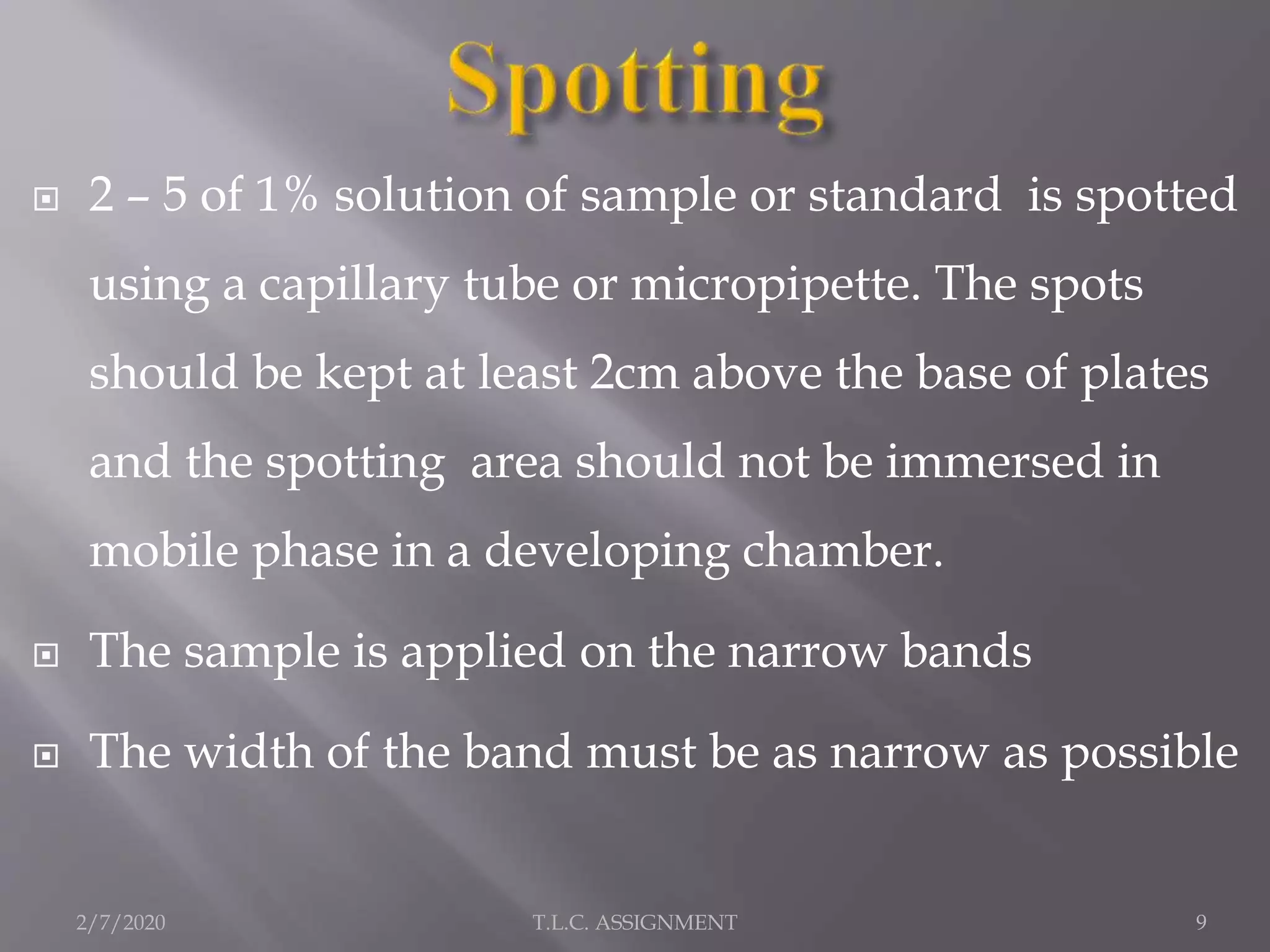
 2 – 5 of 1% solution of sample or standard is spotted
using a capillary tube or micropipette. The spots
should be kept at least 2cm above the base of plates
and the spotting area should not be immersed in
mobile phase in a developing chamber.
 The sample is applied on the narrow bands
 The width of the band must be as narrow as possible
2/7/2020 9T.L.C. ASSIGNMENT
2/7/2020 10T.L.C. ASSIGNMENT
 Step 1: Prepare the developing container
 Step 2: Prepare the TLC plate
 Step 3: Spot the TLC plate
 Step 4: Develop the plate
 Step 5: Visualize the spot
2/7/2020 11T.L.C. ASSIGNMENT
2/7/2020 12T.L.C. ASSIGNMENT
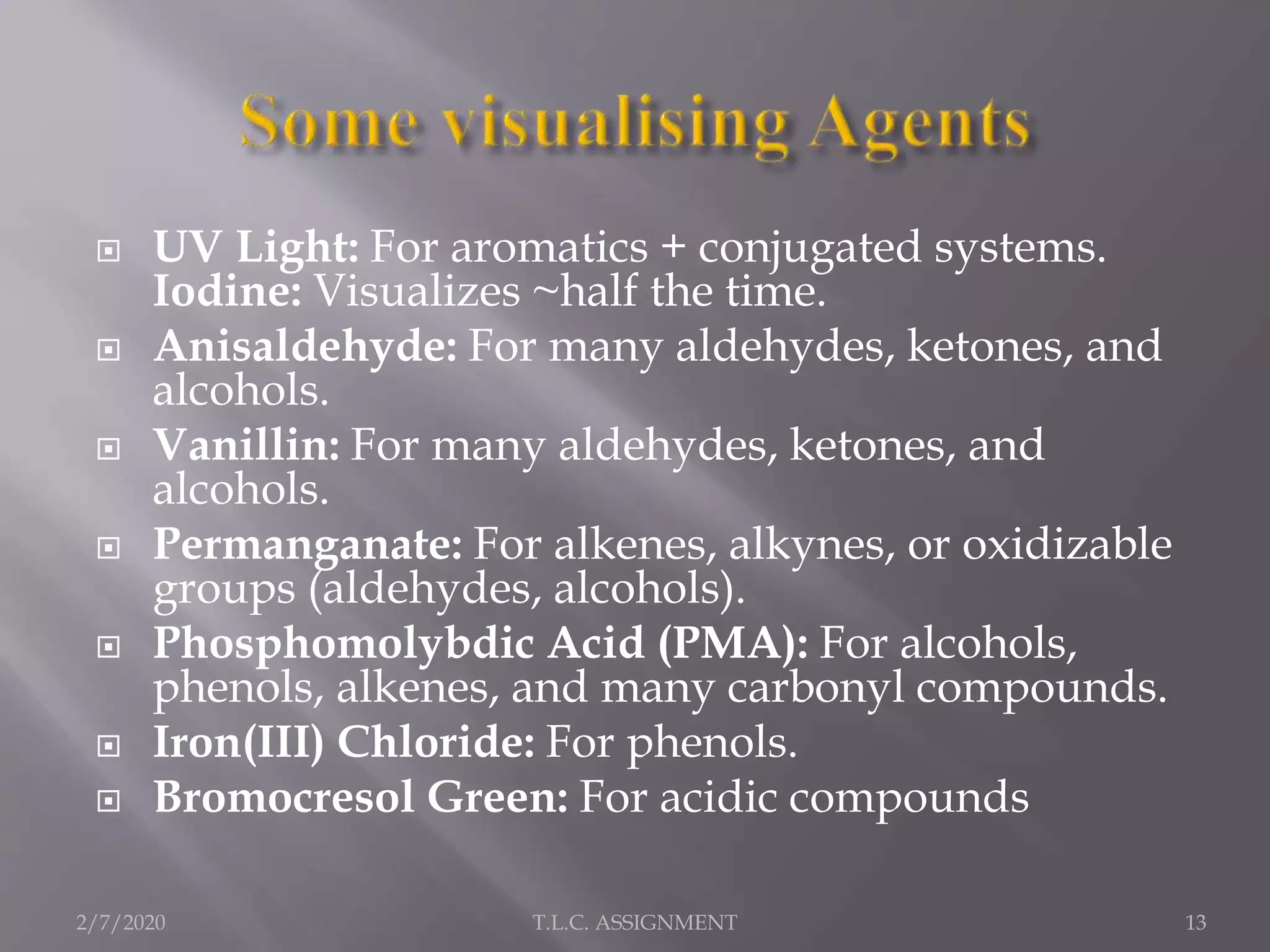
 UV Light: For aromatics + conjugated systems.
Iodine: Visualizes ~half the time.
 Anisaldehyde: For many aldehydes, ketones, and
alcohols.
 Vanillin: For many aldehydes, ketones, and
alcohols.
 Permanganate: For alkenes, alkynes, or oxidizable
groups (aldehydes, alcohols).
 Phosphomolybdic Acid (PMA): For alcohols,
phenols, alkenes, and many carbonyl compounds.
 Iron(III) Chloride: For phenols.
 Bromocresol Green: For acidic compounds
2/7/2020 T.L.C. ASSIGNMENT 13
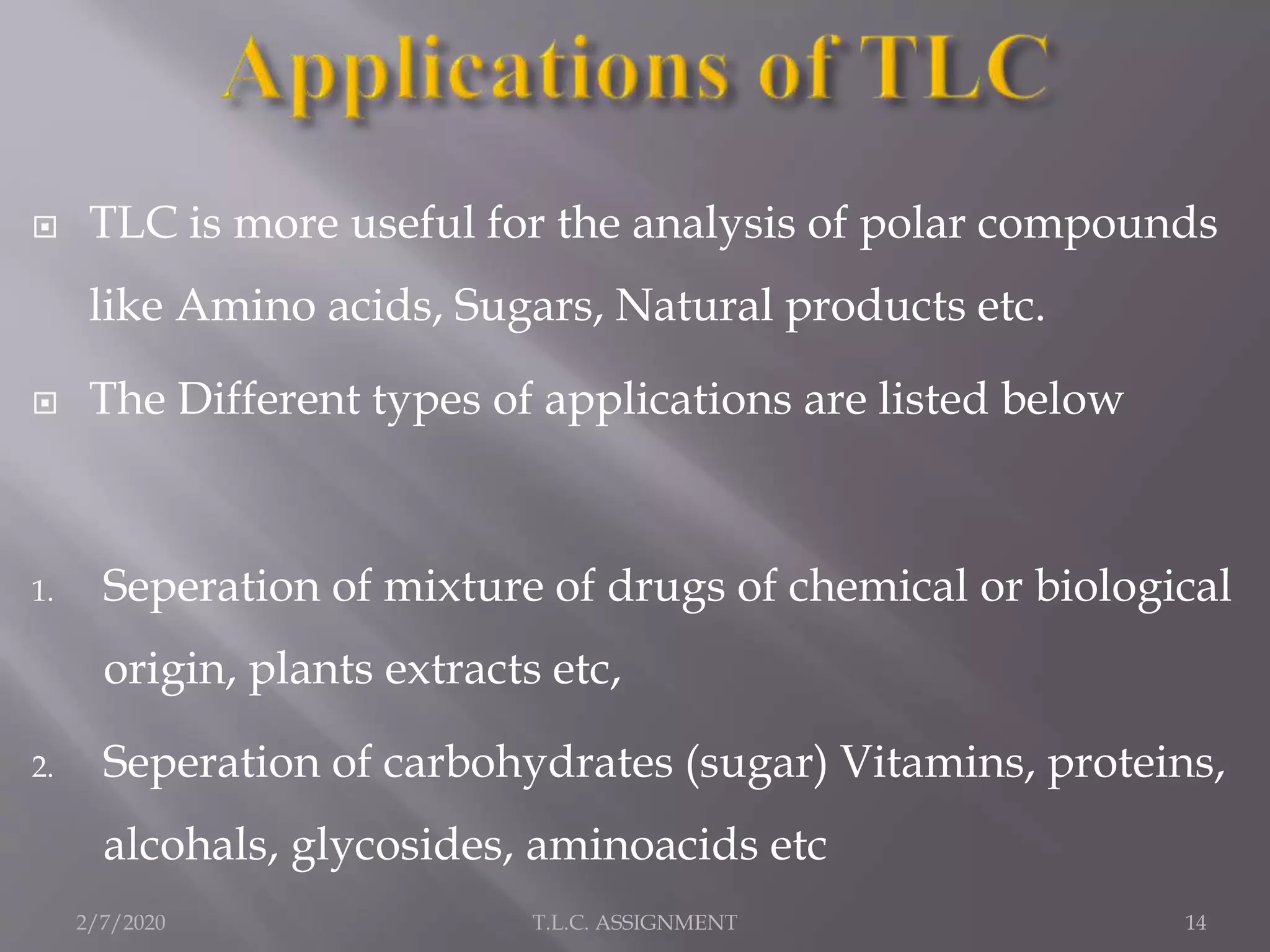
 TLC is more useful for the analysis of polar compounds
like Amino acids, Sugars, Natural products etc.
 The Different types of applications are listed below
1. Seperation of mixture of drugs of chemical or biological
origin, plants extracts etc,
2. Seperation of carbohydrates (sugar) Vitamins, proteins,
alcohals, glycosides, aminoacids etc
2/7/2020 14T.L.C. ASSIGNMENT
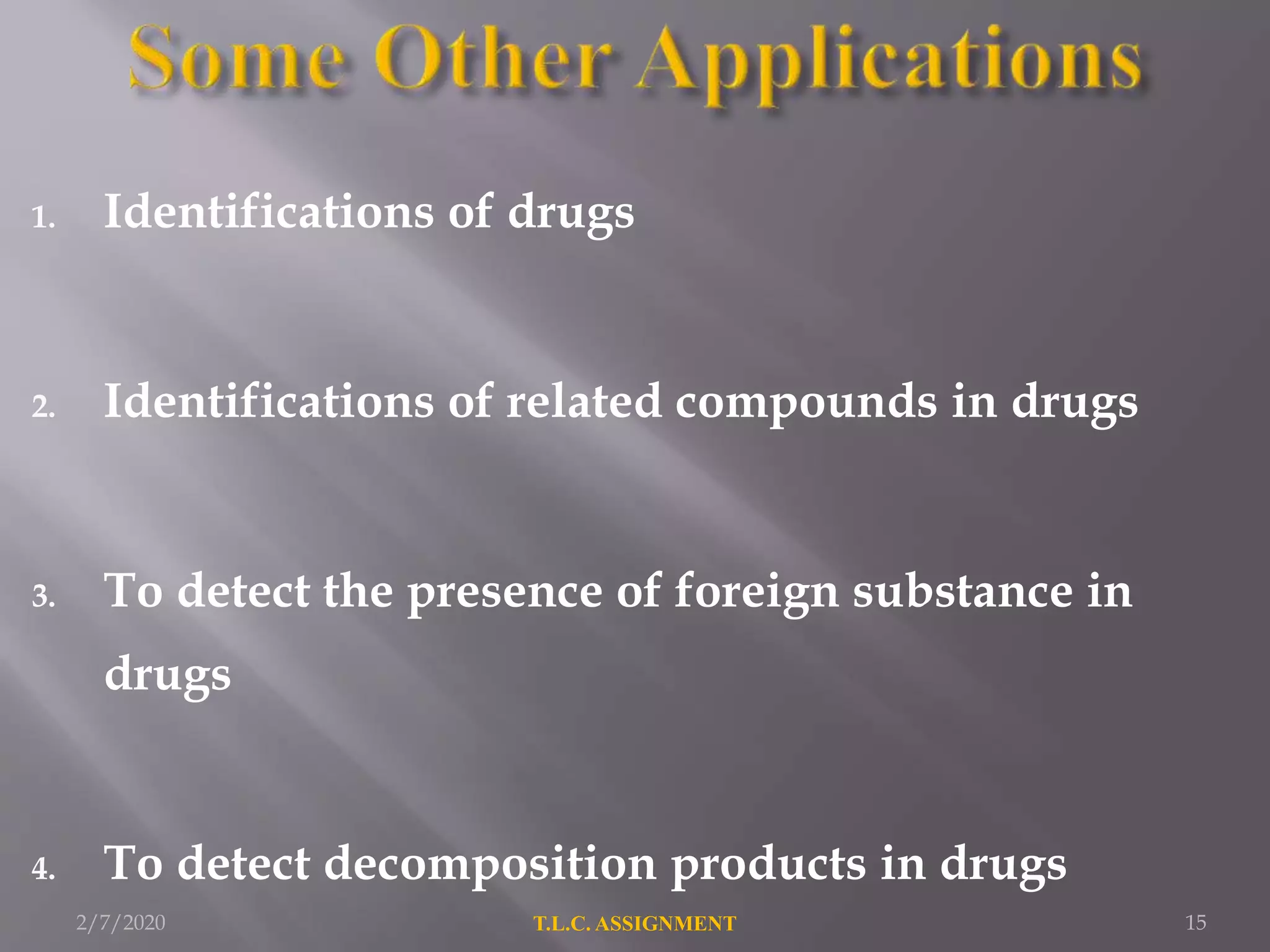
1. Identifications of drugs
2. Identifications of related compounds in drugs
3. To detect the presence of foreign substance in
drugs
4. To detect decomposition products in drugs
2/7/2020 15T.L.C. ASSIGNMENT
2/7/2020 16T.L.C. ASSIGNMENT
 Bernard Fried and Josef Sherma
 Prem kumar Jaiswal
 Egon Stahi
 Chatwal
 Google Wikipidia
 Slideshare
2/7/2020 T.L.C. ASSIGNMENT 17
2/7/2020 18T.L.C. ASSIGNMENT

Thin layer chromatography

  • 1.
    (I.S.F. COLLEGE OFPHARMACY MOGA) Presented by- Atul Chaudhary M.PhaRm. First Year PHARMACEUTICS
  • 2.
     Chromatography isa laboratory technique for the separation of a mixture. The mixture is dissolved in a fluid called the mobile phase, which carries it through a structure holding another material called the stationary phase. The separation is based on differential partitioning between the mobile and stationary phases Subtle differences in a compound's partition coefficient result in differential retention on the stationary phase and thus affect the separation2/7/2020 2T.L.C. ASSIGNMENT
  • 3.
     Thin-layer chromatography(TLC) is a widely employed laboratory technique used to separate different biochemicals on the basis of their relative attractions to the stationary and mobile phases.  TLC is very versatile; multiple samples can be separated simultaneously on the same layer, making it very useful for screening applications such as testing drug levels and water purity. 2/7/2020 3T.L.C. ASSIGNMENT
  • 4.
  • 5.
  • 6.
     The slurry,which is a mixture of stationary phase and water is prepared by using the ratio mentioned earlier. After preparing the slurry, the TLC plates can be prepared by using any one of the following techniques.  Pouring  Dipping  Spraying  Spreading 2/7/2020 6T.L.C. ASSIGNMENT
  • 7.
     Normal thicknessof 0.25cm is used for analytical purpose and 2mm thickness for preparative purpose  Then the spreader is rolled only once on the plate.  The plate are allowed for setting . This is done to avoid cracks  The plates are activated by keeping in an oven at 100 degree centegrade to 120 degree centigrade for 1 hour 2/7/2020 7T.L.C. ASSIGNMENT
  • 8.
  • 9.
     2 –5 of 1% solution of sample or standard is spotted using a capillary tube or micropipette. The spots should be kept at least 2cm above the base of plates and the spotting area should not be immersed in mobile phase in a developing chamber.  The sample is applied on the narrow bands  The width of the band must be as narrow as possible 2/7/2020 9T.L.C. ASSIGNMENT
  • 10.
  • 11.
     Step 1:Prepare the developing container  Step 2: Prepare the TLC plate  Step 3: Spot the TLC plate  Step 4: Develop the plate  Step 5: Visualize the spot 2/7/2020 11T.L.C. ASSIGNMENT
  • 12.
  • 13.
     UV Light:For aromatics + conjugated systems. Iodine: Visualizes ~half the time.  Anisaldehyde: For many aldehydes, ketones, and alcohols.  Vanillin: For many aldehydes, ketones, and alcohols.  Permanganate: For alkenes, alkynes, or oxidizable groups (aldehydes, alcohols).  Phosphomolybdic Acid (PMA): For alcohols, phenols, alkenes, and many carbonyl compounds.  Iron(III) Chloride: For phenols.  Bromocresol Green: For acidic compounds 2/7/2020 T.L.C. ASSIGNMENT 13
  • 14.
     TLC ismore useful for the analysis of polar compounds like Amino acids, Sugars, Natural products etc.  The Different types of applications are listed below 1. Seperation of mixture of drugs of chemical or biological origin, plants extracts etc, 2. Seperation of carbohydrates (sugar) Vitamins, proteins, alcohals, glycosides, aminoacids etc 2/7/2020 14T.L.C. ASSIGNMENT
  • 15.
    1. Identifications ofdrugs 2. Identifications of related compounds in drugs 3. To detect the presence of foreign substance in drugs 4. To detect decomposition products in drugs 2/7/2020 15T.L.C. ASSIGNMENT
  • 16.
  • 17.
     Bernard Friedand Josef Sherma  Prem kumar Jaiswal  Egon Stahi  Chatwal  Google Wikipidia  Slideshare 2/7/2020 T.L.C. ASSIGNMENT 17
  • 18.