Presentedby
MISS.JYOTIDIPAKMHOPREKAR
M.PHARM(PHARMACEUTICS)
(SEMI ) Rollno. 06
DEPARTMENTOF PHARMACEUTICS
SHREESANTKRUPACOLLEGEOF PHARMACYGHOGAON.
CONTENTS:
Introduction
History
Principle
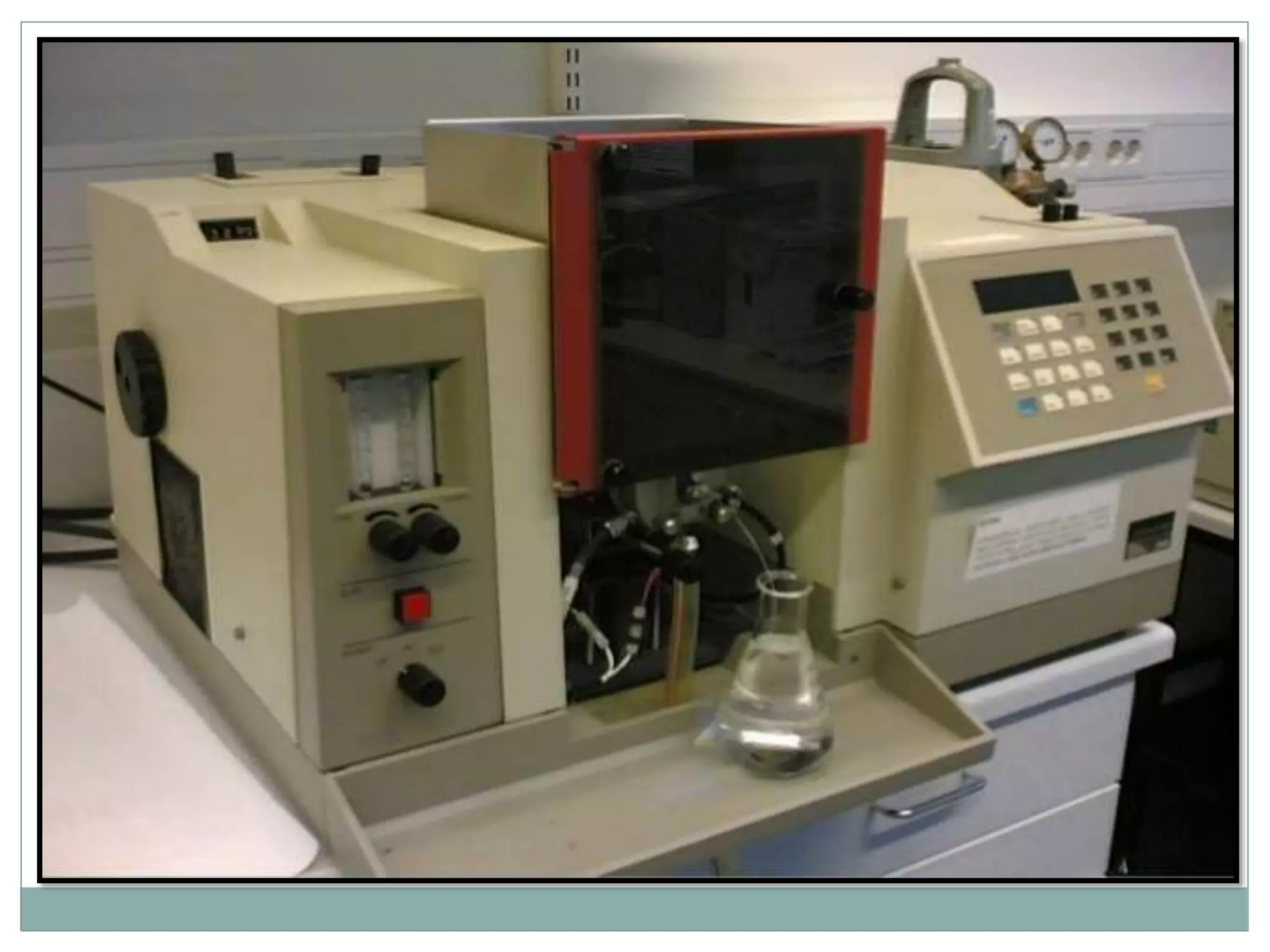
Instrumentation
Interferences
Applications
INTRODUCTION:
Atomic absorption spectroscopy is a very common technique for
detecting metals and metalloids in samples.
It is very reliable and simple to use.
It also measure the concentration of metals in the sample.
Atomic absorption spectroscopy is an analytical technique that
measure the concentration of an element by measuring the amount of
light that is absorbed at a characteristic wavelength when it passes
through cloud of atoms.
As the number of atoms in the light path increases, the amount of
light absorbed increases.
HISTORY :
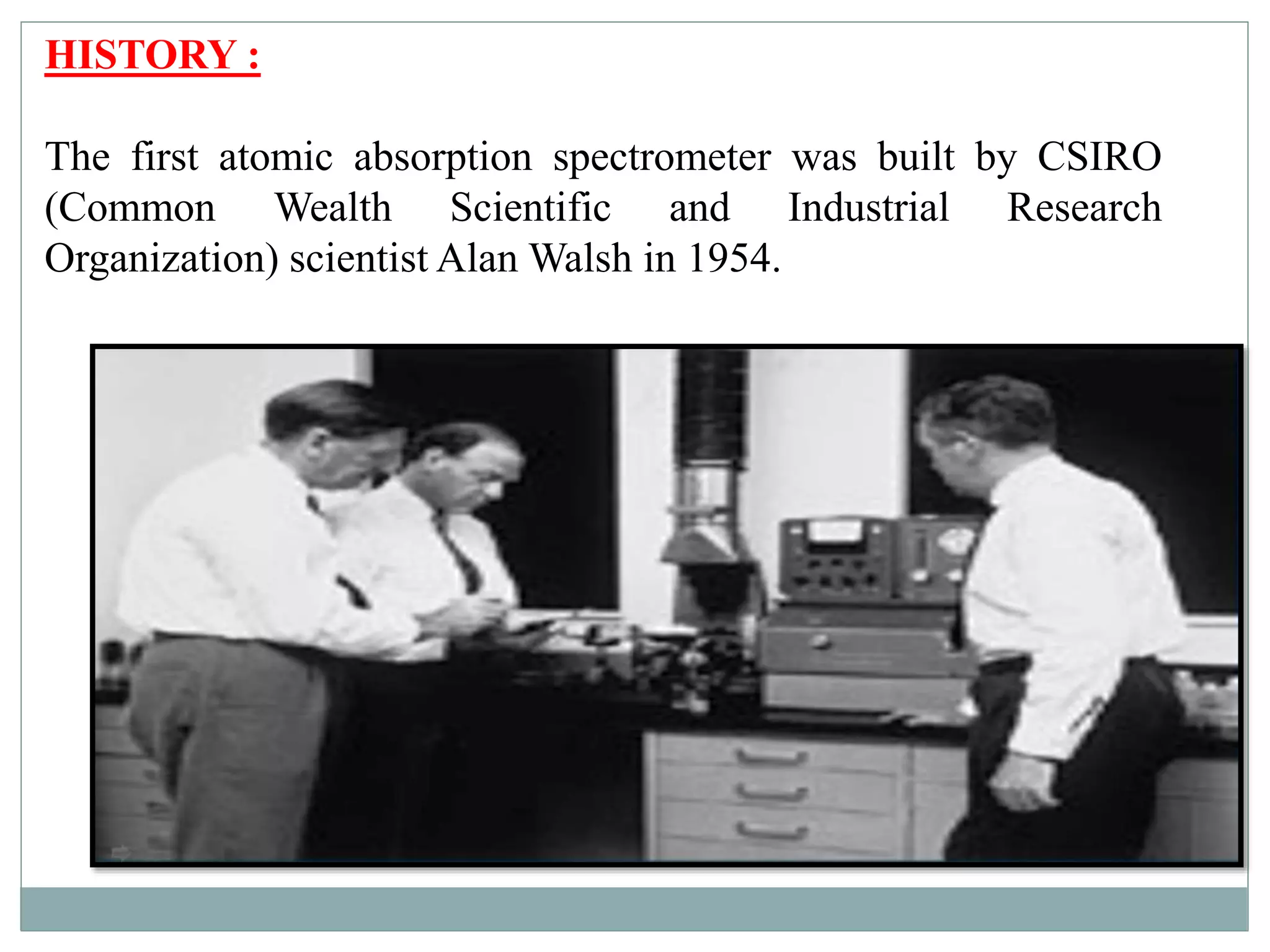
The first atomic absorption spectrometer was built by CSIRO
(Common Wealth Scientific and Industrial Research
Organization) scientist Alan Walsh in 1954.
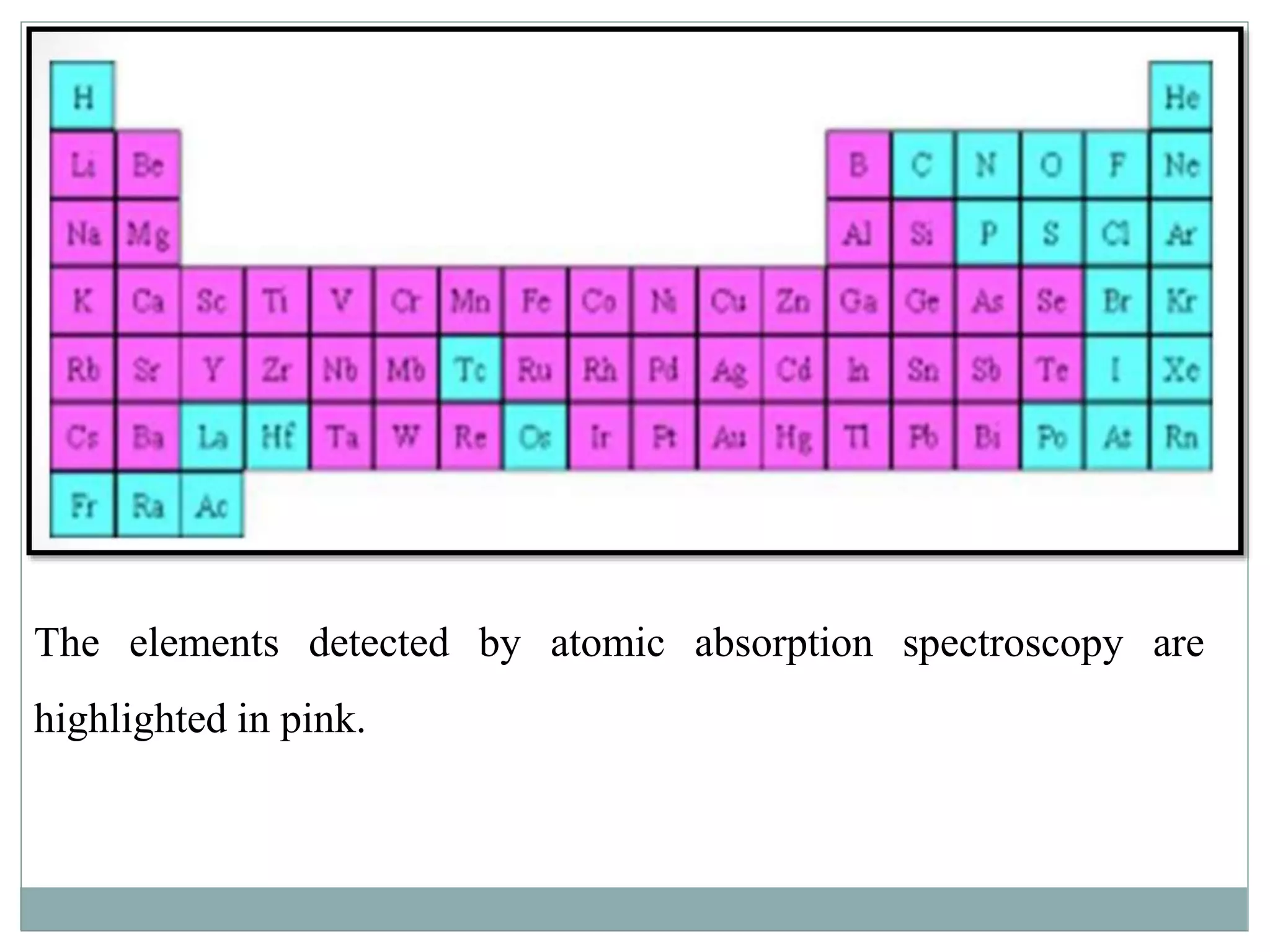
The elements detected by atomic absorption spectroscopy are
highlighted in pink.
PRINCIPLE:
The technique uses basically the principle that free atoms generated
in an atomizer can absorb radiation at specific frequency.
Atomic absorption spectroscopy quantifies the absorption of ground
state atoms in the gaseous state.
The atoms absorb UV or visible light and make transition to higher
electronic energy level. The analyte concentration is determined from
the amount of absorption.
Concentration measurements are usually determined from a working
curve after the instrument with standards of known concentration.
INSTRUMENTATION:
1) Radiation Source
2) Nebulisations of liquid sample
3) Atomizers
4) Monochromators
5) Detectors
Schematic diagram of AAS :
1) Radiation source:
Hollow cathode lamp are the most common radiation source in
AAS.
It contains a tungsten anode and a hollow cylindrical cathode.
These are sealed in a glass tube filled with an inert gas. (mainly
neon and argon)
Each elements has its own unique lamp which must be used for that
analysis.
2) Nebulizer :
 Nebulizer suck up liquid samples at controlled rate.
 Create a fine aerosol spray for introduction into the flame.
 Mix the aerosol and fuel and oxidant thoroughly for introduction
into flame.
3) Atomizers :
 Elements to be analyzed needs to be in atomic state.
 Atomization is separation particles into individual molecules and
breaking molecules into atoms.
 This is done by exposing the analyte to high temperatures in a
flame and graphite furnace.
 The atomizers most commonly used now days are :
 (spectroscopic) flames and
 electro thermal (graphite tube) atomizers.
 Flame atomizers :
Nebulizer suck up liquid sample at controlled rate and creates a fine
aerosol spray for introduction into flame.
To create flame, we need to mix an oxidant gas and a fuel gas.
In most of the cases air –acetylene flame or nitrous oxide acetylene
flame is used.
Liquids or dissolved samples are typically used with flame
atomizer.
 Electro thermal (graphite tube) atomizer :
It uses a graphite coated furnace to vaporize the sample.
Samples are deposited in a small graphite coated tube which then
heated to vaporize and atomize the analyte.
The graphite tubes are heated using a high current power supply.
Steps in electro thermal atomization :
 Drying
 Pyrolysis
 Atomization
 Cleaning
4) Monochromator :
 This is very important part in an AAS.
 It is used to separate out all of the thousand of lines.
 A monochromator is used to select the specific wavelength of
light which is absorbed by the sample, and to exclude other
wavelengths.
 The selection of the specific light allows the determination of the
selected element in the presence of others.
5) Detectors :
The light selected by the monochromator is directed onto a detector
that is typically a photomultiplier tube, whose function is to convert
the light signals into a electrical signals proportional to the light
intensity.
The processing of electrical signal is fulfilled by a signal amplifier.
the signal could be displayed for readout, or further fed into a data
station for printout by the requested format.
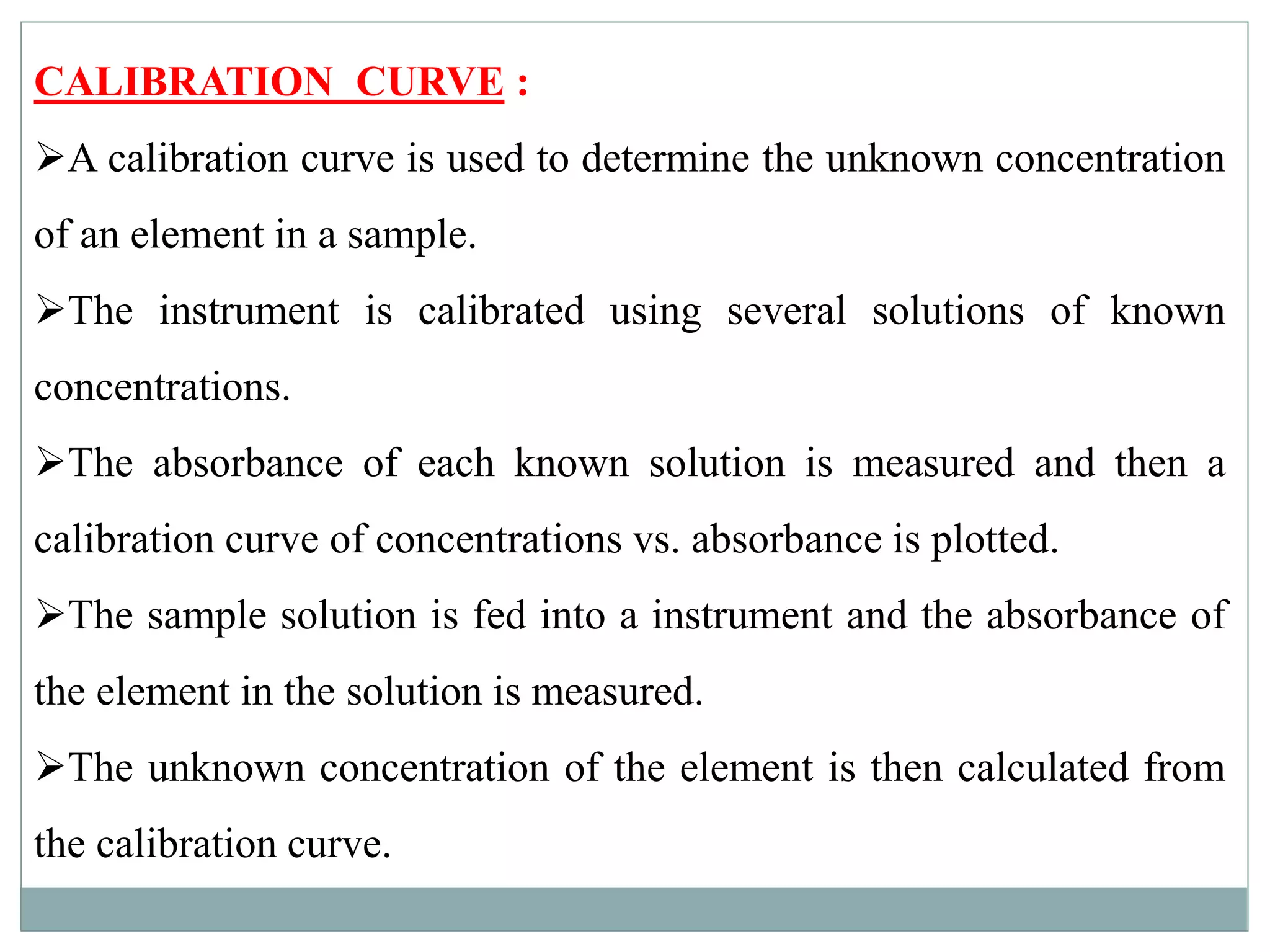
CALIBRATION CURVE :
A calibration curve is used to determine the unknown concentration
of an element in a sample.
The instrument is calibrated using several solutions of known
concentrations.
The absorbance of each known solution is measured and then a
calibration curve of concentrations vs. absorbance is plotted.
The sample solution is fed into a instrument and the absorbance of
the element in the solution is measured.
The unknown concentration of the element is then calculated from
the calibration curve.
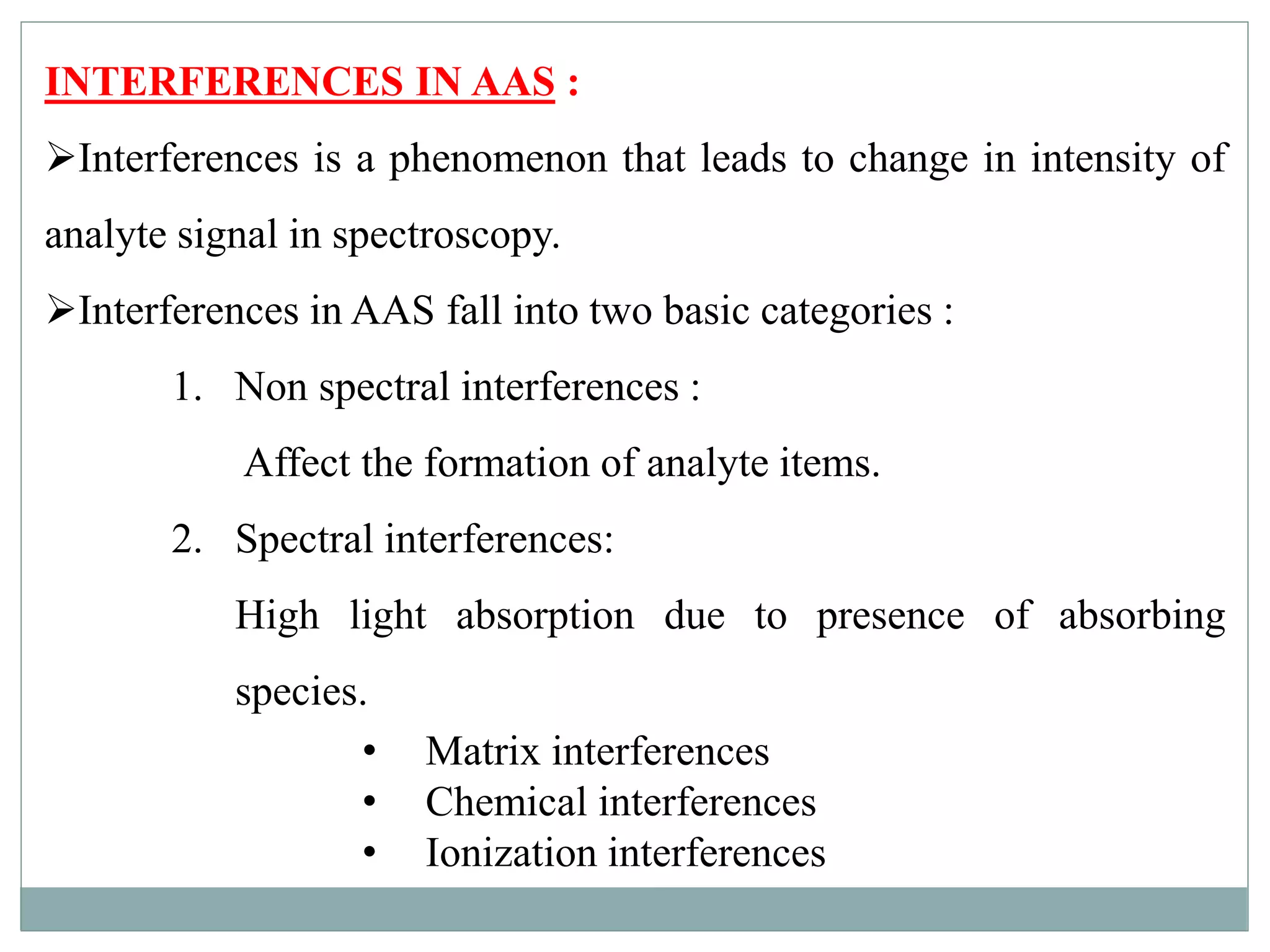
INTERFERENCES IN AAS :
Interferences is a phenomenon that leads to change in intensity of
analyte signal in spectroscopy.
Interferences in AAS fall into two basic categories :
1. Non spectral interferences :
Affect the formation of analyte items.
2. Spectral interferences:
High light absorption due to presence of absorbing
species.
• Matrix interferences
• Chemical interferences
• Ionization interferences
Matrix Interferences :
When a sample is more viscous or has different surface tension
then the standard it results in difference in sample uptake rate due to
changes in nebulization efficiency.
Such interferences are minimized by matching the matrix
composition of standard and sample.
Chemical interferences :
It is sample contains a species which forms a thermally stable
compound with analyte that is not completely decomposed by the
flame energy then chemical interferences exist.
Such interferences are minimized by using higher flame
temperature to provide higher dissociation energy.
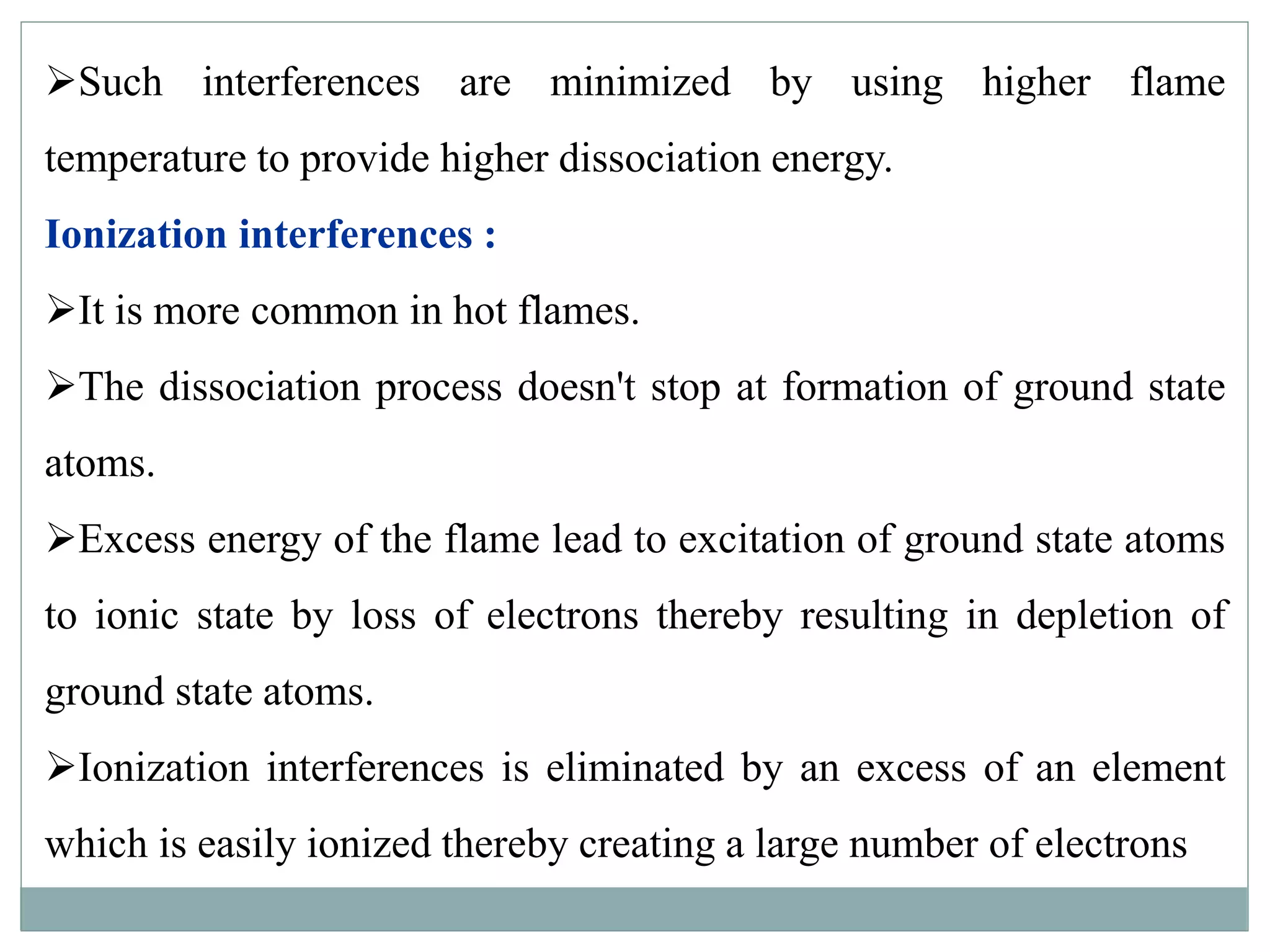
Ionization interferences :
It is more common in hot flames.
The dissociation process doesn't stop at formation of ground state
atoms.
Excess energy of the flame lead to excitation of ground state atoms
to ionic state by loss of electrons thereby resulting in depletion of
ground state atoms.
Ionization interferences is eliminated by an excess of an element
which is easily ionized thereby creating a large number of electrons
In the flame and suppressing the ionization of the analyte.
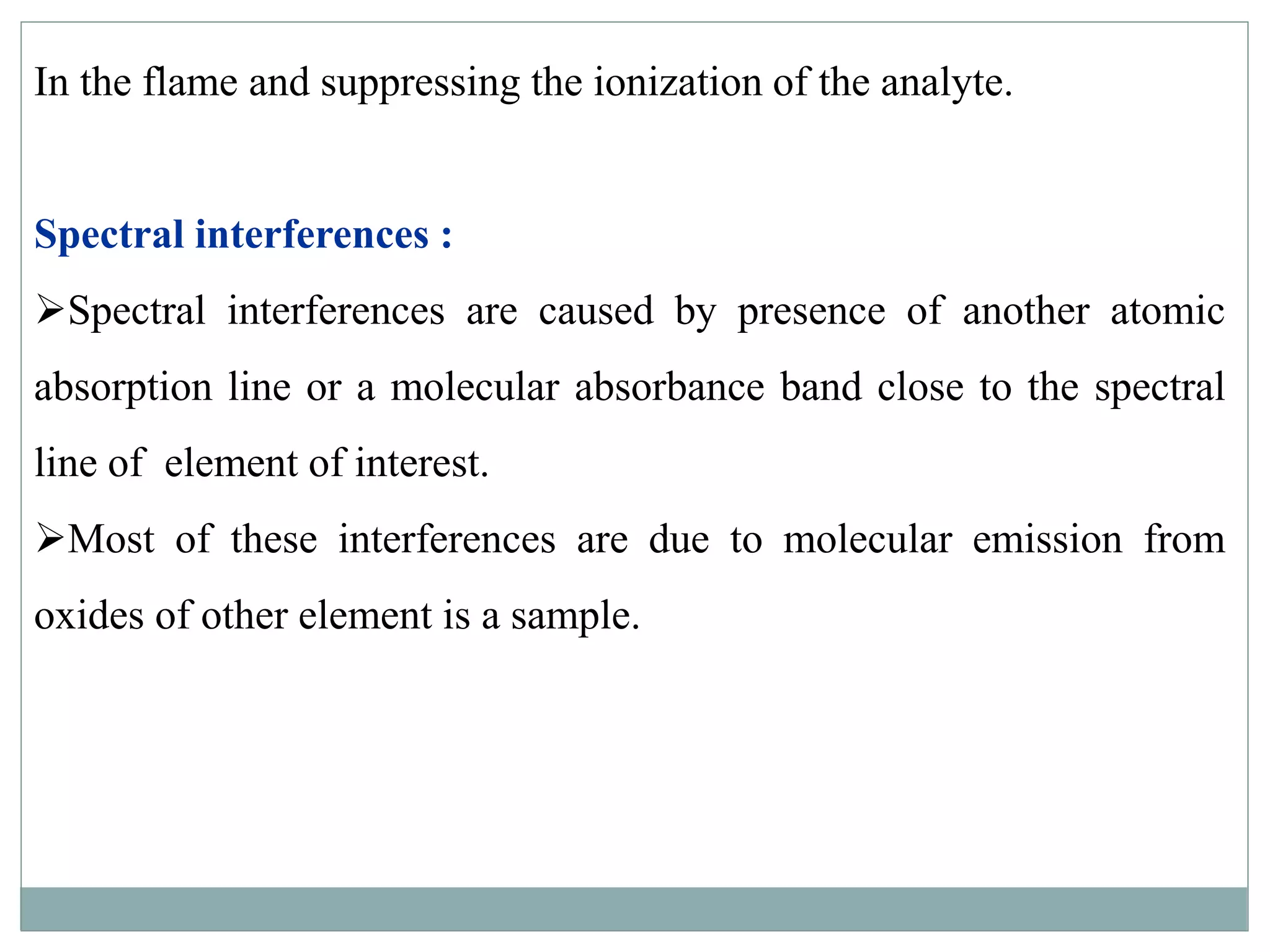
Spectral interferences :
Spectral interferences are caused by presence of another atomic
absorption line or a molecular absorbance band close to the spectral
line of element of interest.
Most of these interferences are due to molecular emission from
oxides of other element is a sample.
APPLICATIONS :
Determination of small amount of metals (lead, mercury, calcium,
magnesium)
AAS is widely used in metallurgy, alloys and in inorganic analysis.
Determination of calcium, magnesium, sodium and potassium in
blood serum.
Biochemical analysis
Determination of metallic elements in food industry
Environmental studies
Pharmaceutical industry
EXPERIMENTS :
Determination of vanadium in lubricating oil.
Determination of trace elements in contaminated soil.
Determination of vanadium in lubricating oil :
Theory:
High temperature corrosion and fouling can be attributed to
vanadium in the fuel, during combustion, the element oxidize and
form semi liquid and low melting salts (vanadium pentoxide) which
adhere to exhaust valve and turbochargers. In practice, the extent of
hot corrosion and fouling are generally maintained at an acceptable
level through temperature control, an operational solution, and
material selection.
The oil is dissolved in white spirit and the absorption of this solution
is compared with the absorption of standard.
STANDARD SOLUTION :
The standard solutions are made up from vanadium naphthenate in
white spirit which contain about 3% of vanadium.
weigh out 0.6 gm of vanadium naphthenate into a 100ml flask and
made up to mark with white spirit. Dilute portions of this stock
solution to obtain a series of working standards containing 10-40 mg
of vanadium.
PROCEDURE :
Weigh out accurately about 5 gm of the oil sample, dissolve in small
volume of white spirit and transfer to 50ml flask.
Using same solvent, make up the solution to the mark.
Set up the vanadium hollow cathode lamp selecting a resonance line
of wavelength 318.5nm.
Adjust gas controls to give a fuel rich acetylene nitrous oxide flame.
 aspirate successfully into the flame the solvent blank, standard
solutions and finally the test solution.
In each case recording the absorbance reading, plot the calibration
curve and ascertain the vanadium content of the oil.
Lead in contaminated soil :
Sampling : samples of aprox 50 gm should be taken from specified
sampling points on the site.
The sampling point should include surface soil and two further
samples taken at depth, at 0.5 and 1.0 m.
The exact location of these point should be noted, for it may be
necessary to take further samples.
PROCEDURE :
Weight out about 1 gm of seived soil and transfer to a 100ml beaker.
Add 20ml of 1:1 nitric acid.
Boil gently on a hot plate until the volume of nitric acid is reduced
to 5ml.
Add 20ml of deionised water and boil gently again until the volume
is 10ml.
Cool the suspension and filter through a whatman filter paper,
washing the beaker and filer paper with deionised water until a volume
about 25ml is obtained.
Transfer the filtrate into a 50ml flask and make up to the mark with
deionised water.
Set up acetylene air flame with resonance line 217.0 nm.
Standard lead solutions containing 1-10 mg/ml are suitable for
measurement.
atomic absorption spectroscopy

atomic absorption spectroscopy

  • 1.
    Presentedby MISS.JYOTIDIPAKMHOPREKAR M.PHARM(PHARMACEUTICS) (SEMI ) Rollno.06 DEPARTMENTOF PHARMACEUTICS SHREESANTKRUPACOLLEGEOF PHARMACYGHOGAON.
  • 2.
  • 3.
    INTRODUCTION: Atomic absorption spectroscopyis a very common technique for detecting metals and metalloids in samples. It is very reliable and simple to use. It also measure the concentration of metals in the sample. Atomic absorption spectroscopy is an analytical technique that measure the concentration of an element by measuring the amount of light that is absorbed at a characteristic wavelength when it passes through cloud of atoms. As the number of atoms in the light path increases, the amount of light absorbed increases.
  • 4.
    HISTORY : The firstatomic absorption spectrometer was built by CSIRO (Common Wealth Scientific and Industrial Research Organization) scientist Alan Walsh in 1954.
  • 5.
    The elements detectedby atomic absorption spectroscopy are highlighted in pink.
  • 6.
    PRINCIPLE: The technique usesbasically the principle that free atoms generated in an atomizer can absorb radiation at specific frequency. Atomic absorption spectroscopy quantifies the absorption of ground state atoms in the gaseous state. The atoms absorb UV or visible light and make transition to higher electronic energy level. The analyte concentration is determined from the amount of absorption. Concentration measurements are usually determined from a working curve after the instrument with standards of known concentration.
  • 7.
    INSTRUMENTATION: 1) Radiation Source 2)Nebulisations of liquid sample 3) Atomizers 4) Monochromators 5) Detectors
  • 9.
  • 10.
    1) Radiation source: Hollowcathode lamp are the most common radiation source in AAS. It contains a tungsten anode and a hollow cylindrical cathode. These are sealed in a glass tube filled with an inert gas. (mainly neon and argon) Each elements has its own unique lamp which must be used for that analysis.
  • 12.
    2) Nebulizer : Nebulizer suck up liquid samples at controlled rate.  Create a fine aerosol spray for introduction into the flame.  Mix the aerosol and fuel and oxidant thoroughly for introduction into flame.
  • 13.
    3) Atomizers : Elements to be analyzed needs to be in atomic state.  Atomization is separation particles into individual molecules and breaking molecules into atoms.  This is done by exposing the analyte to high temperatures in a flame and graphite furnace.  The atomizers most commonly used now days are :  (spectroscopic) flames and  electro thermal (graphite tube) atomizers.
  • 14.
     Flame atomizers: Nebulizer suck up liquid sample at controlled rate and creates a fine aerosol spray for introduction into flame. To create flame, we need to mix an oxidant gas and a fuel gas. In most of the cases air –acetylene flame or nitrous oxide acetylene flame is used. Liquids or dissolved samples are typically used with flame atomizer.
  • 16.
     Electro thermal(graphite tube) atomizer : It uses a graphite coated furnace to vaporize the sample. Samples are deposited in a small graphite coated tube which then heated to vaporize and atomize the analyte. The graphite tubes are heated using a high current power supply. Steps in electro thermal atomization :  Drying  Pyrolysis  Atomization  Cleaning
  • 17.
    4) Monochromator : This is very important part in an AAS.  It is used to separate out all of the thousand of lines.  A monochromator is used to select the specific wavelength of light which is absorbed by the sample, and to exclude other wavelengths.  The selection of the specific light allows the determination of the selected element in the presence of others.
  • 18.
    5) Detectors : Thelight selected by the monochromator is directed onto a detector that is typically a photomultiplier tube, whose function is to convert the light signals into a electrical signals proportional to the light intensity. The processing of electrical signal is fulfilled by a signal amplifier. the signal could be displayed for readout, or further fed into a data station for printout by the requested format.
  • 19.
    CALIBRATION CURVE : Acalibration curve is used to determine the unknown concentration of an element in a sample. The instrument is calibrated using several solutions of known concentrations. The absorbance of each known solution is measured and then a calibration curve of concentrations vs. absorbance is plotted. The sample solution is fed into a instrument and the absorbance of the element in the solution is measured. The unknown concentration of the element is then calculated from the calibration curve.
  • 20.
    INTERFERENCES IN AAS: Interferences is a phenomenon that leads to change in intensity of analyte signal in spectroscopy. Interferences in AAS fall into two basic categories : 1. Non spectral interferences : Affect the formation of analyte items. 2. Spectral interferences: High light absorption due to presence of absorbing species. • Matrix interferences • Chemical interferences • Ionization interferences
  • 21.
    Matrix Interferences : Whena sample is more viscous or has different surface tension then the standard it results in difference in sample uptake rate due to changes in nebulization efficiency. Such interferences are minimized by matching the matrix composition of standard and sample. Chemical interferences : It is sample contains a species which forms a thermally stable compound with analyte that is not completely decomposed by the flame energy then chemical interferences exist.
  • 22.
    Such interferences areminimized by using higher flame temperature to provide higher dissociation energy. Ionization interferences : It is more common in hot flames. The dissociation process doesn't stop at formation of ground state atoms. Excess energy of the flame lead to excitation of ground state atoms to ionic state by loss of electrons thereby resulting in depletion of ground state atoms. Ionization interferences is eliminated by an excess of an element which is easily ionized thereby creating a large number of electrons
  • 23.
    In the flameand suppressing the ionization of the analyte. Spectral interferences : Spectral interferences are caused by presence of another atomic absorption line or a molecular absorbance band close to the spectral line of element of interest. Most of these interferences are due to molecular emission from oxides of other element is a sample.
  • 24.
    APPLICATIONS : Determination ofsmall amount of metals (lead, mercury, calcium, magnesium) AAS is widely used in metallurgy, alloys and in inorganic analysis. Determination of calcium, magnesium, sodium and potassium in blood serum. Biochemical analysis Determination of metallic elements in food industry Environmental studies Pharmaceutical industry
  • 25.
    EXPERIMENTS : Determination ofvanadium in lubricating oil. Determination of trace elements in contaminated soil.
  • 26.
    Determination of vanadiumin lubricating oil : Theory: High temperature corrosion and fouling can be attributed to vanadium in the fuel, during combustion, the element oxidize and form semi liquid and low melting salts (vanadium pentoxide) which adhere to exhaust valve and turbochargers. In practice, the extent of hot corrosion and fouling are generally maintained at an acceptable level through temperature control, an operational solution, and material selection. The oil is dissolved in white spirit and the absorption of this solution is compared with the absorption of standard.
  • 27.
    STANDARD SOLUTION : Thestandard solutions are made up from vanadium naphthenate in white spirit which contain about 3% of vanadium. weigh out 0.6 gm of vanadium naphthenate into a 100ml flask and made up to mark with white spirit. Dilute portions of this stock solution to obtain a series of working standards containing 10-40 mg of vanadium.
  • 28.
    PROCEDURE : Weigh outaccurately about 5 gm of the oil sample, dissolve in small volume of white spirit and transfer to 50ml flask. Using same solvent, make up the solution to the mark. Set up the vanadium hollow cathode lamp selecting a resonance line of wavelength 318.5nm. Adjust gas controls to give a fuel rich acetylene nitrous oxide flame.  aspirate successfully into the flame the solvent blank, standard solutions and finally the test solution. In each case recording the absorbance reading, plot the calibration curve and ascertain the vanadium content of the oil.
  • 29.
    Lead in contaminatedsoil : Sampling : samples of aprox 50 gm should be taken from specified sampling points on the site. The sampling point should include surface soil and two further samples taken at depth, at 0.5 and 1.0 m. The exact location of these point should be noted, for it may be necessary to take further samples.
  • 30.
    PROCEDURE : Weight outabout 1 gm of seived soil and transfer to a 100ml beaker. Add 20ml of 1:1 nitric acid. Boil gently on a hot plate until the volume of nitric acid is reduced to 5ml. Add 20ml of deionised water and boil gently again until the volume is 10ml.
  • 31.
    Cool the suspensionand filter through a whatman filter paper, washing the beaker and filer paper with deionised water until a volume about 25ml is obtained. Transfer the filtrate into a 50ml flask and make up to the mark with deionised water. Set up acetylene air flame with resonance line 217.0 nm. Standard lead solutions containing 1-10 mg/ml are suitable for measurement.