China and Japan
IMPERIALISM IN EAST ASIA
IMPERIALISM IN CHINA
• Manchu rulers – Chinese considered as
foreigners.
• Superiors – the government of China
• Inferiors – foreign countries were expected to
send lavish gifts/tribute, to the emperor as a
sign of respect
• kowtow – to kneel on both knees & bow 3
times, touching his nose to the floor
• By the end of 18th century, Indo-British
economic ties were so entrenched in a
neo-mercantile system that India
provide a stepping stone for British
trade with China.
• English wool and Indian cotton for
Chinese teas and textile
• Hongs – act as agents for the government
FOREIGN MERCHANTS FOLLOW THE STRICT
RULES:
1. No foreign warships may sail inside the
inlet to the river.
2. Neither foreign woman nor firearms may be
brought into factories warehouse.
3. Foreign factories shall employ no maids &
no more than 8 Chinese male servants.
4. Foreign trade must be conducted trough the
hongs merchants. Foreigners living in the
factories must not move in & out too frequently,
although they may walk freely w/in a 100 yards
of their factories.
5. Foreigners may neither buy Chinese books nor
learn Chinese.
6. Foreigners may not communicate w/ Chinese
officials except through the hongs.
7. Foreigners are not allowed to row boats freely
in the river.
8. Foreign traders must not remain in Canton after
the trading season.
• By the 1830’s, Britain realized it
could make up the trade deficit with
China by selling Indian opium into
the Chinese markets.
• Concerned with the sharp rise in opium
addiction and the associated social costs
and rise in criminal acts, the Chinese
government, led by the aging Manchu
dynasty, took action against the British.
• Opium – a narcotic drug made from
poppies.
• Poppy – a flowering plant.
• In 1839, the Chinese destroyed British
opium in the port city of Canton, sparking
the Opium Wars of 1839-1842.
• The British expeditionary force blockaded
Chinese ports, occupied Shanghai, and
took complete control of Canton.
• 1842 -Treaty of Nanking
• Europeans maintained extraterritoriality
inside thousands of Chinese port cities.
• The resulting lawlessness on the part of the
Europeans, combined with the actuality of
European economic, political, and military
domination of the Chinese, contributed to a
virulent anti-imperial sentiment.
• The Secret Societies are formed.
• White lotus – one of the oldest secret society
• Hsui-ch’uan – started a new society, a village
teacher who read some Christian missionary
writings and Chinese classics. He was the
“Heavenly Younger Brother” the savior of
China & declared himself as “Heavenly
Kingdom of Great Place.”
• Tie-ping – great peace
• Open door policy – give all countries an
equal trading rights
• In 1900, the Boxer Rebellion saw that
sentiment explode into mass social unrest
and war.
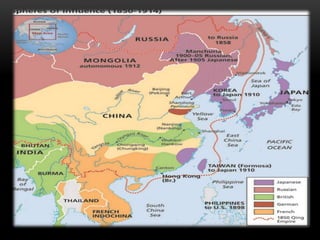
• Beyond China, European imperialism in
Asia remained strong. Britain moved into
Hong Kong in 1842, into Burma in 1886, and
into Kowloon in 1898. France took direct
control over the provinces of Indochina--
Annam, Tonkin, and Cochinchina (which
together make up modern day Vietnam),
Laos, and Cambodia.
CHINA AND JAPAN
• In the context of a) the political chaos that follows the
fall of the centralized dynastic power of the Qing in the
Republican Revolution in 1911 and b) the growing
nationalism that crystallizes as the May 4th Movement
after the 1919 Versailles Peace settlement— two
political parties work and compete to reunify China and
to modernize it to face the challenge of imperialist
encroachment by the West and Japan. These are the
Nationalist Party (Guomindang or Kuomintang) and the
Chinese Communist Party.
• Inadequate political control over the Japanese military, economic strains, and the
worldwide Depression of the 1930s set the stage for the rise of the military in Japan
and the pursuit of Japanese imperialist interests in Asia. Japan feels excluded by the
West in the division of spoils in China. Japan pursues its own dominance of China
by occupying Manchuria in 1931 and invading China in 1937 and remaining there
until its defeat at the conclusion of WW II in 1945.
• In China, the army of the Nationalist Party, led by Chiang Kai-shek
(political heir of Sun Yat-sen), marches north in 1926 on the
"Northern Expedition" from its base in southern China to establish
a new government at Nanking in 1927 and to reunify part of China.
This is sometimes called the Nationalist Revolution. The
Nationalist government remained in power in Nanking until 1937
(1927-37 is known as the "Nanking Decade") when it is forced by
the Japanese invasion to move inland and ultimately establish its
wartime capital in Chungking (Chongqing) in 1938, where it
remains until 1945. Japan captures the capital city of Nanking in
1937 in a brutal battle and subsequent reign of terror known as the
"Rape of Nanking."
JAPAN
o By the early 1800s many other countries wanted the Japanese to open
their ports for trade and Japan refused to allow it
o 1853 the U.S. sends four warships into Tokyo Harbor and the
Tokugawa Shoguns realized he had no choice but to receive them
o A letter from the president of the US asked the Japanese to open trade
o One year later the US navy returned and Japan signed the Treaty of
Kanagawa
o Japan opened two ports where the US could trade and take on
supplies
o Other Western powers soon followed
o By 1860 Japan allowed foreigners from many countries permission to
trade at several ports and it extended extraterritorial rights to many
nations
o Japanese were angry that the country was opened to foreigners
and the Tokugawa shogun stepped down
o This ended the military dictatorship that had lasted for 500
years
o The new emperor was Mutsuhito, his reign lasted for 45 years
and was called the Meiji Era
o The Meiji emperor knew that Japan had to modernize
o He sent officials to other countries to find western ways that
could be adopted
o Led reform of the government, military and education system
o Japan began to industrialize
o Built railroads
o Developed Silk and tea processing industries to give them
unique products to trade
 Developed other industries to make them
competitive with European countries
 Barbarians – foreign people
 Sonno – honor the emperor
 Joi – expel the barbarians
 meiji – the enlightened government
 Samurai –
 Katana – a sword used by Samurai warriors
Imperial Japan
• By 1890 Japan had the strongest military in Asia
• As they gained economic, political and military strength they wanted to
get rid of the extraterritorial rights of foreign countries
• 1894 all extraterritorial rights were abolished
• Japan become more imperialistic and national pride increased
• 1876 Japan attacked Korea to force Korea to open ports to foreign
trade
• 1885 Japan and China signed an agreement to keep both of their
armies out of Korea
• 1894 China breaks the agreement
• Japan sends troops to Korea
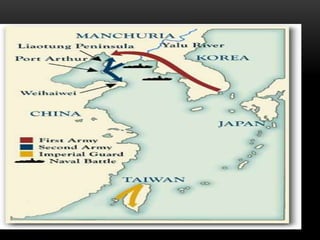
• The Sino Japanese War lasted only a few months and the Japanese
were the victors
• Japan destroyed the Chinese navy, gained a foothold in Manchuria and
gained colonies in Taiwan
Russo-Japanese War
• Russia and Japan were the two major powers in
East Asia
• 1903 the countries went to war over Manchuria (a
region in northeast China)
• 1904 Japan launched a surprise attack on the
Russian navy
• Japan defeated Russian troops and destroyed
most of their navy
• 1905 the Treaty of Portsmouth gave Japan
Manchuria and forced the Russians out of the
region
• After defeating Russia Japan took more control
over Korea
• 1907 the Korean king gave up control of the
country and disbanded the army
• 1910 Japan officially annexed Korea (put the
country under their control)
• Japan shut down newspapers and replaced
the Korean language with Japanese in
schools
• They encouraged Japanese businesses and
forbid Koreans to go into business for
themselves.

East imperialism

  • 1.
  • 3.
    IMPERIALISM IN CHINA •Manchu rulers – Chinese considered as foreigners. • Superiors – the government of China • Inferiors – foreign countries were expected to send lavish gifts/tribute, to the emperor as a sign of respect • kowtow – to kneel on both knees & bow 3 times, touching his nose to the floor
  • 4.
    • By theend of 18th century, Indo-British economic ties were so entrenched in a neo-mercantile system that India provide a stepping stone for British trade with China. • English wool and Indian cotton for Chinese teas and textile • Hongs – act as agents for the government
  • 5.
    FOREIGN MERCHANTS FOLLOWTHE STRICT RULES: 1. No foreign warships may sail inside the inlet to the river. 2. Neither foreign woman nor firearms may be brought into factories warehouse. 3. Foreign factories shall employ no maids & no more than 8 Chinese male servants.
  • 6.
    4. Foreign trademust be conducted trough the hongs merchants. Foreigners living in the factories must not move in & out too frequently, although they may walk freely w/in a 100 yards of their factories. 5. Foreigners may neither buy Chinese books nor learn Chinese.
  • 7.
    6. Foreigners maynot communicate w/ Chinese officials except through the hongs. 7. Foreigners are not allowed to row boats freely in the river. 8. Foreign traders must not remain in Canton after the trading season.
  • 8.
    • By the1830’s, Britain realized it could make up the trade deficit with China by selling Indian opium into the Chinese markets.
  • 9.
    • Concerned withthe sharp rise in opium addiction and the associated social costs and rise in criminal acts, the Chinese government, led by the aging Manchu dynasty, took action against the British. • Opium – a narcotic drug made from poppies. • Poppy – a flowering plant.
  • 11.
    • In 1839,the Chinese destroyed British opium in the port city of Canton, sparking the Opium Wars of 1839-1842. • The British expeditionary force blockaded Chinese ports, occupied Shanghai, and took complete control of Canton. • 1842 -Treaty of Nanking
  • 13.
    • Europeans maintainedextraterritoriality inside thousands of Chinese port cities. • The resulting lawlessness on the part of the Europeans, combined with the actuality of European economic, political, and military domination of the Chinese, contributed to a virulent anti-imperial sentiment.
  • 14.
    • The SecretSocieties are formed. • White lotus – one of the oldest secret society • Hsui-ch’uan – started a new society, a village teacher who read some Christian missionary writings and Chinese classics. He was the “Heavenly Younger Brother” the savior of China & declared himself as “Heavenly Kingdom of Great Place.”
  • 15.
    • Tie-ping –great peace • Open door policy – give all countries an equal trading rights • In 1900, the Boxer Rebellion saw that sentiment explode into mass social unrest and war.
  • 16.
    • Beyond China,European imperialism in Asia remained strong. Britain moved into Hong Kong in 1842, into Burma in 1886, and into Kowloon in 1898. France took direct control over the provinces of Indochina-- Annam, Tonkin, and Cochinchina (which together make up modern day Vietnam), Laos, and Cambodia.
  • 17.
    CHINA AND JAPAN •In the context of a) the political chaos that follows the fall of the centralized dynastic power of the Qing in the Republican Revolution in 1911 and b) the growing nationalism that crystallizes as the May 4th Movement after the 1919 Versailles Peace settlement— two political parties work and compete to reunify China and to modernize it to face the challenge of imperialist encroachment by the West and Japan. These are the Nationalist Party (Guomindang or Kuomintang) and the Chinese Communist Party.
  • 18.
    • Inadequate politicalcontrol over the Japanese military, economic strains, and the worldwide Depression of the 1930s set the stage for the rise of the military in Japan and the pursuit of Japanese imperialist interests in Asia. Japan feels excluded by the West in the division of spoils in China. Japan pursues its own dominance of China by occupying Manchuria in 1931 and invading China in 1937 and remaining there until its defeat at the conclusion of WW II in 1945.
  • 19.
    • In China,the army of the Nationalist Party, led by Chiang Kai-shek (political heir of Sun Yat-sen), marches north in 1926 on the "Northern Expedition" from its base in southern China to establish a new government at Nanking in 1927 and to reunify part of China. This is sometimes called the Nationalist Revolution. The Nationalist government remained in power in Nanking until 1937 (1927-37 is known as the "Nanking Decade") when it is forced by the Japanese invasion to move inland and ultimately establish its wartime capital in Chungking (Chongqing) in 1938, where it remains until 1945. Japan captures the capital city of Nanking in 1937 in a brutal battle and subsequent reign of terror known as the "Rape of Nanking."
  • 20.
  • 21.
    o By theearly 1800s many other countries wanted the Japanese to open their ports for trade and Japan refused to allow it o 1853 the U.S. sends four warships into Tokyo Harbor and the Tokugawa Shoguns realized he had no choice but to receive them o A letter from the president of the US asked the Japanese to open trade o One year later the US navy returned and Japan signed the Treaty of Kanagawa o Japan opened two ports where the US could trade and take on supplies o Other Western powers soon followed o By 1860 Japan allowed foreigners from many countries permission to trade at several ports and it extended extraterritorial rights to many nations
  • 22.
    o Japanese wereangry that the country was opened to foreigners and the Tokugawa shogun stepped down o This ended the military dictatorship that had lasted for 500 years o The new emperor was Mutsuhito, his reign lasted for 45 years and was called the Meiji Era o The Meiji emperor knew that Japan had to modernize o He sent officials to other countries to find western ways that could be adopted o Led reform of the government, military and education system o Japan began to industrialize o Built railroads o Developed Silk and tea processing industries to give them unique products to trade
  • 23.
     Developed otherindustries to make them competitive with European countries  Barbarians – foreign people  Sonno – honor the emperor  Joi – expel the barbarians  meiji – the enlightened government  Samurai –  Katana – a sword used by Samurai warriors
  • 24.
    Imperial Japan • By1890 Japan had the strongest military in Asia • As they gained economic, political and military strength they wanted to get rid of the extraterritorial rights of foreign countries • 1894 all extraterritorial rights were abolished • Japan become more imperialistic and national pride increased • 1876 Japan attacked Korea to force Korea to open ports to foreign trade • 1885 Japan and China signed an agreement to keep both of their armies out of Korea • 1894 China breaks the agreement • Japan sends troops to Korea • The Sino Japanese War lasted only a few months and the Japanese were the victors • Japan destroyed the Chinese navy, gained a foothold in Manchuria and gained colonies in Taiwan
  • 26.
    Russo-Japanese War • Russiaand Japan were the two major powers in East Asia • 1903 the countries went to war over Manchuria (a region in northeast China) • 1904 Japan launched a surprise attack on the Russian navy • Japan defeated Russian troops and destroyed most of their navy • 1905 the Treaty of Portsmouth gave Japan Manchuria and forced the Russians out of the region
  • 28.
    • After defeatingRussia Japan took more control over Korea • 1907 the Korean king gave up control of the country and disbanded the army • 1910 Japan officially annexed Korea (put the country under their control) • Japan shut down newspapers and replaced the Korean language with Japanese in schools • They encouraged Japanese businesses and forbid Koreans to go into business for themselves.