The plates are moving at a very

slow rate of about one to ten
centimeters per year.
In areas plates are moving

together and others are moving
apart.
http://www.youtube.com/watch?v=0mW
Qs1_L3fA
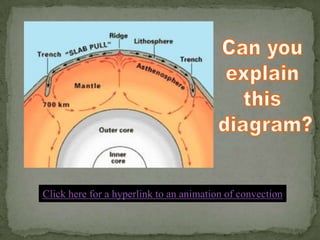
Click here for a hyperlink to an animation of convection
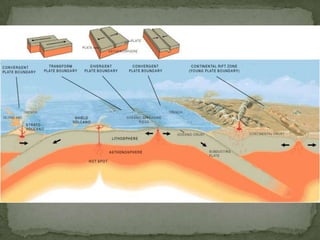
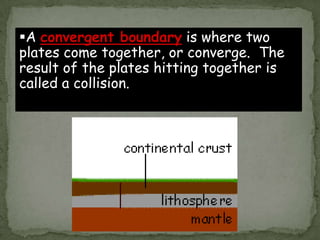
A convergent boundary is where two
plates come together, or converge. The
result of the plates hitting together is
called a collision.
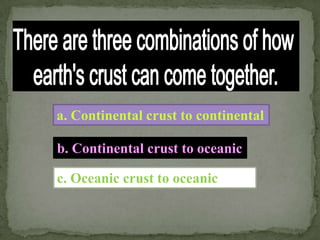
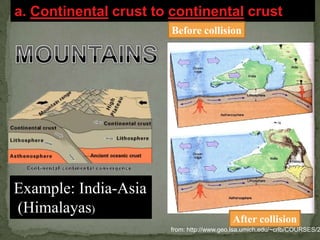
a. Continental crust to continental

b. Continental crust to oceanic
c. Oceanic crust to oceanic
a. Continental crust to continental crust
Before collision

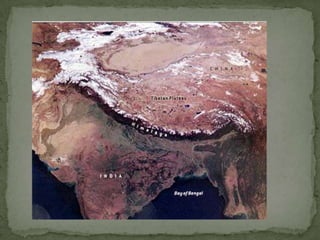
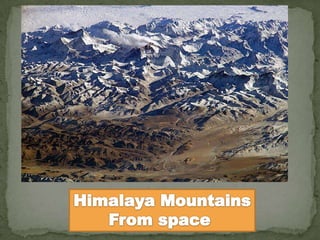
Example: India-Asia
(Himalayas)

After collision

from: http://www.geo.lsa.umich.edu/~crlb/COURSES/2
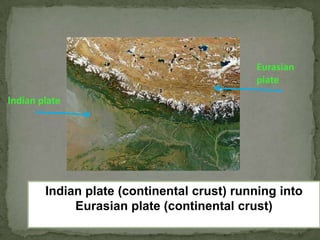
Eurasian
plate
Indian plate

Indian plate (continental crust) running into
Eurasian plate (continental crust)
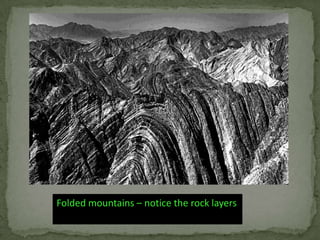
Folded mountains – notice the rock layers
SUBDUCTION
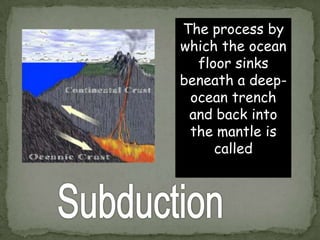
The process by
which the ocean
floor sinks
beneath a deepocean trench
and back into
the mantle is
called
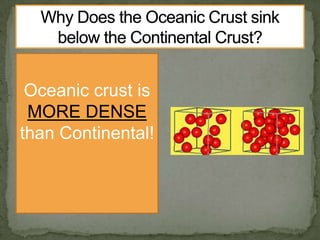
Oceanic crust is
MORE DENSE
than Continental!
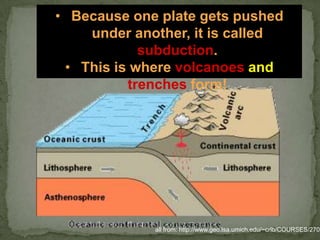
• Because one plate gets pushed
under another, it is called
subduction.
• This is where volcanoes and
trenches form!

all from: http://www.geo.lsa.umich.edu/~crlb/COURSES/270
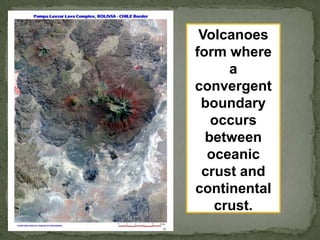
Volcanoes
form where
a
convergent
boundary
occurs
between
oceanic
crust and
continental
crust.
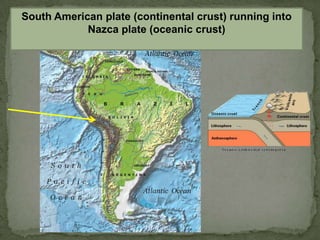
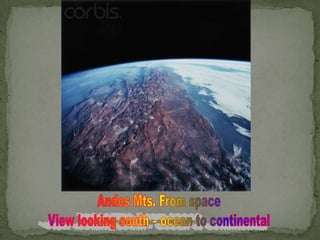
South American plate (continental crust) running into
Nazca plate (oceanic crust)
SUBDUCTION
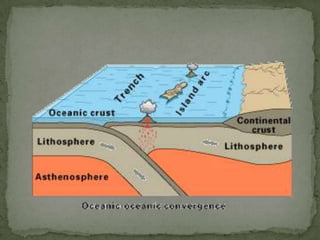
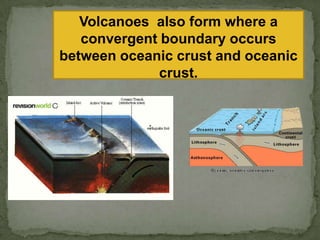
Volcanoes also form where a
convergent boundary occurs
between oceanic crust and oceanic
crust.
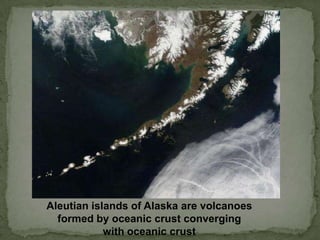
Aleutian islands of Alaska are volcanoes
formed by oceanic crust converging
with oceanic crust
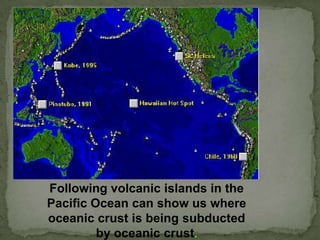
Following volcanic islands in the
Pacific Ocean can show us where
oceanic crust is being subducted
by oceanic crust.
Here is an great link for seeing
where each type of boundary is
located.

Plate tectonics review