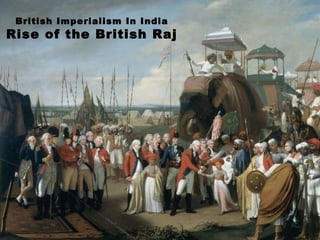
British Imperialism In India
Rise of the British Raj
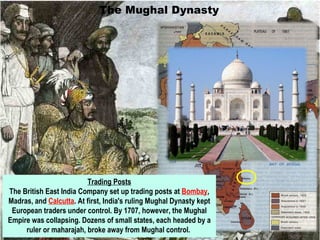
The Mughal Dynasty
Trading Posts
The British East India Company set up trading posts at Bombay,
Madras, and Calcutta. At first, India's ruling Mughal Dynasty kept
European traders under control. By 1707, however, the Mughal
Empire was collapsing. Dozens of small states, each headed by a
ruler or maharajah, broke away from Mughal control.
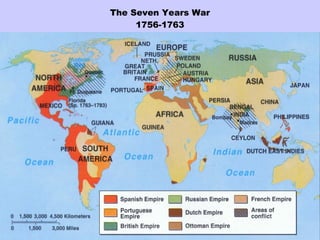
The Seven Years War
1756-1763
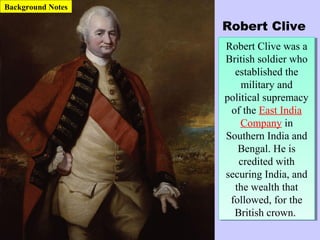
Robert Clive
Robert Clive was a
British soldier who
established the
military and
political supremacy
of the East India
Company in
Southern India and
Bengal. He is
credited with
securing India, and
the wealth that
followed, for the
British crown.
Robert Clive was a
British soldier who
established the
military and
political supremacy
of the East India
Company in
Southern India and
Bengal. He is
credited with
securing India, and
the wealth that
followed, for the
British crown.
Background Notes
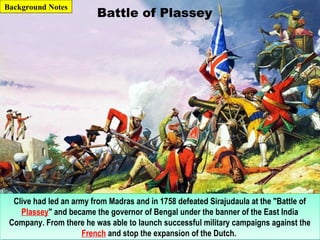
Battle of Plassey
Clive had led an army from Madras and in 1758 defeated Sirajudaula at the "Battle of
Plassey" and became the governor of Bengal under the banner of the East India
Company. From there he was able to launch successful military campaigns against the
French and stop the expansion of the Dutch.
Clive had led an army from Madras and in 1758 defeated Sirajudaula at the "Battle of
Plassey" and became the governor of Bengal under the banner of the East India
Company. From there he was able to launch successful military campaigns against the
French and stop the expansion of the Dutch.
Background Notes
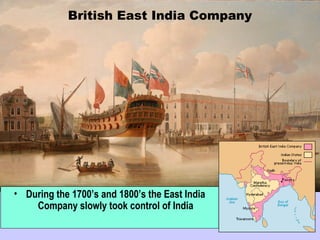
British East India Company
• During the 1700’s and 1800’s the East India
Company slowly took control of India
British East India Company
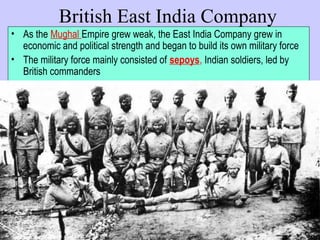
• As the Mughal Empire grew weak, the East India Company grew in
economic and political strength and began to build its own military force
• The military force mainly consisted of sepoys, Indian soldiers, led by
British commanders
The British
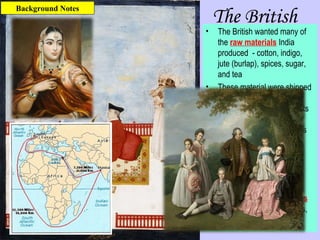
• The British wanted many of
the raw materials India
produced - cotton, indigo,
jute (burlap), spices, sugar,
and tea
• These material were shipped
to Britain for use in British
factories – finished products
were then shipped around
the world to British colonies
• There were some
advantages of the British
invasion – railroads,
education, hospitals,
common language,
• There were disadvantages
too – low wages, few rights,
no say in government
Background Notes
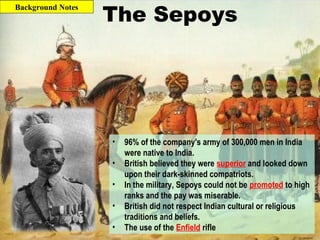
The Sepoys
• 96% of the company's army of 300,000 men in India
were native to India.
• British believed they were superior and looked down
upon their dark-skinned compatriots.
• In the military, Sepoys could not be promoted to high
ranks and the pay was miserable.
• British did not respect Indian cultural or religious
traditions and beliefs.
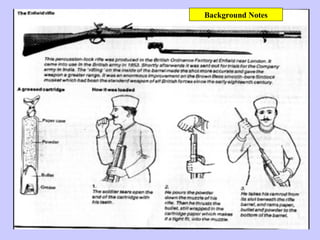
• The use of the Enfield rifle
Background Notes
Background Notes
Sepoy Rebellion
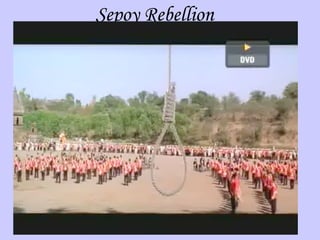
Sepoy Rebellion
Sepoy Rebellion
Sepoy Rebellion
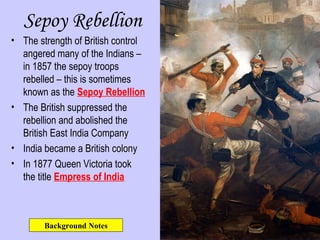
• The strength of British control
angered many of the Indians –
in 1857 the sepoy troops
rebelled – this is sometimes
known as the Sepoy Rebellion
• The British suppressed the
rebellion and abolished the
British East India Company
• India became a British colony
• In 1877 Queen Victoria took
the title Empress of India
Background Notes
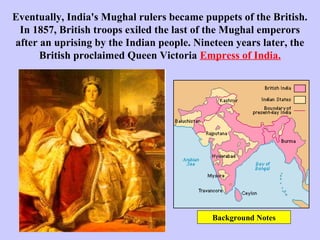
Eventually, India's Mughal rulers became puppets of the British.
In 1857, British troops exiled the last of the Mughal emperors
after an uprising by the Indian people. Nineteen years later, the
British proclaimed Queen Victoria Empress of India.
Background Notes
Ritual of Sati
Ritual of Sati
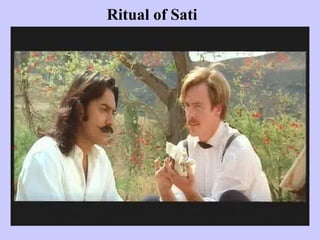
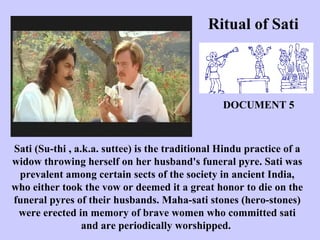
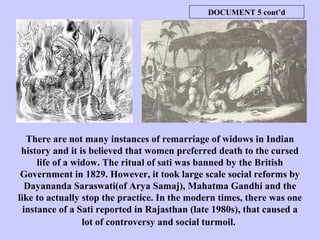
Sati (Su-thi , a.k.a. suttee) is the traditional Hindu practice of a
widow throwing herself on her husband's funeral pyre. Sati was
prevalent among certain sects of the society in ancient India,
who either took the vow or deemed it a great honor to die on the
funeral pyres of their husbands. Maha-sati stones (hero-stones)
were erected in memory of brave women who committed sati
and are periodically worshipped.
DOCUMENT 5
There are not many instances of remarriage of widows in Indian
history and it is believed that women preferred death to the cursed
life of a widow. The ritual of sati was banned by the British
Government in 1829. However, it took large scale social reforms by
Dayananda Saraswati(of Arya Samaj), Mahatma Gandhi and the
like to actually stop the practice. In the modern times, there was one
instance of a Sati reported in Rajasthan (late 1980s), that caused a
lot of controversy and social turmoil.
DOCUMENT 5 cont’d
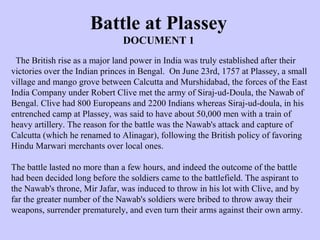
The British rise as a major land power in India was truly established after their
victories over the Indian princes in Bengal. On June 23rd, 1757 at Plassey, a small
village and mango grove between Calcutta and Murshidabad, the forces of the East
India Company under Robert Clive met the army of Siraj-ud-Doula, the Nawab of
Bengal. Clive had 800 Europeans and 2200 Indians whereas Siraj-ud-doula, in his
entrenched camp at Plassey, was said to have about 50,000 men with a train of
heavy artillery. The reason for the battle was the Nawab's attack and capture of
Calcutta (which he renamed to Alinagar), following the British policy of favoring
Hindu Marwari merchants over local ones.
The battle lasted no more than a few hours, and indeed the outcome of the battle
had been decided long before the soldiers came to the battlefield. The aspirant to
the Nawab's throne, Mir Jafar, was induced to throw in his lot with Clive, and by
far the greater number of the Nawab's soldiers were bribed to throw away their
weapons, surrender prematurely, and even turn their arms against their own army.
Battle at Plassey
DOCUMENT 1
Battle at Plassey
DOCUMENT 1 cont’d
Siraj fled, leaving a still nervous Mir Jafar to occupy the palace and treasury,
and to await Clive's coming before ascending the masnad or throne. The act
ended with the capture of Siraj-ud-doula when nearing Bihar, and he was
brutally murdered by Mir Jafar's son Miran. After the battle, all the soldiers
who had betrayed their Nawab were killed by the British on the maxim : "If
you could betray your Lord and Master, you will betray us tomorrow."
Plassey was decisive for the British in India, and for Clive. Jawaharlal
Nehru, in The Discovery of India (1946), justly describes Clive as having
won the battle "by promoting treason and forgery," and pointedly notes that
British rule in India had "an unsavory beginning and something of that bitter
taste has clung to it ever since." The Battle of Plassey is considered to be the
start of British rule in India.
British East
India
CompanyDocument #1
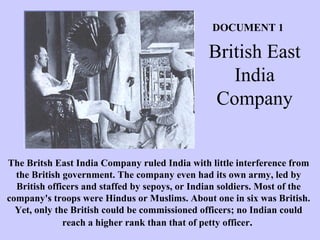
The Britsh East India Company ruled India with little interference from
the British government. The company even had its own army, led by
British officers and staffed by sepoys, or Indian soldiers. Most of the
company's troops were Hindus or Muslims. About one in six was British.
Yet, only the British could be commissioned officers; no Indian could
reach a higher rank than that of petty officer.
DOCUMENT 1
Economic Restrictions
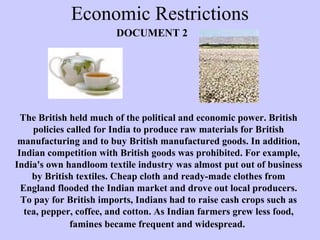
The British held much of the political and economic power. British
policies called for India to produce raw materials for British
manufacturing and to buy British manufactured goods. In addition,
Indian competition with British goods was prohibited. For example,
India's own handloom textile industry was almost put out of business
by British textiles. Cheap cloth and ready-made clothes from
England flooded the Indian market and drove out local producers.
To pay for British imports, Indians had to raise cash crops such as
tea, pepper, coffee, and cotton. As Indian farmers grew less food,
famines became frequent and widespread.
DOCUMENT 2
Economic Restrictions
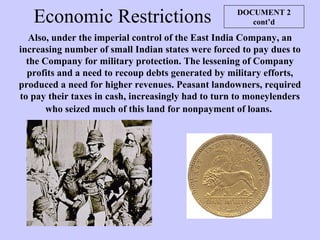
Also, under the imperial control of the East India Company, an
increasing number of small Indian states were forced to pay dues to
the Company for military protection. The lessening of Company
profits and a need to recoup debts generated by military efforts,
produced a need for higher revenues. Peasant landowners, required
to pay their taxes in cash, increasingly had to turn to moneylenders
who seized much of this land for nonpayment of loans.
DOCUMENT 2
cont’d
Advancements In Transportation
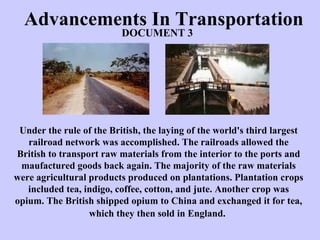
Under the rule of the British, the laying of the world's third largest
railroad network was accomplished. The railroads allowed the
British to transport raw materials from the interior to the ports and
maufactured goods back again. The majority of the raw materials
were agricultural products produced on plantations. Plantation crops
included tea, indigo, coffee, cotton, and jute. Another crop was
opium. The British shipped opium to China and exchanged it for tea,
which they then sold in England.
DOCUMENT 3
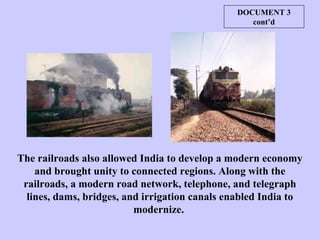
The railroads also allowed India to develop a modern economy
and brought unity to connected regions. Along with the
railroads, a modern road network, telephone, and telegraph
lines, dams, bridges, and irrigation canals enabled India to
modernize.
DOCUMENT 3
cont’d
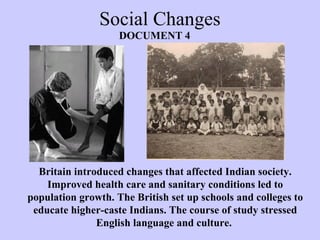
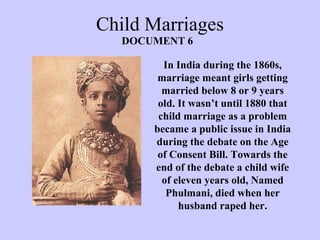
Social Changes
Britain introduced changes that affected Indian society.
Improved health care and sanitary conditions led to
population growth. The British set up schools and colleges to
educate higher-caste Indians. The course of study stressed
English language and culture.
DOCUMENT 4
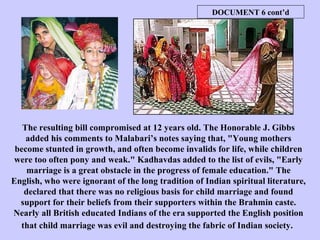
Child Marriages
In India during the 1860s,
marriage meant girls getting
married below 8 or 9 years
old. It wasn’t until 1880 that
child marriage as a problem
became a public issue in India
during the debate on the Age
of Consent Bill. Towards the
end of the debate a child wife
of eleven years old, Named
Phulmani, died when her
husband raped her.
DOCUMENT 6
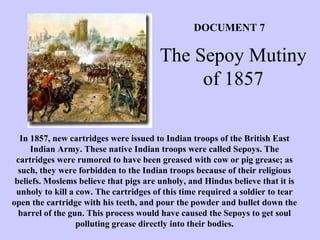
The resulting bill compromised at 12 years old. The Honorable J. Gibbs
added his comments to Malabari’s notes saying that, "Young mothers
become stunted in growth, and often become invalids for life, while children
were too often pony and weak." Kadhavdas added to the list of evils, "Early
marriage is a great obstacle in the progress of female education." The
English, who were ignorant of the long tradition of Indian spiritual literature,
declared that there was no religious basis for child marriage and found
support for their beliefs from their supporters within the Brahmin caste.
Nearly all British educated Indians of the era supported the English position
that child marriage was evil and destroying the fabric of Indian society.
DOCUMENT 6 cont’d
The Sepoy Mutiny
of 1857
In 1857, new cartridges were issued to Indian troops of the British East
Indian Army. These native Indian troops were called Sepoys. The
cartridges were rumored to have been greased with cow or pig grease; as
such, they were forbidden to the Indian troops because of their religious
beliefs. Moslems believe that pigs are unholy, and Hindus believe that it is
unholy to kill a cow. The cartridges of this time required a soldier to tear
open the cartridge with his teeth, and pour the powder and bullet down the
barrel of the gun. This process would have caused the Sepoys to get soul
polluting grease directly into their bodies.
DOCUMENT 7
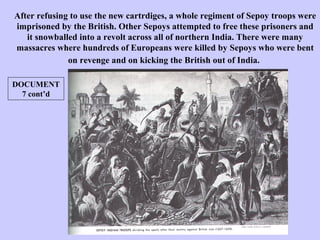
After refusing to use the new cartrdiges, a whole regiment of Sepoy troops were
imprisoned by the British. Other Sepoys attempted to free these prisoners and
it snowballed into a revolt across all of northern India. There were many
massacres where hundreds of Europeans were killed by Sepoys who were bent
on revenge and on kicking the British out of India.
DOCUMENT
7 cont’d
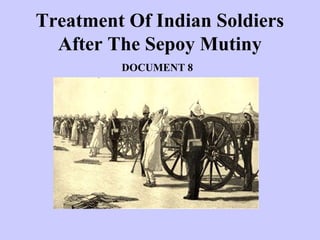
Treatment Of Indian Soldiers
After The Sepoy Mutiny
DOCUMENT 8
The Results of the Sepoy
Rebellion
The mutiny marked a turning point in Indian history. As a
result of the mutiny, in 1858 the British government took
direct command of India. The part of India that was under
direct British rule was called the Raj. The term Raj referred
to British rule over India from 1757 until 1914. India was
divided into 11 provinces and some 250 districts. Sometimes a
handful of British officials were the only British among a
million or so people in the district. A viceroy, or a British-
general, carried out the government's orders.
DOCUMENT 9

British In India

  • 1.
    British Imperialism InIndia Rise of the British Raj
  • 2.
    The Mughal Dynasty TradingPosts The British East India Company set up trading posts at Bombay, Madras, and Calcutta. At first, India's ruling Mughal Dynasty kept European traders under control. By 1707, however, the Mughal Empire was collapsing. Dozens of small states, each headed by a ruler or maharajah, broke away from Mughal control.
  • 3.
    The Seven YearsWar 1756-1763
  • 4.
    Robert Clive Robert Clivewas a British soldier who established the military and political supremacy of the East India Company in Southern India and Bengal. He is credited with securing India, and the wealth that followed, for the British crown. Robert Clive was a British soldier who established the military and political supremacy of the East India Company in Southern India and Bengal. He is credited with securing India, and the wealth that followed, for the British crown. Background Notes
  • 5.
    Battle of Plassey Clivehad led an army from Madras and in 1758 defeated Sirajudaula at the "Battle of Plassey" and became the governor of Bengal under the banner of the East India Company. From there he was able to launch successful military campaigns against the French and stop the expansion of the Dutch. Clive had led an army from Madras and in 1758 defeated Sirajudaula at the "Battle of Plassey" and became the governor of Bengal under the banner of the East India Company. From there he was able to launch successful military campaigns against the French and stop the expansion of the Dutch. Background Notes
  • 6.
    British East IndiaCompany • During the 1700’s and 1800’s the East India Company slowly took control of India
  • 7.
    British East IndiaCompany • As the Mughal Empire grew weak, the East India Company grew in economic and political strength and began to build its own military force • The military force mainly consisted of sepoys, Indian soldiers, led by British commanders
  • 8.
    The British • TheBritish wanted many of the raw materials India produced - cotton, indigo, jute (burlap), spices, sugar, and tea • These material were shipped to Britain for use in British factories – finished products were then shipped around the world to British colonies • There were some advantages of the British invasion – railroads, education, hospitals, common language, • There were disadvantages too – low wages, few rights, no say in government Background Notes
  • 9.
    The Sepoys • 96%of the company's army of 300,000 men in India were native to India. • British believed they were superior and looked down upon their dark-skinned compatriots. • In the military, Sepoys could not be promoted to high ranks and the pay was miserable. • British did not respect Indian cultural or religious traditions and beliefs. • The use of the Enfield rifle Background Notes
  • 10.
  • 11.
  • 12.
  • 13.
  • 14.
    Sepoy Rebellion • Thestrength of British control angered many of the Indians – in 1857 the sepoy troops rebelled – this is sometimes known as the Sepoy Rebellion • The British suppressed the rebellion and abolished the British East India Company • India became a British colony • In 1877 Queen Victoria took the title Empress of India Background Notes
  • 15.
    Eventually, India's Mughalrulers became puppets of the British. In 1857, British troops exiled the last of the Mughal emperors after an uprising by the Indian people. Nineteen years later, the British proclaimed Queen Victoria Empress of India. Background Notes
  • 16.
  • 17.
    Ritual of Sati Sati(Su-thi , a.k.a. suttee) is the traditional Hindu practice of a widow throwing herself on her husband's funeral pyre. Sati was prevalent among certain sects of the society in ancient India, who either took the vow or deemed it a great honor to die on the funeral pyres of their husbands. Maha-sati stones (hero-stones) were erected in memory of brave women who committed sati and are periodically worshipped. DOCUMENT 5
  • 18.
    There are notmany instances of remarriage of widows in Indian history and it is believed that women preferred death to the cursed life of a widow. The ritual of sati was banned by the British Government in 1829. However, it took large scale social reforms by Dayananda Saraswati(of Arya Samaj), Mahatma Gandhi and the like to actually stop the practice. In the modern times, there was one instance of a Sati reported in Rajasthan (late 1980s), that caused a lot of controversy and social turmoil. DOCUMENT 5 cont’d
  • 19.
    The British riseas a major land power in India was truly established after their victories over the Indian princes in Bengal. On June 23rd, 1757 at Plassey, a small village and mango grove between Calcutta and Murshidabad, the forces of the East India Company under Robert Clive met the army of Siraj-ud-Doula, the Nawab of Bengal. Clive had 800 Europeans and 2200 Indians whereas Siraj-ud-doula, in his entrenched camp at Plassey, was said to have about 50,000 men with a train of heavy artillery. The reason for the battle was the Nawab's attack and capture of Calcutta (which he renamed to Alinagar), following the British policy of favoring Hindu Marwari merchants over local ones. The battle lasted no more than a few hours, and indeed the outcome of the battle had been decided long before the soldiers came to the battlefield. The aspirant to the Nawab's throne, Mir Jafar, was induced to throw in his lot with Clive, and by far the greater number of the Nawab's soldiers were bribed to throw away their weapons, surrender prematurely, and even turn their arms against their own army. Battle at Plassey DOCUMENT 1
  • 20.
    Battle at Plassey DOCUMENT1 cont’d Siraj fled, leaving a still nervous Mir Jafar to occupy the palace and treasury, and to await Clive's coming before ascending the masnad or throne. The act ended with the capture of Siraj-ud-doula when nearing Bihar, and he was brutally murdered by Mir Jafar's son Miran. After the battle, all the soldiers who had betrayed their Nawab were killed by the British on the maxim : "If you could betray your Lord and Master, you will betray us tomorrow." Plassey was decisive for the British in India, and for Clive. Jawaharlal Nehru, in The Discovery of India (1946), justly describes Clive as having won the battle "by promoting treason and forgery," and pointedly notes that British rule in India had "an unsavory beginning and something of that bitter taste has clung to it ever since." The Battle of Plassey is considered to be the start of British rule in India.
  • 21.
    British East India CompanyDocument #1 TheBritsh East India Company ruled India with little interference from the British government. The company even had its own army, led by British officers and staffed by sepoys, or Indian soldiers. Most of the company's troops were Hindus or Muslims. About one in six was British. Yet, only the British could be commissioned officers; no Indian could reach a higher rank than that of petty officer. DOCUMENT 1
  • 22.
    Economic Restrictions The Britishheld much of the political and economic power. British policies called for India to produce raw materials for British manufacturing and to buy British manufactured goods. In addition, Indian competition with British goods was prohibited. For example, India's own handloom textile industry was almost put out of business by British textiles. Cheap cloth and ready-made clothes from England flooded the Indian market and drove out local producers. To pay for British imports, Indians had to raise cash crops such as tea, pepper, coffee, and cotton. As Indian farmers grew less food, famines became frequent and widespread. DOCUMENT 2
  • 23.
    Economic Restrictions Also, underthe imperial control of the East India Company, an increasing number of small Indian states were forced to pay dues to the Company for military protection. The lessening of Company profits and a need to recoup debts generated by military efforts, produced a need for higher revenues. Peasant landowners, required to pay their taxes in cash, increasingly had to turn to moneylenders who seized much of this land for nonpayment of loans. DOCUMENT 2 cont’d
  • 24.
    Advancements In Transportation Underthe rule of the British, the laying of the world's third largest railroad network was accomplished. The railroads allowed the British to transport raw materials from the interior to the ports and maufactured goods back again. The majority of the raw materials were agricultural products produced on plantations. Plantation crops included tea, indigo, coffee, cotton, and jute. Another crop was opium. The British shipped opium to China and exchanged it for tea, which they then sold in England. DOCUMENT 3
  • 25.
    The railroads alsoallowed India to develop a modern economy and brought unity to connected regions. Along with the railroads, a modern road network, telephone, and telegraph lines, dams, bridges, and irrigation canals enabled India to modernize. DOCUMENT 3 cont’d
  • 26.
    Social Changes Britain introducedchanges that affected Indian society. Improved health care and sanitary conditions led to population growth. The British set up schools and colleges to educate higher-caste Indians. The course of study stressed English language and culture. DOCUMENT 4
  • 27.
    Child Marriages In Indiaduring the 1860s, marriage meant girls getting married below 8 or 9 years old. It wasn’t until 1880 that child marriage as a problem became a public issue in India during the debate on the Age of Consent Bill. Towards the end of the debate a child wife of eleven years old, Named Phulmani, died when her husband raped her. DOCUMENT 6
  • 28.
    The resulting billcompromised at 12 years old. The Honorable J. Gibbs added his comments to Malabari’s notes saying that, "Young mothers become stunted in growth, and often become invalids for life, while children were too often pony and weak." Kadhavdas added to the list of evils, "Early marriage is a great obstacle in the progress of female education." The English, who were ignorant of the long tradition of Indian spiritual literature, declared that there was no religious basis for child marriage and found support for their beliefs from their supporters within the Brahmin caste. Nearly all British educated Indians of the era supported the English position that child marriage was evil and destroying the fabric of Indian society. DOCUMENT 6 cont’d
  • 29.
    The Sepoy Mutiny of1857 In 1857, new cartridges were issued to Indian troops of the British East Indian Army. These native Indian troops were called Sepoys. The cartridges were rumored to have been greased with cow or pig grease; as such, they were forbidden to the Indian troops because of their religious beliefs. Moslems believe that pigs are unholy, and Hindus believe that it is unholy to kill a cow. The cartridges of this time required a soldier to tear open the cartridge with his teeth, and pour the powder and bullet down the barrel of the gun. This process would have caused the Sepoys to get soul polluting grease directly into their bodies. DOCUMENT 7
  • 30.
    After refusing touse the new cartrdiges, a whole regiment of Sepoy troops were imprisoned by the British. Other Sepoys attempted to free these prisoners and it snowballed into a revolt across all of northern India. There were many massacres where hundreds of Europeans were killed by Sepoys who were bent on revenge and on kicking the British out of India. DOCUMENT 7 cont’d
  • 31.
    Treatment Of IndianSoldiers After The Sepoy Mutiny DOCUMENT 8
  • 32.
    The Results ofthe Sepoy Rebellion The mutiny marked a turning point in Indian history. As a result of the mutiny, in 1858 the British government took direct command of India. The part of India that was under direct British rule was called the Raj. The term Raj referred to British rule over India from 1757 until 1914. India was divided into 11 provinces and some 250 districts. Sometimes a handful of British officials were the only British among a million or so people in the district. A viceroy, or a British- general, carried out the government's orders. DOCUMENT 9