An ISO 9001:2000 Company
                                        INFRA RED THERMOMETERS
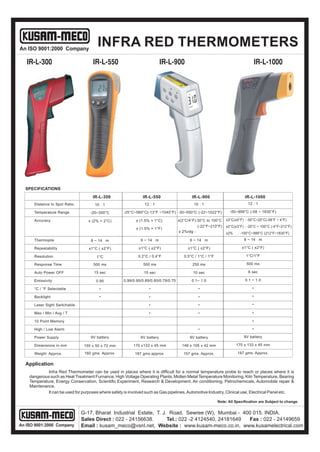
   IR-L-300                          IR-L-550                               IR-L-900                                                 IR-L-1000


  SPECIFICATIONS
                                     IR-L-300                   IR-L-550                     IR-L-900                        IR-L-1000
      Distance to Spot Ratio          10 : 1                     12 : 1                       10 : 1                           12 : 1

      Temperature Range             -20~350°C         -25°C~560°C(-13°F ~1040°F) -30~550°C (-22~1022°F)             -50~999°C (-58 ~ 1830°F)

      Accuracy                     ± (2% + 2°C)             ± (1.5% + 1°C)            ±(2°C/4°F):30°C to 100°C    ±3°C(±5°F) : -50°C~20°C(-58°F ~ 4°F)
                                                                                                  (-22°F~212°F)   ±2°C(±3°F) : -20°C ~ 100°C (-4°F~212°F)
                                                            ± (1.5% + 1°F)
                                                                                      ± 2%rdg :                   ±2%    : -100°C~999°C (212°F~1830°F)
      Thermopile                    8 ~ 14 mm                  6 ~ 14 mm                    6 ~ 14 mm                       8 ~ 14 mm

      Repeatability                ±1°C ( ±2°F)               ±1°C ( ±2°F)                 ±1°C ( ±2°F)                    ±1°C ( ±2°F)

      Resolution                       1°C                    0.2°C / 0.4°F              0.5°C / 1°C / 1°F                   1°C/1°F

      Response Time                   500 ms                    500 ms                        250 ms                          500 ms

      Auto Power OFF                  15 sec                     15 sec                       10 sec                           6 sec

      Emissivity                       0.95           0.99/0.95/0.89/0.85/0.79/0.75          0.1~ 1.0                        0.1 ~ 1.0

      °C / °F Selectable                 •                          •                             •                              •

      Backlight                          •                          •                             •                              •

      Laser Sight Switchable                                        •                             •                              •

      Max / Min / Avg / T                                           •                             •                              •

      10 Point Memory                                                                                                            •

      High / Low Alarm                                                                            •                              •

      Power Supply                  9V battery                 9V battery                   9V battery                      9V battery

      Dimensions in mm           155 x 50 x 72 mm          170 x133 x 45 mm             148 x 105 x 42 mm               170 x 133 x 45 mm

      Weight Approx.             160 gms. Approx.           187 gms.approx.              157 gms. Approx.               187 gms. Approx.

  Application
             Infra Red Thermometer can be used in places where it is difficult for a normal temperature probe to reach or places where it is
    dangerous such as Heat Treatment Furnance, High Voltage Operating Plants, Molten Metal Temperature Monitoring, Kiln Temperature, Bearing
    Temperature, Energy Conservation, Scientific Experiment, Research & Development, Air conditioning, Petrochemicals, Automobile repair &
    Maintenance.
             It can be used for purposes where safety is involved such as Gas pipelines, Automotive Industry, Clinical use, Electrical Panel etc.

                                                                                                             Note: All Specification are Subject to change.


                               G-17, Bharat Industrial Estate, T. J. Road, Sewree (W), Mumbai - 400 015. INDIA.
                               Sales Direct : 022 - 24156638.       Tel.: 022 -2 4124540, 24181649 Fax : 022 - 24149659
An ISO 9001:2000 Company       Email : kusam_meco@vsnl.net, Website : www.kusam-meco.co.in, www.kusamelectrical.com
An ISO 9001:2008 company
                                        INFRA RED THERMOMETERS
What is an Infrared Thermometer?
An infrared thermometer is a non-contact temperature measurement device. Infrared Thermometers detect the infrared energy emitted by all
materials -- at temperatures above absolute zero, (0°Kelvin)-- and converts the energy factor into a temperature reading.

How do infrared Thermometers work?
The most basic design consists of a lens to focus the infrared (IR) energy on to a detector, which converts the energy to an electrical signal that
can be displayed in units of temperature after being compensated for ambient temperature variation. This configuration facilitates temperature
measurement from a distance without contact with the object to be measured. As such, the infrared thermometer is useful for measuring
temperature under circumstances where thermocouples or other probe type sensors cannot be used or do not produce accurate data for a
variety of reasons. Some typical circumstances are where the object to be measured is moving; where the object is surrounded by an EM field,
as in induction heating; where the object is contained in a vacuum or other controlled atmosphere; or in applications where a fast response is
required.

Common Questions When Using an Infrared Thermometer :
Why should I use an infrared thermometer to measure temperature in my application ?
Infrared pyrometers allow users to measure temperature in applications where conventional sensors cannot be employed. Specifically, in
cases dealing with moving objects (i.e., Rollers, moving machinery, or a conveyor belt), or where non-contact measurements are required
because of contamination or hazardous reasons (such as high voltage), where distances are too great, or where the temperatures to be
measured are too high for thermocouples or other contact sensors.
What should I consider about my application when selecting an infrared thermometer ?
The critical considerations for any infrared pyrometer include field of view (target size and distance), type of surface being measured (emissivity
considerations), spectral response (for atmospheric effects or transmission through surfaces), temperature range and mounting (handheld
portable or fixed mount). Other considerations include response time, environment, mounting limitations, viewing port or window applications,
and desired signal processing.

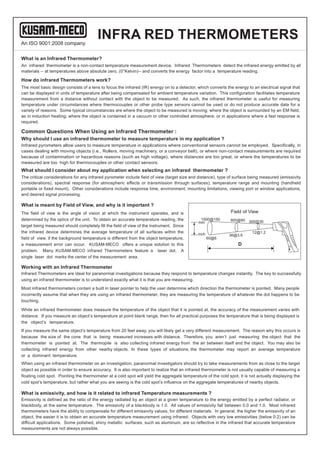
What is meant by Field of View, and why is it important ?
The field of view is the angle of vision at which the instrument operates, and is                              Field of View
determined by the optics of the unit. To obtain an accurate temperature reading, the           1500@150        900@90    300@30
                                                                                              mm
target being measured should completely fill the field of view of the instrument. Since
the infrared device determines the average temperature of all surfaces within the             inch                        12@1.2
                                                                                                              36@3.6
field of view, if the background temperature is different from the object temperature,               60@6
a measurement error can occur. KUSAM-MECO offers a unique solution to this                                         D
problem. Many KUSAM-MECO infrared Thermometers feature a laser dot. A
single laser dot marks the center of the measurement area.

Working with an Infrared Thermometer
Infrared Thermometers are ideal for paranormal investigations because they respond to temperature changes instantly. The key to successfully
using an infrared thermometer is to understand exactly what it is that you are measuring.
Most infrared thermometers contain a built in laser pointer to help the user determine which direction the thermometer is pointed. Many people
incorrectly assume that when they are using an infrared thermometer, they are measuring the temperature of whatever the dot happens to be
touching.

While an infrared thermometer does measure the temperature of the object that it is pointed at, the accuracy of the measurement varies with
distance. If you measure an object’s temperature at point blank range, then for all practical purposes the temperature that is being displayed is
the object’s temperature.
If you measure the same object’s temperature from 20 feet away, you will likely get a very different measurement. The reason why this occurs is
because the size of the cone that is being measured increases with distance. Therefore, you aren’t just measuring the object that the
thermometer is pointed at. The thermopile is also collecting infrared energy from the air between itself and the object. You may also be
collecting infrared energy from other nearby objects. In these types of situations, the thermometer may report an average temperature
or a dominant temperature.
When using an infrared thermometer on an investigation, paranormal investigators should try to take measurements from as close to the target
object as possible in order to ensure accuracy. It is also important to realize that an infrared thermometer is not usually capable of measuring a
floating cold spot. Pointing the thermometer at a cold spot will yield the aggregate temperature of the cold spot, it is not actually displaying the
cold spot’s temperature, but rather what you are seeing is the cold spot’s influence on the aggregate temperatures of nearby objects.

What is emissivity, and how is it related to infrared Temperature measurements ?
Emissivity is defined as the ratio of the energy radiated by an object at a given temperature to the energy emitted by a perfect radiator, or
blackbody, at the same temperature. The emissivity of a blackbody is 1.0. All values of emissivity fall between 0.0 and 1.0. Most infrared
thermometers have the ability to compensate for different emissivity values, for different materials. In general, the higher the emissivity of an
object, the easier it is to obtain an accurate temperature measurement using infrared. Objects with very low emissivities (below 0.2) can be
difficult applications. Some polished, shiny metallic surfaces, such as aluminum, are so reflective in the infrared that accurate temperature
measurements are not always possible.
Five Ways to Determine Emissivity
There are five ways to determine the emissivity of the material, to ensure accurate temperature measurements. :
1. Heat a sample of the material to a known temperature, using a precise sensor, and measure the temperature using the IR instrument. Then
   adjust the emissivity value to force the indicator to display the correct temperature.
2. For relatively low temperatures (up to 500°F) , a piece of masking tape, with an emissivity of 0.95, can be measured. Then adjust the
   emissivity value to force the indicator to display the correct temperature of the material.
3. For high temperature measurements, a hole (depth of which is at least 6 times the diameter) can be drilled into the object. This hole acts as
   a blackbody with emissivity of 1.0. Measure the temperature in the hole, then adjust the emissivity to force the indicator to display the correct
   temperature of the material.
4. If the material, or a portion of it, can be coated, a dull black paint will have an emissivity of approx. 1.0. Measure the temperature of the
   paint, then adjust the emissivity to force the indicator to display the correct temperature.
5. Standardized emissivity values for most materials are available. These can be entered into the instrument to estimate the material’s
   emissivity value.
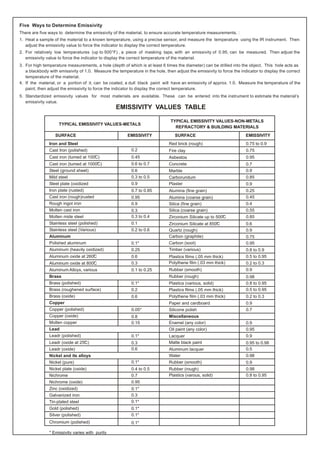
                                                  EMISSIVITY VALUES TABLE

                                                                               TYPICAL EMISSIVITY VALUES-NON-METALS
                    TYPICAL EMISSIVITY VALUES-METALS
                                                                                 REFRACTORY & BUILDING MATERIALS
                  SURFACE                               EMISSIVITY               SURFACE                               EMISSIVITY
               Iron and Steel                                                 Red brick (rough)                        0.75 to 0.9
               Cast Iron (polished)                       0.2                 Fire clay                                0.75
                                      o
               Cast iron (tumed at 100C)                  0.45                Asbestos                                 0.95
                                           o
               Cast iron (tumed at 1000C)                 0.6 to 0.7          Concrete                                 0.7
               Steel (ground sheet)                       0.6                 Marble                                   0.9
               Mild steel                                 0.3 to 0.5          Carborundum                              0.85
               Steel plate (oxidized                      0.9                 Plaster                                  0.9
               Iron plate (rusted)                        0.7 to 0.85         Alumina (fine grain)                     0.25
               Cast iron (rough)rusted                    0.95                Alumina (coarse grain)                   0.45
               Rough ingot iron                           0.9                 Silica (fine grain)                      0.4
               Molten cast iron                           0.3                 Silica (coarse grain)                    0.55
                                                                                                          o
               Molten mide steel                          0.3 to 0.4          Zirconium Silicate up to 500C            0.85
                                                                                                          o
               Stainless steel (polished)                 0.1                 Zirconium Silicate at 850C               0.6
               Stainless steel (Various)                  0.2 to 0.6          Quartz (rough)                           0.9
               Aluminum                                                       Carbon (graphite)                        0.75
               Polished aluminum                          0.1*                Carbon (soot)                            0.95
               Aluminum (heavily oxidized)                0.25                Timber (various)                         0.8 to 0.9
                                       o
               Aluminum oxide at 260C                     0.6                 Plastics films (.05 mm thick)            0.5 to 0.95
                                    o
               Aluminum oxide at 800C                     0.3                 Polythene film (.03 mm thick)            0.2 to 0.3
               Aluminum Alloys, various                   0.1 to 0.25         Rubber (smooth)                          0.9
               Brass                                                          Rubber (rough)                           0.98
               Brass (polished)                           0.1*                Plastics (various, solid)                0.8 to 0.95
               Brass (roughened surface)                  0.2                 Plastics films (.05 mm thick)            0.5 to 0.95
               Brass (oxide)                              0.6                 Polythene film (.03 mm thick)            0.2 to 0.3
               Copper                                                         Paper and cardboard                      0.9
               Copper (polished)                          0.05*               Silicone polish                          0.7
               Copper (oxide)                             0.8                 Miscellaneous
               Molten copper                              0.15                Enamel (any color)                       0.9
               Lead                                                           Oil paint (any color)                    0.95
               Leadr (polished)                           0.1*                Lacquer                                  0.9
                                 o
               Leadr (oxide at 25C)                       0.3                 Matte black paint                        0.95 to 0.98
               Leadr (oxide)                              0.6                 Aluminum lacquer                         0.5
               Nickel and its alloys                                          Water                                    0.98
               Nickel (pure)                              0.1*                Rubber (smooth)                          0.9
               Nickel plate (oxide)                       0.4 to 0.5          Rubber (rough)                           0.98
               Nichrome                                   0.7                 Plastics (varous, solid)                 0.8 to 0.95
               Nichrome (oxide)                           0.95
               Zinc (oxidized)                            0.1*
               Galvanized iron                            0.3
               Tin-plated steel                           0.1*
               Gold (polished)                            0.1*
               Silver (polished)                          0.1*
               Chromium (polished)                        0.1*

               * Emissivity varies with purity

Irl 300-550-900-1000

  • 1.
    An ISO 9001:2000Company INFRA RED THERMOMETERS IR-L-300 IR-L-550 IR-L-900 IR-L-1000 SPECIFICATIONS IR-L-300 IR-L-550 IR-L-900 IR-L-1000 Distance to Spot Ratio 10 : 1 12 : 1 10 : 1 12 : 1 Temperature Range -20~350°C -25°C~560°C(-13°F ~1040°F) -30~550°C (-22~1022°F) -50~999°C (-58 ~ 1830°F) Accuracy ± (2% + 2°C) ± (1.5% + 1°C) ±(2°C/4°F):30°C to 100°C ±3°C(±5°F) : -50°C~20°C(-58°F ~ 4°F) (-22°F~212°F) ±2°C(±3°F) : -20°C ~ 100°C (-4°F~212°F) ± (1.5% + 1°F) ± 2%rdg : ±2% : -100°C~999°C (212°F~1830°F) Thermopile 8 ~ 14 mm 6 ~ 14 mm 6 ~ 14 mm 8 ~ 14 mm Repeatability ±1°C ( ±2°F) ±1°C ( ±2°F) ±1°C ( ±2°F) ±1°C ( ±2°F) Resolution 1°C 0.2°C / 0.4°F 0.5°C / 1°C / 1°F 1°C/1°F Response Time 500 ms 500 ms 250 ms 500 ms Auto Power OFF 15 sec 15 sec 10 sec 6 sec Emissivity 0.95 0.99/0.95/0.89/0.85/0.79/0.75 0.1~ 1.0 0.1 ~ 1.0 °C / °F Selectable • • • • Backlight • • • • Laser Sight Switchable • • • Max / Min / Avg / T • • • 10 Point Memory • High / Low Alarm • • Power Supply 9V battery 9V battery 9V battery 9V battery Dimensions in mm 155 x 50 x 72 mm 170 x133 x 45 mm 148 x 105 x 42 mm 170 x 133 x 45 mm Weight Approx. 160 gms. Approx. 187 gms.approx. 157 gms. Approx. 187 gms. Approx. Application Infra Red Thermometer can be used in places where it is difficult for a normal temperature probe to reach or places where it is dangerous such as Heat Treatment Furnance, High Voltage Operating Plants, Molten Metal Temperature Monitoring, Kiln Temperature, Bearing Temperature, Energy Conservation, Scientific Experiment, Research & Development, Air conditioning, Petrochemicals, Automobile repair & Maintenance. It can be used for purposes where safety is involved such as Gas pipelines, Automotive Industry, Clinical use, Electrical Panel etc. Note: All Specification are Subject to change. G-17, Bharat Industrial Estate, T. J. Road, Sewree (W), Mumbai - 400 015. INDIA. Sales Direct : 022 - 24156638. Tel.: 022 -2 4124540, 24181649 Fax : 022 - 24149659 An ISO 9001:2000 Company Email : kusam_meco@vsnl.net, Website : www.kusam-meco.co.in, www.kusamelectrical.com
  • 2.
    An ISO 9001:2008company INFRA RED THERMOMETERS What is an Infrared Thermometer? An infrared thermometer is a non-contact temperature measurement device. Infrared Thermometers detect the infrared energy emitted by all materials -- at temperatures above absolute zero, (0°Kelvin)-- and converts the energy factor into a temperature reading. How do infrared Thermometers work? The most basic design consists of a lens to focus the infrared (IR) energy on to a detector, which converts the energy to an electrical signal that can be displayed in units of temperature after being compensated for ambient temperature variation. This configuration facilitates temperature measurement from a distance without contact with the object to be measured. As such, the infrared thermometer is useful for measuring temperature under circumstances where thermocouples or other probe type sensors cannot be used or do not produce accurate data for a variety of reasons. Some typical circumstances are where the object to be measured is moving; where the object is surrounded by an EM field, as in induction heating; where the object is contained in a vacuum or other controlled atmosphere; or in applications where a fast response is required. Common Questions When Using an Infrared Thermometer : Why should I use an infrared thermometer to measure temperature in my application ? Infrared pyrometers allow users to measure temperature in applications where conventional sensors cannot be employed. Specifically, in cases dealing with moving objects (i.e., Rollers, moving machinery, or a conveyor belt), or where non-contact measurements are required because of contamination or hazardous reasons (such as high voltage), where distances are too great, or where the temperatures to be measured are too high for thermocouples or other contact sensors. What should I consider about my application when selecting an infrared thermometer ? The critical considerations for any infrared pyrometer include field of view (target size and distance), type of surface being measured (emissivity considerations), spectral response (for atmospheric effects or transmission through surfaces), temperature range and mounting (handheld portable or fixed mount). Other considerations include response time, environment, mounting limitations, viewing port or window applications, and desired signal processing. What is meant by Field of View, and why is it important ? The field of view is the angle of vision at which the instrument operates, and is Field of View determined by the optics of the unit. To obtain an accurate temperature reading, the 1500@150 900@90 300@30 mm target being measured should completely fill the field of view of the instrument. Since the infrared device determines the average temperature of all surfaces within the inch 12@1.2 36@3.6 field of view, if the background temperature is different from the object temperature, 60@6 a measurement error can occur. KUSAM-MECO offers a unique solution to this D problem. Many KUSAM-MECO infrared Thermometers feature a laser dot. A single laser dot marks the center of the measurement area. Working with an Infrared Thermometer Infrared Thermometers are ideal for paranormal investigations because they respond to temperature changes instantly. The key to successfully using an infrared thermometer is to understand exactly what it is that you are measuring. Most infrared thermometers contain a built in laser pointer to help the user determine which direction the thermometer is pointed. Many people incorrectly assume that when they are using an infrared thermometer, they are measuring the temperature of whatever the dot happens to be touching. While an infrared thermometer does measure the temperature of the object that it is pointed at, the accuracy of the measurement varies with distance. If you measure an object’s temperature at point blank range, then for all practical purposes the temperature that is being displayed is the object’s temperature. If you measure the same object’s temperature from 20 feet away, you will likely get a very different measurement. The reason why this occurs is because the size of the cone that is being measured increases with distance. Therefore, you aren’t just measuring the object that the thermometer is pointed at. The thermopile is also collecting infrared energy from the air between itself and the object. You may also be collecting infrared energy from other nearby objects. In these types of situations, the thermometer may report an average temperature or a dominant temperature. When using an infrared thermometer on an investigation, paranormal investigators should try to take measurements from as close to the target object as possible in order to ensure accuracy. It is also important to realize that an infrared thermometer is not usually capable of measuring a floating cold spot. Pointing the thermometer at a cold spot will yield the aggregate temperature of the cold spot, it is not actually displaying the cold spot’s temperature, but rather what you are seeing is the cold spot’s influence on the aggregate temperatures of nearby objects. What is emissivity, and how is it related to infrared Temperature measurements ? Emissivity is defined as the ratio of the energy radiated by an object at a given temperature to the energy emitted by a perfect radiator, or blackbody, at the same temperature. The emissivity of a blackbody is 1.0. All values of emissivity fall between 0.0 and 1.0. Most infrared thermometers have the ability to compensate for different emissivity values, for different materials. In general, the higher the emissivity of an object, the easier it is to obtain an accurate temperature measurement using infrared. Objects with very low emissivities (below 0.2) can be difficult applications. Some polished, shiny metallic surfaces, such as aluminum, are so reflective in the infrared that accurate temperature measurements are not always possible.
  • 3.
    Five Ways toDetermine Emissivity There are five ways to determine the emissivity of the material, to ensure accurate temperature measurements. : 1. Heat a sample of the material to a known temperature, using a precise sensor, and measure the temperature using the IR instrument. Then adjust the emissivity value to force the indicator to display the correct temperature. 2. For relatively low temperatures (up to 500°F) , a piece of masking tape, with an emissivity of 0.95, can be measured. Then adjust the emissivity value to force the indicator to display the correct temperature of the material. 3. For high temperature measurements, a hole (depth of which is at least 6 times the diameter) can be drilled into the object. This hole acts as a blackbody with emissivity of 1.0. Measure the temperature in the hole, then adjust the emissivity to force the indicator to display the correct temperature of the material. 4. If the material, or a portion of it, can be coated, a dull black paint will have an emissivity of approx. 1.0. Measure the temperature of the paint, then adjust the emissivity to force the indicator to display the correct temperature. 5. Standardized emissivity values for most materials are available. These can be entered into the instrument to estimate the material’s emissivity value. EMISSIVITY VALUES TABLE TYPICAL EMISSIVITY VALUES-NON-METALS TYPICAL EMISSIVITY VALUES-METALS REFRACTORY & BUILDING MATERIALS SURFACE EMISSIVITY SURFACE EMISSIVITY Iron and Steel Red brick (rough) 0.75 to 0.9 Cast Iron (polished) 0.2 Fire clay 0.75 o Cast iron (tumed at 100C) 0.45 Asbestos 0.95 o Cast iron (tumed at 1000C) 0.6 to 0.7 Concrete 0.7 Steel (ground sheet) 0.6 Marble 0.9 Mild steel 0.3 to 0.5 Carborundum 0.85 Steel plate (oxidized 0.9 Plaster 0.9 Iron plate (rusted) 0.7 to 0.85 Alumina (fine grain) 0.25 Cast iron (rough)rusted 0.95 Alumina (coarse grain) 0.45 Rough ingot iron 0.9 Silica (fine grain) 0.4 Molten cast iron 0.3 Silica (coarse grain) 0.55 o Molten mide steel 0.3 to 0.4 Zirconium Silicate up to 500C 0.85 o Stainless steel (polished) 0.1 Zirconium Silicate at 850C 0.6 Stainless steel (Various) 0.2 to 0.6 Quartz (rough) 0.9 Aluminum Carbon (graphite) 0.75 Polished aluminum 0.1* Carbon (soot) 0.95 Aluminum (heavily oxidized) 0.25 Timber (various) 0.8 to 0.9 o Aluminum oxide at 260C 0.6 Plastics films (.05 mm thick) 0.5 to 0.95 o Aluminum oxide at 800C 0.3 Polythene film (.03 mm thick) 0.2 to 0.3 Aluminum Alloys, various 0.1 to 0.25 Rubber (smooth) 0.9 Brass Rubber (rough) 0.98 Brass (polished) 0.1* Plastics (various, solid) 0.8 to 0.95 Brass (roughened surface) 0.2 Plastics films (.05 mm thick) 0.5 to 0.95 Brass (oxide) 0.6 Polythene film (.03 mm thick) 0.2 to 0.3 Copper Paper and cardboard 0.9 Copper (polished) 0.05* Silicone polish 0.7 Copper (oxide) 0.8 Miscellaneous Molten copper 0.15 Enamel (any color) 0.9 Lead Oil paint (any color) 0.95 Leadr (polished) 0.1* Lacquer 0.9 o Leadr (oxide at 25C) 0.3 Matte black paint 0.95 to 0.98 Leadr (oxide) 0.6 Aluminum lacquer 0.5 Nickel and its alloys Water 0.98 Nickel (pure) 0.1* Rubber (smooth) 0.9 Nickel plate (oxide) 0.4 to 0.5 Rubber (rough) 0.98 Nichrome 0.7 Plastics (varous, solid) 0.8 to 0.95 Nichrome (oxide) 0.95 Zinc (oxidized) 0.1* Galvanized iron 0.3 Tin-plated steel 0.1* Gold (polished) 0.1* Silver (polished) 0.1* Chromium (polished) 0.1* * Emissivity varies with purity