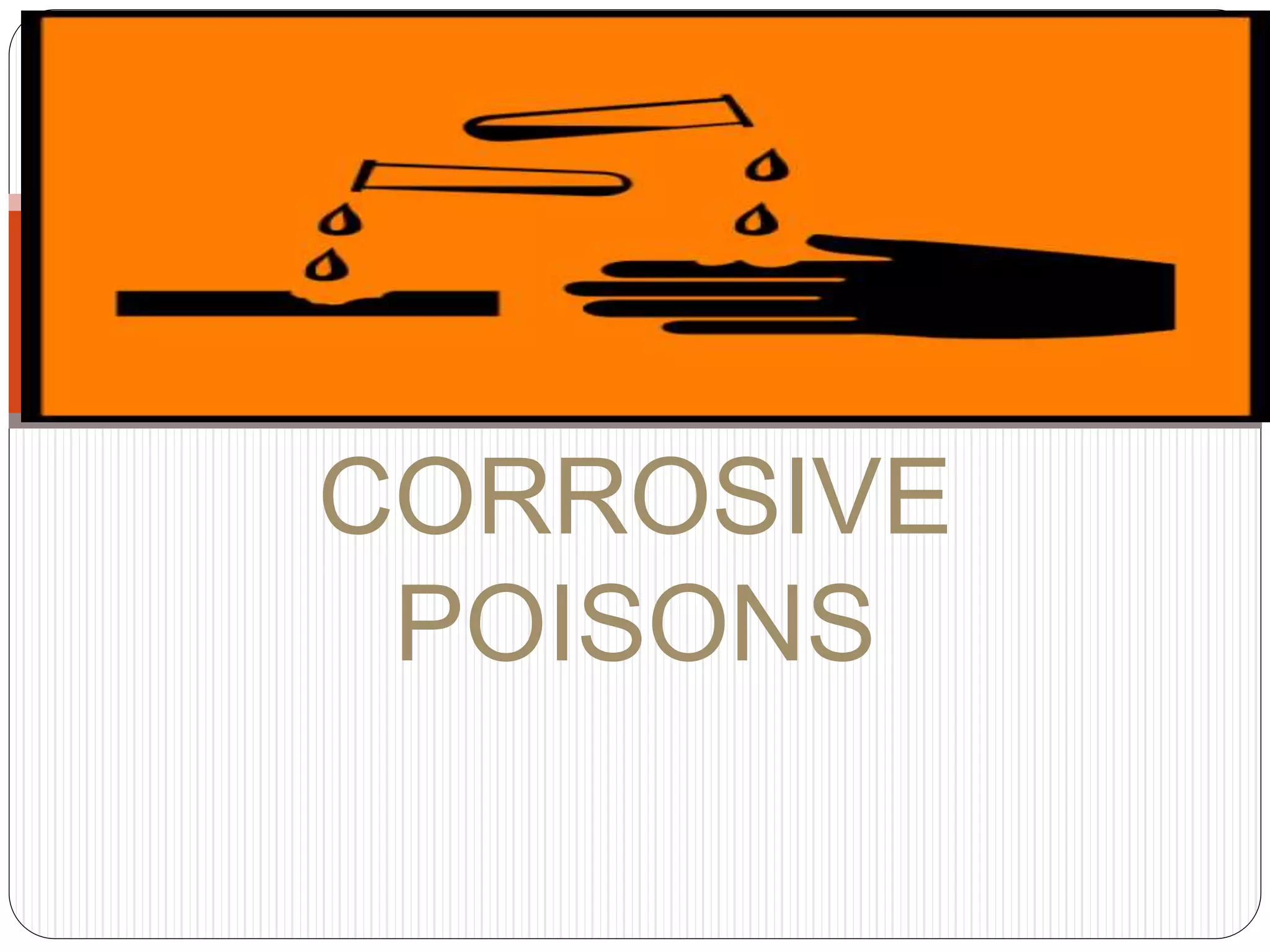
CORROSIVE
POISONS
 CORROSIVE: The corrosive have a local chemical action
of corroding and destroying the tissues they come in
contact with.
 ACIDS: are hydrogen containing substances that, on
dissociation in water, produce hydronium ions. they
produce the coagulation necrosis of tissues by the
precipitation of poison.
 ALKALIES: are substances which neutralize acids.
 INORGANIC ACIDS: are mineral acids used as
reagents. Eg- Sulphuric acid, Nitric Acid, Hydrocholric
acid.
 ORGANIC ACID: are carbon compounds, thus have
better absorption and display prominent systemic effects.
6.EFFECTS: when corrosive agents come in contact with
skin, body – 3 stages.
i. Stage I: intense inflammatory reaction – first 4-7days.
ii. Stage II : granulation stage: fibroplasia, formation of
collagen, starts during 2nd-3rd week. Chance of
perforation – tissues are weak.
iii. Stage III: excessive formation of scar tissue- stricture.
7. SUPPORTIVE THERAPY:
i. Tracheotomy: suffocation with involvement of larynx.
ii. Oxygen and ventilatory support
iii. Perforation needs emergency surgery.
iv. Excoriation : treated as burns.
v. Injury to eye: moistening with plenty of water/saline.
vi. Ingestion of strong acids: shock with I.V infusion &
supportive therapy, pain controlled with morphine.
vii. To prevent stricture of the esophagus; corticosteroid
SULPHURIC ACID
 Pure is colorless, heavy, hygroscopic, oily
liquid and gives out no fumes when
exposed to air. With water, it gives out a
large amount of heat.
 Commercial sulphuric acid: contains
impurities is brown in color ( Industry
chemicals, battery and fertilzers
manufacturing.
 Mode of action : it has high affinity of water,
 Draws out water from the tissues and
destroys them by rapid dehydration
 Gives out large amount of heat – necrosis
CLINICAL FEATURES:
General symptom: burning pain in mouth, throat, esophagus
and stomach with brownish or blood stained vomit.
LIPS: swollen, abrased and brown or black streaks can be
found.
TEETH: chalky white color, rough and deprived of their
polish.
INTENSE THIRST:
VOICE: hoarse and rough – inflammation of the larynx.
HYPERSALIVATION: may seen second or third day.
FATAL DOSE- 5-10ml
FATAL PERIOD: 18-24 HOURS.
TONGUE: swollen, covered with white coating and S, -
darker/ brown in color.
CAUSES OF DEATH:
i. Suffocation: Death may occur instantaneously –
edema, spasmodic closure of glottis by the acid .
ii. shock and circulatory failure: death may occur in
24 hours.
iii. Peritonitis: death may be prolonged for weeks or
months- secondary to esophageal/ pyloric stenosis
or the perforation of stomach.
VITRIOL / ACID THROWING
(VITRIOLAGE):
 Sometimes, envious people use
vitriol or strong sulphuric acid to
disfigure the face.
 Local effects: slight burning pain,
the corrosion of tissues and
formation of brownish scars which
leave permanent scars.
 Common complications:
Conjunctival edema, corneal
destruction or blindness. Death
may also occur by severe burns.
POST-MORTEM APPEARANCE:
1.Lips and surrounding skin- brownish or black corroded
spots- mucus also will be in dark brown.
2. Stomach: (if Perforated – blackening is seen with the
escape gastric contents into peritoneal cavity)
(if not perforated – stomach will be contracted & collapsed,
contents- dark brown in color with mucus and blood.)
3. Liver and Kidneys shows fatty changes.
4. Blood vessels : may showed clotted blood.
MEDICO-LEGAL ASPECTS: Suicidal, homicidal, accidental
& vitriolage.
NITRIC ACID
PROPERTIES:
 Is clear & colorless liquid, powerful
oxidizing agent which dissolves all metals
except gold and platinum.
 Commercial nitric acid varies from yellow
to deep red ( oxides of nitrogen)
USES: used in arts and manufacturing, for
cleaning nickel ornaments, separating gold
from other metals, for the preparation of
explosives, coloring agent & as a fertilizers.
CLINICAL FEATURES:
1. Lips, tongue & mucous membrane of the mouth soften
and became white, but later yellow by the action of acid
with organic matters.
2. Teeth: yellow with partial destruction of enamel.
3. Skin and cloth: yellow turn orange
4. Vomitus: yellowish brown due to blood colour.
5. Abdomen, markedly distended and tender – gaseous
belching is more.
6. Urine: oliguria, anuria, albuminuria & casts.
7. Lock jaw & insensibility : frequently found.
8. Inhalation of fumes : irritation of eyes, lacrimation,
photophobia, cough and breathlessness.
9. Fatal dose: 5-15ml
10. Fatal period: 12-24 hours on an average
POST MORTEM APPEARANCE:
1. Skin and mucous membrane of mouth and lips;
eroded and yellow in color.
2. Stomach: mucous membrane is greenish, wall is soft,
ulcerated and may perforate.
3. Corrosion of duodenum may found.
4. If death was due to inhalation of fumes means-
larynx, trachea and bronchial tubes are congested.
MEDICO-LEGAL ASPECTS:
HYDROCHLORIC ACID
 It is colorless gas with irritating oddour,
extremely soluble in water.
 Commercial acid- HCL gas in water gives
fumes in damp air with yellow color.
 Produces dense white vapors with ammonia
USES: used in industry for preparing chlorine,
For dissolving metals & for medicinal purposes
For erasing the writings.
CLINICAL FEATURES:
1.Less active than other inorganic acids, - symptoms will be
mild .
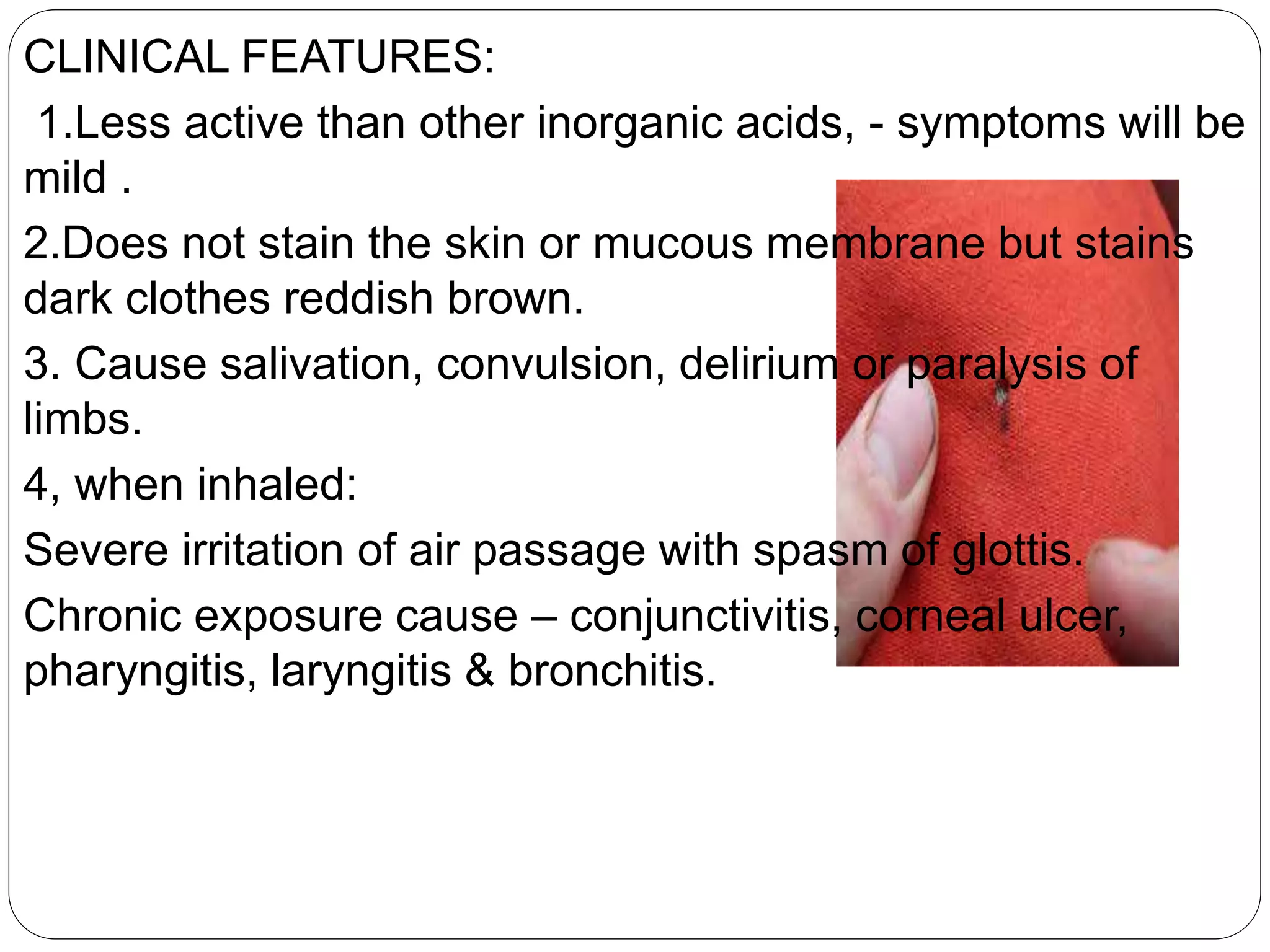
2.Does not stain the skin or mucous membrane but stains
dark clothes reddish brown.
3. Cause salivation, convulsion, delirium or paralysis of
limbs.
4, when inhaled:
Severe irritation of air passage with spasm of glottis.
Chronic exposure cause – conjunctivitis, corneal ulcer,
pharyngitis, laryngitis & bronchitis.
POST-MORTEM APPEARANCE:
Mucous membrane- ash grey/ black in color.
Stomach: wall is red.
Mucosa- brownish leathery and firm.
Perforation may rarely occur.
MEDICO-LEGAL ASPECTS:
Accidental & suicidal cases are common but homicidal rare.
OXALIC ACID
Properties:
 Colorless, transparent, prismatic
crystals, sour taste, strongly acidic:
sublimes after heating: soluble in water
and alcohol.
 Heated with sulphuric acid, it splits up
into CO2, CO & water.
Uses:
 White cloth printing, manufacture straw
hats, cleaning brass and copper
articles & wooden surfaces.
 Bleaching powder for erasing writing
and signatures from paper and printed
CLINICAL FEATURES
LOCAL ACTION:
 As a corrosive
 As a irritant
 Prolonged contact with skin
 GIT: sour acid taste, thirst,
pain and burning in mouth,
throat, stomach.
 Intense vomiting –
greenish brown, black or
ground coffee due to blood
and mucus.
SYSTEMIC ACTION:
 Systemic absorption by
precipitating ionized calcium –
hypocalcemia.
 Insoluble calcium oxalate
accumulates in kidneys, liver,
heart, lungs and blood and is
excreted in the urine.
 Oliguria – diuresis,
albuminuria with hyaline casts
leading to acute renal failure.
 Numbness of limbs
 Feeble, irregular & slow pulse
 Shallow, gasping & slow pulse
 Tetany, cramps , convulsion,
3. Fatal Dose: 15gm
4. Fatal period: 1-2 hours.
TRAETMENT:
 Neutralization of acid
 I.V calcium gluconate
 Gastric lavage with 1% calcium gluconate solution.
 Castor oil with purgative.
 Renal blood flow maintained by the I.V infusion of glucose.
POST- MORTEM APPEARANCE:
A. Oxalic acid taken in concentrated form:
1. Signs of corrosion, their mucous membrane are white,
wrinkled and can easily detached from underlying tissue.
2. STOMACH:
 Contains dark brown, thick and lumpy liquid – formation of
acid hematin.
 Blood vessels – dark brown/black streaks seen
 Deposits of calcium
 Perforation.
3. Intestines: the upper part of duodenum affected.
4. Kidneys: congested and tubules are loaded with crystals-
tubular necrosis.
B. If oxalic acid was dilute :
1. Local irritation may be found – redness, congestion and
the inflammation of mucous membrane.
2. Sometimes the congestion of lungs, liver, kidneys and
brain.
MEDICO LEGAL ASPECTS:
1. Accidental poisoning : common having been swallowed
by mistake as a saline purgative of magnesium sulphate.
2. Suicidal and homicidal are rare.
CARBOLIC ACID
Properties:
Pure acid – short, needle shaped crystals
which turn pink on exposure to light & melt
in mist air, colorless.
It has carbolic odor & a sweetish pungent
taste.
Solubility : insoluble in liquid paraffin &
soluble in water, alcohol, ether glycerine &
volatile oils.
Commercial carbolic acid –
 Phenol camphor
 Crude carbolic acid
CLINICAL FEATURES: poisoning by carbolic acid _
carbolism.
1.Mode of action: In concentrated form- corrosive, when
applied to skin, it causes a burning sensation- tingling
sensation & numbness.
2. Routes of excretion: urine, saliva, skin and stomach.
3. Symptoms: intense thirst and burning sensation in mouth,
throat and stomach. Vomiting of frothy mucus.
4. Causes of death: failure of respiratory center. Shock and
circulatory collapse. Renal failure.
5. Fatal dose: 2gm
6.Fatal period: 3-4 hours.
POST-MORTEM APPERANCE:
1. Dark brown abrasion on the angles of the mouth and the
chin.
2. The mucus membrane of lips, mouth and throat is
congested, swollen.
3. The mucous membrane of esophagus is tough, grey and
arranged in longitudinal folds.
4. STOMACH:
 brown, leathery with hemorrhagic spots and folds.
 contains reddish fluid mixed with mucus and pieces of
epithelium with the odour of carbolic acid.
1. KIDNEYS – shows haemorrhagic nepritis.
2. LUNGS – congested and edematous.
3. BRAIN – Congested
4. BLOOD – dark, semi fluid / partially coagulated.
MEDICO-LEGAL IMPORTANCE: accidental and suicidal
SALICYLIC ACID
OTHER
PREPARATIONS/
NAMES
USES
1. Methyl salicylate (
oil of wintergreen)
i. Used locally as
anti-fungal
ii. As the irritant
and a counter
irritant
2. Aspirin
(acetyl salicylic acid)
i. Antipyretic,
analgesic, anti-
rheumatic & anti-
inflammatory agent.
3. Sodium salicylate Anti-rheumatic and
anti-inflammatory
CLINCAL FEATURES:
1. Burning pain in throat and epigastrium.
2. Difficulty in swallowing, thirst, nausea, vomiting and
diarrhoea.
3. Systemic toxicity:
 Headache, dizziness, buzzing in ear and deafness.
 Vomiting, dehydration, generalized weakness & mental
changes.
 Severe acid-base imbalance.
 Renal functions and carbohydrate disturbances.
 Hyperpyrexia and encephalopathy.
 Death may occur from: cardiac and respiratory failure.
4. Chronic poisoning – SALICYLISM
 Loss of blood in stools. Loss of apetite, GIT disturbances,
Renal impairment
5. Fatal dose : 10gm.
6. Fatal Period : 1-4 days.
TREATMENT:
1. Gastric lavage
2. Activated charcoal
3. Purgatives
4. Advanced life support measures
5. Oxygenation for pul.edema
6. Vit K for Hypoprothrobinaemia.
7. Ventilatory support
8. Injection ACTH as a life-saving therapy.
POSTMORTEM APEARANCE
MEDICO-LEGAL ASPECTS: Accidental poisoning from
overdose administration.
ALKALIES
In concentrated form act as a corrosive poison, in a
dilute form they act as an irritant poison.
Concentrated alkalies are more dangerous than acids-
esophageal burns and stricture.
With fats – soaps, with protein – protinates.
MAJOR CORROSIVE ALKALIES
1.AMMONIA: with water forms a strong solution of
ammonia- liquor ammoniae fortis. Colorless liquid –
very pungent odour.
The gas used as refrigerant and a fertilizer.
2. POTASSIUM HYDROXIDE: Soapy to touch, rapidly
absorbs CO2 from air and soluble in water.
3. SODIUM HYDOXIDE: occurs as white mass.
4. AMMONIUM CARBONATE- translucent, hard,
crystalline mass, water soluble.
5. POTASSIUM CARBONATE: white crystalline
powder, soluble in water, insoluble in alcohol. – used
for washing and cleansing purposes
6. SODIUM CARBONATE: soluble in water but
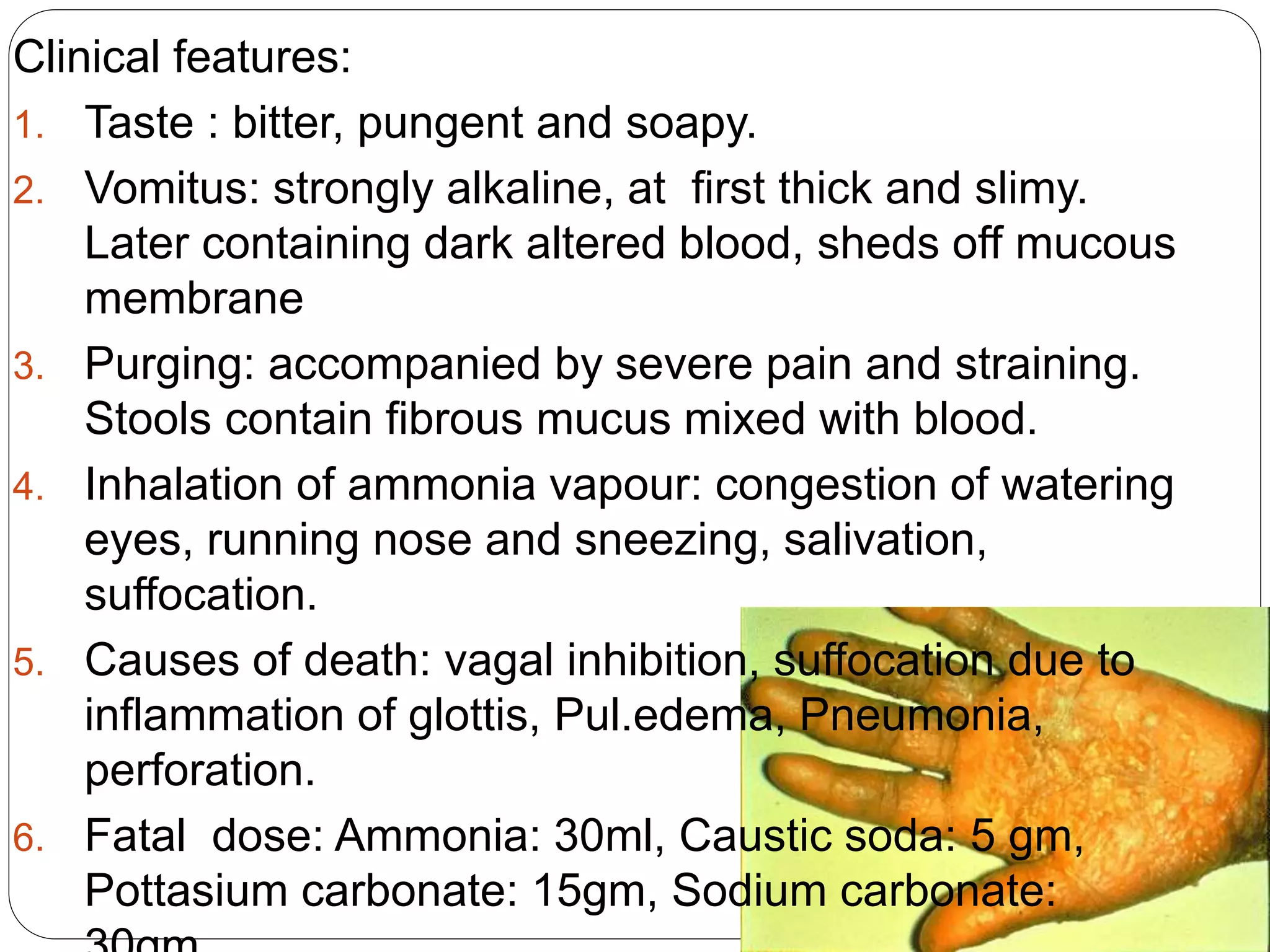
Clinical features:
1. Taste : bitter, pungent and soapy.
2. Vomitus: strongly alkaline, at first thick and slimy.
Later containing dark altered blood, sheds off mucous
membrane
3. Purging: accompanied by severe pain and straining.
Stools contain fibrous mucus mixed with blood.
4. Inhalation of ammonia vapour: congestion of watering
eyes, running nose and sneezing, salivation,
suffocation.
5. Causes of death: vagal inhibition, suffocation due to
inflammation of glottis, Pul.edema, Pneumonia,
perforation.
6. Fatal dose: Ammonia: 30ml, Caustic soda: 5 gm,
Pottasium carbonate: 15gm, Sodium carbonate:
POST-MORTEM APPEARANCES:
1. Marks of corrosion : the mucous membranes of
mouth, throat, pharynx etc. shows- soft mucilage like
necrosed areas & inflamed patches of chocolate or
black color.
2. Stomach content : turbid, blood stained or coffee
color.
3. Perforation: esophagus/stomach
4. Stenosis may be found at the lower end of
esophagus.
MEDICO- LEGAL IMPORTANCE:
Caustic soda- homicidal, criminal abortion.
THANK YOU.
alkalies
Corrosive poisons
Corrosive poisons

Corrosive poisons

  • 1.
  • 2.
     CORROSIVE: Thecorrosive have a local chemical action of corroding and destroying the tissues they come in contact with.  ACIDS: are hydrogen containing substances that, on dissociation in water, produce hydronium ions. they produce the coagulation necrosis of tissues by the precipitation of poison.  ALKALIES: are substances which neutralize acids.  INORGANIC ACIDS: are mineral acids used as reagents. Eg- Sulphuric acid, Nitric Acid, Hydrocholric acid.  ORGANIC ACID: are carbon compounds, thus have better absorption and display prominent systemic effects.
  • 3.
    6.EFFECTS: when corrosiveagents come in contact with skin, body – 3 stages. i. Stage I: intense inflammatory reaction – first 4-7days. ii. Stage II : granulation stage: fibroplasia, formation of collagen, starts during 2nd-3rd week. Chance of perforation – tissues are weak. iii. Stage III: excessive formation of scar tissue- stricture. 7. SUPPORTIVE THERAPY: i. Tracheotomy: suffocation with involvement of larynx. ii. Oxygen and ventilatory support iii. Perforation needs emergency surgery. iv. Excoriation : treated as burns. v. Injury to eye: moistening with plenty of water/saline. vi. Ingestion of strong acids: shock with I.V infusion & supportive therapy, pain controlled with morphine. vii. To prevent stricture of the esophagus; corticosteroid
  • 4.
    SULPHURIC ACID  Pureis colorless, heavy, hygroscopic, oily liquid and gives out no fumes when exposed to air. With water, it gives out a large amount of heat.  Commercial sulphuric acid: contains impurities is brown in color ( Industry chemicals, battery and fertilzers manufacturing.  Mode of action : it has high affinity of water,  Draws out water from the tissues and destroys them by rapid dehydration  Gives out large amount of heat – necrosis
  • 5.
    CLINICAL FEATURES: General symptom:burning pain in mouth, throat, esophagus and stomach with brownish or blood stained vomit. LIPS: swollen, abrased and brown or black streaks can be found. TEETH: chalky white color, rough and deprived of their polish. INTENSE THIRST: VOICE: hoarse and rough – inflammation of the larynx. HYPERSALIVATION: may seen second or third day. FATAL DOSE- 5-10ml FATAL PERIOD: 18-24 HOURS. TONGUE: swollen, covered with white coating and S, - darker/ brown in color.
  • 6.
    CAUSES OF DEATH: i.Suffocation: Death may occur instantaneously – edema, spasmodic closure of glottis by the acid . ii. shock and circulatory failure: death may occur in 24 hours. iii. Peritonitis: death may be prolonged for weeks or months- secondary to esophageal/ pyloric stenosis or the perforation of stomach.
  • 7.
    VITRIOL / ACIDTHROWING (VITRIOLAGE):  Sometimes, envious people use vitriol or strong sulphuric acid to disfigure the face.  Local effects: slight burning pain, the corrosion of tissues and formation of brownish scars which leave permanent scars.  Common complications: Conjunctival edema, corneal destruction or blindness. Death may also occur by severe burns.
  • 8.
    POST-MORTEM APPEARANCE: 1.Lips andsurrounding skin- brownish or black corroded spots- mucus also will be in dark brown. 2. Stomach: (if Perforated – blackening is seen with the escape gastric contents into peritoneal cavity) (if not perforated – stomach will be contracted & collapsed, contents- dark brown in color with mucus and blood.) 3. Liver and Kidneys shows fatty changes. 4. Blood vessels : may showed clotted blood. MEDICO-LEGAL ASPECTS: Suicidal, homicidal, accidental & vitriolage.
  • 9.
    NITRIC ACID PROPERTIES:  Isclear & colorless liquid, powerful oxidizing agent which dissolves all metals except gold and platinum.  Commercial nitric acid varies from yellow to deep red ( oxides of nitrogen) USES: used in arts and manufacturing, for cleaning nickel ornaments, separating gold from other metals, for the preparation of explosives, coloring agent & as a fertilizers.
  • 10.
    CLINICAL FEATURES: 1. Lips,tongue & mucous membrane of the mouth soften and became white, but later yellow by the action of acid with organic matters. 2. Teeth: yellow with partial destruction of enamel. 3. Skin and cloth: yellow turn orange 4. Vomitus: yellowish brown due to blood colour. 5. Abdomen, markedly distended and tender – gaseous belching is more. 6. Urine: oliguria, anuria, albuminuria & casts. 7. Lock jaw & insensibility : frequently found. 8. Inhalation of fumes : irritation of eyes, lacrimation, photophobia, cough and breathlessness. 9. Fatal dose: 5-15ml 10. Fatal period: 12-24 hours on an average
  • 11.
    POST MORTEM APPEARANCE: 1.Skin and mucous membrane of mouth and lips; eroded and yellow in color. 2. Stomach: mucous membrane is greenish, wall is soft, ulcerated and may perforate. 3. Corrosion of duodenum may found. 4. If death was due to inhalation of fumes means- larynx, trachea and bronchial tubes are congested. MEDICO-LEGAL ASPECTS:
  • 12.
    HYDROCHLORIC ACID  Itis colorless gas with irritating oddour, extremely soluble in water.  Commercial acid- HCL gas in water gives fumes in damp air with yellow color.  Produces dense white vapors with ammonia USES: used in industry for preparing chlorine, For dissolving metals & for medicinal purposes For erasing the writings.
  • 13.
    CLINICAL FEATURES: 1.Less activethan other inorganic acids, - symptoms will be mild . 2.Does not stain the skin or mucous membrane but stains dark clothes reddish brown. 3. Cause salivation, convulsion, delirium or paralysis of limbs. 4, when inhaled: Severe irritation of air passage with spasm of glottis. Chronic exposure cause – conjunctivitis, corneal ulcer, pharyngitis, laryngitis & bronchitis.
  • 14.
    POST-MORTEM APPEARANCE: Mucous membrane-ash grey/ black in color. Stomach: wall is red. Mucosa- brownish leathery and firm. Perforation may rarely occur. MEDICO-LEGAL ASPECTS: Accidental & suicidal cases are common but homicidal rare.
  • 15.
    OXALIC ACID Properties:  Colorless,transparent, prismatic crystals, sour taste, strongly acidic: sublimes after heating: soluble in water and alcohol.  Heated with sulphuric acid, it splits up into CO2, CO & water. Uses:  White cloth printing, manufacture straw hats, cleaning brass and copper articles & wooden surfaces.  Bleaching powder for erasing writing and signatures from paper and printed
  • 16.
    CLINICAL FEATURES LOCAL ACTION: As a corrosive  As a irritant  Prolonged contact with skin  GIT: sour acid taste, thirst, pain and burning in mouth, throat, stomach.  Intense vomiting – greenish brown, black or ground coffee due to blood and mucus. SYSTEMIC ACTION:  Systemic absorption by precipitating ionized calcium – hypocalcemia.  Insoluble calcium oxalate accumulates in kidneys, liver, heart, lungs and blood and is excreted in the urine.  Oliguria – diuresis, albuminuria with hyaline casts leading to acute renal failure.  Numbness of limbs  Feeble, irregular & slow pulse  Shallow, gasping & slow pulse  Tetany, cramps , convulsion,
  • 17.
    3. Fatal Dose:15gm 4. Fatal period: 1-2 hours. TRAETMENT:  Neutralization of acid  I.V calcium gluconate  Gastric lavage with 1% calcium gluconate solution.  Castor oil with purgative.  Renal blood flow maintained by the I.V infusion of glucose.
  • 18.
    POST- MORTEM APPEARANCE: A.Oxalic acid taken in concentrated form: 1. Signs of corrosion, their mucous membrane are white, wrinkled and can easily detached from underlying tissue. 2. STOMACH:  Contains dark brown, thick and lumpy liquid – formation of acid hematin.  Blood vessels – dark brown/black streaks seen  Deposits of calcium  Perforation. 3. Intestines: the upper part of duodenum affected. 4. Kidneys: congested and tubules are loaded with crystals- tubular necrosis.
  • 19.
    B. If oxalicacid was dilute : 1. Local irritation may be found – redness, congestion and the inflammation of mucous membrane. 2. Sometimes the congestion of lungs, liver, kidneys and brain. MEDICO LEGAL ASPECTS: 1. Accidental poisoning : common having been swallowed by mistake as a saline purgative of magnesium sulphate. 2. Suicidal and homicidal are rare.
  • 20.
    CARBOLIC ACID Properties: Pure acid– short, needle shaped crystals which turn pink on exposure to light & melt in mist air, colorless. It has carbolic odor & a sweetish pungent taste. Solubility : insoluble in liquid paraffin & soluble in water, alcohol, ether glycerine & volatile oils. Commercial carbolic acid –  Phenol camphor  Crude carbolic acid
  • 21.
    CLINICAL FEATURES: poisoningby carbolic acid _ carbolism. 1.Mode of action: In concentrated form- corrosive, when applied to skin, it causes a burning sensation- tingling sensation & numbness. 2. Routes of excretion: urine, saliva, skin and stomach. 3. Symptoms: intense thirst and burning sensation in mouth, throat and stomach. Vomiting of frothy mucus. 4. Causes of death: failure of respiratory center. Shock and circulatory collapse. Renal failure. 5. Fatal dose: 2gm 6.Fatal period: 3-4 hours.
  • 22.
    POST-MORTEM APPERANCE: 1. Darkbrown abrasion on the angles of the mouth and the chin. 2. The mucus membrane of lips, mouth and throat is congested, swollen. 3. The mucous membrane of esophagus is tough, grey and arranged in longitudinal folds. 4. STOMACH:  brown, leathery with hemorrhagic spots and folds.  contains reddish fluid mixed with mucus and pieces of epithelium with the odour of carbolic acid. 1. KIDNEYS – shows haemorrhagic nepritis. 2. LUNGS – congested and edematous. 3. BRAIN – Congested 4. BLOOD – dark, semi fluid / partially coagulated. MEDICO-LEGAL IMPORTANCE: accidental and suicidal
  • 23.
    SALICYLIC ACID OTHER PREPARATIONS/ NAMES USES 1. Methylsalicylate ( oil of wintergreen) i. Used locally as anti-fungal ii. As the irritant and a counter irritant 2. Aspirin (acetyl salicylic acid) i. Antipyretic, analgesic, anti- rheumatic & anti- inflammatory agent. 3. Sodium salicylate Anti-rheumatic and anti-inflammatory
  • 24.
    CLINCAL FEATURES: 1. Burningpain in throat and epigastrium. 2. Difficulty in swallowing, thirst, nausea, vomiting and diarrhoea. 3. Systemic toxicity:  Headache, dizziness, buzzing in ear and deafness.  Vomiting, dehydration, generalized weakness & mental changes.  Severe acid-base imbalance.  Renal functions and carbohydrate disturbances.  Hyperpyrexia and encephalopathy.  Death may occur from: cardiac and respiratory failure. 4. Chronic poisoning – SALICYLISM  Loss of blood in stools. Loss of apetite, GIT disturbances, Renal impairment 5. Fatal dose : 10gm. 6. Fatal Period : 1-4 days.
  • 25.
    TREATMENT: 1. Gastric lavage 2.Activated charcoal 3. Purgatives 4. Advanced life support measures 5. Oxygenation for pul.edema 6. Vit K for Hypoprothrobinaemia. 7. Ventilatory support 8. Injection ACTH as a life-saving therapy. POSTMORTEM APEARANCE MEDICO-LEGAL ASPECTS: Accidental poisoning from overdose administration.
  • 26.
    ALKALIES In concentrated formact as a corrosive poison, in a dilute form they act as an irritant poison. Concentrated alkalies are more dangerous than acids- esophageal burns and stricture. With fats – soaps, with protein – protinates.
  • 27.
    MAJOR CORROSIVE ALKALIES 1.AMMONIA:with water forms a strong solution of ammonia- liquor ammoniae fortis. Colorless liquid – very pungent odour. The gas used as refrigerant and a fertilizer. 2. POTASSIUM HYDROXIDE: Soapy to touch, rapidly absorbs CO2 from air and soluble in water. 3. SODIUM HYDOXIDE: occurs as white mass. 4. AMMONIUM CARBONATE- translucent, hard, crystalline mass, water soluble. 5. POTASSIUM CARBONATE: white crystalline powder, soluble in water, insoluble in alcohol. – used for washing and cleansing purposes 6. SODIUM CARBONATE: soluble in water but
  • 28.
    Clinical features: 1. Taste: bitter, pungent and soapy. 2. Vomitus: strongly alkaline, at first thick and slimy. Later containing dark altered blood, sheds off mucous membrane 3. Purging: accompanied by severe pain and straining. Stools contain fibrous mucus mixed with blood. 4. Inhalation of ammonia vapour: congestion of watering eyes, running nose and sneezing, salivation, suffocation. 5. Causes of death: vagal inhibition, suffocation due to inflammation of glottis, Pul.edema, Pneumonia, perforation. 6. Fatal dose: Ammonia: 30ml, Caustic soda: 5 gm, Pottasium carbonate: 15gm, Sodium carbonate:
  • 29.
    POST-MORTEM APPEARANCES: 1. Marksof corrosion : the mucous membranes of mouth, throat, pharynx etc. shows- soft mucilage like necrosed areas & inflamed patches of chocolate or black color. 2. Stomach content : turbid, blood stained or coffee color. 3. Perforation: esophagus/stomach 4. Stenosis may be found at the lower end of esophagus. MEDICO- LEGAL IMPORTANCE: Caustic soda- homicidal, criminal abortion.
  • 30.
  • 31.