Thermal Injuries
THERMAL INJURIES
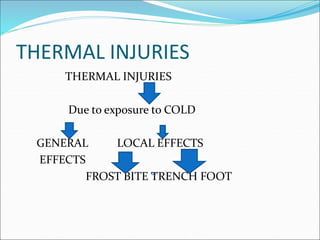
THERMAL INJURIES
Due to exposure to COLD
GENERAL LOCAL EFFECTS
EFFECTS
FROST BITE TRENCH FOOT
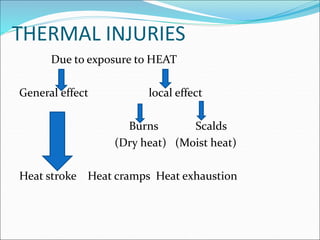
THERMAL INJURIES
Due to exposure to HEAT
General effect local effect
Burns Scalds
(Dry heat) (Moist heat)
Heat stroke Heat cramps Heat exhaustion
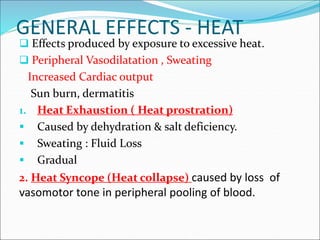
GENERAL EFFECTS - HEAT
 Effects produced by exposure to excessive heat.
 Peripheral Vasodilatation , Sweating
Increased Cardiac output
Sun burn, dermatitis
1. Heat Exhaustion ( Heat prostration)
 Caused by dehydration & salt deficiency.
 Sweating : Fluid Loss
 Gradual
2. Heat Syncope (Heat collapse) caused by loss of
vasomotor tone in peripheral pooling of blood.
3. Heat Fatigue:-
 May be transient or deterioration in a performance of
skilled task
4. Heat Hyperpyrexia:-
Heat stroke or Sun stroke or Hyperpyrexia
 Due to impaired functioning of heat regulating
mechanism.
Heat stroke :- is due to its failure
Sweating – Usually absent, Skin – Hot and Dry,
Pupil – Dialated
THERMAL INJURIES
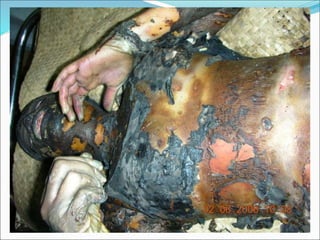
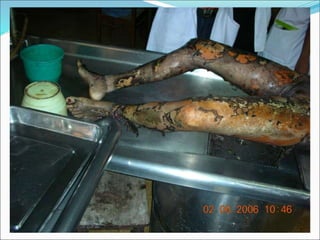
Burns - are injuries produced by the application of
DRY HEAT such as flame, radiant heat or heated solid
substance like metal or glass, to the surface of the
body.
Scalds – are moist heat injuries.
EFFECTS OF BURNS
1. The intensity of heat applied
2. Duration of exposure
3. The extent of total body surface area
4. The site
5. Age of the patient
6. Sex
CLASSIFICATION OF BURNS
 Dupuytren’s
I st degree- VI degree
 Hebras
Ist, IInd, IIIrd degree
 Wilsons
Epidermal – Erythema & Blisterring
Dermo epidermal:- Full thickness of skin
Deep :- Deeper tissue below skin.
CLASSIFICATION OF BURNS
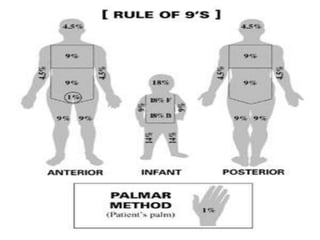
 RULE OF 9’S
CAUSES OF DEATH
I. Immediate
a. Shock – Primary – secondary
b. Suffocation
c. Accidents or Injuries
II. Delayed
a. Inflammation
b. Toxaemia
c. Hypoproteinaemia
d. Exhaustion
e. Lardaveous Disease
f. Erysipelas, Septicemia, Pyaemia, Gangrene, tetanus
o Fatal Period – 24- 48 hours. I st week fatal
Nature of burns in the absence death
o Simple – I and II if not extensive
o Grievous
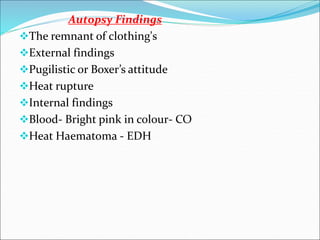
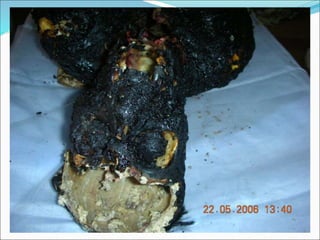
Autopsy Findings
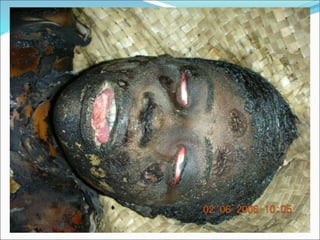
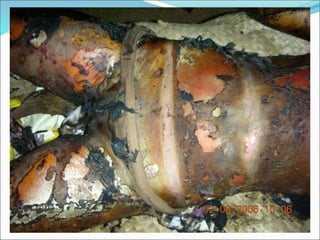
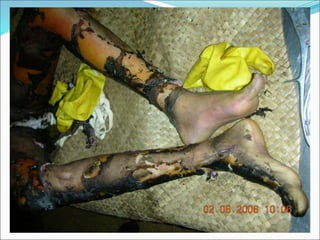
The remnant of clothing's
External findings
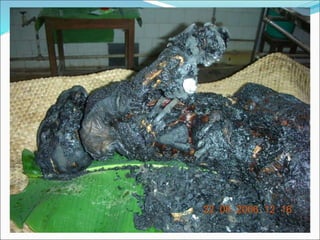
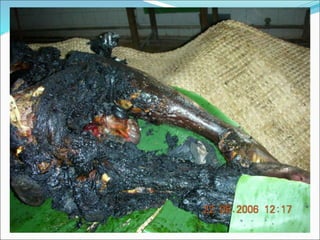
Pugilistic or Boxer’s attitude
Heat rupture
Internal findings
Blood- Bright pink in colour- CO
Heat Haematoma - EDH
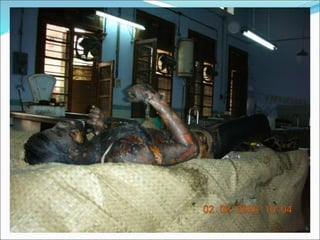
Pugilistic or Boxer’s attitude
 When the body has been exposed to substantial
heat, it will almost always assume the appearance
known as ‘pugilistic or boxer’s attitude’.
 This occurs due to coagulation of the muscle
protein resulting in contraction of the muscle
fiber.
 As the flexors are bulkier than the extensor, they
contract more & force the body assume such an
attitude.
HEAT HAEMATOMA
 This condition has an appearance of EDH but actually
is an artefact.
 Occurring in where the head has been exposed to
intense heat.
 Chocolate brown colour of the blood, the clot is soft,
friable & present a honey comb appearance due to
presence of bubbles of steam produced due to boiling
of blood by external heat.
IMPORTANT FINDINGS IN THE RESPIRATORY
PASSAGE
 The tongue, fauces, larynx, trachea, & bronchi are
usually inflamed & contain soot intimately mixed with
mucus.
mm
MEDICOLEGAL CONSIDERATIONS
 1. Identity of the deceased.
 2. X-ray of the body.
 3. Antemortem or Postmortem Nature burns
a. Prescence of Smoke in the air passage.
b. Evidence of Thermal injury of the Respiratory Tract
by Fumes /Hot Gases.
c. Elevated Blood Carboxy Haemoglobin Levels.
d. Saturation of hemoglobin with carbon monoxide
varies from case to case.
e. Another remarkable advantage of estimation of
carbon monoxide.
MEDICOLEGAL CONSIDERATIONS
F. Presence of other Toxic Gases in the Blood.
HCN, NH3, SO2, NO, CO2 .
G. Cutaneous reaction to Heat & Flame.
H. Presence of Vital reaction.
I. Vesiccation ( Blisters):- Burns during life
contains a serous fluid containing albumen
& chlorides. Red inflamed base &
erythmatous border.
MEDICOLEGAL CONSIDERATIONS
 J. Microscopic examination the tissue from the burnt
area.
 K. Histological methods of distinguishing antemotem
& Postmortem burns.
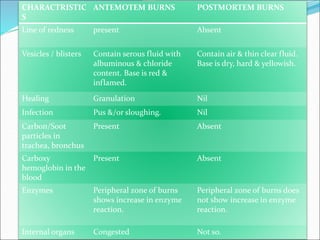
CHARACTRISTIC
S
ANTEMOTEM BURNS POSTMORTEM BURNS
Line of redness present Absent
Vesicles / blisters Contain serous fluid with
albuminous & chloride
content. Base is red &
inflamed.
Contain air & thin clear fluid.
Base is dry, hard & yellowish.
Healing Granulation Nil
Infection Pus &/or sloughing. Nil
Carbon/Soot
particles in
trachea, bronchus
Present Absent
Carboxy
hemoglobin in the
blood
Present Absent
Enzymes Peripheral zone of burns
shows increase in enzyme
reaction.
Peripheral zone of burns does
not show increase in enzyme
reaction.
Internal organs Congested Not so.
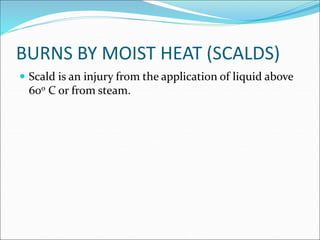
BURNS BY MOIST HEAT (SCALDS)
 Scald is an injury from the application of liquid above
600 C or from steam.
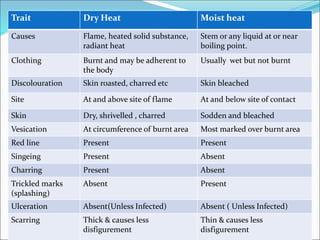
Trait Dry Heat Moist heat
Causes Flame, heated solid substance,
radiant heat
Stem or any liquid at or near
boiling point.
Clothing Burnt and may be adherent to
the body
Usually wet but not burnt
Discolouration Skin roasted, charred etc Skin bleached
Site At and above site of flame At and below site of contact
Skin Dry, shrivelled , charred Sodden and bleached
Vesication At circumference of burnt area Most marked over burnt area
Red line Present Present
Singeing Present Absent
Charring Present Absent
Trickled marks
(splashing)
Absent Present
Ulceration Absent(Unless Infected) Absent ( Unless Infected)
Scarring Thick & causes less
disfigurement
Thin & causes less
disfigurement
HYPOTHERMIA
( EXPOSURE TO COLD)
Circumstances :-
o Exogenous- always environmental air temperature
below 10 degree C
o Endogenous
I. Disease :
 Endocrine
 Hypopituitarism
 Hypothyroidism
Drugs :
 Barbiturates
 Diazepam etc.
II. Age and physique
III. Lack of food
MECHANISM OF DEATH
Temperature regulating mechanism gets disturbed
decreased disassociation of
oxyhaemoglobin
Autopsy Findings :
 External – Pale
 Hypostasis – Pink
 R. M show upper and last longer
 Front Bite
 Trench Foot
LOCAL EFFECTS
1. Vasoconstriction
2. Intra and Extracellular formation of ice crystals.
3. Injury to small blood vessels, Arteries, veins and
capillaries, agglutinative thrombi
Direct Effect :
Most Evident in the fatty tissue & myelinated nerve fiber.
TRENCH FOOT / IMMERSION FOOT
 Trench foot, also called immersion foot, is a medical
condition characterized by a tingling or itching
sensation of the foot accompanied by swelling, pain,
and numbness.
 A condition of the foot resembling frostbite, caused by
prolonged exposure to cold and dampness and often
affecting soldiers in trenches. Also called immersion
foot
TRENCH FOOT / IMMERSION FOOT
 Leg cramps are common in those with trench foot,
and the pulse may be slowed or completely
stopped in the affected foot.
 A person with trench foot may also develop blisters
on the foot within two to seven days after the foot
is excessively soaked.
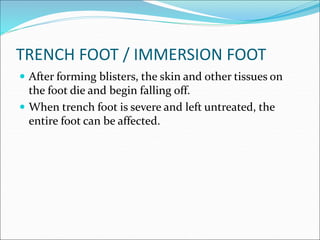
TRENCH FOOT / IMMERSION FOOT
 After forming blisters, the skin and other tissues on
the foot die and begin falling off.
 When trench foot is severe and left untreated, the
entire foot can be affected.
FROSTBITE
 Frostbite is the medical condition whereby damage is
caused to skin and other tissues due to extreme cold.
At or below -15° C (5° F), blood vessels close to the skin
start to narrow (constrict).
 This helps to preserve core body temperature.
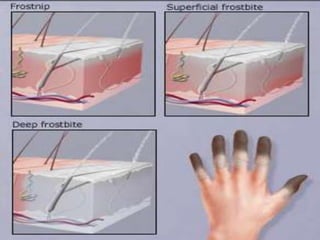
FROSTBITE
 The combination of cold temperature and poor blood
flow can cause severe tissue injury by freezing the
tissue.
 The initial stages of frostbite are sometimes called
"frostnip",
FROSTBITE
 Generally, frostbite is accompanied with discoloration
of the skin, along with burning and/or tingling
sensations, partial or complete numbness, and
possibly intense pain.
 If the nerves and blood vessels have been severely
damaged, gangrene may follow, and amputation may
eventually
DEATH BY ELECROCUTION
Fatal electrocution may be divided into three groups
Domestic
Industrial
Lightning
FACTORS RELATED TO THE NATURE
OF ELECTRIC SUPPLY INCLUDE
 1. Voltage.
 2.Amperage ( Intensity).
 3. Form of current ( Whether AC/DC)
FACTORS RELATED TO THE VICTIM
INCLUDES
 1. Resistance of the body tissue.
 2. Area of contact of the body.
 3. Duration of the contact.
 4. Earthing /Insulation.
THE FOLLOWING MECHANISM MAY
OPERAT IN CAUSING DEATH.
 1. Ventricular Fibrillation.
 2. Spasm of the respiratory muscle.
 3. paralysis of the respiratory centre.
 4. Secondary causes.
AUTOPSY FINDINGS
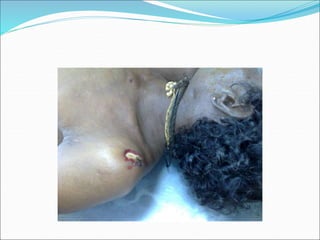
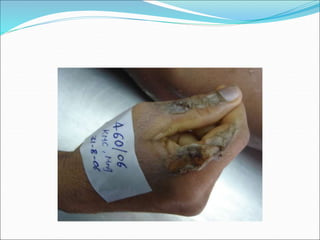
 The point where the current enters the body is usually
characterized by the presence of an electric mark or
electric burn, joule burn or endogenous burn.
 Electric mark is a round or oval, shallow crater,
bordered by raised areola of blanched skin around a
part of whole of its circumference.
 Pale zone, collapsed blisters with raised edge & pale
areola, fused nodule of keratin.
AUTOPSY FINDINGS
HSITOLOGICAL APPEARANCE
 Epidermis flattened due to distortion cells
 Epidermis get separate and form blisters.
 The cells of the epidermis are elongated & the nuclei
of the lower layers get stretched.
 Occurrence of space of varying size & shapes, in the
corium& epidermis to impact a honey-comb
appearance.
LIGHTNING
 The burns produced by lightning may be studied
under the following groups.
Surface burns.
Linear burns.
Arborescent or filigree burns
Arborescent or filigree burns or feathering
 Usually appear like that of the branches of a tree or the
frond of fern, are due to rupture of small blood vessels
at several places giving rise to echymoses with
arborescent pattern.

thermal injuries.pptx

  • 1.
  • 2.
    THERMAL INJURIES THERMAL INJURIES Dueto exposure to COLD GENERAL LOCAL EFFECTS EFFECTS FROST BITE TRENCH FOOT
  • 3.
    THERMAL INJURIES Due toexposure to HEAT General effect local effect Burns Scalds (Dry heat) (Moist heat) Heat stroke Heat cramps Heat exhaustion
  • 4.
    GENERAL EFFECTS -HEAT  Effects produced by exposure to excessive heat.  Peripheral Vasodilatation , Sweating Increased Cardiac output Sun burn, dermatitis 1. Heat Exhaustion ( Heat prostration)  Caused by dehydration & salt deficiency.  Sweating : Fluid Loss  Gradual 2. Heat Syncope (Heat collapse) caused by loss of vasomotor tone in peripheral pooling of blood.
  • 5.
    3. Heat Fatigue:- May be transient or deterioration in a performance of skilled task 4. Heat Hyperpyrexia:- Heat stroke or Sun stroke or Hyperpyrexia  Due to impaired functioning of heat regulating mechanism. Heat stroke :- is due to its failure Sweating – Usually absent, Skin – Hot and Dry, Pupil – Dialated
  • 6.
    THERMAL INJURIES Burns -are injuries produced by the application of DRY HEAT such as flame, radiant heat or heated solid substance like metal or glass, to the surface of the body. Scalds – are moist heat injuries.
  • 7.
    EFFECTS OF BURNS 1.The intensity of heat applied 2. Duration of exposure 3. The extent of total body surface area 4. The site 5. Age of the patient 6. Sex
  • 8.
    CLASSIFICATION OF BURNS Dupuytren’s I st degree- VI degree  Hebras Ist, IInd, IIIrd degree  Wilsons Epidermal – Erythema & Blisterring Dermo epidermal:- Full thickness of skin Deep :- Deeper tissue below skin.
  • 9.
  • 11.
    CAUSES OF DEATH I.Immediate a. Shock – Primary – secondary b. Suffocation c. Accidents or Injuries II. Delayed a. Inflammation b. Toxaemia c. Hypoproteinaemia
  • 12.
    d. Exhaustion e. LardaveousDisease f. Erysipelas, Septicemia, Pyaemia, Gangrene, tetanus o Fatal Period – 24- 48 hours. I st week fatal Nature of burns in the absence death o Simple – I and II if not extensive o Grievous
  • 13.
    Autopsy Findings The remnantof clothing's External findings Pugilistic or Boxer’s attitude Heat rupture Internal findings Blood- Bright pink in colour- CO Heat Haematoma - EDH
  • 14.
    Pugilistic or Boxer’sattitude  When the body has been exposed to substantial heat, it will almost always assume the appearance known as ‘pugilistic or boxer’s attitude’.  This occurs due to coagulation of the muscle protein resulting in contraction of the muscle fiber.  As the flexors are bulkier than the extensor, they contract more & force the body assume such an attitude.
  • 16.
    HEAT HAEMATOMA  Thiscondition has an appearance of EDH but actually is an artefact.  Occurring in where the head has been exposed to intense heat.  Chocolate brown colour of the blood, the clot is soft, friable & present a honey comb appearance due to presence of bubbles of steam produced due to boiling of blood by external heat.
  • 17.
    IMPORTANT FINDINGS INTHE RESPIRATORY PASSAGE  The tongue, fauces, larynx, trachea, & bronchi are usually inflamed & contain soot intimately mixed with mucus.
  • 18.
  • 26.
    MEDICOLEGAL CONSIDERATIONS  1.Identity of the deceased.  2. X-ray of the body.  3. Antemortem or Postmortem Nature burns a. Prescence of Smoke in the air passage. b. Evidence of Thermal injury of the Respiratory Tract by Fumes /Hot Gases. c. Elevated Blood Carboxy Haemoglobin Levels. d. Saturation of hemoglobin with carbon monoxide varies from case to case. e. Another remarkable advantage of estimation of carbon monoxide.
  • 27.
    MEDICOLEGAL CONSIDERATIONS F. Presenceof other Toxic Gases in the Blood. HCN, NH3, SO2, NO, CO2 . G. Cutaneous reaction to Heat & Flame. H. Presence of Vital reaction. I. Vesiccation ( Blisters):- Burns during life contains a serous fluid containing albumen & chlorides. Red inflamed base & erythmatous border.
  • 28.
    MEDICOLEGAL CONSIDERATIONS  J.Microscopic examination the tissue from the burnt area.  K. Histological methods of distinguishing antemotem & Postmortem burns.
  • 29.
    CHARACTRISTIC S ANTEMOTEM BURNS POSTMORTEMBURNS Line of redness present Absent Vesicles / blisters Contain serous fluid with albuminous & chloride content. Base is red & inflamed. Contain air & thin clear fluid. Base is dry, hard & yellowish. Healing Granulation Nil Infection Pus &/or sloughing. Nil Carbon/Soot particles in trachea, bronchus Present Absent Carboxy hemoglobin in the blood Present Absent Enzymes Peripheral zone of burns shows increase in enzyme reaction. Peripheral zone of burns does not show increase in enzyme reaction. Internal organs Congested Not so.
  • 30.
    BURNS BY MOISTHEAT (SCALDS)  Scald is an injury from the application of liquid above 600 C or from steam.
  • 31.
    Trait Dry HeatMoist heat Causes Flame, heated solid substance, radiant heat Stem or any liquid at or near boiling point. Clothing Burnt and may be adherent to the body Usually wet but not burnt Discolouration Skin roasted, charred etc Skin bleached Site At and above site of flame At and below site of contact Skin Dry, shrivelled , charred Sodden and bleached Vesication At circumference of burnt area Most marked over burnt area Red line Present Present Singeing Present Absent Charring Present Absent Trickled marks (splashing) Absent Present Ulceration Absent(Unless Infected) Absent ( Unless Infected) Scarring Thick & causes less disfigurement Thin & causes less disfigurement
  • 32.
    HYPOTHERMIA ( EXPOSURE TOCOLD) Circumstances :- o Exogenous- always environmental air temperature below 10 degree C o Endogenous I. Disease :  Endocrine  Hypopituitarism  Hypothyroidism
  • 33.
    Drugs :  Barbiturates Diazepam etc. II. Age and physique III. Lack of food
  • 34.
    MECHANISM OF DEATH Temperatureregulating mechanism gets disturbed decreased disassociation of oxyhaemoglobin Autopsy Findings :  External – Pale  Hypostasis – Pink  R. M show upper and last longer  Front Bite  Trench Foot
  • 35.
    LOCAL EFFECTS 1. Vasoconstriction 2.Intra and Extracellular formation of ice crystals. 3. Injury to small blood vessels, Arteries, veins and capillaries, agglutinative thrombi Direct Effect : Most Evident in the fatty tissue & myelinated nerve fiber.
  • 36.
    TRENCH FOOT /IMMERSION FOOT  Trench foot, also called immersion foot, is a medical condition characterized by a tingling or itching sensation of the foot accompanied by swelling, pain, and numbness.  A condition of the foot resembling frostbite, caused by prolonged exposure to cold and dampness and often affecting soldiers in trenches. Also called immersion foot
  • 38.
    TRENCH FOOT /IMMERSION FOOT  Leg cramps are common in those with trench foot, and the pulse may be slowed or completely stopped in the affected foot.  A person with trench foot may also develop blisters on the foot within two to seven days after the foot is excessively soaked.
  • 39.
    TRENCH FOOT /IMMERSION FOOT  After forming blisters, the skin and other tissues on the foot die and begin falling off.  When trench foot is severe and left untreated, the entire foot can be affected.
  • 40.
    FROSTBITE  Frostbite isthe medical condition whereby damage is caused to skin and other tissues due to extreme cold. At or below -15° C (5° F), blood vessels close to the skin start to narrow (constrict).  This helps to preserve core body temperature.
  • 41.
    FROSTBITE  The combinationof cold temperature and poor blood flow can cause severe tissue injury by freezing the tissue.  The initial stages of frostbite are sometimes called "frostnip",
  • 43.
    FROSTBITE  Generally, frostbiteis accompanied with discoloration of the skin, along with burning and/or tingling sensations, partial or complete numbness, and possibly intense pain.  If the nerves and blood vessels have been severely damaged, gangrene may follow, and amputation may eventually
  • 44.
    DEATH BY ELECROCUTION Fatalelectrocution may be divided into three groups Domestic Industrial Lightning
  • 45.
    FACTORS RELATED TOTHE NATURE OF ELECTRIC SUPPLY INCLUDE  1. Voltage.  2.Amperage ( Intensity).  3. Form of current ( Whether AC/DC)
  • 46.
    FACTORS RELATED TOTHE VICTIM INCLUDES  1. Resistance of the body tissue.  2. Area of contact of the body.  3. Duration of the contact.  4. Earthing /Insulation.
  • 47.
    THE FOLLOWING MECHANISMMAY OPERAT IN CAUSING DEATH.  1. Ventricular Fibrillation.  2. Spasm of the respiratory muscle.  3. paralysis of the respiratory centre.  4. Secondary causes.
  • 48.
    AUTOPSY FINDINGS  Thepoint where the current enters the body is usually characterized by the presence of an electric mark or electric burn, joule burn or endogenous burn.  Electric mark is a round or oval, shallow crater, bordered by raised areola of blanched skin around a part of whole of its circumference.  Pale zone, collapsed blisters with raised edge & pale areola, fused nodule of keratin.
  • 49.
    AUTOPSY FINDINGS HSITOLOGICAL APPEARANCE Epidermis flattened due to distortion cells  Epidermis get separate and form blisters.  The cells of the epidermis are elongated & the nuclei of the lower layers get stretched.  Occurrence of space of varying size & shapes, in the corium& epidermis to impact a honey-comb appearance.
  • 52.
    LIGHTNING  The burnsproduced by lightning may be studied under the following groups. Surface burns. Linear burns. Arborescent or filigree burns
  • 53.
    Arborescent or filigreeburns or feathering  Usually appear like that of the branches of a tree or the frond of fern, are due to rupture of small blood vessels at several places giving rise to echymoses with arborescent pattern.