Thermal Injuries
Learning Objectives
• Scalds
• Differentiate dry burns from scalds
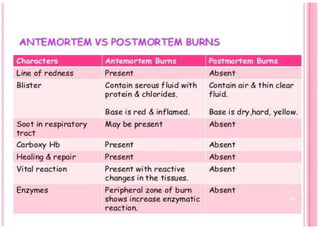
• Antemortem vs Postmortem burns
• Heat cramps, Heat exhaustion and Heat Stroke
• Hypothermia
• Frostbite, immersion foot and foot trench
• Paradoxical undressing
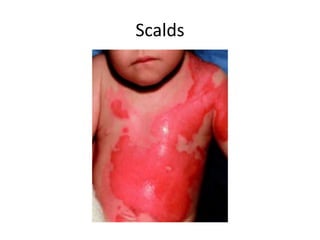
Scalds
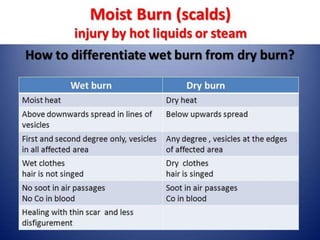
Scalds /Moist burns
Injuries produced by liquids at or near
boiling point,or from steam.
Severity of injury depends primarily on
the temperature and duration of
exposure.
Burns result in 20 sec at 131 F, 3 seconds
at 140 F, 2 sec at 150 F and in 1sec at 158
F. Burns can be avoided by keeping hot
water settings below 120 F
Classification
Classified in three degrees:
•Erythema – redness appear
immediately which is due to vascular
dilation, called as 1st degree burn.
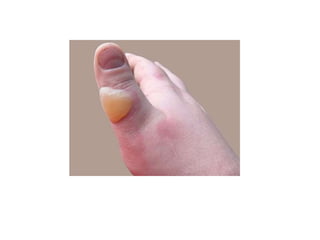
•Extensive vesication blister formation
occurs within a few minutes. Also called
2nd degree burn. It is due to increased
vascular permeability.
•Extensive Necrosis. Such change of dermis is
a 3rd degree burn.
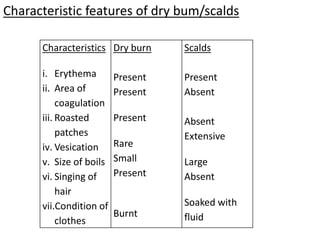
Characteristics
i. Erythema
ii. Area of
coagulation
iii. Roasted
patches
iv. Vesication
v. Size of boils
vi. Singing of
hair
vii.Condition of
clothes
Dry burn
Present
Present
Present
Rare
Small
Present
Burnt
Scalds
Present
Absent
Absent
Extensive
Large
Absent
Soaked with
fluid
Characteristic features of dry bum/scalds
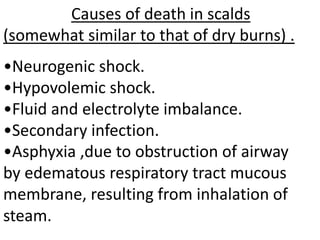
Causes of death in scalds
(somewhat similar to that of dry burns) .
•Neurogenic shock.
•Hypovolemic shock.
•Fluid and electrolyte imbalance.
•Secondary infection.
•Asphyxia ,due to obstruction of airway
by edematous respiratory tract mucous
membrane, resulting from inhalation of
steam.
Manner of death
•Homicidal
•Suicidal
•Accidental
Trauma and death from exposure to
high environmental temperature
•Heat cramps.
•Heat exhaustion
•Heat stroke
The spectrum of heat-related
illnesses that begin with heat
cramps, progresses to heat
exhaustion, and finally to heat
stroke.
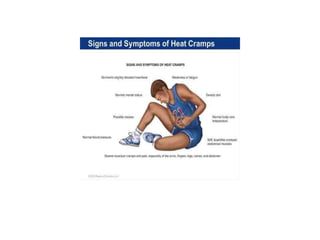
•Heat cramps. painful spasm of the
voluntary muscle which follows
strenuous exercise in hot humid
atmosphere.
•Earliest sign of heat wave.
•cramps occur due to rapid dehydration
of the body through loss of water and
salts due to sweating.
• Mortality rate is negligible
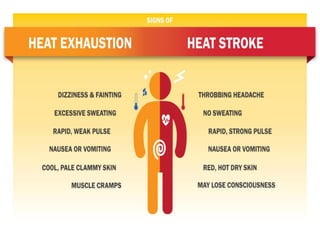
•Heat stroke also called hyperpyrexia sun
stroke, systemic hyperthermia and thermic
fever
• condition caused by your body overheating, usually
as a result of prolonged exposure to or physical
exertion in high temperatures.
• Due to prolonged exposure to hot and/or humid
atmosphere
• Impaired functioning of heat regulating mechanism viz
failure of cutaneous circulation and sweating.
Symptoms may be acute! and the person may
collapse suddenly.
Usually preceded by prodromal symptoms.
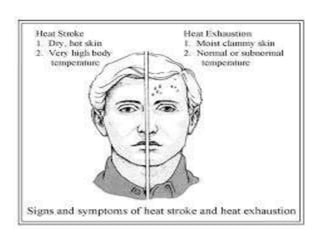
•Hot dry skin, rapid pulse, flushed face, excessive
thirst nausea, vomiting, headache, cramps, dizziness
and weakness in legs.
•The body temperature may rise to 1060F or up to
1110F
•Delirium and convulsion may precede death.
•Mortality rate is high.
•fatal period is from a few minutes to 3 days.
Treatment
•Shift the patient to a cooler and well ventilated
place
•Cold water sponging
•Maintain I/v line and fluid/electrolyte balance
is maintained.
•Prophylactic antibiotic may be given.
•In severe cases, parental steroids may also be
given.
Heat exhaustion /prostration.
it is a condition of collapse “without
elevation of body temperature” which
follows after prolonged exposure to
excessive heat .
characterized by:
peripheral vascular collapse as poor venous
return, hypotension and pallor
Autopsy findings in person died of heat:
• Increased temperature or may rise further.
•R.M sets in early and disappears early
•Putrefaction is rapid
• internally, viscera shows congestion, edema and
petecchial hemorrhage
•Cerebrum shows flattening of gyri due to brain
edema.
•Lungs shows hemorrhagic fluid in air passages.
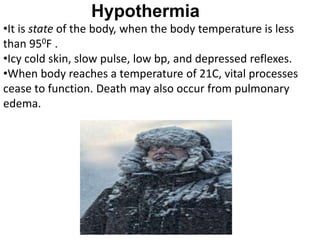
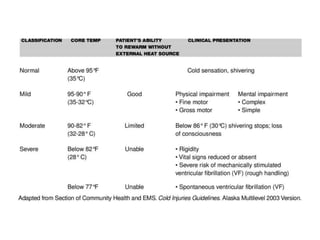
Hypothermia
•It is state of the body, when the body temperature is less
than 950F .
•Icy cold skin, slow pulse, low bp, and depressed reflexes.
•When body reaches a temperature of 21C, vital processes
cease to function. Death may also occur from pulmonary

edema.
The contributory factors are:
A.(Exogenous)
1. Intensity of cold (environmental
temperature)
2. Duration of exposure.
B.(Endogenous factors):
•Age
•Sex
•Health
Moist cold atmosphere is more
damaging than a dry cold one
Mechanism:
1.when the body is exposed to extreme of cold:
• BMR falls,
• respiratory rate and B.P falls.
• O2 doesn’t readily dissociate from Hb, anoxic
changes occur
• On prolonged exposure, vasomotor control is
paralyzed, capillaries dilate.
• Dilation of capillaries>>stasis of blood and
thrombosis>>necrosis in exposed parts such as
tip of nose, ear ,fingers and toes.
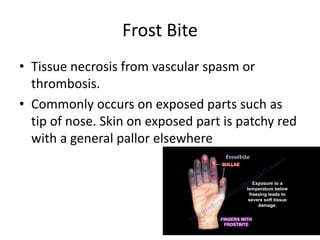
Frost Bite
• Tissue necrosis from vascular spasm or
thrombosis.
• Commonly occurs on exposed parts such as
tip of nose. Skin on exposed part is patchy red
with a general pallor elsewhere
Trench feet /Immersion foot
Cold injury to foot occurring after sustained
exposure to cold under moist conditions. There
is death of peripheral nerves with edema of
the part, bullae formation and sometimes
superficial gangrene. Common in soldiers
during winter warfare, especially in trenches.
It happens due to prolonged exposure to
cold water, especially in artctic areas.
Unlike frostbite, trench foot usually occurs at
temperatures above freezing.
Autopsy findings of a person suspected to be
died of hypothermia
•Postmortem lividity is bright red in color due to non
dissociation of oxyhemoglobin.
•The body is extremely cold
•Presence of large irregular erythematous patches
on the trunk and limbs. Localized changes like frost
bite or immersion foot may be seen
•The body is completely stiff due the effect of cold
and rigor mortis develops after thawing of the body
•Gangrene of fingers and toes seen due to extreme
vasoconstriction
•Putrefaction is delayed
•Congestion of internal organs with packing of
blood cells in small vessels
•Fat necrosis of variable degree along the
pancreas one of the constant feature
•Small sub mucosal gastric and duodenal
haemorrhages
•Degenerative foci in myocardium
•Liver, spleen and kidneys shows droplets
of fat
Medicolegal Significance
Mainly accidental as in the cases of
drunkards, baggers sleeping on roads in
winter or people lost in snow draft.
Homicidal cases occur by exposing the
children, the aged or mentally sick
persons to extremely cold temperature
Paradoxical undressing
People exposed to prolonged cold ,experience
a feeling of heat just before death.
Reason: it is due to vasodilatation of extremely
constricted blood vessels as they fail to
maintain body temperature . And due to
thissudden vasodilatation a feeling of sudden
warmth sets in)
As a result, the person removes his clothes .
Ironically, the body temperature falls more and
death results.
Lightning
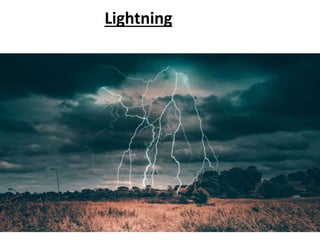
An electrical discharge from cloud to earth
through an object
The electrical current is direct, not
alternating.
•It is about 20,000 amperes and 100-1000
million volts .A flash lasts for 1/1000th of a
sec
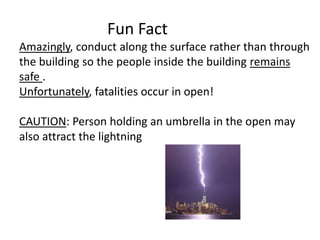
Fun Fact
Amazingly, conduct along the surface rather than through
the building so the people inside the building remains
safe .
Unfortunately, fatalities occur in open!
CAUTION: Person holding an umbrella in the open may
also attract the lightning
Effects of lightning
•Direct effect
•Burning by super heated air.
•Blast effect of rapidly expanding air at the site of
lightening .
•Sledge hammer blow .it is compression and
decompression effect of the forces called
electrostatic forces. A person is thrown away.
•The injury sustained may be bruise, laceration, and
fracture of bone or dislocation of joint.
Direct effects due to flash
1. Burning by heat due to resistance zigzag lines.
Appear in skin folds and moist areas of skin as they
offer least resistance.
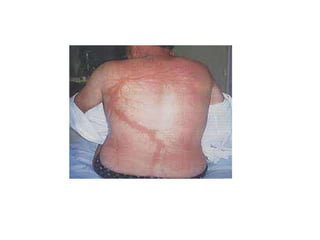
2.Arborescent marks . due to passage of current .so
called as it appears like branches of a tree. They are
due to rupture of small blood vessels and
development of eccyhemoses. Involve only the
epidermal layer of skin.These markings fade with
time. Also called filigree burns
3.Fusion and magnetization of metallic articles. true burns
and usually occur beneath the metallic objects like ring.
This heat can melt the metal and can cause fusion with
underlying skin.
These metallic objects also get magnetized due to passage of
current and this phenomenon is called magnetization
.the nylon clothes are melted
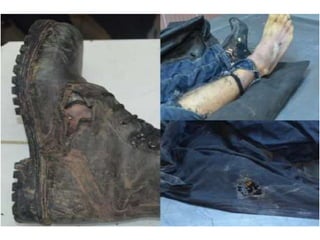
4. Blast effect .there is tearing of clothes. If the
discharge finds its way through feet, skin may be
ruptured and shoes may be torn Ear drum may be
damaged due to sudden over pressure
5. If the current passes through cardiac area there
may be cardiac fibrillation and cardiac failure.
Autopsy
1. H/o thunder storm
2. circumstantial evidence
3.postmortem finding
Burning and tearing of clothes
External injuries: arborescent markings, fractures ,rigor mortis
appear soon after death and passes off quickly
Internally: Pulmonary hemorrhages and edema, parenchymal
necrosis and fractured bones may be found.
Cause of death
Death is due to electro-thermal injuries from high voltage direct current
or by involvement of CNS with paralysis of respiratory and cardiac
centres.
Safety pre cautions.
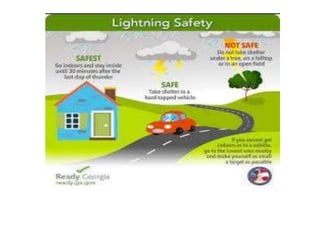
•stay indoor
• take shelter under buildings
• avoid standing in open doors or windows or near fire places with open
chimneys.
•Electrical equipment should be avoided or turn off.
•Metal articles should be avoided
•If outside should stand under short trees as it will affect the taller trees
first .and never choose the isolated tree
Shelter can be taken in car as if car is struck the charge will travel
along the surface and will not affect the occupant
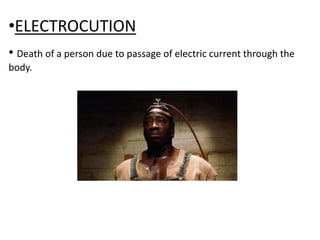
•ELECTROCUTION
• Death of a person due to passage of electric current through the
body.
FACTORS INFLUENCING THE ELECTRICAL INJURIES .
1.Voltage ..Supply of voltage is of three types.
Domestic . two types either 110-140 or 220-240
volts.
Industrial .440-1200 or 11k-4 million volts.
Lightening. very, very high in millions of volts
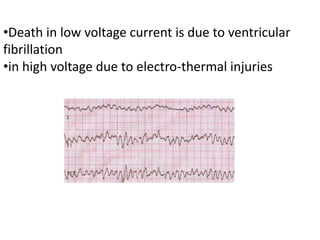
•Death in low voltage current is due to ventricular
fibrillation
•in high voltage due to electro-thermal injuries
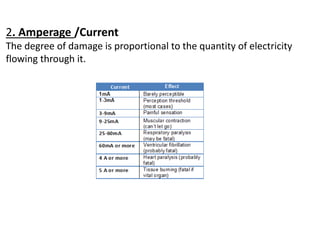
2. Amperage /Current
The degree of damage is proportional to the quantity of electricity
flowing through it.
•only a sensation is received with the current of 1 m.A
•5mA will produce muscle tremors.
•at 9-16 mA the person is unable to leave the source of
current and called hold on phenomenon .
( due to the spasm of the muscles that is responsible
for the non release of the live conductor)
•. At about 50mA , muscular control is lost and there is
paralysis.
• Between 75-100 mA ,ventricular fibrillation happens
•at 2 Amperes and above ventricular arrest.
•When the intensity increases the hold on phenomenon
does not exist and with high tension current the person is
thrown off which may cause mechanical injuries but the
period of contact is less.
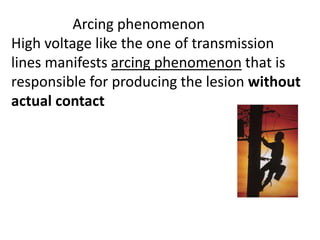
Arcing phenomenon
High voltage like the one of transmission
lines manifests arcing phenomenon that is
responsible for producing the lesion without
actual contact
3. Kind of current .
•An A/C current is one that reverses its direction regularly at recurring
interval.
• Standard commercial cycles are 25-60 cycles/sec.
•D/C is one where current follows constantly in the same direction.
•A/C is more dangerous than D/C.
• human organs are 4-6 times more sensitive to A/C than D/C .
•40 -150 cps is dangerous .
•50 -60 cps is the critical frequency[Most Dangerous]
•At frequency more than 1700 cps heart becomes 20 times more
tolerant
4.Resistance.
the unit of electrical resistance , measured in ohm which is
calculated by formula V=I*R
. The skin of palm and sole offer greatest resistance,
•Skin --- 500 – 10,000 ohms.
• Wet skin----resistance reduced to 200-300 ohms.
•Since voltage is constant, the most important factor in
electrocution is resistance.
•Vascular area like check are better conductors ,and most of
the current passes through the blood vessels
Miscellaneous factors
•Exposure: a low ampere current if passed for a
longer time may cause fatal result
•Awareness or anticipation .
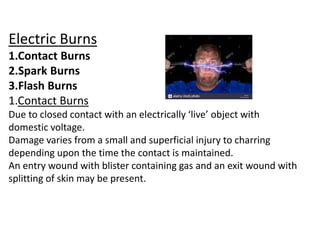
Electric Burns
1.Contact Burns
2.Spark Burns
3.Flash Burns
1.Contact Burns
Due to closed contact with an electrically ‘live’ object with
domestic voltage.
Damage varies from a small and superficial injury to charring
depending upon the time the contact is maintained.
An entry wound with blister containing gas and an exit wound with
splitting of skin may be present.
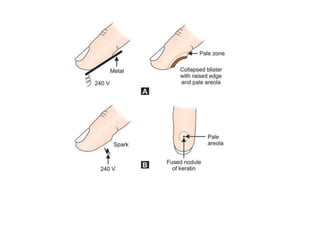
•Loose contact or spark wound
•if the contact is not good . A spark is produced at the
gap between the skin and the conductor.
•The keratin of outer skin is melted and on cooling it is
condensed to form a small brownish nodule called
spark lesion.
•Industrial or high voltage current ---
•Flashburn.
• contact with very high voltage lines more than 1000 volts
As in kite flying, installing an aerial for radio or TV or
operating some tall equipment as crane.
• linemen working on grid system or thieves stealing copper
wires .
•lesion are due to continuous contact of high
voltage or due to arcing phenomenon
•lesions resemble a thermal burn.
•involves large area of skin.
• Entry and exit wounds are absent
•Brownish discoloration of large area of skin
apart from actual burning.
• Arborescent pattern of lightening burn
.
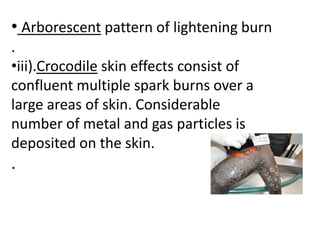
•iii).Crocodile skin effects consist of
confluent multiple spark burns over a
large areas of skin. Considerable
number of metal and gas particles is
deposited on the skin.
.
Joule burn effect
•Electricity causes generation of heat and
burning of tissues called joule burns or
endogenous burn.
•it is not a true burn but an electrical necrosis
caused by the heat generated by the current in
contrast to exogenous burn which are caused
by application of heat
Metallization .a very minute particle of the
metal liberated from the conductor and get
embedded in the tissues. This phenomenon is
called metallization and the lesion appear as
small tiny particle surrounded by a pale area
and the outermost is the hyperemic area .
the color print depends upon the metal of the
conductor .
iron ---black
,copper---reddish brown,
almunium—silvery
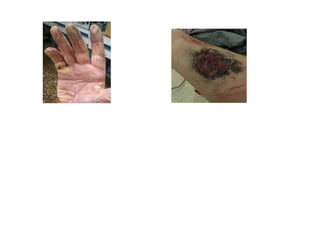
•autopsy findings
•depth is greater than the surface appearance
suggest.
• dry, hard to touch and do not bleed.
•Effect of heat is from inside not outside due to
conversion of electricity into heat within the tissues.
•The lesion appears both at the point of entry and
exit.
• The lesion varies from no visible mark— pin point
lesion or small blister to heat coagulation—to
different stages of burning—to complete charring.
•Internal findings.
• non-specific findings of asphyxia.
• pataechial heamorrhage in various organs.
•Pulmonary edema
•Cerebral edema
.
Mechanism of death
•Ventricular fibrillation.(mode is syncope).
Respiratory arrest .(mode is asphyxia ).When the
current passes through respiratory Centre, it causes
paralysis of vital centre in medulla .It occurs when the
head is involved
• Titanic asphyxia .(asphyxia )Low and medium
current passing through the chest can induce
titanic contraction of the extrinsic muscles of
respiration and death from mechanical asphyxia .
• Cerebral anoxia .( coma ).Prolong ventricular
fibrillation may cause brain damage due to
decrease blood supply.
• Neurological damage .current may cause tearing
of nervous tissues ,.
• Delayed death due to complication of burns and
their toxic effects.
Medicolegal Significance
Accidental
Suicidal
Homicidal
Radiation injuries
injuries resulting from prolong exposure to radiation
The source of radiation may be
Natural -----cosmic rays
Artificial ----x-rays, radio-isotopes ionizing
agents and nuclear weapons
•Effects of x-rays.
•The effect depends upon the
• dose,
• period of exposure and
• type of tissues involved.
Skin
•Erythema
•blister formation
•Finger nails may be effected by degenerative
changes
• atrophy of superficial tissues resulting in
shedding of hair, epidermis, and formation of
ulcers with a tendency to malignancy.
•The scar formed by healing is radiate in shape
and associated with pigmentation of
surrounding skin.
Bone marrow.
1. Bone marrow depression
Gut irritation of epithelium with
destruction of lining of small gut.
Vomiting, diarrhea and ulceration
Gonads.Uterus---abortion, premature
delivery and still birth
Ovaries ---atrophy and
dysfunction
Testes ---atrophy and permanent
sterility and loss of sexual power.
Radium burns are similar to x-rays burn.
Sunlight it contain ultraviolet rays .the
effects are due to prolong exposure.
Medicolegal aspects
medical negligence
Compensation .
The end

Thermal injuries

  • 1.
  • 2.
    Learning Objectives • Scalds •Differentiate dry burns from scalds • Antemortem vs Postmortem burns • Heat cramps, Heat exhaustion and Heat Stroke • Hypothermia • Frostbite, immersion foot and foot trench • Paradoxical undressing
  • 3.
  • 4.
    Scalds /Moist burns Injuriesproduced by liquids at or near boiling point,or from steam. Severity of injury depends primarily on the temperature and duration of exposure. Burns result in 20 sec at 131 F, 3 seconds at 140 F, 2 sec at 150 F and in 1sec at 158 F. Burns can be avoided by keeping hot water settings below 120 F
  • 5.
    Classification Classified in threedegrees: •Erythema – redness appear immediately which is due to vascular dilation, called as 1st degree burn. •Extensive vesication blister formation occurs within a few minutes. Also called 2nd degree burn. It is due to increased vascular permeability. •Extensive Necrosis. Such change of dermis is a 3rd degree burn.
  • 7.
    Characteristics i. Erythema ii. Areaof coagulation iii. Roasted patches iv. Vesication v. Size of boils vi. Singing of hair vii.Condition of clothes Dry burn Present Present Present Rare Small Present Burnt Scalds Present Absent Absent Extensive Large Absent Soaked with fluid Characteristic features of dry bum/scalds
  • 9.
    Causes of deathin scalds (somewhat similar to that of dry burns) . •Neurogenic shock. •Hypovolemic shock. •Fluid and electrolyte imbalance. •Secondary infection. •Asphyxia ,due to obstruction of airway by edematous respiratory tract mucous membrane, resulting from inhalation of steam.
  • 11.
  • 12.
    Trauma and deathfrom exposure to high environmental temperature •Heat cramps. •Heat exhaustion •Heat stroke The spectrum of heat-related illnesses that begin with heat cramps, progresses to heat exhaustion, and finally to heat stroke.
  • 13.
    •Heat cramps. painfulspasm of the voluntary muscle which follows strenuous exercise in hot humid atmosphere. •Earliest sign of heat wave. •cramps occur due to rapid dehydration of the body through loss of water and salts due to sweating. • Mortality rate is negligible
  • 16.
    •Heat stroke alsocalled hyperpyrexia sun stroke, systemic hyperthermia and thermic fever • condition caused by your body overheating, usually as a result of prolonged exposure to or physical exertion in high temperatures. • Due to prolonged exposure to hot and/or humid atmosphere • Impaired functioning of heat regulating mechanism viz failure of cutaneous circulation and sweating.
  • 17.
    Symptoms may beacute! and the person may collapse suddenly. Usually preceded by prodromal symptoms. •Hot dry skin, rapid pulse, flushed face, excessive thirst nausea, vomiting, headache, cramps, dizziness and weakness in legs. •The body temperature may rise to 1060F or up to 1110F •Delirium and convulsion may precede death. •Mortality rate is high. •fatal period is from a few minutes to 3 days.
  • 18.
    Treatment •Shift the patientto a cooler and well ventilated place •Cold water sponging •Maintain I/v line and fluid/electrolyte balance is maintained. •Prophylactic antibiotic may be given. •In severe cases, parental steroids may also be given.
  • 19.
    Heat exhaustion /prostration. itis a condition of collapse “without elevation of body temperature” which follows after prolonged exposure to excessive heat . characterized by: peripheral vascular collapse as poor venous return, hypotension and pallor
  • 22.
    Autopsy findings inperson died of heat: • Increased temperature or may rise further. •R.M sets in early and disappears early •Putrefaction is rapid • internally, viscera shows congestion, edema and petecchial hemorrhage •Cerebrum shows flattening of gyri due to brain edema. •Lungs shows hemorrhagic fluid in air passages.
  • 23.
    Hypothermia •It is stateof the body, when the body temperature is less than 950F . •Icy cold skin, slow pulse, low bp, and depressed reflexes. •When body reaches a temperature of 21C, vital processes cease to function. Death may also occur from pulmonary edema.
  • 24.
    The contributory factorsare: A.(Exogenous) 1. Intensity of cold (environmental temperature) 2. Duration of exposure.
  • 25.
    B.(Endogenous factors): •Age •Sex •Health Moist coldatmosphere is more damaging than a dry cold one
  • 26.
    Mechanism: 1.when the bodyis exposed to extreme of cold: • BMR falls, • respiratory rate and B.P falls. • O2 doesn’t readily dissociate from Hb, anoxic changes occur • On prolonged exposure, vasomotor control is paralyzed, capillaries dilate. • Dilation of capillaries>>stasis of blood and thrombosis>>necrosis in exposed parts such as tip of nose, ear ,fingers and toes.
  • 28.
    Frost Bite • Tissuenecrosis from vascular spasm or thrombosis. • Commonly occurs on exposed parts such as tip of nose. Skin on exposed part is patchy red with a general pallor elsewhere
  • 29.
    Trench feet /Immersionfoot Cold injury to foot occurring after sustained exposure to cold under moist conditions. There is death of peripheral nerves with edema of the part, bullae formation and sometimes superficial gangrene. Common in soldiers during winter warfare, especially in trenches. It happens due to prolonged exposure to cold water, especially in artctic areas.
  • 30.
    Unlike frostbite, trenchfoot usually occurs at temperatures above freezing.
  • 31.
    Autopsy findings ofa person suspected to be died of hypothermia •Postmortem lividity is bright red in color due to non dissociation of oxyhemoglobin. •The body is extremely cold •Presence of large irregular erythematous patches on the trunk and limbs. Localized changes like frost bite or immersion foot may be seen •The body is completely stiff due the effect of cold and rigor mortis develops after thawing of the body •Gangrene of fingers and toes seen due to extreme vasoconstriction
  • 32.
    •Putrefaction is delayed •Congestionof internal organs with packing of blood cells in small vessels •Fat necrosis of variable degree along the pancreas one of the constant feature •Small sub mucosal gastric and duodenal haemorrhages •Degenerative foci in myocardium •Liver, spleen and kidneys shows droplets of fat
  • 33.
    Medicolegal Significance Mainly accidentalas in the cases of drunkards, baggers sleeping on roads in winter or people lost in snow draft. Homicidal cases occur by exposing the children, the aged or mentally sick persons to extremely cold temperature
  • 35.
    Paradoxical undressing People exposedto prolonged cold ,experience a feeling of heat just before death. Reason: it is due to vasodilatation of extremely constricted blood vessels as they fail to maintain body temperature . And due to thissudden vasodilatation a feeling of sudden warmth sets in) As a result, the person removes his clothes . Ironically, the body temperature falls more and death results.
  • 36.
  • 37.
    An electrical dischargefrom cloud to earth through an object The electrical current is direct, not alternating. •It is about 20,000 amperes and 100-1000 million volts .A flash lasts for 1/1000th of a sec
  • 38.
    Fun Fact Amazingly, conductalong the surface rather than through the building so the people inside the building remains safe . Unfortunately, fatalities occur in open! CAUTION: Person holding an umbrella in the open may also attract the lightning
  • 39.
    Effects of lightning •Directeffect •Burning by super heated air. •Blast effect of rapidly expanding air at the site of lightening . •Sledge hammer blow .it is compression and decompression effect of the forces called electrostatic forces. A person is thrown away. •The injury sustained may be bruise, laceration, and fracture of bone or dislocation of joint.
  • 40.
    Direct effects dueto flash 1. Burning by heat due to resistance zigzag lines. Appear in skin folds and moist areas of skin as they offer least resistance. 2.Arborescent marks . due to passage of current .so called as it appears like branches of a tree. They are due to rupture of small blood vessels and development of eccyhemoses. Involve only the epidermal layer of skin.These markings fade with time. Also called filigree burns
  • 42.
    3.Fusion and magnetizationof metallic articles. true burns and usually occur beneath the metallic objects like ring. This heat can melt the metal and can cause fusion with underlying skin. These metallic objects also get magnetized due to passage of current and this phenomenon is called magnetization .the nylon clothes are melted 4. Blast effect .there is tearing of clothes. If the discharge finds its way through feet, skin may be ruptured and shoes may be torn Ear drum may be damaged due to sudden over pressure 5. If the current passes through cardiac area there may be cardiac fibrillation and cardiac failure.
  • 44.
    Autopsy 1. H/o thunderstorm 2. circumstantial evidence 3.postmortem finding Burning and tearing of clothes External injuries: arborescent markings, fractures ,rigor mortis appear soon after death and passes off quickly Internally: Pulmonary hemorrhages and edema, parenchymal necrosis and fractured bones may be found. Cause of death Death is due to electro-thermal injuries from high voltage direct current or by involvement of CNS with paralysis of respiratory and cardiac centres.
  • 45.
    Safety pre cautions. •stayindoor • take shelter under buildings • avoid standing in open doors or windows or near fire places with open chimneys. •Electrical equipment should be avoided or turn off. •Metal articles should be avoided •If outside should stand under short trees as it will affect the taller trees first .and never choose the isolated tree Shelter can be taken in car as if car is struck the charge will travel along the surface and will not affect the occupant
  • 47.
    •ELECTROCUTION • Death ofa person due to passage of electric current through the body.
  • 48.
    FACTORS INFLUENCING THEELECTRICAL INJURIES . 1.Voltage ..Supply of voltage is of three types. Domestic . two types either 110-140 or 220-240 volts. Industrial .440-1200 or 11k-4 million volts. Lightening. very, very high in millions of volts
  • 49.
    •Death in lowvoltage current is due to ventricular fibrillation •in high voltage due to electro-thermal injuries
  • 50.
    2. Amperage /Current Thedegree of damage is proportional to the quantity of electricity flowing through it.
  • 51.
    •only a sensationis received with the current of 1 m.A •5mA will produce muscle tremors. •at 9-16 mA the person is unable to leave the source of current and called hold on phenomenon . ( due to the spasm of the muscles that is responsible for the non release of the live conductor)
  • 52.
    •. At about50mA , muscular control is lost and there is paralysis. • Between 75-100 mA ,ventricular fibrillation happens •at 2 Amperes and above ventricular arrest. •When the intensity increases the hold on phenomenon does not exist and with high tension current the person is thrown off which may cause mechanical injuries but the period of contact is less.
  • 53.
    Arcing phenomenon High voltagelike the one of transmission lines manifests arcing phenomenon that is responsible for producing the lesion without actual contact
  • 54.
    3. Kind ofcurrent . •An A/C current is one that reverses its direction regularly at recurring interval. • Standard commercial cycles are 25-60 cycles/sec. •D/C is one where current follows constantly in the same direction. •A/C is more dangerous than D/C. • human organs are 4-6 times more sensitive to A/C than D/C . •40 -150 cps is dangerous . •50 -60 cps is the critical frequency[Most Dangerous] •At frequency more than 1700 cps heart becomes 20 times more tolerant
  • 55.
    4.Resistance. the unit ofelectrical resistance , measured in ohm which is calculated by formula V=I*R . The skin of palm and sole offer greatest resistance, •Skin --- 500 – 10,000 ohms. • Wet skin----resistance reduced to 200-300 ohms. •Since voltage is constant, the most important factor in electrocution is resistance. •Vascular area like check are better conductors ,and most of the current passes through the blood vessels
  • 56.
    Miscellaneous factors •Exposure: alow ampere current if passed for a longer time may cause fatal result •Awareness or anticipation .
  • 57.
    Electric Burns 1.Contact Burns 2.SparkBurns 3.Flash Burns 1.Contact Burns Due to closed contact with an electrically ‘live’ object with domestic voltage. Damage varies from a small and superficial injury to charring depending upon the time the contact is maintained. An entry wound with blister containing gas and an exit wound with splitting of skin may be present.
  • 58.
    •Loose contact orspark wound •if the contact is not good . A spark is produced at the gap between the skin and the conductor. •The keratin of outer skin is melted and on cooling it is condensed to form a small brownish nodule called spark lesion.
  • 60.
    •Industrial or highvoltage current --- •Flashburn. • contact with very high voltage lines more than 1000 volts As in kite flying, installing an aerial for radio or TV or operating some tall equipment as crane. • linemen working on grid system or thieves stealing copper wires .
  • 61.
    •lesion are dueto continuous contact of high voltage or due to arcing phenomenon •lesions resemble a thermal burn. •involves large area of skin. • Entry and exit wounds are absent •Brownish discoloration of large area of skin apart from actual burning.
  • 62.
    • Arborescent patternof lightening burn . •iii).Crocodile skin effects consist of confluent multiple spark burns over a large areas of skin. Considerable number of metal and gas particles is deposited on the skin. .
  • 63.
    Joule burn effect •Electricitycauses generation of heat and burning of tissues called joule burns or endogenous burn. •it is not a true burn but an electrical necrosis caused by the heat generated by the current in contrast to exogenous burn which are caused by application of heat
  • 64.
    Metallization .a veryminute particle of the metal liberated from the conductor and get embedded in the tissues. This phenomenon is called metallization and the lesion appear as small tiny particle surrounded by a pale area and the outermost is the hyperemic area . the color print depends upon the metal of the conductor . iron ---black ,copper---reddish brown, almunium—silvery
  • 65.
    •autopsy findings •depth isgreater than the surface appearance suggest. • dry, hard to touch and do not bleed. •Effect of heat is from inside not outside due to conversion of electricity into heat within the tissues. •The lesion appears both at the point of entry and exit. • The lesion varies from no visible mark— pin point lesion or small blister to heat coagulation—to different stages of burning—to complete charring.
  • 67.
    •Internal findings. • non-specificfindings of asphyxia. • pataechial heamorrhage in various organs. •Pulmonary edema •Cerebral edema .
  • 68.
    Mechanism of death •Ventricularfibrillation.(mode is syncope). Respiratory arrest .(mode is asphyxia ).When the current passes through respiratory Centre, it causes paralysis of vital centre in medulla .It occurs when the head is involved
  • 69.
    • Titanic asphyxia.(asphyxia )Low and medium current passing through the chest can induce titanic contraction of the extrinsic muscles of respiration and death from mechanical asphyxia . • Cerebral anoxia .( coma ).Prolong ventricular fibrillation may cause brain damage due to decrease blood supply. • Neurological damage .current may cause tearing of nervous tissues ,. • Delayed death due to complication of burns and their toxic effects.
  • 70.
  • 71.
    Radiation injuries injuries resultingfrom prolong exposure to radiation The source of radiation may be Natural -----cosmic rays Artificial ----x-rays, radio-isotopes ionizing agents and nuclear weapons
  • 72.
    •Effects of x-rays. •Theeffect depends upon the • dose, • period of exposure and • type of tissues involved.
  • 73.
    Skin •Erythema •blister formation •Finger nailsmay be effected by degenerative changes • atrophy of superficial tissues resulting in shedding of hair, epidermis, and formation of ulcers with a tendency to malignancy. •The scar formed by healing is radiate in shape and associated with pigmentation of surrounding skin.
  • 74.
    Bone marrow. 1. Bonemarrow depression Gut irritation of epithelium with destruction of lining of small gut. Vomiting, diarrhea and ulceration
  • 75.
    Gonads.Uterus---abortion, premature delivery andstill birth Ovaries ---atrophy and dysfunction Testes ---atrophy and permanent sterility and loss of sexual power. Radium burns are similar to x-rays burn. Sunlight it contain ultraviolet rays .the effects are due to prolong exposure.
  • 76.
  • 77.