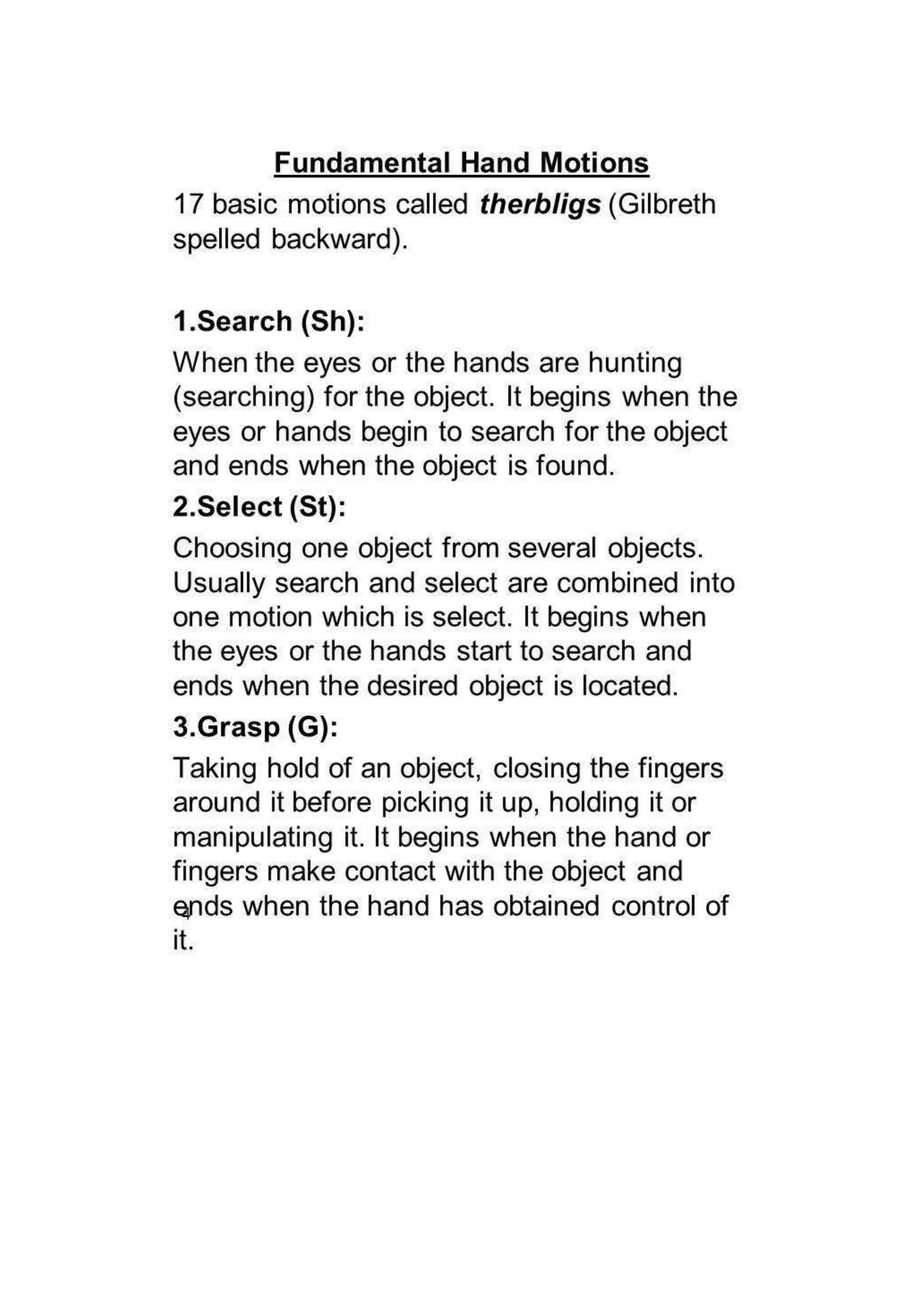
The basic motion elements
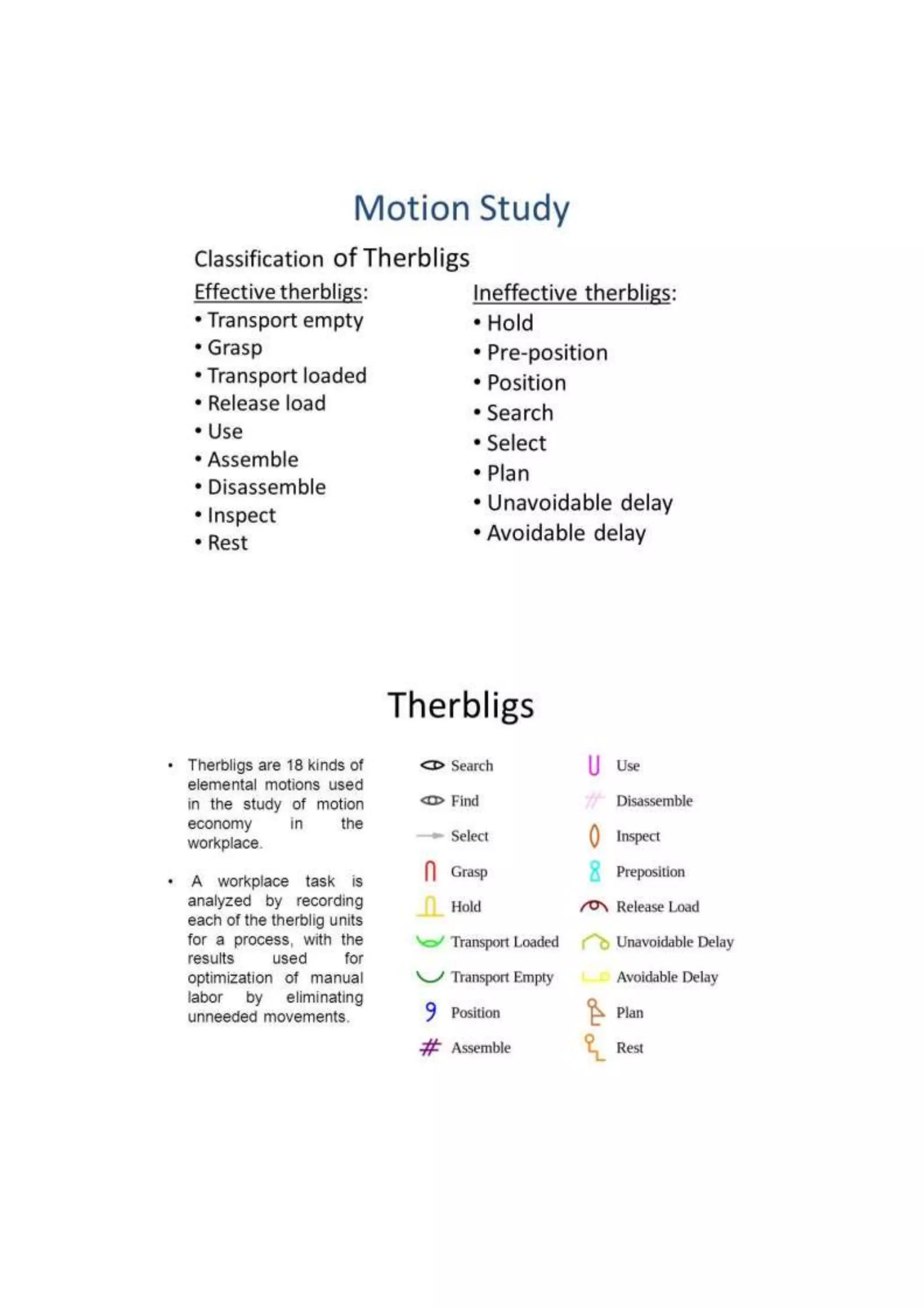
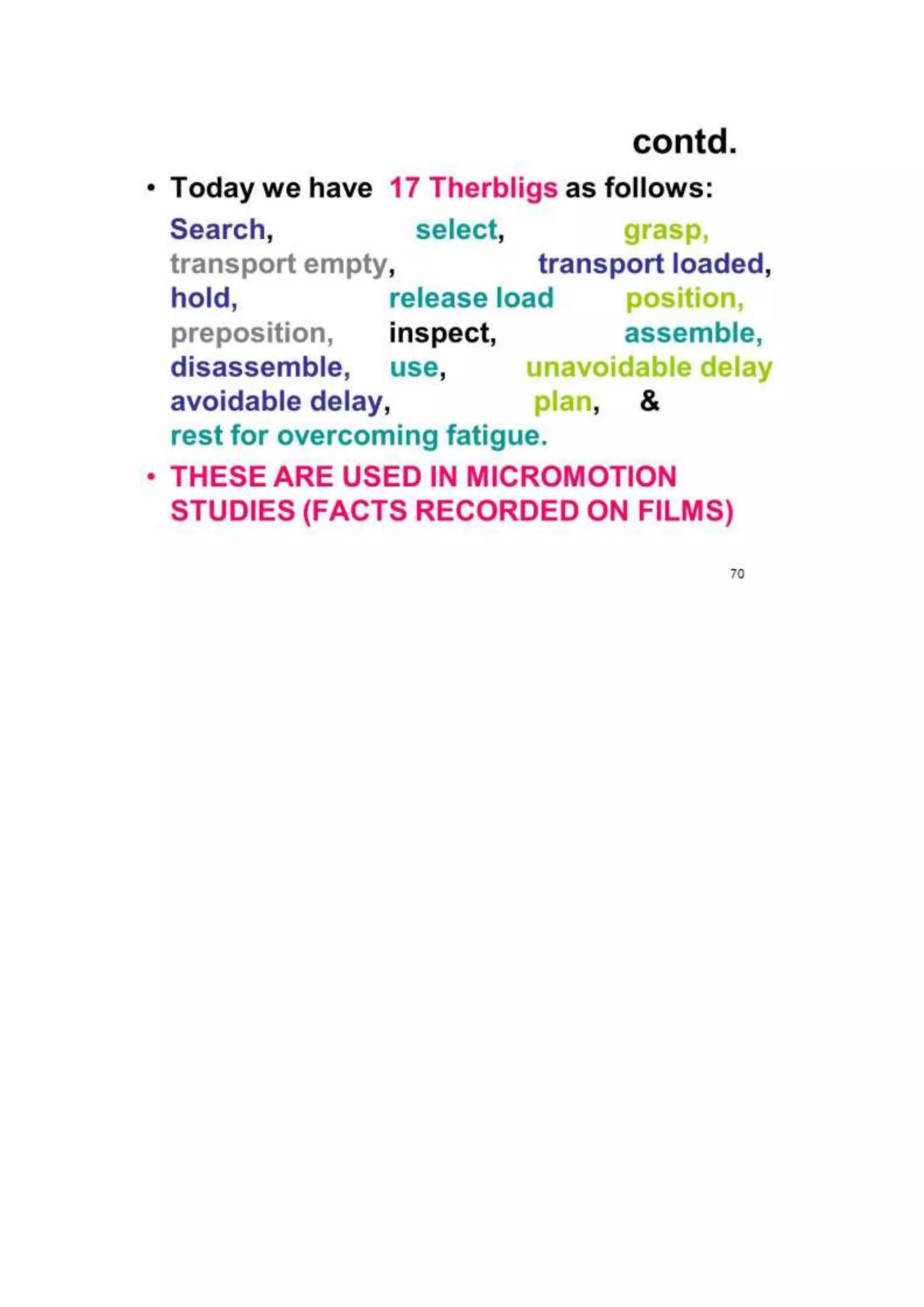
The 18 therbligs.
A basic motion element is one of a set of fundamental motions required for a worker
to perform a manual operation or task. The set consists of 18 elements, each
describing a standardized activity.
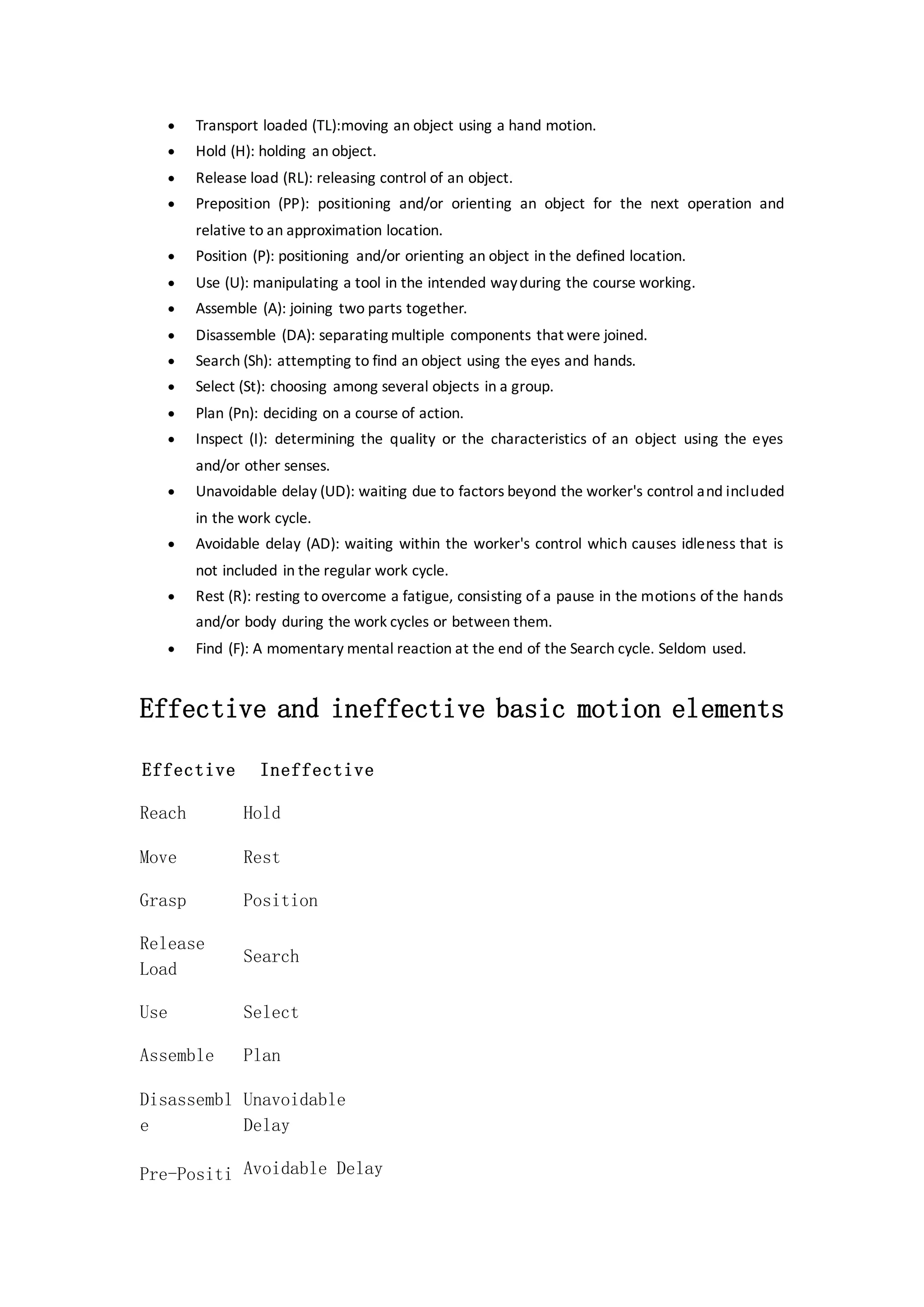
 Transport empty [unloaded] (TE): reaching for an object with an empty hand. (Now
called "Reach")
 Grasp (G): grasping an object with the active hand.
 Transport loaded (TL):moving an object using a hand motion.
 Hold (H): holding an object.
 Release load (RL): releasing control of an object.
 Preposition (PP): positioning and/or orienting an object for the next operation and
relative to an approximation location.
 Position (P): positioning and/or orienting an object in the defined location.
 Use (U): manipulating a tool in the intended wayduring the course working.
 Assemble (A): joining two parts together.
 Disassemble (DA): separating multiple components that were joined.
 Search (Sh): attempting to find an object using the eyes and hands.
 Select (St): choosing among several objects in a group.
 Plan (Pn): deciding on a course of action.
 Inspect (I): determining the quality or the characteristics of an object using the eyes
and/or other senses.
 Unavoidable delay (UD): waiting due to factors beyond the worker's control and included
in the work cycle.
 Avoidable delay (AD): waiting within the worker's control which causes idleness that is
not included in the regular work cycle.
 Rest (R): resting to overcome a fatigue, consisting of a pause in the motions of the hands
and/or body during the work cycles or between them.
 Find (F): A momentary mental reaction at the end of the Search cycle. Seldom used.
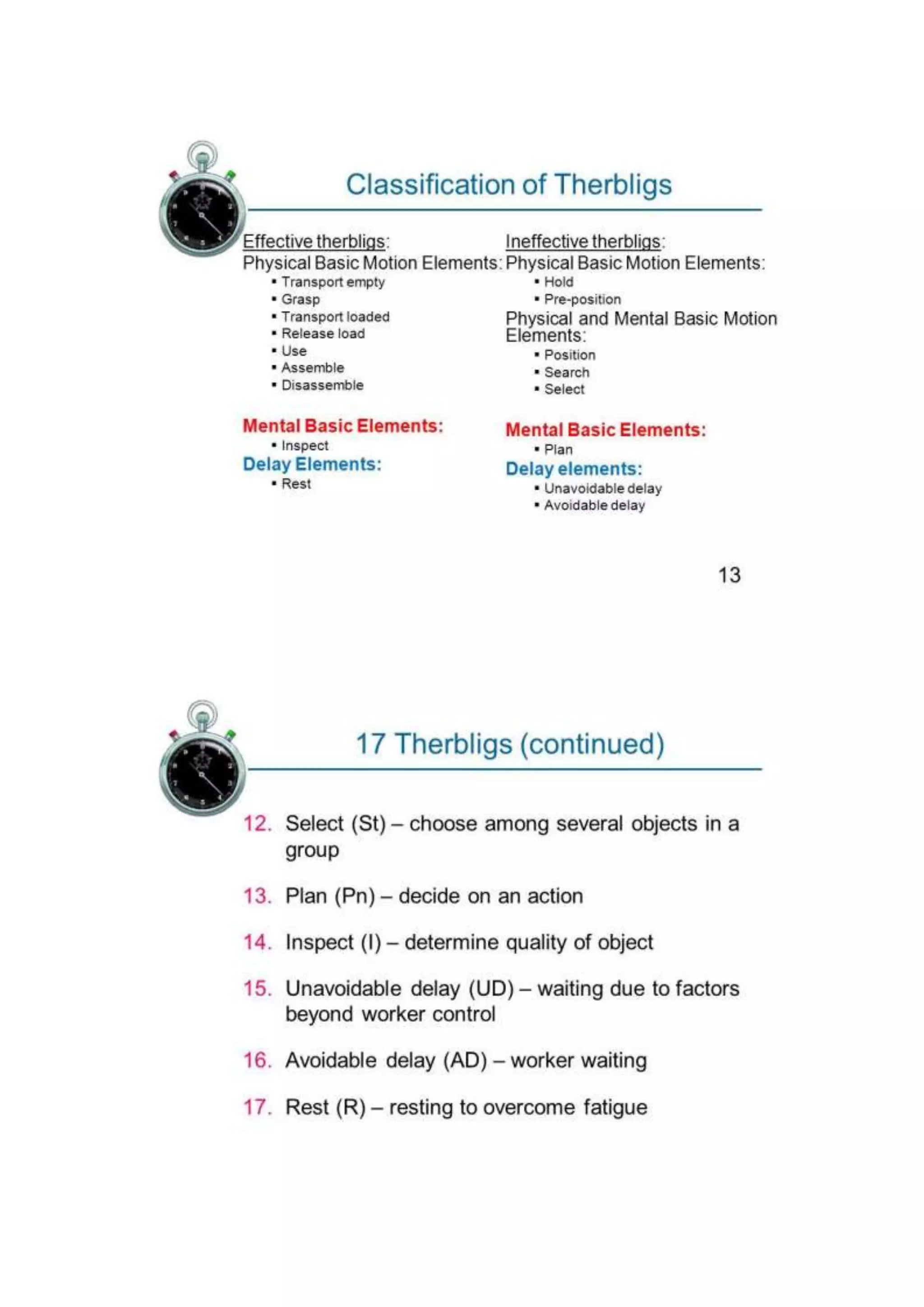
Effective and ineffective basic motion elements
Effective Ineffective
Reach Hold
Move Rest
Grasp Position
Release
Load
Search
Use Select
Assemble Plan
Disassembl
e
Unavoidable
Delay
Pre-Positi Avoidable Delay
on
Inspect
Example usage
Here is an example of how therbligs can be used to analyze motion:[1]
...Suppose a man goes into a bathroom and shave. We'll assume that
his face is all lathered and that he is ready to pick up his razor. He
knows where the razor is, but first he must locate it with his eye. That
is "search", the first Therblig. His eye finds it and comes to rest -- that's
"find", the second Therblig. Third comes "select", the process of
sliding the razor prior to the fourth Therblig, "grasp." Fifth is
"transport loaded," bringing the razor up to his face, and sixth is
"position," getting the razor set on his face. There are eleven other
Therbligs -- the last one is "think"!
— Frank Gilbreth, Jr. and Ernestine Gilbreth Carey, Cheaper By the
Work factor-Anant Patel
1. 1. WORK-FACTOR PRESENTED BY: ANANT PATEL MTO9IND010 M.Tech. Industrial
Engineering, VNIT, NAGPUR. 2009-10
2. 2.
Work- -Factor Systems • Detailed Work-Factor • Simplified
Work-Factor • Abbreviated Work-Factor • Ready Work-Factor • Brief Work-Factor •
Detailed Mento- -Factor -Factor
standard elements of work
3. 3. -Factor (WF) is an elemental time systems for compiling time
standards to establish the expected productivity of the human when performing useful
manual and mental work.
4. 4.
Work-
Sequence Technique (MOST),1967
5. 5. DEFINITIONS OF WORK- -
-
-Fact -Factor Standards Elements of Work
6. 6. WORK-
measurements....
7. 7. Detailed Work-
Work- - - -
Detailed Mento Factor
8. 8. -
-Factor system is based on the principle that the Four Major
Variables which affect the time to perform manual motions are: 1. Body Member used 2.
Distance Moved 3. Manual Control required 4. weight or Resistance involved
9. 9. 2) Arm 3) Forearm
Swivel 4) Trunk 5) Foot 6) Leg 7) Head Time values for these body members are
illustrated in table.
10. 10.
and stopping points of the motion as described by body
11. 11. - -
Work- -Factor • Its evaluation is made more difficult as
there is no physical measuring device with which its effects can be checked
12. 12.
Forearm Swivel Motions are rotary, measured in pound-inches of torque.
13. 13.
le, value is 55, corresponds to 0.0055 minutes
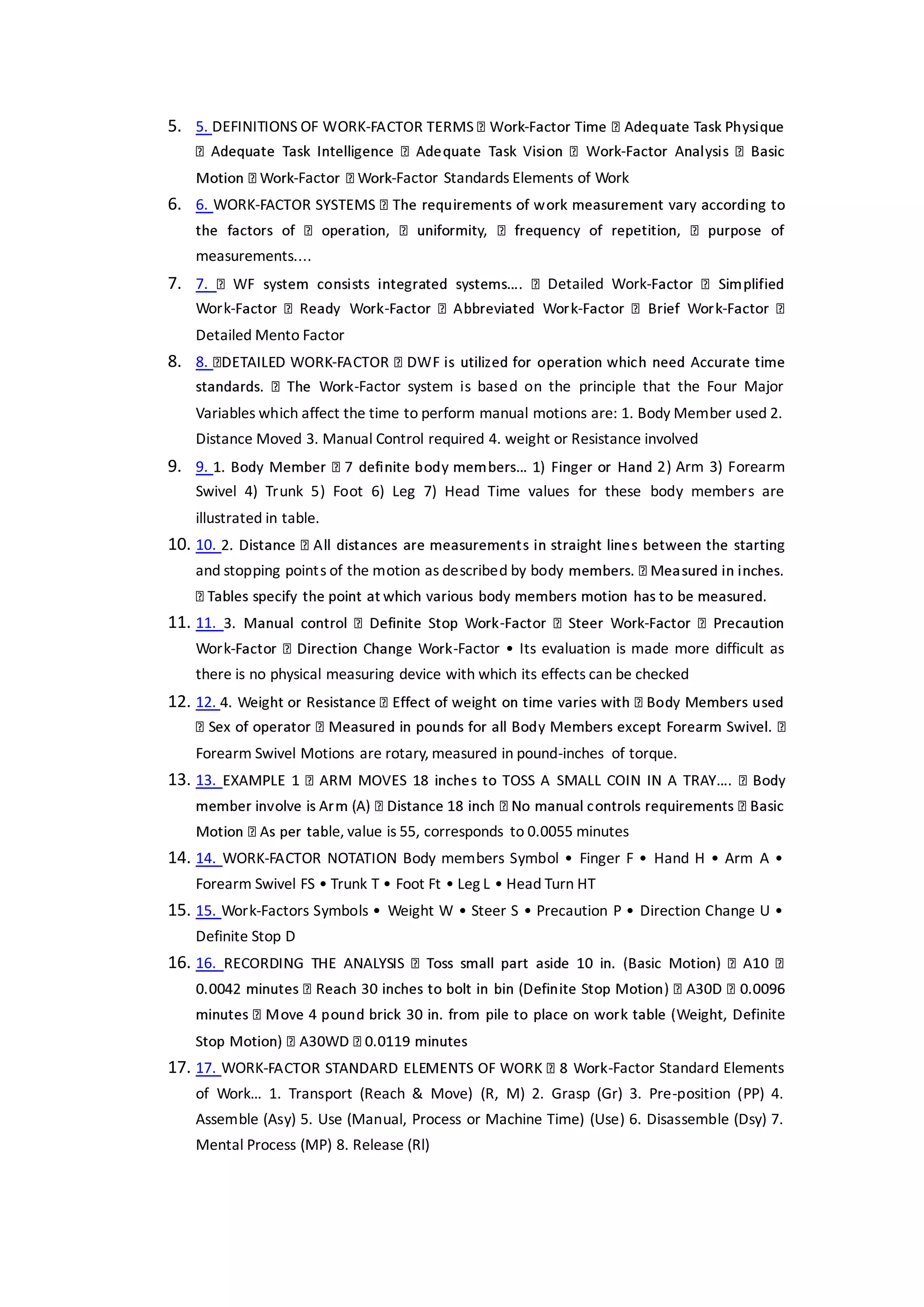
14. 14. WORK-FACTOR NOTATION Body members Symbol • Finger F • Hand H • Arm A •
Forearm Swivel FS • Trunk T • Foot Ft • Leg L • Head Turn HT
15. 15. Work-Factors Symbols • Weight W • Steer S • Precaution P • Direction Change U •
Definite Stop D
16. 16.
inite
17. 17. WORK- -Factor Standard Elements
of Work… 1. Transport (Reach & Move) (R, M) 2. Grasp (Gr) 3. Pre-position (PP) 4.
Assemble (Asy) 5. Use (Manual, Process or Machine Time) (Use) 6. Disassemble (Dsy) 7.
Mental Process (MP) 8. Release (Rl)
18. 18.
19. 19. obtaining Manual Control of an object for the purpose of transporting,
using, or holding.
20. 20. PRE-
pre-positioned for assembly into a tapped hole by turning it end-for-end with one hand.
An average of 3 Finger Motion is required to complete the Pre-
this Pre-position is V3F1-50%.
21. 21.
Assemble begins immediately after the Move bringing the objects to a position where
-Factor Assembles utilize the concept of Plug and Target,
where a Plug is inserted into or placed on a Target.
22. 22.
23. 23. - m
-
preparing estimates before actual production starts.
24. 24. - -
unit is 0.005 (recorded as 5) minutes rather
percent of the DWF.
25. 25. - -
One Ready Units equals 10 Detailed Work-Factor
- Factor required 9
Ready Units, or 0.009 minute.
26. 26. -
unit of 0.005 min
and with the Ready systems.
27. 27.
Cal
28. 28. -Factor Time Standards,
McGraw- -
Design and Measurement of Work
Work Study and Ergonomics, Katson Books, Delhi, 2003-
Study, vol-3, 1986.

Therbligs details

  • 1.
    The basic motionelements The 18 therbligs. A basic motion element is one of a set of fundamental motions required for a worker to perform a manual operation or task. The set consists of 18 elements, each describing a standardized activity.  Transport empty [unloaded] (TE): reaching for an object with an empty hand. (Now called "Reach")  Grasp (G): grasping an object with the active hand.
  • 2.
     Transport loaded(TL):moving an object using a hand motion.  Hold (H): holding an object.  Release load (RL): releasing control of an object.  Preposition (PP): positioning and/or orienting an object for the next operation and relative to an approximation location.  Position (P): positioning and/or orienting an object in the defined location.  Use (U): manipulating a tool in the intended wayduring the course working.  Assemble (A): joining two parts together.  Disassemble (DA): separating multiple components that were joined.  Search (Sh): attempting to find an object using the eyes and hands.  Select (St): choosing among several objects in a group.  Plan (Pn): deciding on a course of action.  Inspect (I): determining the quality or the characteristics of an object using the eyes and/or other senses.  Unavoidable delay (UD): waiting due to factors beyond the worker's control and included in the work cycle.  Avoidable delay (AD): waiting within the worker's control which causes idleness that is not included in the regular work cycle.  Rest (R): resting to overcome a fatigue, consisting of a pause in the motions of the hands and/or body during the work cycles or between them.  Find (F): A momentary mental reaction at the end of the Search cycle. Seldom used. Effective and ineffective basic motion elements Effective Ineffective Reach Hold Move Rest Grasp Position Release Load Search Use Select Assemble Plan Disassembl e Unavoidable Delay Pre-Positi Avoidable Delay
  • 3.
    on Inspect Example usage Here isan example of how therbligs can be used to analyze motion:[1] ...Suppose a man goes into a bathroom and shave. We'll assume that his face is all lathered and that he is ready to pick up his razor. He knows where the razor is, but first he must locate it with his eye. That is "search", the first Therblig. His eye finds it and comes to rest -- that's "find", the second Therblig. Third comes "select", the process of sliding the razor prior to the fourth Therblig, "grasp." Fifth is "transport loaded," bringing the razor up to his face, and sixth is "position," getting the razor set on his face. There are eleven other Therbligs -- the last one is "think"! — Frank Gilbreth, Jr. and Ernestine Gilbreth Carey, Cheaper By the
  • 8.
    Work factor-Anant Patel 1.1. WORK-FACTOR PRESENTED BY: ANANT PATEL MTO9IND010 M.Tech. Industrial Engineering, VNIT, NAGPUR. 2009-10 2. 2. Work- -Factor Systems • Detailed Work-Factor • Simplified Work-Factor • Abbreviated Work-Factor • Ready Work-Factor • Brief Work-Factor • Detailed Mento- -Factor -Factor standard elements of work 3. 3. -Factor (WF) is an elemental time systems for compiling time standards to establish the expected productivity of the human when performing useful manual and mental work. 4. 4. Work- Sequence Technique (MOST),1967
  • 9.
    5. 5. DEFINITIONSOF WORK- - - -Fact -Factor Standards Elements of Work 6. 6. WORK- measurements.... 7. 7. Detailed Work- Work- - - - Detailed Mento Factor 8. 8. - -Factor system is based on the principle that the Four Major Variables which affect the time to perform manual motions are: 1. Body Member used 2. Distance Moved 3. Manual Control required 4. weight or Resistance involved 9. 9. 2) Arm 3) Forearm Swivel 4) Trunk 5) Foot 6) Leg 7) Head Time values for these body members are illustrated in table. 10. 10. and stopping points of the motion as described by body 11. 11. - - Work- -Factor • Its evaluation is made more difficult as there is no physical measuring device with which its effects can be checked 12. 12. Forearm Swivel Motions are rotary, measured in pound-inches of torque. 13. 13. le, value is 55, corresponds to 0.0055 minutes 14. 14. WORK-FACTOR NOTATION Body members Symbol • Finger F • Hand H • Arm A • Forearm Swivel FS • Trunk T • Foot Ft • Leg L • Head Turn HT 15. 15. Work-Factors Symbols • Weight W • Steer S • Precaution P • Direction Change U • Definite Stop D 16. 16. inite 17. 17. WORK- -Factor Standard Elements of Work… 1. Transport (Reach & Move) (R, M) 2. Grasp (Gr) 3. Pre-position (PP) 4. Assemble (Asy) 5. Use (Manual, Process or Machine Time) (Use) 6. Disassemble (Dsy) 7. Mental Process (MP) 8. Release (Rl)
  • 10.
    18. 18. 19. 19.obtaining Manual Control of an object for the purpose of transporting, using, or holding. 20. 20. PRE- pre-positioned for assembly into a tapped hole by turning it end-for-end with one hand. An average of 3 Finger Motion is required to complete the Pre- this Pre-position is V3F1-50%. 21. 21. Assemble begins immediately after the Move bringing the objects to a position where -Factor Assembles utilize the concept of Plug and Target, where a Plug is inserted into or placed on a Target. 22. 22. 23. 23. - m - preparing estimates before actual production starts. 24. 24. - - unit is 0.005 (recorded as 5) minutes rather percent of the DWF. 25. 25. - - One Ready Units equals 10 Detailed Work-Factor - Factor required 9 Ready Units, or 0.009 minute. 26. 26. - unit of 0.005 min and with the Ready systems. 27. 27. Cal 28. 28. -Factor Time Standards, McGraw- - Design and Measurement of Work Work Study and Ergonomics, Katson Books, Delhi, 2003- Study, vol-3, 1986.