PRINCIPLES OF MOTION
       ECONOMY
        PREPARED BY


JJOSEPH GEORGE KONNULLY
SUBDIVISIONS OF PRINCIPLES OF MOTION ECONOMY


     Principles of motion economy will be presented

         under the following three subdivisions:

      1) Principles of motion economy as related to

                     the human body.

      2) Principles of motion economy as related to

               the arrangement of the place.

      3) Principles of motion economy as related to

            the design of tools and equipment.
PRINCIPLES OF MOTION ECONOMY RELATED TO USE
                OF HUMAN BODY
Principle of m otion economy as related to t he u se of t he human body.
1 . T he two hands should begin as well as complete
    t heir m otions at t he same t ime.
2. T he two hands should not be idle at t he same t ime
    except du ring rest period.
3. Motions of t he arms should be m ade in opposite
    and symmetrical directions and should be m ade
    simultaneously.
4. Hand and body motions should be confined to the
    lowest classification with which it is possible to
    per form the work sat isfactorily.
   General Classification o f Hand Motions
    a. Finger m otions.
    b. Motions involving fingers and wrist.
    c. Motions involving fingers, wrist, and forearm.
    d. Motions involving fingers, wrist, forearm, and u pper
       arm.
    e. Motions involving fingers, wrist, forearm, u pper arm and shoulder.
PRINCIPLES OF MOTIOM ECONOMY RELATED TO USE
                 OF HUMAN BODY

5. Momentum should be employed to assist the worker
   wherever possible, and it should be reduced to a
   minimum if it must be overcome by muscular effort.
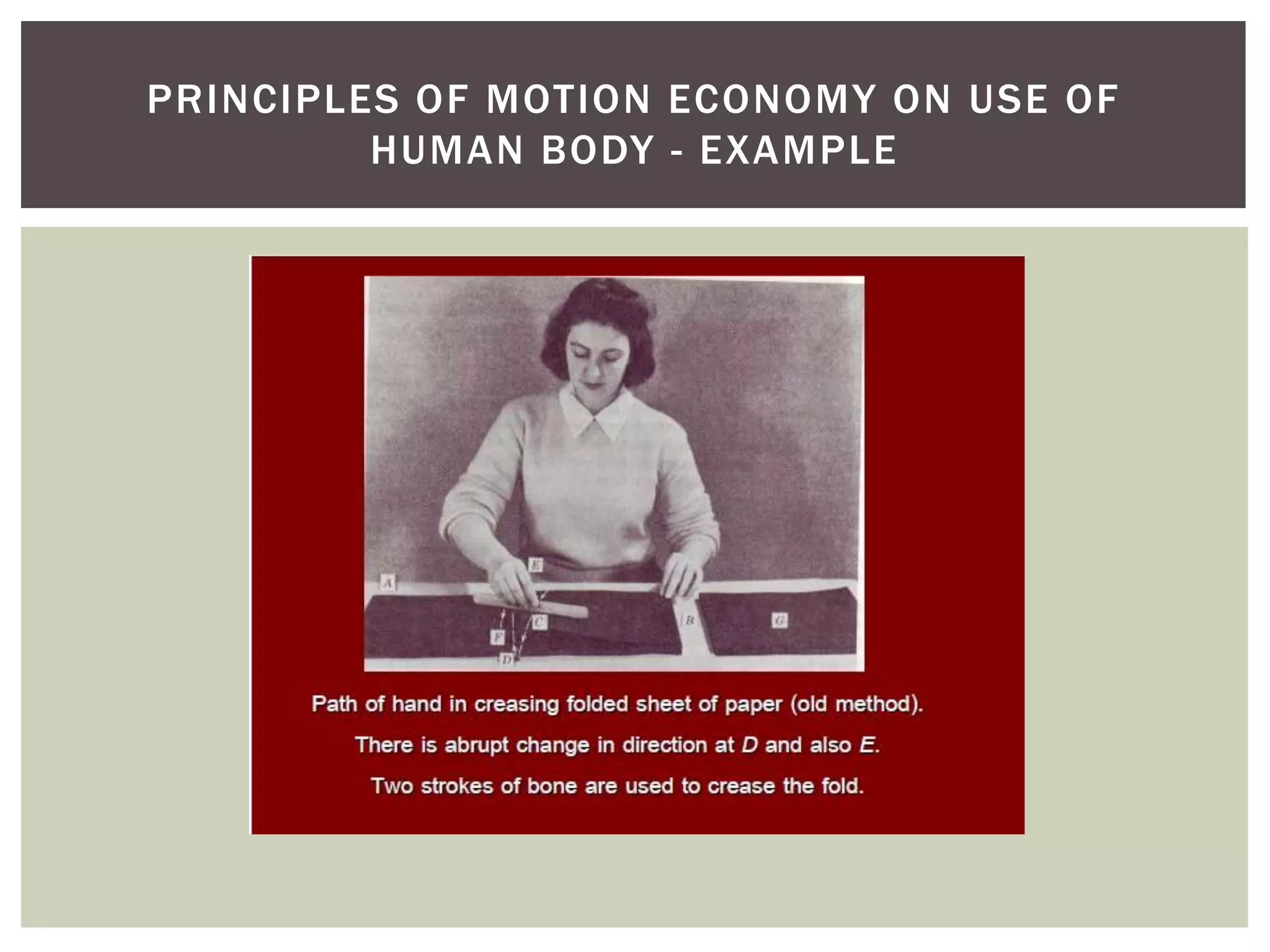
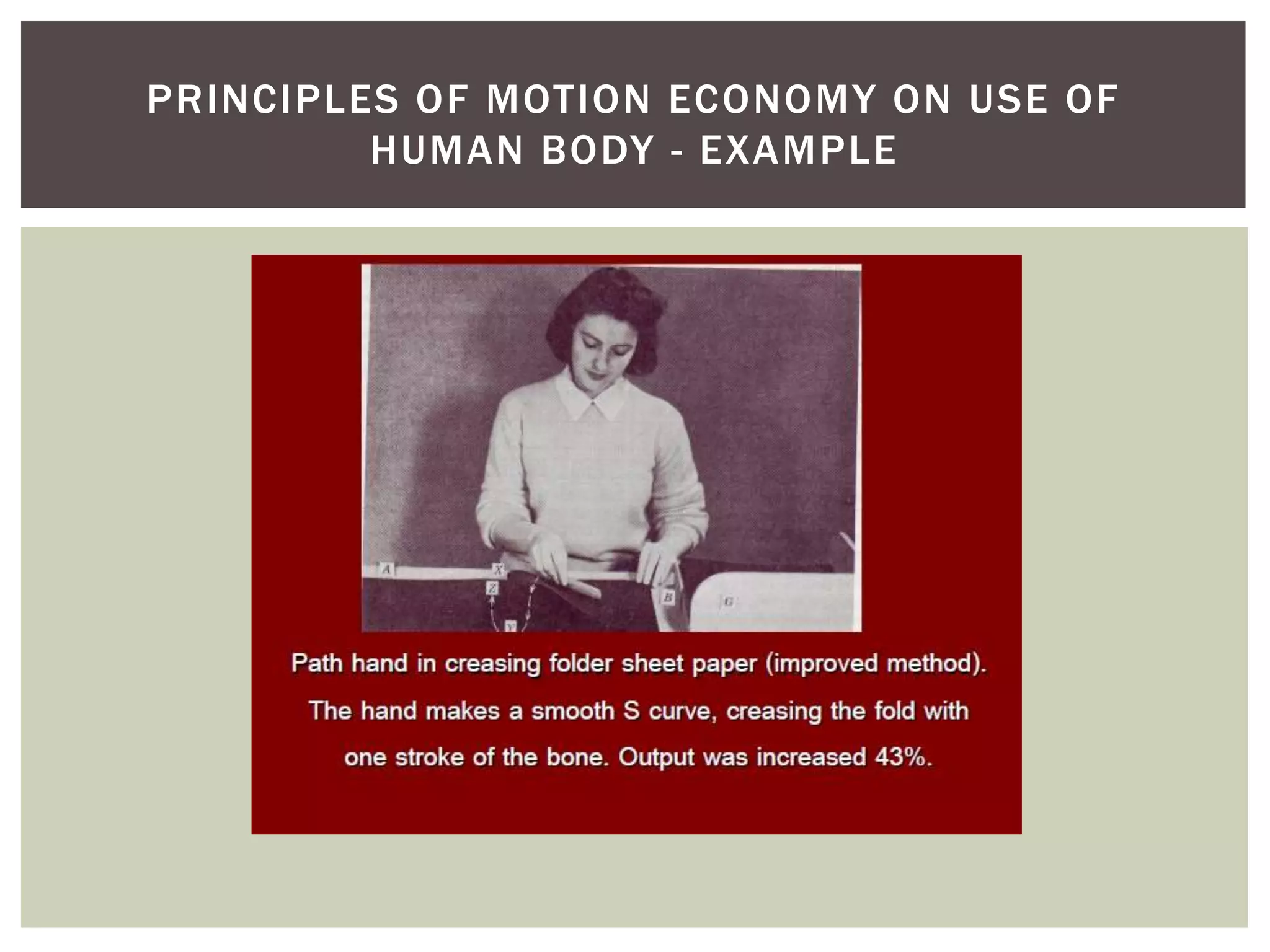
6. Smooth continuous cur ved motions of the hands are
   preferable to straight line motion involving sudden
    and sharp changes in direction.
7. Ballistic movements are faster, easier, and more
   accurate than restricted (fixation) or “controlled”
   movements.
8. Work should be arranged to permit an easy and natural
    rhythm wherever possible.
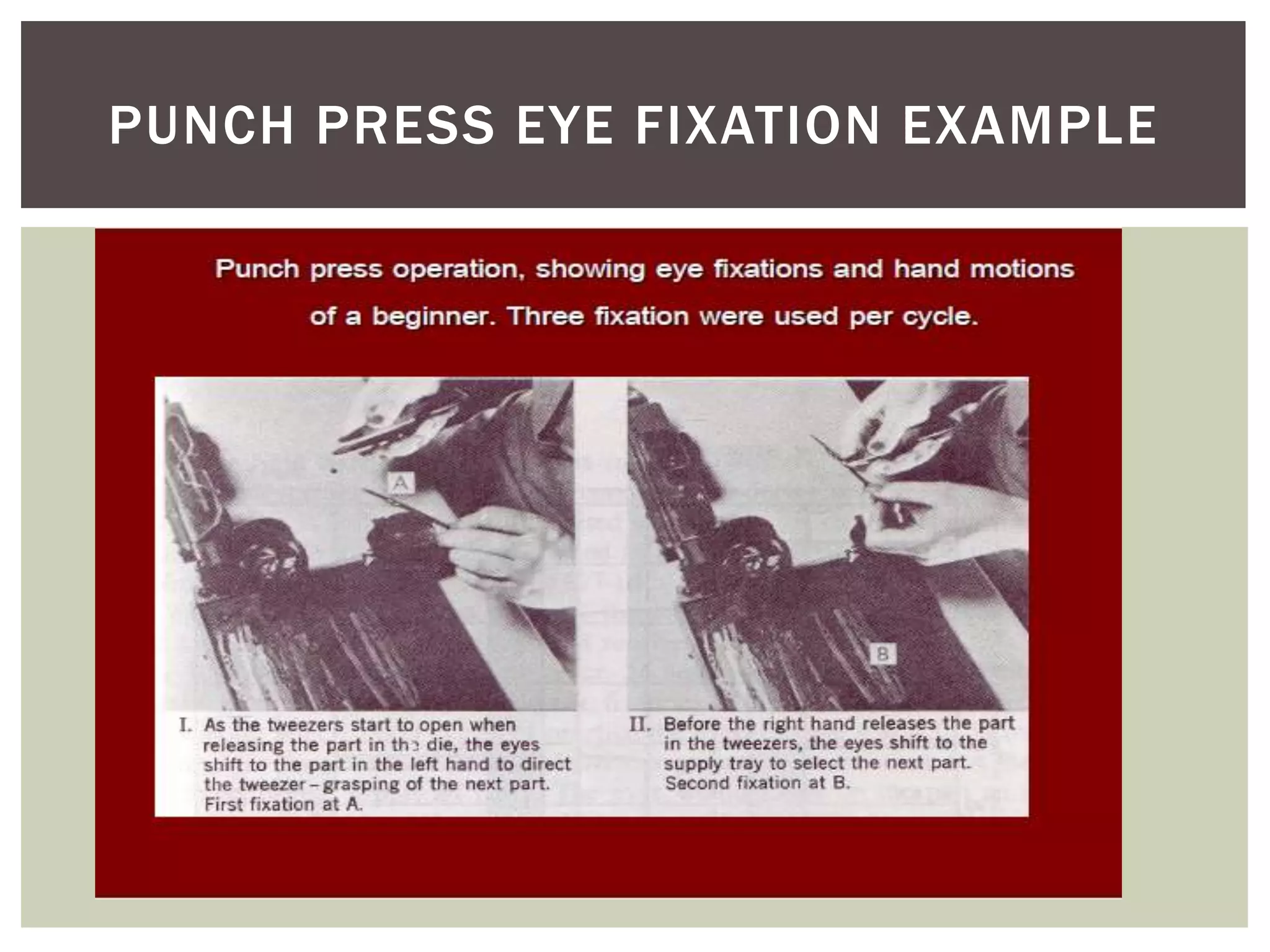
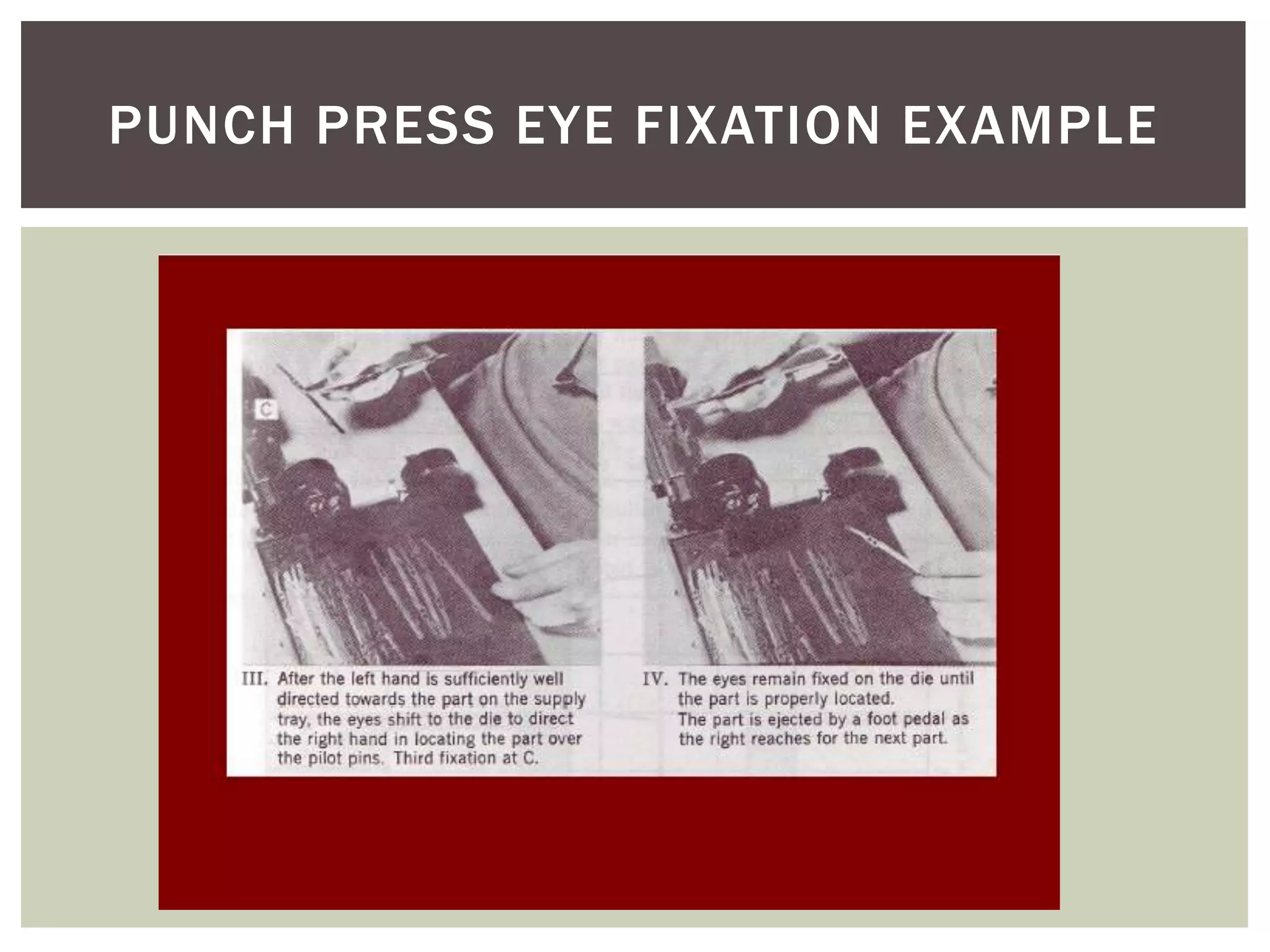
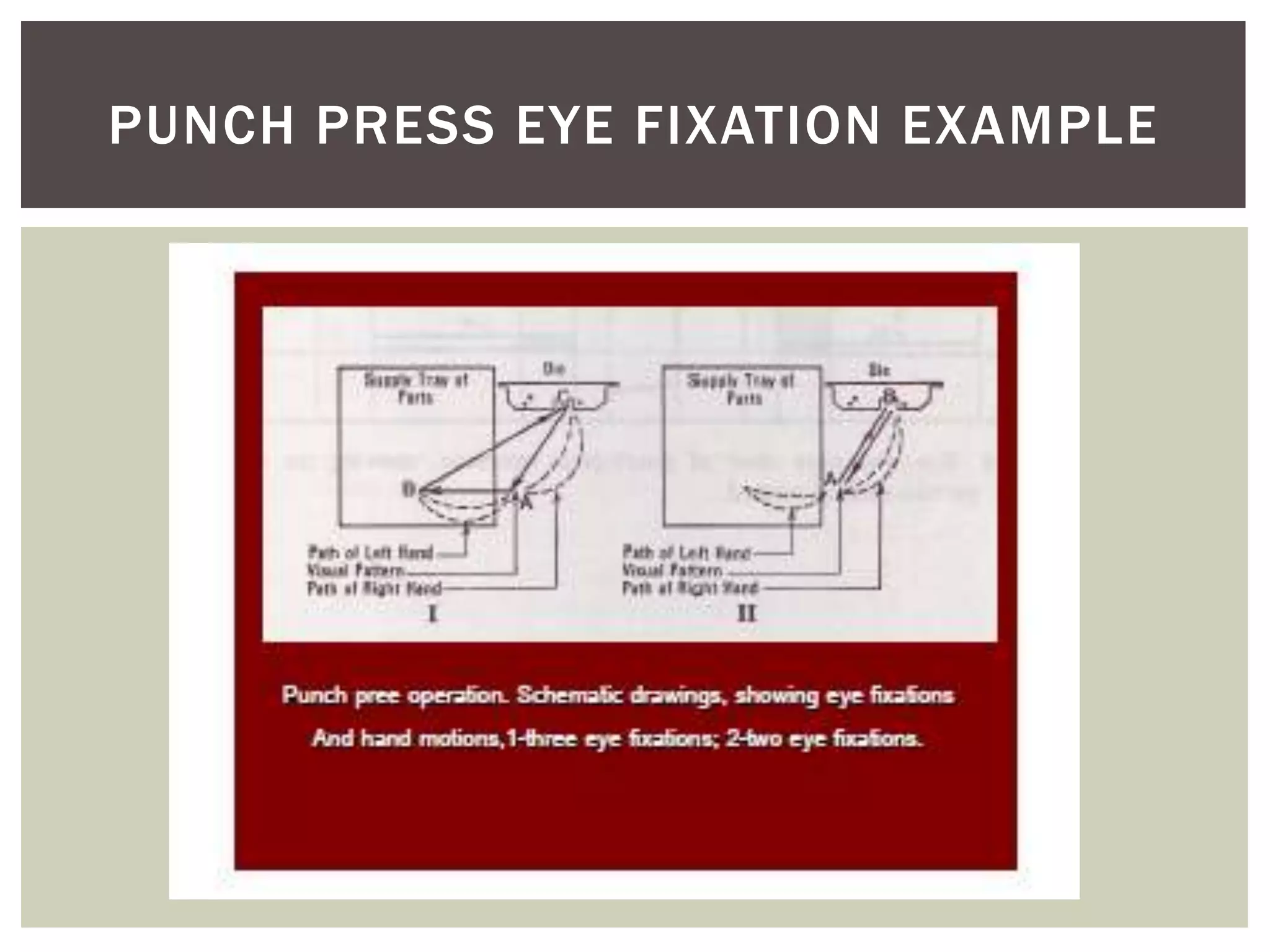
9. Eye fixations should be as few as close together as
    possible.
 - Eye Movements
 - Eye – Hand Coordination
EXAMPLE ON USE OF HUMAN BODY USING MOTION
               PICTURE FILM


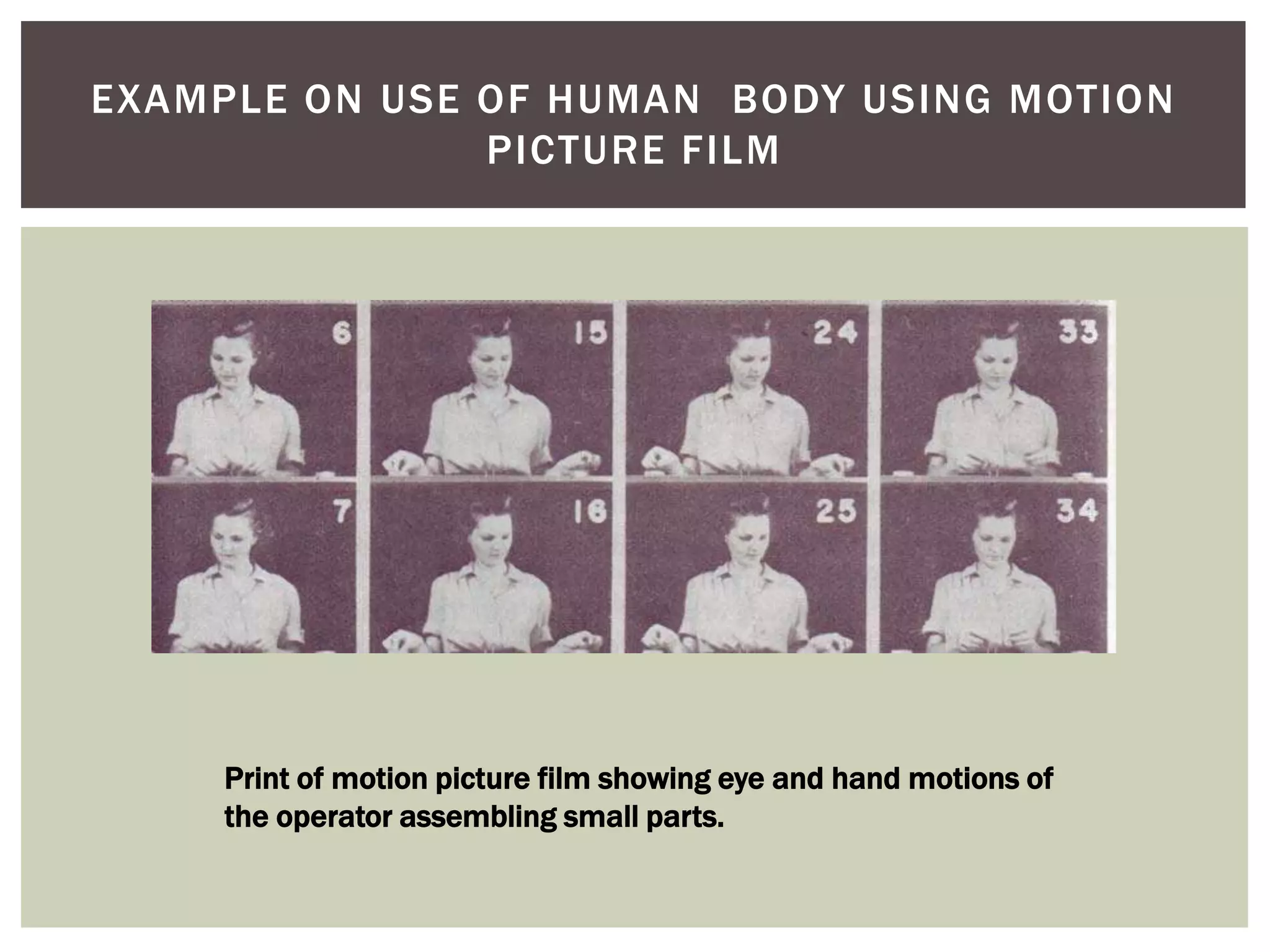
     Print of motion picture film showing eye and hand motions of
     the operator assembling small parts.
PRINCIPLES OF MOTION ECONOMY ON USE OF
         HUMAN BODY - EXAMPLE
PRINCIPLES OF MOTION ECONOMY ON USE OF
         HUMAN BODY - EXAMPLE
PUNCH PRESS EYE FIXATION EXAMPLE
PRINCIPLES RELATED TO ARRANGEMENT OF
                    WORKPLACE

   Principle of motion economy as related to the
   work place.
1 . There should be a definite and fixed place for all tools
    and materials.
2. Tools, materials, and controls should be located close
    to the point of use.
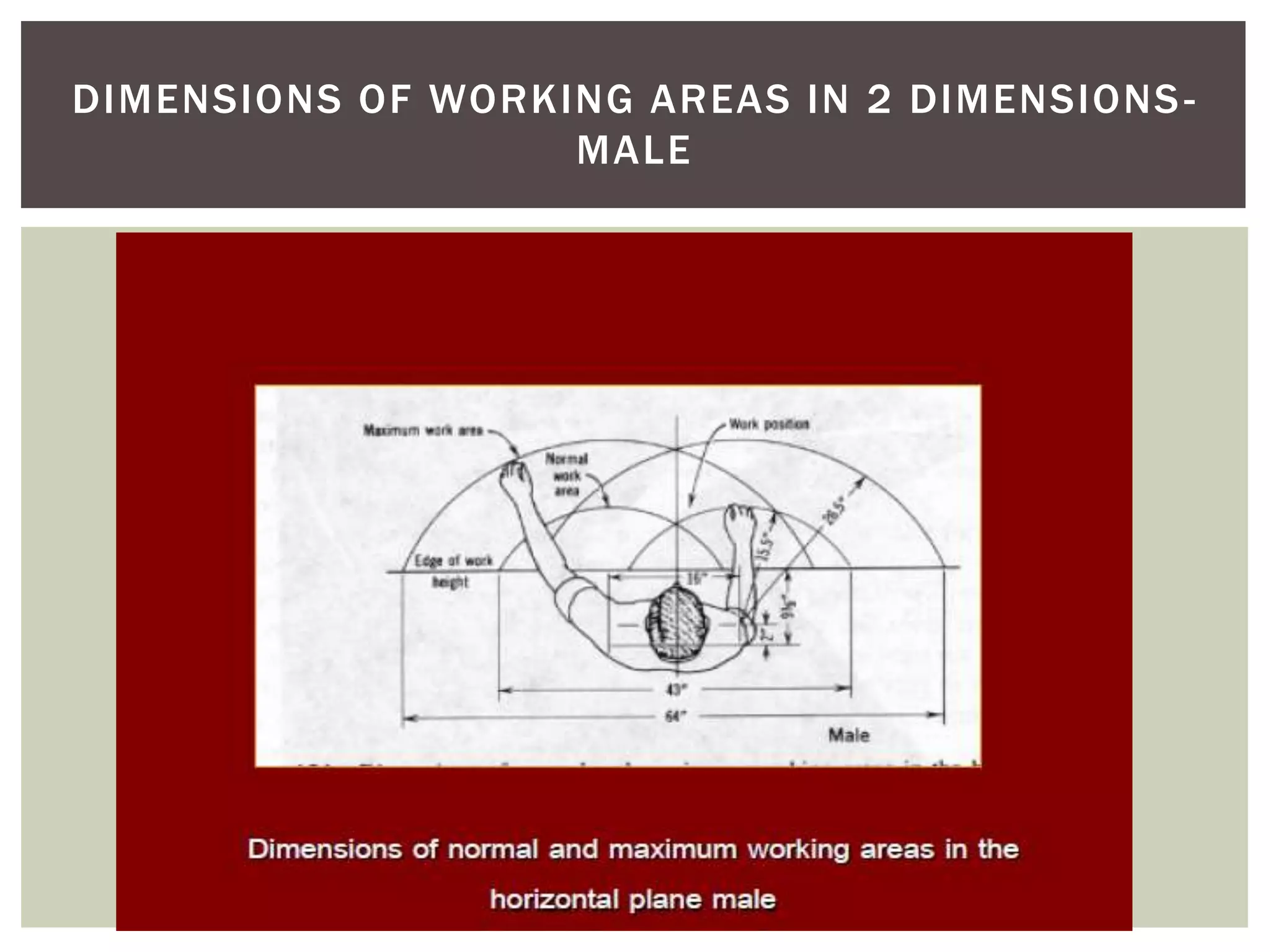
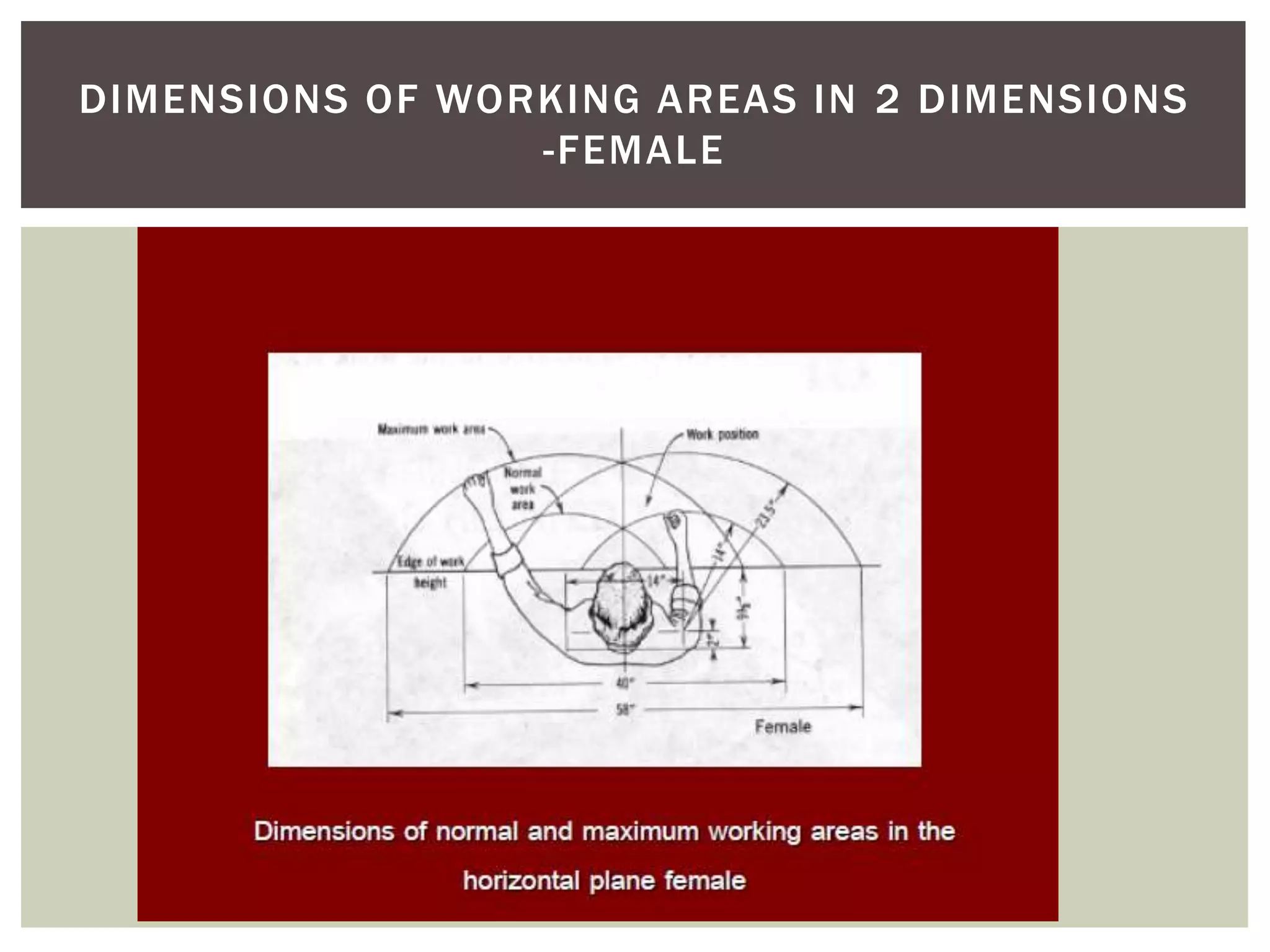
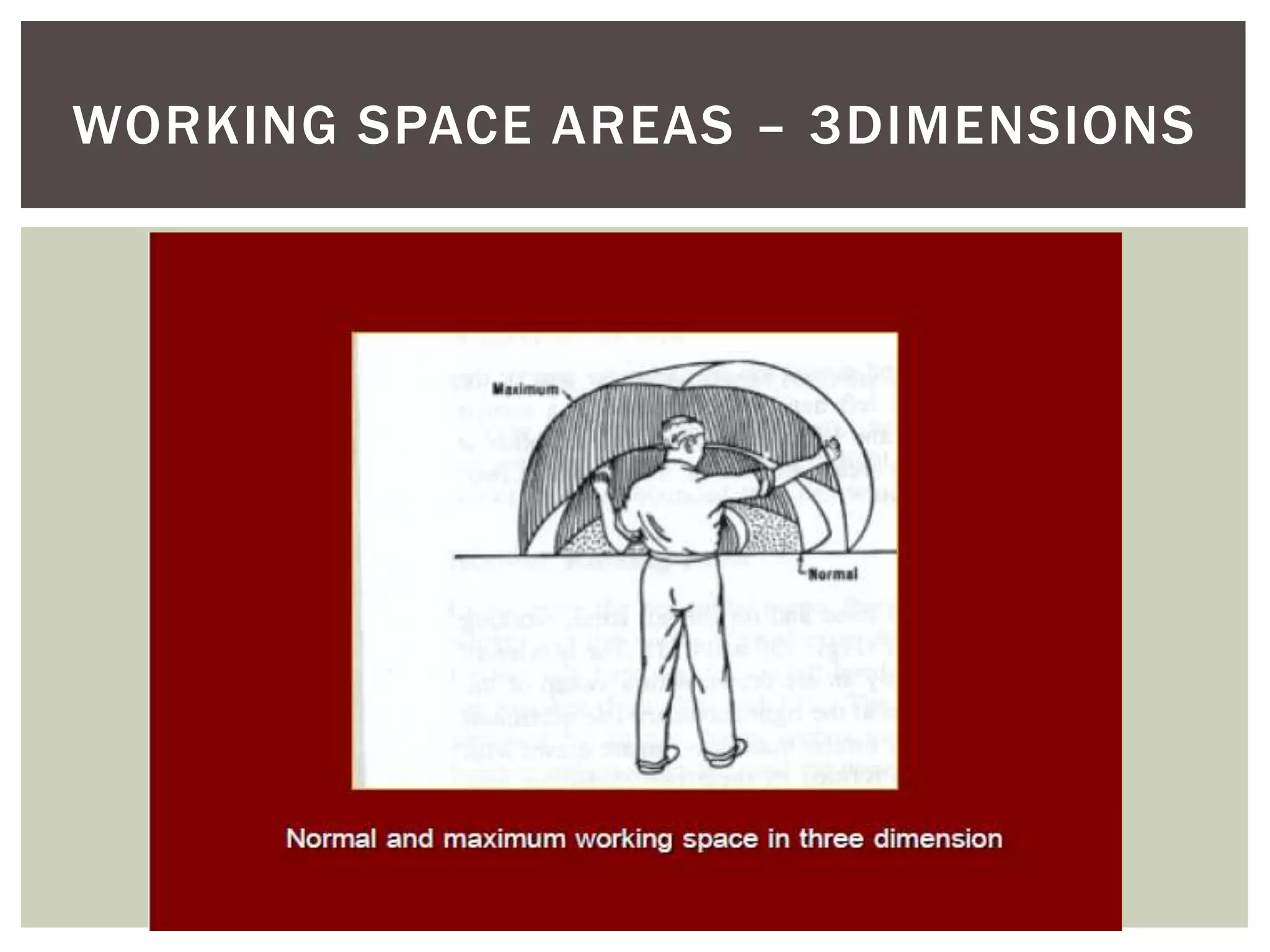
 - Normal working area
 - Maximum working area
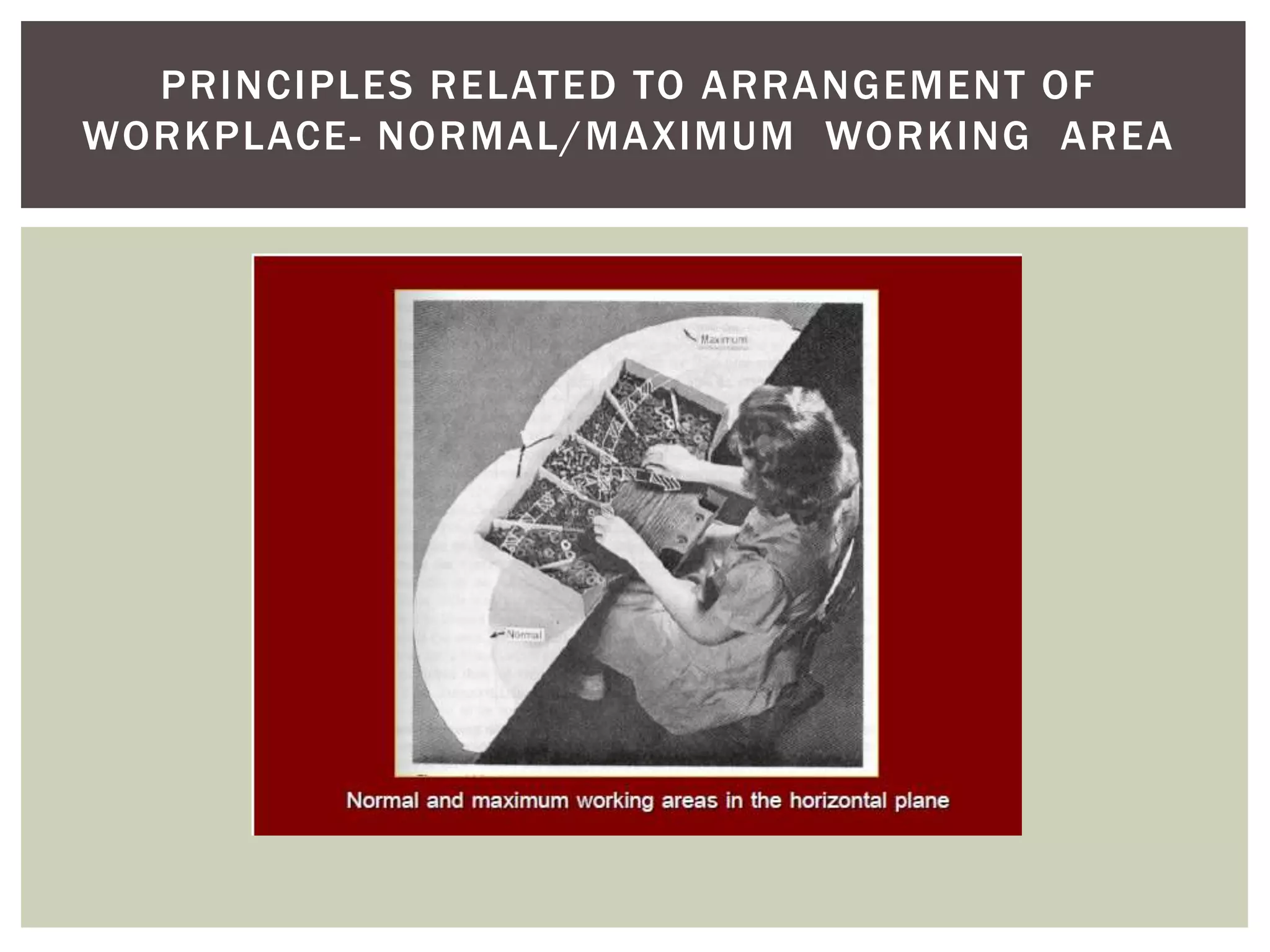
PRINCIPLES RELATED TO ARRANGEMENT OF
WORKPLACE- NORMAL/MAXIMUM WORKING AREA
DIMENSIONS OF WORKING AREAS IN 2 DIMENSIONS -
                   MALE
DIMENSIONS OF WORKING AREAS IN 2 DIMENSIONS
                 -FEMALE
WORKING SPACE AREAS – 3DIMENSIONS
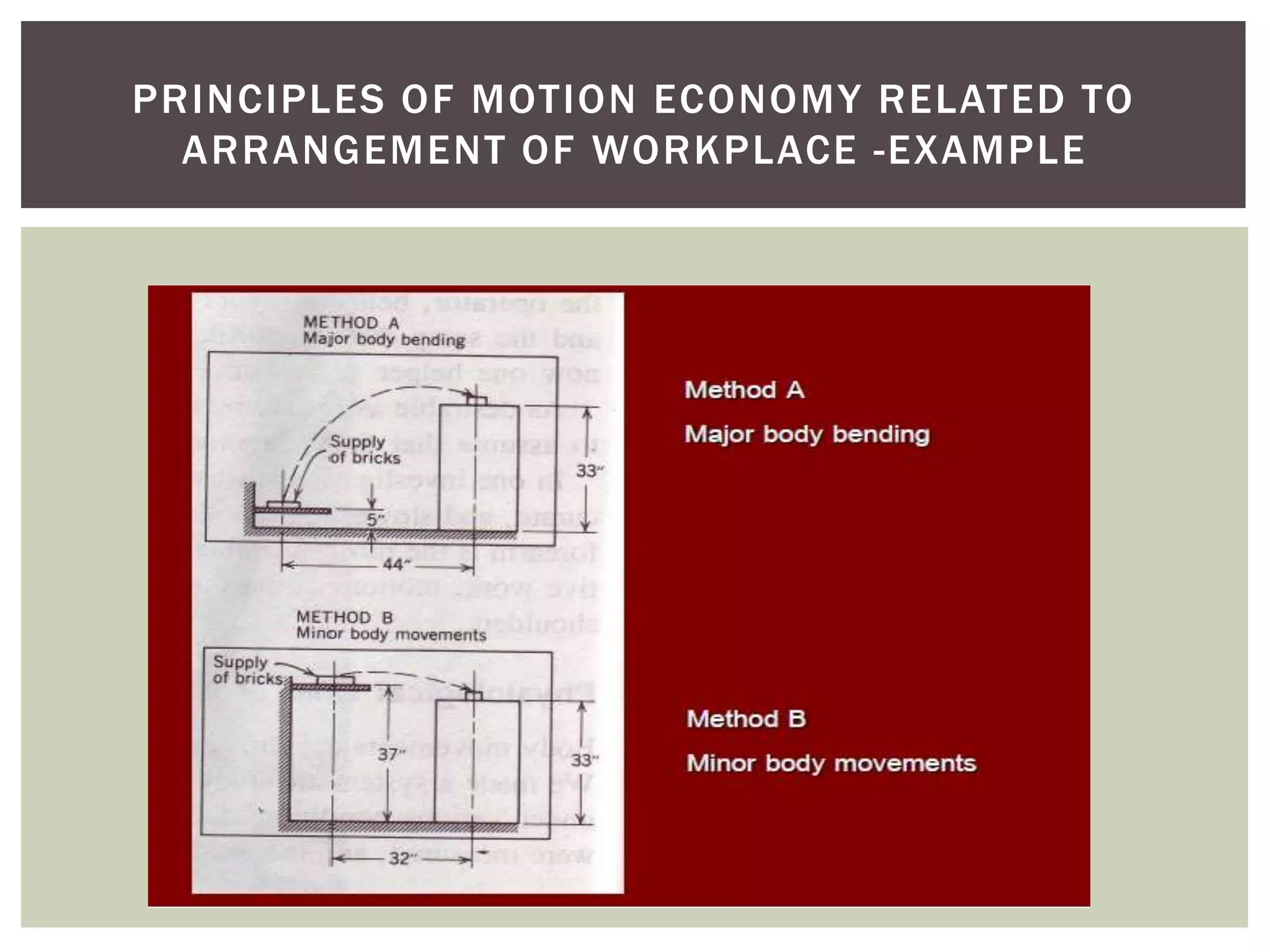
PRINCIPLES OF MOTION ECONOMY RELATED TO
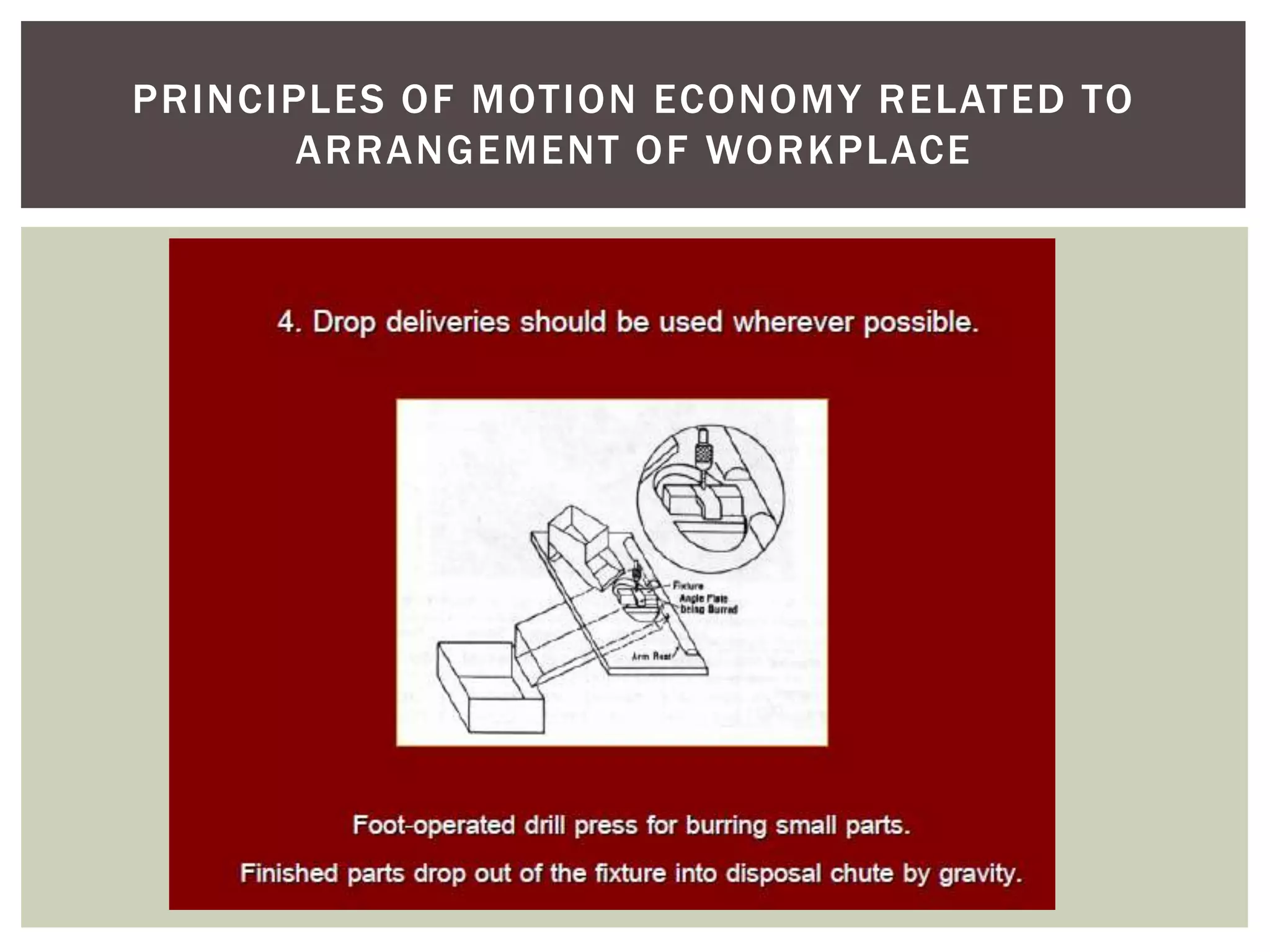
  ARRANGEMENT OF WORKPLACE -EXAMPLE
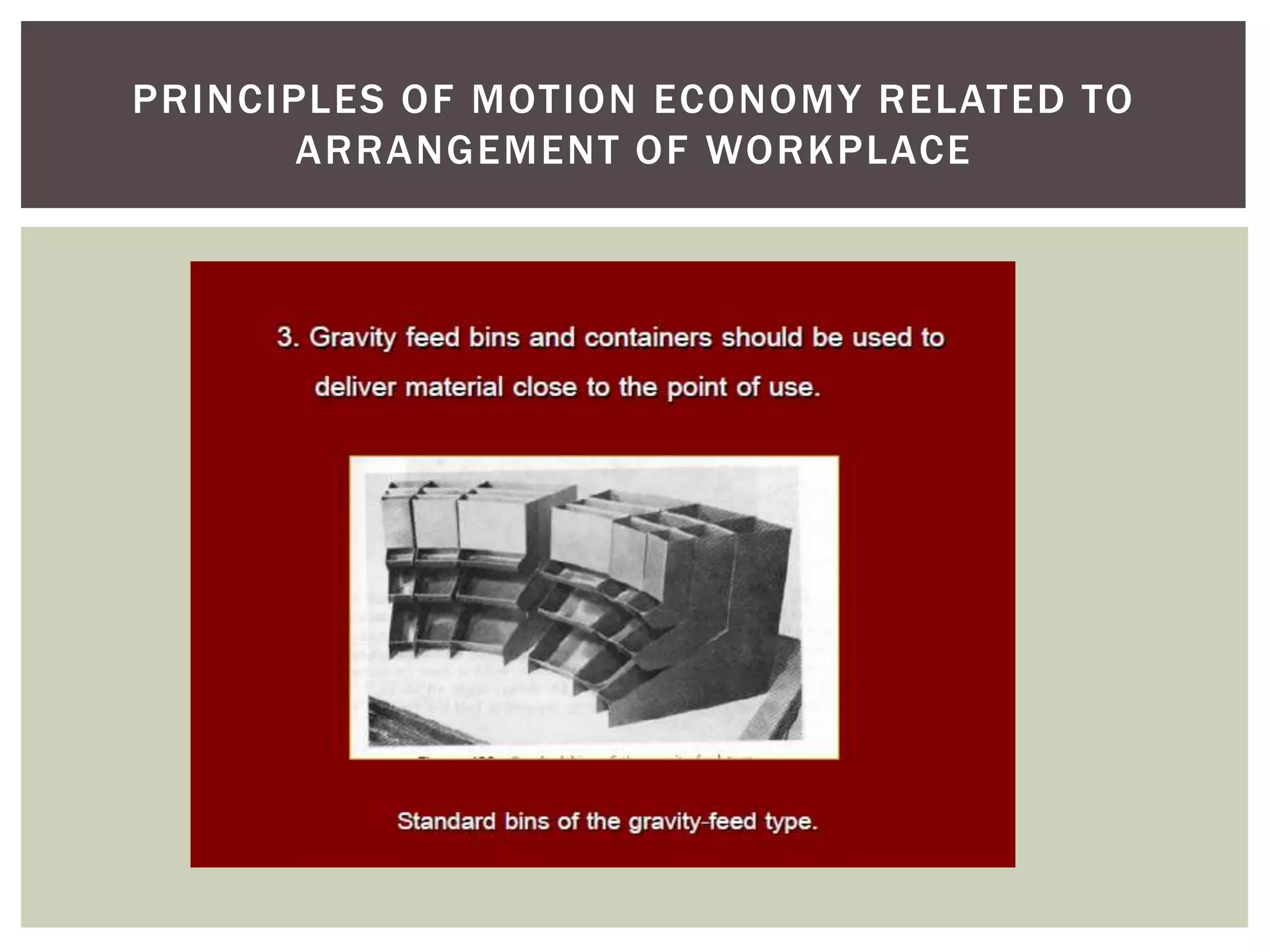
PRINCIPLES OF MOTION ECONOMY RELATED TO
       ARRANGEMENT OF WORKPLACE
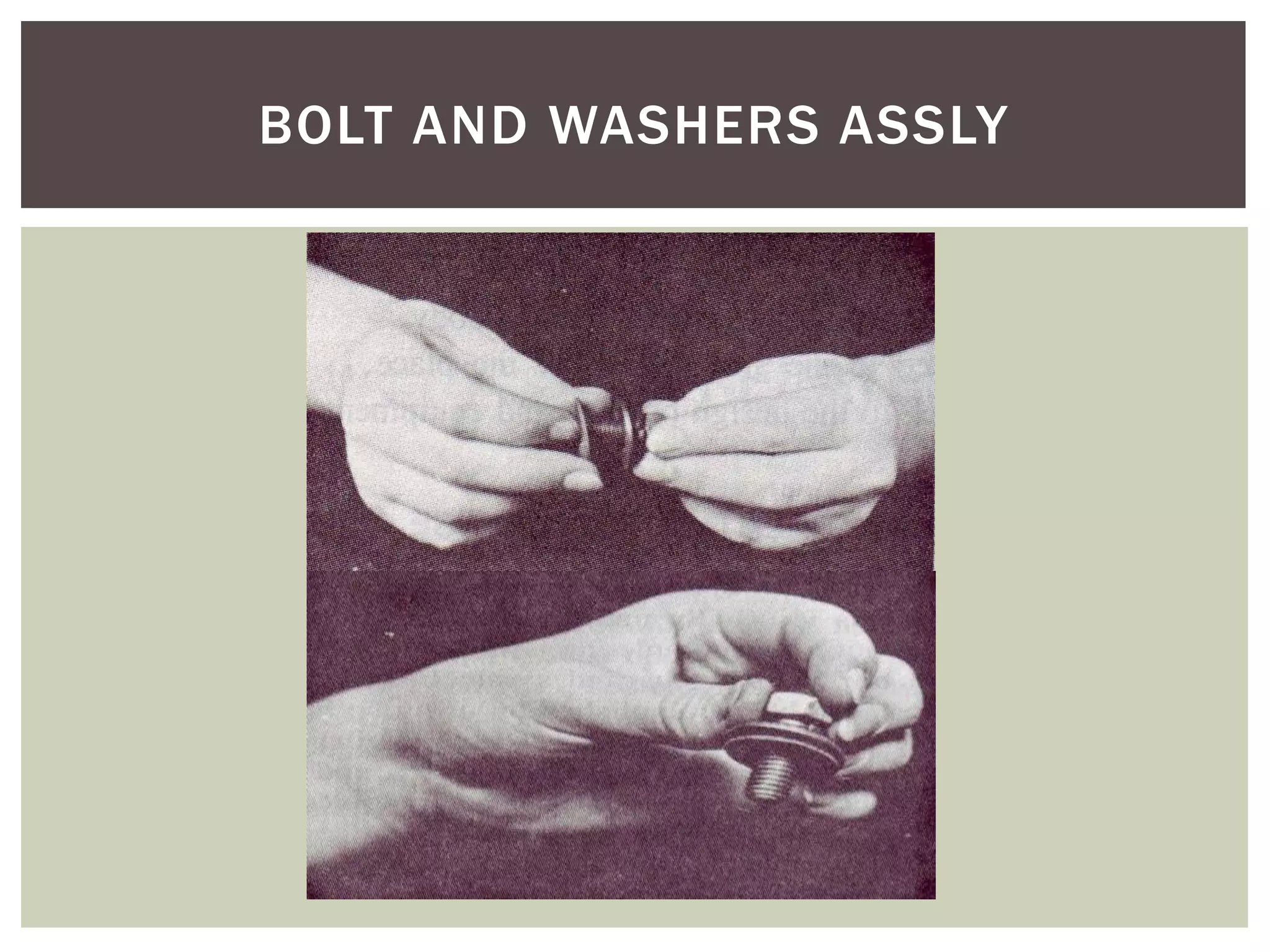
BOLT AND WASHERS ASSLY
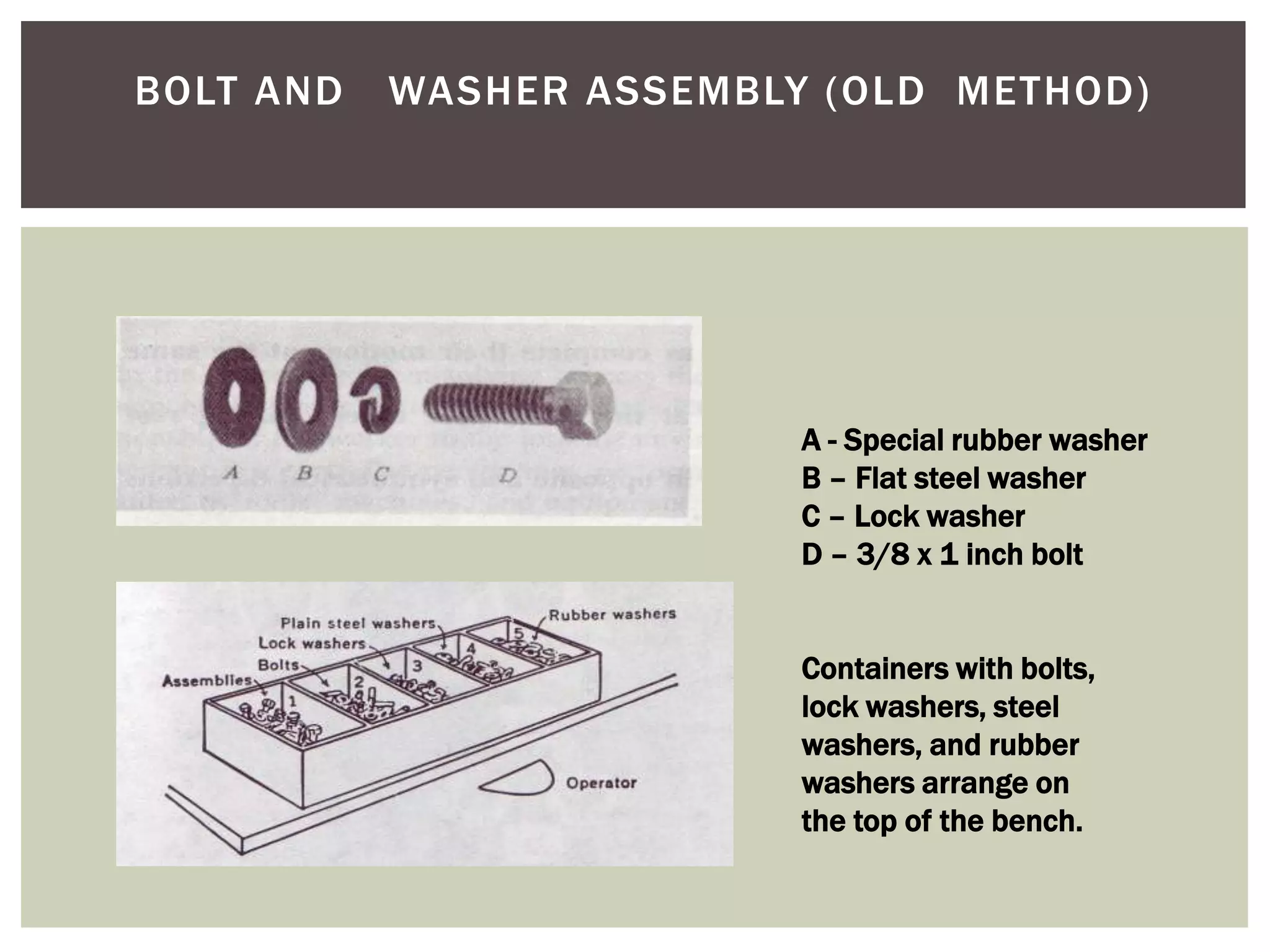
BOLT AND   WASHER ASSEMBLY (OLD METHOD)


                          A - Special rubber washer
                          B – Flat steel washer
                          C – Lock washer
                          D – 3/8 x 1 inch bolt


                          Containers with bolts,
                          lock washers, steel
                          washers, and rubber
                          washers arrange on
                          the top of the bench.
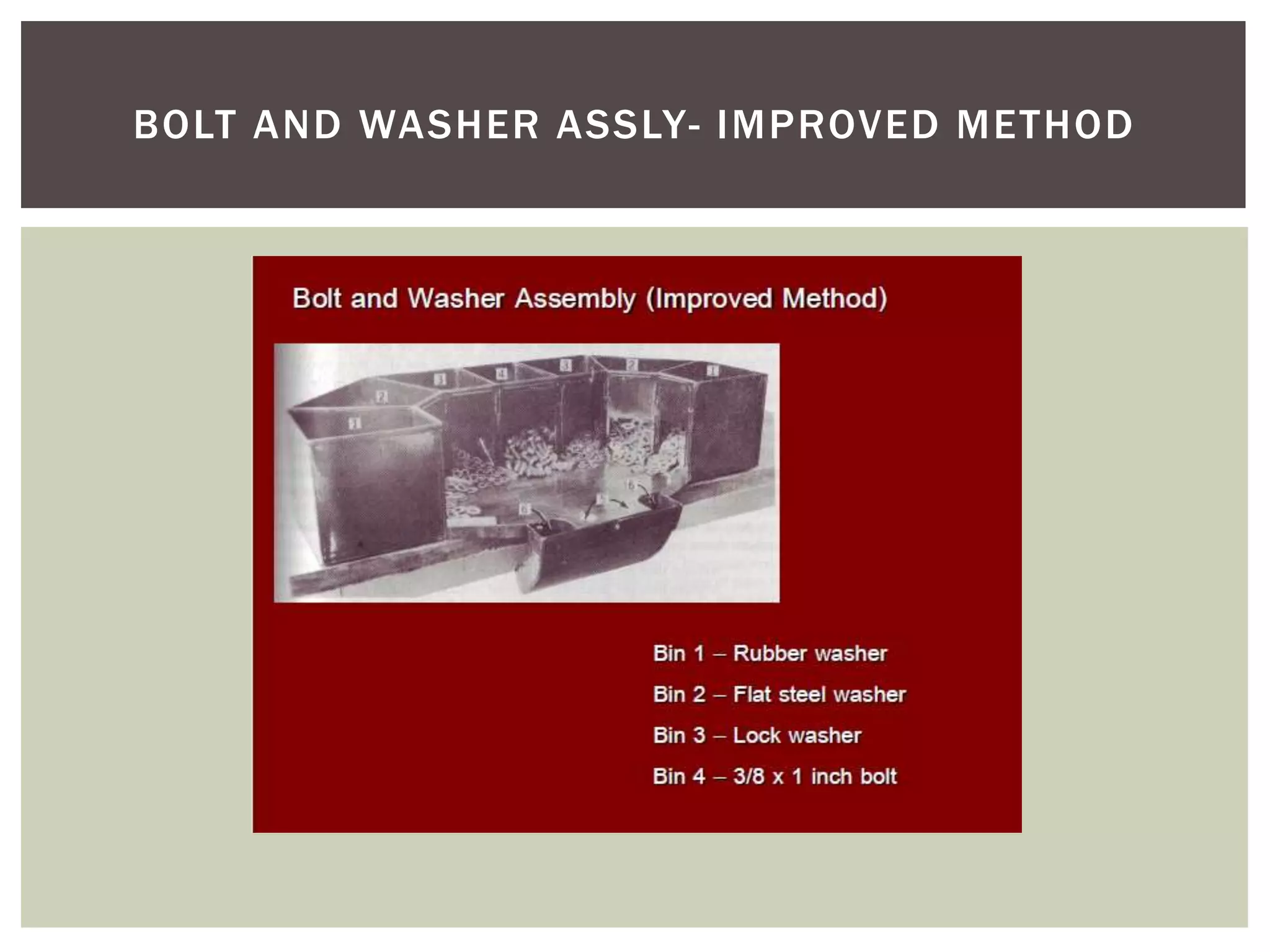
BOLT AND WASHER ASSLY- IMPROVED METHOD
PRINCIPLES OF MOTION ECONOMY RELATED TO
       ARRANGEMENT OF WORKPLACE
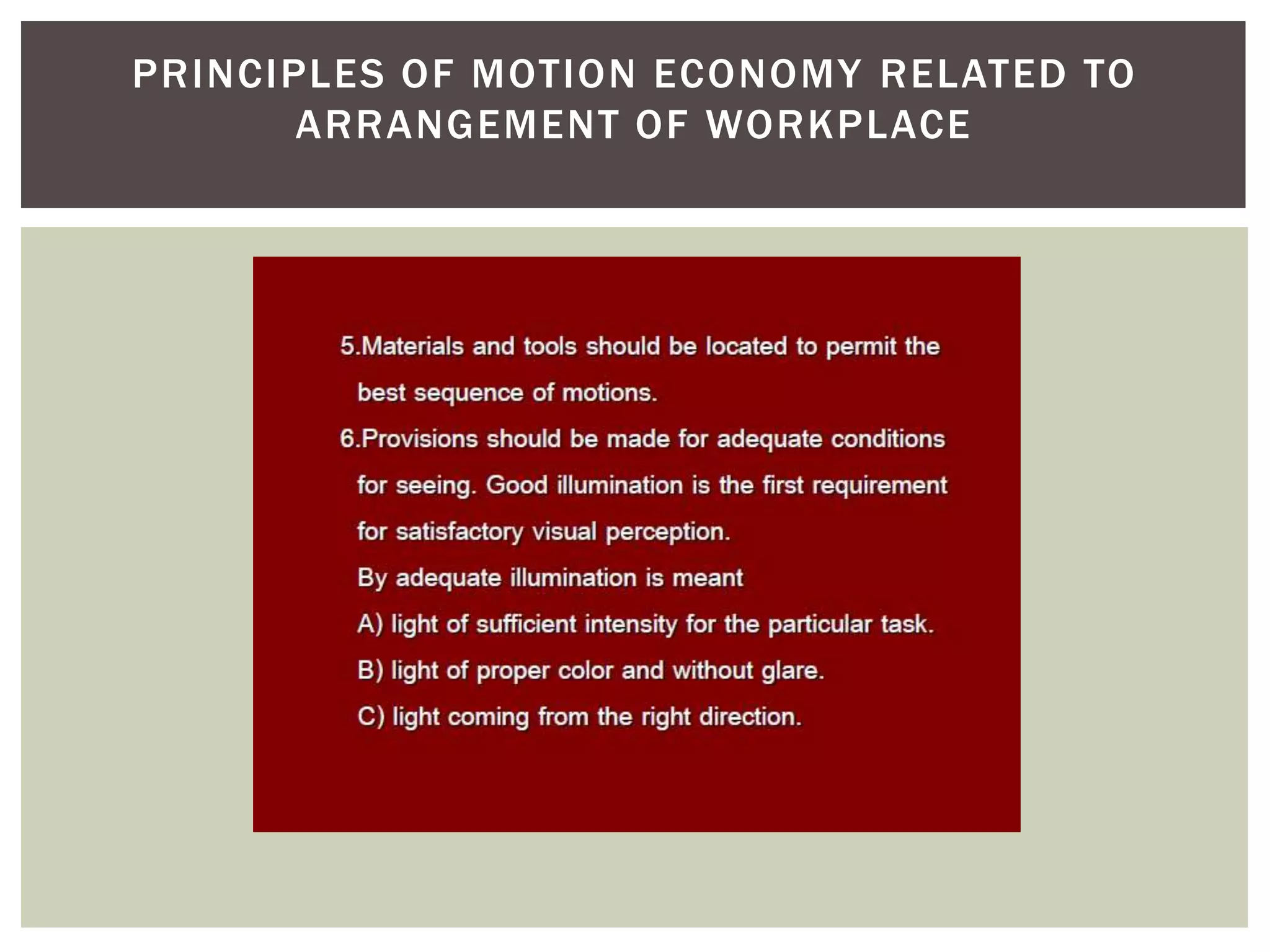
PRINCIPLES OF MOTION ECONOMY RELATED TO
       ARRANGEMENT OF WORKPLACE
PRINCIPLES OF MOTION ECONOMY RELATED TO
          ARRANGEMENT OF WORKPLACE


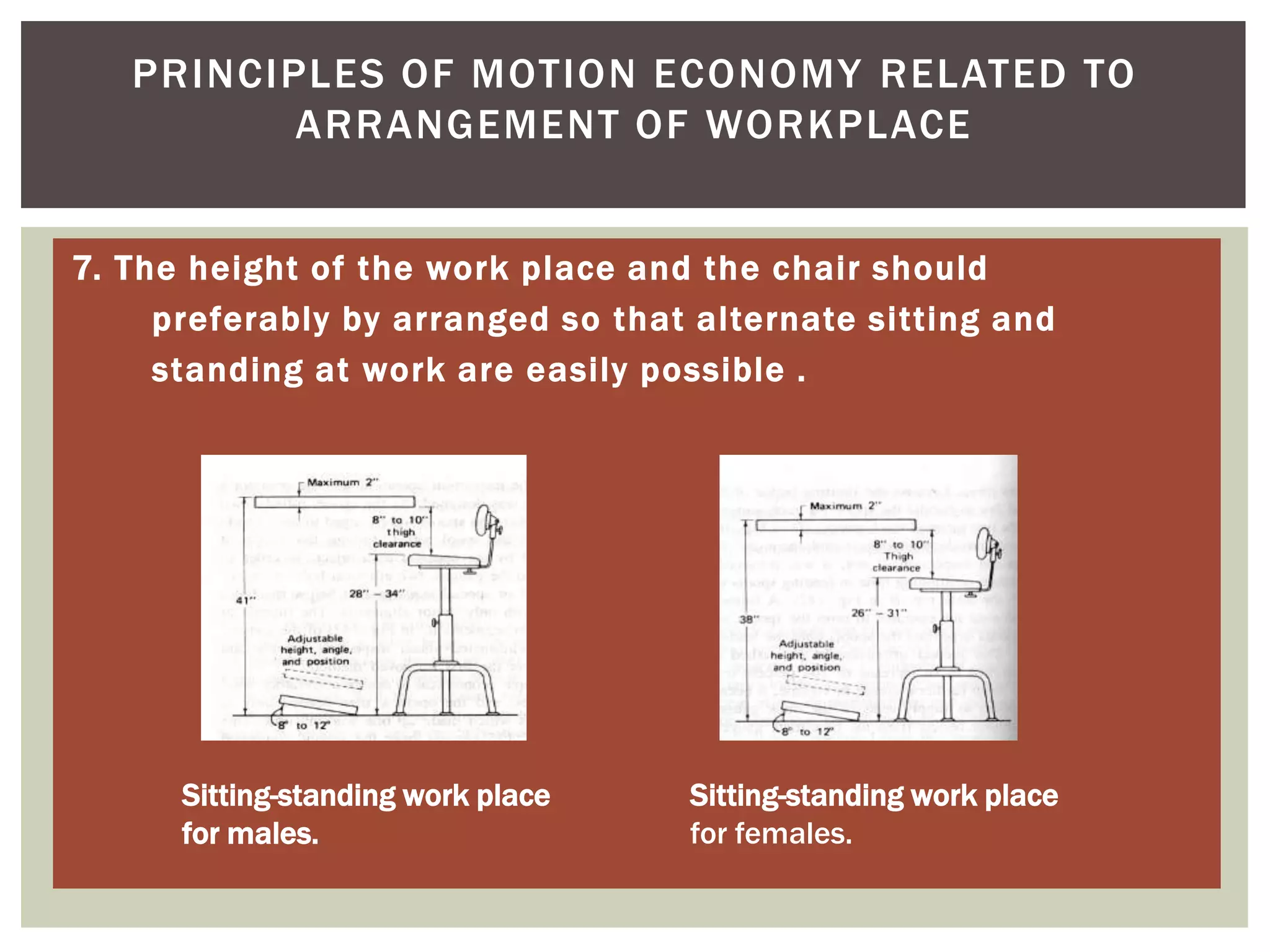
7. The height of the work place and the chair should
     preferably by arranged so that alternate sitting and
     standing at work are easily possible .


      Sitting-standing work place   Sitting-standing work place
      for males.                    for females.
PRINCIPLES OF MOTION ECONOMY RELATED TO
          ARRANGEMENT OF WORKPLACE


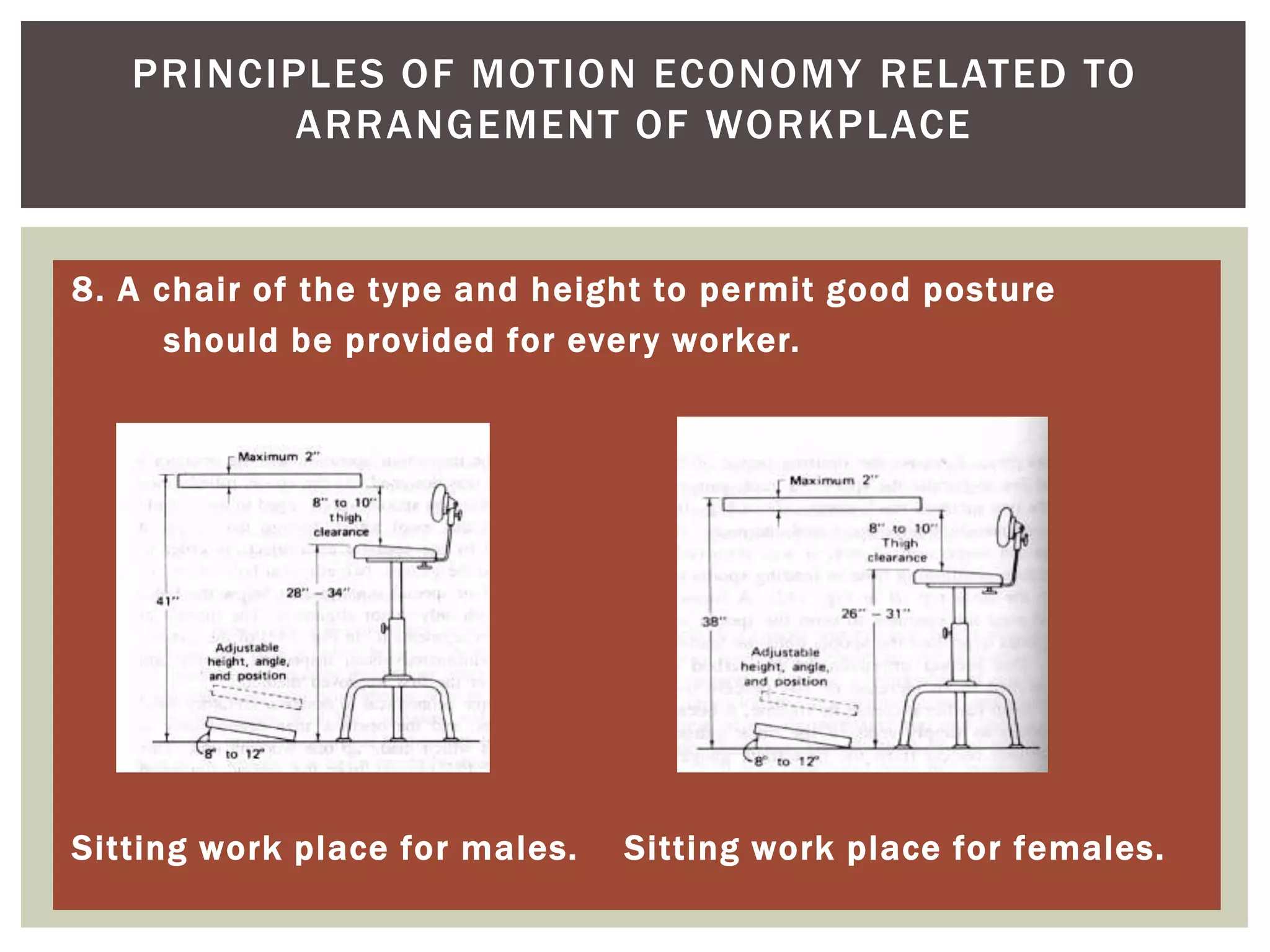
8. A chair of the type and height to permit good posture
      should be provided for every worker.


Sitting work place for males.   Sitting work place for females.
PRINCIPLES OF MOTION ECONOMY RELATED TO
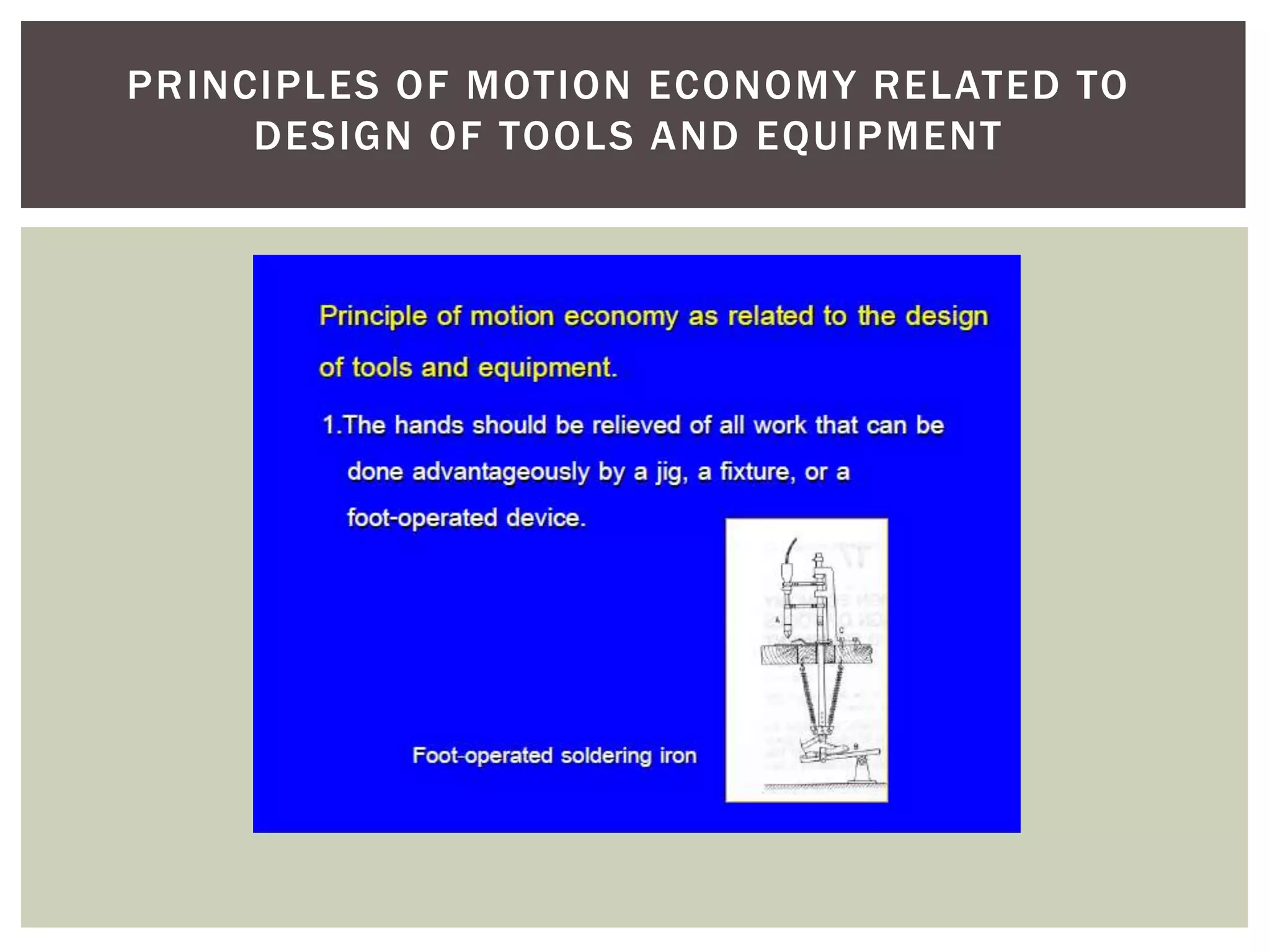
     DESIGN OF TOOLS AND EQUIPMENT
PRINCIPLE OF MOTION ECONOMY RELATED TO
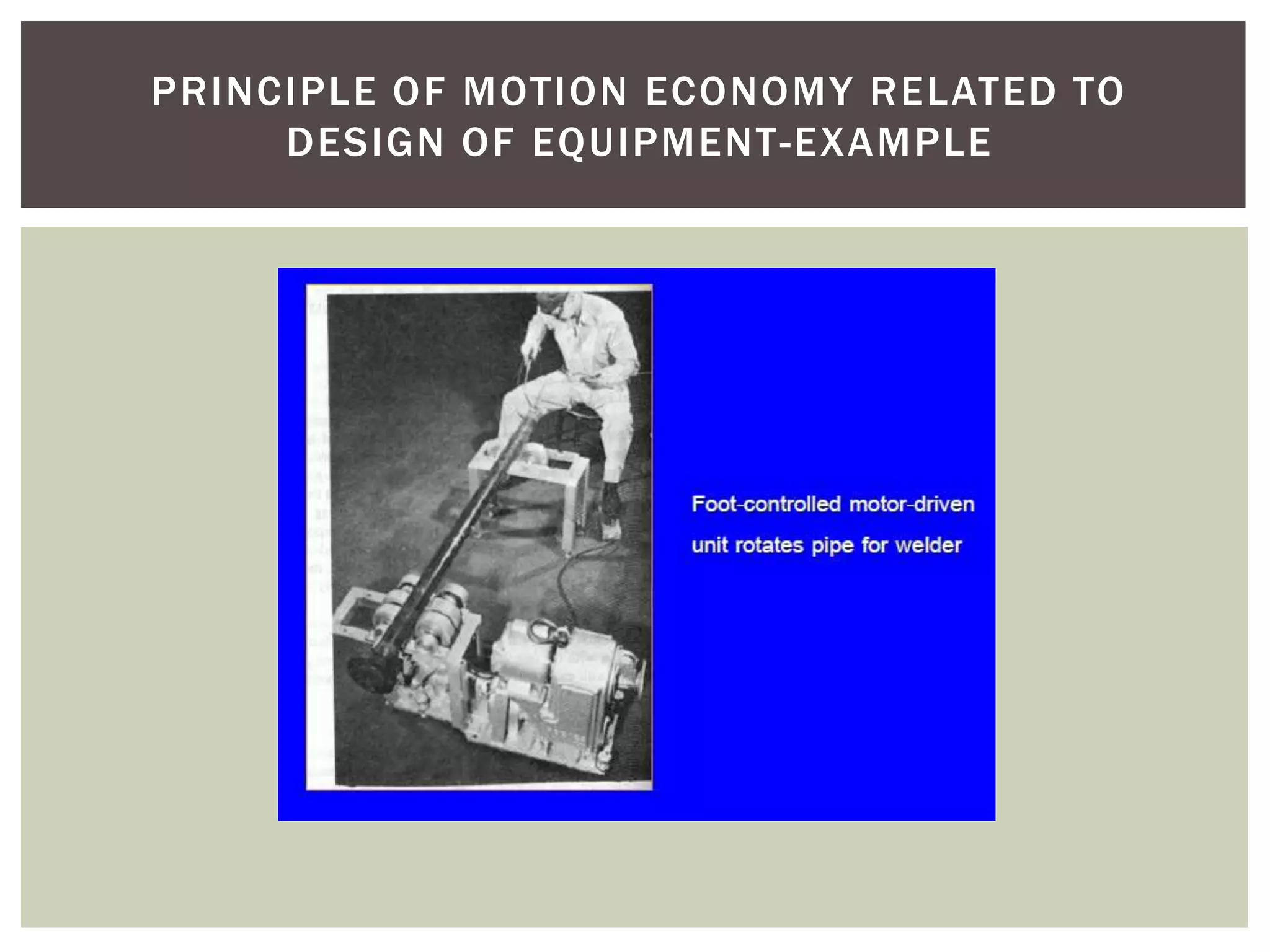
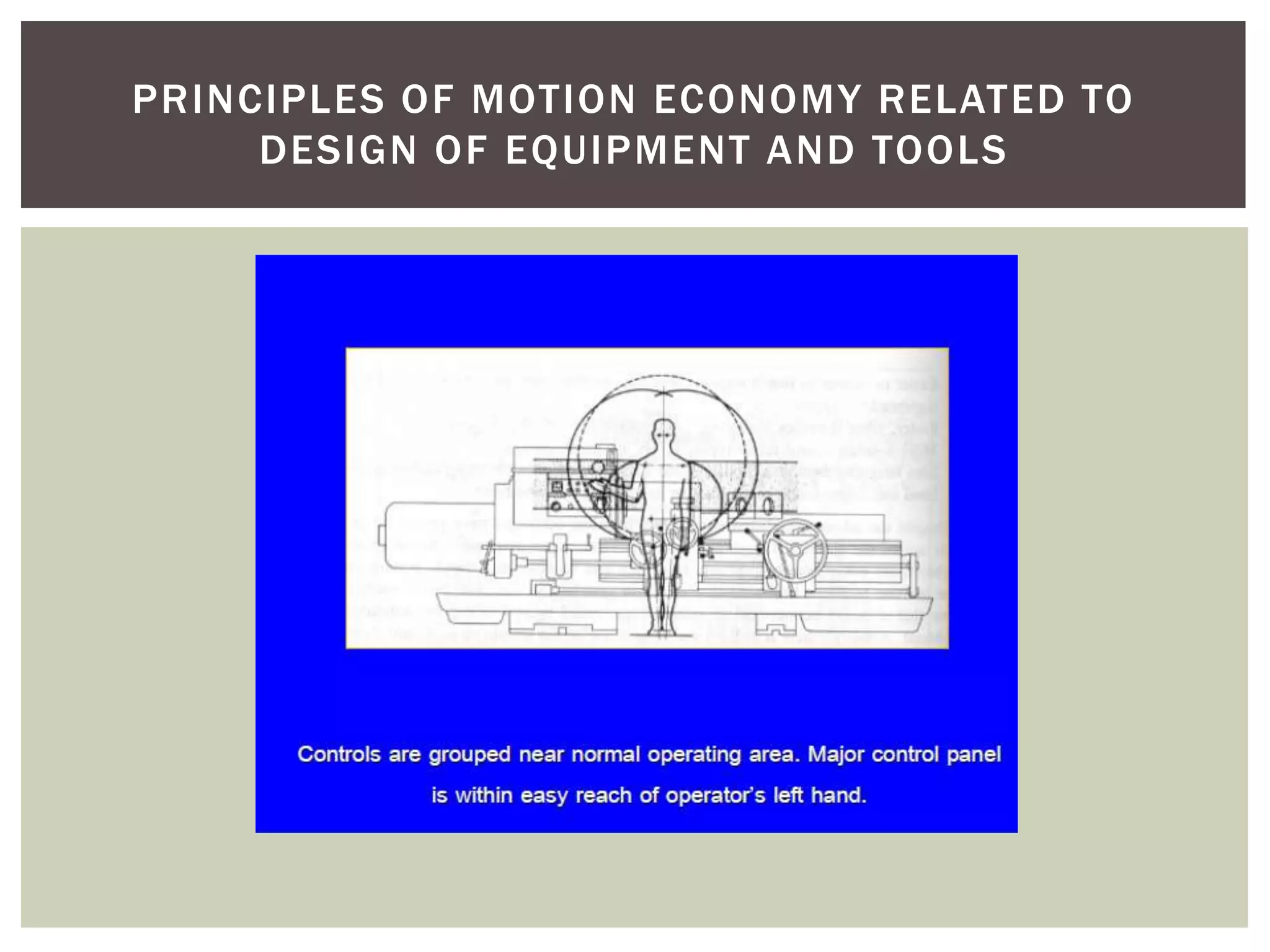
     DESIGN OF EQUIPMENT-EXAMPLE
PRINCIPLE OF MOTION ECONOMY RELATED TO
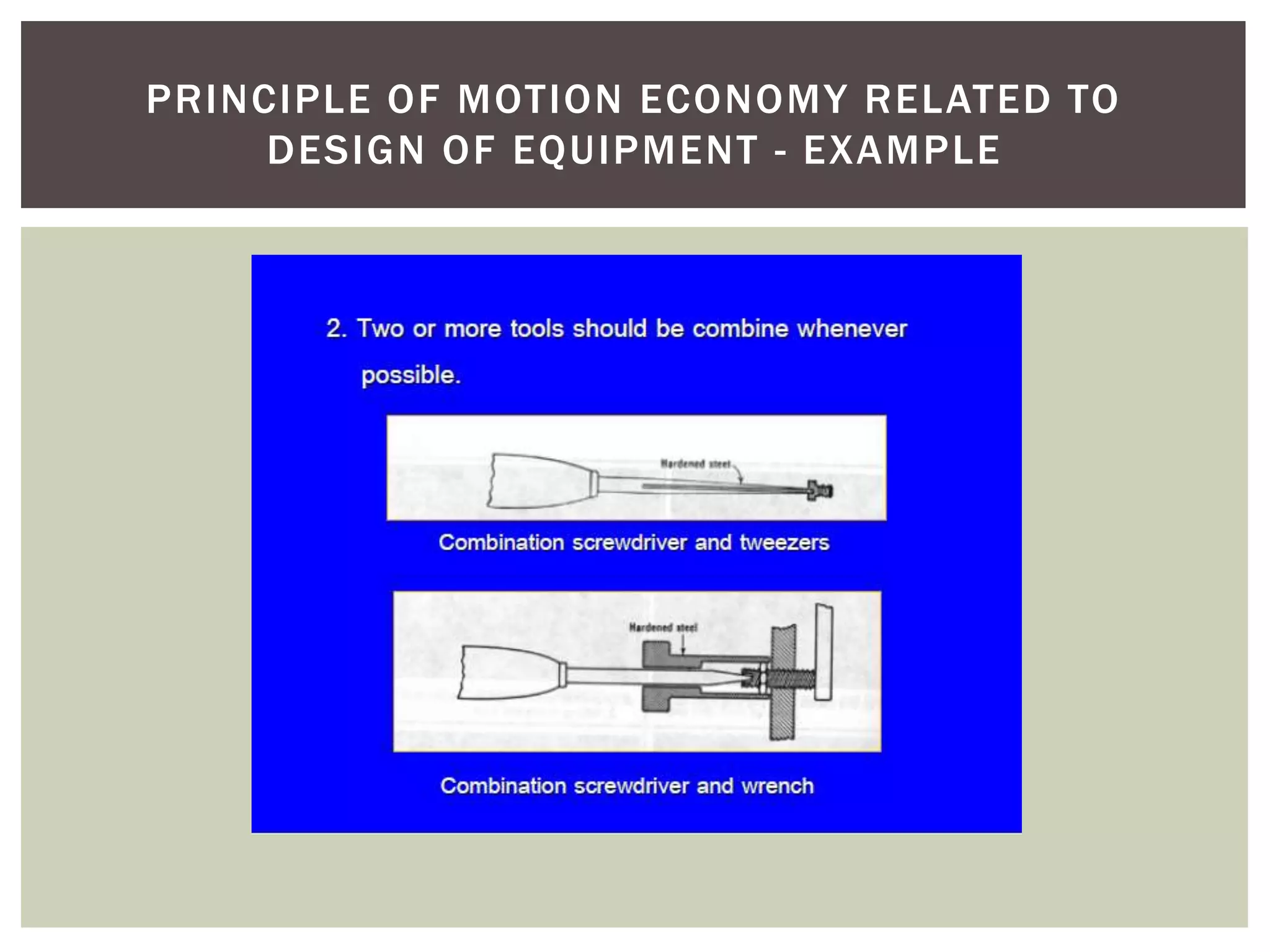
     DESIGN OF EQUIPMENT - EXAMPLE
PRINCIPLE OF MOTION ECONOMY RELATED TO
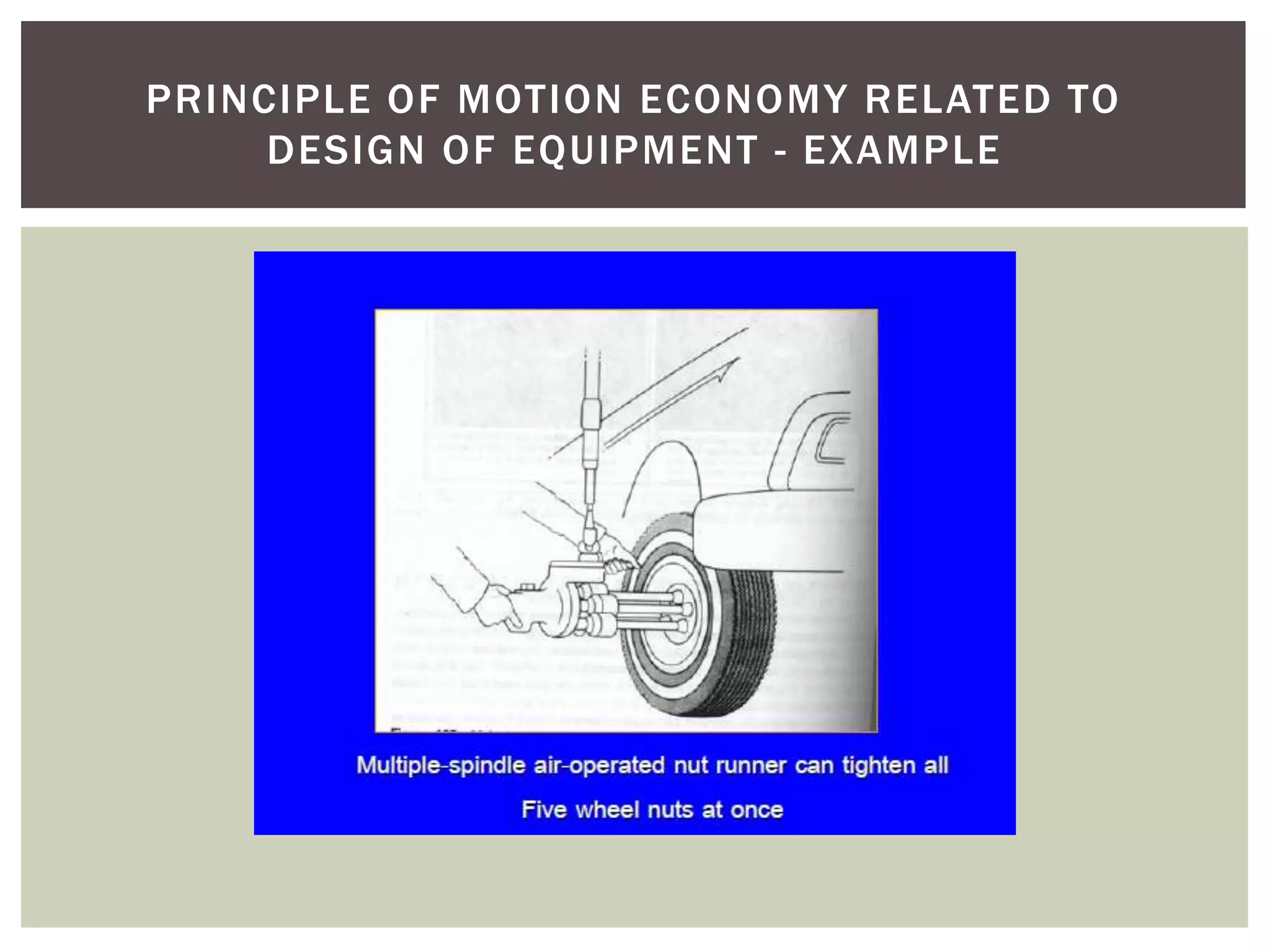
     DESIGN OF EQUIPMENT - EXAMPLE
PRINCIPLES OF MOTION ECONOMY RELATED TO
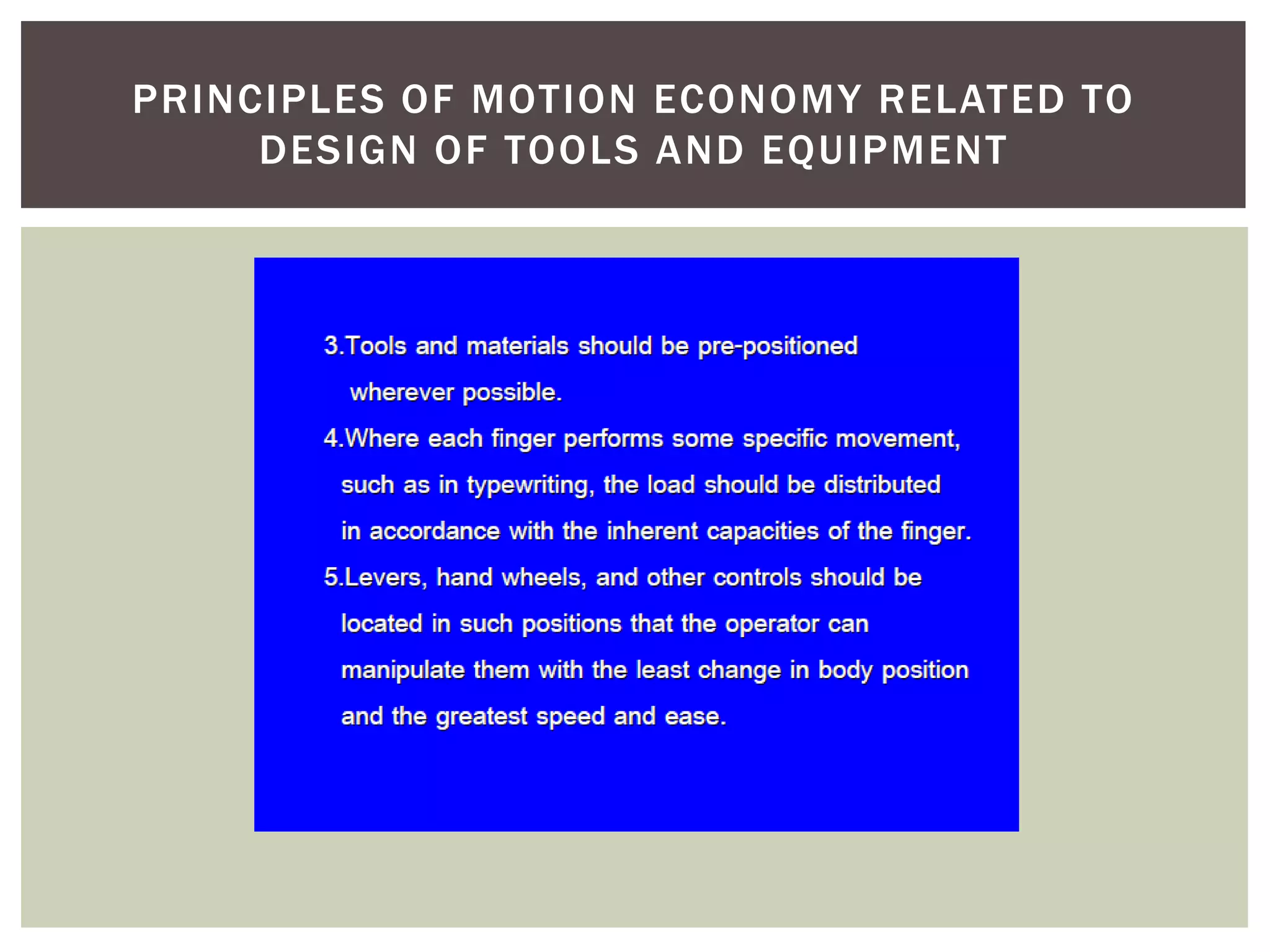
     DESIGN OF TOOLS AND EQUIPMENT
PRINCIPLES OF MOTION ECONOMY RELATED TO
     DESIGN OF EQUIPMENT AND TOOLS

Principles of Motion Economy

  • 1.
    PRINCIPLES OF MOTION ECONOMY PREPARED BY JJOSEPH GEORGE KONNULLY
  • 2.
    SUBDIVISIONS OF PRINCIPLESOF MOTION ECONOMY Principles of motion economy will be presented under the following three subdivisions: 1) Principles of motion economy as related to the human body. 2) Principles of motion economy as related to the arrangement of the place. 3) Principles of motion economy as related to the design of tools and equipment.
  • 3.
    PRINCIPLES OF MOTIONECONOMY RELATED TO USE OF HUMAN BODY Principle of m otion economy as related to t he u se of t he human body. 1 . T he two hands should begin as well as complete t heir m otions at t he same t ime. 2. T he two hands should not be idle at t he same t ime except du ring rest period. 3. Motions of t he arms should be m ade in opposite and symmetrical directions and should be m ade simultaneously. 4. Hand and body motions should be confined to the lowest classification with which it is possible to per form the work sat isfactorily. General Classification o f Hand Motions a. Finger m otions. b. Motions involving fingers and wrist. c. Motions involving fingers, wrist, and forearm. d. Motions involving fingers, wrist, forearm, and u pper arm. e. Motions involving fingers, wrist, forearm, u pper arm and shoulder.
  • 4.
    PRINCIPLES OF MOTIOMECONOMY RELATED TO USE OF HUMAN BODY 5. Momentum should be employed to assist the worker wherever possible, and it should be reduced to a minimum if it must be overcome by muscular effort. 6. Smooth continuous cur ved motions of the hands are preferable to straight line motion involving sudden and sharp changes in direction. 7. Ballistic movements are faster, easier, and more accurate than restricted (fixation) or “controlled” movements. 8. Work should be arranged to permit an easy and natural rhythm wherever possible. 9. Eye fixations should be as few as close together as possible.  - Eye Movements  - Eye – Hand Coordination
  • 5.
    EXAMPLE ON USEOF HUMAN BODY USING MOTION PICTURE FILM Print of motion picture film showing eye and hand motions of the operator assembling small parts.
  • 6.
    PRINCIPLES OF MOTIONECONOMY ON USE OF HUMAN BODY - EXAMPLE
  • 7.
    PRINCIPLES OF MOTIONECONOMY ON USE OF HUMAN BODY - EXAMPLE
  • 8.
    PUNCH PRESS EYEFIXATION EXAMPLE
  • 9.
    PUNCH PRESS EYEFIXATION EXAMPLE
  • 10.
    PUNCH PRESS EYEFIXATION EXAMPLE
  • 11.
    PRINCIPLES RELATED TOARRANGEMENT OF WORKPLACE Principle of motion economy as related to the work place. 1 . There should be a definite and fixed place for all tools and materials. 2. Tools, materials, and controls should be located close to the point of use.  - Normal working area  - Maximum working area
  • 12.
    PRINCIPLES RELATED TOARRANGEMENT OF WORKPLACE- NORMAL/MAXIMUM WORKING AREA
  • 13.
    DIMENSIONS OF WORKINGAREAS IN 2 DIMENSIONS - MALE
  • 14.
    DIMENSIONS OF WORKINGAREAS IN 2 DIMENSIONS -FEMALE
  • 15.
    WORKING SPACE AREAS– 3DIMENSIONS
  • 16.
    PRINCIPLES OF MOTIONECONOMY RELATED TO ARRANGEMENT OF WORKPLACE -EXAMPLE
  • 17.
    PRINCIPLES OF MOTIONECONOMY RELATED TO ARRANGEMENT OF WORKPLACE
  • 18.
  • 19.
    BOLT AND WASHER ASSEMBLY (OLD METHOD) A - Special rubber washer B – Flat steel washer C – Lock washer D – 3/8 x 1 inch bolt Containers with bolts, lock washers, steel washers, and rubber washers arrange on the top of the bench.
  • 20.
    BOLT AND WASHERASSLY- IMPROVED METHOD
  • 21.
    PRINCIPLES OF MOTIONECONOMY RELATED TO ARRANGEMENT OF WORKPLACE
  • 22.
    PRINCIPLES OF MOTIONECONOMY RELATED TO ARRANGEMENT OF WORKPLACE
  • 23.
    PRINCIPLES OF MOTIONECONOMY RELATED TO ARRANGEMENT OF WORKPLACE 7. The height of the work place and the chair should preferably by arranged so that alternate sitting and standing at work are easily possible . Sitting-standing work place Sitting-standing work place for males. for females.
  • 24.
    PRINCIPLES OF MOTIONECONOMY RELATED TO ARRANGEMENT OF WORKPLACE 8. A chair of the type and height to permit good posture should be provided for every worker. Sitting work place for males. Sitting work place for females.
  • 25.
    PRINCIPLES OF MOTIONECONOMY RELATED TO DESIGN OF TOOLS AND EQUIPMENT
  • 26.
    PRINCIPLE OF MOTIONECONOMY RELATED TO DESIGN OF EQUIPMENT-EXAMPLE
  • 27.
    PRINCIPLE OF MOTIONECONOMY RELATED TO DESIGN OF EQUIPMENT - EXAMPLE
  • 28.
    PRINCIPLE OF MOTIONECONOMY RELATED TO DESIGN OF EQUIPMENT - EXAMPLE
  • 29.
    PRINCIPLES OF MOTIONECONOMY RELATED TO DESIGN OF TOOLS AND EQUIPMENT
  • 30.
    PRINCIPLES OF MOTIONECONOMY RELATED TO DESIGN OF EQUIPMENT AND TOOLS