PRODUCTION AND
MATERIAL
MANAGEMENT
M . C O M 1
R O L L N O. 7 6 0 2
PERFORMANCE RATING
The process of adjustment to the observed time to arrive at the normal working
working is called as rating. 2 main methods for rating the performance of workers are
followed:
100% rating
Westing house rating
ALLOWANCES
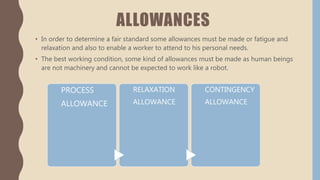
• In order to determine a fair standard some allowances must be made or fatigue and
relaxation and also to enable a worker to attend to his personal needs.
• The best working condition, some kind of allowances must be made as human beings
are not machinery and cannot be expected to work like a robot.
PROCESS
ALLOWANCE
RELAXATION
ALLOWANCE
CONTINGENCY
ALLOWANCE
PROCESS ALLOWANCE
• The time given to the operator in order to compensate him for idleness caused due to
character of the process or operation on which he is employed.
• 5% of the basic time is considered as process allowance.
RELAXATION ALLOWANCE
• In order to provide the worker an opportunity to recover from fatigue both
physiological as well as psychological relaxation allowance is allowed.
• It is given as a percentage of basic time , normally 3%-5% for men and women. Exact
% depends upon the nature of job.
• It may further be divided as fixed and variable allowance . Fixed part comprises of
fatigue allowance and personal needs allowance. Variable comprises of the allowance
provided in addition to fixed allowance to the operator working under poor conditions.
CONTINGENCY ALLOWANCE
• A small allowance not exceeding 5% which may be included in the standard time to
cover irregular occurrence , delays etc.
PRE DETERMINED MOTION TIME
STUDY
• It establishes set time for completing certain tasks taken from the observation of various
operatives on varying occasions.
• Time standards issued at the standard rating which is fixed rate of working is independent
of any particular operator
• Systems like methods time measurement and work factor are being installed by consultants
from respective organizations. These systems depend upon manuals which give various
elements like arm, leg and finger movements and so on . Steps are taken to make
allowance for certain important factors like weight, resistance to motion etc.
• Engineer is charged with he responsibility of setting operation times with these systems,
analyses the job into individual movements. He will determine the time required for
motions from the appropriate table.
• This system is good as the engineer is compelled to study every job in detail and
hence he can find out if there is any bad habit or procedure existing in the process.
• Other reliable systems used in countries like Britain, America is the detailed work factor
system wherein the charts supplied from certain standards companies like THE WOFAC
corporation contain the standard or work factor time units. Although most of these
published work factor systems are far less detailed they are regarded as most reliable
because they loose comparatively very little in accuracy.
TOOLS OF MOTION STUDY
PROCESS CHART
APPLICATION OF
LAWS OF MOTION
PREPRATION OF
QUESTIONNAIRE
ANALYSIS OF
THERBLINGS
MICRO MOTION
STUDY
PROCESS CHARTS
• They are prepared to picturize the movement of job as to find out the ways to improve
it.
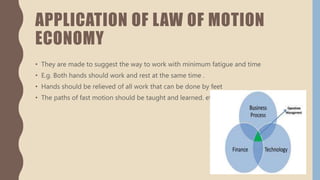
APPLICATION OF LAW OF MOTION
ECONOMY
• They are made to suggest the way to work with minimum fatigue and time
• E.g. Both hands should work and rest at the same time .
• Hands should be relieved of all work that can be done by feet
• The paths of fast motion should be taught and learned. etc.,.
PREPARATION OF QUESTIONNAIRES
• Prepare questionnaire and seek the answers
• E.g..
• Who, where , why and when is the job done?
• Can the job be performed by the machine.
• Etc.
ANALYSIS OF THERBLINGS
• Bodily movements are called therblings are analyzed to find a better method of doing
a work.
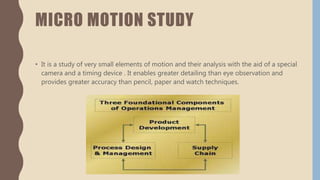
MICRO MOTION STUDY
• It is a study of very small elements of motion and their analysis with the aid of a special
camera and a timing device . It enables greater detailing than eye observation and
provides greater accuracy than pencil, paper and watch techniques.
SYNTHETIC TIME
STANDARDS/SYNTHESIS
• The setting of times by synthetic tool is similar to PMTS , the times so set here are
obtained from enterprise own past studies. The engineer charged with the
responsibility of making such study will after completing the required studies , time
certain elements which may be common to other jobs.
• The important distinguishing point in the case of the times set under PMTS but are set
for whole parts of cycles of perhaps 3 to 4 second’s duration.
ANALYTICAL ESTIMATING
• It is used when the timing of the new job cannot be synthesized as there may be some
work element for which previously assessed data is unavailable.
• This is manly used for longer cycle jobs and for jobs containing variable elements .
• It is applicable to non repetitive jobs such as maintenance of office routines, stores,
duties etc. as the jobs vary in size and complexity a standard is set for the time taken
for an average job.
• It is supplemented by estimates based on knowledge and experience of the estimator
for elements of work for which synthetic data is not available.
ACTIVITY SAMPLING
• Also called work sampling , it represents another technique of work measurement that
has gained increased attention these days. It was introduced by L.H.C. Tippett in 1934.
• It entails making observations and recording what is happening on a agreed number
of visits in a period but at a frequency picked at random.it depends upon he RANDOM
SAMPLING THEORY .
• Fundamental principle underlying this is % of occurrence of a condition as found in
random sample to a known degree of accuracy , the % of that condition in the total
activity.
• It is necessary to decide at the outset the level of confidence desired. Normally a
confidence level of 955 is used which means that there is probability that 95% of time
the random observation will represent the facts and 5% of the time it will not.
THANKYOU

Production and material management

  • 1.
    PRODUCTION AND MATERIAL MANAGEMENT M .C O M 1 R O L L N O. 7 6 0 2
  • 2.
    PERFORMANCE RATING The processof adjustment to the observed time to arrive at the normal working working is called as rating. 2 main methods for rating the performance of workers are followed: 100% rating Westing house rating
  • 3.
    ALLOWANCES • In orderto determine a fair standard some allowances must be made or fatigue and relaxation and also to enable a worker to attend to his personal needs. • The best working condition, some kind of allowances must be made as human beings are not machinery and cannot be expected to work like a robot. PROCESS ALLOWANCE RELAXATION ALLOWANCE CONTINGENCY ALLOWANCE
  • 4.
    PROCESS ALLOWANCE • Thetime given to the operator in order to compensate him for idleness caused due to character of the process or operation on which he is employed. • 5% of the basic time is considered as process allowance.
  • 5.
    RELAXATION ALLOWANCE • Inorder to provide the worker an opportunity to recover from fatigue both physiological as well as psychological relaxation allowance is allowed. • It is given as a percentage of basic time , normally 3%-5% for men and women. Exact % depends upon the nature of job. • It may further be divided as fixed and variable allowance . Fixed part comprises of fatigue allowance and personal needs allowance. Variable comprises of the allowance provided in addition to fixed allowance to the operator working under poor conditions.
  • 6.
    CONTINGENCY ALLOWANCE • Asmall allowance not exceeding 5% which may be included in the standard time to cover irregular occurrence , delays etc.
  • 7.
    PRE DETERMINED MOTIONTIME STUDY • It establishes set time for completing certain tasks taken from the observation of various operatives on varying occasions. • Time standards issued at the standard rating which is fixed rate of working is independent of any particular operator • Systems like methods time measurement and work factor are being installed by consultants from respective organizations. These systems depend upon manuals which give various elements like arm, leg and finger movements and so on . Steps are taken to make allowance for certain important factors like weight, resistance to motion etc. • Engineer is charged with he responsibility of setting operation times with these systems, analyses the job into individual movements. He will determine the time required for motions from the appropriate table.
  • 8.
    • This systemis good as the engineer is compelled to study every job in detail and hence he can find out if there is any bad habit or procedure existing in the process. • Other reliable systems used in countries like Britain, America is the detailed work factor system wherein the charts supplied from certain standards companies like THE WOFAC corporation contain the standard or work factor time units. Although most of these published work factor systems are far less detailed they are regarded as most reliable because they loose comparatively very little in accuracy.
  • 9.
    TOOLS OF MOTIONSTUDY PROCESS CHART APPLICATION OF LAWS OF MOTION PREPRATION OF QUESTIONNAIRE ANALYSIS OF THERBLINGS MICRO MOTION STUDY
  • 10.
    PROCESS CHARTS • Theyare prepared to picturize the movement of job as to find out the ways to improve it.
  • 11.
    APPLICATION OF LAWOF MOTION ECONOMY • They are made to suggest the way to work with minimum fatigue and time • E.g. Both hands should work and rest at the same time . • Hands should be relieved of all work that can be done by feet • The paths of fast motion should be taught and learned. etc.,.
  • 12.
    PREPARATION OF QUESTIONNAIRES •Prepare questionnaire and seek the answers • E.g.. • Who, where , why and when is the job done? • Can the job be performed by the machine. • Etc.
  • 13.
    ANALYSIS OF THERBLINGS •Bodily movements are called therblings are analyzed to find a better method of doing a work.
  • 14.
    MICRO MOTION STUDY •It is a study of very small elements of motion and their analysis with the aid of a special camera and a timing device . It enables greater detailing than eye observation and provides greater accuracy than pencil, paper and watch techniques.
  • 15.
    SYNTHETIC TIME STANDARDS/SYNTHESIS • Thesetting of times by synthetic tool is similar to PMTS , the times so set here are obtained from enterprise own past studies. The engineer charged with the responsibility of making such study will after completing the required studies , time certain elements which may be common to other jobs. • The important distinguishing point in the case of the times set under PMTS but are set for whole parts of cycles of perhaps 3 to 4 second’s duration.
  • 16.
    ANALYTICAL ESTIMATING • Itis used when the timing of the new job cannot be synthesized as there may be some work element for which previously assessed data is unavailable. • This is manly used for longer cycle jobs and for jobs containing variable elements . • It is applicable to non repetitive jobs such as maintenance of office routines, stores, duties etc. as the jobs vary in size and complexity a standard is set for the time taken for an average job. • It is supplemented by estimates based on knowledge and experience of the estimator for elements of work for which synthetic data is not available.
  • 17.
    ACTIVITY SAMPLING • Alsocalled work sampling , it represents another technique of work measurement that has gained increased attention these days. It was introduced by L.H.C. Tippett in 1934. • It entails making observations and recording what is happening on a agreed number of visits in a period but at a frequency picked at random.it depends upon he RANDOM SAMPLING THEORY . • Fundamental principle underlying this is % of occurrence of a condition as found in random sample to a known degree of accuracy , the % of that condition in the total activity. • It is necessary to decide at the outset the level of confidence desired. Normally a confidence level of 955 is used which means that there is probability that 95% of time the random observation will represent the facts and 5% of the time it will not.
  • 18.