1
METHOD STUDY
Definition:
“It is a systematic recording and critical examination of existing and proposed
ways of doing work, as a means of developing and applying easier and more
effective methods and reducing costs.”

WHY:
The improvement of processes and procedures.
The improvement of factory, shop and workplace layout.
The improvement of the design of plant and equipment.
Economy in human effort and the reduction of unnecessary fatigue.
Improvements in the use of materials, machines and manpower.
The development of a better physical working environment.
Improvement of quality of the products.
2
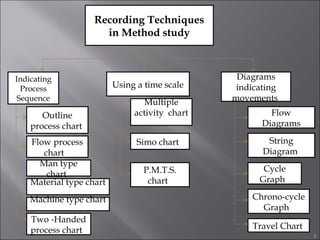
Recording Techniques
in Method study

Indicating
Process
Sequence

Outline
process chart
Flow process
chart
Man type
chart
Material type chart

Using a time scale
Multiple
activity chart
Simo chart
P.M.T.S.
chart

Diagrams
indicating
movements
Flow
Diagrams
String
Diagram
Cycle
Graph

Machine type chart

Chrono-cycle
Graph

Two -Handed
process chart

Travel Chart
3
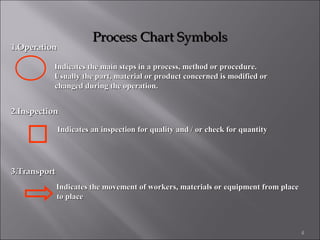
Process Chart Symbols

1.Operation

Indicates the main steps in a process, method or procedure.
Usually the part, material or product concerned is modified or
changed during the operation.

2.Inspection
Indicates an inspection for quality and / or check for quantity

3.Transport
Indicates the movement of workers, materials or equipment from place
to place

4
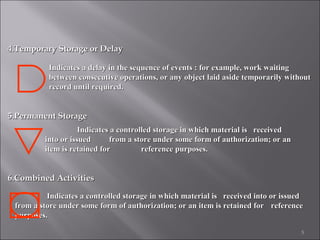
4.Temporary Storage or Delay
Indicates a delay in the sequence of events : for example, work waiting
between consecutive operations, or any object laid aside temporarily without
record until required.

5.Permanent Storage
Indicates a controlled storage in which material is received
into or issued
from a store under some form of authorization; or an
item is retained for
reference purposes.

6.Combined Activities
Indicates a controlled storage in which material is received into or issued
from a store under some form of authorization; or an item is retained for reference
purposes.
5
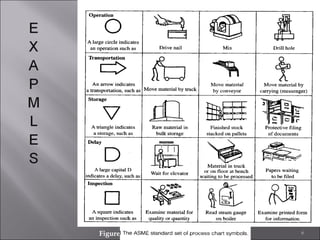
Figure:

6
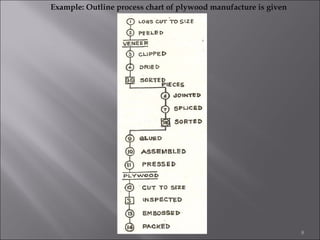
Outline Process Chart
Definition:
An outline process chart is a process chart giving an
overall picture by recording in sequence only the main
operations and inspections.

 While preparing the outline process chart we
use Symbols of Operation and Inspection
 A brief note of the nature of each operation is
made beside the symbol
 In an outline process chart, only the principal
operations and the inspections carried out are
recorded to ensure effectiveness
7
Example: Outline process chart of plywood manufacture is given 

8
Flow process charts

Definition:

 Flow process charts are graphic representations of the
sequences of operations, transportation, inspections,
delays and storages occurring during a process or a
procedure and include information considered for
analysis such as, time required and distance moved.
To develop an understanding how a process or work
happening and clearly documenting how a particular job
is done, in addition of that mapping a process in flow
chart format helps us where the process can be
improved.
9
Types of Flow Process Charts
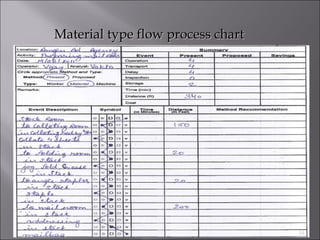
Material or product type.
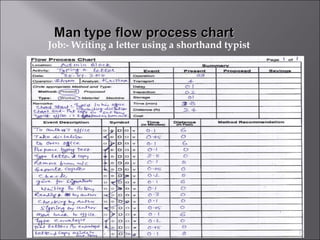
Man type.
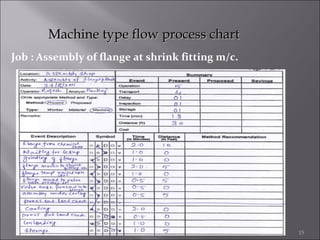
Machine type or equipment.
Material or product type flow process chart:Records what happens to the material or product i.e. the changes the
material or product undergoes in location or condition (includes
operation and transportation).

Man type process flow process chart:-

Records the activities of worker or operator i.e. what a worker or
operator does. In this type of chart usually storage term is not
applicable.

Machine or equipment type flow process charts:- Records
the manner in which a machine or an equipment is used.

10
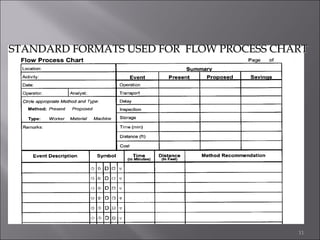
STANDARD FORMATS USED FOR FLOW PROCESS CHART

11
Job:- Writing a letter using a shorthand typist

12
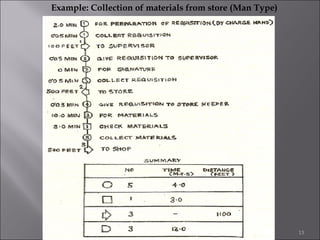
Example: Collection of materials from store (Man Type)

13
Material type flow process chart

14
Machine type flow process chart
Job : Assembly of flange at shrink fitting m/c.

15
Two Hand Process Chart
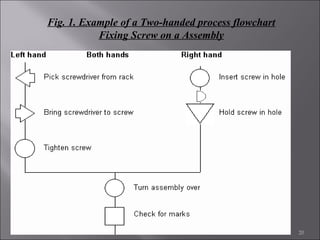
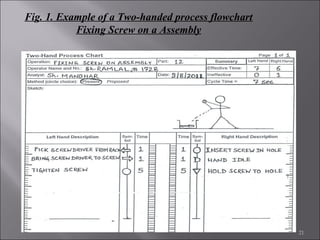
Two-Handed Flow Process Chart, is a
motion study where the study is done to
analyse the motions used by the worker in
performing an activity.
In this chart the activities of a worker’s
hands (or limbs) are recorded in their
relationship to one another.
A Two-Handed Process Flow Chart
individually shows the movement of each
hand in a manual process. It is typically
used for repetitive operation when analyzing
a manual assembly process, to help make it
easier to perform. 

16
Why:

The objective of this investigation is to eliminate or reduce
the unwanted motions and to arrange the remaining motions
in a best sequence.

How:

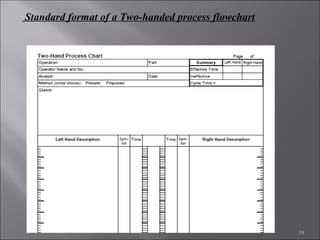
 A two-handed process chart is made up of two
columns in which the activities of the left hand
and right hand and the appropriate symbols are
respectively recorded in sequence.
 The activities of the two hands are inter-related
by aligning the symbols on the chart so that
movements by both hands appear opposite to
each other.
 Additional columns can be designed to record
the activities of the other parts of the body
whenever necessary.
17
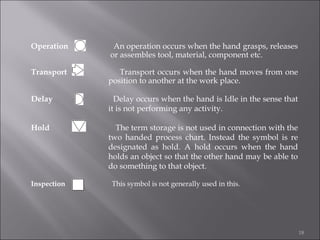
Operation

An operation occurs when the hand grasps, releases
or assembles tool, material, component etc.

Transport

Transport occurs when the hand moves from one
position to another at the work place.

Delay

Delay occurs when the hand is Idle in the sense that
it is not performing any activity.

Hold

The term storage is not used in connection with the
two handed process chart. Instead the symbol is re
designated as hold. A hold occurs when the hand
holds an object so that the other hand may be able to
do something to that object.

Inspection

This symbol is not generally used in this.

18
Standard format of a Two-handed process flowchart

19
Fig. 1. Example of a Two-handed process flowchart
Fixing Screw on a Assembly


20
Fig. 1. Example of a Two-handed process flowchart
Fixing Screw on a Assembly

21
MULTIPLE ACTIVITY CHART

A Chart in which the activities of more than one item are
recorded on a common time scale to show their interrelationship. Man machine chart is the type of multiple activity
charts.
TYPES:
Man - Machine chart: One man handling one job or one machine.
Man - Multi machine chart: One man handling a numbers of machines.
Machine Multi - man chart: A group or gang doing collectively one job
as in riveting.
Multi – Man - Machine chart: A number of persons working on a
computer system.

22
MULTIPLE ACTIVITY CHART
Definition:
A Multiple activity chart is a form of process chart recording the
related sequence of work of a number of operators and/or
machines on common time scale. In it, the activities of more than
one item, worker, machine or equipment are recorded on a
common time scale to show their inter relation ship.

Why:
Multiple Activity Charts are very useful tool for understanding
the flow of work in a cyclic process and as a consequence
understanding which resource is controlling the overall progress of
the work.
The tool can be used to model different scenarios to determine the
optimum mix of resources for the work.
23
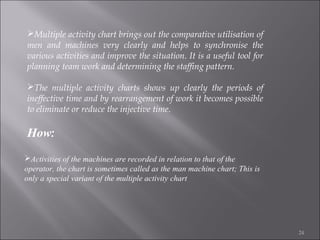
Multiple activity chart brings out the comparative utilisation of
men and machines very clearly and helps to synchronise the
various activities and improve the situation. It is a useful tool for
planning team work and determining the staffing pattern.
The multiple activity charts shows up clearly the periods of
ineffective time and by rearrangement of work it becomes possible
to eliminate or reduce the injective time.

How:
Activities of the machines are recorded in relation to that of the
operator, the chart is sometimes called as the man machine chart; This is
only a special variant of the multiple activity chart

24
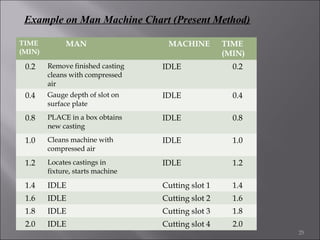
Example on Man Machine Chart (Present Method)
TIME
(MIN)

MAN

MACHINE

TIME
(MIN)

0.2

Remove finished casting
cleans with compressed
air

IDLE

0.2

0.4

Gauge depth of slot on
surface plate

IDLE

0.4

0.8

PLACE in a box obtains
new casting

IDLE

0.8

1.0

Cleans machine with
compressed air

IDLE

1.0

1.2

Locates castings in
fixture, starts machine

IDLE

1.2

1.4

IDLE

Cutting slot 1

1.4

1.6

IDLE

Cutting slot 2

1.6

1.8

IDLE

Cutting slot 3

1.8

2.0

IDLE

Cutting slot 4

2.0
25
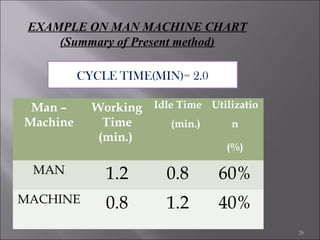
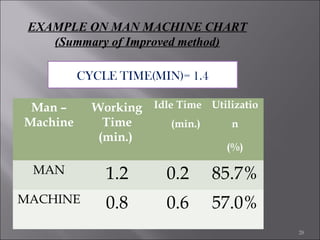
EXAMPLE ON MAN MACHINE CHART
(Summary of Present method)
CYCLE TIME(MIN)= 2.0
Man –
Machine

Working Idle Time Utilizatio
Time
(min.)
n
(min.)
(%)

MAN

1.2

0.8

60%

MACHINE

0.8

1.2

40%
26
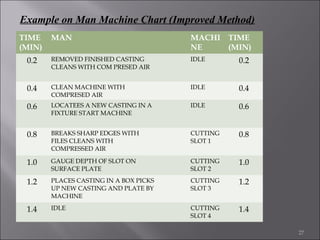
Example on Man Machine Chart (Improved Method)
TIME
(MIN)

MAN

MACHI TIME
NE
(MIN)

0.2

REMOVED FINISHED CASTING
CLEANS WITH COM PRESED AIR

IDLE

0.2

0.4

CLEAN MACHINE WITH
COMPRESED AIR

IDLE

0.4

0.6

LOCATEES A NEW CASTING IN A
FIXTURE START MACHINE

IDLE

0.6

0.8

BREAKS SHARP EDGES WITH
FILES CLEANS WITH
COMPRESSED AIR

CUTTING
SLOT 1

0.8

1.0

GAUGE DEPTH OF SLOT ON
SURFACE PLATE

CUTTING
SLOT 2

1.0

1.2

PLACES CASTING IN A BOX PICKS
UP NEW CASTING AND PLATE BY
MACHINE

CUTTING
SLOT 3

1.2

1.4

IDLE

CUTTING
SLOT 4

1.4
27
EXAMPLE ON MAN MACHINE CHART
(Summary of Improved method)
CYCLE TIME(MIN)= 1.4
Man –
Machine

Working Idle Time Utilizatio
Time
(min.)
n
(min.)
(%)

MAN

1.2

0.2

85.7%

MACHINE

0.8

0.6

57.0%
28
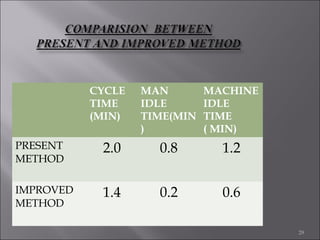
CYCLE
TIME
(MIN)

MAN
IDLE
TIME(MIN
)

MACHINE
IDLE
TIME
( MIN)

PRESENT
METHOD

2.0

0.8

1.2

IMPROVED
METHOD

1.4

0.2

0.6
29
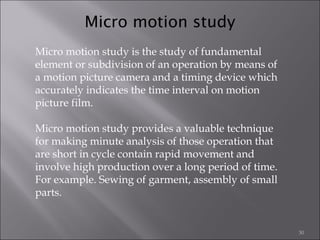
Micro motion study
Micro motion study is the study of fundamental
element or subdivision of an operation by means of
a motion picture camera and a timing device which
accurately indicates the time interval on motion
picture film.
Micro motion study provides a valuable technique
for making minute analysis of those operation that
are short in cycle contain rapid movement and
involve high production over a long period of time.
For example. Sewing of garment, assembly of small
parts.

30










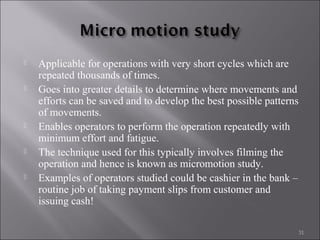
Applicable for operations with very short cycles which are
repeated thousands of times.
Goes into greater details to determine where movements and
efforts can be saved and to develop the best possible patterns
of movements.
Enables operators to perform the operation repeatedly with
minimum effort and fatigue.
The technique used for this typically involves filming the
operation and hence is known as micromotion study.
Examples of operators studied could be cashier in the bank –
routine job of taking payment slips from customer and
issuing cash!
31








Based on the idea that human activity can be divided into
movements or group of movements (therbligs) according to
the purpose for which they are made.
The therbligs cover movements or reasons for the absence of
movement.
Each therblig has specific color, symbol and letter for
recording purposes.
Therbligs refer primarily to motions of the human body at
the workplace and to the mental activities associated with
them.

32




They permit a much more precise and detailed description of
the work than any other method described.
Considerable practice is required in identification of
therbligs before they can be used for analysis with
confidence.

33
Main advantages of films over visual methods are:

Permit greater detailing than eye observation;

Provide greater accuracy than pencil, paper and stop watch;

More convenient;

Provide a positive record;

Help in the development of the work study person.

34
Objective of Micro motion study
1. To find most efficient way of doing work
2. Helps to study repetitive short cycle operation which
cannot be studied by ordinary method.
3. To train operator regarding motion economy.
4. It is permanent means of keeping record of method.
5. It assists in research project in the field of work study
6. It helps to study complex activities of short duration
performed with extreme rapidity.

35
Procedure/ Step in micro motion study
1.
2.
3.
4.

Filming the operation to be studied.
Analyzing the film.
Charting the result of analysis.
Developing and improve method.

Filming :-

The filming speed is 16 frames per second with a 16 mm movie
camera.

Film Analysis:-

1.A Projector is used for analysis purpose.
2. Projector runs the films very slowly and film can be stopped &
reversed whenever required.

36
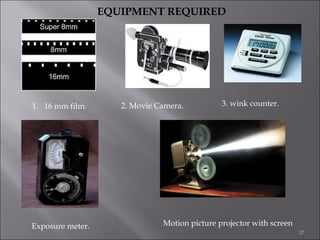
EQUIPMENT REQUIRED

1. 16 mm film.

Exposure meter.

2. Movie Camera.

3. wink counter.

Motion picture projector with screen
37


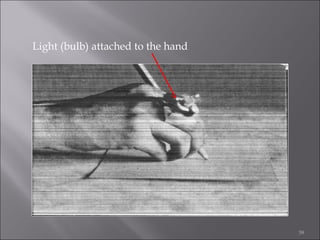
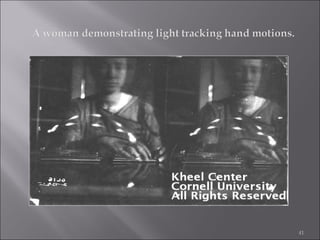
A record of path of movements, usually traced by a
continuous source of a light on a photograph.



The path of movement of a hand, may be recorded on
a photograph by putting a ring carrying small light on
worker’s hand.




A path of light resembling a white wire is seen.
Later it is used with a stereoscopic camera to show
the path in three dimensions .

38
Light (bulb) attached to the hand

39








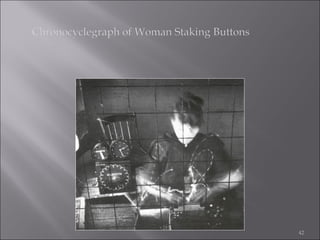
This is a development of the cycle graph by interrupting the
flow of current so as to obtain, in the resulting sequence of
flashes, a record of the time and direction of the motions under
observation. The resulting image was a chronocyclograph.
The path of light appears as a series of pear-shaped dots, the
movement being in the direction in which the dots point.
The spacing between the dots indicate the speed of movement
and show acceleration and deceleration.
This is done by using a turning fork, which is vibrating at a
known speed, and connected with a “make and break”
contact.

40
41
42
43
Diagrams
 Diagrams gives pictorial view of the layout of workplace on
which locations of different equipment, machines etc. are
indicated.
 The movement of subject(man or machine) is then indicated on
the diagram by a line or a string.
 The diagram are valuable in highlighting the movement so the
analyst can take steps to simplify or reduce it so as to obtain
saving in time.
 The most commonly used method study diagrams are:
o Flow diagram
o String diagram
o Travel chart
o Cyclegraph and Chronocyclegraph
44
Flow diagram
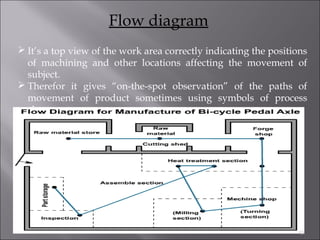
 It’s a top view of the work area correctly indicating the positions
of machining and other locations affecting the movement of
subject.
 Therefor it gives “on-the-spot observation” of the paths of
movement of product sometimes using symbols of process
charts.

45











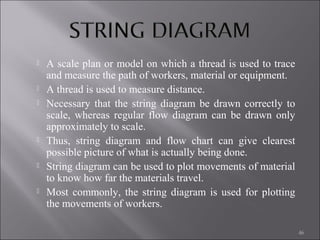
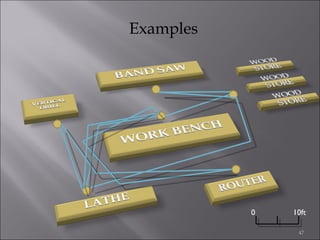
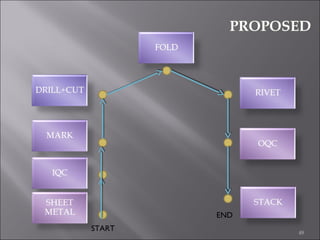
A scale plan or model on which a thread is used to trace
and measure the path of workers, material or equipment.
A thread is used to measure distance.
Necessary that the string diagram be drawn correctly to
scale, whereas regular flow diagram can be drawn only
approximately to scale.
Thus, string diagram and flow chart can give clearest
possible picture of what is actually being done.
String diagram can be used to plot movements of material
to know how far the materials travel.
Most commonly, the string diagram is used for plotting
the movements of workers.
46
Examples

0

10ft
47
END
START

48
Travel chart
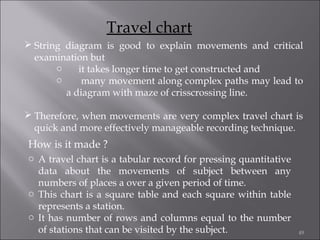
 String diagram is good to explain movements and critical
examination but
o
it takes longer time to get constructed and
o
many movement along complex paths may lead to
a diagram with maze of crisscrossing line.
 Therefore, when movements are very complex travel chart is
quick and more effectively manageable recording technique.

How is it made ?
o A travel chart is a tabular record for pressing quantitative
data about the movements of subject between any
numbers of places a over a given period of time.
o This chart is a square table and each square within table
represents a station.
o It has number of rows and columns equal to the number
of stations that can be visited by the subject.

49

Recording techniques used in method study ppt

  • 1.
  • 2.
    METHOD STUDY Definition: “It isa systematic recording and critical examination of existing and proposed ways of doing work, as a means of developing and applying easier and more effective methods and reducing costs.” WHY: The improvement of processes and procedures. The improvement of factory, shop and workplace layout. The improvement of the design of plant and equipment. Economy in human effort and the reduction of unnecessary fatigue. Improvements in the use of materials, machines and manpower. The development of a better physical working environment. Improvement of quality of the products. 2
  • 3.
    Recording Techniques in Methodstudy Indicating Process Sequence Outline process chart Flow process chart Man type chart Material type chart Using a time scale Multiple activity chart Simo chart P.M.T.S. chart Diagrams indicating movements Flow Diagrams String Diagram Cycle Graph Machine type chart Chrono-cycle Graph Two -Handed process chart Travel Chart 3
  • 4.
    Process Chart Symbols 1.Operation Indicatesthe main steps in a process, method or procedure. Usually the part, material or product concerned is modified or changed during the operation. 2.Inspection Indicates an inspection for quality and / or check for quantity 3.Transport Indicates the movement of workers, materials or equipment from place to place 4
  • 5.
    4.Temporary Storage orDelay Indicates a delay in the sequence of events : for example, work waiting between consecutive operations, or any object laid aside temporarily without record until required. 5.Permanent Storage Indicates a controlled storage in which material is received into or issued from a store under some form of authorization; or an item is retained for reference purposes. 6.Combined Activities Indicates a controlled storage in which material is received into or issued from a store under some form of authorization; or an item is retained for reference purposes. 5
  • 6.
  • 7.
    Outline Process Chart Definition: Anoutline process chart is a process chart giving an overall picture by recording in sequence only the main operations and inspections.  While preparing the outline process chart we use Symbols of Operation and Inspection  A brief note of the nature of each operation is made beside the symbol  In an outline process chart, only the principal operations and the inspections carried out are recorded to ensure effectiveness 7
  • 8.
    Example: Outline processchart of plywood manufacture is given  8
  • 9.
    Flow process charts Definition: Flow process charts are graphic representations of the sequences of operations, transportation, inspections, delays and storages occurring during a process or a procedure and include information considered for analysis such as, time required and distance moved. To develop an understanding how a process or work happening and clearly documenting how a particular job is done, in addition of that mapping a process in flow chart format helps us where the process can be improved. 9
  • 10.
    Types of FlowProcess Charts Material or product type. Man type. Machine type or equipment. Material or product type flow process chart:Records what happens to the material or product i.e. the changes the material or product undergoes in location or condition (includes operation and transportation). Man type process flow process chart:- Records the activities of worker or operator i.e. what a worker or operator does. In this type of chart usually storage term is not applicable. Machine or equipment type flow process charts:- Records the manner in which a machine or an equipment is used. 10
  • 11.
    STANDARD FORMATS USEDFOR FLOW PROCESS CHART 11
  • 12.
    Job:- Writing aletter using a shorthand typist 12
  • 13.
  • 14.
    Material type flowprocess chart 14
  • 15.
    Machine type flowprocess chart Job : Assembly of flange at shrink fitting m/c. 15
  • 16.
    Two Hand ProcessChart Two-Handed Flow Process Chart, is a motion study where the study is done to analyse the motions used by the worker in performing an activity. In this chart the activities of a worker’s hands (or limbs) are recorded in their relationship to one another. A Two-Handed Process Flow Chart individually shows the movement of each hand in a manual process. It is typically used for repetitive operation when analyzing a manual assembly process, to help make it easier to perform.  16
  • 17.
    Why: The objective ofthis investigation is to eliminate or reduce the unwanted motions and to arrange the remaining motions in a best sequence. How:  A two-handed process chart is made up of two columns in which the activities of the left hand and right hand and the appropriate symbols are respectively recorded in sequence.  The activities of the two hands are inter-related by aligning the symbols on the chart so that movements by both hands appear opposite to each other.  Additional columns can be designed to record the activities of the other parts of the body whenever necessary. 17
  • 18.
    Operation An operation occurswhen the hand grasps, releases or assembles tool, material, component etc. Transport Transport occurs when the hand moves from one position to another at the work place. Delay Delay occurs when the hand is Idle in the sense that it is not performing any activity. Hold The term storage is not used in connection with the two handed process chart. Instead the symbol is re designated as hold. A hold occurs when the hand holds an object so that the other hand may be able to do something to that object. Inspection This symbol is not generally used in this. 18
  • 19.
    Standard format ofa Two-handed process flowchart 19
  • 20.
    Fig. 1. Exampleof a Two-handed process flowchart Fixing Screw on a Assembly   20
  • 21.
    Fig. 1. Exampleof a Two-handed process flowchart Fixing Screw on a Assembly 21
  • 22.
    MULTIPLE ACTIVITY CHART AChart in which the activities of more than one item are recorded on a common time scale to show their interrelationship. Man machine chart is the type of multiple activity charts. TYPES: Man - Machine chart: One man handling one job or one machine. Man - Multi machine chart: One man handling a numbers of machines. Machine Multi - man chart: A group or gang doing collectively one job as in riveting. Multi – Man - Machine chart: A number of persons working on a computer system. 22
  • 23.
    MULTIPLE ACTIVITY CHART Definition: AMultiple activity chart is a form of process chart recording the related sequence of work of a number of operators and/or machines on common time scale. In it, the activities of more than one item, worker, machine or equipment are recorded on a common time scale to show their inter relation ship. Why: Multiple Activity Charts are very useful tool for understanding the flow of work in a cyclic process and as a consequence understanding which resource is controlling the overall progress of the work. The tool can be used to model different scenarios to determine the optimum mix of resources for the work. 23
  • 24.
    Multiple activity chartbrings out the comparative utilisation of men and machines very clearly and helps to synchronise the various activities and improve the situation. It is a useful tool for planning team work and determining the staffing pattern. The multiple activity charts shows up clearly the periods of ineffective time and by rearrangement of work it becomes possible to eliminate or reduce the injective time. How: Activities of the machines are recorded in relation to that of the operator, the chart is sometimes called as the man machine chart; This is only a special variant of the multiple activity chart 24
  • 25.
    Example on ManMachine Chart (Present Method) TIME (MIN) MAN MACHINE TIME (MIN) 0.2 Remove finished casting cleans with compressed air IDLE 0.2 0.4 Gauge depth of slot on surface plate IDLE 0.4 0.8 PLACE in a box obtains new casting IDLE 0.8 1.0 Cleans machine with compressed air IDLE 1.0 1.2 Locates castings in fixture, starts machine IDLE 1.2 1.4 IDLE Cutting slot 1 1.4 1.6 IDLE Cutting slot 2 1.6 1.8 IDLE Cutting slot 3 1.8 2.0 IDLE Cutting slot 4 2.0 25
  • 26.
    EXAMPLE ON MANMACHINE CHART (Summary of Present method) CYCLE TIME(MIN)= 2.0 Man – Machine Working Idle Time Utilizatio Time (min.) n (min.) (%) MAN 1.2 0.8 60% MACHINE 0.8 1.2 40% 26
  • 27.
    Example on ManMachine Chart (Improved Method) TIME (MIN) MAN MACHI TIME NE (MIN) 0.2 REMOVED FINISHED CASTING CLEANS WITH COM PRESED AIR IDLE 0.2 0.4 CLEAN MACHINE WITH COMPRESED AIR IDLE 0.4 0.6 LOCATEES A NEW CASTING IN A FIXTURE START MACHINE IDLE 0.6 0.8 BREAKS SHARP EDGES WITH FILES CLEANS WITH COMPRESSED AIR CUTTING SLOT 1 0.8 1.0 GAUGE DEPTH OF SLOT ON SURFACE PLATE CUTTING SLOT 2 1.0 1.2 PLACES CASTING IN A BOX PICKS UP NEW CASTING AND PLATE BY MACHINE CUTTING SLOT 3 1.2 1.4 IDLE CUTTING SLOT 4 1.4 27
  • 28.
    EXAMPLE ON MANMACHINE CHART (Summary of Improved method) CYCLE TIME(MIN)= 1.4 Man – Machine Working Idle Time Utilizatio Time (min.) n (min.) (%) MAN 1.2 0.2 85.7% MACHINE 0.8 0.6 57.0% 28
  • 29.
  • 30.
    Micro motion study Micromotion study is the study of fundamental element or subdivision of an operation by means of a motion picture camera and a timing device which accurately indicates the time interval on motion picture film. Micro motion study provides a valuable technique for making minute analysis of those operation that are short in cycle contain rapid movement and involve high production over a long period of time. For example. Sewing of garment, assembly of small parts. 30
  • 31.
         Applicable for operationswith very short cycles which are repeated thousands of times. Goes into greater details to determine where movements and efforts can be saved and to develop the best possible patterns of movements. Enables operators to perform the operation repeatedly with minimum effort and fatigue. The technique used for this typically involves filming the operation and hence is known as micromotion study. Examples of operators studied could be cashier in the bank – routine job of taking payment slips from customer and issuing cash! 31
  • 32.
        Based on theidea that human activity can be divided into movements or group of movements (therbligs) according to the purpose for which they are made. The therbligs cover movements or reasons for the absence of movement. Each therblig has specific color, symbol and letter for recording purposes. Therbligs refer primarily to motions of the human body at the workplace and to the mental activities associated with them. 32
  • 33.
      They permit amuch more precise and detailed description of the work than any other method described. Considerable practice is required in identification of therbligs before they can be used for analysis with confidence. 33
  • 34.
    Main advantages offilms over visual methods are:  Permit greater detailing than eye observation;  Provide greater accuracy than pencil, paper and stop watch;  More convenient;  Provide a positive record;  Help in the development of the work study person. 34
  • 35.
    Objective of Micromotion study 1. To find most efficient way of doing work 2. Helps to study repetitive short cycle operation which cannot be studied by ordinary method. 3. To train operator regarding motion economy. 4. It is permanent means of keeping record of method. 5. It assists in research project in the field of work study 6. It helps to study complex activities of short duration performed with extreme rapidity. 35
  • 36.
    Procedure/ Step inmicro motion study 1. 2. 3. 4. Filming the operation to be studied. Analyzing the film. Charting the result of analysis. Developing and improve method. Filming :- The filming speed is 16 frames per second with a 16 mm movie camera. Film Analysis:- 1.A Projector is used for analysis purpose. 2. Projector runs the films very slowly and film can be stopped & reversed whenever required. 36
  • 37.
    EQUIPMENT REQUIRED 1. 16mm film. Exposure meter. 2. Movie Camera. 3. wink counter. Motion picture projector with screen 37
  • 38.
     A record ofpath of movements, usually traced by a continuous source of a light on a photograph.  The path of movement of a hand, may be recorded on a photograph by putting a ring carrying small light on worker’s hand.   A path of light resembling a white wire is seen. Later it is used with a stereoscopic camera to show the path in three dimensions . 38
  • 39.
    Light (bulb) attachedto the hand 39
  • 40.
        This is adevelopment of the cycle graph by interrupting the flow of current so as to obtain, in the resulting sequence of flashes, a record of the time and direction of the motions under observation. The resulting image was a chronocyclograph. The path of light appears as a series of pear-shaped dots, the movement being in the direction in which the dots point. The spacing between the dots indicate the speed of movement and show acceleration and deceleration. This is done by using a turning fork, which is vibrating at a known speed, and connected with a “make and break” contact. 40
  • 41.
  • 42.
  • 43.
  • 44.
    Diagrams  Diagrams givespictorial view of the layout of workplace on which locations of different equipment, machines etc. are indicated.  The movement of subject(man or machine) is then indicated on the diagram by a line or a string.  The diagram are valuable in highlighting the movement so the analyst can take steps to simplify or reduce it so as to obtain saving in time.  The most commonly used method study diagrams are: o Flow diagram o String diagram o Travel chart o Cyclegraph and Chronocyclegraph 44
  • 45.
    Flow diagram  It’sa top view of the work area correctly indicating the positions of machining and other locations affecting the movement of subject.  Therefor it gives “on-the-spot observation” of the paths of movement of product sometimes using symbols of process charts. 45
  • 46.
          A scale planor model on which a thread is used to trace and measure the path of workers, material or equipment. A thread is used to measure distance. Necessary that the string diagram be drawn correctly to scale, whereas regular flow diagram can be drawn only approximately to scale. Thus, string diagram and flow chart can give clearest possible picture of what is actually being done. String diagram can be used to plot movements of material to know how far the materials travel. Most commonly, the string diagram is used for plotting the movements of workers. 46
  • 47.
  • 48.
  • 49.
    Travel chart  Stringdiagram is good to explain movements and critical examination but o it takes longer time to get constructed and o many movement along complex paths may lead to a diagram with maze of crisscrossing line.  Therefore, when movements are very complex travel chart is quick and more effectively manageable recording technique. How is it made ? o A travel chart is a tabular record for pressing quantitative data about the movements of subject between any numbers of places a over a given period of time. o This chart is a square table and each square within table represents a station. o It has number of rows and columns equal to the number of stations that can be visited by the subject. 49