RAJIV GANDHI PROUDYOGIKI
VISHWAVIDYALAYA, BHOPAL
Mechanical Engineering, V-Semester
OPEN ELECTIVE ME- 504 (A)
INDUSTRIAL ENGINEERING & ERGONOMICS
JOSY GEORGE
ASSISTANT PROFESSOR
LAKSHMI NARAIN COLLEGE OF TECHNOLOGY, BHOPAL
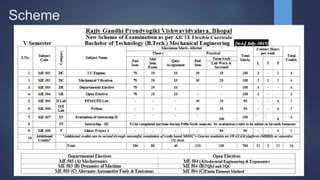
Scheme
Syllabus
Unit 1 Method study: purpose of work study, its objectives, procedure and applications; method study
definition and basic procedure, selection of job, various recording techniques like outline process
charts, flow process charts, man machine charts, two handed process charts, string diagram, flow
diagram, multiple activity chart, simo, cyclographs and chrono-cyclographs; critical examination,
development, installation and maintenance of improved method; principles of motion economy and
their application in work design; micro motion study, memo motion study and their use in methods
study.
Unit 2 Work measurement: Introduction & definition, objectives and basic procedure of work
measurement; application of work measurement in industries; time study: basic procedure,
equipment's needed, methods of measuring time, selection of jobs, breaking a job into elements;
numbers of cycles to be timed; rating and methods of rating, allowances, calculation of standard time.
Work sampling: Basic procedure, design of work sampling study conducting work sampling study and
establishment of standard-time.
Syllabus
Unit 3 Job evaluation and incentive schemes: Starlight line, Tailor, Merrick and Gantt incentive plans
Standard data system; elemental and non-elemental predetermined motion systems, work factors
system; Methods Time Measurement (MTM), MOST.
Unit 4 Human factor engineering: Definition and history of development of human factors engineering,
types & characteristics of man-machine-system, relative capabilities of human being and machines;
development and use of human factor data; information input and processing: Introduction to
information theory; factors effecting information reception and processing; coding and selecting of
sensory inputs.
Unit 5 Display systems and anthropometric data: Display- types of visual display, visual indicators and
warning signals; factorial and graphic display; general principles of auditory and tactral display,
characteristics and selection.
Reference
1. ILO; work-study; International Labour Organization
2. Khan MI; Industrial Ergonomics; PHI Learning
3. Barrnes RM; Motion and Time Study; Wiley pub
4. Megaw ED; Contemporary ergonomics; Taylor & Francis
5. Sandera M and Mc Cormick E; Human Factors in Engineering and design; McGraw Hill
6. Currie RM; Work study; BIM publications
7. Mynard; Hand book of Industrial Engineering
Fundamentals of Production
Production is a conversion process that converts inputs (raw materials, man, equipment,
tools, energy, money, etc.) into finished products that have value for the customers and
consumers. The conversion process usually involves a series of steps, each step a adding
value to the inputs and thereby bringing the material close to the desired state of product.
There is a wide variety of products required by the market place. These products are
manufactured in different types of industries using different technologies, raw materials,
etc. The large list of industrial units can be categories based upon;
 Nature of products
 Nature of end use of product
 Nature of production system
Classifying the industrial units help in underlying common features, of designing
manufacturing strategies, production planning and production control procedures and
systems. The efficiency and effectiveness of any production system lies in the use
minimum utilization of resources to produce the desired products of desired quality of
desired time. This leads us to the definition of productivity
Basic Concept of Productivity
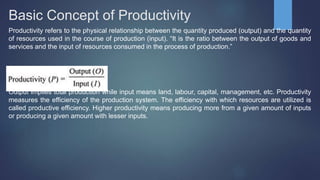
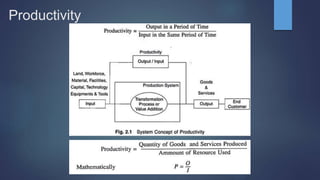
Productivity refers to the physical relationship between the quantity produced (output) and the quantity
of resources used in the course of production (input). “It is the ratio between the output of goods and
services and the input of resources consumed in the process of production.”
Output implies total production while input means land, labour, capital, management, etc. Productivity
measures the efficiency of the production system. The efficiency with which resources are utilized is
called productive efficiency. Higher productivity means producing more from a given amount of inputs
or producing a given amount with lesser inputs.
Productivity
Other Definitions
Productivity is the quantitative relation between; what a firm produces and what a firm uses as a
resource to produce output, i.e. arithmetic ratio of amount produced (output) to the amount of
resources (input).
Productivity is an aggregate measure of the efficiency of production; it is the ratio of output to inputs
i.e. capital, labor, land, energy and materials.
Productivity refers to the efficiency of the production system and an indicator to; how well the factors of
production (land, capital, labor and energy) are utilized.
Productivity is the ratio between output of wealth and input of resources used in production processes.
Output means the quantity of products produced and the inputs are the various resources used in the
production. The resources used may be land, building, equipment, machinery, materials, labour etc.
Productivity can be increased by:
 Increasing the output using the same input.
 Reducing the input by maintaining the output as constant.
 Increasing the output to a maximum extent with a smaller increase in input.
 A combination of both.
Utility of Increasing Productivity
To the Individual Concern
 Higher productivity means more wages directly to the piece-workers and more production bonus to
all workers. It means satisfied staff and harmonious staff relations.
 The factory earns more profit because of the reduction in costs.
 Continuous higher productivity may induce the management to reduce selling prices so that sales
and production may increase.
To the Industry
 Higher productivity in some concerns will enable less efficient firms to follow them for their own
survival.
To the Government
 Higher profits earned by factories will bring more revenue to the government by taxation.
 Export trades may develop bringing more foreign exchange to the nation.
 Overall higher productivity will raise an all round living standard of labour.
Basic Principle of Work Study
Work study is the investigation, by means of a consistent system of the work done in an organization
in order to attain the best utilization of resources i.e. Materials, Machines, Men and Money. All the
technologies and management systems are related with productivity.
Work study is one of the basic techniques of improving productivity.
In order to resolve this aspect, work study aims:
 To analyse the work in order to achieve work simplification and thereby improving productivity of the
system.
 To have optimum utilization of resources i.e., 4 Ms.
 To evaluate the work content through work measurement.
 To set time standards for various jobs.
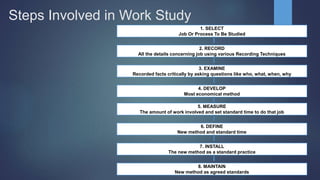
Steps Involved in Work Study
1. SELECT
Job Or Process To Be Studied
2. RECORD
All the details concerning job using various Recording Techniques
3. EXAMINE
Recorded facts critically by asking questions like who, what, when, why
4. DEVELOP
Most economical method
5. MEASURE
The amount of work involved and set standard time to do that job
6. DEFINE
New method and standard time
7. INSTALL
The new method as a standard practice
8. MAINTAIN
New method as agreed standards
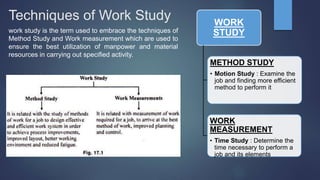
Techniques of Work Study
work study is the term used to embrace the techniques of
Method Study and Work measurement which are used to
ensure the best utilization of manpower and material
resources in carrying out specified activity.
WORK
STUDY
METHOD STUDY
• Motion Study : Examine the
job and finding more efficient
method to perform it
WORK
MEASUREMENT
• Time Study : Determine the
time necessary to perform a
job and its elements
Role of Work Study
 To standardize the method of doing a work,
 To minimize the unit cost of production,
 To determine the standard time for doing a task,
 To minimize the material movement, and operators movement,
 To eliminate unnecessary human movements,
 To utilize facilities such as man, machine and materials most effectively, and
 To a systematic investigation of all factors.
Objectives of Work Study
 Increased efficiency,
 Better product quality,
 To choose the fastest method to do a job,
 To improve the working process,
 Less fatigue to operators and workers,
 Effective labour control,
 Effective utilization of resources,
 To decide equipment requirements,
 To pay fair wages,
 To aid in calculating exact delivery,
 To formulate realistic labour budgeting, and
 To decide the required manpower to do a job.
Advantages of Work Study
 Work study ensures higher productivity,
 Better working conditions with less fatigue,
 Higher wages to workers,
 Uniform production flow,
 Job satisfaction and job security to workers,
 Reduction in unit cost of production,
 Quality products to consumers,
 Fast delivery schedule,
 Harmonious employer-employee relation, and
 Better service to customers
METHOD STUDY
Method study enables the industrial engineer to subject each operation to systematic
analysis. The main purpose of method study is to eliminate the unnecessary
operations and to achieve the best method of performing the operation.
According to British Standards Institution (BS 3138): “Method study is the systematic
recording and critical examination or existing and proposed ways or doing work as
a means or developing and applying easier and more effective methods and
reducing cost.”
Method study is the systematic recording and critical examination of production,
service and business processes in order to make improvements.
Fundamentally method study involves the breakdown of an operation or procedure
into its component elements and their systematic analysis. In carrying out the
method study, the right attitude of mind is important. The method study man should
have:
 The desire and determination to produce results.
 Ability to achieve results.
 An understanding of the human factors involved.
Method study scope lies in improving work methods through process and operation
analysis, such as:
1. Manufacturing operations and their sequence.
2. Workmen, Materials, tools and gauges.
3. Layout of physical facilities and work station design.
4. Movement of men and material handling.
5. Work environment.
Objectives of Method Study
The improvement in efficiency is achieved through:
1. Improved layout and design of workplace.
2. Improved and efficient work procedures.
3. Effective utilisation of men, machines and materials.
4. Improved design or specification of the final product.
The objectives of method study techniques are:
1. Present and analyse true facts concerning the situation.
2. To examine those facts critically.
3. To develop the best answer possible under given circumstances based on critical
examination of facts.
Scope of Method Study
The scope of method study is not restricted to only manufacturing industries. Method study techniques
can be applied effectively in service sector as well. It can be applied in offices, hospitals, banks and
other service organizations.
The areas to which method study can be applied successfully in manufacturing are:
1. To improve work methods and procedures.
2. To determine the best sequence of doing work.
3. To smoothen material flow with minimum of back tracking and to improve layout.
4. To improve the working conditions and hence to improve labour efficiency.
5. To reduce monotony in the work.
6. To improve plant utilisation and material utilisation.
7. Elimination of waste and unproductive operations.
8. To reduce the manufacturing costs through reducing cycle time of operations.
Method Study - Basic Approach
The basic approach suggested for the method study consists of six/eight steps.
1. SELECT
2. RECORD
3. EXAMINE
4. DEVELOP
5. EVALUATE
6. DEFINE
7. INSTALL
8. MAINTAIN
Method Study: Brief explanation
1. SELECT
The process to be studied to selected and its boundaries are to be defined
Practically, any activity or a job is a potential project for improvement but as the work study engineer is
to sell his ideas and maintain his existence in the organisation, he should always attempt to select
those jobs for improvement which are unpopular among employees or are considered “dirty” by
them.
By improving such jobs, he would earn goodwill from the employees as well as the management, and
can expect their full cooperation for other studies in the future.
Considerations may be given to the following factors while selecting a job for method study
 Economic Factors
 Technical Factors
 Human Factors
Method Study: Brief explanation
Economic Factors:
If the economic importance of a job is small, it is not wise to start or continue a long study. Priorities
should be given to those types of job which offer greater potential for cost reduction. Such jobs are
easily identifiable, as they have
 High labour content, i.e. they consume more time
 excessive machine or man idleness
 higher frequency of occurrence, i.e. they have large demand
 bottlenecks in production line
 higher proportion of accidents
 movement of material or men over long distance
 high scrap and reprocessing costs
 high payment of overtime bills.
Method Study: Brief explanation
Technical Factors: The method study engineer must have the necessary technical knowledge about
the job to be studied. Only surface knowledge about the subject may not lead to the right solution
to the real problem. To illustrate, consider that a particular machine tool in proving bottleneck. The
output from this machine is not reaching the assembly line in the required quantity. Through a
preliminary study, it is found that it is running at lower speed and feed than that recommended for
the pair of work and tool material used. Just increase in speed or feed may not be the solution of
this problem. It may be possible that the machine itself is not rigid enough to operate at higher
speeds or take a deeper cut. Just increase in speed may increase the output but the quality of job
may be seriously affected. Technical expertise in machine tools and metal cutting process would
be essential to solve problem of this kind.
Human Factors: Emotional reaction of the workers to the method study and changes in method are
important considerations. If the study of a particular job is suspected to cause unrest or ill feeling, it
should not be undertaken, however useful it may be from the economic point of view. It is always
better to take up first those jobs which are considered ‘dirty', unsafe, unpleasant, boring, or highly
fatiguing, and improvements brought about as a result of method study. This would possibly
ensure cooperative from the workers for the other jobs as well.
Method Study: Brief explanation
2. RECORD
The process is to be recorded in specified charts and diagrams.
Process charts
Flow charts
Flow diagram
A variety of techniques for analysis and charting have for a long time been established as IE
techniques. Among the methods of analysis, process analysis, operation analysis, motion study,
time study, work sampling, and flow analysis are widely used. Similarly, among the charting
techniques, process charts, pitch diagrams, multiple activity charts, process charts, and machine
sequential charts are used. From among these various techniques, the appropriate one will be
chosen, based on the object being analyzed [3].
Process charts were used and advocated by Frank Gilbreth in a paper presented to ASME in 1921.
Method Study: Brief explanation
3. EXAMINE
A process or method has activities.
The activities are categorized into action activities and idle (inventory) activities.
Action categories are subdivided into
(i) MAKE READY activities,
(ii) Do operations
(iii) PUT AWAY activities
Each activity is subjected to a series of questions:
A. Purpose
What is done?
Why is it done?
What else might be done?
What should be done?
Method Study: Brief explanation
B. Place
Where is it done?
Why is it done there?
Where else might it be done?
Where should it be done?
C. Sequence
When is it done?
Why is done then?
When it might be done?
When should it be done?
D. Person
Who does it?
Why does that person do it?
Who else might do it?
Who should do it?
Method Study: Brief explanation
E. Means
How is it done?
Why is it done that way?
How else might it be done?
How should it be done?
These questions in the above sequence must be asked every time a method study is
undertaken. They are the basis of successful method study.
4.DEVELOP
The shortcomings of the present process are brought out by the systematic questioning process
that is combined with a knowledge relevant to the process being examined. Industrial may have the
knowledge required or may not have the adequate knowledge. They need to have a knowledge
library to support their effort as well as access to the experts during the study period. Alternatives to
the current activities which have the shortcomings are to be generated during this stage.
Method Study: Brief explanation
5. EVALUATE
Alternatives are to be evaluated at this stage to find their contribution to the efficiency of the
process as well as effectiveness.
6. DEFINE
The new method or process suggested has to be put down standard process sheets that are
issued to the shop or department.
7. INSTALL
Industrial engineers of methods study persons have to train the operators and their supervisors in
the new method and participate in installing the method.
Method Study: Brief explanation
8. MAINTAIN
Industrial engineers have to conduct a periodic review of methods to observe modifications
brought into the installed methods by operators and supervisors and if they are beneficial, they
have to be made part of standard operating procedure (SOP). If they are not beneficial,
supervisors are to be informed of the same to bring the method back to SOP.
Approaches to Analysis
When thinking about how to improve a certain process or operation, an efficient way is to consider
how to eliminate, combine, rearrange, and simplify (in that order) the components of the process
or operation. If an operation can be eliminated, the elements and equipment related to that
operation can be eliminated at the same time. For this reason, elimination of operation in a
process or method usually produces the best improvement results, and should therefore be the
first activity considered. Next consideration is how to combine. By finding opportunities to combine
operations, tools, jigs, or parts and to perform simultaneous processing, we can often expect to
reduce the amount of material handling as well. In addition, by rearranging, a better sequence
for operations frequently results in the elimination of redundant work.
After these steps—eliminate, combine, and rearrange operations have been completed, simplify
will be considered. Simplify implies operation improvement, operation analysis or kaizen (in
Japanese terminology), and involves establishing the operation and its elements in a very
concrete and practical way of positioning of parts and materials, the layout of the work area, the
use of appropriate jigs and tools, etc.
The 5W1H Method.
This is a rationalizing step. For every operation and every element, the rationale of doing it and
doing it in a particular way is identified in this step. The ideas is that some operations or elements
do not have sufficient rationale to exist.
To accomplish the important step of verifying the necessity of existing work elements, the 5W1H
method is effective. This method entails a clear definition of the conventional 4W1H (What?
Where? Who? When? How?) in regard to the process or operation being studied, and in addition
the question: Why? The technique of seeking improvement ideas through the combination of the
5W1H method and ECRS can be quite useful.
Principles of Methods Study
1. General goal: Most industries have as a goal a better product for a lower cost. For industrial
engineering projects, the general goals most of the times are going to be cost reduction and
increased productivity.
2. After the general goals is decided the next decision is "where to start the work?" Will it be single
operation or full process.?
3. For each specific problem, a specific goal is to be determined, Some of the specific goal
alternatives are:
Eliminate time spent in obtaining and tools
Reduce discomfort of the operator
Improve the organization of the workplace
Eliminate some make-ready time.
Eliminate some put-away time.
Reduce operator delay
Reduce total cycle time.
Reduce scrap.
Information Collection and Recording
Information Collection Techniques:
The accuracy of data about the method study problem is important for the development of improved
method. The following techniques are used for the collection of information / data about the task
under consideration. These are not exclusive of each other, and for any particular method study
problem, some or all the techniques may be employed.
Observation. It is a common technique used for collecting information about the present method or
the existing problem. The method study person visits the site where the work is currently being
done and observes various steps in the method being followed. There are many instances where
all the data needed is obtained by only observing the work or work site.
Discussion. Discussion with those who do or who supervise the work can frequently provide
information not obtainable by observation. The discussion technique is commonly used where
irregular work is involved or where one is trying to analyze past work in order to improve efficiency
of work to be done in future. Even where observation by itself may accomplish the data collection
task, discussion may be used for developing good human relations.
Information Collection Techniques
Records. Valuable information can be obtained from past records concerning production, cost, time,
inventory and sub-contracts. For certain type of information concerning the past practice,
sometimes this is the only way to obtain authentic data.
Motion Pictures or video Films. Accurate and most detailed information can be obtained by taking
motion pictures or video film. Information obtained by this procedure can easily be transmitted /
forwarded to all levels in the organization and if needed, can be used directly for training purposes.
The film can be used to focus attention at particular point or motion in an operation. For obtaining
information concerning those types of work that involve large crew size, it is probably the only
procedure.
Information Recording Techniques:
There are three main types of information recording techniques. These are
 Process Charts
 Diagrams
 Templates
Information Collection Techniques
A Process Chart is a graphic means of representing the activities that occur during a manufacturing or
servicing job.
There are several types of process charts. These can be divided into two groups.
(i) Those which are used to record a process sequence (i.e. series of events in the order in which they
occur) but do not depict the events to time scale.
 Charts falling in this group are
 Operation process chart
 Flow process chart – (man / material / equipment type)
Operator chart (also called Two Handed Process Chart)
(ii) Those which record events in the sequence in which they occur on a time scale so that the
interaction of related events can be more easily studied. Charts falling in this group are
 Multiple activity chart
 Simo chart
Information Collection Techniques
Diagrams. A diagram gives pictorial view of the layout of workplace or floor on which locations of
different equipment, machines, etc. are indicated. The movement of subject (man or material) is
then indicated on the diagram by a line or a string. The diagrams are valuable in highlighting the
movement so that analyst can take steps to simplify or reduce it and thus effect saving in time or
reduction in collisions / accidents.
Two types of diagrams are common: Flow diagram and string diagram.
Templates and 3-D models: Two-dimensional cut outs made from thin card sheet representing
machinery, furniture, etc. can be used for developing new layouts and methods. The templates may
have pieces of permanent magnet attached to them, so that when used on iron board; they remain
glued on the board whenever placed. A scaled 3-D model of a working area helps easy
understanding of lighting, ventilation, maintenance and safety aspects that may be important in a
method. Such models are often of great value in demonstrating the advantages of the proposed
changes to all concerned. However, their use is limited because of higher cost involved. Some
computer software's are available which help in constructing the layout and possibility of visualizing
the working of process in a systematic way.
Elements of Work
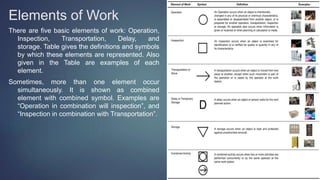
There are five basic elements of work: Operation,
Inspection, Transportation, Delay, and
storage. Table gives the definitions and symbols
by which these elements are represented. Also
given in the Table are examples of each
element.
Sometimes, more than one element occur
simultaneously. It is shown as combined
element with combined symbol. Examples are
“Operation in combination will inspection”, and
“Inspection in combination with Transportation”.
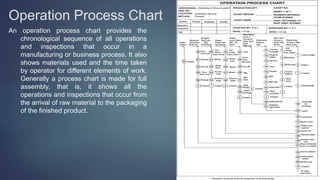
Operation Process Chart
An operation process chart provides the
chronological sequence of all operations
and inspections that occur in a
manufacturing or business process. It also
shows materials used and the time taken
by operator for different elements of work.
Generally a process chart is made for full
assembly, that is, it shows all the
operations and inspections that occur from
the arrival of raw material to the packaging
of the finished product.
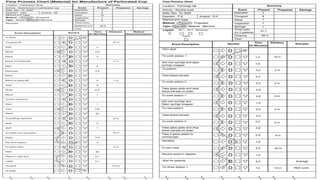
Flow Process Chart
A flow process chart is used for recording greater detail than is possible in an operation process chart.
It is made for each component of an assembly rather than for the whole assembly.
A flow process chart shows a complete process in terms of all the elements of work. There are two
main types of flow charts: product or material type , and the operator type . The product type
records the details of the events that occur to a product or material, while the operator flow chart
details how a person performs an operational sequence.
An important and valuable feature of this chart is its recording of non-productive hidden costs, such as
delays, temporary storages, unnecessary inspections, and unnecessary long distances traveled.
When the time spent on these non productive activities is highlighted, analyst can take steps to
minimize it and thus reduce costs.
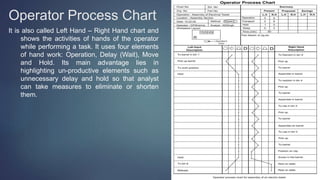
Operator Process Chart
It is also called Left Hand – Right Hand chart and
shows the activities of hands of the operator
while performing a task. It uses four elements
of hand work: Operation, Delay (Wait), Move
and Hold. Its main advantage lies in
highlighting un-productive elements such as
unnecessary delay and hold so that analyst
can take measures to eliminate or shorten
them.
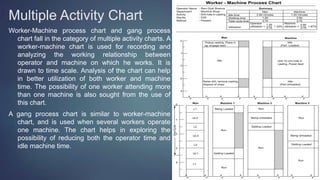
Multiple Activity Chart
Worker-Machine process chart and gang process
chart fall in the category of multiple activity charts. A
worker-machine chart is used for recording and
analyzing the working relationship between
operator and machine on which he works. It is
drawn to time scale. Analysis of the chart can help
in better utilization of both worker and machine
time. The possibility of one worker attending more
than one machine is also sought from the use of
this chart.
A gang process chart is similar to worker-machine
chart, and is used when several workers operate
one machine. The chart helps in exploring the
possibility of reducing both the operator time and
idle machine time.
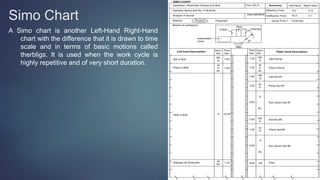
Simo Chart
A Simo chart is another Left-Hand Right-Hand
chart with the difference that it is drawn to time
scale and in terms of basic motions called
therbligs. It is used when the work cycle is
highly repetitive and of very short duration.
CRITICAL EXAMINATION
Critical examination of the information recorded about the process in charts / diagrams is the most
important phase of the method study. In this, each element of the work, as presently being done
and recorded on the chart is subjected to a systematic and progressive series of questions with
the purpose of determining true reasons for which it is done. Based on the reasons, improvements
are found and adopted into a new method, called better method. This examination, thus requires
exhaustive collaboration with everyone whose contribution can prove useful, and also full use of all
available sources of technical information. The use of questioning technique reduces the
possibility of missing any information which may be useful for the development of better method.
A popular procedure of carrying out critical examination uses two sets of questions: Primary questions
(answers to these show up the necessity of carrying out the activity), and Secondary questions
(answers to these allow considerations to alternative methods of doing the activity). Selection of
the best way of doing each activity is later determined to develop new method which is introduced
as a standard practice.
Primary Questions
1. Purpose. The need of carrying out the activity is challenged by the questions-What is achieved? Is
it necessary? Why?
The answers to these questions determine whether the particular activity will be included in the
proposals of new method for the process.
2. Means. The means of carrying out the activity are challenged by the questions- 'How is it done?'
and 'Why that way'?
3. Place. The location of carrying out the activity is challenged by the questions- 'Where is it done'?
and 'Why there'?
4. Sequence. The time of carrying out the activity is challenged by the questions- 'When is it done'?
and 'Why then'?
5. Person. The level of skill and experience of the person performing the activity is challenged by the
questions- 'Who does it'? and 'Why that person'?
The main object of the primary questions is to make sure that the reasons for every aspect of the
presently used method are clearly understood. The answers to these questions should clearly
bring out any part of the work which is unnecessary or inefficient in respect of means, sequence,
person or place.
Secondary Questions
1. Purpose. If the answer to the primary question 'Is the activity necessary"? is convincingly 'Yes',
alternatives to achieve the object of carrying nut the activity are considered by the question— 'What
else could be done'?
2. Means. All the alternative means to achieve the object are considered by the question— 'How else
could it be done'?
3. Place. Other places for carry ing out the activity are considered by the question— 'Where else could
it be done'?
4. Sequence. The secondary question asked under this heading is— 'When else could it be clone'?
5. Person. The possibilities for carrying out the activity by other persons are considered by asking the
question- 'Who else should do it' ?
Developing Better Method
With the present method or procedure for the job in mind, the application of ‘critical analysis' highlights
the essential part of the job, for which alternative ways for its carrying out are developed.
When developing alternative ways for doing a task the following may be considered.
 Where and how to use ‘man' in the process?
 What better work procedure be adopted?
 What better equipment be used?
 What better layout of work station, shop or factory be used?
In deciding whether a particular element of work (operation, inspection, or transportation) be carried
out manually or with the help of a device, method study engineer must be well aware of things
which man cannot do or does in inferior fashion than machine.
Developing Better Method
 Exert large amount of force, as needed in metal cutting.
 Exert force precisely or smoothly at a fixed rate as needed in metal forming.
 Do high speed computations of complex nature.
 Perform repetitive tasks without suffering from side effects like boredom, fatigue, etc.
 Move at high speeds for hours together.
 Carry out several tasks simultaneously.
 Respond fast to frequently changing control signals.
 Perform satisfactorily in an environment where conditions relating to cold, heat, noise, dampness,
etc. are extreme.
In most cases, the relative roles of man and machine vary from one extreme end in which entire
process is manual to the other extreme in which the process is completely mechanized with the
presence of man only for monitoring, trouble shooting, maintenance, and the like.
Installation of Improved Method
When the proposals of the improved method for a job are approved by the management of the
company, the next step is to put this method into practice. Installation of method requires
necessary prior preparation for which the active support of everyone concerned is very important.
The activities of the installation phase include:
1. Gaining acceptance of the change by the workers involved and their representatives. The method
change may affect the routine and paper work of wages, costs, planning, and even purchase
department. It may require displacement of staff from one section to another of the organisation.
Adjustments of this type need to be carried out very carefully so that the least possible hardship or
inconvenience is caused.
2. Retraining the workers. The extent to which workers need retraining will depend on the nature of the
job and the changes involved. It is much more for those jobs which have a high degree of manual
dexterity and where the workers have been doing the work by traditional methods. The use of films
demonstrating the advantages of new method as compared to traditional one are often very useful
in retraining the workers.
Installation of Improved Method
3. Arranging the requirements of the new method. This involves -
 arranging the necessary plant, tools and equipment at all the workplaces,
 arranging building-up of necessary stocks of new raw materials, and running-down of old stocks,
 checking up the availability and continuity of all supplies and services, and
 arranging any clerical records which may be required for purposes of control and comparison.
4. Taking other necessary actions. These will depend upon situation to situation. For example, if
changes in working hours are involved, necessary instructions should be passed on to auxiliary
services such as transport, canteen, water supply, etc. If change in wages is involved, information
concerning the date of installation must reach the costing department. Necessary instructions
should be passed on to every one concerned about the time table for the installation of the change
in method.
Follow-up
The work of method study man is not complete with the installation of the improved method; the
maintenance of the new method in its specified form is also part of his activities. The main aim of
maintenance of the new method is to ensure that the workers do not slip back into old method, or
introduce elements which are not part of the proposed method.
For effective maintenance it is important to define and specify the new method very clearly. An
operator chart giving adequate details of the tools, equipment, and workplace layout and operator-
motion pattern is often helpful.
The workers have tendency to drift away from the method laid down. The purpose of the method-
maintenance is to check this tendency. But if it is found that the change from the method specified
is in fact an improvement which can be made in the method, this should be officially incorporated.
Motion Study
Motion study is a technique of analyzing the body motions employed in doing a task in order to
eliminate or reduce ineffective movements and facilitates effective movements. By using motion
study and the principles of motion economy the task is redesigned to be more effective and less
time consuming.
The Gilbreths pioneered the study of manual motions and developed basic laws of motion economy
that are still relevant today. They were also responsible for the development of detailed motion
picture studies, termed as Micro Motion Studies, which are extremely useful for analyzing highly
repetitive manual operations. With the improvement in technology, of course, video camera has
replaced the traditional motion picture film camera.
In a broad sense, motion study encompasses micro motion study and both have the same objective:
job simplification so that it is less fatiguing and less time consuming. While motion study involves a
simple visual analysis, micro motion study uses more expensive equipment. The two types of
studies may be compared to viewing a task under a magnifying glass versus viewing the same
under a microscope. The added detail revealed by the microscope may be needed in exceptional
cases when even a minute improvement in motions matters, i.e. on extremely short repetitive
tasks.
Motion Study
Taking the cine films @ 16 to 20 frames per second with motion picture camera, developing the film
and analyzing the film for micro motion study had always been considered a costly affair. To save
on the cost of developing the film and the cost of film itself, a technique was used in which camera
took only 5 to 10 frames per minute. This saved on the time of film analysis too. In applications
where infrequent shots of camera could provide almost same information, the technique proved
fruitful and acquired the name Memo Motion Study.
Traditionally, the data from micro motion studies are recorded on a Simultaneous Motion (simo) Chart
while that from motion studies are recorded on a Right Hand - Left Hand Process Chart.
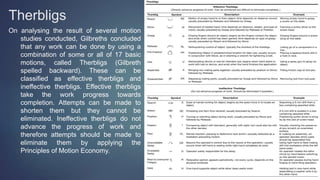
Therbligs
On analysing the result of several motion
studies conducted, Gilbreths concluded
that any work can be done by using a
combination of some or all of 17 basic
motions, called Therbligs (Gilbreth
spelled backward). These can be
classified as effective therbligs and
ineffective therbligs. Effective therbligs
take the work progress towards
completion. Attempts can be made to
shorten them but they cannot be
eliminated. Ineffective therbligs do not
advance the progress of work and
therefore attempts should be made to
eliminate them by applying the
Principles of Motion Economy.
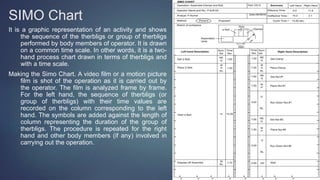
SIMO Chart
It is a graphic representation of an activity and shows
the sequence of the therbligs or group of therbligs
performed by body members of operator. It is drawn
on a common time scale. In other words, it is a two-
hand process chart drawn in terms of therbligs and
with a time scale.
Making the Simo Chart. A video film or a motion picture
film is shot of the operation as it is carried out by
the operator. The film is analyzed frame by frame.
For the left hand, the sequence of therbligs (or
group of therbligs) with their time values are
recorded on the column corresponding to the left
hand. The symbols are added against the length of
column representing the duration of the group of
therbligs. The procedure is repeated for the right
hand and other body members (if any) involved in
carrying out the operation.
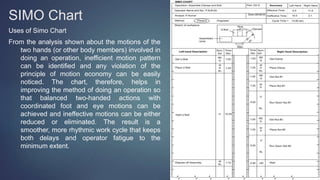
SIMO Chart
Uses of Simo Chart
From the analysis shown about the motions of the
two hands (or other body members) involved in
doing an operation, inefficient motion pattern
can be identified and any violation of the
principle of motion economy can be easily
noticed. The chart, therefore, helps in
improving the method of doing an operation so
that balanced two-handed actions with
coordinated foot and eye motions can be
achieved and ineffective motions can be either
reduced or eliminated. The result is a
smoother, more rhythmic work cycle that keeps
both delays and operator fatigue to the
minimum extent.
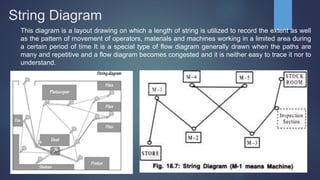
String Diagram
This diagram is a layout drawing on which a length of string is utilized to record the extent as well
as the pattern of movement of operators, materials and machines working in a limited area during
a certain period of time It is a special type of flow diagram generally drawn when the paths are
many and repetitive and a flow diagram becomes congested and it is neither easy to trace it nor to
understand.
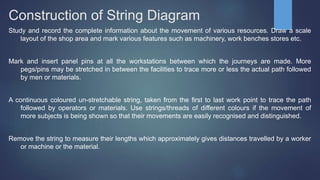
Construction of String Diagram
Study and record the complete information about the movement of various resources. Draw a scale
layout of the shop area and mark various features such as machinery, work benches stores etc.
Mark and insert panel pins at all the workstations between which the journeys are made. More
pegs/pins may be stretched in between the facilities to trace more or less the actual path followed
by men or materials.
A continuous coloured un-stretchable string, taken from the first to last work point to trace the path
followed by operators or materials. Use strings/threads of different colours if the movement of
more subjects is being shown so that their movements are easily recognised and distinguished.
Remove the string to measure their lengths which approximately gives distances travelled by a worker
or machine or the material.
Benefits of String Diagram
 A string diagram represents the record of an existing set of conditions and thus helps the methods
engineer in visualizing the actual situation.
 It indicates complex movements, back tracking, congestion, bottle necks and over and underutilized
paths on the shop floor.
 It is an aid for comparison between different layouts or the methods of doing a job as far as the
distances moved are involved.
 It helps in tracing existing paths of movement for incorporating necessary modifications if any.
 It is preferred when movements are not regular as far as frequency and distance moved are
concerned.
 Indicates the pattern of movements and thus helps in deciding the most economical routes to
perform a particular operation.
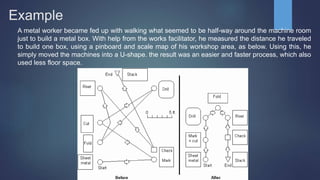
Example
A metal worker became fed up with walking what seemed to be half-way around the machine room
just to build a metal box. With help from the works facilitator, he measured the distance he traveled
to build one box, using a pinboard and scale map of his workshop area, as below. Using this, he
simply moved the machines into a U-shape. the result was an easier and faster process, which also
used less floor space.
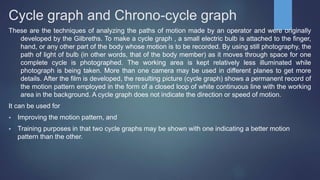
Cycle graph and Chrono-cycle graph
These are the techniques of analyzing the paths of motion made by an operator and were originally
developed by the Gilbreths. To make a cycle graph , a small electric bulb is attached to the finger,
hand, or any other part of the body whose motion is to be recorded. By using still photography, the
path of light of bulb (in other words, that of the body member) as it moves through space for one
complete cycle is photographed. The working area is kept relatively less illuminated while
photograph is being taken. More than one camera may be used in different planes to get more
details. After the film is developed, the resulting picture (cycle graph) shows a permanent record of
the motion pattern employed in the form of a closed loop of white continuous line with the working
area in the background. A cycle graph does not indicate the direction or speed of motion.
It can be used for
 Improving the motion pattern, and
 Training purposes in that two cycle graphs may be shown with one indicating a better motion
pattern than the other.
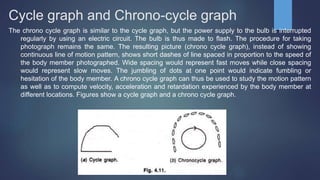
Cycle graph and Chrono-cycle graph
The chrono cycle graph is similar to the cycle graph, but the power supply to the bulb is interrupted
regularly by using an electric circuit. The bulb is thus made to flash. The procedure for taking
photograph remains the same. The resulting picture (chrono cycle graph), instead of showing
continuous line of motion pattern, shows short dashes of line spaced in proportion to the speed of
the body member photographed. Wide spacing would represent fast moves while close spacing
would represent slow moves. The jumbling of dots at one point would indicate fumbling or
hesitation of the body member. A chrono cycle graph can thus be used to study the motion pattern
as well as to compute velocity, acceleration and retardation experienced by the body member at
different locations. Figures show a cycle graph and a chrono cycle graph.
Cycle graph and Chrono-cycle graph
Advantages
 All types of movements i.e. complex, very fast or unrestricted movements can be recorded.
 It can be used for training purposes when the superiority of one motion pattern is shown as better
than other ore.
 It can be used for method improvement.
 These graphs provide an aid in explaining the pattern of motion which is used in performing the
operation.
Limitations
 Workers may feel uncomfortable while doing job if their hand are tied with electric bulb or any wire.
 Very good photographic skills are required.
 These techniques are not very common because of their specialized nature.
Principles of Motion Economy
These principles can be considered under three different groups.
 Those related to the use of the human body.
 Those related to the workplace arrangement, and
 Those related to the design of tools and equipment.
Principles of Motion Economy
1. Principles related to the use of human body
 Both hands should begin and end their basic divisions of activity simultaneously and should not be
idle at the same instant, except during the rest periods.
 The hand motions should be made symmetrically and simultaneously away from and toward the
centre of the body.
 Momentum should be employed to assist the worker wherever possible, and it should be reduced
to a minimum if it must be overcome by muscular effort.
 Continuous curved motions should be preferred to straight line motions involving sudden and sharp
changes in the direction.
 The least number of basic divisions should be employed and these should be confined to the
lowest practicable classifications. These classifications, summarized in ascending order of time and
fatigue expended in their performance, are:
 Finger motions
 Finger and wrist motions.
 Finger, wrist, and lower arm motions.
Principles of Motion Economy
 Finger, wrist, lower arm, and upper arm motions.
 Finger, wrist, lower arm, upper arm motions and body motions.
 Work that can be done by the feet should be arranged so that it is done together with work being
done by the hands. It should be recognized, however, that it is difficult to move the hand and foot
simultaneously.
 The middle finger and the thumb should be used for handling heavy loads over extended periods
as these are the strongest working fingers. The index finger, fourth finger, and little finger are
capable of handling only light loads for short durations.
 The feet should not be employed for operating pedals when the operator is in standing position.
 Twisting motions should be performed with the elbows bent.
 To grip tools, the segment of the fingers closed to the palm of the hand should be used.
Principles of Motion Economy
2. Principles related to the arrangement and conditions of workplace
Fixed locations should be provided for all tools and materials so as to permit the best sequence and
eliminate search and select .
Gravity bins and drop delivery should be used to reduce reach and move times. Use may be made of
ejectors for removing finished parts.
All materials and tools should be located within the normal working area in both the vertical and
horizontal plane, and as close to the point of use as possible.
Work table height should permit work by the operator in alternately sitting and standing posture.
Glare-free adequate illumination, proper ventilation and proper temperature should be provided.
Dials and other indicators should be patterned such that maximum information can be obtained in
minimum of time and error.
Principles of Motion Economy
3. Principles related to the design of tools and equipment
 Use colour, shape or size coding to maximize speed and minimize error in finding controls.
 Use simple on/off, either/or indicators whenever possible. If simple on/off indicator is not sufficient,
use qualitative type indicator, and use quantitative type indicator only when absolutely essential.
 All levers, handles, wheels and other control devices should be readily accessible to the operator
and should be designed so as to give the best possible mechanical advantage and utilize the
strongest available muscle group. Their direction of motion should conform to stereo-typed
reactions.
 Use quick acting fixture to hold the part or material upon which the work is being performed.
 Use stop guides to reduce the control necessary in positioning motions.
 Operating, set-up and emergency controls should be grouped according to the function.
Principles of Motion Economy
Design of Workplace Layout
The design of workplace layout involves the following
 Determination of work surface height
 Design of operator chair (if work is to be done in sitting posture), or allowing the use of anti-fatigue mats
for standing operator
 Determination of location of tools, materials, controls, displays and other devices.
A. Work Place Height
 This should be decided from the standpoint of comfortable working posture for the operator. Generally, it
is equal to the elbow height of operator whether work is done in standing or sitting posture. However, for
work involving lifting of heavy parts, it is useful to lower the work surface height by as much as 20 cm.
This would reduce the fatigue to the trunk of operator. Similarly, it may be useful to raise the work
surface height when work involves visual examination of minute details of fine parts. This would reduce
the eye fatigue to the operator. Alternatively, the work surface may be inclined by 15 degrees or so.
Work surface height may also be made adjustable in situations where operator is permitted to do work in
alternatively sitting and standing postures.
Principles of Motion Economy
B. Design of Operator Chair
 A seated posture is better than standing posture from the standpoint of stress reduction on the feet
and the overall energy expenditure. A well-designed seat should
 Provide trunk stabilization so that a good posture is maintained,
 Permit change of posture, and
 Not unduly press the thigh tissues.
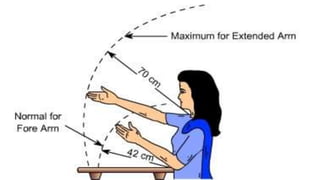
C. Determination of location of tools, materials, controls, displays and other devices
We all know that greater the distance through which operator moves his body member while doing
work, larger is the requirement of muscular effort, control and time. This means that all tools,
materials, controls, etc need to be located within close reach of the operator. In this context, two
areas can be identified: normal working area and maximum working area.
Principles of Motion Economy
 Importance Principle. According to this principle, the most important item or group of items is first
located within the normal area in the best position. The next important component item or group of
items is then selected and located in the best location within the remaining area. In this way, all the
items are located.
 Frequency of Use Principle. According to this principle, the item with the greatest frequency of use
has the highest priority for location at the optimum position. From within the remaining items to be
located in the remaining area, the same principle can then be applied repetitively.
 Functional Principle. This principle provides for grouping of items according to their function. For
instance, all controls that are functionally related may be grouped together and located at one
place.
 Sequence of Use Principle. According to this principle, items are located according to sequence of
their use. For illustration, let us consider the case of assembly. As we know, an assembly is made
by assembling the sub-assemblies in a specific order. From motion economy or production
efficiency point of view, it would be better if sub-assemblies and other items are located in the
sequence in which they are to be used in assembly.
Industrial Engineering - Method Study

Industrial Engineering - Method Study

  • 1.
    RAJIV GANDHI PROUDYOGIKI VISHWAVIDYALAYA,BHOPAL Mechanical Engineering, V-Semester OPEN ELECTIVE ME- 504 (A) INDUSTRIAL ENGINEERING & ERGONOMICS JOSY GEORGE ASSISTANT PROFESSOR LAKSHMI NARAIN COLLEGE OF TECHNOLOGY, BHOPAL
  • 2.
  • 3.
    Syllabus Unit 1 Methodstudy: purpose of work study, its objectives, procedure and applications; method study definition and basic procedure, selection of job, various recording techniques like outline process charts, flow process charts, man machine charts, two handed process charts, string diagram, flow diagram, multiple activity chart, simo, cyclographs and chrono-cyclographs; critical examination, development, installation and maintenance of improved method; principles of motion economy and their application in work design; micro motion study, memo motion study and their use in methods study. Unit 2 Work measurement: Introduction & definition, objectives and basic procedure of work measurement; application of work measurement in industries; time study: basic procedure, equipment's needed, methods of measuring time, selection of jobs, breaking a job into elements; numbers of cycles to be timed; rating and methods of rating, allowances, calculation of standard time. Work sampling: Basic procedure, design of work sampling study conducting work sampling study and establishment of standard-time.
  • 4.
    Syllabus Unit 3 Jobevaluation and incentive schemes: Starlight line, Tailor, Merrick and Gantt incentive plans Standard data system; elemental and non-elemental predetermined motion systems, work factors system; Methods Time Measurement (MTM), MOST. Unit 4 Human factor engineering: Definition and history of development of human factors engineering, types & characteristics of man-machine-system, relative capabilities of human being and machines; development and use of human factor data; information input and processing: Introduction to information theory; factors effecting information reception and processing; coding and selecting of sensory inputs. Unit 5 Display systems and anthropometric data: Display- types of visual display, visual indicators and warning signals; factorial and graphic display; general principles of auditory and tactral display, characteristics and selection.
  • 5.
    Reference 1. ILO; work-study;International Labour Organization 2. Khan MI; Industrial Ergonomics; PHI Learning 3. Barrnes RM; Motion and Time Study; Wiley pub 4. Megaw ED; Contemporary ergonomics; Taylor & Francis 5. Sandera M and Mc Cormick E; Human Factors in Engineering and design; McGraw Hill 6. Currie RM; Work study; BIM publications 7. Mynard; Hand book of Industrial Engineering
  • 6.
    Fundamentals of Production Productionis a conversion process that converts inputs (raw materials, man, equipment, tools, energy, money, etc.) into finished products that have value for the customers and consumers. The conversion process usually involves a series of steps, each step a adding value to the inputs and thereby bringing the material close to the desired state of product. There is a wide variety of products required by the market place. These products are manufactured in different types of industries using different technologies, raw materials, etc. The large list of industrial units can be categories based upon;  Nature of products  Nature of end use of product  Nature of production system Classifying the industrial units help in underlying common features, of designing manufacturing strategies, production planning and production control procedures and systems. The efficiency and effectiveness of any production system lies in the use minimum utilization of resources to produce the desired products of desired quality of desired time. This leads us to the definition of productivity
  • 7.
    Basic Concept ofProductivity Productivity refers to the physical relationship between the quantity produced (output) and the quantity of resources used in the course of production (input). “It is the ratio between the output of goods and services and the input of resources consumed in the process of production.” Output implies total production while input means land, labour, capital, management, etc. Productivity measures the efficiency of the production system. The efficiency with which resources are utilized is called productive efficiency. Higher productivity means producing more from a given amount of inputs or producing a given amount with lesser inputs.
  • 8.
  • 9.
    Other Definitions Productivity isthe quantitative relation between; what a firm produces and what a firm uses as a resource to produce output, i.e. arithmetic ratio of amount produced (output) to the amount of resources (input). Productivity is an aggregate measure of the efficiency of production; it is the ratio of output to inputs i.e. capital, labor, land, energy and materials. Productivity refers to the efficiency of the production system and an indicator to; how well the factors of production (land, capital, labor and energy) are utilized. Productivity is the ratio between output of wealth and input of resources used in production processes. Output means the quantity of products produced and the inputs are the various resources used in the production. The resources used may be land, building, equipment, machinery, materials, labour etc.
  • 10.
    Productivity can beincreased by:  Increasing the output using the same input.  Reducing the input by maintaining the output as constant.  Increasing the output to a maximum extent with a smaller increase in input.  A combination of both.
  • 11.
    Utility of IncreasingProductivity To the Individual Concern  Higher productivity means more wages directly to the piece-workers and more production bonus to all workers. It means satisfied staff and harmonious staff relations.  The factory earns more profit because of the reduction in costs.  Continuous higher productivity may induce the management to reduce selling prices so that sales and production may increase. To the Industry  Higher productivity in some concerns will enable less efficient firms to follow them for their own survival. To the Government  Higher profits earned by factories will bring more revenue to the government by taxation.  Export trades may develop bringing more foreign exchange to the nation.  Overall higher productivity will raise an all round living standard of labour.
  • 12.
    Basic Principle ofWork Study Work study is the investigation, by means of a consistent system of the work done in an organization in order to attain the best utilization of resources i.e. Materials, Machines, Men and Money. All the technologies and management systems are related with productivity. Work study is one of the basic techniques of improving productivity. In order to resolve this aspect, work study aims:  To analyse the work in order to achieve work simplification and thereby improving productivity of the system.  To have optimum utilization of resources i.e., 4 Ms.  To evaluate the work content through work measurement.  To set time standards for various jobs.
  • 13.
    Steps Involved inWork Study 1. SELECT Job Or Process To Be Studied 2. RECORD All the details concerning job using various Recording Techniques 3. EXAMINE Recorded facts critically by asking questions like who, what, when, why 4. DEVELOP Most economical method 5. MEASURE The amount of work involved and set standard time to do that job 6. DEFINE New method and standard time 7. INSTALL The new method as a standard practice 8. MAINTAIN New method as agreed standards
  • 14.
    Techniques of WorkStudy work study is the term used to embrace the techniques of Method Study and Work measurement which are used to ensure the best utilization of manpower and material resources in carrying out specified activity. WORK STUDY METHOD STUDY • Motion Study : Examine the job and finding more efficient method to perform it WORK MEASUREMENT • Time Study : Determine the time necessary to perform a job and its elements
  • 15.
    Role of WorkStudy  To standardize the method of doing a work,  To minimize the unit cost of production,  To determine the standard time for doing a task,  To minimize the material movement, and operators movement,  To eliminate unnecessary human movements,  To utilize facilities such as man, machine and materials most effectively, and  To a systematic investigation of all factors.
  • 16.
    Objectives of WorkStudy  Increased efficiency,  Better product quality,  To choose the fastest method to do a job,  To improve the working process,  Less fatigue to operators and workers,  Effective labour control,  Effective utilization of resources,  To decide equipment requirements,  To pay fair wages,  To aid in calculating exact delivery,  To formulate realistic labour budgeting, and  To decide the required manpower to do a job.
  • 17.
    Advantages of WorkStudy  Work study ensures higher productivity,  Better working conditions with less fatigue,  Higher wages to workers,  Uniform production flow,  Job satisfaction and job security to workers,  Reduction in unit cost of production,  Quality products to consumers,  Fast delivery schedule,  Harmonious employer-employee relation, and  Better service to customers
  • 18.
    METHOD STUDY Method studyenables the industrial engineer to subject each operation to systematic analysis. The main purpose of method study is to eliminate the unnecessary operations and to achieve the best method of performing the operation. According to British Standards Institution (BS 3138): “Method study is the systematic recording and critical examination or existing and proposed ways or doing work as a means or developing and applying easier and more effective methods and reducing cost.” Method study is the systematic recording and critical examination of production, service and business processes in order to make improvements.
  • 19.
    Fundamentally method studyinvolves the breakdown of an operation or procedure into its component elements and their systematic analysis. In carrying out the method study, the right attitude of mind is important. The method study man should have:  The desire and determination to produce results.  Ability to achieve results.  An understanding of the human factors involved. Method study scope lies in improving work methods through process and operation analysis, such as: 1. Manufacturing operations and their sequence. 2. Workmen, Materials, tools and gauges. 3. Layout of physical facilities and work station design. 4. Movement of men and material handling. 5. Work environment.
  • 20.
    Objectives of MethodStudy The improvement in efficiency is achieved through: 1. Improved layout and design of workplace. 2. Improved and efficient work procedures. 3. Effective utilisation of men, machines and materials. 4. Improved design or specification of the final product. The objectives of method study techniques are: 1. Present and analyse true facts concerning the situation. 2. To examine those facts critically. 3. To develop the best answer possible under given circumstances based on critical examination of facts.
  • 21.
    Scope of MethodStudy The scope of method study is not restricted to only manufacturing industries. Method study techniques can be applied effectively in service sector as well. It can be applied in offices, hospitals, banks and other service organizations. The areas to which method study can be applied successfully in manufacturing are: 1. To improve work methods and procedures. 2. To determine the best sequence of doing work. 3. To smoothen material flow with minimum of back tracking and to improve layout. 4. To improve the working conditions and hence to improve labour efficiency. 5. To reduce monotony in the work. 6. To improve plant utilisation and material utilisation. 7. Elimination of waste and unproductive operations. 8. To reduce the manufacturing costs through reducing cycle time of operations.
  • 22.
    Method Study -Basic Approach The basic approach suggested for the method study consists of six/eight steps. 1. SELECT 2. RECORD 3. EXAMINE 4. DEVELOP 5. EVALUATE 6. DEFINE 7. INSTALL 8. MAINTAIN
  • 23.
    Method Study: Briefexplanation 1. SELECT The process to be studied to selected and its boundaries are to be defined Practically, any activity or a job is a potential project for improvement but as the work study engineer is to sell his ideas and maintain his existence in the organisation, he should always attempt to select those jobs for improvement which are unpopular among employees or are considered “dirty” by them. By improving such jobs, he would earn goodwill from the employees as well as the management, and can expect their full cooperation for other studies in the future. Considerations may be given to the following factors while selecting a job for method study  Economic Factors  Technical Factors  Human Factors
  • 24.
    Method Study: Briefexplanation Economic Factors: If the economic importance of a job is small, it is not wise to start or continue a long study. Priorities should be given to those types of job which offer greater potential for cost reduction. Such jobs are easily identifiable, as they have  High labour content, i.e. they consume more time  excessive machine or man idleness  higher frequency of occurrence, i.e. they have large demand  bottlenecks in production line  higher proportion of accidents  movement of material or men over long distance  high scrap and reprocessing costs  high payment of overtime bills.
  • 25.
    Method Study: Briefexplanation Technical Factors: The method study engineer must have the necessary technical knowledge about the job to be studied. Only surface knowledge about the subject may not lead to the right solution to the real problem. To illustrate, consider that a particular machine tool in proving bottleneck. The output from this machine is not reaching the assembly line in the required quantity. Through a preliminary study, it is found that it is running at lower speed and feed than that recommended for the pair of work and tool material used. Just increase in speed or feed may not be the solution of this problem. It may be possible that the machine itself is not rigid enough to operate at higher speeds or take a deeper cut. Just increase in speed may increase the output but the quality of job may be seriously affected. Technical expertise in machine tools and metal cutting process would be essential to solve problem of this kind. Human Factors: Emotional reaction of the workers to the method study and changes in method are important considerations. If the study of a particular job is suspected to cause unrest or ill feeling, it should not be undertaken, however useful it may be from the economic point of view. It is always better to take up first those jobs which are considered ‘dirty', unsafe, unpleasant, boring, or highly fatiguing, and improvements brought about as a result of method study. This would possibly ensure cooperative from the workers for the other jobs as well.
  • 26.
    Method Study: Briefexplanation 2. RECORD The process is to be recorded in specified charts and diagrams. Process charts Flow charts Flow diagram A variety of techniques for analysis and charting have for a long time been established as IE techniques. Among the methods of analysis, process analysis, operation analysis, motion study, time study, work sampling, and flow analysis are widely used. Similarly, among the charting techniques, process charts, pitch diagrams, multiple activity charts, process charts, and machine sequential charts are used. From among these various techniques, the appropriate one will be chosen, based on the object being analyzed [3]. Process charts were used and advocated by Frank Gilbreth in a paper presented to ASME in 1921.
  • 27.
    Method Study: Briefexplanation 3. EXAMINE A process or method has activities. The activities are categorized into action activities and idle (inventory) activities. Action categories are subdivided into (i) MAKE READY activities, (ii) Do operations (iii) PUT AWAY activities Each activity is subjected to a series of questions: A. Purpose What is done? Why is it done? What else might be done? What should be done?
  • 28.
    Method Study: Briefexplanation B. Place Where is it done? Why is it done there? Where else might it be done? Where should it be done? C. Sequence When is it done? Why is done then? When it might be done? When should it be done? D. Person Who does it? Why does that person do it? Who else might do it? Who should do it?
  • 29.
    Method Study: Briefexplanation E. Means How is it done? Why is it done that way? How else might it be done? How should it be done? These questions in the above sequence must be asked every time a method study is undertaken. They are the basis of successful method study. 4.DEVELOP The shortcomings of the present process are brought out by the systematic questioning process that is combined with a knowledge relevant to the process being examined. Industrial may have the knowledge required or may not have the adequate knowledge. They need to have a knowledge library to support their effort as well as access to the experts during the study period. Alternatives to the current activities which have the shortcomings are to be generated during this stage.
  • 30.
    Method Study: Briefexplanation 5. EVALUATE Alternatives are to be evaluated at this stage to find their contribution to the efficiency of the process as well as effectiveness. 6. DEFINE The new method or process suggested has to be put down standard process sheets that are issued to the shop or department. 7. INSTALL Industrial engineers of methods study persons have to train the operators and their supervisors in the new method and participate in installing the method.
  • 31.
    Method Study: Briefexplanation 8. MAINTAIN Industrial engineers have to conduct a periodic review of methods to observe modifications brought into the installed methods by operators and supervisors and if they are beneficial, they have to be made part of standard operating procedure (SOP). If they are not beneficial, supervisors are to be informed of the same to bring the method back to SOP.
  • 32.
    Approaches to Analysis Whenthinking about how to improve a certain process or operation, an efficient way is to consider how to eliminate, combine, rearrange, and simplify (in that order) the components of the process or operation. If an operation can be eliminated, the elements and equipment related to that operation can be eliminated at the same time. For this reason, elimination of operation in a process or method usually produces the best improvement results, and should therefore be the first activity considered. Next consideration is how to combine. By finding opportunities to combine operations, tools, jigs, or parts and to perform simultaneous processing, we can often expect to reduce the amount of material handling as well. In addition, by rearranging, a better sequence for operations frequently results in the elimination of redundant work. After these steps—eliminate, combine, and rearrange operations have been completed, simplify will be considered. Simplify implies operation improvement, operation analysis or kaizen (in Japanese terminology), and involves establishing the operation and its elements in a very concrete and practical way of positioning of parts and materials, the layout of the work area, the use of appropriate jigs and tools, etc.
  • 33.
    The 5W1H Method. Thisis a rationalizing step. For every operation and every element, the rationale of doing it and doing it in a particular way is identified in this step. The ideas is that some operations or elements do not have sufficient rationale to exist. To accomplish the important step of verifying the necessity of existing work elements, the 5W1H method is effective. This method entails a clear definition of the conventional 4W1H (What? Where? Who? When? How?) in regard to the process or operation being studied, and in addition the question: Why? The technique of seeking improvement ideas through the combination of the 5W1H method and ECRS can be quite useful.
  • 34.
    Principles of MethodsStudy 1. General goal: Most industries have as a goal a better product for a lower cost. For industrial engineering projects, the general goals most of the times are going to be cost reduction and increased productivity. 2. After the general goals is decided the next decision is "where to start the work?" Will it be single operation or full process.? 3. For each specific problem, a specific goal is to be determined, Some of the specific goal alternatives are: Eliminate time spent in obtaining and tools Reduce discomfort of the operator Improve the organization of the workplace Eliminate some make-ready time. Eliminate some put-away time. Reduce operator delay Reduce total cycle time. Reduce scrap.
  • 35.
    Information Collection andRecording Information Collection Techniques: The accuracy of data about the method study problem is important for the development of improved method. The following techniques are used for the collection of information / data about the task under consideration. These are not exclusive of each other, and for any particular method study problem, some or all the techniques may be employed. Observation. It is a common technique used for collecting information about the present method or the existing problem. The method study person visits the site where the work is currently being done and observes various steps in the method being followed. There are many instances where all the data needed is obtained by only observing the work or work site. Discussion. Discussion with those who do or who supervise the work can frequently provide information not obtainable by observation. The discussion technique is commonly used where irregular work is involved or where one is trying to analyze past work in order to improve efficiency of work to be done in future. Even where observation by itself may accomplish the data collection task, discussion may be used for developing good human relations.
  • 36.
    Information Collection Techniques Records.Valuable information can be obtained from past records concerning production, cost, time, inventory and sub-contracts. For certain type of information concerning the past practice, sometimes this is the only way to obtain authentic data. Motion Pictures or video Films. Accurate and most detailed information can be obtained by taking motion pictures or video film. Information obtained by this procedure can easily be transmitted / forwarded to all levels in the organization and if needed, can be used directly for training purposes. The film can be used to focus attention at particular point or motion in an operation. For obtaining information concerning those types of work that involve large crew size, it is probably the only procedure. Information Recording Techniques: There are three main types of information recording techniques. These are  Process Charts  Diagrams  Templates
  • 37.
    Information Collection Techniques AProcess Chart is a graphic means of representing the activities that occur during a manufacturing or servicing job. There are several types of process charts. These can be divided into two groups. (i) Those which are used to record a process sequence (i.e. series of events in the order in which they occur) but do not depict the events to time scale.  Charts falling in this group are  Operation process chart  Flow process chart – (man / material / equipment type) Operator chart (also called Two Handed Process Chart) (ii) Those which record events in the sequence in which they occur on a time scale so that the interaction of related events can be more easily studied. Charts falling in this group are  Multiple activity chart  Simo chart
  • 38.
    Information Collection Techniques Diagrams.A diagram gives pictorial view of the layout of workplace or floor on which locations of different equipment, machines, etc. are indicated. The movement of subject (man or material) is then indicated on the diagram by a line or a string. The diagrams are valuable in highlighting the movement so that analyst can take steps to simplify or reduce it and thus effect saving in time or reduction in collisions / accidents. Two types of diagrams are common: Flow diagram and string diagram. Templates and 3-D models: Two-dimensional cut outs made from thin card sheet representing machinery, furniture, etc. can be used for developing new layouts and methods. The templates may have pieces of permanent magnet attached to them, so that when used on iron board; they remain glued on the board whenever placed. A scaled 3-D model of a working area helps easy understanding of lighting, ventilation, maintenance and safety aspects that may be important in a method. Such models are often of great value in demonstrating the advantages of the proposed changes to all concerned. However, their use is limited because of higher cost involved. Some computer software's are available which help in constructing the layout and possibility of visualizing the working of process in a systematic way.
  • 39.
    Elements of Work Thereare five basic elements of work: Operation, Inspection, Transportation, Delay, and storage. Table gives the definitions and symbols by which these elements are represented. Also given in the Table are examples of each element. Sometimes, more than one element occur simultaneously. It is shown as combined element with combined symbol. Examples are “Operation in combination will inspection”, and “Inspection in combination with Transportation”.
  • 40.
    Operation Process Chart Anoperation process chart provides the chronological sequence of all operations and inspections that occur in a manufacturing or business process. It also shows materials used and the time taken by operator for different elements of work. Generally a process chart is made for full assembly, that is, it shows all the operations and inspections that occur from the arrival of raw material to the packaging of the finished product.
  • 41.
    Flow Process Chart Aflow process chart is used for recording greater detail than is possible in an operation process chart. It is made for each component of an assembly rather than for the whole assembly. A flow process chart shows a complete process in terms of all the elements of work. There are two main types of flow charts: product or material type , and the operator type . The product type records the details of the events that occur to a product or material, while the operator flow chart details how a person performs an operational sequence. An important and valuable feature of this chart is its recording of non-productive hidden costs, such as delays, temporary storages, unnecessary inspections, and unnecessary long distances traveled. When the time spent on these non productive activities is highlighted, analyst can take steps to minimize it and thus reduce costs.
  • 43.
    Operator Process Chart Itis also called Left Hand – Right Hand chart and shows the activities of hands of the operator while performing a task. It uses four elements of hand work: Operation, Delay (Wait), Move and Hold. Its main advantage lies in highlighting un-productive elements such as unnecessary delay and hold so that analyst can take measures to eliminate or shorten them.
  • 44.
    Multiple Activity Chart Worker-Machineprocess chart and gang process chart fall in the category of multiple activity charts. A worker-machine chart is used for recording and analyzing the working relationship between operator and machine on which he works. It is drawn to time scale. Analysis of the chart can help in better utilization of both worker and machine time. The possibility of one worker attending more than one machine is also sought from the use of this chart. A gang process chart is similar to worker-machine chart, and is used when several workers operate one machine. The chart helps in exploring the possibility of reducing both the operator time and idle machine time.
  • 45.
    Simo Chart A Simochart is another Left-Hand Right-Hand chart with the difference that it is drawn to time scale and in terms of basic motions called therbligs. It is used when the work cycle is highly repetitive and of very short duration.
  • 46.
    CRITICAL EXAMINATION Critical examinationof the information recorded about the process in charts / diagrams is the most important phase of the method study. In this, each element of the work, as presently being done and recorded on the chart is subjected to a systematic and progressive series of questions with the purpose of determining true reasons for which it is done. Based on the reasons, improvements are found and adopted into a new method, called better method. This examination, thus requires exhaustive collaboration with everyone whose contribution can prove useful, and also full use of all available sources of technical information. The use of questioning technique reduces the possibility of missing any information which may be useful for the development of better method. A popular procedure of carrying out critical examination uses two sets of questions: Primary questions (answers to these show up the necessity of carrying out the activity), and Secondary questions (answers to these allow considerations to alternative methods of doing the activity). Selection of the best way of doing each activity is later determined to develop new method which is introduced as a standard practice.
  • 47.
    Primary Questions 1. Purpose.The need of carrying out the activity is challenged by the questions-What is achieved? Is it necessary? Why? The answers to these questions determine whether the particular activity will be included in the proposals of new method for the process. 2. Means. The means of carrying out the activity are challenged by the questions- 'How is it done?' and 'Why that way'? 3. Place. The location of carrying out the activity is challenged by the questions- 'Where is it done'? and 'Why there'? 4. Sequence. The time of carrying out the activity is challenged by the questions- 'When is it done'? and 'Why then'? 5. Person. The level of skill and experience of the person performing the activity is challenged by the questions- 'Who does it'? and 'Why that person'? The main object of the primary questions is to make sure that the reasons for every aspect of the presently used method are clearly understood. The answers to these questions should clearly bring out any part of the work which is unnecessary or inefficient in respect of means, sequence, person or place.
  • 48.
    Secondary Questions 1. Purpose.If the answer to the primary question 'Is the activity necessary"? is convincingly 'Yes', alternatives to achieve the object of carrying nut the activity are considered by the question— 'What else could be done'? 2. Means. All the alternative means to achieve the object are considered by the question— 'How else could it be done'? 3. Place. Other places for carry ing out the activity are considered by the question— 'Where else could it be done'? 4. Sequence. The secondary question asked under this heading is— 'When else could it be clone'? 5. Person. The possibilities for carrying out the activity by other persons are considered by asking the question- 'Who else should do it' ?
  • 49.
    Developing Better Method Withthe present method or procedure for the job in mind, the application of ‘critical analysis' highlights the essential part of the job, for which alternative ways for its carrying out are developed. When developing alternative ways for doing a task the following may be considered.  Where and how to use ‘man' in the process?  What better work procedure be adopted?  What better equipment be used?  What better layout of work station, shop or factory be used? In deciding whether a particular element of work (operation, inspection, or transportation) be carried out manually or with the help of a device, method study engineer must be well aware of things which man cannot do or does in inferior fashion than machine.
  • 50.
    Developing Better Method Exert large amount of force, as needed in metal cutting.  Exert force precisely or smoothly at a fixed rate as needed in metal forming.  Do high speed computations of complex nature.  Perform repetitive tasks without suffering from side effects like boredom, fatigue, etc.  Move at high speeds for hours together.  Carry out several tasks simultaneously.  Respond fast to frequently changing control signals.  Perform satisfactorily in an environment where conditions relating to cold, heat, noise, dampness, etc. are extreme. In most cases, the relative roles of man and machine vary from one extreme end in which entire process is manual to the other extreme in which the process is completely mechanized with the presence of man only for monitoring, trouble shooting, maintenance, and the like.
  • 51.
    Installation of ImprovedMethod When the proposals of the improved method for a job are approved by the management of the company, the next step is to put this method into practice. Installation of method requires necessary prior preparation for which the active support of everyone concerned is very important. The activities of the installation phase include: 1. Gaining acceptance of the change by the workers involved and their representatives. The method change may affect the routine and paper work of wages, costs, planning, and even purchase department. It may require displacement of staff from one section to another of the organisation. Adjustments of this type need to be carried out very carefully so that the least possible hardship or inconvenience is caused. 2. Retraining the workers. The extent to which workers need retraining will depend on the nature of the job and the changes involved. It is much more for those jobs which have a high degree of manual dexterity and where the workers have been doing the work by traditional methods. The use of films demonstrating the advantages of new method as compared to traditional one are often very useful in retraining the workers.
  • 52.
    Installation of ImprovedMethod 3. Arranging the requirements of the new method. This involves -  arranging the necessary plant, tools and equipment at all the workplaces,  arranging building-up of necessary stocks of new raw materials, and running-down of old stocks,  checking up the availability and continuity of all supplies and services, and  arranging any clerical records which may be required for purposes of control and comparison. 4. Taking other necessary actions. These will depend upon situation to situation. For example, if changes in working hours are involved, necessary instructions should be passed on to auxiliary services such as transport, canteen, water supply, etc. If change in wages is involved, information concerning the date of installation must reach the costing department. Necessary instructions should be passed on to every one concerned about the time table for the installation of the change in method.
  • 53.
    Follow-up The work ofmethod study man is not complete with the installation of the improved method; the maintenance of the new method in its specified form is also part of his activities. The main aim of maintenance of the new method is to ensure that the workers do not slip back into old method, or introduce elements which are not part of the proposed method. For effective maintenance it is important to define and specify the new method very clearly. An operator chart giving adequate details of the tools, equipment, and workplace layout and operator- motion pattern is often helpful. The workers have tendency to drift away from the method laid down. The purpose of the method- maintenance is to check this tendency. But if it is found that the change from the method specified is in fact an improvement which can be made in the method, this should be officially incorporated.
  • 54.
    Motion Study Motion studyis a technique of analyzing the body motions employed in doing a task in order to eliminate or reduce ineffective movements and facilitates effective movements. By using motion study and the principles of motion economy the task is redesigned to be more effective and less time consuming. The Gilbreths pioneered the study of manual motions and developed basic laws of motion economy that are still relevant today. They were also responsible for the development of detailed motion picture studies, termed as Micro Motion Studies, which are extremely useful for analyzing highly repetitive manual operations. With the improvement in technology, of course, video camera has replaced the traditional motion picture film camera. In a broad sense, motion study encompasses micro motion study and both have the same objective: job simplification so that it is less fatiguing and less time consuming. While motion study involves a simple visual analysis, micro motion study uses more expensive equipment. The two types of studies may be compared to viewing a task under a magnifying glass versus viewing the same under a microscope. The added detail revealed by the microscope may be needed in exceptional cases when even a minute improvement in motions matters, i.e. on extremely short repetitive tasks.
  • 55.
    Motion Study Taking thecine films @ 16 to 20 frames per second with motion picture camera, developing the film and analyzing the film for micro motion study had always been considered a costly affair. To save on the cost of developing the film and the cost of film itself, a technique was used in which camera took only 5 to 10 frames per minute. This saved on the time of film analysis too. In applications where infrequent shots of camera could provide almost same information, the technique proved fruitful and acquired the name Memo Motion Study. Traditionally, the data from micro motion studies are recorded on a Simultaneous Motion (simo) Chart while that from motion studies are recorded on a Right Hand - Left Hand Process Chart.
  • 56.
    Therbligs On analysing theresult of several motion studies conducted, Gilbreths concluded that any work can be done by using a combination of some or all of 17 basic motions, called Therbligs (Gilbreth spelled backward). These can be classified as effective therbligs and ineffective therbligs. Effective therbligs take the work progress towards completion. Attempts can be made to shorten them but they cannot be eliminated. Ineffective therbligs do not advance the progress of work and therefore attempts should be made to eliminate them by applying the Principles of Motion Economy.
  • 57.
    SIMO Chart It isa graphic representation of an activity and shows the sequence of the therbligs or group of therbligs performed by body members of operator. It is drawn on a common time scale. In other words, it is a two- hand process chart drawn in terms of therbligs and with a time scale. Making the Simo Chart. A video film or a motion picture film is shot of the operation as it is carried out by the operator. The film is analyzed frame by frame. For the left hand, the sequence of therbligs (or group of therbligs) with their time values are recorded on the column corresponding to the left hand. The symbols are added against the length of column representing the duration of the group of therbligs. The procedure is repeated for the right hand and other body members (if any) involved in carrying out the operation.
  • 58.
    SIMO Chart Uses ofSimo Chart From the analysis shown about the motions of the two hands (or other body members) involved in doing an operation, inefficient motion pattern can be identified and any violation of the principle of motion economy can be easily noticed. The chart, therefore, helps in improving the method of doing an operation so that balanced two-handed actions with coordinated foot and eye motions can be achieved and ineffective motions can be either reduced or eliminated. The result is a smoother, more rhythmic work cycle that keeps both delays and operator fatigue to the minimum extent.
  • 59.
    String Diagram This diagramis a layout drawing on which a length of string is utilized to record the extent as well as the pattern of movement of operators, materials and machines working in a limited area during a certain period of time It is a special type of flow diagram generally drawn when the paths are many and repetitive and a flow diagram becomes congested and it is neither easy to trace it nor to understand.
  • 60.
    Construction of StringDiagram Study and record the complete information about the movement of various resources. Draw a scale layout of the shop area and mark various features such as machinery, work benches stores etc. Mark and insert panel pins at all the workstations between which the journeys are made. More pegs/pins may be stretched in between the facilities to trace more or less the actual path followed by men or materials. A continuous coloured un-stretchable string, taken from the first to last work point to trace the path followed by operators or materials. Use strings/threads of different colours if the movement of more subjects is being shown so that their movements are easily recognised and distinguished. Remove the string to measure their lengths which approximately gives distances travelled by a worker or machine or the material.
  • 61.
    Benefits of StringDiagram  A string diagram represents the record of an existing set of conditions and thus helps the methods engineer in visualizing the actual situation.  It indicates complex movements, back tracking, congestion, bottle necks and over and underutilized paths on the shop floor.  It is an aid for comparison between different layouts or the methods of doing a job as far as the distances moved are involved.  It helps in tracing existing paths of movement for incorporating necessary modifications if any.  It is preferred when movements are not regular as far as frequency and distance moved are concerned.  Indicates the pattern of movements and thus helps in deciding the most economical routes to perform a particular operation.
  • 62.
    Example A metal workerbecame fed up with walking what seemed to be half-way around the machine room just to build a metal box. With help from the works facilitator, he measured the distance he traveled to build one box, using a pinboard and scale map of his workshop area, as below. Using this, he simply moved the machines into a U-shape. the result was an easier and faster process, which also used less floor space.
  • 63.
    Cycle graph andChrono-cycle graph These are the techniques of analyzing the paths of motion made by an operator and were originally developed by the Gilbreths. To make a cycle graph , a small electric bulb is attached to the finger, hand, or any other part of the body whose motion is to be recorded. By using still photography, the path of light of bulb (in other words, that of the body member) as it moves through space for one complete cycle is photographed. The working area is kept relatively less illuminated while photograph is being taken. More than one camera may be used in different planes to get more details. After the film is developed, the resulting picture (cycle graph) shows a permanent record of the motion pattern employed in the form of a closed loop of white continuous line with the working area in the background. A cycle graph does not indicate the direction or speed of motion. It can be used for  Improving the motion pattern, and  Training purposes in that two cycle graphs may be shown with one indicating a better motion pattern than the other.
  • 64.
    Cycle graph andChrono-cycle graph The chrono cycle graph is similar to the cycle graph, but the power supply to the bulb is interrupted regularly by using an electric circuit. The bulb is thus made to flash. The procedure for taking photograph remains the same. The resulting picture (chrono cycle graph), instead of showing continuous line of motion pattern, shows short dashes of line spaced in proportion to the speed of the body member photographed. Wide spacing would represent fast moves while close spacing would represent slow moves. The jumbling of dots at one point would indicate fumbling or hesitation of the body member. A chrono cycle graph can thus be used to study the motion pattern as well as to compute velocity, acceleration and retardation experienced by the body member at different locations. Figures show a cycle graph and a chrono cycle graph.
  • 65.
    Cycle graph andChrono-cycle graph Advantages  All types of movements i.e. complex, very fast or unrestricted movements can be recorded.  It can be used for training purposes when the superiority of one motion pattern is shown as better than other ore.  It can be used for method improvement.  These graphs provide an aid in explaining the pattern of motion which is used in performing the operation. Limitations  Workers may feel uncomfortable while doing job if their hand are tied with electric bulb or any wire.  Very good photographic skills are required.  These techniques are not very common because of their specialized nature.
  • 66.
    Principles of MotionEconomy These principles can be considered under three different groups.  Those related to the use of the human body.  Those related to the workplace arrangement, and  Those related to the design of tools and equipment.
  • 67.
    Principles of MotionEconomy 1. Principles related to the use of human body  Both hands should begin and end their basic divisions of activity simultaneously and should not be idle at the same instant, except during the rest periods.  The hand motions should be made symmetrically and simultaneously away from and toward the centre of the body.  Momentum should be employed to assist the worker wherever possible, and it should be reduced to a minimum if it must be overcome by muscular effort.  Continuous curved motions should be preferred to straight line motions involving sudden and sharp changes in the direction.  The least number of basic divisions should be employed and these should be confined to the lowest practicable classifications. These classifications, summarized in ascending order of time and fatigue expended in their performance, are:  Finger motions  Finger and wrist motions.  Finger, wrist, and lower arm motions.
  • 68.
    Principles of MotionEconomy  Finger, wrist, lower arm, and upper arm motions.  Finger, wrist, lower arm, upper arm motions and body motions.  Work that can be done by the feet should be arranged so that it is done together with work being done by the hands. It should be recognized, however, that it is difficult to move the hand and foot simultaneously.  The middle finger and the thumb should be used for handling heavy loads over extended periods as these are the strongest working fingers. The index finger, fourth finger, and little finger are capable of handling only light loads for short durations.  The feet should not be employed for operating pedals when the operator is in standing position.  Twisting motions should be performed with the elbows bent.  To grip tools, the segment of the fingers closed to the palm of the hand should be used.
  • 69.
    Principles of MotionEconomy 2. Principles related to the arrangement and conditions of workplace Fixed locations should be provided for all tools and materials so as to permit the best sequence and eliminate search and select . Gravity bins and drop delivery should be used to reduce reach and move times. Use may be made of ejectors for removing finished parts. All materials and tools should be located within the normal working area in both the vertical and horizontal plane, and as close to the point of use as possible. Work table height should permit work by the operator in alternately sitting and standing posture. Glare-free adequate illumination, proper ventilation and proper temperature should be provided. Dials and other indicators should be patterned such that maximum information can be obtained in minimum of time and error.
  • 71.
    Principles of MotionEconomy 3. Principles related to the design of tools and equipment  Use colour, shape or size coding to maximize speed and minimize error in finding controls.  Use simple on/off, either/or indicators whenever possible. If simple on/off indicator is not sufficient, use qualitative type indicator, and use quantitative type indicator only when absolutely essential.  All levers, handles, wheels and other control devices should be readily accessible to the operator and should be designed so as to give the best possible mechanical advantage and utilize the strongest available muscle group. Their direction of motion should conform to stereo-typed reactions.  Use quick acting fixture to hold the part or material upon which the work is being performed.  Use stop guides to reduce the control necessary in positioning motions.  Operating, set-up and emergency controls should be grouped according to the function.
  • 72.
    Principles of MotionEconomy Design of Workplace Layout The design of workplace layout involves the following  Determination of work surface height  Design of operator chair (if work is to be done in sitting posture), or allowing the use of anti-fatigue mats for standing operator  Determination of location of tools, materials, controls, displays and other devices. A. Work Place Height  This should be decided from the standpoint of comfortable working posture for the operator. Generally, it is equal to the elbow height of operator whether work is done in standing or sitting posture. However, for work involving lifting of heavy parts, it is useful to lower the work surface height by as much as 20 cm. This would reduce the fatigue to the trunk of operator. Similarly, it may be useful to raise the work surface height when work involves visual examination of minute details of fine parts. This would reduce the eye fatigue to the operator. Alternatively, the work surface may be inclined by 15 degrees or so. Work surface height may also be made adjustable in situations where operator is permitted to do work in alternatively sitting and standing postures.
  • 73.
    Principles of MotionEconomy B. Design of Operator Chair  A seated posture is better than standing posture from the standpoint of stress reduction on the feet and the overall energy expenditure. A well-designed seat should  Provide trunk stabilization so that a good posture is maintained,  Permit change of posture, and  Not unduly press the thigh tissues. C. Determination of location of tools, materials, controls, displays and other devices We all know that greater the distance through which operator moves his body member while doing work, larger is the requirement of muscular effort, control and time. This means that all tools, materials, controls, etc need to be located within close reach of the operator. In this context, two areas can be identified: normal working area and maximum working area.
  • 74.
    Principles of MotionEconomy  Importance Principle. According to this principle, the most important item or group of items is first located within the normal area in the best position. The next important component item or group of items is then selected and located in the best location within the remaining area. In this way, all the items are located.  Frequency of Use Principle. According to this principle, the item with the greatest frequency of use has the highest priority for location at the optimum position. From within the remaining items to be located in the remaining area, the same principle can then be applied repetitively.  Functional Principle. This principle provides for grouping of items according to their function. For instance, all controls that are functionally related may be grouped together and located at one place.  Sequence of Use Principle. According to this principle, items are located according to sequence of their use. For illustration, let us consider the case of assembly. As we know, an assembly is made by assembling the sub-assemblies in a specific order. From motion economy or production efficiency point of view, it would be better if sub-assemblies and other items are located in the sequence in which they are to be used in assembly.