
Probability
Probability 
 It allows us to quantify the 
variability in the outcome of an 
experiment whose exact result can’t 
be predicted with certainty.
Definitions 
 Random Experiment 
A random experiment or trial is one which 
when conducted successively under the 
identical conditions, the result is not 
unique but may be any one of the various 
possible outcomes. 
Example: Tossing a fair coin in an experiment.
 Sample space: 
The set of all possible outcomes is a 
sample space. 
 Event: 
Outcome or combination of outcomes 
 Outcome: 
The result of an event which we finally 
achieved is called an outcome or a 
sample point.
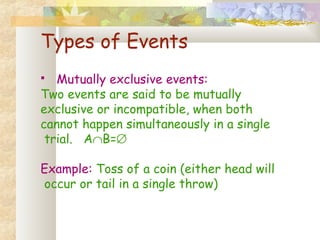
Types of Events 
 Mutually exclusive events: 
Two events are said to be mutually 
exclusive or incompatible, when both 
cannot happen simultaneously in a single 
trial. AÇB=Æ 
Example: Toss of a coin (either head will 
occur or tail in a single throw)
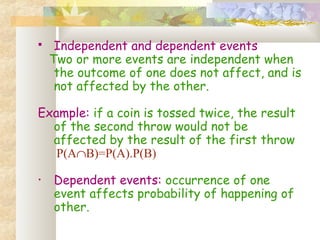
 Independent and dependent events 
Two or more events are independent when 
the outcome of one does not affect, and is 
not affected by the other. 
Example: if a coin is tossed twice, the result 
of the second throw would not be 
affected by the result of the first throw 
P(AÇB)=P(A).P(B) 
• Dependent events: occurrence of one 
event affects probability of happening of 
other.
 Equally likely events: events are 
called equally likely if they have the 
same chance of occurrence. 
Example: Throw of unbiased coin (both 
head and tail have equal chance of 
occurrence.)
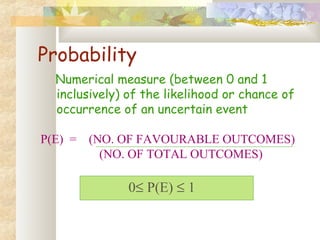
Probability 
Numerical measure (between 0 and 1 
inclusively) of the likelihood or chance of 
occurrence of an uncertain event 
P(E) = (NO. OF FAVOURABLE OUTCOMES) 
(NO. OF TOTAL OUTCOMES) 
0£ P(E) £ 1
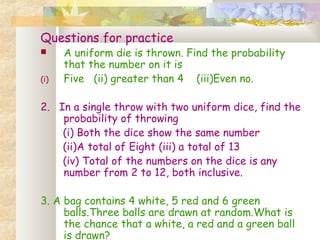
Questions for practice 
 A uniform die is thrown. Find the probability 
that the number on it is 
(i) Five (ii) greater than 4 (iii)Even no. 
2. In a single throw with two uniform dice, find the 
probability of throwing 
(i) Both the dice show the same number 
(ii)A total of Eight (iii) a total of 13 
(iv) Total of the numbers on the dice is any 
number from 2 to 12, both inclusive. 
3. A bag contains 4 white, 5 red and 6 green 
balls.Three balls are drawn at random.What is 
the chance that a white, a red and a green ball 
is drawn?
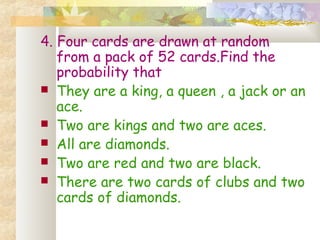
4. Four cards are drawn at random 
from a pack of 52 cards.Find the 
probability that 
 They are a king, a queen , a jack or an 
ace. 
 Two are kings and two are aces. 
 All are diamonds. 
 Two are red and two are black. 
 There are two cards of clubs and two 
cards of diamonds.
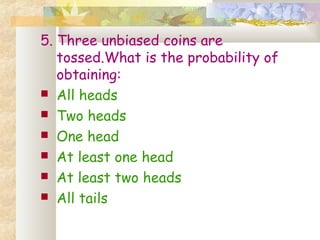
5. Three unbiased coins are 
tossed.What is the probability of 
obtaining: 
 All heads 
 Two heads 
 One head 
 At least one head 
 At least two heads 
 All tails
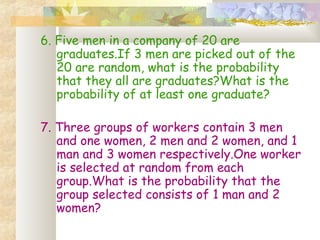
6. Five men in a company of 20 are 
graduates.If 3 men are picked out of the 
20 are random, what is the probability 
that they all are graduates?What is the 
probability of at least one graduate? 
7. Three groups of workers contain 3 men 
and one women, 2 men and 2 women, and 1 
man and 3 women respectively.One worker 
is selected at random from each 
group.What is the probability that the 
group selected consists of 1 man and 2 
women?
Answers 
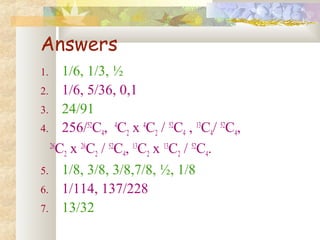
1. 1/6, 1/3, ½ 
2. 1/6, 5/36, 0,1 
3. 24/91 
4. 256/52C4, 4C2 x 4C2 / 52C4 , 13C4/ 52C4, 
26C2 x 26C2 / 52C4, 13C2 x 13C2 / 52C4. 
5. 1/8, 3/8, 3/8,7/8, ½, 1/8 
6. 1/114, 137/228 
7. 13/32
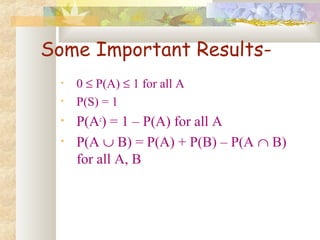
Some Important Results- 
• 0 £ P(A) £ 1 for all A 
• P(S) = 1 
• P(Ac) = 1 – P(A) for all A 
• P(A È B) = P(A) + P(B) – P(A Ç B) 
for all A, B
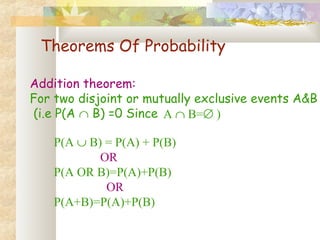
Theorems Of Probability 
Addition theorem: 
For two disjoint or mutually exclusive events A&B 
(i.e P(A Ç B) =0 Since A Ç B=Æ ) 
P(A È B) = P(A) + P(B) 
OR 
P(A OR B)=P(A)+P(B) 
OR 
P(A+B)=P(A)+P(B)
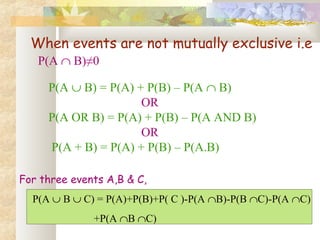
When events are not mutually exclusive i.e 
P(A Ç B)≠0 
P(A È B) = P(A) + P(B) – P(A Ç B) 
OR 
P(A OR B) = P(A) + P(B) – P(A AND B) 
OR 
P(A + B) = P(A) + P(B) – P(A.B) 
For three events A,B & C, 
P(A È B È C) = P(A)+P(B)+P( C )-P(A ÇB)-P(B ÇC)-P(A ÇC) 
+P(A ÇB ÇC)
Questions for practice 
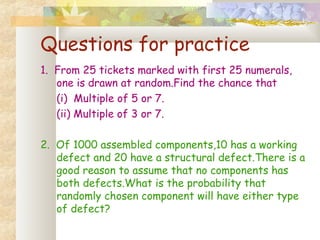
1. From 25 tickets marked with first 25 numerals, 
one is drawn at random.Find the chance that 
(i) Multiple of 5 or 7. 
(ii) Multiple of 3 or 7. 
2. Of 1000 assembled components,10 has a working 
defect and 20 have a structural defect.There is a 
good reason to assume that no components has 
both defects.What is the probability that 
randomly chosen component will have either type 
of defect?
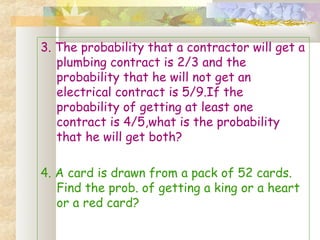
3. The probability that a contractor will get a 
plumbing contract is 2/3 and the 
probability that he will not get an 
electrical contract is 5/9.If the 
probability of getting at least one 
contract is 4/5,what is the probability 
that he will get both? 
4. A card is drawn from a pack of 52 cards. 
Find the prob. of getting a king or a heart 
or a red card?
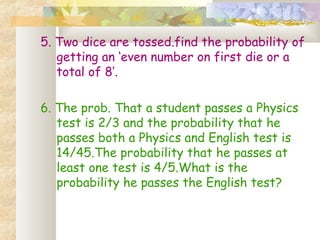
5. Two dice are tossed.find the probability of 
getting an ‘even number on first die or a 
total of 8’. 
6. The prob. That a student passes a Physics 
test is 2/3 and the probability that he 
passes both a Physics and English test is 
14/45.The probability that he passes at 
least one test is 4/5.What is the 
probability he passes the English test?
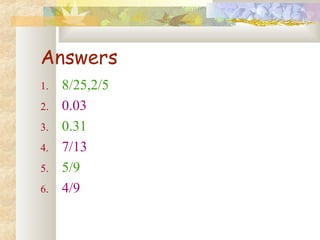
Answers 
1. 8/25,2/5 
2. 0.03 
3. 0.31 
4. 7/13 
5. 5/9 
6. 4/9
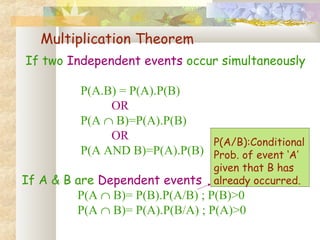
Multiplication Theorem 
If two Independent events occur simultaneously 
P(A.B) = P(A).P(B) 
OR 
P(A Ç B)=P(A).P(B) 
OR 
P(A AND B)=P(A).P(B) 
If A & B are Dependent events 
P(A/B):Conditional 
Prob. of event ‘A’ 
given that B has 
already occurred. 
P(A Ç B)= P(B).P(A/B) ; P(B)>0 
P(A Ç B)= P(A).P(B/A) ; P(A)>0
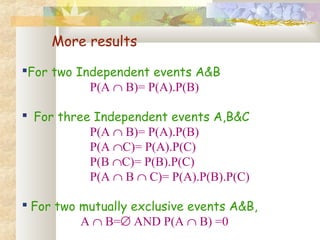
More results 
For two Independent events A&B 
P(A Ç B)= P(A).P(B) 
 For three Independent events A,B&C 
P(A Ç B)= P(A).P(B) 
P(A ÇC)= P(A).P(C) 
P(B ÇC)= P(B).P(C) 
P(A Ç B Ç C)= P(A).P(B).P(C) 
 For two mutually exclusive events A&B, 
A Ç B=Æ AND P(A Ç B) =0
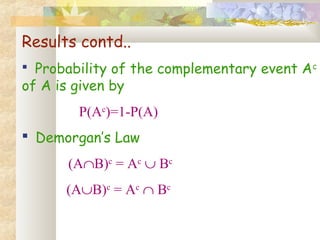
Results contd.. 
 Probability of the complementary event Ac 
of A is given by 
P(Ac)=1-P(A) 
 Demorgan’s Law 
(AÇB)c = Ac È Bc 
(AÈB)c = Ac Ç Bc
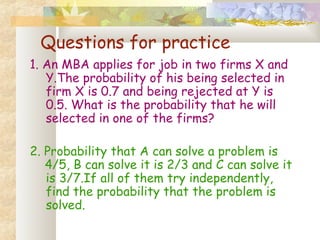
Questions for practice 
1. An MBA applies for job in two firms X and 
Y.The probability of his being selected in 
firm X is 0.7 and being rejected at Y is 
0.5. What is the probability that he will 
selected in one of the firms? 
2. Probability that A can solve a problem is 
4/5, B can solve it is 2/3 and C can solve it 
is 3/7.If all of them try independently, 
find the probability that the problem is 
solved.
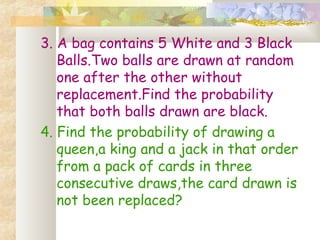
3. A bag contains 5 White and 3 Black 
Balls.Two balls are drawn at random 
one after the other without 
replacement.Find the probability 
that both balls drawn are black. 
4. Find the probability of drawing a 
queen,a king and a jack in that order 
from a pack of cards in three 
consecutive draws,the card drawn is 
not been replaced?
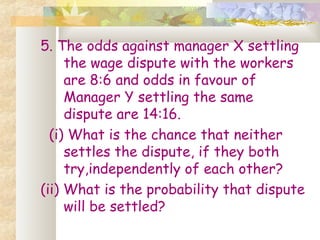
5. The odds against manager X settling 
the wage dispute with the workers 
are 8:6 and odds in favour of 
Manager Y settling the same 
dispute are 14:16. 
(i) What is the chance that neither 
settles the dispute, if they both 
try,independently of each other? 
(ii) What is the probability that dispute 
will be settled?
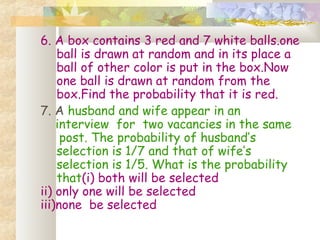
6. A box contains 3 red and 7 white balls.one 
ball is drawn at random and in its place a 
ball of other color is put in the box.Now 
one ball is drawn at random from the 
box.Find the probability that it is red. 
7. A husband and wife appear in an 
interview for two vacancies in the same 
post. The probability of husband’s 
selection is 1/7 and that of wife’s 
selection is 1/5. What is the probability 
that(i) both will be selected 
ii) only one will be selected 
iii)none be selected
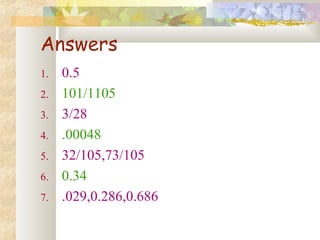
Answers 
1. 0.5 
2. 101/1105 
3. 3/28 
4. .00048 
5. 32/105,73/105 
6. 0.34 
7. .029,0.286,0.686

5. probability qt 1st tri semester

  • 1.
  • 2.
    Probability  Itallows us to quantify the variability in the outcome of an experiment whose exact result can’t be predicted with certainty.
  • 3.
    Definitions  RandomExperiment A random experiment or trial is one which when conducted successively under the identical conditions, the result is not unique but may be any one of the various possible outcomes. Example: Tossing a fair coin in an experiment.
  • 4.
     Sample space: The set of all possible outcomes is a sample space.  Event: Outcome or combination of outcomes  Outcome: The result of an event which we finally achieved is called an outcome or a sample point.
  • 5.
    Types of Events  Mutually exclusive events: Two events are said to be mutually exclusive or incompatible, when both cannot happen simultaneously in a single trial. AÇB=Æ Example: Toss of a coin (either head will occur or tail in a single throw)
  • 6.
     Independent anddependent events Two or more events are independent when the outcome of one does not affect, and is not affected by the other. Example: if a coin is tossed twice, the result of the second throw would not be affected by the result of the first throw P(AÇB)=P(A).P(B) • Dependent events: occurrence of one event affects probability of happening of other.
  • 7.
     Equally likelyevents: events are called equally likely if they have the same chance of occurrence. Example: Throw of unbiased coin (both head and tail have equal chance of occurrence.)
  • 8.
    Probability Numerical measure(between 0 and 1 inclusively) of the likelihood or chance of occurrence of an uncertain event P(E) = (NO. OF FAVOURABLE OUTCOMES) (NO. OF TOTAL OUTCOMES) 0£ P(E) £ 1
  • 9.
    Questions for practice  A uniform die is thrown. Find the probability that the number on it is (i) Five (ii) greater than 4 (iii)Even no. 2. In a single throw with two uniform dice, find the probability of throwing (i) Both the dice show the same number (ii)A total of Eight (iii) a total of 13 (iv) Total of the numbers on the dice is any number from 2 to 12, both inclusive. 3. A bag contains 4 white, 5 red and 6 green balls.Three balls are drawn at random.What is the chance that a white, a red and a green ball is drawn?
  • 10.
    4. Four cardsare drawn at random from a pack of 52 cards.Find the probability that  They are a king, a queen , a jack or an ace.  Two are kings and two are aces.  All are diamonds.  Two are red and two are black.  There are two cards of clubs and two cards of diamonds.
  • 11.
    5. Three unbiasedcoins are tossed.What is the probability of obtaining:  All heads  Two heads  One head  At least one head  At least two heads  All tails
  • 12.
    6. Five menin a company of 20 are graduates.If 3 men are picked out of the 20 are random, what is the probability that they all are graduates?What is the probability of at least one graduate? 7. Three groups of workers contain 3 men and one women, 2 men and 2 women, and 1 man and 3 women respectively.One worker is selected at random from each group.What is the probability that the group selected consists of 1 man and 2 women?
  • 13.
    Answers 1. 1/6,1/3, ½ 2. 1/6, 5/36, 0,1 3. 24/91 4. 256/52C4, 4C2 x 4C2 / 52C4 , 13C4/ 52C4, 26C2 x 26C2 / 52C4, 13C2 x 13C2 / 52C4. 5. 1/8, 3/8, 3/8,7/8, ½, 1/8 6. 1/114, 137/228 7. 13/32
  • 14.
    Some Important Results- • 0 £ P(A) £ 1 for all A • P(S) = 1 • P(Ac) = 1 – P(A) for all A • P(A È B) = P(A) + P(B) – P(A Ç B) for all A, B
  • 15.
    Theorems Of Probability Addition theorem: For two disjoint or mutually exclusive events A&B (i.e P(A Ç B) =0 Since A Ç B=Æ ) P(A È B) = P(A) + P(B) OR P(A OR B)=P(A)+P(B) OR P(A+B)=P(A)+P(B)
  • 16.
    When events arenot mutually exclusive i.e P(A Ç B)≠0 P(A È B) = P(A) + P(B) – P(A Ç B) OR P(A OR B) = P(A) + P(B) – P(A AND B) OR P(A + B) = P(A) + P(B) – P(A.B) For three events A,B & C, P(A È B È C) = P(A)+P(B)+P( C )-P(A ÇB)-P(B ÇC)-P(A ÇC) +P(A ÇB ÇC)
  • 17.
    Questions for practice 1. From 25 tickets marked with first 25 numerals, one is drawn at random.Find the chance that (i) Multiple of 5 or 7. (ii) Multiple of 3 or 7. 2. Of 1000 assembled components,10 has a working defect and 20 have a structural defect.There is a good reason to assume that no components has both defects.What is the probability that randomly chosen component will have either type of defect?
  • 18.
    3. The probabilitythat a contractor will get a plumbing contract is 2/3 and the probability that he will not get an electrical contract is 5/9.If the probability of getting at least one contract is 4/5,what is the probability that he will get both? 4. A card is drawn from a pack of 52 cards. Find the prob. of getting a king or a heart or a red card?
  • 19.
    5. Two diceare tossed.find the probability of getting an ‘even number on first die or a total of 8’. 6. The prob. That a student passes a Physics test is 2/3 and the probability that he passes both a Physics and English test is 14/45.The probability that he passes at least one test is 4/5.What is the probability he passes the English test?
  • 20.
    Answers 1. 8/25,2/5 2. 0.03 3. 0.31 4. 7/13 5. 5/9 6. 4/9
  • 21.
    Multiplication Theorem Iftwo Independent events occur simultaneously P(A.B) = P(A).P(B) OR P(A Ç B)=P(A).P(B) OR P(A AND B)=P(A).P(B) If A & B are Dependent events P(A/B):Conditional Prob. of event ‘A’ given that B has already occurred. P(A Ç B)= P(B).P(A/B) ; P(B)>0 P(A Ç B)= P(A).P(B/A) ; P(A)>0
  • 22.
    More results Fortwo Independent events A&B P(A Ç B)= P(A).P(B)  For three Independent events A,B&C P(A Ç B)= P(A).P(B) P(A ÇC)= P(A).P(C) P(B ÇC)= P(B).P(C) P(A Ç B Ç C)= P(A).P(B).P(C)  For two mutually exclusive events A&B, A Ç B=Æ AND P(A Ç B) =0
  • 23.
    Results contd.. Probability of the complementary event Ac of A is given by P(Ac)=1-P(A)  Demorgan’s Law (AÇB)c = Ac È Bc (AÈB)c = Ac Ç Bc
  • 24.
    Questions for practice 1. An MBA applies for job in two firms X and Y.The probability of his being selected in firm X is 0.7 and being rejected at Y is 0.5. What is the probability that he will selected in one of the firms? 2. Probability that A can solve a problem is 4/5, B can solve it is 2/3 and C can solve it is 3/7.If all of them try independently, find the probability that the problem is solved.
  • 25.
    3. A bagcontains 5 White and 3 Black Balls.Two balls are drawn at random one after the other without replacement.Find the probability that both balls drawn are black. 4. Find the probability of drawing a queen,a king and a jack in that order from a pack of cards in three consecutive draws,the card drawn is not been replaced?
  • 26.
    5. The oddsagainst manager X settling the wage dispute with the workers are 8:6 and odds in favour of Manager Y settling the same dispute are 14:16. (i) What is the chance that neither settles the dispute, if they both try,independently of each other? (ii) What is the probability that dispute will be settled?
  • 27.
    6. A boxcontains 3 red and 7 white balls.one ball is drawn at random and in its place a ball of other color is put in the box.Now one ball is drawn at random from the box.Find the probability that it is red. 7. A husband and wife appear in an interview for two vacancies in the same post. The probability of husband’s selection is 1/7 and that of wife’s selection is 1/5. What is the probability that(i) both will be selected ii) only one will be selected iii)none be selected
  • 28.
    Answers 1. 0.5 2. 101/1105 3. 3/28 4. .00048 5. 32/105,73/105 6. 0.34 7. .029,0.286,0.686