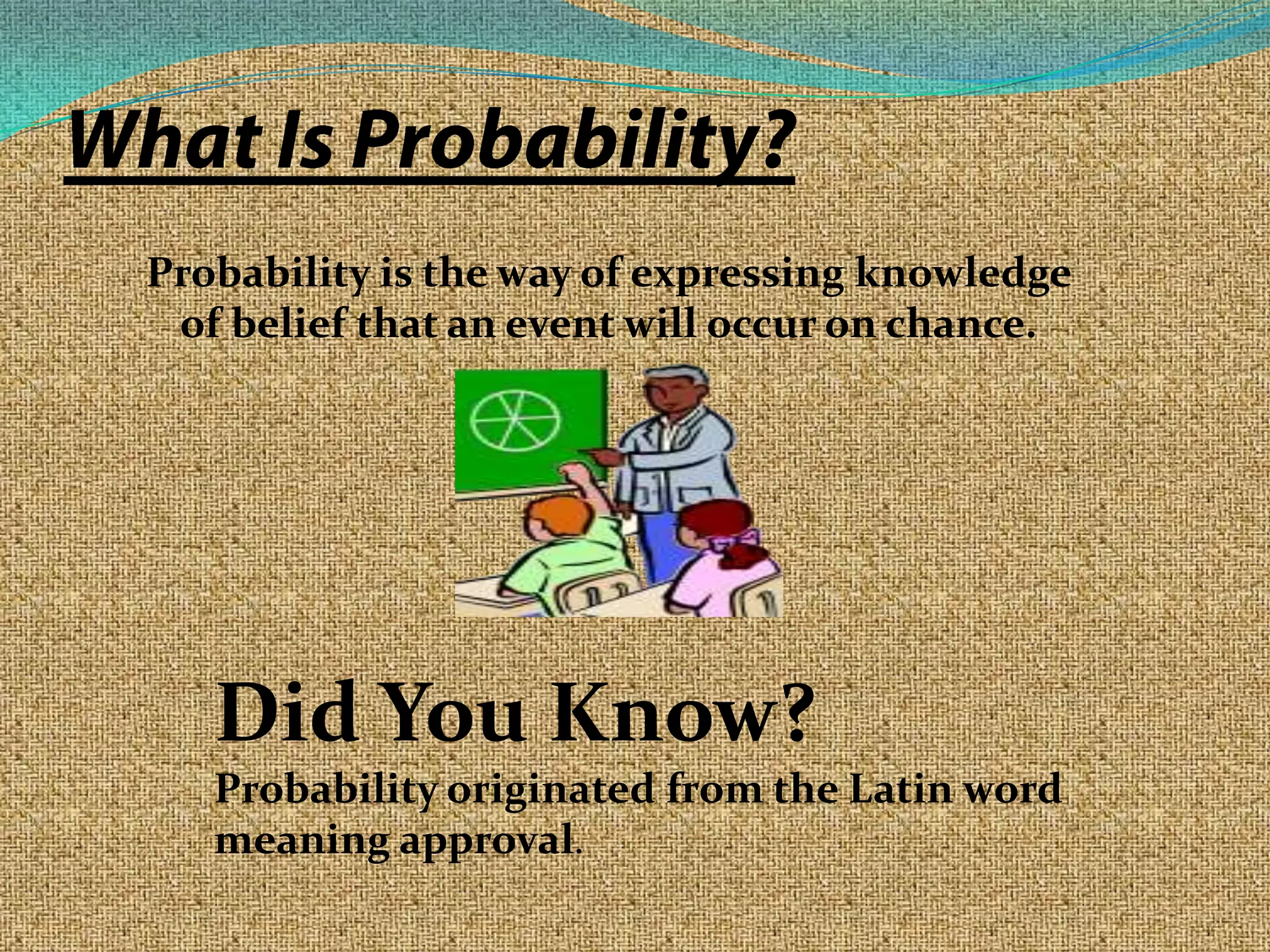
Probability is the way of expressing knowledge
 of belief that an event will occur on chance.


   Did You Know?
   Probability originated from the Latin word
   meaning approval.
 Probability is the branch of math that
 studies patterns of chance

 The idea of probability is based on
 observation. Probability describes what
 happens over many, many trials.
Definition of Probability
❤ Probability is the measure of how likely it
  is the some event will occur, a number
  expressing the ratio of favorable cases to
  the whole number or cases possible.
❤ For example the chance of a coin landing
  on heads is 50%. This is because a coin
  has two sides so there is a 50% chance
  that the coin will land on heads and 50%
  that a coin will land on tails.
Definition Of Theoretical
       Probability

P(E)=    No. of Favorable outcomes
         Total no. of outcomes

Where E - event
Definition of Experimental
 Probability
Experimental Probability is the chance of something
 happening, based on repeated testing and observing
 results. It is the ration of the number of times an even has
 occurred to the number of times it has been tested.
For example to find the probability of getting a six when
 rolling a dice, you need to roll the dice many times, then
 divide the number of times who rolled a six with how many
 times you rolled the dice in total.
When question arises related to
chance of something happening
, you are dealing with
probability.
Some common terms related to probability
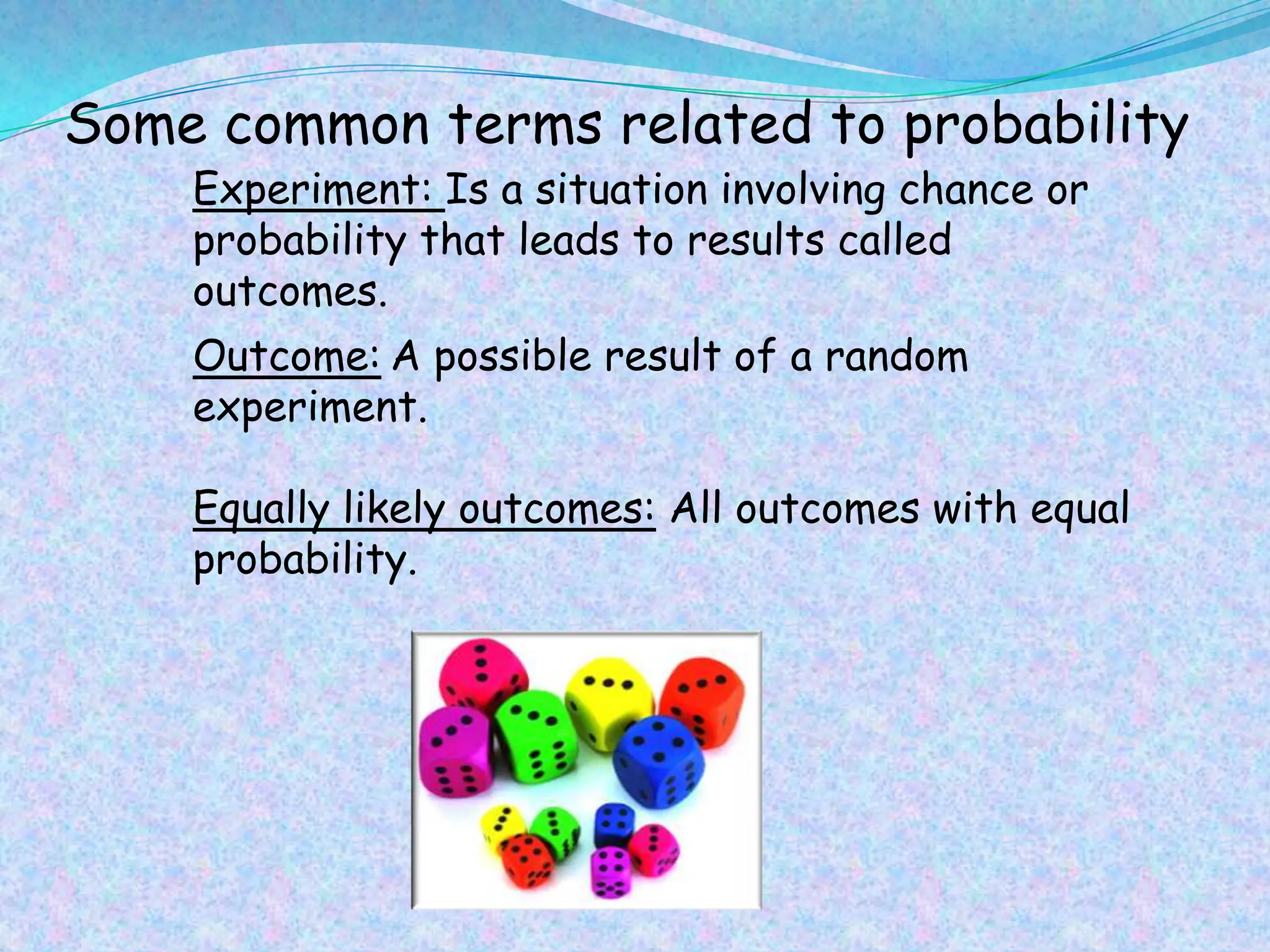
    Experiment: Is a situation involving chance or
    probability that leads to results called
    outcomes.
    Outcome: A possible result of a random
    experiment.

    Equally likely outcomes: All outcomes with equal
    probability.
Some common terms related to probability
(contd.)
Sample space: The set of outcomes of an experiment is
known as sample space.

 Event: One or more outcomes in an experiment.

Sample point: Each element of the sample space is called
a sample point.
Key Points
 P(A)= (the number of times the desired outcome
  occurs) ÷ (the total number of trials)
 Events are independent if the outcome of one event
  does not influence the outcome of any other event
 Events are mutually exclusive if they cannot occur
  together
 Addition Rule: P(A or B)= P(A) + P(B) – P(A and B)
Probability A vs. B
• IF P (A) > P (B)
• THEN A is more likely to occur


• IF P(A) = P(B)
• THEN P (AB) are equally likely to
 occur
Types Of Events
 Simple Event – If an event E has only one sample
 point in sample space, it is called a simple or
 elementary event.

 Compound Event – If an event has more than one
 sample point, it is called compound event.
  Two events are mutually exclusive events if
   occurrence of any one of them excludes the
   occurrence of the other, i.e. they can not occur
   simultaneously.
  For Example: Let A and B be two different events
i.e. A={1,3,5} , B={2,4,6}
Then in this case A and B are mutually exclusive
 events.
As A∩B=ф
So, this implies mutually exclusive events are
   disjoint
sets
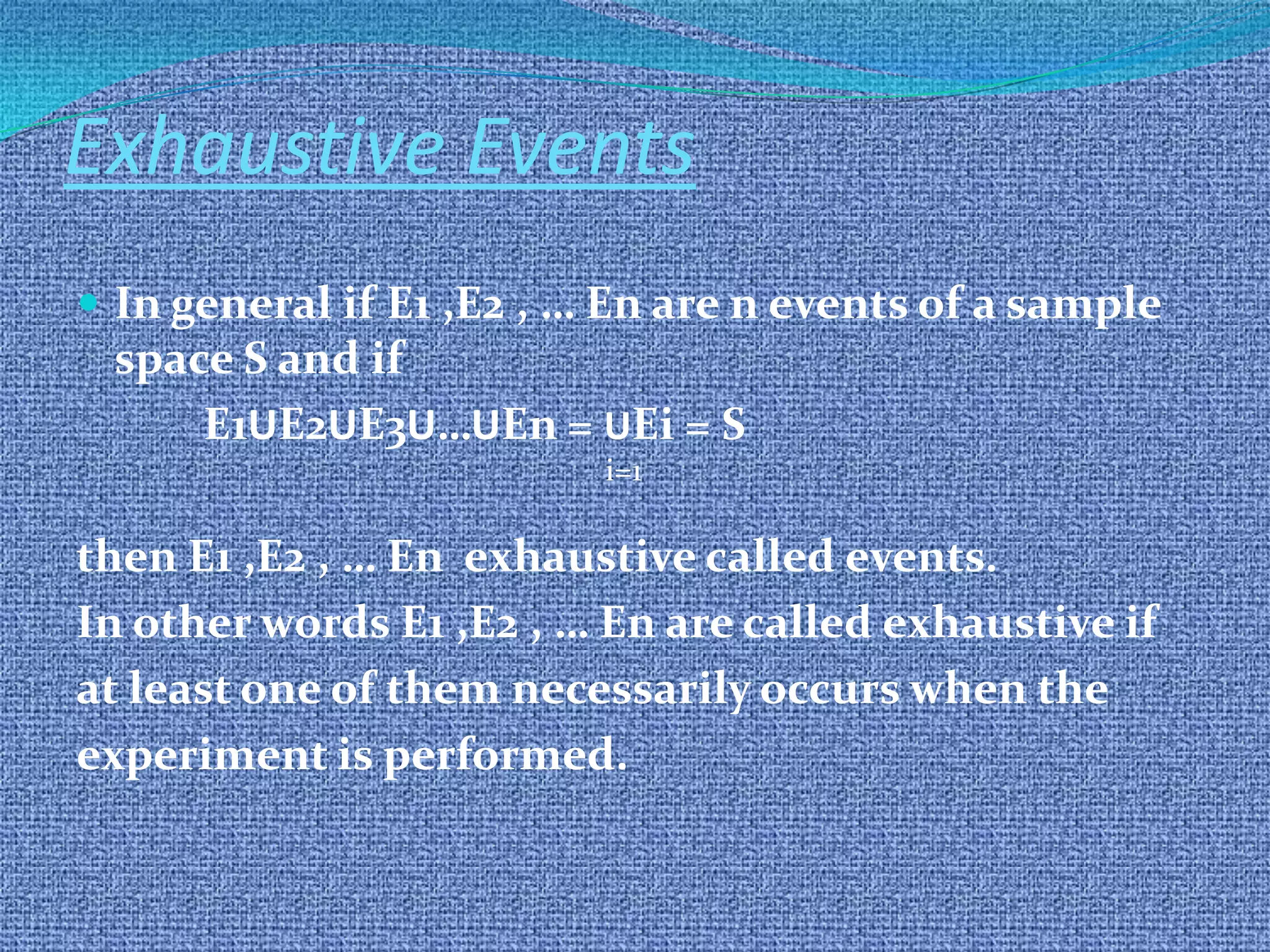
Exhaustive Events
 In general if E1 ,E2 , … En are n events of a sample
 space S and if
     E1UE2UE3U…UEn = UEi = S
                          i=1

then E1 ,E2 , … En exhaustive called events.
In other words E1 ,E2 , … En are called exhaustive if
at least one of them necessarily occurs when the
experiment is performed.
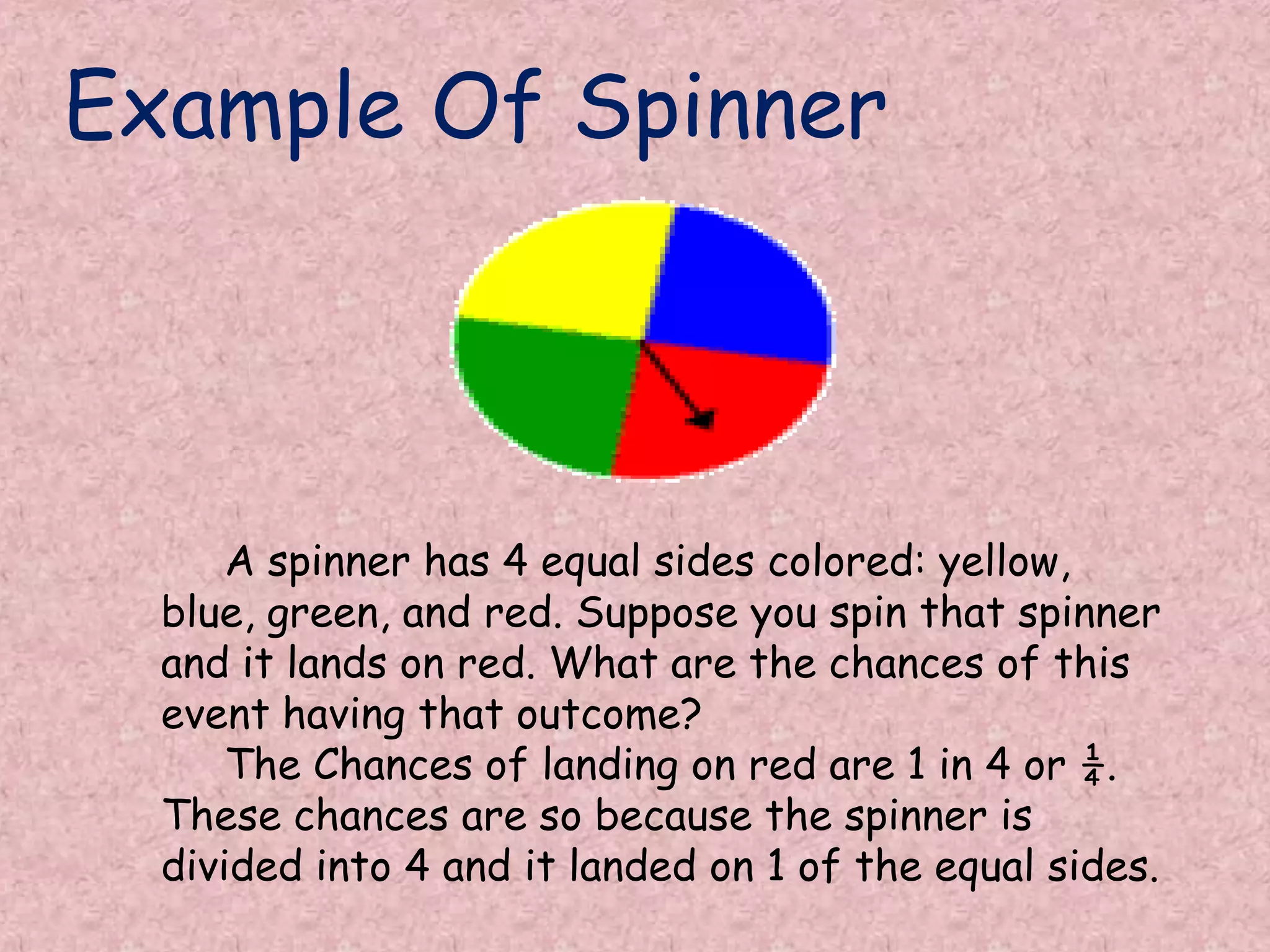
Example Of Spinner


      A spinner has 4 equal sides colored: yellow,
  blue, green, and red. Suppose you spin that spinner
  and it lands on red. What are the chances of this
  event having that outcome?
      The Chances of landing on red are 1 in 4 or ¼.
  These chances are so because the spinner is
  divided into 4 and it landed on 1 of the equal sides.
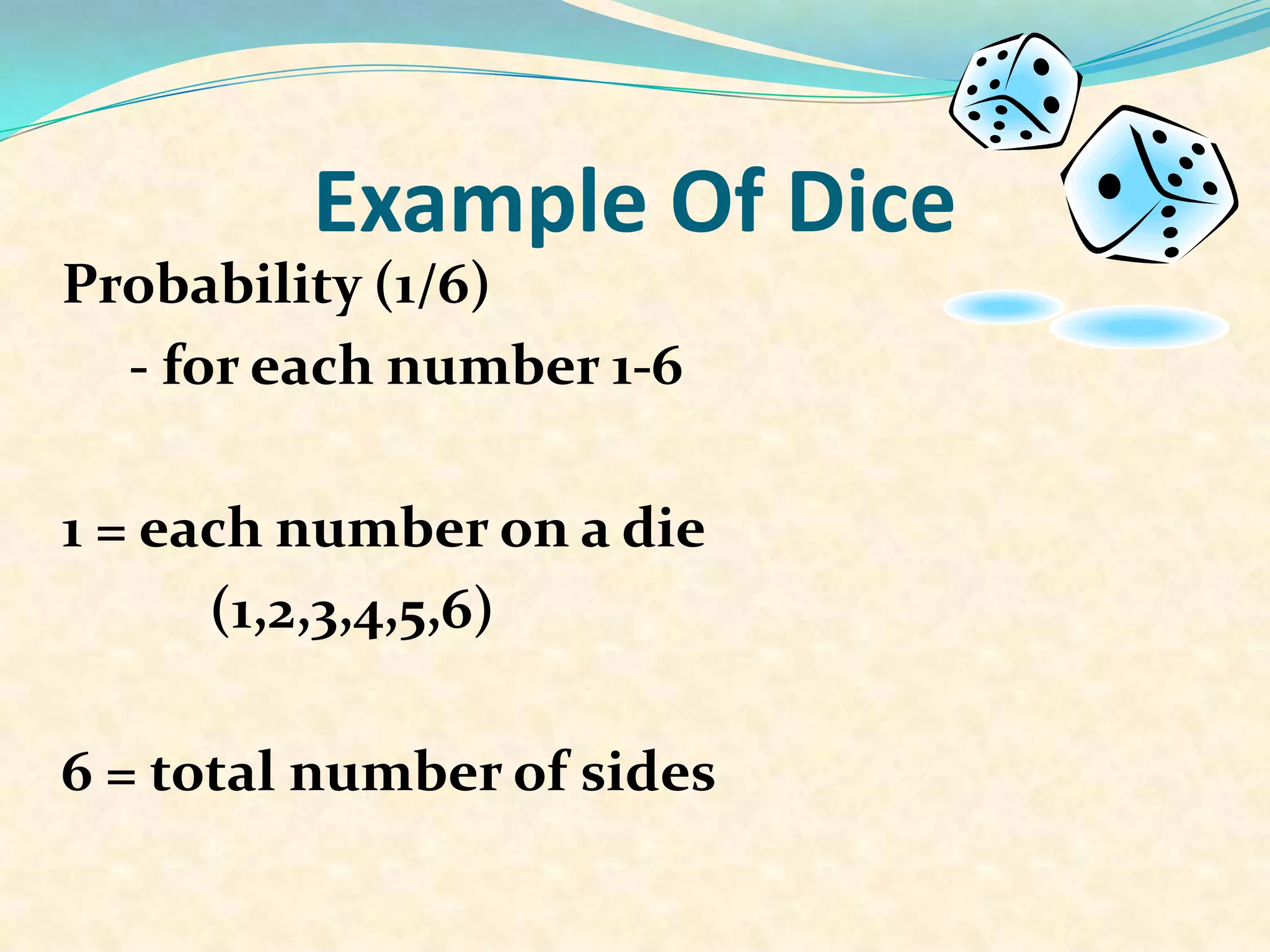
Example Of Dice
Probability (1/6)
  - for each number 1-6

1 = each number on a die
      (1,2,3,4,5,6)

6 = total number of sides
Continued…
We Can Also Say…

•Probability of EVEN numbers:
•P (3/6) OR  (1/3)

•Probability of ODD numbers:
•P (3/6) OR  (1/3)
Probability- General Rules
 1. Probability is a number between 0 and 1.
 2. The sum of the probabilities of all
  possible outcomes in a sample space is 1.
 3. The probability that an event does not
  occur is 1 minus the probability that it does
  occur. (also called the complement of A)
Probability- General Rules
(contd.)
Probability of a sure event is 1.

Probability of an impossible event
is 0.
Possible outcomes and counting
techniques
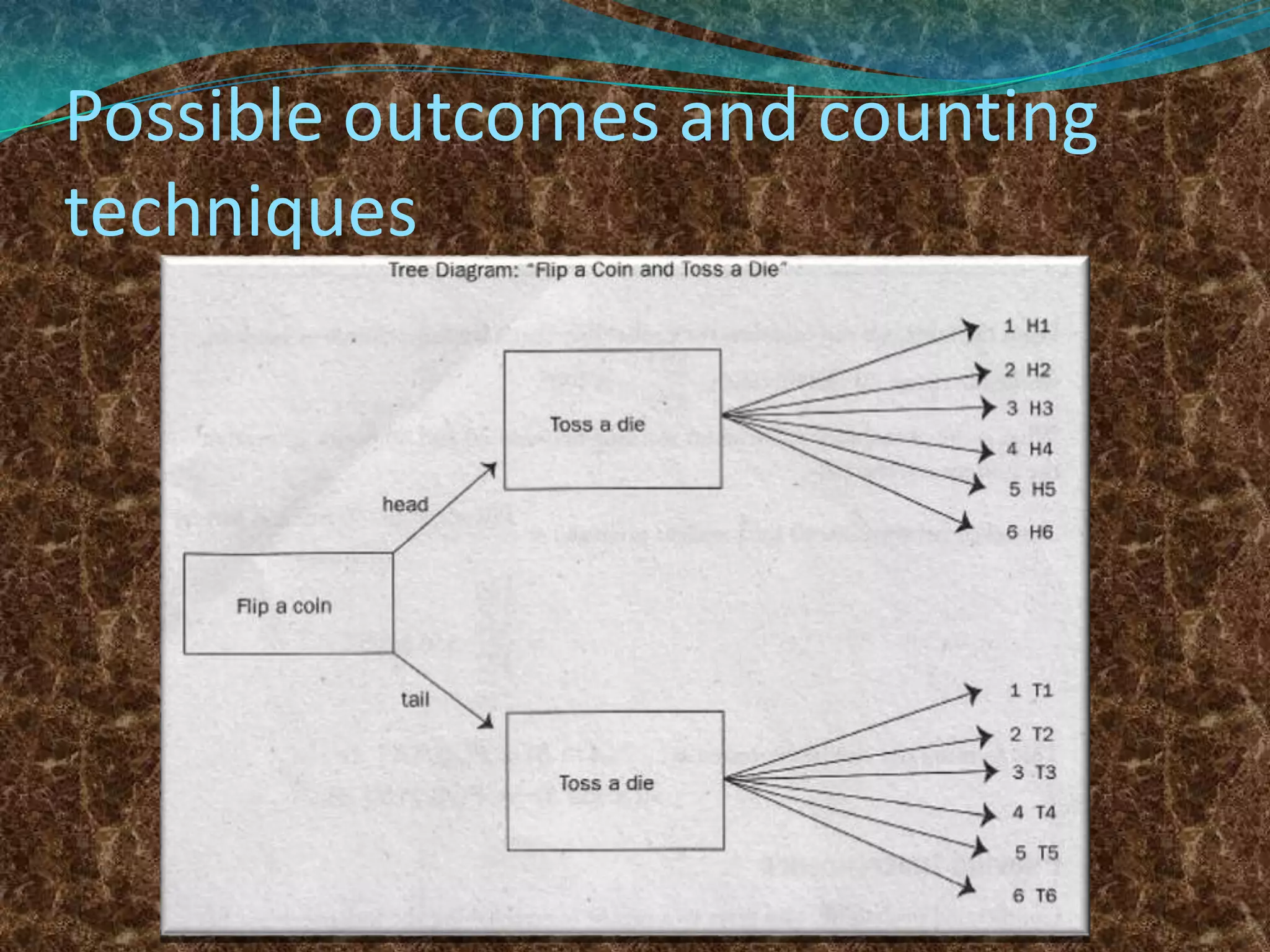
 If you can do one task in A ways and a second task in B
 ways, then both tasks can be done in A x B ways.

 Flip a coin and toss a die (2)(6)= 12 possible outcomes
Possible outcomes and counting
techniques
Where is Probability Used?
Probability is used a lot in daily life,
 Probability is used in such as Math,
 Statistics, Finance, Gambling,
 Science, Machine and Artificial
 Intelligence, and in many other
 activities.
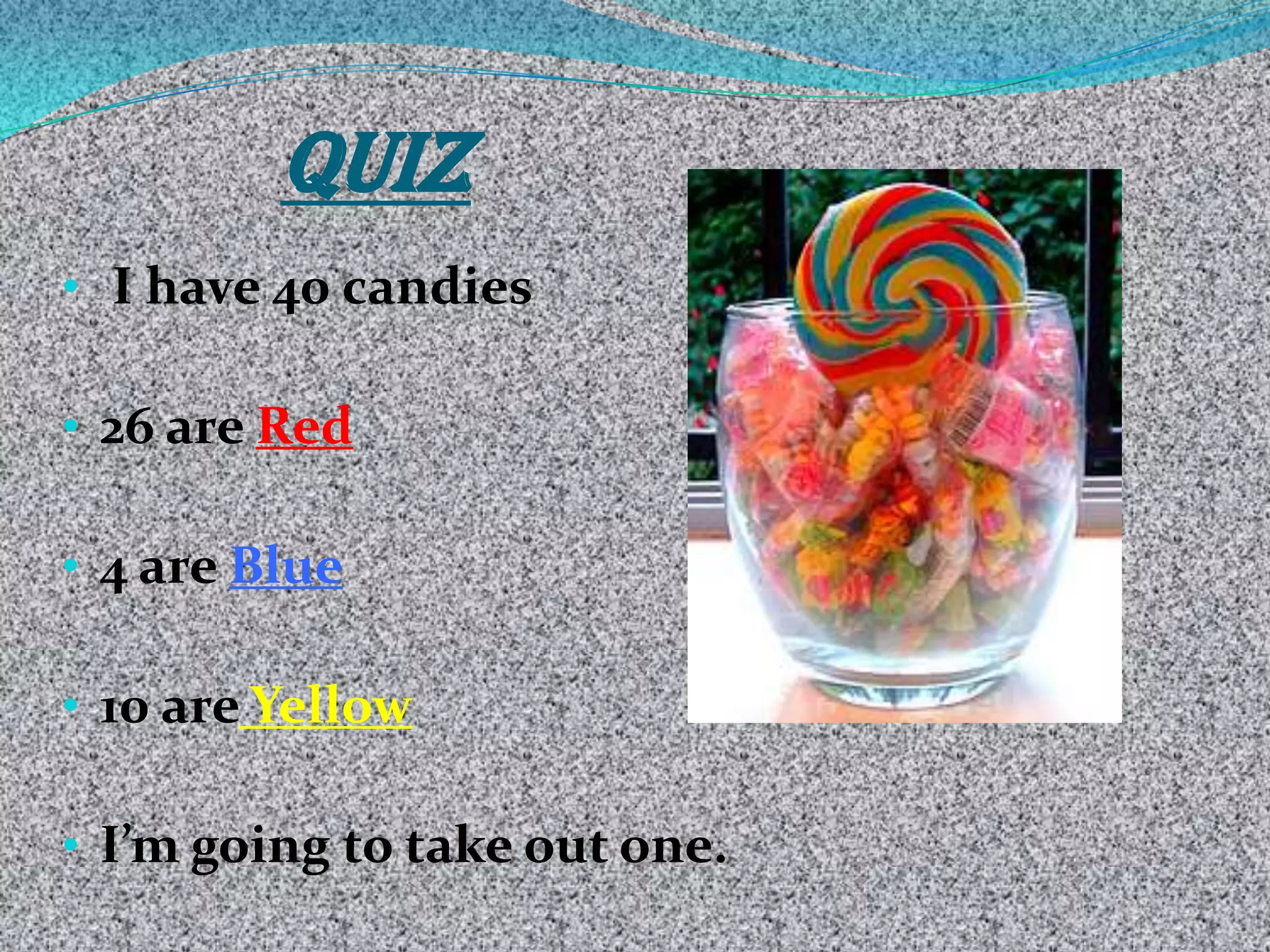
QUIZ
• I have 40 candies

• 26 are Red

• 4 are Blue

• 10 are Yellow

• I’m going to take out one.
Question and Answers
• Q: What is the probability of getting a red candy?
• A: 13/20 or 0.65


• Q: What is the probability of getting a yellow
  candy?
• A: ¼ or 0.25


• Q:What is the probability of getting a blue candy
• A: 1/10 or o.1
Probability

Probability

  • 2.
    Probability is theway of expressing knowledge of belief that an event will occur on chance. Did You Know? Probability originated from the Latin word meaning approval.
  • 3.
     Probability isthe branch of math that studies patterns of chance  The idea of probability is based on observation. Probability describes what happens over many, many trials.
  • 4.
    Definition of Probability ❤Probability is the measure of how likely it is the some event will occur, a number expressing the ratio of favorable cases to the whole number or cases possible. ❤ For example the chance of a coin landing on heads is 50%. This is because a coin has two sides so there is a 50% chance that the coin will land on heads and 50% that a coin will land on tails.
  • 5.
    Definition Of Theoretical Probability P(E)= No. of Favorable outcomes Total no. of outcomes Where E - event
  • 6.
    Definition of Experimental Probability Experimental Probability is the chance of something happening, based on repeated testing and observing results. It is the ration of the number of times an even has occurred to the number of times it has been tested. For example to find the probability of getting a six when rolling a dice, you need to roll the dice many times, then divide the number of times who rolled a six with how many times you rolled the dice in total.
  • 7.
    When question arisesrelated to chance of something happening , you are dealing with probability.
  • 8.
    Some common termsrelated to probability Experiment: Is a situation involving chance or probability that leads to results called outcomes. Outcome: A possible result of a random experiment. Equally likely outcomes: All outcomes with equal probability.
  • 9.
    Some common termsrelated to probability (contd.) Sample space: The set of outcomes of an experiment is known as sample space. Event: One or more outcomes in an experiment. Sample point: Each element of the sample space is called a sample point.
  • 10.
    Key Points  P(A)=(the number of times the desired outcome occurs) ÷ (the total number of trials)  Events are independent if the outcome of one event does not influence the outcome of any other event  Events are mutually exclusive if they cannot occur together  Addition Rule: P(A or B)= P(A) + P(B) – P(A and B)
  • 11.
    Probability A vs.B • IF P (A) > P (B) • THEN A is more likely to occur • IF P(A) = P(B) • THEN P (AB) are equally likely to occur
  • 12.
    Types Of Events Simple Event – If an event E has only one sample point in sample space, it is called a simple or elementary event.  Compound Event – If an event has more than one sample point, it is called compound event.
  • 13.
     Twoevents are mutually exclusive events if occurrence of any one of them excludes the occurrence of the other, i.e. they can not occur simultaneously. For Example: Let A and B be two different events i.e. A={1,3,5} , B={2,4,6} Then in this case A and B are mutually exclusive events. As A∩B=ф So, this implies mutually exclusive events are disjoint sets
  • 14.
    Exhaustive Events  Ingeneral if E1 ,E2 , … En are n events of a sample space S and if E1UE2UE3U…UEn = UEi = S i=1 then E1 ,E2 , … En exhaustive called events. In other words E1 ,E2 , … En are called exhaustive if at least one of them necessarily occurs when the experiment is performed.
  • 15.
    Example Of Spinner A spinner has 4 equal sides colored: yellow, blue, green, and red. Suppose you spin that spinner and it lands on red. What are the chances of this event having that outcome? The Chances of landing on red are 1 in 4 or ¼. These chances are so because the spinner is divided into 4 and it landed on 1 of the equal sides.
  • 16.
    Example Of Dice Probability(1/6) - for each number 1-6 1 = each number on a die (1,2,3,4,5,6) 6 = total number of sides
  • 17.
    Continued… We Can AlsoSay… •Probability of EVEN numbers: •P (3/6) OR  (1/3) •Probability of ODD numbers: •P (3/6) OR  (1/3)
  • 18.
    Probability- General Rules 1. Probability is a number between 0 and 1.  2. The sum of the probabilities of all possible outcomes in a sample space is 1.  3. The probability that an event does not occur is 1 minus the probability that it does occur. (also called the complement of A)
  • 19.
    Probability- General Rules (contd.) Probabilityof a sure event is 1. Probability of an impossible event is 0.
  • 20.
    Possible outcomes andcounting techniques  If you can do one task in A ways and a second task in B ways, then both tasks can be done in A x B ways.  Flip a coin and toss a die (2)(6)= 12 possible outcomes
  • 21.
    Possible outcomes andcounting techniques
  • 22.
    Where is ProbabilityUsed? Probability is used a lot in daily life, Probability is used in such as Math, Statistics, Finance, Gambling, Science, Machine and Artificial Intelligence, and in many other activities.
  • 23.
    QUIZ • I have40 candies • 26 are Red • 4 are Blue • 10 are Yellow • I’m going to take out one.
  • 24.
    Question and Answers •Q: What is the probability of getting a red candy? • A: 13/20 or 0.65 • Q: What is the probability of getting a yellow candy? • A: ¼ or 0.25 • Q:What is the probability of getting a blue candy • A: 1/10 or o.1